Hello, welcome back. This week, I am combining two things I sometimes do: Sunday Retold, and a poem drawn from the reading. For those who follow set Bible readings through the weeks, we’re still in the season of Epiphany, when we look at moments of understanding and revelation. And this Sunday, we’re meditating on the first sign recorded in John’s gospel, which took place at a wedding. As I was reading it, the image of those stone water jars filled my mind, and I’ve attempted to turn my meditation into a poem, below. I thought I would share it with you even though it’s so new, in case it helps you or prompts you in your own reflection.
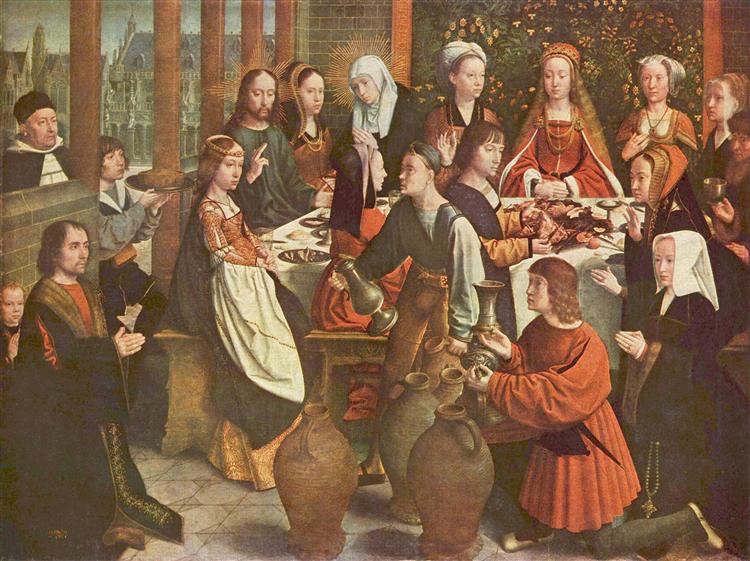
On the third day after Jesus called his disciples, Jesus went with them to a wedding in Cana, near Lake Galilee. The whole community was there, eating and drinking, dancing and laughing, blessing the young man and woman who were starting their life together. But Jesus’ mother, Mary, noticed that the wine had run out and said to her son, “They have no more wine!” “Dear mother, why are you telling me this? Now is not my time.” But later, Jesus spoke to the servants. “Fill those jars with water!” he said. For there were six large stone water jars nearby – the sort that were used to store the pure, fresh water the Jewish people used to cleanse and purify themselves before worship. The servants filled the jars with water and, puzzled, dipped their serving jugs into the newly filled jars. They poured some out for the host, as Jesus had told them. Then the host called the bridegroom over, a broad smile on his face. “By now people are usually serving the rough wine – but this wine is really good – wonderful! You’ve kept the best till last.” He gulped another warm mouthful of the wine that had been water as the servants served the wedding guests. Jesus had taken the water from the stone jars and turned it into fine wine. When his disciples saw what had happened, and saw the servants pouring out new wine for all the guests at the wedding, they gasped in wonder. They had caught a glimpse of Jesus’ glory, and the glory of God’s kingdom. The disciples put their faith in the one who turned water into wine.
It’s a beloved story, often shared at weddings, its many layers rich with meaning. I tend to find that something strikes me in particular, draws me in, and this time it was those empty stone jars. So, here is a poem that grew out of turning the image of those empy jars over in my mind. There is much else that could be said, but today, it’s simply this…..
Empty/Water into Wine
Those empty stone jars, I see them – pale grey, with a film of dust, leaning against the wall, overlooked, unregarded as the wedding rolls on, music and dancing and laughter sending tiny tremors through their hollowness.
Six of them, as empty as days can be, an emptiness we know by taste, our dry mouths rimed with fine powdered stone.
And this is where you began your work, with these empty jars. Had them filled with cool water – so far, so expected. For purification, cleansing, the couple’s, the town’s, love and life, as the wise look on, nodding, sure that they have your meaning.
Oh, how you delight in upending expectations, traditions. What was drawn from these jars was not water for making pure, but the red bubbling joy of good wine, poured and shared, for the delight of all gathered, for the blessing of love, and union, uproariously, and without fanfare.
After three days, this is the glory revealed, this is what it means to be full of grace and truth,
To have our days, our beings, filled with water, only for it to poured out as fine vintage, only for it to be transfigured, transformed, as wondrous as the grapes on the vine, as wondrous as a day, a life, so open to joy.
If you would like to use the poem or reading, please feel free to do so. I’d appreciate it if you mention this blog and my name is doing so.
This New Year, I’m picking up the occasional series, Sunday Retold. Many churches follow a set pattern of readings, so communities up and down the country are gathering around the same stories, the same prayers, and meditating on them together. Often, at least one of the passages appears in my retelling of the Bible, The Bible Story Retold, and so it seems a good idea to share that with you. If you’d like to use any of the material on this blog please do, and please say where you got it from. My books should be available to order at all the usual real life and online places.
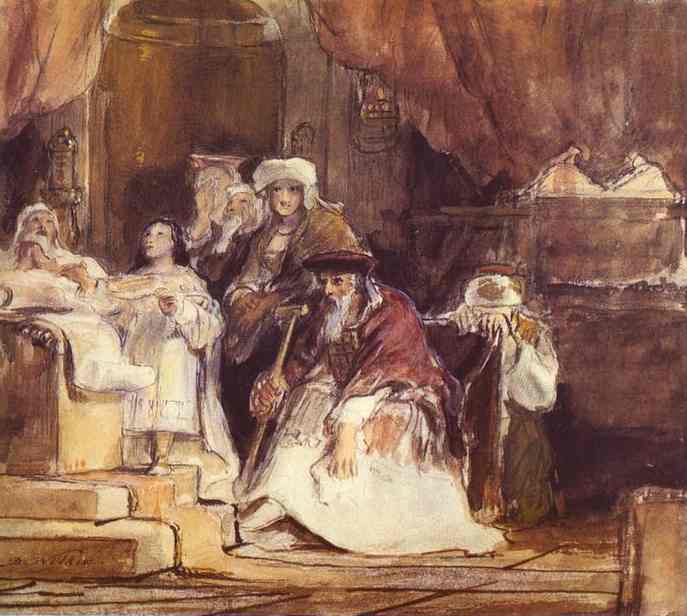
Samuel Dedicated by Hannah at the Temple by Frank W.W. Topham
Anyway, this week is a story often shared with children – at least in part. The central character is the boy Samuel, son of Hannah. He was a much longed for child, who was given to the service of God in the temple at a very young age. Eli, the priest, was given charge of him.
The set reading is 1 Samuel 3:1-10, and here is my retelling:
The boy Samuel learned how to serve God in the shrine. And he slept by the lamp of God’s presence, close to the holy ark of the covenant. One night, in the darkness before dawn a voice called out, “Samuel, Samuel!” So Samuel got up and went to Eli, who was ond, with failing eyes. “Here I am! You called me!” Samuel said. Eli stirred. “I didn’t call you! Go back to sleep!” So he did. But there was the voice again. “Samuel, Samuel!” The boy got up again and went to Eli. “You called, and I came!” “No I didn’t call you. Go back to sleep.” But, when Samuel woke Eli a third time, he wondered what this voice could mean. Perhaps God was speaking. “Go back and lie down. If you are called again, say, ‘Speak, Lord, your servant is listening.'” So Samuel went back to bed and lay there, waiting, hardly daring to breathe. “Samuel, Samuel!” came the voice. Samuel remembered Eli’s words. “Speak, Lord, your servant is listening!” And so God spoke to Samuel. God said that the right to be priests would be taken away from Eli’s family, because his sons had donw wrong, and Eli had not stopped them. They would be punished. In the morning, Samuel had to tell his tacher what God had said. ”God is God, and will do what is best!” Eli sighed.
From The Bible Story Retold in Twelve Chapters
Often, when this passage is shared, the empasis falls on listening to God’s voice, and being ready to respond. We’ll get back to that in due course, but for now I’m following my immediate reaction to this passage today, and how it might help us navigate this difficult new season we’re in.
Samuel in the Temple by David Wilkie
What a message for a child to have to deliver to their high-status, powerful teacher – you and your line have fallen short of the standards expected of you, and your position will be taken away from you. It must have been terrifying for Samuel to have to speak up, even with Eli’s encouragement. I can imagine him shaking in his sandals. Although this story is often a Sunday School favourite, I don’t think many teachers and others in authority would be bold enough to encourage youngsters actively speaking up in condemnation of their elders. And yet, as so often, these stories show God’s leaning towards the powerless, the young, the outsider. So often, the perils of power, and the shortcomings of those who practice it, are central to this counter-cultural narrative. Indeed, as we follow on with Samuel’s story, of how the people of Israel ended up with a king, we see that pattern all the more strongly.
As a story of a child challenging conventional ideas of power, and who has it, the story of the boy Samuel sits well in the season. It’s one of the Epiphany stories in which the rich, the wise, the powerful humbly bow before a mother and child in a simple, working house. It also follows on well from Mary’s radical song in the early stages of her pregnancy, which in turn draws on the words of Hannah, Samuel’s mother, when she leaves her son in Eli’s care. I love the dense connections which imaginatively weave all this together, so rich patterns emerge from the threads. I love the way the lectionary puts things near each other, and then sees what connections and conversation arise like a good host.
And so, back to what struck me today on reading this passage – the wisdom of the child, the going astray of the elders and those in power. I thought of the prophesy “And a little child will lead them” (Isaiah 11.6), and how, today, the young who lives will stretch out far into this century are trying to shake us awake, to speak to us of those things which they care about and will affect their lives and the lives of their children. They see that the way we are living is doing harm, they see the injustice and the destruction more clearly than those of us who may have become immured to it. They see that the structures of power seem to protect the powerful and ride roughshod over those whom the scriptures speak highly of – the widow, the orphan, the outsider, the poor, the young, the old. We need those in power to be humble enough, like Eli, to hear their voices, and to act in their interests. Intergenerational justice is a concept that is coming alive now – especially in terms of debt, and the damage to the ecosystems on which we all depend. We need to pay attention to those who have no voice, and give due respect to the rest of the natural world, as well as to the young. Can we, at the beginning of this year, resolve to notice our natural bias towards the rich and powerful, and seek to listen to the young and the powerless? I think that would be good for us all.
Here in the UK, many have been moved, outraged, saddened and stirred to speak up by the ITV drama, Mr Bates vs The Post Office. It was a powerful drama, compassionately acted. I am always curious, though, about things which really catch the public mood – why this, why now? And I think part of it is the theme of people with power who feel immune and distant from the consequences of their actions, who listen to each other rather than to ordinary people – in this case their employees. I think there is a rising sense of injustice about how some are gathering so much to themselves, while others are stripped of what they have, and what they might come to have in the future too. And this injustice reminds me of the words of the prophets, including the child Samuel.
Of course, this passage carries many meanings, and this critique of power is one amongst many – but it is one that chimes with the biblical narrative as a whole. When we’re thinking of how we might live by it, another question naturally arises – how do we know, in a world of so many voices, which ones to heed? In this passage it is Eli who wonders whether the voice might be God. Yet history is littered with terrible tales of those who were convinced they were acting for God, or doing what was right, and going horribly wrong. Often the very worst things are done by those who claim good motives. And that should give us all pause. I touched on an exploration of this theme in my book, “Jesus said, I Am. Finding life in the everyday” in the chapter on Jesus, the good shepherd, when he talks about the flock knowing his voice.
Of course, knowing the voice, and distinguishing it from the voices of those who would lead us to harm, is no easy thing. I think it helps to come to a place where we don’t see the path ahead of us as a narrow tightrope – one false move and we are lost – but that we look for the relationship, and recognise the freedom to walk behind the shepherd, listening for the voice. ……. History is full of the mistakes people have made, thinking they are doing the right thing but going terribly wrong. I do not ee us going so wrong when we seek to follow the way of love, seeking to keep our eyes fixed on Jesus, and learning from him.
And so, noticing the topsy-turvy nature of the gospel, the way things are not what they seem, let’s be ready to listen, be ready to respond to those promptings and quiet voices which would guide us better than the pomp and power and authority which make so much noise and show.
Dear God, When we hear a mighty wind, strong enough to shatter roci, when the ground underneath us shakes like an earthquake, when fire comes from mountains, help us to know these sounds of power and anger are not your voice. Help us to listen in the silence for your whisper. Help us to wait for your whisper






 Andrea Skevington