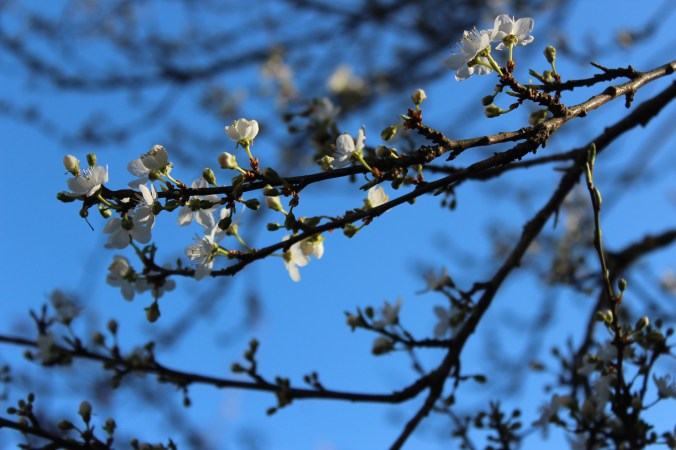
The earliest blossom in our garden – mirabelle, or wild cherry plum
After I sent in the manuscript for my first book of poetry – The Year’s Circle – a couple of months ago, I felt I needed a little creative winter – of rest and quiet and recovering energy. Lately, I’ve been finding things catch my attention again, and my pen and notebook have been coming out into the garden with me.
What follows is the closest to a finished poem that has emerged so far, and I thought I’d share it with you.
Last year, in the long hot, dry summer, we had an abundance of fruit. I thought this year the trees would be exhausted, and take a bit of a sabbatical too – it’s a healthy pattern….. but this spring, hot and dry as it has been, has been awash with blossom, and now, in the few days of rain we’ve had, the fruit is beginning to swell. It’s looking promising!
Blossom
The blossom opens – first mirabelle, then pear, apple, cherry, Iranian quince,
A white tide frothing and foaming over the garden, dazzling, loud with birdsong, petals opening like hungry beaks in nests,
All opening in turn, and all, in turn, shaken by the sudden shifts of wind – how hot it gusts now. So the petals fall, they tumble over faded daffodils, spent tulips.
And so it seems that all is lost, all that blossom, all that promise, all that beauty scattered on the wind. How the spring days scutter away.
And yet, I have come to know that all is not lost, even as the petals fall. They had their purpose. And that purpose – invisible at first, then the tiniest roundness of stem, of not yet – a held breath of green before summer’s ripening. And it will come, it will come, in its time.
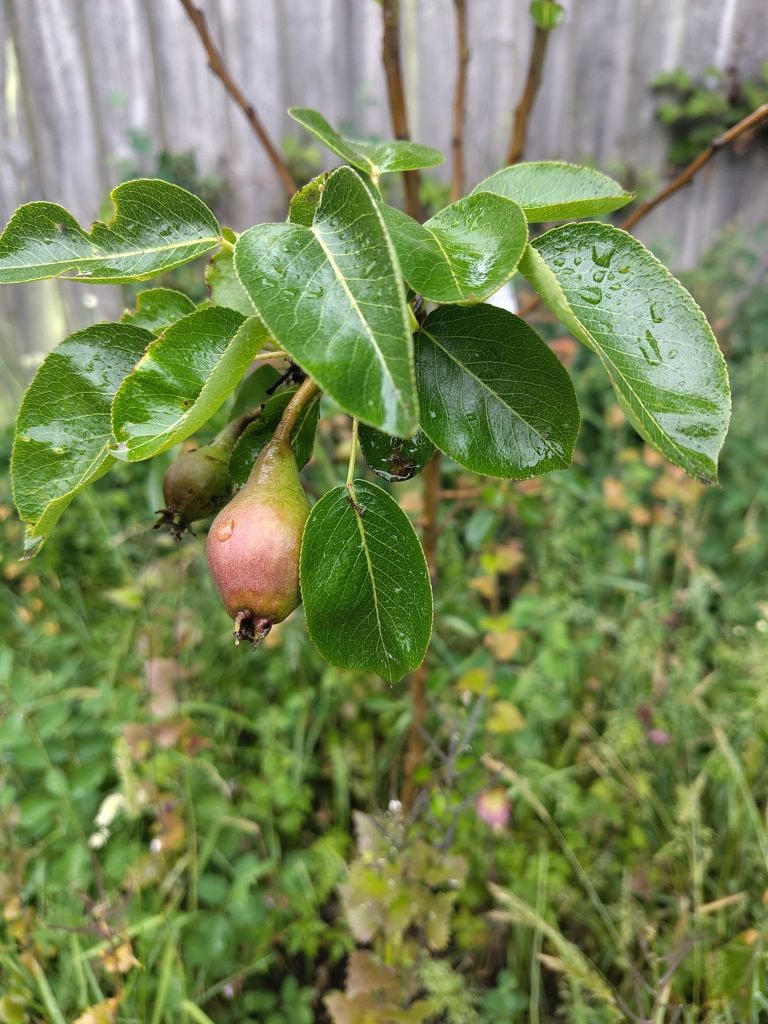
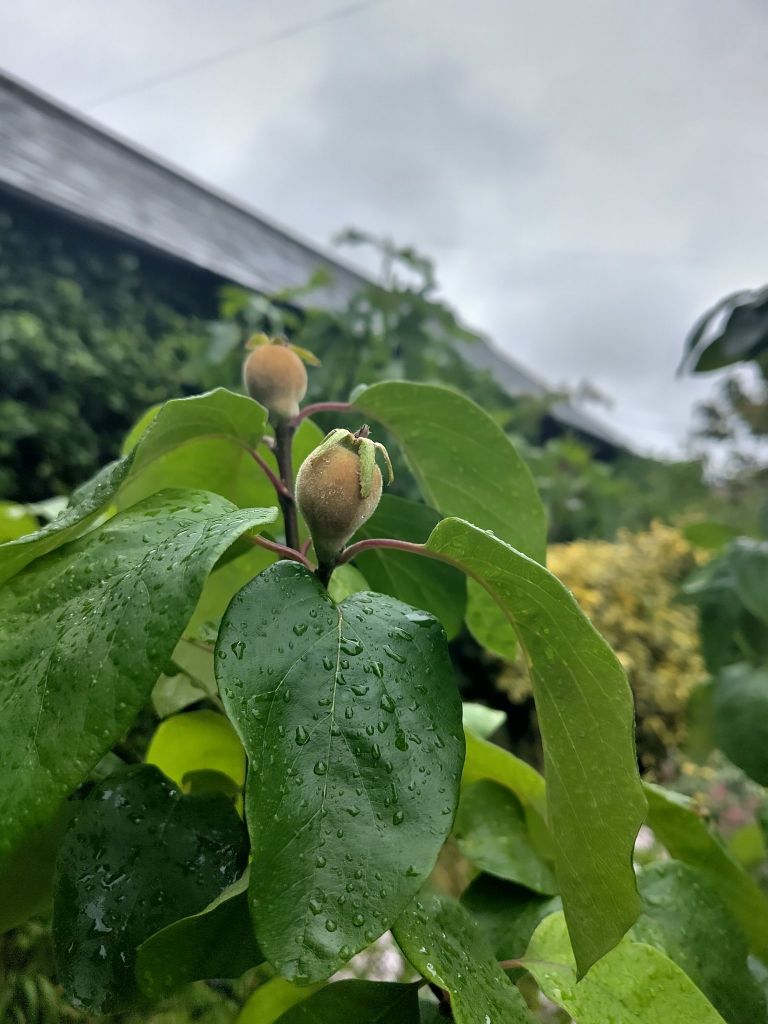
I’m particularly pleased with these two small trees. They’re both a few years old now, and this is the first time they’ve started developing tiny fruit. The top picture is a pear, the bottom the Iranian quince – fragrant and delicious. When I see these small, new fruits, I’m reminded of that rich and ancient civilisation that has suffered and is suffering so much.
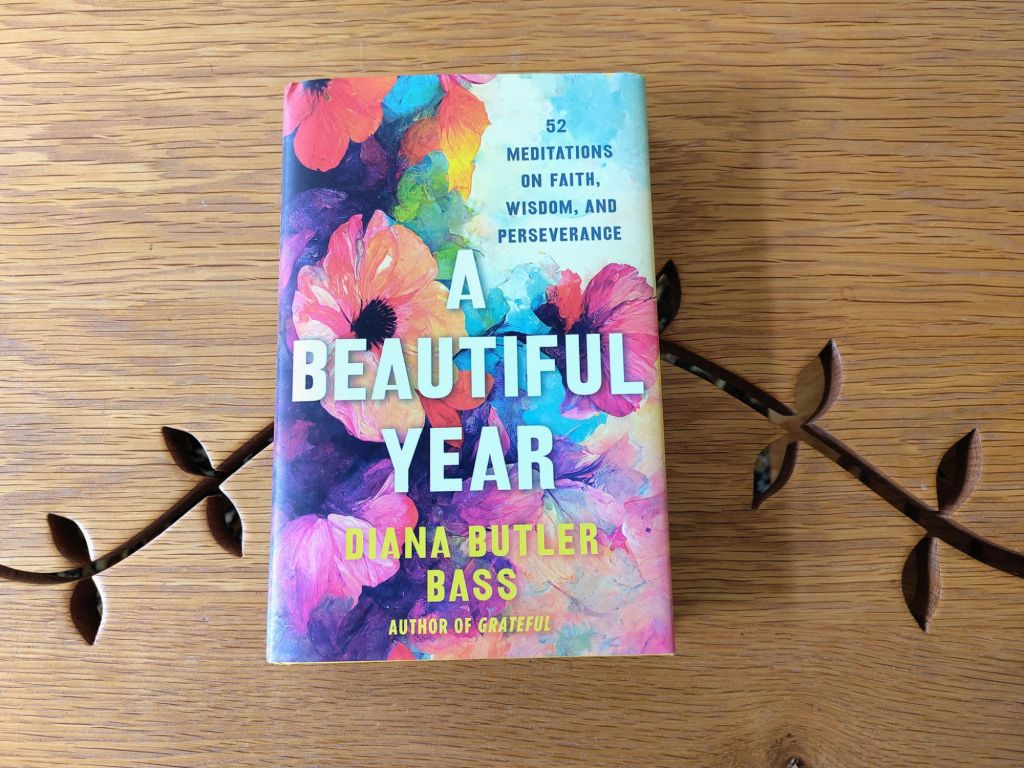
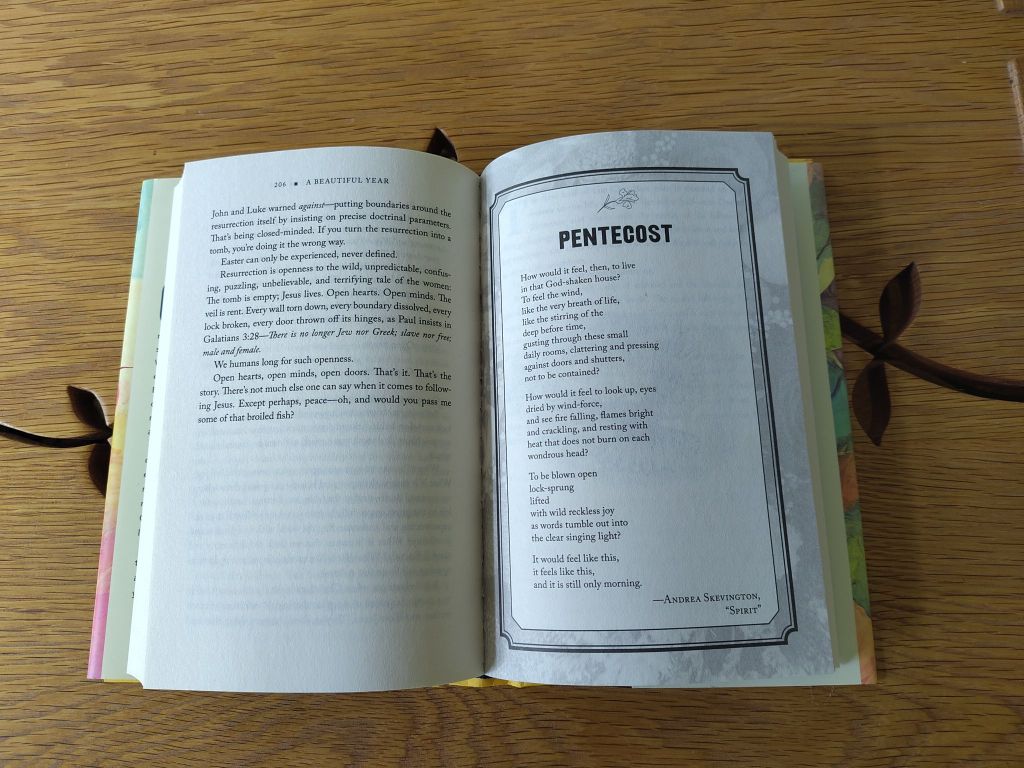
Hello! I wanted to tell you that my poem for Pentecost – when we celebrate the coming of the Spirit – has been published in this glorious book by Diana Butler Bass.
If you follow the church seasons you will find this an invaluable resource taking you through the weeks. If you don’t, you may find it refreshing and insightful. I particularly like the way she explores the radical nature of Jesus’ teachings with deep scholarship and lived experience. I heartily recommend it.
So, this poem marks the beginning of a new season in the book, and I couldn’t be more pleased. I am highly honoured to be in such company.
I’ve also included it in the manuscript for my own collection, The Year’s Circle, to be published by Wild Goose of Iona Publishing, and that’s very exciting too. I’ll let you know when I have any news of a publication date.
If you’d like to read the poem more easily, you’ll find it below – along with some other pieces that sit with it. Please feel free to use any of my work that helps you, giving my name and referring to this blog – or one of the books above. I’d love to hear about it if you do.
Both poem and reading show the way that the Spirit can burst through our shut away places and times, taking the ordinary and transforming it. I hope you find some encouragement here.
SPIRIT
How would it feel, then, to live in that God-shaken house? To feel the wind, like the very breath of life, like the stirring of the deep before time, gusting through these small daily rooms, clattering and pressing against doors and shutters, not to be contained?
How would it feel to look up, eyes dried by wind-force, and see fire falling, flames bright and crackling, and resting with heat that does not burn on each wondrous head?
To be blown open lock-sprung lifted with wild reckless joy as words tumble out into the clear singing light?
It would feel like this, it feels like this, and it is still only morning.
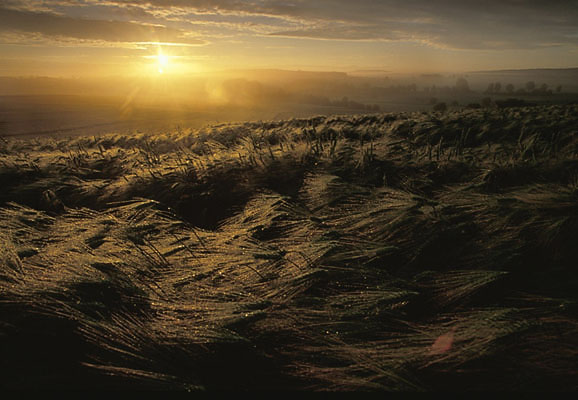
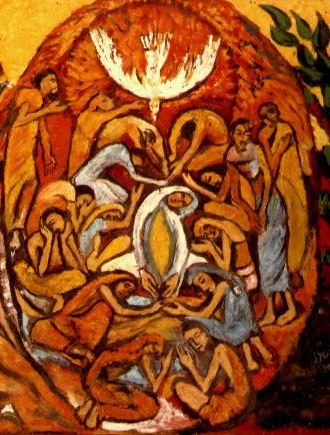
From the fields it came: the first sheaf of barley cut for that year’s harvest. It was carried high through streets crammed with visitors, and on to the Temple. And then the priest offered it to God, giving thanks for the good land, and for the gift of harvest. For that day was the celebration of the first fruits. It was Pentecost. Meanwhile, the disciples were all together, waiting. Then, suddenly, it began. It stared with sound – a sound like the wind – but this was no gentle harvest breeze. This was a shaking and a roaring: a sound of power, whooshing and howling about the house, rattling every door and shutter. The sound seemed to come down from heaven itself, and filled the house as the wind fills sails. Then, the disciples watched wide-eyed as something that looked like fire came down, and tongues of flame peeled off it and rested on each of them without burning them. All of them were filled, for the Holy Spirit had come. And as it happened, their tongues were loosened, and they began to speak as the Spirit gave them words. These words were not Aramaic, their own language, but in languages that were unknown to them. A crowd had gathered by the house because of the extraordinary sound, but then they heard voices. There were pilgrims in Jerusalem from all over the known world, and they recognized the words the disciples were speaking. “He’s talking Egyptian!” said one. “That one’s talking my language,” said a visitor from Crete – and the same was true for all. Each person heard God’s praises in their own tongue. “What can it mean?” they asked each other. But others among the crowd joked that the disciples had been drinking. The Twelve heard what they were saying, so Simon Peter stood up to speak to the crowds. “Listen, I’ll tell you what’s happening. We’re not drunk! It’s too early in the day for that! This is God’s promise come true. Do you remember what one of the prophets wrote long ago? I’ll pour out my Spirit on everyone – young and old. Your sons and daughters will prophesy, young men will have visions, and old men dreams. All who follow me – men and women – will be given my Spirit, and there will be wonders!
Christ has no body now on earth but yours, no hands but yours, no feet but yours… Yours are the feet with which he is to go about doing good, and yours are the hands with which he is to bless us now. St Theresa of Avila 1515-82
Spirit of God put love in my life. Spirit of God put joy in my life. Spirit of God put peace in my life. Spirit of God make me patient. Spirit of God make me kind. Spirit of God make me good. Spirit of God give me faithfulness. Spirit of God give me humility. Spirit of God give me self-control.
I’m sharing another poem from my collection-in-preparation with you, as promised. I started gathering and writing poems last March, and so this Easter poem – and the one to follow – were amongst the first new ones I wrote. So, quite simply, here it is….
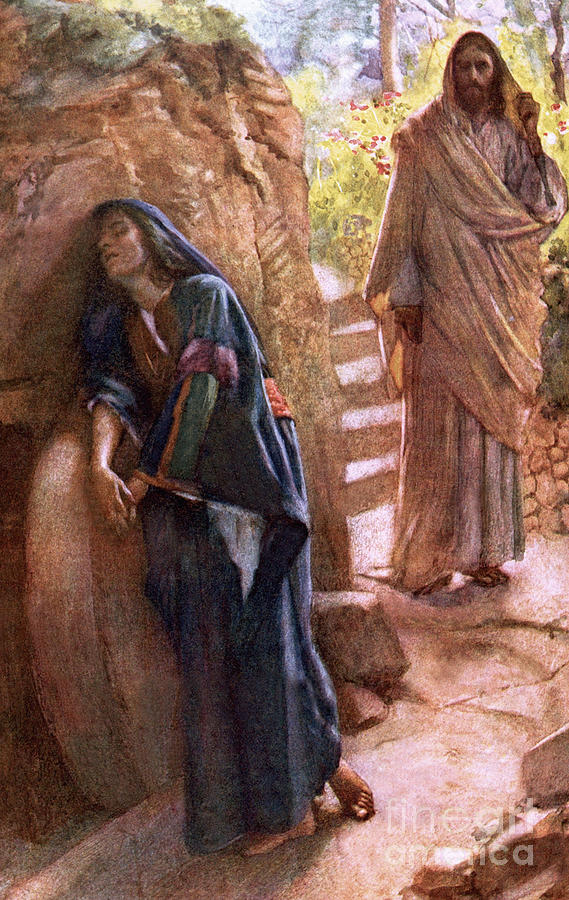
Mary Magdalene at the Sepulchre by Harold Copping
Mary in the garden
It was in the garden that Mary stood weeping. First light, first flush of green spreading over the warming stones. A quiet place, now.
Alone, shocked, bewildered, she did not see the flowers opening at her feet, or hear the song of the turtledoves.
For she is one who stands by a tomb lost, deserted, heavy-burdened with grief – the weight of a million tears – as if this grief might carry the pain of us all.
And seeing you, she did not see, thought you were like a second Adam, tending the garden in this strange new dawn.
Then, you spoke out a name – her own name. Mary. She knew you then. What must have risen up in that broken heart, touched as she was by your tenderness. Yet as your eyes met, her hand stopped in the warming air between you, singing with birdsong, shining with light.
John 20:11-18, 1 Corinthians 15:21-22
If you would like to read the story, you can find more in the link below….
Here is another poem of resurrection – this one exploring the deep, unwitnessed moment of awakening. I’m intrigued by the stirring of seeds, the quiet power of life returning in Spring, and the imagery of spring filled my mind as I thought about Easter resurrection. My forthcoming book – The Year’s Circle, publisher Wild Goose – weaves together poems from the church seasons and the Earth’s seasons. In this piece, I hope, the presence of spring hums through.
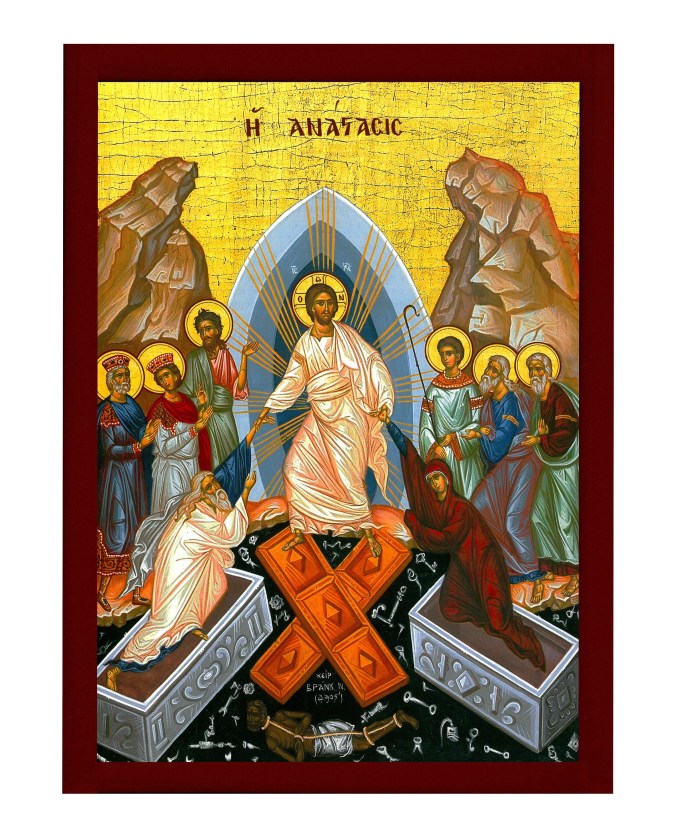
I love the way Eastern Orthodox icons celebrate resurrection not as an event involving one alone, but as something including all those needing to be set free…. and gives us an insight into the pattern of life out of death, hope out of despair, new out of old.
Before first light
Out of the earth, the grave, the tomb, the darkness, life steps out into a shining spring dawn.
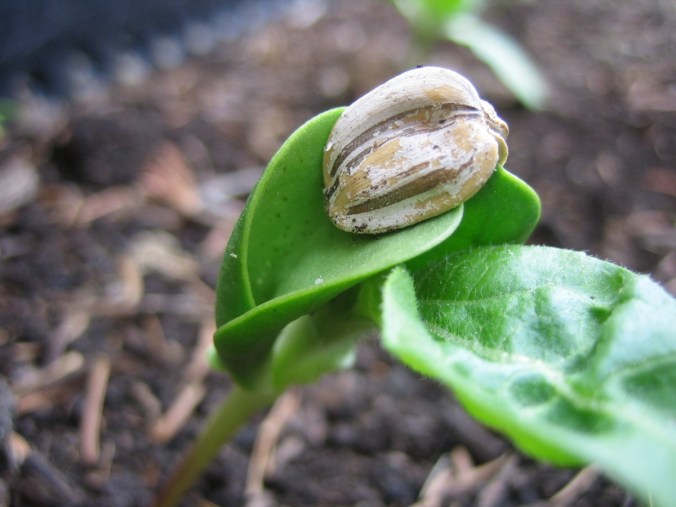
Out of the seed, the grain, the stone, the pip, life uncurls in a shimmer of new green.
We do not see the moment of breaking, of rising, it is hidden in the dark womb of the Earth.
But perhaps the ground shakes, a tremor in the deep, as the stone rolls away and death’s imperial seal is broken.
Then, out of a cave humming with clear morning light – no need of grave clothes, no need of husk and shell and stone and seal,
No need of the linen napkin for it is finished, and folded –
Out of the earth who tends her dead, there is a great greening, an awakening, a rising up. Life, and life, and life is stronger even than the grave, and love is stronger than death.
And look, and see, all things are being made new. Now, and now, and now.
Matthew 27:65-7, Mark 16:1-7, Luke 24:1-11, John 20:1-10
If you would like to use this poem, please do so, giving my name and this blog as reference.
I’m sharing another poem from my collection-in-preparation with you, as promised. I started gathering and writing poems last March, and so this Easter poem – and the one to follow – were amongst the first new ones I wrote. So, quite simply, here it is….
Mary Magdalene at the Sepulchre by Harold Copping
Mary in the garden
It was in the garden that Mary stood weeping. First light, first flush of green spreading over the warming stones. A quiet place, now.
Alone, shocked, bewildered, she did not see the flowers opening at her feet, or hear the song of the turtledoves.
For she is one who stands by a tomb lost, deserted, heavy-burdened with grief – the weight of a million tears – as if this grief might carry the pain of us all.
And seeing you, she did not see, thought you were like a second Adam, tending the garden in this strange new dawn.
Then, you spoke out a name – her own name. Mary. She knew you then. What must have risen up in that broken heart, touched as she was by your tenderness. Yet as your eyes met, her hand stopped in the warming air between you, singing with birdsong, shining with light.
John 20:11-18, 1 Corinthians 15:21-22
If you would like to read the story, you can find more in the link below….
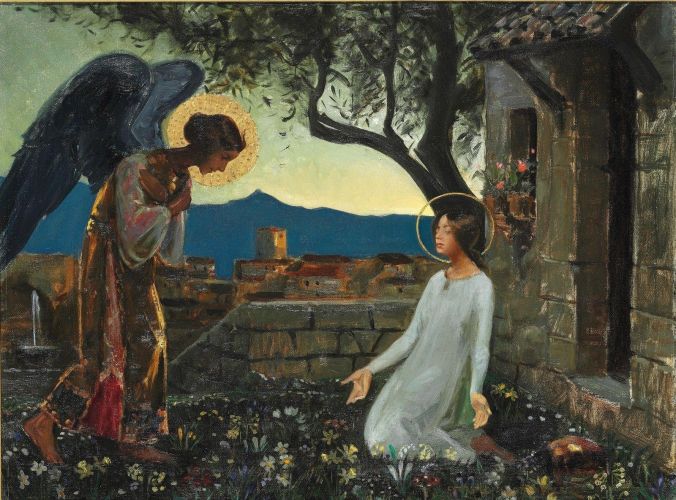
The Proclamation of the Virgin Mary by Harald Slott-Moller
Hello blog readers! It’s been a while since posted. I’ve been working on my collection of Poetry for Wild Goose, Iona Publishing, and have now submitted it. It’s been a huge project, taking me just under a year, and I’ve loved immersing myself in weaving together a pattern of words and images. I’ll let you know when I have news of a publication date, but I know it’ll be a little while before they get to it. As a quick reminder, it’s called The Year’s Circle, and it follows the seasons of the year – celebrating the unfolding natural world and the seasons some churches follow in their prayers and readings.
As many celebrate the Annunciation on 25th March, I thought I’d share with you the poem I’ve written for the new book. A meditation on the angel’s visit to Mary. In the book, I’ve placed it in Advent, at the time when we often celebrate Mary. It certainly suits spring too, with the stirrings of new life we see all around. I hope it also reminds us that new beginnings are often hidden, small, and in unexpected places. It reminds us to look beyond the surface of Empire and power, and see what is happening elsewhere. Those things may be more important than we think.
Anunciation
I see her standing at the doorway of her home as the earth quickens at her feet, awakening.
A sudden shaft of light falls on her and she raises her face to feel it warm on her winter skin
For one joins her there, on the threshold, with great wings folded. An indication, if one were needed, that he comes from another place, is made of other matter.
And so this strange meeting begins at the threshold of Earth and Spirit, Word and Flesh, Eternity and youth. The shining one greets her with a song of God’s favour, of one-to-be-born of her – as she draws back a breath into her accustomed room, afraid,
Tests the future with a question. For this high favour will take her down a dark path, and a dangerous one, with sanction and scorn and incomprehension – her own too.
Yet, even so, she takes that tentative step forward, towards the light, gives her Yes to all this, to being a God-bearer, carrying the Anointed One in the closed blood-dark room of her womb.
And so begins this strange folding of the infinite, the Alpha and Omega, into a single cell within a slight girl, the most vulnerable of forms, this Mary, full of grace. What strange and troubling gifts are these to stir the brightening air.
Luke 1: 26-38
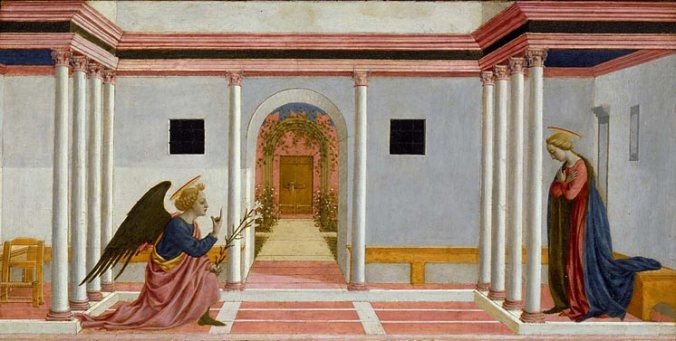
The Annunciation by Domenico Veneziano – Fitzwilliam Museum collection
Many paintings of this scene are strong on architecture. Artists, like Domenico Veneziano, were experimenting with their newly developed techniques of managing perspective. This one has a tiny pinprick in the centre, the vanishing point on which all lines converge. They ususally place Mary inside, or in some kind of indeterminate space like this one – a sheltered, nearly outdoor space. As I was meditating on the passage, I was struck by the image of thresholds, of liminal space, tentative and uncertain but open to possibility. In these early paintings, you often find the angel and Mary facing each other, like this, across the space, and then your eye is drawn to another line directly from the viewer to the background of the image. A window with a glimpse of a view, a door – in this case the door is closed. The closed door is a symbol of virginity, but here, I can’t help thinking of another collection of symbols – the closed off way back to the Garden of Eden, a way out of the confines of law and punishment, a door out into the freedom of a rich and green landscape. This line, front to back, out of the picture, forms a cross with the direction of gaze between the two figures, and that intrigues me. It does seem like an invitation to walk that path out towards the spring, towards new and abundant life.
I notice that many of you good readers are looking at my blog for poems on the themes of Holy Week, so here is a link that will help. I have a couple of new pieces for Easter Sunday, I’ll try to get those up here in the next week. Please do feel free to use my work, crediting me and this blog. It’s so good to know my work is being read in different parts of the world. Thank you for your support.
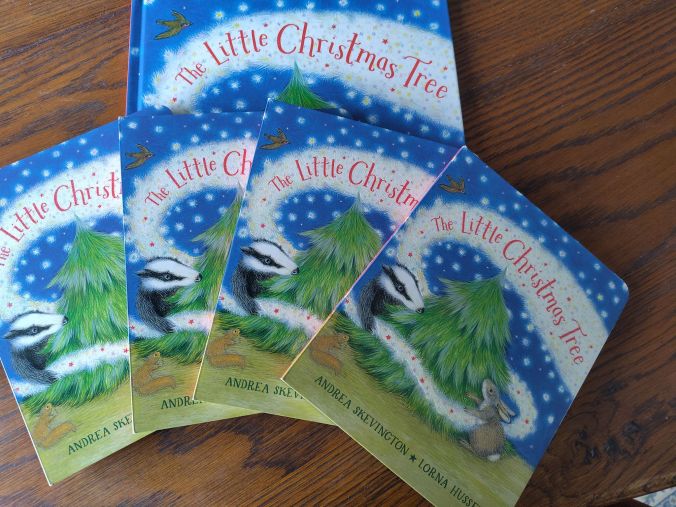
Thank you, good people, for the interest you’re taking in my Christmas picture book. I’ve been keeping an eye on availability, where I can, and it does seem to be selling well. It goes out of stock every now and again on Amazon, and they rustle up a few more copies.
Local bookshops have it in stock or to order. For local friends, Woodbridge Books have copies, and St Mary’s House too the last time I asked.
So, I’m rather bashfully encouraging you to order a copy if you were thinking of doing so, as they may well be in short supply for last minute shopping.
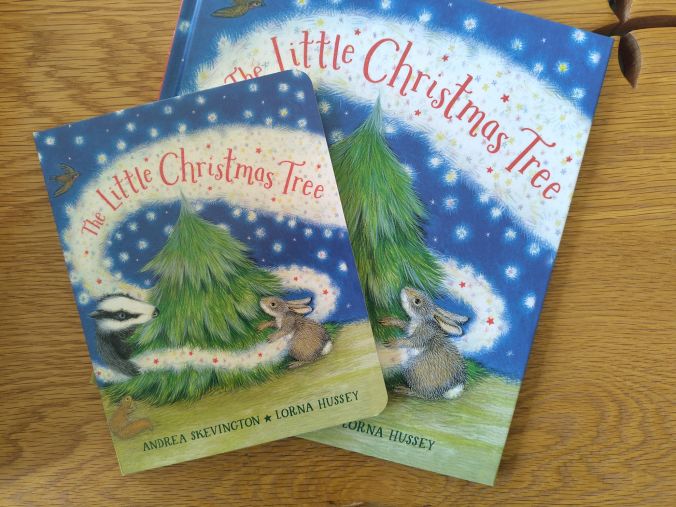
It’s available in two formats – a hardback and a slightly abridged board book for the very young. Both are illustrated by Lorna Hussey, and her artwork is enchanting and much loved by small people.
You can find out more about the book by searching on this blog, but this link will give you a good way in.
You can order it from your usual online places, such as….
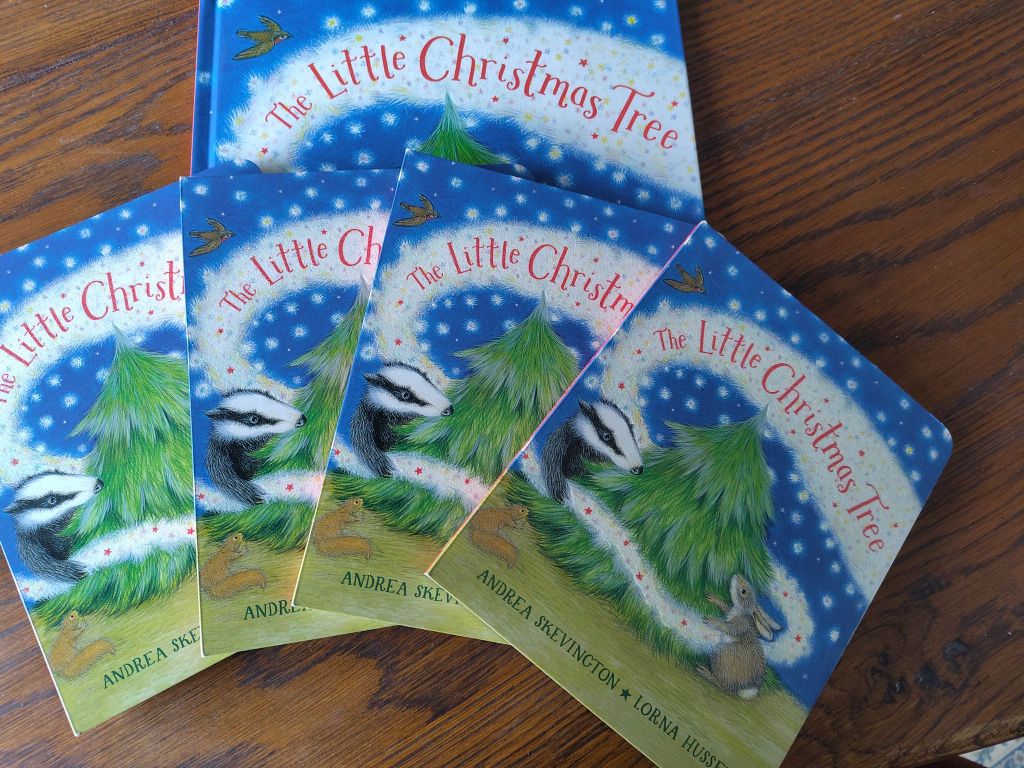
The new editions of my first story are making their way into bookshops ready for Christmas, and I know that some of you are coming across them. That’s so good, and a little bit exciting!
It’s given me the opportunity to take another read of the story, and think about it in the context of the world we’re living in now, and I’ve noticed something else.
Previously, I’ve thought about it telling a story into our shifting and stormy climate – and you can read more about that here. Today is the first day COP 30, so it seems particularly appropriate to be thinking of the importance of woods to regenerate our land, how important it is to treasure the natural world and give it space and time to return to strength and function. (If you’re not familiar with Prince William’s Earthshot Prize, I would commend that to you as a hopeful, active antidote to political wranglings – necessary as these may be.)
I’ve also thought about it as a version of Mary’s radical, prophetic message in the passage we refer to as the Magnificat, and you can read more on that here. And once again, the contrast she draws between the mighty and powerful, and the hungry, speaks directly into our unequal world.
What’s been on my mind this year is the matter of welcome – how we welcome, or not, those who have to flee their homes.
I love Lorna Hussey’s warm and intricate illustrations. Thank you Lorna!
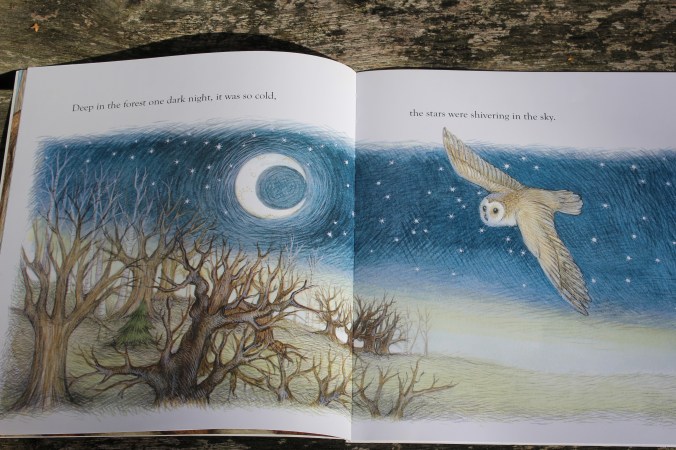
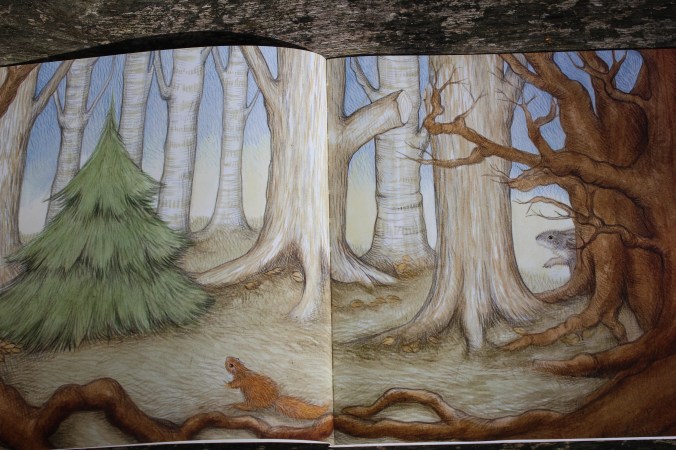
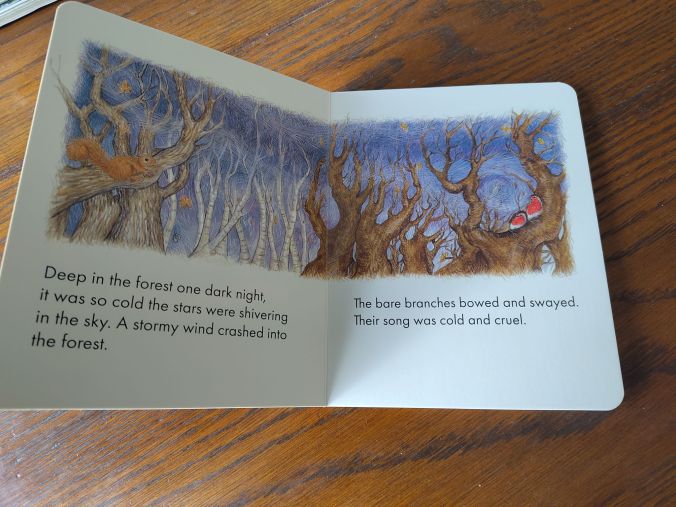
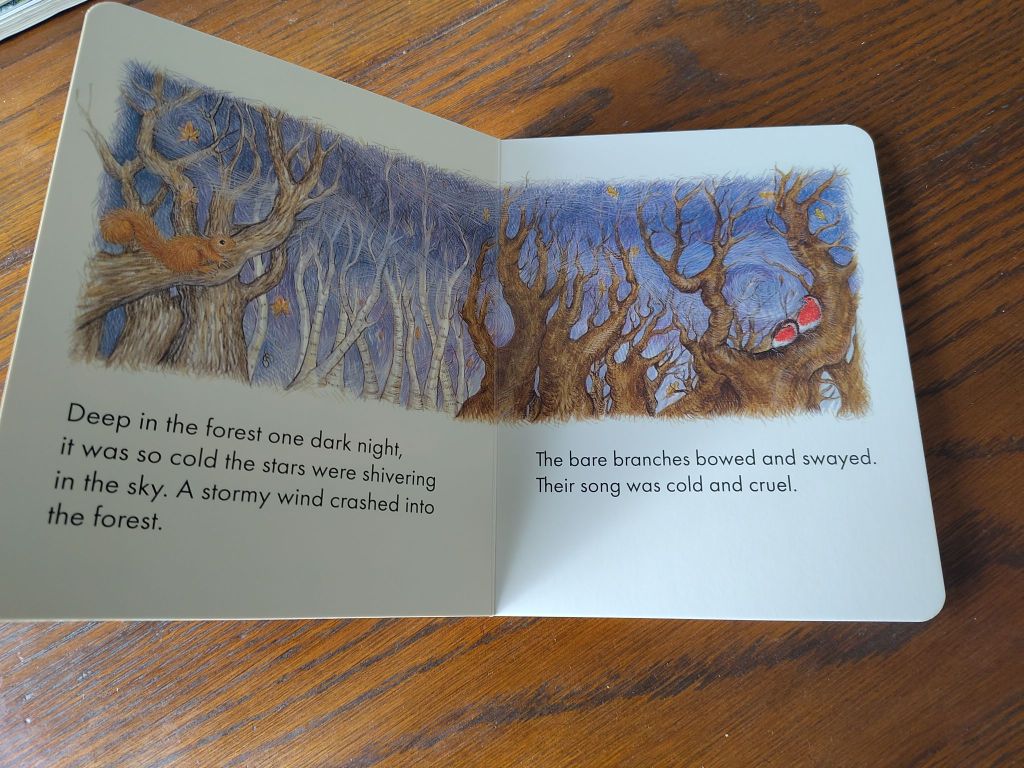
In the story, a storm rips into the wood, and the animals are looking for a place to shelter. They find one in the branches of a little fir tree, who welcomes them in. When I first told the story to my own children years ago, I never thought such an action might be controversial, or political. It was simply a practice of kindness, empathy, hospitality. These have always been regarded as Christian virtues, and those who read the scriptures will be well aware that welcoming strangers, and treating the poor and the vulnerable with compassion, is commended again and again. These qualities are upheld by ethical systems in all cultures across the world. And yet, here we are.
Of course, the global situation is complex, and it’s vital we have good, fair systems which work for all people. Of course, those who profit from exploiting those who are seeking sanctuary should be prevented and brought to justice. Those things are part of the empathy, and the welcome. It is the shift of heart which troubles me, towards hostility and violence towards those who have in all probability already experienced a great deal of it.
Can we reconnect with our deep, inbuilt response to the troubles of others – to seek to help how and where we can? Just up the coast here in Suffolk houses are being bulldozed as the sea bites ever bigger chunks out of the coast. Of course, there’s no comparison with those in the Caribbean and Asia who are suffering the most appaling tragedies from our changing climate, but it’s enough to awaken some fellow feeling, and to imagine how little it would take to find ourselves displaced and relying on kindness – both the kindness of individuals and the kindness of efficient, just and compassionate systems.
In the story, it is the Little Christmas Tree who welcomes the animals, and we share the warmth and compassion and richness that comes from that simple act. There is real joy in it. The book ends with a kind of party.
We can think too of the first Christmas, where a displaced mother was offered somewhere to have her child, and soon after the family became refugees in Egypt running from a tyrannical and jealous Herod. I’ve written about in the link above.
There is much need of kindness, and it is as precious and profound as ever. Perhaps we can remember times when we have both given and received when in need, how good that was – difficult, sometimes, but good.
As we approach Advent, let’s see if we can cultivate kindness, and welcome, and look for local ways to help people who may need it most.
The book is available in two editions, a hardback and a board book. You can order them from your local bookshop, or the usual online places.
I’m so pleased that my first story has come out as a board book today. It looks so appealing for young readers and listeners with Lorna Hussey’s gentle artwork of the woodland animals.
The story is abridged a little for the format, just perfect for little ones, and I hope it will find it’s way into many hands.
Local bookshops will be able to order it for you, usually for next day delivery, if not in stock. Also available at all the usual places you get books. You could try Eden Books