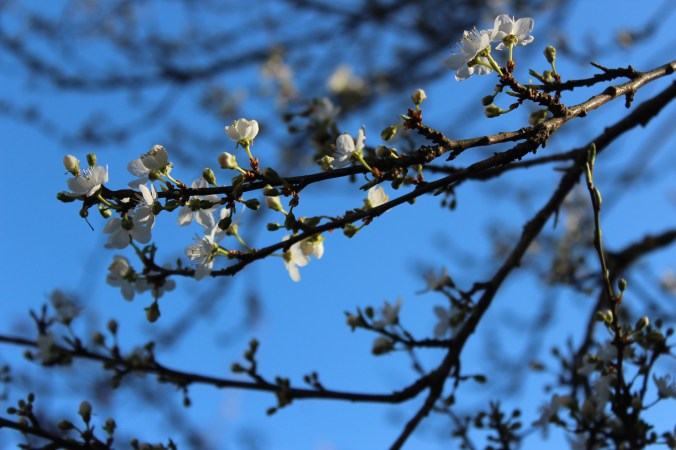
The earliest blossom in our garden – mirabelle, or wild cherry plum
After I sent in the manuscript for my first book of poetry – The Year’s Circle – a couple of months ago, I felt I needed a little creative winter – of rest and quiet and recovering energy. Lately, I’ve been finding things catch my attention again, and my pen and notebook have been coming out into the garden with me.
What follows is the closest to a finished poem that has emerged so far, and I thought I’d share it with you.
Last year, in the long hot, dry summer, we had an abundance of fruit. I thought this year the trees would be exhausted, and take a bit of a sabbatical too – it’s a healthy pattern….. but this spring, hot and dry as it has been, has been awash with blossom, and now, in the few days of rain we’ve had, the fruit is beginning to swell. It’s looking promising!
Blossom
The blossom opens – first mirabelle, then pear, apple, cherry, Iranian quince,
A white tide frothing and foaming over the garden, dazzling, loud with birdsong, petals opening like hungry beaks in nests,
All opening in turn, and all, in turn, shaken by the sudden shifts of wind – how hot it gusts now. So the petals fall, they tumble over faded daffodils, spent tulips.
And so it seems that all is lost, all that blossom, all that promise, all that beauty scattered on the wind. How the spring days scutter away.
And yet, I have come to know that all is not lost, even as the petals fall. They had their purpose. And that purpose – invisible at first, then the tiniest roundness of stem, of not yet – a held breath of green before summer’s ripening. And it will come, it will come, in its time.
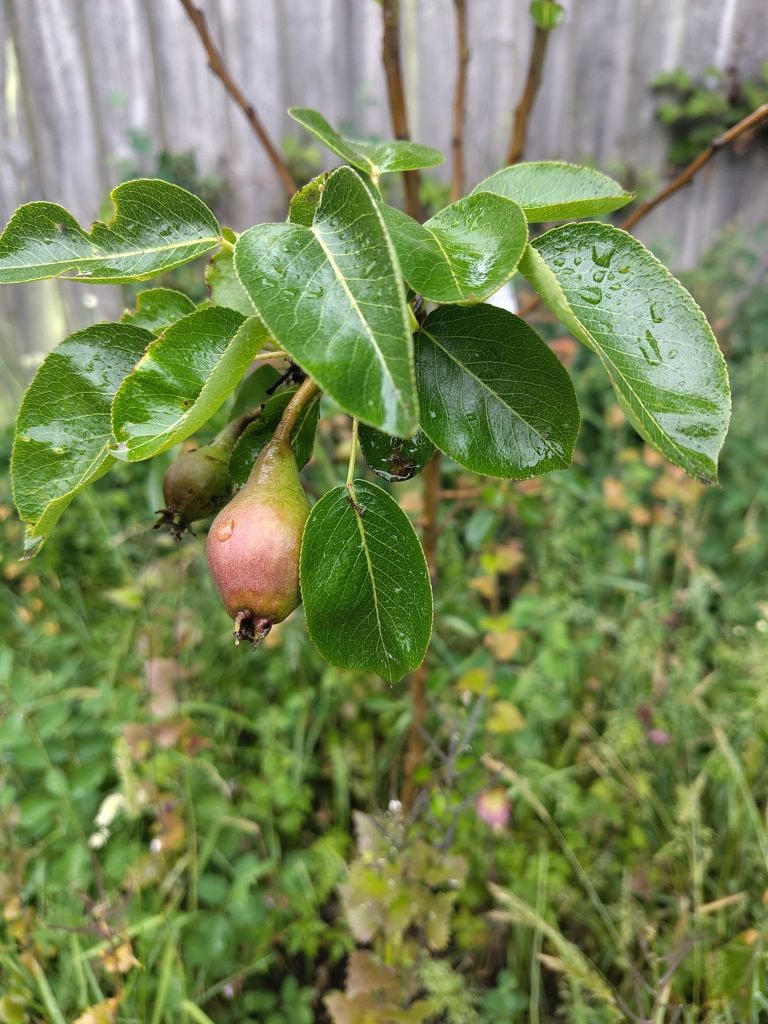
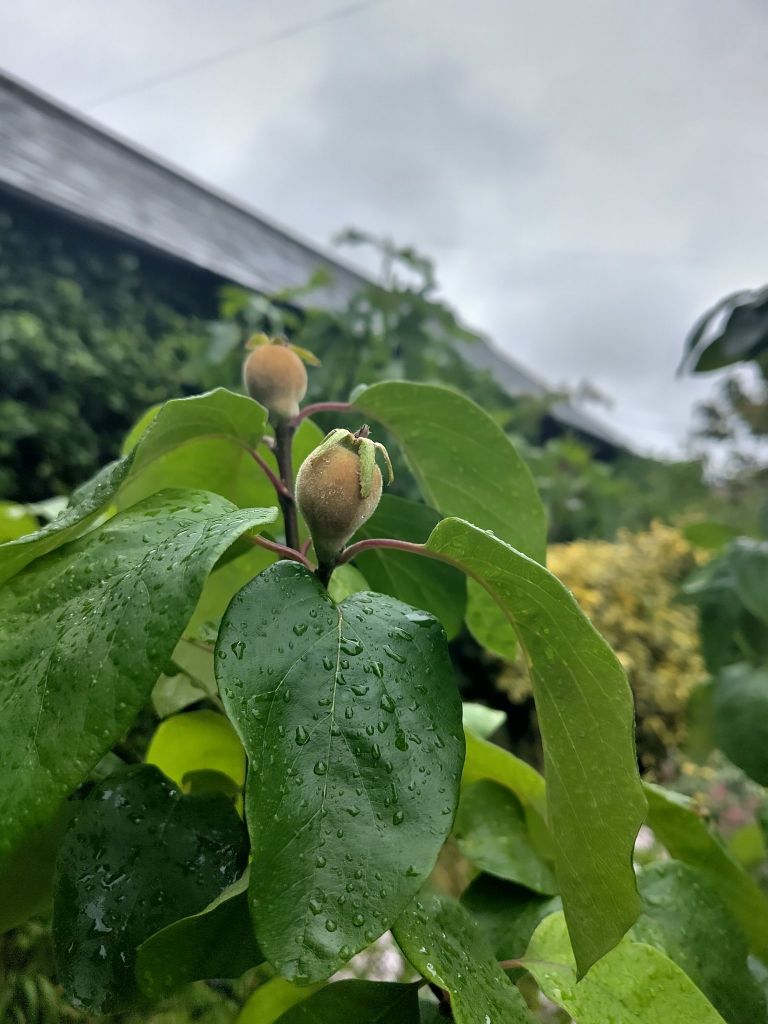
I’m particularly pleased with these two small trees. They’re both a few years old now, and this is the first time they’ve started developing tiny fruit. The top picture is a pear, the bottom the Iranian quince – fragrant and delicious. When I see these small, new fruits, I’m reminded of that rich and ancient civilisation that has suffered and is suffering so much.
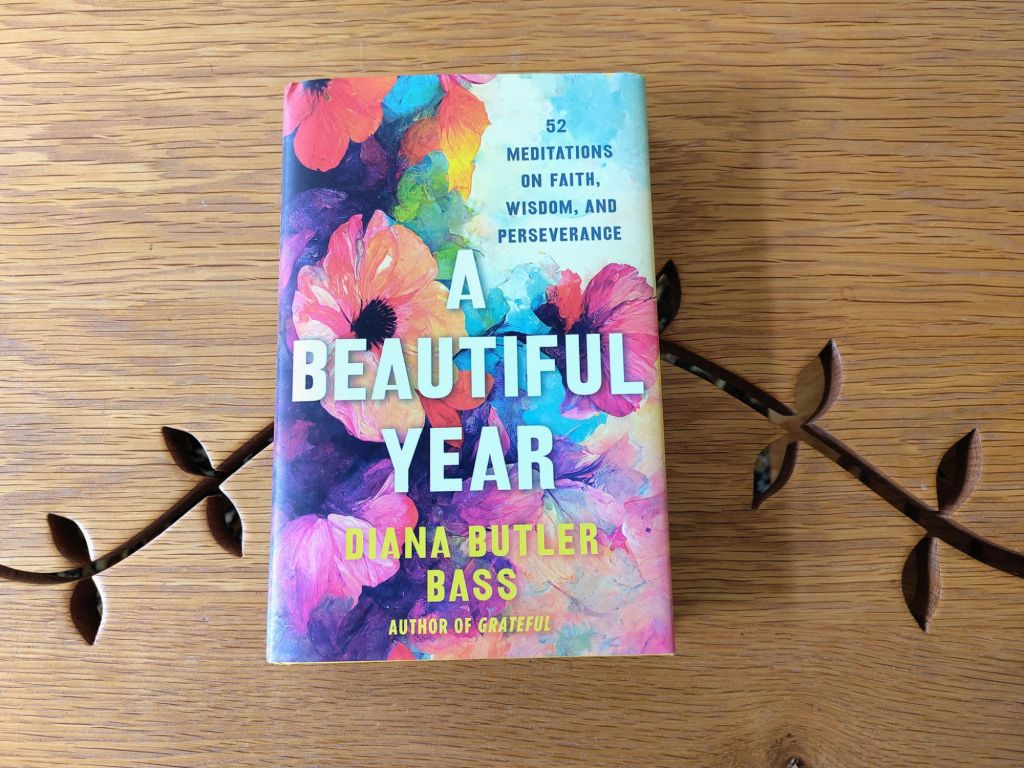
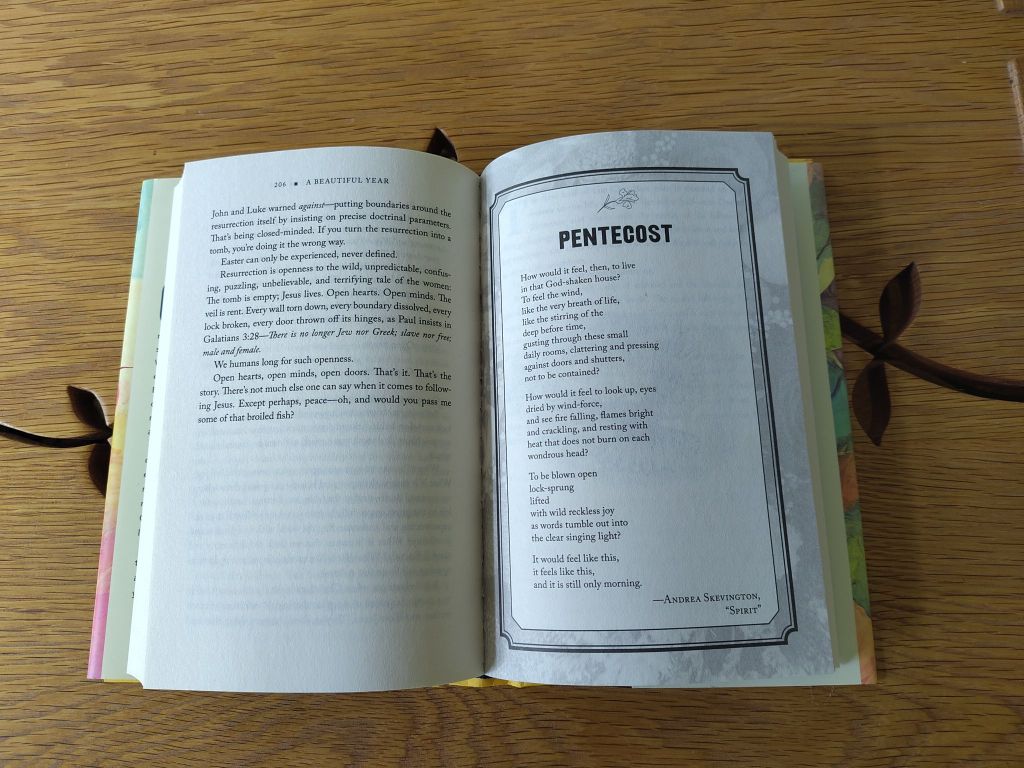
Hello! I wanted to tell you that my poem for Pentecost – when we celebrate the coming of the Spirit – has been published in this glorious book by Diana Butler Bass.
If you follow the church seasons you will find this an invaluable resource taking you through the weeks. If you don’t, you may find it refreshing and insightful. I particularly like the way she explores the radical nature of Jesus’ teachings with deep scholarship and lived experience. I heartily recommend it.
So, this poem marks the beginning of a new season in the book, and I couldn’t be more pleased. I am highly honoured to be in such company.
I’ve also included it in the manuscript for my own collection, The Year’s Circle, to be published by Wild Goose of Iona Publishing, and that’s very exciting too. I’ll let you know when I have any news of a publication date.
If you’d like to read the poem more easily, you’ll find it below – along with some other pieces that sit with it. Please feel free to use any of my work that helps you, giving my name and referring to this blog – or one of the books above. I’d love to hear about it if you do.
Both poem and reading show the way that the Spirit can burst through our shut away places and times, taking the ordinary and transforming it. I hope you find some encouragement here.
SPIRIT
How would it feel, then, to live in that God-shaken house? To feel the wind, like the very breath of life, like the stirring of the deep before time, gusting through these small daily rooms, clattering and pressing against doors and shutters, not to be contained?
How would it feel to look up, eyes dried by wind-force, and see fire falling, flames bright and crackling, and resting with heat that does not burn on each wondrous head?
To be blown open lock-sprung lifted with wild reckless joy as words tumble out into the clear singing light?
It would feel like this, it feels like this, and it is still only morning.
From the fields it came: the first sheaf of barley cut for that year’s harvest. It was carried high through streets crammed with visitors, and on to the Temple. And then the priest offered it to God, giving thanks for the good land, and for the gift of harvest. For that day was the celebration of the first fruits. It was Pentecost. Meanwhile, the disciples were all together, waiting. Then, suddenly, it began. It stared with sound – a sound like the wind – but this was no gentle harvest breeze. This was a shaking and a roaring: a sound of power, whooshing and howling about the house, rattling every door and shutter. The sound seemed to come down from heaven itself, and filled the house as the wind fills sails. Then, the disciples watched wide-eyed as something that looked like fire came down, and tongues of flame peeled off it and rested on each of them without burning them. All of them were filled, for the Holy Spirit had come. And as it happened, their tongues were loosened, and they began to speak as the Spirit gave them words. These words were not Aramaic, their own language, but in languages that were unknown to them. A crowd had gathered by the house because of the extraordinary sound, but then they heard voices. There were pilgrims in Jerusalem from all over the known world, and they recognized the words the disciples were speaking. “He’s talking Egyptian!” said one. “That one’s talking my language,” said a visitor from Crete – and the same was true for all. Each person heard God’s praises in their own tongue. “What can it mean?” they asked each other. But others among the crowd joked that the disciples had been drinking. The Twelve heard what they were saying, so Simon Peter stood up to speak to the crowds. “Listen, I’ll tell you what’s happening. We’re not drunk! It’s too early in the day for that! This is God’s promise come true. Do you remember what one of the prophets wrote long ago? I’ll pour out my Spirit on everyone – young and old. Your sons and daughters will prophesy, young men will have visions, and old men dreams. All who follow me – men and women – will be given my Spirit, and there will be wonders!
Christ has no body now on earth but yours, no hands but yours, no feet but yours… Yours are the feet with which he is to go about doing good, and yours are the hands with which he is to bless us now. St Theresa of Avila 1515-82
Spirit of God put love in my life. Spirit of God put joy in my life. Spirit of God put peace in my life. Spirit of God make me patient. Spirit of God make me kind. Spirit of God make me good. Spirit of God give me faithfulness. Spirit of God give me humility. Spirit of God give me self-control.
I’m sharing another poem from my collection-in-preparation with you, as promised. I started gathering and writing poems last March, and so this Easter poem – and the one to follow – were amongst the first new ones I wrote. So, quite simply, here it is….
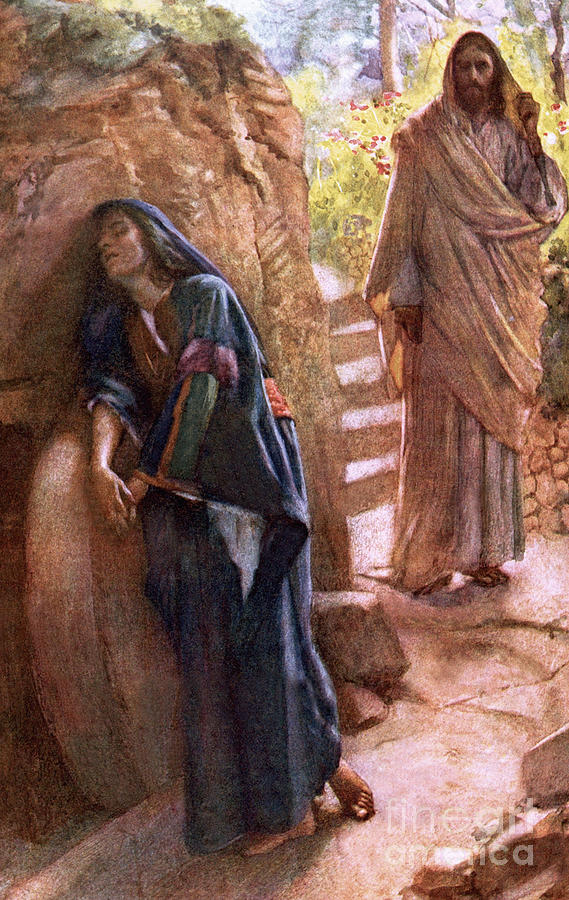
Mary Magdalene at the Sepulchre by Harold Copping
Mary in the garden
It was in the garden that Mary stood weeping. First light, first flush of green spreading over the warming stones. A quiet place, now.
Alone, shocked, bewildered, she did not see the flowers opening at her feet, or hear the song of the turtledoves.
For she is one who stands by a tomb lost, deserted, heavy-burdened with grief – the weight of a million tears – as if this grief might carry the pain of us all.
And seeing you, she did not see, thought you were like a second Adam, tending the garden in this strange new dawn.
Then, you spoke out a name – her own name. Mary. She knew you then. What must have risen up in that broken heart, touched as she was by your tenderness. Yet as your eyes met, her hand stopped in the warming air between you, singing with birdsong, shining with light.
John 20:11-18, 1 Corinthians 15:21-22
If you would like to read the story, you can find more in the link below….
Christ chasing the money changers from the temple Raymond Balze
The story of Jesus turning over the tables of the moneychangers in the temple is often told today, as we approach Easter. So, I’m sharing with you again my retelling of the story and a poem that I’ve included in my upcoming collection, The Year’s Circle, Iona Publishing.
Jesus went into the Temple courts, and found them choked up with stalls and salesmen, ringing with the shouts of hawkers and hagglers. People were not gathering for worship: they were changing their money into special Temple coins, and buying birds for Temple offerings. Jesus grabbed the traders’ tables and threw them over. The money changers and the dove sellers shouted angrily while the coins clattered and rolled across the stone floor. “You’ve taken ‘the house of prayer’ and turnind it into a ‘den of thieves’!” Jesus said, and all fell silent at his words. Then, the blind and the lame came to him and were healed. And children came, too, running and shounting, “Hosanna to the Son of David!” The Temple was filled with joy, and the priests and teachers of the Law drew back, muttering angrily.
From The Bible Story Retold, based on Matthew 21
One of the things I found while working on this retelling was that there was always so much more I wanted to explore – so much depth and meaning hinted at, or concealed by years and culture and translations. My practice in writing the book was to read widely, and then to meditate on the passages in the style of Lectio Divina – imagine myself into the story, and allow it to unfurl in my mind – a mind with questions, open to prompting I hope. So with this one, there was so much here about Jesus’ rage at the commodification of the things of God, making what was freely given into a commercial venture. We are so used to everything falling into the realm of money it can be hard to imagine how things could be any different, or how the realm of God might offer a radically different Way. Jesus spoke more about money than about prayer, and yet it’s a difficult subject to explore for us. So many of the ills and injustices and exploitation of the natural world we are currently experiencing suggest to me that something has gone wrong with the way we view and use money. Can we begin to dip into the realm of gift, generosity, and finding ways to do what is necessary and right? I hope so.
The Little Free Pantry at St Andrew’s Church, Melton. An example of gift, of sharing. Apologies for the soft focus!
And so, to the poem which came out of my reflections. The meaning of gift and the exchange that arose in my imagination on reading the passage was many layered, and I hope the poem can be read a number of ways depending on what chimes with you the reader. It draws from the Mattew 21 passage, as above, but also the passage early in John’s gospel (John 2).
Poured out and Overturned
Some things cannot be bought and yet, they are. See those neat piles of coins, counted carefully, those inkmarks methodically made, those animals sold for sacrifice, coins given for prayers, for favour, for the words and work of God.
His carpenter’s hands gripped the smooth grained tables and upended them. Poured out the shimmering piles of coins rolling and chiming over the stone floor.
Some things, perhaps, once, all are freely given – life, air, water, growing things for food, breath, beauty, favour, love. So many things we lay out in rows, so many tables, so many neat marks of ink or light.
Bound, we see no alternative, cannot imagine another way, and yet, here is a man throwing coins to the floor, with a whip to drive out money changers while wooden tables lie groaning on their sides.
Set free, then, what happens in this space, this chaos, with all our reckoning upended? The blind and the lame come, and are healed. And the children run and shout Hosanna. And what is, and what will be is all gift. So it is, and may it be so.
John 2:13-22, Matthew 21:12-17
Elisabeth Frink, Chapel of the Transfiguration, St Edmundsbury Cathedral.
I notice that some of you good people are looking up resources for Easter on this blog. Thank you for considering my work. If it helps, here’s a link to a summary…… Please feel free to use my writing in any way that helps, mentioning my name and this blog. And do feel free to let me know, I do love to hear where it gets to!
Edit: Sunday 3rd March.
I’m absolutely delighted to find my poem below at Diana Butler Bass’ The Cottage. She shares an informative piece on this passage which I’ve found has helped me understand what can be a puzzling story. Do read it if you haven’t already. I hope this link will take you there…..
Further edit… I seem to be having difficulty clicking through on this link. She has included one of my Mary of Bethany poems in another recent post if I’ve whetted your appetite and you can’t find Overturned…. try this.
If you search for her name on this blog, you will find other poems and other links.
I’m sharing another poem from my collection-in-preparation with you, as promised. I started gathering and writing poems last March, and so this Easter poem – and the one to follow – were amongst the first new ones I wrote. So, quite simply, here it is….
Mary Magdalene at the Sepulchre by Harold Copping
Mary in the garden
It was in the garden that Mary stood weeping. First light, first flush of green spreading over the warming stones. A quiet place, now.
Alone, shocked, bewildered, she did not see the flowers opening at her feet, or hear the song of the turtledoves.
For she is one who stands by a tomb lost, deserted, heavy-burdened with grief – the weight of a million tears – as if this grief might carry the pain of us all.
And seeing you, she did not see, thought you were like a second Adam, tending the garden in this strange new dawn.
Then, you spoke out a name – her own name. Mary. She knew you then. What must have risen up in that broken heart, touched as she was by your tenderness. Yet as your eyes met, her hand stopped in the warming air between you, singing with birdsong, shining with light.
John 20:11-18, 1 Corinthians 15:21-22
If you would like to read the story, you can find more in the link below….
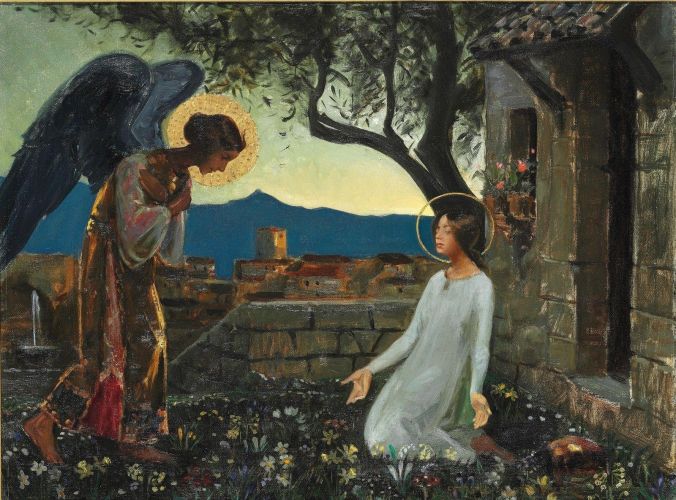
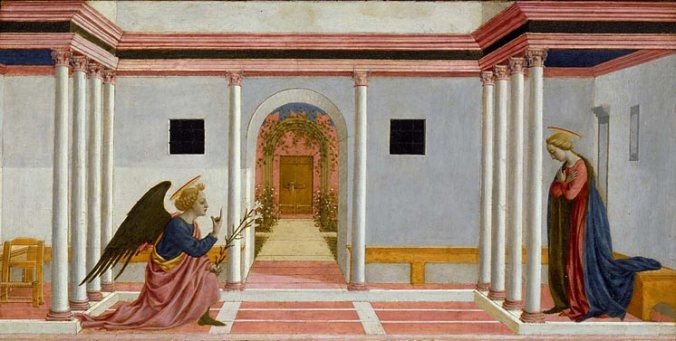
The Proclamation of the Virgin Mary by Harald Slott-Moller
Hello blog readers! It’s been a while since posted. I’ve been working on my collection of Poetry for Wild Goose, Iona Publishing, and have now submitted it. It’s been a huge project, taking me just under a year, and I’ve loved immersing myself in weaving together a pattern of words and images. I’ll let you know when I have news of a publication date, but I know it’ll be a little while before they get to it. As a quick reminder, it’s called The Year’s Circle, and it follows the seasons of the year – celebrating the unfolding natural world and the seasons some churches follow in their prayers and readings.
As many celebrate the Annunciation on 25th March, I thought I’d share with you the poem I’ve written for the new book. A meditation on the angel’s visit to Mary. In the book, I’ve placed it in Advent, at the time when we often celebrate Mary. It certainly suits spring too, with the stirrings of new life we see all around. I hope it also reminds us that new beginnings are often hidden, small, and in unexpected places. It reminds us to look beyond the surface of Empire and power, and see what is happening elsewhere. Those things may be more important than we think.
Anunciation
I see her standing at the doorway of her home as the earth quickens at her feet, awakening.
A sudden shaft of light falls on her and she raises her face to feel it warm on her winter skin
For one joins her there, on the threshold, with great wings folded. An indication, if one were needed, that he comes from another place, is made of other matter.
And so this strange meeting begins at the threshold of Earth and Spirit, Word and Flesh, Eternity and youth. The shining one greets her with a song of God’s favour, of one-to-be-born of her – as she draws back a breath into her accustomed room, afraid,
Tests the future with a question. For this high favour will take her down a dark path, and a dangerous one, with sanction and scorn and incomprehension – her own too.
Yet, even so, she takes that tentative step forward, towards the light, gives her Yes to all this, to being a God-bearer, carrying the Anointed One in the closed blood-dark room of her womb.
And so begins this strange folding of the infinite, the Alpha and Omega, into a single cell within a slight girl, the most vulnerable of forms, this Mary, full of grace. What strange and troubling gifts are these to stir the brightening air.
Luke 1: 26-38
The Annunciation by Domenico Veneziano – Fitzwilliam Museum collection
Many paintings of this scene are strong on architecture. Artists, like Domenico Veneziano, were experimenting with their newly developed techniques of managing perspective. This one has a tiny pinprick in the centre, the vanishing point on which all lines converge. They ususally place Mary inside, or in some kind of indeterminate space like this one – a sheltered, nearly outdoor space. As I was meditating on the passage, I was struck by the image of thresholds, of liminal space, tentative and uncertain but open to possibility. In these early paintings, you often find the angel and Mary facing each other, like this, across the space, and then your eye is drawn to another line directly from the viewer to the background of the image. A window with a glimpse of a view, a door – in this case the door is closed. The closed door is a symbol of virginity, but here, I can’t help thinking of another collection of symbols – the closed off way back to the Garden of Eden, a way out of the confines of law and punishment, a door out into the freedom of a rich and green landscape. This line, front to back, out of the picture, forms a cross with the direction of gaze between the two figures, and that intrigues me. It does seem like an invitation to walk that path out towards the spring, towards new and abundant life.
I notice that many of you good readers are looking at my blog for poems on the themes of Holy Week, so here is a link that will help. I have a couple of new pieces for Easter Sunday, I’ll try to get those up here in the next week. Please do feel free to use my work, crediting me and this blog. It’s so good to know my work is being read in different parts of the world. Thank you for your support.
I’m sharing this post again, September 2025 as part of the Season of Creation some Christian traditions are marking at this time. Meanwhile, I’m continuing to work on a collection of poems for Wild Goose, The Year’s Circle – and this poem is part of that work. I’ll be sharing more on that as we go along.
I hope you find this post a helpful starting point for contemplation.
Additional note, 24th September2023. I am delighted that this post has appeared at The Cottage, Diana Butler Bass’ rich and thought-provoking Substack, this morning. I’ve admired her work for many years, and it’s such an honour, and very exciting for me, to find myself in her company today, under Inspiration. It’s a profound exploration of envy and gratitude, and a reflection on the deep drivers of our climate and ecological crisis. It’s well worth reading and allowing it to do its inner work on us. You can do so here.
Original post, published 12th July 2021, emerging from lockdowns:
As we are beginning to venture out a little more, we thought we would pay a visit to Ely, and the vast indoor space of its ancient cathedral. They often have contemporary art there, which helps the old stones continue to sing, giving a new perspective on ancient truths. We knew that Gaia, an installation by Luke Jerram, was going to be there in July, and so we went and saw this beautiful, astonishing sight. The comparative emptiness of the cathedral space made it all the more powerful as it floated above us.
And as the space is vast, and it takes time to walk up to, around and beyond the piece, you do have time and space in which to allow the work to speak to you, to stir up responses, and to pray. I am sure that one of the intentions is to give us all an opportunity to experience something like “earthrise”, when the astronauts first saw the whole of the Earth from space, and how that shifted their perspective, and began to change the way all of us are able to see our home. The staggering, indescribable beauty of the whole called out my sense of awe, which sat uncomfortably alongside my awareness of the damage we are doing to our precious, unique home.
In the setting of the cathedral, as Gaia hangs in the nave under the painted ceiling which tells the long stretch of the Bible’s story, I found the language of repentance surprisingly, and helpfully, came to mind. Repentance both in our more familiar understanding of sorrow for wrongdoing, and desire to amend, and in the possibly more ancient meanings carried in the old texts, of returning home, and of undergoing a profound change of mind – a paradigm shift in the way you see.
Much of my writing celebrates the beauty of the natural world, how lovely, precious, and vulnerable it is. But sometimes, that love spills over into grief. So the old stones, and the old story, seemed illuminated by our current crisis, and, in turn, those ancient words seemed to express something necessary, and powerful, and, in the end, with the potential for hope.
You can listen to the poem here.
Gaia at Ely Cathedral
She seems to float, lit up with her own light, slowly turning, blue and blooming with clouds as we walk up, look up, small before her.
While above our steps, the familiar painted roof rolls on, telling its painted story, from the tree, and the garden, on towards this
fathomless shining beauty, the ‘all’ that was so very good in that beginning. Now as she turns we see how she hangs below the story’s last scenes – the gift of a beloved child held on his mother’s lap, held forward towards us, loved and given and giving, and the wounded golden king, who gives still.
And below, below hangs the whole shining Earth, dazzling, vast with sea, turning and flowering with clouds from the southern ice-shine, melting although we do not see her weep,
And the land, those small green swathes and swags, are dressed in white too, a veil of vapour, while the deserts spread brown and red above our eyes.
The lands are small, countries seem tales we tell. What is certain is this one great flow – ocean and ice and cloud – and the unseen winds that bear them through our blue, breathing air.
And the people stand beneath her, lit by ice, and hold up their hands as if to carry her, or hold her, or save her from falling.
How beautiful it is. How strange and wondrous that we should be creatures who live within so much living perfection.
And as she turns slowly under the child and the king, I wonder, what do those familiar words mean now, ‘the sins of the world’, as the stain of our reckless harm seeps through the blue and green, through all this living glory,
And is there any hope in our waking up to beauty with grief and loss, even as dust and ashes float across the sky, across us all, late as we are in our repenting?
And is there hope, hope that we might be granted this grace – time for amendment of life, to tend the garden with its leaves and fruit, shining and greening, to take part in the work of loving and healing, of restoration, of making all things new.
Looking at Gaia from behind the communion table brought to mind the words of repentance from that service, and I was aware of my sense of what “the sins of the world” might mean was creaking open a little wider.
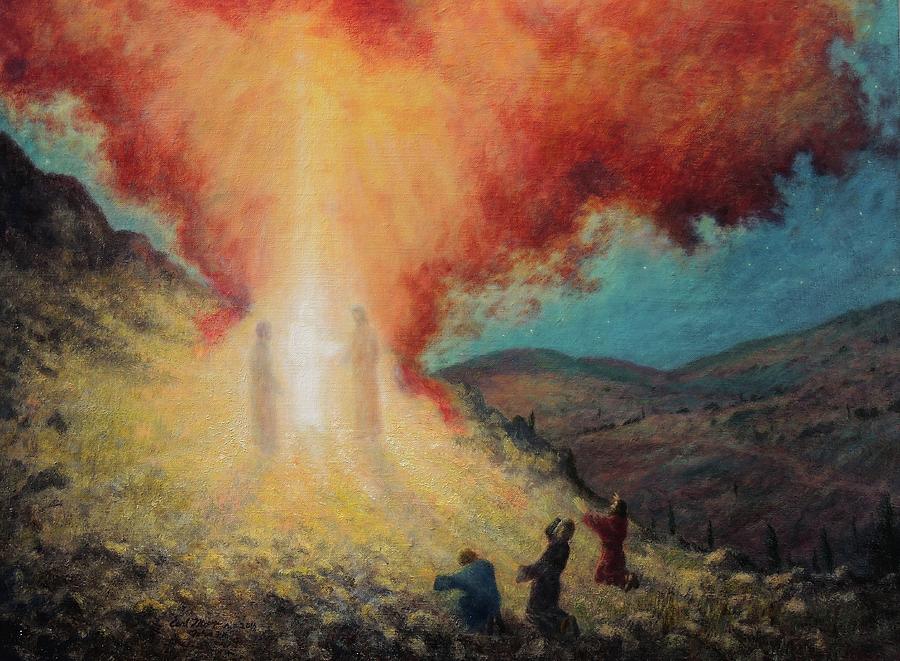
I’m working away at my collection of poems, The Year’s Circle, weaving together the seasons of the year and the seasons of the readings many churches follow. And we’re coming up to the story we call the Transfiguration – when three of his friends see Jesus in an otherworldly, shining – vision? or what was it? – with Moses and Elijah from the Hebrew Scriptures. It’s a pivot point in the gospel accounts, important and central, and also strange.
Some have interpreted this event as a revelation of Jesus’ true identity, and perhaps a foreshadowing of the resurrection appearances, and perhaps a glimpse of the Universal Christ – a theme explored by Richard Rohr in his book of that name.
As usual, there is no explanation, no interpretation in the gospel accounts. And there’s something about the event which encouraged me to explore the way it asks questions of us – what we think is really real, and really lasting. How we see – do we see glory? Do we see cloud? Those explorations reminded me of the medieval work, The Cloud of Unknowing, and how beneficial it is to be open and patient with things that are beyond our understanding. It feels like a story to sit with in contemplation, expanding our way of seeing, inviting us into a deeper and truer experience.
Earl Mott’s painting of the Transfiguration
When I was reading Luke’s account I was struck, as I often am, by his ordering of the events. There seems to be a theme emerging, with questions of who Jesus was, and also, what greatness might mean. And so I wrote a short series picking up those themes and exploring them. There are other events woven through that are not covered by the following sequence of poems – the Feeding of the Five Thousand, for instance – which is developing a sequence all of its own.
If you are looking for something to use in your devotions or public worship for the Feast of the Transfiguration (on 6th August), the parts stand alone, and can be used singly. But I was intrigued by the flow of ideas and wanted some space to ponder them on the page. I began with Herod, troubled and awkward in his guilt, and moved through the stories to the little child, standing in the midst of them.
So, here it is….. four poems following a trail.
Who? Luke 9, Matthew 16-18
I Herod
Herod found you a question he did not know how to answer. Perplexed, he heard whispers that you were John back from the dead, a ghost to stalk his conscience, shock his dreams, or the great Elijah, or another prophet.
He sought you out, he tried to see you. Perhaps to ask you who you were. What might have been, what could have been, if he had met you then?
II Peter’s confession
You asked those who knew you best, Who do they say I am? and Who do you say I am?
To the first, they gave the answers that blew in the air like smoke, whispers that swirled dark around Herod’s palace, and through courts and crowds. John the Baptist, back from the dead. Elijah. One of the prophets.
And to the second – a moment’s pause, an intake of breath, a strangeness rising – to be asked to name, to more than name, one they knew daily, and loved, and still, barely understood. How to give answer to such a question?
But Peter did. The vast words formed in his mouth. He called you Messiah, the Christ, the anointed one.
How good it is to be seen, to be known, to be understood. How warmed you were by those words. Enough to give him a new name – Rock – and a new identity – foundation stone. For all his impulsiveness, changeability, you knew him as deeper, and truer.
And yet a sadness enters here. The anointed one does not walk in greatness. The road you will take is hard and stony. A way of weeping. And a warning enters too – those who consider themselves God’s guardians will subject you to death, yet death will not hold you.
Such words cannot be borne. Such an upending, a contradiction, such pain. They fall to the earth like so many hard-shelled seeds, trodden into the dirt and snatched up by dark, shining beaks.
Sometimes our seeing falls away and we catch a glimpse of deeper truth. We say we see the light
Away from everyday thinking, on the mountain, in prayer, weighted with sleep. Perhaps we see a beloved face lucent in sudden light.
But here, on this mountaintop, three friends lifted up their eyes and saw – what shall we say? to whom shall we compare him?
Shining like the sun, as white as light, as bright as lightning – the one they walked with, ate with, laughed with.
Was it like the lifting of a veil, or perhaps a dragonfly splitting his dark skin to emerge a jewel? Was it a peering through the door of heaven, or coming to see the glory of things here, and now? I do not know. I do know it feels a moment of endless truth.
And in that moment, Jesus, Elijah and Moses do not speak of the glory that blazes around them, they talk of the pain that is to come – as ones who can understand. I hope there was some comfort in it.
Something like comfort too in the sightless seeing cloud, shekinah, that reveals how we do not and cannot see – God is beyond us
And yet is with us, as close as mist filling our lungs, beading on our skin, as close as one we love.
And then they hear that true voice speaking tenderly, calling him beloved, and saying to listen, to listen to their dazzling friend.
Words they will carry in their hearts, words which in turn will carry them on that long wide-eyed walk down the mountain, and through all that is to come.
As above, also reference to Isaiah 40
IIII Greatness
It is not what we think. Greatness is not the pomp, the power, the show, the mountaintop.
It is the welcoming of a little child. It is the being like a little child. In doing so, we draw closer to the one who calls Jesus beloved, the Son I love.
Greatness, a costume cloak of purple and foil. Let it slip from your shoulders. Let it fall.
As ever, I’m sharing with you work in progress. There may be some tweeks and amendments before things land in the book – Wild Goose, Iona Publishing, next year. Also, as ever, please feel free to use any of my material that helps, referencing this blog as your source. I love to hear about where my poems fly to, and where they land.
Here is a link to some more I’ve written on the Transfiguration. It includes extracts from my retelling, and some thoughts on how we might come to see more truly. I hope you find it nourishing.
I’m continuing to share with you some poems I’m working on for a new book, The Year’s Circle, which will be out next year – with Wild Goose of Iona Publishing. You can read more about that here.
As I’m settling into the work, I’m finding it so rewarding. I love looking for threads and connections between things, and so I’m weaving together poems which follow the pattern of the church year and poems drawn from nature. I’ve always found the natural world rich with image and meaning, and that is particularly true of the wild beauty of late spring.
This poem has been a bit of a knotty one to unravel, but now I think it’s settled and working. I’m giving it to you a little early, in case anyone is looking for a poem for Ascension (this year, Thursday 29th May) . At the beginning of the book of Acts we find this account of Jesus being taken up, and I have been wondering about what it might mean for us.
I thought first of what it must have been like for his friends, a kind of second losing. They are still caught up in their concerns – they are still thinking of a kingdom with power and borders. And every day, now, we are seeing the pain of kingdoms and borders, the terrible suffering of the people of Gaza and the long history of cause and effect that leads to children, the frail, the displaced and the wounded – starving. It’s shocking and distressing. I find those images fill my inner vision as I read the words of the disciples. And I notice that their nationalistic hopes do not align with the task set them by Jesus.
I have wondered about the complete change in perspective that Jesus seeks to share. I think it might help us, and give us a way of seeing that opens us up to a better way.
He is not speaking of kingdoms with borders. He is sending them out – over borders, without consideration of the divisions between peoples we might make – to the whole earth. A shift in thinking, a higher, more inclusive view. So, in this poem, I try to explore that shift. The poem has two strands. The experience of Jesus’ friends as he slips away from them, and this wider way of seeing he invites them to share.
Hidden/All things – Ascension
Perhaps it had seemed a partial parting, a gradual letting go.
In life, they had lived with him, travelled dusty roads, slept under stars, ate bread and shared a cup.
Then, after that dark Friday, that bright Sunday, there came these strange, sudden meetings, brief comings and goings, words they found hard to understand – such puzzling reassurance.
And still they ate together, and he spoke of another presence who would come to them, be with them. And despite their questions of nations and times, his was always a wider vision.
Always wider and other Out to the old enemy and the ends of the earth Everywhere and everyone
And then at last they came to this last parting, and he was taken up in rolling clouds and hidden from their sight, a long perspective they could not yet share
that saw the whole blue green turning Earth and all things – things in heaven and things on earth – holding together reconciled all very good and all beloved. Above all, beloved.
Acts1:1-11 Colossians 1:15-20
This image is of Gaia by Luke Jerram, when it was at Ely Cathedral. As I’m playing with the arrangement of poems in The Year’s Circle, I’ve placed my poem inspired by this artwork in a group that follows this one on the Ascension – a group that begins to explore our perception of the Earth as an interconnected whole. You can read the Gaia poem here.
And, in the spirit of the original Sunday Retold, here are some passages which might be of interest.
‘The disciples never knew when Jesus would appear among them – but appear he did, telling them more about the kingdom of God, and kindling hope in their hearts. “Wait in Jerusalem and you will receive God’s gift. You remember how John baptized with water? In a few days, you will be baptized with the Holy Spirit of God.” Another time they asked him, “Lord, will Israel be a great kingdom again now?” “That’s not for you to know. The Holy Spirit will come and fill you with power, and then you will tell everyone what you have seen and heard. Start in Jerusalem, and Judea, but then go out beyond Israel to Samaria, and even further – to the whole earth!” Then Jesus was lifted up, above and beyond the earth, and a cloud hid him…….’
Ascension Day ‘Christ has no body now on earth but yours, no hands but yours, no feet but yours…. Yours are the feet with which is to go about doing good, and yours are the hands with which he is to bless us now.’ St Teresa of Avila
So, this Sunday Retold is a little different. The retelling is a poem, which you’ll find below. Some of you may remember that I’m absolutely delighted to be bringing out a book of poems next year, based on the cycle of the seasons – both in nature and in the readings that many churches follow. You can find out a little more about that here. Wild Goose, the publishers, are happy for me to share some pieces in progress with you here as I work on the book.
It seems good to start with Easter, and this week – of the poems I’ve been working on – the one that seems most nearly there is one that happens to tell the story of this week’s gospel reading, John 21:1-19.
It’s such a rich passage, and there is so much that could be and has been said. I think the reason this poem has come most readily is connected to the warmth and tenderness I felt when reading the story. Although we often focus on the extraordinary elements – and they are there, sure enough – I warmed to the ordinary. Once again, Jesus is feeding his friends. He knows they have been working all night, and he anticipates the depth of their hunger, their cold, their disappointment, and their need for this breakfast. It is a feature of these Easter stories, how often eating together is involved, how simple and reassuring the talk.
And here, we see the dance of grace – forgiveness for Peter, yes – but there is also the simple lifegiving grace of sharing food, of receiving, and giving. Of giving, and receiving. It is a revolutionary gift economy in fishing and sharing, in forgiveness and purpose, and its something I’ve missed before…. Perhaps I’ve been too caught up in the strangeness, or the textural intricacies, or the story being about Peter, to see how this new life is also about cooking breakfast for hungry people, and them having enough – strength, fish, new beginnings – to feed others in turn.
I love Wendell Berry’s phrase, “practice resurrection”, and this Easter, I’m wondering what that might mean….
But here is the poem.
Overflowing
Gathered around the fire, dripping with lake-water and morning chill, they warmed themselves in quiet, not asking who it was who cooked them breakfast on charcoal and hot stones.
After such a night, such an empty- netted night of no-going-back to the old life, of cold, of hunger, of ropes against skin, they sat on the shore with the smokesmell of griddled fish and fresh bread filling their senses.
In the dawn shadows – the last stars fading, the first light gleaming – you handed them this feast – loaves and fishes, bread broken – you fed them and warmed them.
This is how it flows, the dance of new life.
We may be fisherfolk with empty nets, but you guide our hands. And we are overflowing. You cook breakfast, and we share a feast.
And then, and then, the invitation, the instruction, the grace to Peter and perhaps to all – Feed my lambs, Feed my sheep, my sheep.
We receive, and we give, we give, and receive, for there is enough. There is grace enough to break the nets and yet the nets are whole, and look, still the sea is full of fish
Overflowing Dancing In the new light of dawn.
The Little Free Pantry at St Andrew’s Church, Melton – one of many now springing up.
This story, of the miraculous catch of fish, and Peter’s restoration, is included in my retelling pictured above.








 Andrea Skevington