Sunday Retold: Christ the King

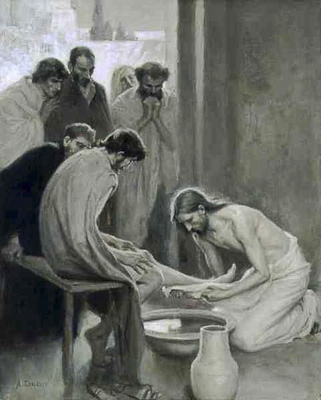
Jesus Washing the Feet of his Disciples, by Albert Gustaf Aristides Edelfelt, (1854-1905)

This week, I thought I’d share with you my retelling of the reading many churches will be following this Sunday, in the spirit of Sunday Retold.

It explores themes of power, and so follows on from last week’s poem, Stones.
This week’s reading is that electrifying encounter between Jesus and Pontius Pilate – a trial of sorts. For the flow of the storytelling, I’ve taken a longer sweep than the set reading.

So here’s the story from The Bible Story Retold

At the same time, as dawn was breaking, the council gathered – elders, chief priests, teachers of the Law – and faced Jesus.
“If you are the Christ, the promised one, then tell us!” one said, rolling the words around his mouth as if they were bitter to his taste.
“If I told you, you would not believe me,” Jesus replied, holding him in his steady gaze.
“Are you the Son of God?” they asked.
“You are right to say so.”
At this they rose to their feet with an angry roar, and carried Jesus off to the palace of Pilate, the Roman governor, who had power to sentence people to death.
“This man is a threat to the peace – he claims to be Christ, a king, and opposes Roman taxes,” the accusers called out as Pilate circled around Jesus.
“Are you the King of the Jews?” he asked. Jesus felt the cold edges of the mosaic under his bare feet.
“Yes,” he replied. “But my kingdom is not like the kingdoms of this world.”
“So, you are a king!” Pilate responded.
“Yes! That is why I came, to speak the truth. Everyone who is on the side of truth will listen to me.”
“But what is truth?” Pilate asked. Then he went out to see the leaders and the people together. “I see no reason to charge him,” Pilate said. “This man has done nothing to deserve death. I will set him free.”
“No, set Barabbas free instead!” they cired. Now, Barabbas was a rebel who had killed a man.
They shouted louder, drowning out Pilate’s words: “He’s done nothing wrong! I will release him!”
But, with rising rage, the mob shouted, “Crucify crucify!” In the end, Pilate gave in: he set Barabbas free and handed Jesus over to the guards.
The guards tormented Jesus, the one called king. They draped a fine, purple robe around him, and twisted him a crown of sharp thorns to wear. They called out, “Hail, King of the Jews!” and fell on their kneeds before him, laughing. They spat on him, and struck his head with a staff. They, they took back the robe, and led him out to be crucified in his own simple clothes
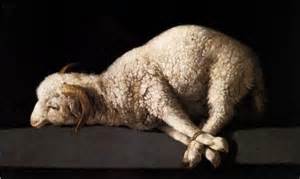
Francisco De Zurbaran

We see how those who held religious power allied themselves with the Imperial power of Rome. I expect they were sure they were being faithful, upholding the law and their traditions, defending their faith as they saw it. Being certain you are right can lead you very astray. And we see too how Pilate saw Jesus very differently, one who had done nothing wrong, and yet seemed to have little power in the face of an angry crowd.

The biggest difference of all, to my mind, is in the understanding of what power is, what a kingdom is, who a king is. Those who are embedded in the power structures of this world, and, to be honest, the rest of us too, find it hard to imagine a different kind of power. One that follows a path downwards, even to death. One that washes the feet of the followers, that does not insist on its own place, but instead works through love, in humility, in radical engagement with the world as it is. We will soon be in Advent, preparing for the coming of Jesus. At that time we think of his unity and solidarity with frail humanity, born in such a humble way, amongst the extraordinary, ordinary, beloved people of Bethlehem.

Lord Jesus,
May our lives bear the mark of love.
As we are kind, as we share, as we are gentle,
may your love be seen in us.
Help us, for this is hard for us.

Dear God,
May I welcome you as my king:
King of peace,
King of love,
King in death,
King of life.

From my book of prayers to accompany The Bible Story Retold, Prayers and Verses


Poem: Stones. Sunday Retold.

The open doorway of St Peter-on-the-Wall (founded about 660 AD). The wall in question is Roman. The chapel was built using some of the old stone from that wall. Bradwell, Essex.

I took a look at the set readings for this coming Sunday (17th November), and they are difficult and unsettling. Something about the Gospel reading caught my attention, and I thought I’d follow where that led.

Mark 13:1-8

 And as he came out of the temple, one of his disciples said to him, “Look, Teacher, what wonderful stones and what wonderful buildings!” And Jesus said to him, “Do you see these great buildings? There will not be left here one stone upon another that will not be thrown down.”

And as he sat on the Mount of Olives opposite the temple, Peter and James and John and Andrew asked him privately, “Tell us, when will these things be, and what will be the sign when all these things are about to be accomplished?” And Jesus began to say to them, “See that no one leads you astray. Many will come in my name, saying, ‘I am he!’ and they will lead many astray. And when you hear of wars and rumours of wars, do not be alarmed. This must take place, but the end is not yet. For nation will rise against nation, and kingdom against kingdom. There will be earthquakes in various places; there will be famines. These are but the beginning of the birth pains.

Once again in our world, we see wars, we see power misused, we see the places where we might put our hope and trust are frail. Just this week, the Church of England has been forced to reckon with terrible abuse that has taken place, and the failure of those in authority to protect the young. And COP 29 has opened with the absence of many leaders, and the presence of corruption – although I have been encouraged to see Kier Starmer taking a lead. Much that has seemed firm has been crumbling, and at the same time, forces which seem to be serving themselves seem very powerful, immovable. It’s a hard place to be for many, and we may need to give time to our fear and grief. We may need to find others with whom to walk through these hard places.

And so, turning to this reading, I see we are invited into something like a practice of deep realism, and a long view. We remember that for Mark’s early readers and listeners, this passage would call to mind the terror and trauma of the destruction of the Temple in AD 70 after a relentless seige by the Romans. The Roman historian Josephus records that 1.1 million people died during that time. It’s hard to imagine the suffering and shock of such loss. It must indeed have felt the end of the world. It was the end of the world for many. Even in the midst of such terror and shock, these words may have offered something to hold on to. Maybe there is some wisdom here about how to live through difficult times, when all seems destroyed, or we fear all may be destroyed. Such wisdom is arrived at through pain and loss, it is not intended as some kind of spiritual bypassing, that eveything is going to be fine. Everything is not fine. That much is clear.

So this poem, written in response to Jesus’ words, is an experiment in that long view. I hope that, if it lands with you at the right moment, it might resonate with you.

Stones

These beautiful stones
This beautiful Temple
all that wealth and power
all Herod’s might and posturing

Always, always can
and will be
thrown down.

And always, always, it is not
the end of all things
although it is the end.
For time still stretches out
among ruins lost to
twilight,
and dust settles, or
blows on the grey wind.

Strength seems invincible.
Stones seem solid, immovable.
The might and ritual of a temple
have such sure foundations
in the mind.

And yet time, wind, whispers,
armies, the running of water,
the roots of trees can and will
undo them all.

So do not be cowed
by these great walls,
for they will fall,
nor by their falling

For fall they must,
and the world will turn
and turn again, and what
was an ending may come
to seem the blowing of dry
leaves in autumn, an absence –
it may even, dare we hope,
begin to be birth-pangs, after all.

Gaia at Ely Cathedral. You can find more about that – including a poem – here.

You might enjoy this gentle conversation(Nomad Podcast) with the the musician Jon Bilbrough, known as Wilderthorn. Towards the end is some music recorded in the chapel pictured at the head of this post, St Peter-on-the-wall.


I’m turning back to that chapel in my mind – imagining how the stones from the old Roman wall, probably a fort, were reused in the building of this – itself ancient – place of peace and prayer.


Swords beaten into ploughshares, and things being made new.

New things can and do emerge, in time. That is something we can gather around, and work for.

From Prayers and Verses These are prayers in response to the stories of Exile we find in the Hebrew Scriptures, and I know that experience will resonate with many today. I hope this helps.

Poem: September. Bees. Ivy.

This poem has arrived on the blog a little late. It became marooned in my notebook for a while, until I flicked through the pages and found it again. And although crowds of bees are no longer buzzing among the ivy, there are still a few, here and there.

I hope, though, that although this poem arose out of a particular time, it has something to say in other times, too. About stillness. About the restorative power of simply being, and paying attention. About finding our breath again. We all need that. We all need to feel that connection to the rest of the natural world (oh, how I wish we had better language for these things – bear with, it will emerge) which grounds us, and from which we can rise. For those reading this blog who need a little peace right now, I hope it helps. I’m thinking particularly of dear readers in America, where the election atmosphere seems turbulent. I wish you well over the next days and weeks.

The old hedgeline in front of our house has, in places, been overcome by ivy, which has formed its own structures and patterns of flowering and fruiting. Cutting some of it back to make space for other plants to grow, I was careful to leave the ivy flowers for the bees – which will become fruit for the birds in time. Accidentally, I created a little bower, where I put a chair and sat for a while. As I sat I gradually heard the road less and less, as my attention was taken up with the many bees who were enjoying the feast. And so, this poem emerged.

thebiologist.rsb.org

September. Bees. Ivy.

It is taking a while,
this sitting
in a carved out cave
in the ivy.
Just sitting,
stilling, breathing.
A bower of green leaves
above, and above that
blue sky, white clouds.

In time, the hum of bees,
and their intricate woven
patterns of flight,
come to replace thoughts,
become another form
of thought.
So too the birds –
that wren shaking
the leaves, and
the pipping robin.

And this grey and green lacework
of wild is all that separates
me from the roar of the road –
those black lines we make,
always going
somewhere….

And yet, here is a marvel.
More bees than I have
seen all year.  A hum that soothes
the soul. The darkness of butterflies.

These strands of green woven
through the world – not enough,
by no means enough –

But they shelter the bees,
and me. A space for
the soft and alive,
breathing, green in spirit.
We can be here, the bees and me.
We can be, in this hollowed out
hedge, in a cloud of lightfilled wings.