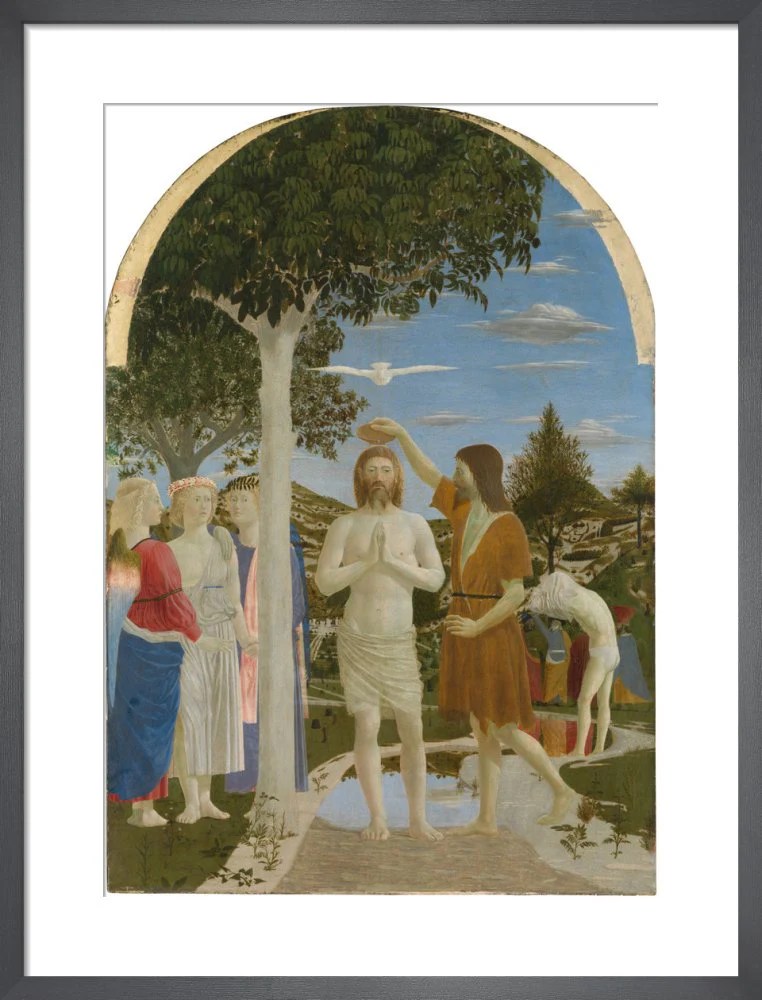
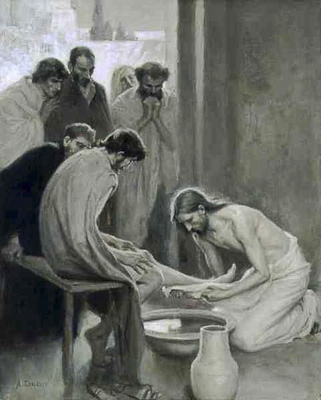
Jesus Washing the Feet of his Disciples, by Albert Gustaf Aristides Edelfelt, (1854-1905)
This week, I thought I’d share with you my retelling of the reading many churches will be following this Sunday, in the spirit of Sunday Retold.
It explores themes of power, and so follows on from last week’s poem, Stones. This week’s reading is that electrifying encounter between Jesus and Pontius Pilate – a trial of sorts. For the flow of the storytelling, I’ve taken a longer sweep than the set reading.
At the same time, as dawn was breaking, the council gathered – elders, chief priests, teachers of the Law – and faced Jesus. “If you are the Christ, the promised one, then tell us!” one said, rolling the words around his mouth as if they were bitter to his taste. “If I told you, you would not believe me,” Jesus replied, holding him in his steady gaze. “Are you the Son of God?” they asked. “You are right to say so.” At this they rose to their feet with an angry roar, and carried Jesus off to the palace of Pilate, the Roman governor, who had power to sentence people to death. “This man is a threat to the peace – he claims to be Christ, a king, and opposes Roman taxes,” the accusers called out as Pilate circled around Jesus. “Are you the King of the Jews?” he asked. Jesus felt the cold edges of the mosaic under his bare feet. “Yes,” he replied. “But my kingdom is not like the kingdoms of this world.” “So, you are a king!” Pilate responded. “Yes! That is why I came, to speak the truth. Everyone who is on the side of truth will listen to me.” “But what is truth?” Pilate asked. Then he went out to see the leaders and the people together. “I see no reason to charge him,” Pilate said. “This man has done nothing to deserve death. I will set him free.” “No, set Barabbas free instead!” they cired. Now, Barabbas was a rebel who had killed a man. They shouted louder, drowning out Pilate’s words: “He’s done nothing wrong! I will release him!” But, with rising rage, the mob shouted, “Crucify crucify!” In the end, Pilate gave in: he set Barabbas free and handed Jesus over to the guards. The guards tormented Jesus, the one called king. They draped a fine, purple robe around him, and twisted him a crown of sharp thorns to wear. They called out, “Hail, King of the Jews!” and fell on their kneeds before him, laughing. They spat on him, and struck his head with a staff. They, they took back the robe, and led him out to be crucified in his own simple clothes
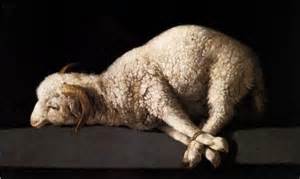
Francisco De Zurbaran
We see how those who held religious power allied themselves with the Imperial power of Rome. I expect they were sure they were being faithful, upholding the law and their traditions, defending their faith as they saw it. Being certain you are right can lead you very astray. And we see too how Pilate saw Jesus very differently, one who had done nothing wrong, and yet seemed to have little power in the face of an angry crowd.
The biggest difference of all, to my mind, is in the understanding of what power is, what a kingdom is, who a king is. Those who are embedded in the power structures of this world, and, to be honest, the rest of us too, find it hard to imagine a different kind of power. One that follows a path downwards, even to death. One that washes the feet of the followers, that does not insist on its own place, but instead works through love, in humility, in radical engagement with the world as it is. We will soon be in Advent, preparing for the coming of Jesus. At that time we think of his unity and solidarity with frail humanity, born in such a humble way, amongst the extraordinary, ordinary, beloved people of Bethlehem.
Lord Jesus, May our lives bear the mark of love. As we are kind, as we share, as we are gentle, may your love be seen in us. Help us, for this is hard for us.
Dear God, May I welcome you as my king: King of peace, King of love, King in death, King of life.
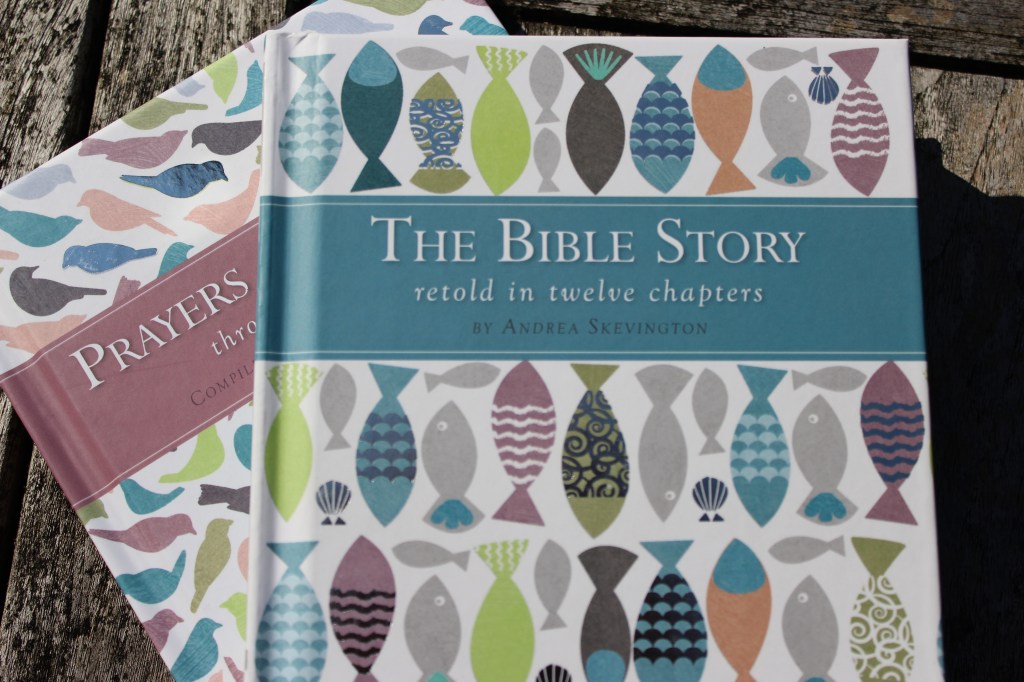
From my book of prayers to accompany The Bible Story Retold, Prayers and Verses
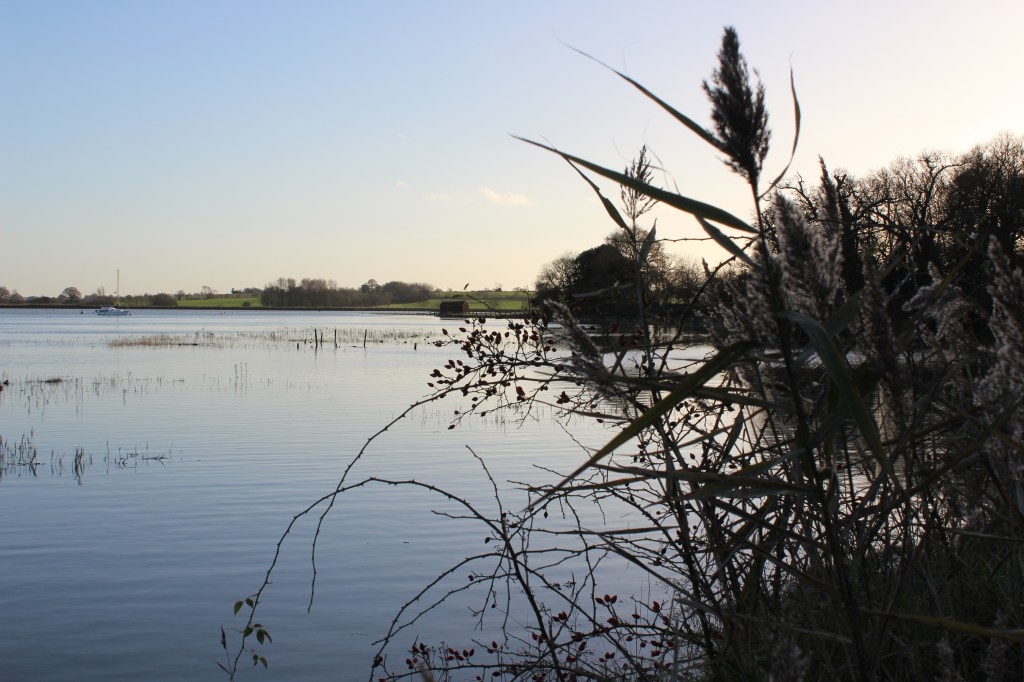
The open doorway of St Peter-on-the-Wall (founded about 660 AD). The wall in question is Roman. The chapel was built using some of the old stone from that wall. Bradwell, Essex.
I took a look at the set readings for this coming Sunday (17th November), and they are difficult and unsettling. Something about the Gospel reading caught my attention, and I thought I’d follow where that led.
Mark 13:1-8
And as he came out of the temple, one of his disciples said to him, “Look, Teacher, what wonderful stones and what wonderful buildings!” 2 And Jesus said to him, “Do you see these great buildings? There will not be left here one stone upon another that will not be thrown down.”
3 And as he sat on the Mount of Olives opposite the temple, Peter and James and John and Andrew asked him privately, 4 “Tell us, when will these things be, and what will be the sign when all these things are about to be accomplished?” 5 And Jesus began to say to them, “See that no one leads you astray. 6 Many will come in my name, saying, ‘I am he!’ and they will lead many astray. 7 And when you hear of wars and rumours of wars, do not be alarmed. This must take place, but the end is not yet. 8 For nation will rise against nation, and kingdom against kingdom. There will be earthquakes in various places; there will be famines. These are but the beginning of the birth pains.
Once again in our world, we see wars, we see power misused, we see the places where we might put our hope and trust are frail. Just this week, the Church of England has been forced to reckon with terrible abuse that has taken place, and the failure of those in authority to protect the young. And COP 29 has opened with the absence of many leaders, and the presence of corruption – although I have been encouraged to see Kier Starmer taking a lead. Much that has seemed firm has been crumbling, and at the same time, forces which seem to be serving themselves seem very powerful, immovable. It’s a hard place to be for many, and we may need to give time to our fear and grief. We may need to find others with whom to walk through these hard places.
And so, turning to this reading, I see we are invited into something like a practice of deep realism, and a long view. We remember that for Mark’s early readers and listeners, this passage would call to mind the terror and trauma of the destruction of the Temple in AD 70 after a relentless seige by the Romans. The Roman historian Josephus records that 1.1 million people died during that time. It’s hard to imagine the suffering and shock of such loss. It must indeed have felt the end of the world. It was the end of the world for many. Even in the midst of such terror and shock, these words may have offered something to hold on to. Maybe there is some wisdom here about how to live through difficult times, when all seems destroyed, or we fear all may be destroyed. Such wisdom is arrived at through pain and loss, it is not intended as some kind of spiritual bypassing, that eveything is going to be fine. Everything is not fine. That much is clear.
So this poem, written in response to Jesus’ words, is an experiment in that long view. I hope that, if it lands with you at the right moment, it might resonate with you.
Stones
These beautiful stones This beautiful Temple all that wealth and power all Herod’s might and posturing
Always, always can and will be thrown down.
And always, always, it is not the end of all things although it is the end. For time still stretches out among ruins lost to twilight, and dust settles, or blows on the grey wind.
Strength seems invincible. Stones seem solid, immovable. The might and ritual of a temple have such sure foundations in the mind.
And yet time, wind, whispers, armies, the running of water, the roots of trees can and will undo them all.
So do not be cowed by these great walls, for they will fall, nor by their falling
For fall they must, and the world will turn and turn again, and what was an ending may come to seem the blowing of dry leaves in autumn, an absence – it may even, dare we hope, begin to be birth-pangs, after all.
Gaia at Ely Cathedral. You can find more about that – including a poem – here.
You might enjoy this gentle conversation(Nomad Podcast) with the the musician Jon Bilbrough, known as Wilderthorn. Towards the end is some music recorded in the chapel pictured at the head of this post, St Peter-on-the-wall.
I’m turning back to that chapel in my mind – imagining how the stones from the old Roman wall, probably a fort, were reused in the building of this – itself ancient – place of peace and prayer.
New things can and do emerge, in time. That is something we can gather around, and work for.
From Prayers and Verses These are prayers in response to the stories of Exile we find in the Hebrew Scriptures, and I know that experience will resonate with many today. I hope this helps.
This poem has arrived on the blog a little late. It became marooned in my notebook for a while, until I flicked through the pages and found it again. And although crowds of bees are no longer buzzing among the ivy, there are still a few, here and there.
I hope, though, that although this poem arose out of a particular time, it has something to say in other times, too. About stillness. About the restorative power of simply being, and paying attention. About finding our breath again. We all need that. We all need to feel that connection to the rest of the natural world (oh, how I wish we had better language for these things – bear with, it will emerge) which grounds us, and from which we can rise. For those reading this blog who need a little peace right now, I hope it helps. I’m thinking particularly of dear readers in America, where the election atmosphere seems turbulent. I wish you well over the next days and weeks.
The old hedgeline in front of our house has, in places, been overcome by ivy, which has formed its own structures and patterns of flowering and fruiting. Cutting some of it back to make space for other plants to grow, I was careful to leave the ivy flowers for the bees – which will become fruit for the birds in time. Accidentally, I created a little bower, where I put a chair and sat for a while. As I sat I gradually heard the road less and less, as my attention was taken up with the many bees who were enjoying the feast. And so, this poem emerged.
thebiologist.rsb.org
September. Bees. Ivy.
It is taking a while, this sitting in a carved out cave in the ivy. Just sitting, stilling, breathing. A bower of green leaves above, and above that blue sky, white clouds.
In time, the hum of bees, and their intricate woven patterns of flight, come to replace thoughts, become another form of thought. So too the birds – that wren shaking the leaves, and the pipping robin.
And this grey and green lacework of wild is all that separates me from the roar of the road – those black lines we make, always going somewhere….
And yet, here is a marvel. More bees than I have seen all year. A hum that soothes the soul. The darkness of butterflies.
These strands of green woven through the world – not enough, by no means enough –
But they shelter the bees, and me. A space for the soft and alive, breathing, green in spirit. We can be here, the bees and me. We can be, in this hollowed out hedge, in a cloud of lightfilled wings.
After some cold damp days, and flooding in some parts of the country, it’s warm and mild – about 6oC above recent average for this time of year. I find myself to be both delighted and unsettled by this lovely soft warmth. I’ve been able to get on with a bit of clearing and composting in patches, it feels like time this year, and making space to ensure the ivy doesn’t take over completely.
I’ve been able to sit in the sun and watch the rising and falling of insects. After the desolate summer of so little life on the wing, this has been such a joy. It is also an encouragement to keep a wild diversity of flowers in the garden, native and from further south, as the insects appear unexpectedly, at strange times. This autumn it feels time, having left it for a few years, to introduce some disturbance and give a chance for a variety of plants to grow. But apart from enjoying the welcome rays, I have also been aware of the wind and rains this extra warmth carries in its wake. So this poem is an exploration of this turbulence of feeling.
Mid October heat
The sun shines long and low, as warm as sudden laugher, a broadening smile blown in from the south and damp with oceans, I can almost smell the tropics on its strange soft breath.
What do you do with so much disquieting beauty – with a day like this, shining, wild and hot, damp with fever?
The low sun holds too much warmth. The green around me hums and sings with growth, rejoicing, even as the leaves of the trees fade a little, and tumble across the grass on this wild hot wind.
I am afraid. I look up at the strange flows of air and water above me, shifting and changing, heavy and thick, as the dragonflies rise still, hunting among gnats, and the bees hum in this late flowering – at last, the bees, and here a hummingbird moth, and red admirals, all drunk with sweetness in these late days. These late days.
Hello. This week I’ve been taking a look at the readings many churches follow on Sunday, and found something coming up this week that has sparked my interest, and led to some contemplation. A poem has emerged, as they sometimes do. I’m not sure I can say it’s finished, but it is settled for now, and I’d like to share it with you. Those who have been looking at this blog for a while – thank you – may remember that I’ve a thread running through it called Sunday Retold, which includes extracts from my book, The Bible Story Retold in Twelve Chapters.
This beautiful illustration by Sophy Williams is from another edition of the same text, published as The Lion Classic Bible
Here’s my retelling of Jacob’s dream:
Jacob went alone, travelling until it was dark. Shivering in the chill of the desert night, he took a stone for a pillow, and lay down to sleep. As Jacob slept, a dream came to him. He saw a ladder, with its feet on the ground, stretching up and up to heaven. In his dream, he watched as God’s bright angels travelled up and down in between heaven and earth. And in his dream, God himself was there……
Jacob woke with a jolt and looked around. He was alone. “God was here and I didn’t know it! This place is the gate of heaven!” he said Then he took the stone he had slept upon and set it up as an altar to God. He poured oil on it as an offering, and worshipped there. Starting out once more, he left his homeland far behind.
You can read the original here, Genesis 28: 10-17, it’s the set reading for this week. It’s a story which has spoken to many over the centuries, revealing depths of meaning. For me, this time, I was struck by the way comfort came to one who was a fugitive, who had lost all that was precious to him. It also speaks to me of how our perception can shift, and we can be illuminated with a new understanding, how we can find the simplest things holy.
Jacob’s dream and awakening
Night can fall suddenly on the road, when alone. Darkness sweeps in like a flood, and one who lived with others, a dweller among tents, is out in open country now.
Alone, he chooses a stone and rests on cold rock
And finds that to the fugitive, the lonely, the guilty one, dreams may come. And company, too, of sorts – strange, perhaps luminous – angels ascending and descending
And a presence, such a presence, that is here, and now. One who is above the angels, and right beside him, and speaks with that deep resonance that comes through dreams.
Perhaps those away from the knottiness and rush of their own mind can know that this stone, and so every stone, is the gate of heaven, shining with oil. That this place, and so every place, is where God is
That this dream-night can change the day-heart of one who walks away. For even the stones have a sheen of brightness now, wherever they are.
If you’d like to use any of my material, please feel free to do so, acknowledging this blog as the source. It’s always a great encouragement when people let me know where my writing has been read.
Firstly, an apology if you don’t like wasps. I promise this is the only photo you’ll see here. If you can bear to persevere and read the poem, you’ll see how I’ve shiften a little in my view of them, and I hope that might help.
Picture – Gedling conservation trust – Common wasp
Thank you for bearing with me as I took a bit of a break from writing here over the summer. I do hope to share more with you as the days shorten and outside is a little less enticing.
There are notes in my notebook, ready for some further sharpening of my pencil. One of the things that’s really struck me this year has been the absence of insects here in the UK. Wet and cold earlier in the year, while not newsworthy compared to other weather events, seems to have stricken many of our insects and affected those birds and bats who feed off them. I am pleased to see the garden lighting up with wings, late as it is, and that has lifted my spirits. It’s been a strange, unsettling time, though, looking at the flowers that normally draw bees and butterflies, and finding them empty. I’ve wondered when to cut the meadows down, and left it late, so the last flowers might provide something for these missing friends.
Earlier in the year. A feast spread, but where are the guests?
The Butterfly Conservation trust have just published the results of their Citizen Science Survey, and found that the numbers are very low this year. You can read more about that here.
It’s also been strange to enjoy picnics without being troubled by wasps. I have been suprised to find I miss them, and worry about how they’re doing.
And so this morning, I saw a wasp. One of so few this year. And I wrote this.
Wasp
This morning, eating breakfast, slow, I heard a buzz and a tap against the light-streaming windows.
Buzz and tap, buzz and tap. I turned, saw a wasp on the window, and felt joy rising, and knew how strange it was to feel that joy at the sight of her – joy, and compassion, too, as she bumped and bumped against our shining window.
Oh, hello, I whispered, Don’t be afraid, you’ll be out in no time!
And, glass and paper in hand, I released her. She lingered a moment on the rim, gently waving her stinger up and down, then spread wings, flew into the clear September light, bright with late flowers.
And I laughed. Years ago, I would have flapped her away, swatted her even, afraid. And here I was, whispering to a wasp. Years ago, there would have been hundreds.
Not this one solitary marvel, striped, miniature perfection, buzzing and beautiful, in search now of the sweetness of a fallen apple, the ivy thick with bees.
Precious, so precious. Late as it is, I am learning how precious life is.
Edit: 11th November 2025
I was sent this film of the poem by Joseph Davidson. Do watch it, it’s very good.
Monday is Earth Day, when many of us especially remember the gifts of the Earth, its fragility, and our responsibilities towards it. Today (Saturday) in my town we’re having a bit of a celebration down by our river, focusing on good local food and organisations which are seeking to care for our patch of Earth. There’s music and friendship and crafts and storytelling, and local businesses who are doing things differently – beautiful local bread and saffron and wild venison and plants and flour ground by our tide-mill among other things. It’s a good way to mark the occasion.
This spring, I’ve been enjoying Simon Armitage’s beautifully illustrated new collection, Blossomise, in collaboration with the National Trust. I highly recommend it. It’s a celebration of the blossom season, transient and determined, which for us starts in February with this lovely cherry plum, or mirabelle, and is carrying on from one tree to another in our growing collection of fruit trees. We have one apple who is always alarmingly late, but the buds are beginning to swell. Maybe by mid May, if its mild, it may offer the season’s swansong. I also highly recommend the beautiful Orchard by Benedict McDonald and Nicolas Gates – I sent a copy to my MP as a gift when she was Secretary of State for the Environment.
I have been thinking of the Japanese love of blossom, and how it’s fleeting ephemeral nature makes it so precious to them, and to the rest of us. In some ways, it’s a modest theme for such an expansive day – when we consider the whole of this green Earth, but I kept being drawn back to it, so here we go. I think what draws me to it is twofold: there’s something about the dazzling beauty of blossom which is so transient, so easily lost which reminds me of the beauty of all the trees, and oceans, and rivers, the great all of the good Earth which we love and are harming and are called to tend and care for. And secondly, there is the draw of the particular. When I look at the big picture, I am often overwhelmed and frequently despairing, and so I choose to focus on the small, the local, the actions I can take for the trees in my area, the bats who will soon be flying over my garden, the sorry state of my – of our – local river. So this poem I’m sharing with you for this day is, like blossom, small and light.
The most beautiful thing
Outside, the blossom is in full glory now, white star-flowers, delicate as tissue, on black, angled branches – like a print by Hiroshige.
I gathered a blown branch from the ground, and brought it in to shimmer on my mantelpiece in a tall green bottle. It is the loveliest thing in the room, the loveliest thing I might call mine – mine, perhaps, not as possession, but in relation – as in sister of mine, the dancing blossom tree.
For dance she does as the cold wind blows, gusting and wild, in a snowstorm of petals that dress the air about her.
And sister she is too, although the resemblance is slight. We share kinship in chilly breezes and soft rain, nourished alike by this deep dark soil, and made of it, depending on the same gifts of Earth for our brief time of flourishing. This felt kinship, truly the most beautiful thing,
As like her, I dance in the gusting wind, and like her, I look for tomorrow and the promise of sun, and birdsong, and I too hope for the gentle buzz of bees and the fruit that is to come.
Hiroshige blossom
If you are looking for readings for Earth Day, you might find something on this blog to suit. Please feel free to use my work, saying where you found it.
Here are a few suggestions, but if you search by Nature, Creation, Green, there will be many others
I thought I might mention here a few podcasts I like to listen to – I’ll just name them as there are so many different podcast providers. A thing I am noticing amongst those who are working with the land and especially the rewilders is the most deep sense of joy, purpose and accomplishment. There is a rising change in our relation to the rest of the natural world, and perhaps a thing we can all do is cultivate a love and practical care of our place, and find others to work with. So, here are some listening suggestions….
The Jane Goodall Hopecast The Knepp Wildlands Podcast Rewilding the World with Ben Goldsmith The Rewild Podcast with James Shooter Learning How to See with Brian McLaren – latest season is Seeing Nature Wild Podcast by Grange Project How to Save a Planet (for a more North American emphasis)
A little tree rehoming scheme……Some of the saplings dug up from my garden and very kindly donated by others. I’ve passed on about 270 now to local people who are planting woods, orchards and hedgerows. Strangely, it seems to be a notion that has found its moment!
Happy Earth Day. May the place where you live flourish. May the places your food grows be bountiful. May your air and water be clean and life-giving.
Christ chasing the money changers from the temple Raymond Balze
Hello again. Here’s another post combining a look at the reading many churches will be following on Sunday, and a poem which emerged as I read it and read it again. So it draws on my occasional series Sunday Retold, and my practice of dwelling imaginatively with the story, meditating on it, and seeing what arises.
Jesus went into the Temple courts, and found them choked up with stalls and salesmen, ringing with the shouts of hawkers and hagglers. People were not gathering for worship: they were changing their money into special Temple coins, and buying birds for Temple offerings. Jesus grabbed the traders’ tables and threw them over. The money changers and the dove sellers shouted angrily while the coins clattered and rolled across the stone floor. “You’ve taken ‘the house of prayer’ and turnind it into a ‘den of thieves’!” Jesus said, and all fell silent at his words. Then, the blind and the lame came to him and were healed. And children came, too, running and shounting, “Hosanna to the Son of David!” The Temple was filled with joy, and the priests and teachers of the Law drew back, muttering angrily.
From The Bible Story Retold, based on Matthew 21
One of the things I found while working on this retelling was that there was always so much more I wanted to explore – so much depth and meaning hinted at, or concealed by years and culture and translations. My practice in writing the book was to read widely, and then to meditate on the passages in the style of Lectio Divina – imagine myself into the story, and allow it to unfurl in my mind – a mind with questions, open to prompting I hope. So with this one, there was so much here about Jesus’ rage at the commodification of the things of God, making what was freely given into a commercial venture. We are so used to everything falling into the realm of money it can be hard to imagine how things could be any different, or how the realm of God might offer a radically different Way. Jesus spoke more about money than about prayer, and yet it’s a difficult subject to explore for us. So many of the ills and injustices and exploitation of the natural world we are currently experiencing suggest to me that something has gone wrong with the way we view and use money. Can we begin to dip into the realm of gift, generosity, and finding ways to do what is necessary and right? I hope so.
The Little Free Pantry at St Andrew’s Church, Melton. An example of gift, of sharing. Apologies for the soft focus!
And so, to the poem which came out of my reflections. The meaning of gift and the exchange that arose in my imagination on reading the passage was many layered, and I hope the poem can be read a number of ways depending on what chimes with you the reader. It draws from the Mattew 21 passage, as above, but also the passage early in John’s gospel (John 2).
Poured out and Overturned
Some things cannot be bought and yet, they are. See those neat piles of coins, counted carefully, those inkmarks methodically made, those animals sold for sacrifice, coins given for prayers, for favour, for the words and work of God.
His carpenter’s hands gripped the smooth grained tables and upended them. Poured out the shimmering piles of coins rolling and chiming over the stone floor.
Some things, perhaps, once, all are freely given – life, air, water, growing things for food, breath, beauty, favour, love. So many things we lay out in rows, so many tables, so many neat marks of ink or light.
Bound, we see no alternative, cannot imagine another way, and yet, here is a man throwing coins to the floor, with a whip to drive out money changers while wooden tables lie groaning on their sides.
Set free, then, what happens in this space, this chaos, with all our reckoning upended? The blind and the lame come, and are healed. And the children run and shout Hosanna. And what is, and what will be is all gift. So it is, and may it be so.
John 2:13-22, Matthew 21:12-17
Elisabeth Frink, Chapel of the Transfiguration, St Edmundsbury Cathedral.
I notice that some of you good people are looking up resources for Easter on this blog. Thank you for considering my work. If it helps, here’s a link to a summary…… Please feel free to use my writing in any way that helps, mentioning my name and this blog. And do feel free to let me know, I do love to hear where it gets to!
Edit: Sunday 3rd March.
I’m absolutely delighted to find my poem below at Diana Butler Bass’ The Cottage. She shares an informative piece on this passage which I’ve found has helped me understand what can be a puzzling story. Do read it if you haven’t already. I hope this link will take you there…..
Further edit… I seem to be having difficulty clicking through on this link. She has included one of my Mary of Bethany poems in another recent post if I’ve whetted your appetite and you can’t find Overturned…. try this.
If you search for her name on this blog, you will find other poems and other links.
Hello, welcome back. This week, I am combining two things I sometimes do: Sunday Retold, and a poem drawn from the reading. For those who follow set Bible readings through the weeks, we’re still in the season of Epiphany, when we look at moments of understanding and revelation. And this Sunday, we’re meditating on the first sign recorded in John’s gospel, which took place at a wedding. As I was reading it, the image of those stone water jars filled my mind, and I’ve attempted to turn my meditation into a poem, below. I thought I would share it with you even though it’s so new, in case it helps you or prompts you in your own reflection.
On the third day after Jesus called his disciples, Jesus went with them to a wedding in Cana, near Lake Galilee. The whole community was there, eating and drinking, dancing and laughing, blessing the young man and woman who were starting their life together. But Jesus’ mother, Mary, noticed that the wine had run out and said to her son, “They have no more wine!” “Dear mother, why are you telling me this? Now is not my time.” But later, Jesus spoke to the servants. “Fill those jars with water!” he said. For there were six large stone water jars nearby – the sort that were used to store the pure, fresh water the Jewish people used to cleanse and purify themselves before worship. The servants filled the jars with water and, puzzled, dipped their serving jugs into the newly filled jars. They poured some out for the host, as Jesus had told them. Then the host called the bridegroom over, a broad smile on his face. “By now people are usually serving the rough wine – but this wine is really good – wonderful! You’ve kept the best till last.” He gulped another warm mouthful of the wine that had been water as the servants served the wedding guests. Jesus had taken the water from the stone jars and turned it into fine wine. When his disciples saw what had happened, and saw the servants pouring out new wine for all the guests at the wedding, they gasped in wonder. They had caught a glimpse of Jesus’ glory, and the glory of God’s kingdom. The disciples put their faith in the one who turned water into wine.
It’s a beloved story, often shared at weddings, its many layers rich with meaning. I tend to find that something strikes me in particular, draws me in, and this time it was those empty stone jars. So, here is a poem that grew out of turning the image of those empy jars over in my mind. There is much else that could be said, but today, it’s simply this…..
Empty/Water into Wine
Those empty stone jars, I see them – pale grey, with a film of dust, leaning against the wall, overlooked, unregarded as the wedding rolls on, music and dancing and laughter sending tiny tremors through their hollowness.
Six of them, as empty as days can be, an emptiness we know by taste, our dry mouths rimed with fine powdered stone.
And this is where you began your work, with these empty jars. Had them filled with cool water – so far, so expected. For purification, cleansing, the couple’s, the town’s, love and life, as the wise look on, nodding, sure that they have your meaning.
Oh, how you delight in upending expectations, traditions. What was drawn from these jars was not water for making pure, but the red bubbling joy of good wine, poured and shared, for the delight of all gathered, for the blessing of love, and union, uproariously, and without fanfare.
After three days, this is the glory revealed, this is what it means to be full of grace and truth,
To have our days, our beings, filled with water, only for it to poured out as fine vintage, only for it to be transfigured, transformed, as wondrous as the grapes on the vine, as wondrous as a day, a life, so open to joy.
If you would like to use the poem or reading, please feel free to do so. I’d appreciate it if you mention this blog and my name is doing so.
This New Year, I’m picking up the occasional series, Sunday Retold. Many churches follow a set pattern of readings, so communities up and down the country are gathering around the same stories, the same prayers, and meditating on them together. Often, at least one of the passages appears in my retelling of the Bible, The Bible Story Retold, and so it seems a good idea to share that with you. If you’d like to use any of the material on this blog please do, and please say where you got it from. My books should be available to order at all the usual real life and online places.
Samuel Dedicated by Hannah at the Temple by Frank W.W. Topham
Anyway, this week is a story often shared with children – at least in part. The central character is the boy Samuel, son of Hannah. He was a much longed for child, who was given to the service of God in the temple at a very young age. Eli, the priest, was given charge of him.
The set reading is 1 Samuel 3:1-10, and here is my retelling:
The boy Samuel learned how to serve God in the shrine. And he slept by the lamp of God’s presence, close to the holy ark of the covenant. One night, in the darkness before dawn a voice called out, “Samuel, Samuel!” So Samuel got up and went to Eli, who was ond, with failing eyes. “Here I am! You called me!” Samuel said. Eli stirred. “I didn’t call you! Go back to sleep!” So he did. But there was the voice again. “Samuel, Samuel!” The boy got up again and went to Eli. “You called, and I came!” “No I didn’t call you. Go back to sleep.” But, when Samuel woke Eli a third time, he wondered what this voice could mean. Perhaps God was speaking. “Go back and lie down. If you are called again, say, ‘Speak, Lord, your servant is listening.'” So Samuel went back to bed and lay there, waiting, hardly daring to breathe. “Samuel, Samuel!” came the voice. Samuel remembered Eli’s words. “Speak, Lord, your servant is listening!” And so God spoke to Samuel. God said that the right to be priests would be taken away from Eli’s family, because his sons had donw wrong, and Eli had not stopped them. They would be punished. In the morning, Samuel had to tell his tacher what God had said. ”God is God, and will do what is best!” Eli sighed.
From The Bible Story Retold in Twelve Chapters
Often, when this passage is shared, the empasis falls on listening to God’s voice, and being ready to respond. We’ll get back to that in due course, but for now I’m following my immediate reaction to this passage today, and how it might help us navigate this difficult new season we’re in.
Samuel in the Temple by David Wilkie
What a message for a child to have to deliver to their high-status, powerful teacher – you and your line have fallen short of the standards expected of you, and your position will be taken away from you. It must have been terrifying for Samuel to have to speak up, even with Eli’s encouragement. I can imagine him shaking in his sandals. Although this story is often a Sunday School favourite, I don’t think many teachers and others in authority would be bold enough to encourage youngsters actively speaking up in condemnation of their elders. And yet, as so often, these stories show God’s leaning towards the powerless, the young, the outsider. So often, the perils of power, and the shortcomings of those who practice it, are central to this counter-cultural narrative. Indeed, as we follow on with Samuel’s story, of how the people of Israel ended up with a king, we see that pattern all the more strongly.
As a story of a child challenging conventional ideas of power, and who has it, the story of the boy Samuel sits well in the season. It’s one of the Epiphany stories in which the rich, the wise, the powerful humbly bow before a mother and child in a simple, working house. It also follows on well from Mary’s radical song in the early stages of her pregnancy, which in turn draws on the words of Hannah, Samuel’s mother, when she leaves her son in Eli’s care. I love the dense connections which imaginatively weave all this together, so rich patterns emerge from the threads. I love the way the lectionary puts things near each other, and then sees what connections and conversation arise like a good host.
And so, back to what struck me today on reading this passage – the wisdom of the child, the going astray of the elders and those in power. I thought of the prophesy “And a little child will lead them” (Isaiah 11.6), and how, today, the young who lives will stretch out far into this century are trying to shake us awake, to speak to us of those things which they care about and will affect their lives and the lives of their children. They see that the way we are living is doing harm, they see the injustice and the destruction more clearly than those of us who may have become immured to it. They see that the structures of power seem to protect the powerful and ride roughshod over those whom the scriptures speak highly of – the widow, the orphan, the outsider, the poor, the young, the old. We need those in power to be humble enough, like Eli, to hear their voices, and to act in their interests. Intergenerational justice is a concept that is coming alive now – especially in terms of debt, and the damage to the ecosystems on which we all depend. We need to pay attention to those who have no voice, and give due respect to the rest of the natural world, as well as to the young. Can we, at the beginning of this year, resolve to notice our natural bias towards the rich and powerful, and seek to listen to the young and the powerless? I think that would be good for us all.
Here in the UK, many have been moved, outraged, saddened and stirred to speak up by the ITV drama, Mr Bates vs The Post Office. It was a powerful drama, compassionately acted. I am always curious, though, about things which really catch the public mood – why this, why now? And I think part of it is the theme of people with power who feel immune and distant from the consequences of their actions, who listen to each other rather than to ordinary people – in this case their employees. I think there is a rising sense of injustice about how some are gathering so much to themselves, while others are stripped of what they have, and what they might come to have in the future too. And this injustice reminds me of the words of the prophets, including the child Samuel.
Of course, this passage carries many meanings, and this critique of power is one amongst many – but it is one that chimes with the biblical narrative as a whole. When we’re thinking of how we might live by it, another question naturally arises – how do we know, in a world of so many voices, which ones to heed? In this passage it is Eli who wonders whether the voice might be God. Yet history is littered with terrible tales of those who were convinced they were acting for God, or doing what was right, and going horribly wrong. Often the very worst things are done by those who claim good motives. And that should give us all pause. I touched on an exploration of this theme in my book, “Jesus said, I Am. Finding life in the everyday” in the chapter on Jesus, the good shepherd, when he talks about the flock knowing his voice.
Of course, knowing the voice, and distinguishing it from the voices of those who would lead us to harm, is no easy thing. I think it helps to come to a place where we don’t see the path ahead of us as a narrow tightrope – one false move and we are lost – but that we look for the relationship, and recognise the freedom to walk behind the shepherd, listening for the voice. ……. History is full of the mistakes people have made, thinking they are doing the right thing but going terribly wrong. I do not ee us going so wrong when we seek to follow the way of love, seeking to keep our eyes fixed on Jesus, and learning from him.
And so, noticing the topsy-turvy nature of the gospel, the way things are not what they seem, let’s be ready to listen, be ready to respond to those promptings and quiet voices which would guide us better than the pomp and power and authority which make so much noise and show.
Dear God, When we hear a mighty wind, strong enough to shatter roci, when the ground underneath us shakes like an earthquake, when fire comes from mountains, help us to know these sounds of power and anger are not your voice. Help us to listen in the silence for your whisper. Help us to wait for your whisper