Poem: The Wood – Lockdown poems 6

Welcome back to the garden for the next in this series of Lockdown Poems.  These strange lengthening days are bringing us new experiences – some are very unwelcome, but others have something to show us, something that might help us navigate our way to a better world after….
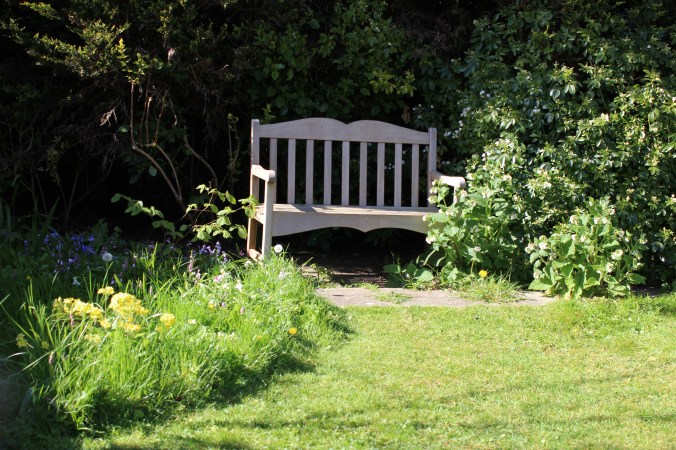
I hope you are finding moments of tranquility.  You are welcome to come and sit on this bench in your imagination, and hear the sounds of spring.

IMG_0982

What has struck me, like so many others, is the birdsong we can hear as our human hubub has quietened.  Although we live very near a small wood, I haven’t heard the birdsong from it before – not from the back of the garden, well past dawn.  Sometimes, in May, you can hear the dawn chorus before the traffic begins, but now there is very little traffic, and the wood’s loudness is astonishing.

IMG_0980


I hope you can hear birdsong where you are.  Here’s a link to a recording of the dawn chorus in the UK if you’d like to listen

So, here’s another poem which emerged from my practice of trying to deepen into contemplative prayer, but being open to the sounds of the natural world as they speak.

The wood – lockdown 6

This April morning,
not even particularly early,
I sat on this bench,
allowing my breath to deepen,
and settling into presence,
and into Presence,

I heard, for the first time,
the sound of the wood –
not too far away,
across the grey snake
of the road.

I heard it like a distant choir,
together and rejoicing,
or an orchestra playing jazz –
wild, improvised,
I heard it as the sound of life,
reaching me even here,
across the silent road,
unquenchable,
green through the blue air,
calling the trees awake,
calling the bluebells – up, up,
and flowing round
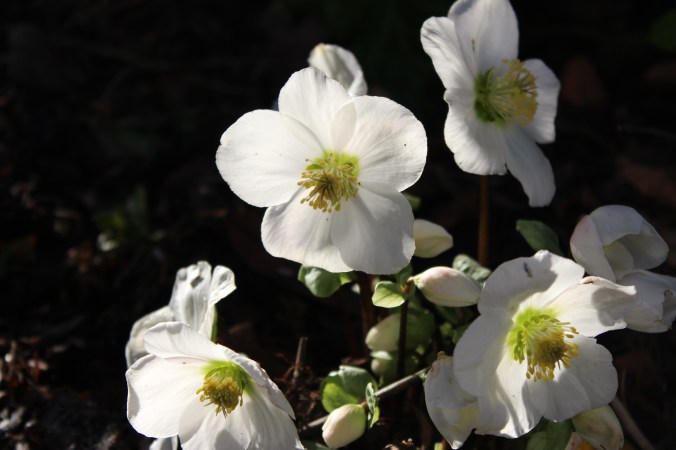
the fragile white anemones
as they bow their many heads.


Poem: Two Trees – Lockdown poems 5

IMG_0982

The next poem that came from this Lockdown is a little different from the others at first glance.  Once again, it was emerged on the page, and has had minimal tweeks.  I was intrigued to find it there.  Its subject is the trees in the Garden of Eden, and it asks tentative questions about human nature, and the human experience, which they raise for me.  I have wondered before why the fruit of the tree of knowledge of good and evil was prohibited, when so many religious systems seem very preoccupied with such knowlege.  I have wondered too how Jesus’ warnings against judging help us understand that, and balanced those warnings with the image of knowing a tree by its fruit, as he advises us to do.

I find it helps to allow the images – of trees, and fruit – to grow in our minds, and see what kind of shoots emerge. This is not a theological exploration, but a poetic instinct. Here,  I have been asking questions of myself, in a kind of uncertain echo of a chatechism, and allowed the questions to be there, partially or inadequately answered.  What if there is a choice, moment by moment – the fruit of the knowlege of good and evil, the fruit of life?  Might that have something to say to us as we seek to choose life, again and again?  Can we say yes to life, moment by moment, even in these moments?

IMG_0970

I don’t have two trees growing in the centre of my garden, but I do have this tree, whose early morning shadow delights me.  I hope you can make it out. The early light was tricky.  I thought I’d offer it to you to see if it might help give another image to add to the trees in this poem – a growing tree and its shadow.


Two trees – lockdown 5

Two trees grow in the midst of the garden; the tree of life and the tree of the knowledge of good and evil.   paraphrase from Genesis 2:9

What if we stand
in the middle of the garden,
choosing the wrong tree,
moment by moment,
again and again?
There they both grow –
tall, beautiful,
pleasing to the eye,
laden with fruit.

And we are drawn to one,
not the other, at least at first.
Wanting power to say things are
this, or that, the illusion of
control, wanting to judge,
wanting to be right.

Do we need to lay all that
hollow fruit aside in order
to eat from the tree of life?
I think so, yes,
Maybe empty-handed is better.

And what if we had made
a different choice
from the beginning?
Chosen that other tree,
unprohibited,
free.
What indeed!
And yet we did not,
and ever since, we have
hungered for its fruit.

And can we choose differently
now, each day, each moment?
I think so, yes, I think that we can
set down the fruit that
sours and spoils,
and choose life
again, and again,
and again.

Poem: Yes – Lockdown Poems 4. For Earth Day

This is the next lockdown poem to emerge – today, here, is clear blue, but we had some stunning clouds a few days ago, and it was good to take a few moments to watch them.

It’s Earth Day, when we look to our place as part of the wonderful whole that is our home, the Earth, and look also to our responsibility to tend it.  One of the things I am experiencing in this time at home is a greater sense of connection, of love, for all that makes up the place, the ground that I’m part of here. I feel this love and connection are deeply significant.  I wonder if they are the necessary roots of a better way of living, one that acknowledges our dependence on the living Earth, and works to heal our environmental crisis, the crisis the living Earth is facing, including us.  These deep connections, this gratitude and love are, I am coming to think, more important than we know. I touched on these themes in a talk I gave at Girton College Chapel, and if you’d like to, you can read more about that here.

I hope there are ways, however small, that you can find connection with the natural world where you are.  Whether you can or not, you are welcome to join me here in your imagination, and sit in the sun.

IMG_0982


Yes, thank you – lockdown 4

The white clouds are coming now,
sails spread, a fanciful armada
on a soft southerly wind.
My skin feels the heat of the sun,
surprising. And I say thank you, and yes
to the blue and white of the sky,
to these various dark bees
among the comfrey,
heads dusted with pollen –
yes, drink your fill,
yes, thank you

To the peacock butterflies waiting
open-winged on the grass,
until another flies by,
and they rise and dance
as perfect as silent larks.
yes, and thank you

To the bright leaved hazel,
to the dark flowered fritillary lilies,
the yellow dandelions and their
white butterflies,
All, yes, thank you.

Poem: Owls – Lockdown Poems 2

IMG_0982

Welcome back, thank you for joining me again.    I hope we can take a few minutes to rest here.

I’m sharing another of my lockdown poems – simple, largely as they appear from my pencil – in the hope you’ll find some companionship, something that helps.  This one begins not in the garden, with light and green, but in the middle of the night.

Waking at night, or disturbed by dreams, thoughts race away.  If I remember to catch myself, I try to pause, to breathe, to notice.  Sometimes, you’re lucky enough to hear something wonderful, which breaks through the patterns of thoughts.
It’s been owls for me, lately. The night has its consolations.


IMG_0983


Owls – lockdown poems 2

Three nights now,
I have heard a pair of owls
in the garden.

 
Startled awake, suddenly,
by a fragment of
remembered news,
of fear,
and then, suddenly,
there they are –
the owls, calling
to each other, and,
it seems, to me.

Now, morning, and I look
up at the solemn black windows
of the barn, great eyes,
one shiny with a film of sky,
one matt and sightless.
I am glad we did not fix that glass.

There is room for an owl’s drawn in wings,
room to fly into that attic darkness,
where the peacock butterflies blink
their wings awake after the winter,
room to fill that desolate space
with life. May it be so. May it be so.

Poem: Today, sound. Lockdown Poems1

IMG_0981

As I mentioned in yesterday’s post, I am writing during this lockdown – as a way of expressing something, as a way of grounding myself in the physical experience of where I am, of keeping some kind of a record of what this time feels like, which is very different from what watching the news feels like, at least for me.  What emerges from this practice is simple, free, unpolished.

My notebook comes with me into the garden, and so it’s to the garden that I invite you now, especially if you are in a place where you have no view of green growing things, and hear no birdsong. I am aware how fortunate I am to have such a place, and how much harder it is to navigate this time without sight of spring.  So I hope that, as I share these poems with you, you can come outside in your imagination, and sit on the bench, and rest awile in the sun.


IMG_0974

Today – sound.  
Lockdown poems 1

Today, it is quiet.
Cars, if they pass at all,
come one by one, strung out,
separate,
dark beads running along
a dark thread.
The old sound comes, and goes,
comes, and goes.

Here, today, in this green space,
we hear, instead, the buzz of
long-tongued bees, feasting
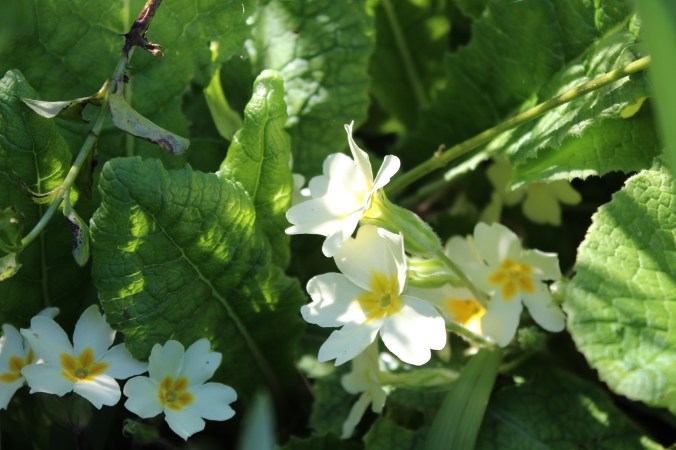
and drunk among the primroses.
Primroses, spilling yellow,
everywhere, in the lawn
on which a faint dark
line threads – the path
of a soft deer
who comes by night.
And above, now,
buzzards and hawks
have the high sky to themselves,
flying in their wide circles.

I hear now, as if for the first time,
full birdsong, triumphant, liberated.
Suddenly an audience has turned
from its spent tables
towards this wide green stage,
and listened, amazed,
as loud song rises louder,
louder, knowing it will be heard.


Poem: Easter 2020 Lockdown poems 9

I have been writing this lockdown, and am sharing this poem with you first, although it is not the first I have written.  I am sharing it while we are still in the season of Easter – a strange, isolated Easter it’s been.

I wonder, though, if it is more like the first Easter than our usual celebrations, in many ways.  I wonder how it will seem, when we look back at it.

seed


Easter 2020  Lockdown 9

It wasn’t loud, or triumphant,
that first Easter.
The worship places were not full
of people shouting, together,
Alleluia.

I wonder if it was,
strangely, more like this.
Strange.  Shut away
for fear, for love,
behind closed doors,

quiet, while the world
fell apart, while dreams
lay cast aside, a coat
for a long-gone season.

And you came like a gardener,
maybe smelling of soil, with
sap-stains on your un-white,
un-shining clothes.  You brought
earth and growth with you

to Mary, who could not touch you,
to others, behind those doors
closed against the world. You
met them in their shut away places.

Maybe you will meet us too,
in our scattered homes, afraid,
untouched,  and working in shops,
and bending in fields, that we may
all eat in this wilderness,

maybe exhausted by
the work of healing,
and still holding the hands of those
who are passing into the darkness
of the tomb,
speaking softly in their ear.
Maybe these are the places you
are to be found, this year,
every year.

Jesus said, I Am – For Lent. Chapter 7, Vine

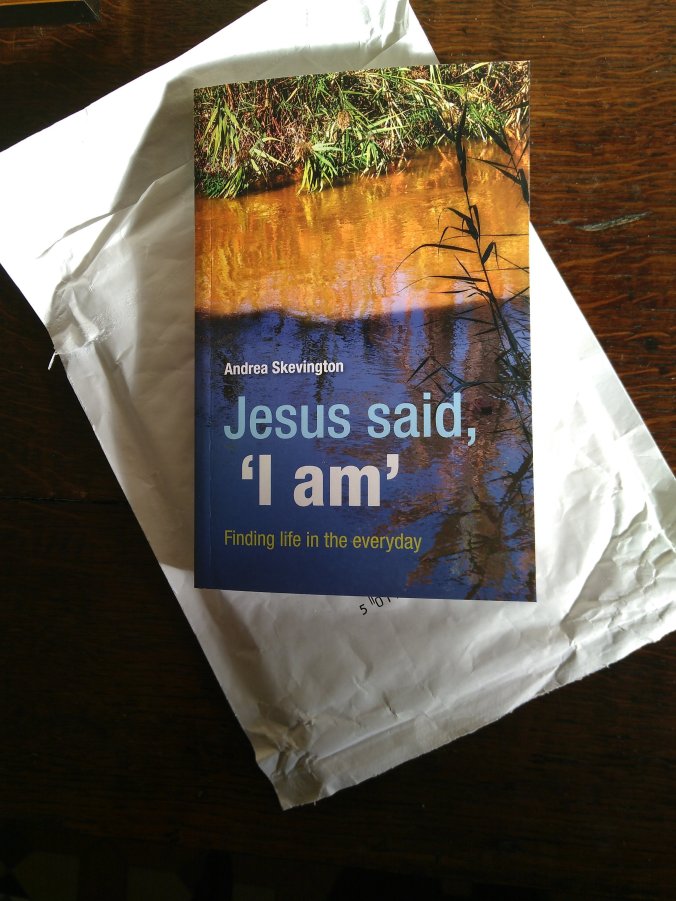
This post – for Holy Week – is the next in the series based on my book, Jesus said, I am – finding life in the everyday.

It’s also Palm Sunday, when we think of the crowds laying down palm leaves. This year, such crowds seem very far away from our experience, as we are isolating at home.  It’s a time when churches often fill with people, or process with branches.  This year, we can’t do that.  Instead, some are making palm crosses, or gathering greenery, to decorate their doors as a sign in participation in this time.  It’s part of how we are all adapting to our situation, and finding ways of connecting, and marking times corporately.  These things help.

IMG_0967

My Palm Sunday leaves.

IMG_0968


Back to another growing thing, to the Vine.

I do not have a vine in my garden, but I have so many other plants that are just opening up to new life.

I have been planting seeds.  My veggie beds, rebuilt a few years ago by my son and a friend, have not been productive in the past, but this year, there are signs of hope.  There are a few little shoots coming up, and raspberry canes beginning to grow.  I hope that we’ll have fresh salad leaves before too long.
IMG_0877.JPG

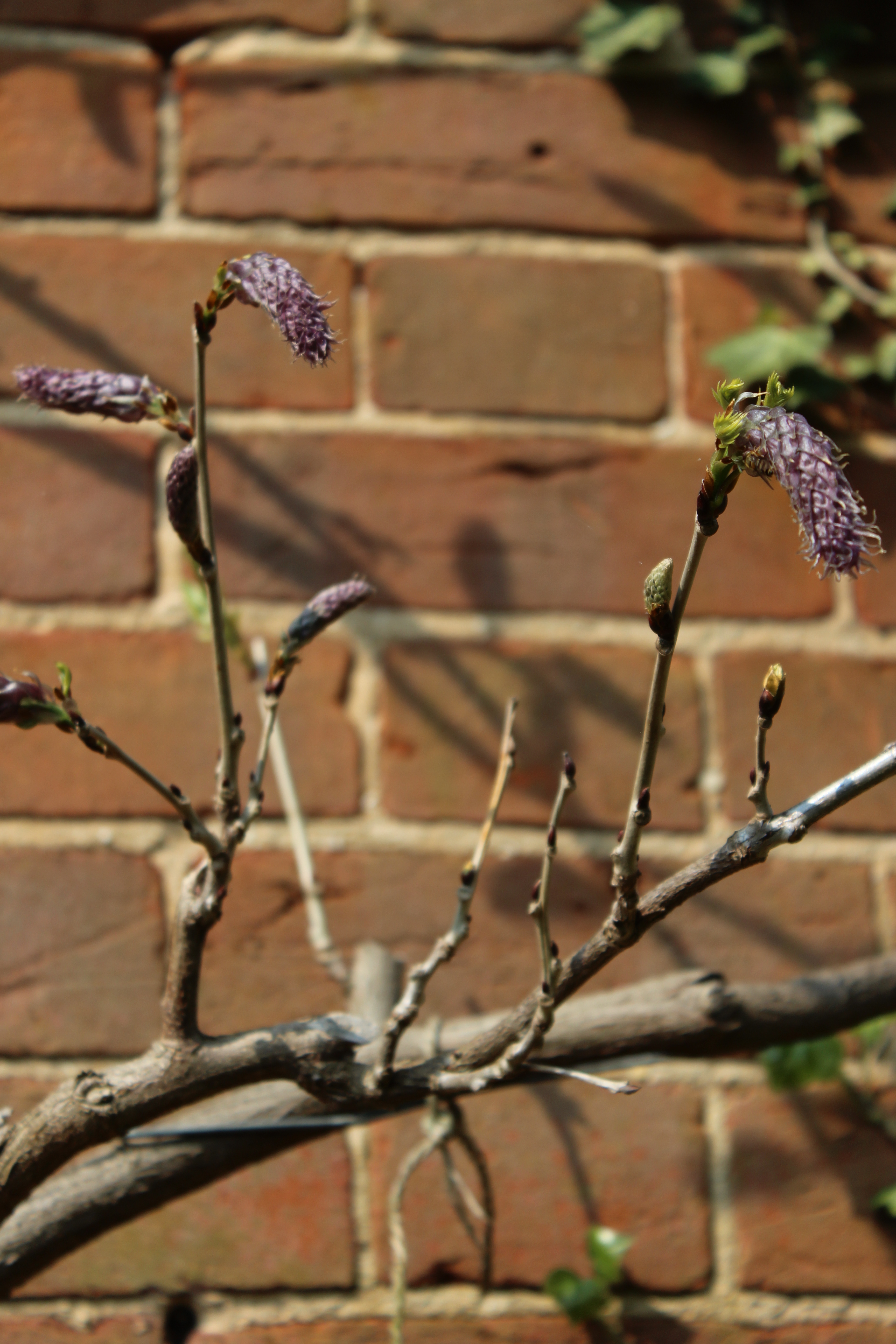
I’ve also been thinking of the wisteria, and the corkscrew hazel, in the light of this reading which tells of vines and gardeners.

This year, the wisteria is covered in long purple buds, and will soon be heady with scented flowers.  Last year, my gardener worked hard to cut back the unproductive growth, to focus the plant’s attention on the buds of  this year’s flowering.

IMG_0885.JPG

The corkscrew hazel requires less skilled intervention – I can manage to tell which stems are coming up straight, and need removing so the wild disarray of the corkscrew can grow freely.

These moments of intervention  are part of what happens here – I also love the wild flowers – or weeds, I love to watch what happens, what grows of its own accord. It is a hospitable place.  I love the rhythm of managed and wild.  I love the crowds of birds, the insects, the butterflies and bees that seem to thrive here.

This year, many are noticing and valuing the gradual creep of spring, the morning birdsong, the clearing skies, in a way they haven’t before.  These small joys are opening up to us, and we find they are deeply satisfying.  If we have a windowbox, or a garden, or a view, the subtle changes we see bring us joy.

Our Father is a gardener, we read.

John 15:1-17

Once again, we will just touch on some of the themes this image opens up for us.  There is always more.  Here are a few things, offered for your reflection – and some suggestions of how we might live inside this  song of the vineyard.

There is a way of seeing the overarching narrative of the Bible that looks like this: three gardens – the garden of Eden in Genesis, the garden tomb of the resurrection and the garden city of Revelation.  If we hold this narrative in our minds, we see a story of flourishing, of hope, of new growth despite the winters we encounter.  Gardens and their gardeners are a theme that runs through the whole Bible text.  Gardens are both beautiful and necessary, a sign of a settled life, a sign of peace and security, a promise of plenty.  And within the garden, the vine winds and trails its way through scripture, a sign of the people of God in both testaments, their frailty and fruitfulness, their need of a gardener to bring out their best flourishing, their provision of fruit and, more especially, wine to gladden the heart, wine soon to be poured out.

We are invited to be part of this fruitfulness and flourishing.  We are invited to be part of something bigger than ourselves, joined to others as well as to Jesus. We are invited to participate, and to contribute, to give and to receive.

As Jesus and his friend walked in the dark past vineyards, the image of the vine was real, fragrant, touchable.  This song was no distant allegory.  It was before them.  What would they have glimpsed, in the thin light?

A winter vineyard looks as dead as dead can be.  The bark flakes and pulls away.  But, here, in the spring, buds would have been bursting out.  What appeared dead was returning to life, throwing out tendrils, leaves, maybe blossoms.  They knew the importance of the vine, and the care and wisdom needed to tend it and make it fruitful. Passover required the drinking of four cups of wine…. Their blood was warmed with wine as they walked through the chill of night.

…..

And in the spring, sap runs through its veins like blood – it pours through, swelling the hidden buds.  This is a kingdom vine.  The way life flows through it is like the way the Spirit will sustain Jesus’ followers after he has gone.  The vine is loved and cared for by the Father.  God alone is the gardener of this vine.


Remain

To a group of people who will soon be scattered in the darkness, who will abandon him, Jesus talks of remaining, abiding.  He talks to them, assuring them they are already connected to the vine, already clean.  What will happen does not change that for them  He says this first, at the beginning of the song.  All else that follows is held within the certainty that they are part of the vine.

Here is the melody of the song, and this is what we need to treasure – that we are also part of this vine, the sap flows through us.

The heart of it all is remaining in Jesus, as Jesus remains in the Father; remaining because of love, so that joy may be complete.  We may not understand, but we an hold open the possibility of this love and grace and belonging.

IMG_0607


Fruit

We have talked about abiding, remaining, but the purpose of the vine is the fruit and the purpose of the pruning is to increase the vine’s capacity to bear fruit.  As Jesus continues his song of the vineyard, we see this fruit linked to a circular pattern of love – it begins with the Father for the Son, flows from the Son to humanity, who are then, for the second time, commanded to love in their (our) turn. The outcome of all this is joy – Jesus’ joy will be in us and our joy will be complete.

Love, joy… from there, we are naturally drawn to another mention of fruit in the New Testament – the fruit of the Spirit.

By contrast, the fruit of the Spirit is love, joy, peace, patience, kindness, generosity, faithfulness, gentleness and self-control.  There is no law against such things.
Galatians 5:22-23

The branches attached to the vine have the life of the Spirit flowing through them.  There is beauty in a fruitful vine, with its leaves, blossom and, in time, the ripening fruit.  Our lives, filled ith the flow of the Spirit, can have such beauty.  The life of Jesus, flowing through us, is transformative.  Maybe Jesus is telling us here how the Spirit works, how our lives can be part of something greater.  Connection to the soure of all life and love leads to flourishing.  We are not isolated, purposeless, lonely individuals.  We are part of the something greater, and we can live out our lives fruitfully.

Reflection and Response

Further Study

Read the account of the wedding at Cana (John 2:1-12). Reflect on the symbolic meaning of the empty jars used for religious cleansing, here filled with fine wine at a wedding.
……

Colossians 1:15-20.  How does this image of Christ connect with your thoughts on the vine? How do all things hold together in Christ?

Prayer and Meditation
Lectio divina
meditation – rooted and grounded in love
Read Ephesians 3:14-16, asking God to speak to you by drawing your attention to a word or phrase.  Read the passage out loud, slowly, twice, leaving silence between and around the readings.  See where your attention snags, what strikes you, and ponder that.  If you are with others, hold a time of silence, then share your words or phrases.

Read again.  On the last reading, be alert to anything that applies to you or your situation directly, any place where the Holy Spirit may be moving or guiding you.  Thank God for what you have learned.

As the Father has loved me, so have I loved you.  Now remain in my love.  John 15:9


When you dwell on the idea of all being connected, and held together in Christ, does that help as you navigate this world in which we are more physically separate than we would wish?

Have you ever experienced anything that felt like pruning?  What happened? What was that like?  Offer any loss, any gain, through that process to God in prayer.  Be alert to signs of new life that may emerge.
Our lives are seriously curtailed at present.  Might there be, even in this real difficulty, some space where something new and better might emerge?


How can we connect in a time of disconnection? How can we show solidarity, and offer help, when the normal means of being together are not available for us?

Life and service

Connection and community
Take some time to connect with people in your community.  Be on the lookout today, this week, for ways you can build connection with those around you.  It can be as simple as taking a few minutes to speak to a neighbour, smiling at a passer by or something more.

ways you might be part of making a stronger community.  Ideas could include:

  • using local shops
  • walking or cycling where you can.
  • with others, notice the needs in your community, and finding ways to bless and reach out – the elderly or housebound may require help, or young families, etc.
  • litter picking the streets around you, or clearing snow or leaves as appropriate

……..

Care for a garden, or a piece of land near where you are.  Collaborate with others to enrich and bless growing and living things nearby.

Further reading – I recommend Richard Rohr’s book, The Divine Dance – the Trinity and your Transformation

rublevtrinityicon.jpg

The Rublev icon


img_20181130_114736372319885.jpg

Jesus said, I Am – for Lent. Chapter 5, the Resurrection and the Life

Welcome back to this Lent series, based on my book Jesus said, I Am – finding life in the everyday.

We come to this chapter at an extraordinary time, the time of coronavirus, when so many are praying anxiously, concerned for their loved ones, maybe separated from their loved ones. This chapter, dealing with the death and rising of Lazarus, may reveal new treasures for us at this time.  As many of us have stepped back from our spiritual communities,  I hope our reading and praying together helps.  We are evolving and strengthening other ways of being community.

As we walk through John’s gospel, getting closer to Easter, and the cross, we see the days grow longer.  There is an inbuilt hope in this season of spring.

Featured Image -- 5148


John 11- 12:8

IMG_0471

Let us return to the gospel story.  As we follow it through, it is worth being on the watch for the flowering of the themes sown in the prologue, at the very beginning, where John talks of light and life, the light that shines in the darkness and the darkness not overcoming it. We see in this story of Lazarus the beauty of that light and life breaking through, and also the power and depth of the darkness.  If we are alert, we will also see the other great themes of the gospel: seeing the glory, grace and truth of God in the life of Jesus, and an invitation to belief.  All these things open and flourish in the account of Lazarus, Martha and Mary.

This is an extraordinary and profound passage of Gospel, so rich and deep.  We’ll just look at a few aspects of it here on the blog – aspects that I hope will give some nourishment,  or encouragement, or consolation – and also ways of living it out, living in the light of this bursting out of life and hope in a place as dark as the grave.  No details are wasted with John, and the slow introduction to this story has lessons for us too.

Messages and prayers

While he is by the Jordan, a desperate message arrives saying that Lazarus, his [Jesus’] beloved friend, is very sick.  And he does not respond. For all of us who have prayed for healing for someone we love, or for the resolution of some terrible situation, we send our messages to God, and then, sometimes, nothing happens.  This experience of silence is one all of us who have prayed encounter.

And yet, and yet, we pray……

When I don’t know how to pray, I ask God to accompany me, to be with me and to be with the one I am praying for.  I find myself expanding my prayer – for others I know in similar circumstances, and then for those I don’t know.  I pray for the support that is there, or that it may be there.  I ask if there are things I can do to be part of the solution.  That is what, in practice, I do.  Even when I don’t know how to pray, or why I am praying, I find that I do.


The death and raising of Lazarus, this journey to the grave and into life, foreshadows the Easter story in all its brightness and strangeness.  Also, in a very real and practical sense, the raising of Lazarus precipitates Jesus’ arrest and all that follows.

So, while Jesus was waiting, was he coming to terms with what was going to happen and seeking the Father? John’s gospel is very full of the bond between the Father and the Son.

Prayer is nothing less than oneing the soul to God.  Julian of Norwich

Prayer propels him into action, as it does now. …. We are not dealing here with a Saviour who is indifferent to the suffering of the world, but who is preparing to enter into it more fully than we can imagine.

And, we know, that Jesus does come, and the two sisters speak to him in their fresh raw grief.
I wrote a sequence of poems about this Mary, and the second one speaks of that moment.  You can read it here.


Lazarus

Lazarus by Jaquie Binns


Lazarus needed to be released from the grave-clothes, but maybe there were other kinds of letting go he needed now.

This story shows us the hard journey into new life Lazarus and his sisters went through, and the possibility, and power, of resurrection.

Practise resurrection

What would it mean to be a resurrection people – to participate with Jesus in making things new, to be part of the new heavens and new earth, to pray and work for his kingdom to come now, on earth, as it is in heaven? Is it possible to go deeper than believing in resurrection, to begin to practise it, to live as if it were the way things were meant to be?  In any experience of darkness, perhaps we can take courage from this story to enter into it, to not be afraid, to know there is a way out on the other side.  Even in darkness, we can look for signs of life.

The line ‘Practice resurrection’ [is]from the poetry of Wendell Berry.

You can see a performance of  Manifesto: The Mad Farmer Liberation Front

by Wendell Berry following the link.
I wonder how much of a manifesto it might be for these strange times, and our hopes for the times to come.  (A link to my previous post, a Poem for a time of isolation)


Once Lazarus is restored to them, they throw a party to celebrate this resurrection power, and to thank Jesus for their brother and their friend.

Feast

One thing resurrection means, in this story of Lazaus, is an extravagant feast and an extravagant anointing…..

Now, this is a ‘Jesus’ uprising – of feasting, a celebration of an empty grave. The feast, the open house, is an image of the kingdom we have come across elsewhere in the gospels, in Jesus’ parables of wedding feasts and banquets, of the hospitality of the Father’s house.

As the feasting continues, Mary enters. In an extravagant act of thanksgiving, a prophetic act too, she pours out precious perfume and anoints Jesus’ feet.  She unbinds her hair, an undressing, a vulnerability, as she gives the most precious gift the house can offer – a jar of nard.  This act of kneeling has its later echo: as Jesus kneels to wash his disciples’ feet.  I wonder whether Jesus was remembering this act of Mary’s when he knelt before his friends.

Maybe, for those of us who are missing Mothers day, or birthday parties, or even their own weddings, because of coronavirus isolation, we can think and begin to plan the kind of joyful gatherings we’ll have, the kind of reuniting with loved ones, when this situation has passed.

This feast as recorded by John, and this kneeling, is the subject of the final of my poems for Mary.  You can read that here.


Reflection and response.

Greening

You will need: a dry twig and a vase or jar, paper cut into leaves, green pencils or felt-tip pens, cotton.
Music suggestion: Hildegard von Bingen (perhaps Antiphon, Caritas Habundant in Omnia

Think of people and situations in need of new life – of healing and restoration and new beginnings.  Write them down on the leaves, colouring them in with green. Ask for the Spirit of life to be given them.  Tie them to the dry twig, giving thanks for new life.

Is there something you could do to support or cheer a sick person, or someone caring for a sick person? Or is there a seemingly dead situation that could be open to new life?

Alternatively, you can pick a budding twig to watch unfold, visiting it each day and praying as above, or cutting it and putting it by a light place in your home. Celebrate the hope of new life coming from something that looks as if it might well be dead.

There are many community groups, and individuals, who are gathering together – often virtually – to help and support those around them – cooking meals, arranging deliveries, making calls – showing love in a way which respects the increased personal boundaries we need at the moment.  If you are feeling anxious, or helpless, in the face of the current situation, there may be something you can do to bring hope or help to someone else.  You can be part of the movement to bring new life to dark places.


Practice resurrection

Ask God whether there are ways you could ‘practise resurrection’. God delights in using the flawed, the old and the cast aside, like Moses or Abraham….. Ask Jesus to bring his resurrection life into yours now, to breathe into the dead and dark places.  Similarly, ask him to do the same for those you love and for your community.

Ask, too, where you could be part of this process of making all things new, bringing new life.

Start simply – renew an old, thrown-away object: restore a piece of furniture, reuse old fabric for a sewing project, plant vegetables in a neglected place, make compost, use broken plates for mosaic, make something beautiful out of what has been cast aside.

wells-cathedral-5492

Wells Cathedral – you can read about it in Lent: Jesus said, I Am….. Week 3, Light


Please feel free to use any of this material that helps you, saying where it is from.

img_20181130_114736372319885.jpg


A Poem for a time of isolation – Rooted

Update: 3rd April 2020.
While out for our household proscribed exercise this evening, we saw a pair of water voles playing in the stream where I saw the one in the poem.  We stayed still for quite a while, and watched them in and out of holes in the bank, and back and forth across the stream.  It was such a joyous thing to see!  That, and the loud birdsong, and clear air, made a simple walk deeply satisfying.

I wrote this poem some time ago, after the joy of seeing a water vole in meadows near our home.  It’s an experience I think about a lot.  I thought about it today…. I will get back to the poem later, I promise, but I can’t go there yet.  I can’t get to that place of stillness right away, I have to look at the things immediately before us as far as I can. Here is today, this morning, a very small beginning of a change in how we live…..

IMG_0773.JPG

It’s so sad, this keeping away from ones you love.  I, like many of you, have cried at the thought of keeping away from family and friends, and also cried when I have heard of doctors cancelling their weddings, and keeping separate from their own families, and working in such difficult conditions, to try to treat those suffering from the effects of coronavirus.

I thought about this on a small trip to the corner shop – not sure whether even this is a good idea, with the slightest of sore throats.  I put on some old leather gloves, thin, so you can still open a purse, and pick things up,  an old fashioned form of contactless.

There were hardly any cars, which was pleasant, and made it easier for us pedestrians to step into the road to avoid each other.  I am grateful to those who counterbalanced this distance with a smile, and a hello. Two items only, for everything, in the shop, and even so, there was little. I knelt on the floor to retrieve the second last loaf of bread from the back of the lowest shelf, and thought that tomorrow, I would start baking my own as I felt so bad taking it. There was someone I knew in the shop, and our distant conversation, and distant air kissing, seemed to start a ripple of laughter, as others avoiding contact found they could still smile and wave to counterbalance the dance of solitariness, of avoiding each other, we were all keeping up, without music.

IMG_0866

As an antidote, back home, I planted three rows of veggies – borlotti beans, butter lettuce, red chard – these gentle things help.  What also helped was doing something that might help someone else….Yesterday, I tended the Little Free Pantry .  It’s a perfect way for people still out, but who want to avoid crowded shops, to pick up or donate some food. I also added my name to the list of local volunteers happy to put things on the doorstep of others isolated inside.  A little of this can help with anxiety.  It can help us be reconciled to the distance we have to keep from loved ones.

If we have to slow down, if we have to disengage, then maybe, having felt the anxiety, we can see if we can find some gifts within it.

814b5d7fb683fa9a622570a639addec8--mary-oliver-quotes-darkness-quotes

Mary Oliver

Maybe, even as we acknowledge the weightiness and pain of the current crisis, we can begin to imagine how the world might emerge, how we might emerge, differently, from it.

Have you heard that dolphins have returned to Venice, and that those living in Wuhan report that the sky is blue, and full of birdsong now?   Maybe, if we live more quietly, we will live more rootedly, more connected to our place and its people.  Maybe, given time, a less frenetic, more sustaining way of being might be made.  Maybe, we have an opportunity now, for some kind of a beginning, if not anew, then perhaps differently.

What would you like it to be? What kind of world, what kind of way of living, do we want?

IMG_0473

HOW TO BE ROOTED

First, you must suspend
all effort, all purpose.

Simply crouch in the damp,
thick grass, and feel your
sense of self seep through
your skin, your feet, into the
air – the earth – the water.

And as the muscles
around your eyes slacken,
and you let in light,
you become aware
of a nuzzling in the
grass, an earth-dark
water vole sliding
into green water.

As your heart slows
a pheasant walks by,
bright among the grasses,
and three ducks fly low
under the oaks, the
beat of  wings
all about you.

Stay still, and you will
sense the scrape
of the crickets through
the back of your hand,
and the tiny spiders,
yellow with newness,
weaving through your hair.
So that, when the
strong green tendrils
of the earth begin to
creep about your feet,
you will know in wonder
that rare thing –
how the world is,

unseen.


May you be blessed, and well.  May you breathe deeply, and freely, may you know you are loved and connected to all, may you feel peace.


Remember you are dust….. Ash Wednesday, for life.


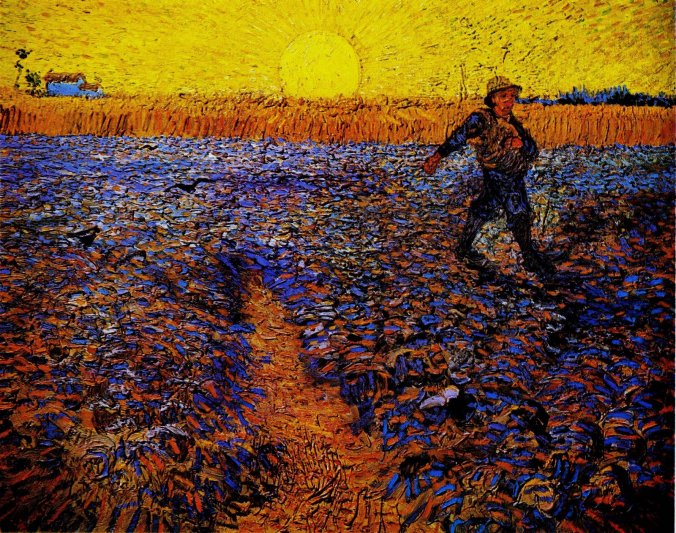
van-gogh-the-sower

I’ve been thinking a lot about being the same stuff as the earth as I’ve been pottering around in the garden watching spring emerge, and reflecting on the parable of the sower, and other stories Jesus told.

IMG_0773.JPG

img_0786

Ransoms, or wild garlic – as I made dumplings with them, and enjoyed them, I felt part of our local wood.

Today, Ash Wednesday, I emptied our Baxi grate, and carried the ash to the compost heap, getting covered in the stuff as a gust of wind blew.  It was a far more comprehensive ashing than we normally receive in church, and it felt given to me, a reminder of my state as dust, ash, earth.  As I stirred them into the first grass clippings of the year, and yesterday’s lemon peel from Shrove Tuesday, I thought about the beloved tree that we lost in our garden, and how it’s kept us warm this winter. I gave thanks for it. I thought too about Malcolm Guite’s Sonnet for Ash Wednesday, that speaks of the burning of the world’s forests.  I though how complex and delicate our relationship with the rest of the natural world is, and how easy it is to abuse and neglect its care.

It’s good we have these days and seasons – Ash Wednesday is right for penitence, and even lament, as we consider how separately we have tried to live from all that is good and true and sustaining.  How we have broken the Shalom, the peace and harmony of God’s intent for us and for all things.

It holds its own remedy, too.   People are normally given a cross of ash at a communion service, the great reminder and restorer of our unity with God, with each other, with the gifts of the earth in the form of bread and wine.  With the gift of Jesus.  Also, a reminder that we are one with the earth puts us in our place, and that place, if we stay with it long enough,  is a deep unity and kinship.  And that circled my thinking back to the parables, back to the talk I gave at Girton College ten days ago. It might help in the context of the burning of our world, and our state of being ash and soil.  Jesus told stories that speak deeply to our nature, and the nature of God and the world.  As we are made of the same stuff as earth, we can rediscover that connection, and in it find hope for an amendment of life, living more fully and abundantly, more joyfully and humbly and thankfully.

As we enter this season of Lent, may we be quiet enough to hear the whisperings, and the stirrings, of – not just new life, but a new way of living. We can repent – the Hebrew word normally translated such carries a meaning of turning back home, the Greek of having a change of mindset.  Both of these carry great hope – the reign of God is very close, all around, within us, if we but look and see.