Days

IMG_0019


overflowing flowers.jpg


Hurry.  I am ill suited to it – especially as the days grow hot.  I wrote this poem as a kind of rebellion against the feeling that my time was constrained, not my own, running away from me while I seemed to have none of it for the important things.

So I snatched time, and wrote.  As I wrote, as I paid attention to what was around me, I felt the time slow.  I felt myself breathe again. I felt the hard shells of the seconds soften, crack, and open like the seeds in the ground – become things of infinite possibility again.  I realised that, although my home is not the manor described in the poem, there are ways in which it is.  I can inhabit my days as if they were timeless, spacious, connected.  By slowing, by paying attention, by breathing, I found what I needed.  Most of all, though, for me, it is by writing.  Writing freely, writing the moment before me, is a kind of contemplation. It can become a kind of prayer.
I am reminded of Mary Oliver’s great advice –

Pay attention   Be astonished   Tell about it.

This poem was highly commended for the Crabbe Memorial Prize.
You can listen to it here


Days

There is little time –
flowers run to seed so fast under
this strong sun, this dry blue sky,
their leaves curling crisply, blanching.
Their hurry towards death unsettles me
as their stems rattle brown, poppyseeds
pouring through my fingers, tiny and dark,
pouring away like hard-shelled seconds.

I want to inhabit each day slowly, quietly,
as if it were an ancient manor among gentle lands,
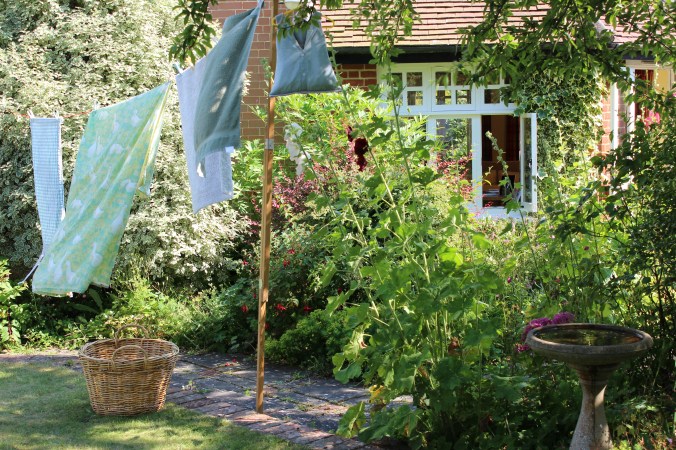
with warm red brick thick with years,
that smells of fires, and of rosepetals
as they overflow cracked china bowls,
where time hangs in the spaces between
each tick of the clock, and open doors
let in the endless songs of trees.

There, I could think – uncurl fresh leaves,
as time shimmers like the deep pool, full of lilies,
where the bright dragonfly waits, and waits.

The Well

down_the_well_by_trilogy20-d3azhyz-701x336

Photographer unknown


IMG_0473.JPG

The grounds of Otley Hall, Suffok, under snow-clouds

This is one of those strange poems that seemed to emerge from somewhere unexpected,  unknown.  I had been thinking about the way it’s so hard to look at things without getting in the way, and changing them in the looking.  How when we look at things our own shadow falls on them, and they are different as a result.  This poem came, in the mysterious way they sometimes do.

It starts where I  intended to start, with how we see, but then it seems to have its own ideas about where to go next.  We move on to light and water, a move which surprised me as I was writing it, but decided to go with it and see what happened.  Always best to do that, I find….and then, we were soon hauling up life-giving water from dark and unexpected places, finding coolness and goodness and satisfaction that quenches our thirsts, even when we least expect it.
Sometimes, we don’t need to understand.  Sometimes, we need to cast a bucket into the deep.

You can listen to the poem here

The Well

You look down, and notice the darkness,
what seems like a deep emptiness.
And perhaps, at first, that is all you see.
Look harder.  There is a faint flash
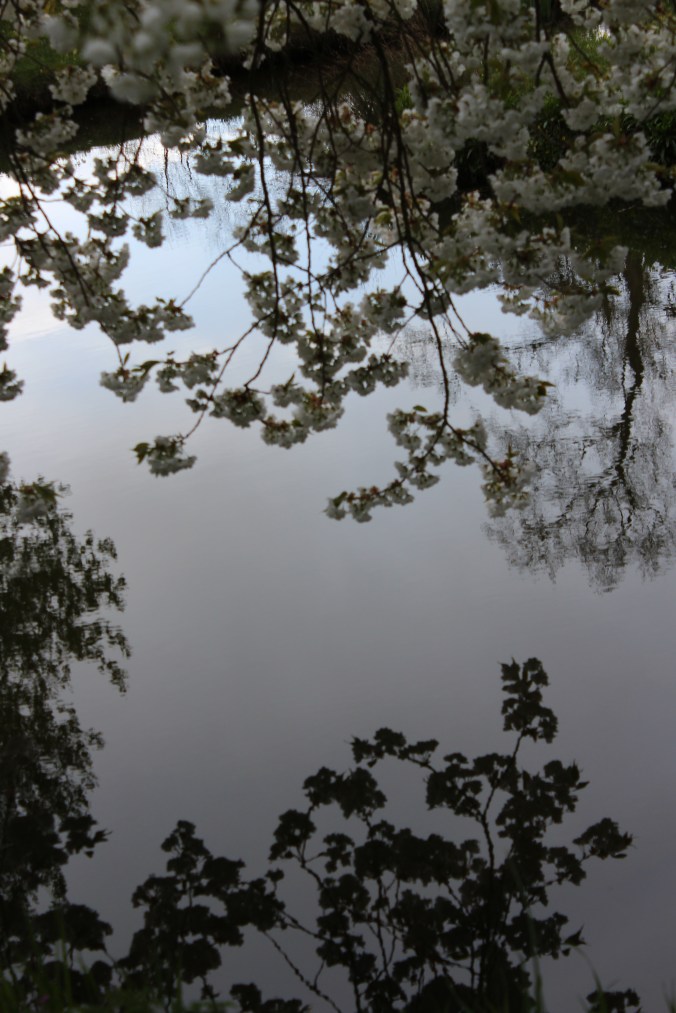
of sky, reflected, glimmering darkly
as your shadow falls across it.

If you could stand back a little,
stand back and let your shadow
fall elsewhere, for a while,
you would notice how the sun
is alive in the darkness.  Bouncing
and scattering brightness over moss
that covers the wall of the well,
living for  such moments of light.

Yes, it seems dark to you,
and indeed, dark it is, but why not
cast down a bucket anyway?
Keeping hold of the rope as it
grows slack and weightless in
the depth of the fall.

It will splash, and bob awhile, and slip
heavily under the water you do not see,
and you will feel the tension in the rope changing.

Haul up the bucket, slopping and dripping
and running over those green plants,
and drink deep of the cool, clear water,
shining at last in the bright midday light.

And you will find that you carry the
sweet taste of that water with you,
like honey on your tongue, your lips.
It could last your whole life.  Be
your whole life. Drink now. Drink again.


It was only after writing the poem that I realised I was drawing on the imagery of this story, of water and wells and thirst and shadows., a snippet of which follows:

From The Bible Story Retold
You can listen to the story here


It was hot when the woman went to get water from the well, near her home town of Sychar in Samaria.  As she drew near, she saw a Jewish man sitting there, in the shade.  She hesitated a moment, nervous of this stranger.  For the Jews and Samaritans had been enemies for centuries, since the time of the exile.  “But,” she thought, “I must have water,” and she carried on walking to the well.

The man was Jesus.  He had left Jerusalem and was making his way back to Galilee.  His disciples were buying food, leaving him to rest from the burning sun. He looked up at the woman.
“Will you give me a drink?” he asked, with a thirsty smile.   Jews and Samaritans never ate or drank together: it was against all the laws and customs.
You, a Jew, are asking me, a Samaritan for a drink?” She was so startled she nearly dropped her water jug.
“If you knew who I was, you’d ask me, and I would give you real, life-giving water!”
“How can you get water?  You have nothing to hold it in!”
“If you drink from the well, you’ll be thirsty again.  If you drink the water I offer, it will become like a clear spring within you, bubbling over with eternal life!”
“Sir, I would like that water!”  she replied.


bible retold cover

Tea-maker

sunday-social-teacups


A while ago, I found myself in Ipswich hospital.  Once things had calmed down a bit, I was moved to Brantham  Assessment Unit, where the lady described in the poem brought me tea.  As well as the NHS doctors who diagnosed, and prescribed medicine that made me better, there were people whose presence, kindness, and generosity of spirit was remarkably healing.  She was one of them.  It was so precious at the time, and still now the memory helps.  A simple cup of tea – it meant so much.

So often we think there is very little we can do for people, that our small gestures, our smiles and cups of tea and gentle touch  can’t make much difference in the face of whatever they are experiencing.  We are wrong when we think that – I know now.  It gave me hope and comfort.

If anyone knows who this lady is, and can pass on my thanks, I would be so grateful.
You can hear a recording of the poem by clicking on the title.

Tea-maker

Here, among the bleeping machines,
the close together trolleys,
and the thin curtains,
there are gifts.

A high slit of window, through
which I see a tree’s green
shimmering in far away light.

And you, lady,
aquamarine turban folded on your head,
swaying to the rhythm of the song
you hear, and hum
so deep, humming from the heart.
It is my gospel song.
You make tea for us,
stranded as we are,
as if it were a sacrament.
You hold each cup a moment,
as if in prayer, and you pass
mine to me with kindness.
I receive it, and feel the blessing of it.
Healing and peace,
presence,
here, even here.

Bees

IMG_0565.JPG

IMG_0570.JPG

IMG_0572.JPG

Hot and thundery, the English summer arrives – it’s too much all at once, at least for me.
Here is a small poem written watching the bees through my window, on the powerful, vivid, lavender.
It is also a poem touching on transformation, something that is beginning to emerge as a theme, although I am not quite sure where it is taking me……. which is perhaps, the point.

Bees

I watch them on the lavender,
each purple flowerstem a pendulum of bees,
keeping time with its humming weight,
White and red tailed, bumble and carder.

A few honeybees come, too,
so few, and already yellow
with sweetness.
And butterflies – cabbage whites,
bright as paper – unfolding
in the scent of flowers.

When the summer storms come,
when storm-rain falls in drops
as big as bumblebees, and
hail clatters against the glass,
they rise, as one, and fly
between the drops, too fast
for me to know where they shelter.

They return to rainwashed flowers
one by one as I gather a few new stems
bright, fragrant, and roll them
slowly in a jar of sugar,
ready, in the time to come,
for delicate sweet biscuits,
icing for dainty cakes.

I do not have the alchemy of bees,
but I have my own, under this roof.

Stamps

Stamp1024_105444k

I have been thinking about the apparently small things that connect us, that help, in times of trouble.  Living in a market town, you often see some of the same people in the street, and in the shops, as you go about running errands, dealing with the necessary things of life.  Sometimes the tiniest of connections can change your day, can make you feel closer the rest of your human family.  And sometimes, going out partly in search of such connection, you find you are able to give, as well as receive.
At least, I hope so.
So often, we underestimate the power of these small, slight gestures.
They matter.


Stamps

Two of the blinds were down,
Position Closed, but yours
hovered, unreadable, just
above your head.

There was   no queue,
and I approached you
cautiously,
clutching thick manila
envelopes.

Are you open? I asked.
As you raised your head,
I saw trails of tears down
your smudged cheeks,
such large heavy drops.

First class, two –
I’m so sorry.
You smiled, and
I stretched out my
hand and touched
fingertips to the glass,

Passed warm coins
through, which you
held a moment,
then gave me stamps,
straightening your back.


New Book News!


IMG_0561.JPG

We arrived back from a few days away to find that, as usual, some post had built up behind the door.  One of the envelopes was quite fat, and it contained a contract for a new book with BRF!  Good news!  It’s a book on the I Am sayings of Jesus,  with an emphasis on how we can respond, and embed these deep truths in our lives.

This book idea began when I was writing a series of meditations for BRF’s Quiet Spaces and found there were too  many ideas, too much to say, to compress into that concentrated format.  I am so grateful they were open to the idea of reading more.   I have till next May to write it, so it will be a while before it is available, but I shall keep you posted on this blog, and hopefully post a few snippets for you to try for yourselves.

I would also like to say thank you to the dear friends who have encouraged me, and especially the St John’s Church Advent Retreat, who patiently listened and tried out various ideas I had been developing, and helped no end with their thoughtful and generous response.

That was not the only post, though.  There was also a parcel containing this:


IMG_0554.JPG

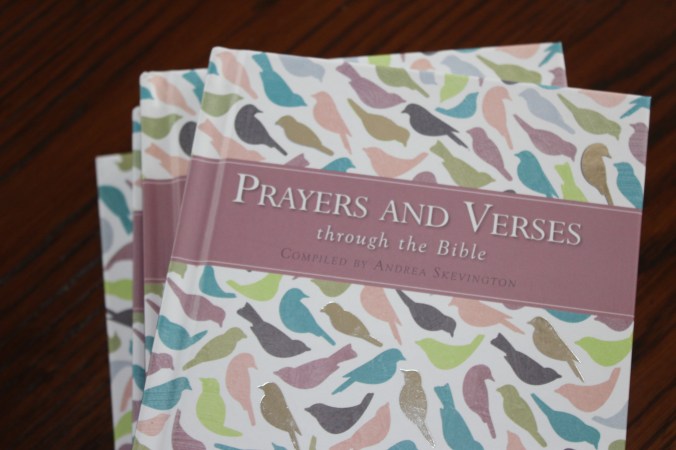
Recently published, it’s the first time I have held Prayers and Verses in my hands, and it is a beautiful piece of work from Lion. It’s always a strange thing, to see your words printed on a white page, to see the way what you hoped for – something where the different verses and prayers seem to  interact with each other and enrich each other – might be happening on the page.  Below you will see it with its companion volume, The Bible Story Retold.


IMG_0557.JPG

And here is a spread from the book – I hope you will excuse the slightly variable focus!
In the UK we are facing a time of huge uncertainty, and I thought I would share with you these few prayers and verses. They are reflecting on the time of Exile in the Jewish story, which seems to be a relevant theme for many, whatever their nationality.

IMG_0555.JPG

Thank you for taking the time to read this little bit of good news.  May there be more good to come for you, too.

Consider

IMG_0495

Last week, I shared with you a poem about daily walks through   Fen Meadow  .
Here is another.  As it is the time for buttercups, buttercups creep into this one, too!

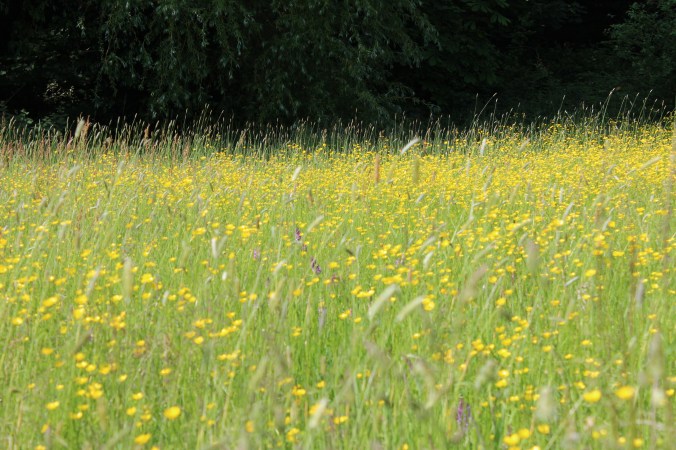
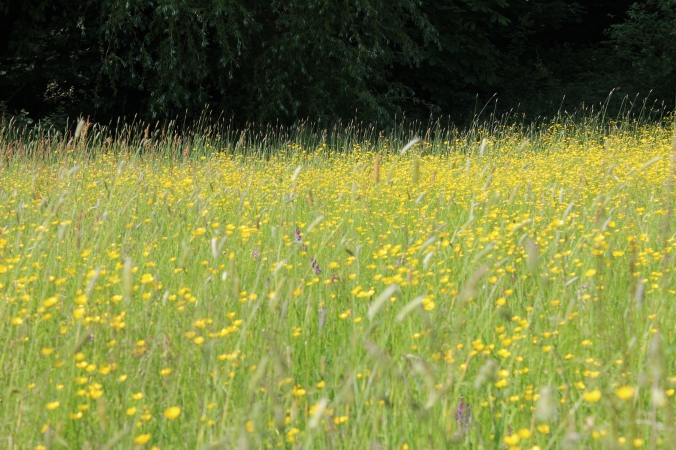
I often find walking the best time for praying, and thinking.  There is something about the rhythm of your body, of your feet in contact with the earth, that quiets the mind and makes prayer easier – at least for me.  As I was walking and turning over my worries/prayers before God, I felt that I was being reminded to pay attention instead to where I was.  In particular, the phrase “consider the lilies of the field” came into my mind.  Now, the lilies of this particular meadows are these beautiful buttercups that grow tall among the grasses, splashed with orchids and clover and birdsfoot trefoil. So, I spent a while considering them, and it was impossible not to feel my heart lift at the sight of so much beauty.

The next day, I approached my walk more enthusiastically – looking forward to seeing the buttercups again.  The sun was shining, they would be perfect.  When I arrived, a large sit-on mower was being driven up and down over the long grass, noisily spraying all that was left of the wild flowers behind it. It felt as if I had just begun to notice something good, when it was mown down.  The poem tells what happened next – if “happened” is the right word!


CONSIDER

I walked behind as he
mowed buttercups down –
scattering gold through
the cut grass –
I gleaned the shattered stems
to carry home.

But, as they wilted in a jar,
they darkened, and drew
to themselves the thought
of other things cut short –
of life, and joy, and hope,
of beauty crushed,
of anger that narrows to
silence –

And yet, today, I came back,
saw the ground  newly
hallowed by many
small shining flowers –
open, nodding to the blowing wind,
running over with saffron light.

Cut down, we flower again, again.
How it all murmurs constantly,
as the shuttle flies across
the loom, and bare feet
are dusted with gold.
And which of you by being anxious can add a single hour to his span of life? And why are you anxious about clothing? Consider the lilies of the field, how they grow: they neither toil nor spin,  yet I tell you, even Solomon in all his glory was not arrayed like one of these.   
Matthew 6:27-29

Fen Meadow – June. The power of memory.


IMG_0496.JPG

IMG_0495.JPG


As we draw closer to the end of an academic year, as children begin to think of doing things for the last time – the last time in this class, this school, with these people, I have been thinking of the poignancy of repeated things coming to an end.   Every day you do something, and then you don’t. In this case, it was the walk to school – now itself a memory.  We passed through a piece of common land within our market town.  It was the nearest place we could go to run, roll down hills, sledge if the snow was right.  Each day, if it is your time for walking through it,  you can see some change in the growth of the plants, hear the birdsong, notice the way the path dusts your shoes, or muddies them. Sometimes it felt as if we were part of the place, and certainly the place is part of me. Each time you walk a familiar path, you can bring the experience of the previous times with you most strongly, it seems. Memory can be vivid, and overlay your experience of the now, as if you are in two times at once.  I try to explore that strange, split-second sensation in this poem.

I have some photos of the Fen Meadow buttercups, and orchids, but none of the willow trees yet.  Dry weather is necessary for the mounds of seeds the poem describes, and that has been hard to find so far this summer!  If I can find a dry moment with my camera, I shall share the pictures with you.  For now, I hope the poem helps you “see” the beauty of the place.

I hope you enjoy.


FEN MEADOW  – JUNE

We have been here so many times
before – this very spot – where
white clouds of seeds drift down
from willow trees, and fill our path.

You smile, and gather mounds of
whiteness – heaping the downy
seeds like warm snow.  What if
it stays till winter? You ask

And suddenly green grass
vanishes in a blaze of white
ice: bare trees, a low sun.
Our screams and laughter are

muffled by scarves as the old sledge
tips – I run my fingers over the scar
we left on the bark – and we shiver
in the warm sun. The very spot.

The breeze trembles again in full
leaves, and all around us buttercups
shine, and dandelion stems shudder.
You pick the clocks and blow

till bedtime, counting the hours:
lunchtime, morning, soft evening.
Your breath floats high, and
hangs in the air. Waiting


Three Days


blackbird2

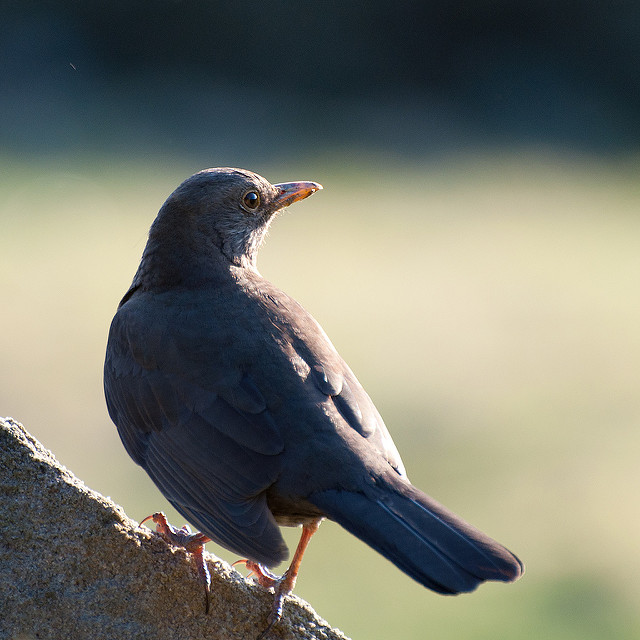
Photo from Flickr, photographer unknown

IMG_0485.JPG

I have been transplanting buttercups into the verge at the front of our house, where there is no pavement, and have been thinking about boundaries – in particular the contrast between the rather wild garden, full of life, and the fast road outside.  This poem, written a few years ago, came about as I watched a female blackbird mourn the death of her mate.  She kept vigil for three days, and then she went.  I did not see her again.  It made me think about not only the intensity, the reality of each creature’s experience, but how often we live in our own enclosed worlds, isolated from each other, and how hard it can be to cross those boundaries.   How hard to credit and acknowledge the fullness of the lives around us. To begin to do so, to begin to see and understand another,  seems to me an important step to take.


Three Days

She stayed by the side of the road,
her brown feathers ragged,
stayed by the place where her mate lay,
black against the tar,
one wing lifted,
catching the breeze –
the passing of many cars.

Startled, sometimes,
she scuttered away into
the green growth,
then returned,
holding her head on one side,
but always she was there,
for three long days
and, for all I knew, nights.

What was the quality of her grief,
of the bond that tied her there?
We know so little of each other,
the unknown world folded
inside each being.
I walked humbly then,
knowing only to be kind.


The ‘Mary, at your feet’ poems – Three

mary-anoints-the-feet-of-jesus-by-frank-wesley

Artist – Frank Wesley

This is the third and final ‘Mary, at your feet’ poem, which tells of an evening in Bethany, at the home of Martha, Mary and Lazarus. Jesus is there, too. They are holding a feast to celebrate Lazarus coming back from the dead, and, it being near Jerusalem, they are joined by many others.

I found some spikenard on line, the closest I could find to nard, the rare perfume Mary pours over Jesus, and burnt it as I meditated on the story. It is pungent and earthy, an intense fragrance. As I meditated, I remembered all the times that Jesus had told stories of the Kingdom involving feasting, and banquets, and how he left us a shared meal to remember him. This particular banquet, celebrating a man coming back from the dead, seems like that.

I thought of Mary giving something so costly out of love, I thought of the other story of a woman anointing Jesus’ feet (Luke 7:36-50). And I remembered that Messiah means anointed one, and that the only earthly anointing Jesus receives is like this, at a feast, in an outpouring of love and gratitude.

This poem, too, was read at the Alive festival 2014, and I used it as a starting place for prayerful writing with a group of people. We burned spikenard, and imagined ourselves into the story. Some beautiful work resulted. People were able to connect with times when their life had been restored to them in some way, with times they were grateful, and wanted to pour our love and thanksgiving. For others, they felt they were outside, looking in at the feast.
In this poem I see the doors wide open, like the gates of the city in the book of Revelation (21:25).

You can read the first poem here
and the second one here

Mary, of Bethany, at your feet a third time

And so you come once more to Bethany,
and share a meal with Lazarus,
a resurrection feast,
foreshadowing, foreshining
all those kingdom feasts you told of:
wedding banquets with long tables
set wide with good things,
with room enough for all,
welcome at your table.

Now, in Bethany, the house is ablaze with light,
shutters and doors thrown open,
all wide open with joy unspeakable,
music, laughter, dancing, wild thanksgiving
for one who was dead is alive again,

And all night, while crowds pour in from Jerusalem,
the feast goes on, and on,
as Mary enters now, cheeks glistening with joy,
past her brother at your side, back from the grave.

She kneels at your feet again,
pours out extravagant nard,
scandalous anointing of your warm, living feet,
unbinds her hair and lets it flow like water
over them, wiping them in such reckless
and tender thanksgiving.
Fragrance fills the room, the house, the night,
as more people pour from Jerusalem to you,
to you, who comes to us in our weeping,
who shares our bread with us,
and brings us to such joy as this.

John 12:1-11

I am greatly honoured that this poem was read at the Good Friday Service of the Riverside Church, New York.
The whole service is recorded. The poem appears at about 21:50
You can see it here

Note, March 2024:

I am delighted this poem was shared by Diana Butler Bass on her substack.

https://open.substack.com/pub/dianabutlerbass/p/halfway-through-lent-mary-magdalene?utm_source=share&utm_medium=android&r=46vqv