Poem: A good place

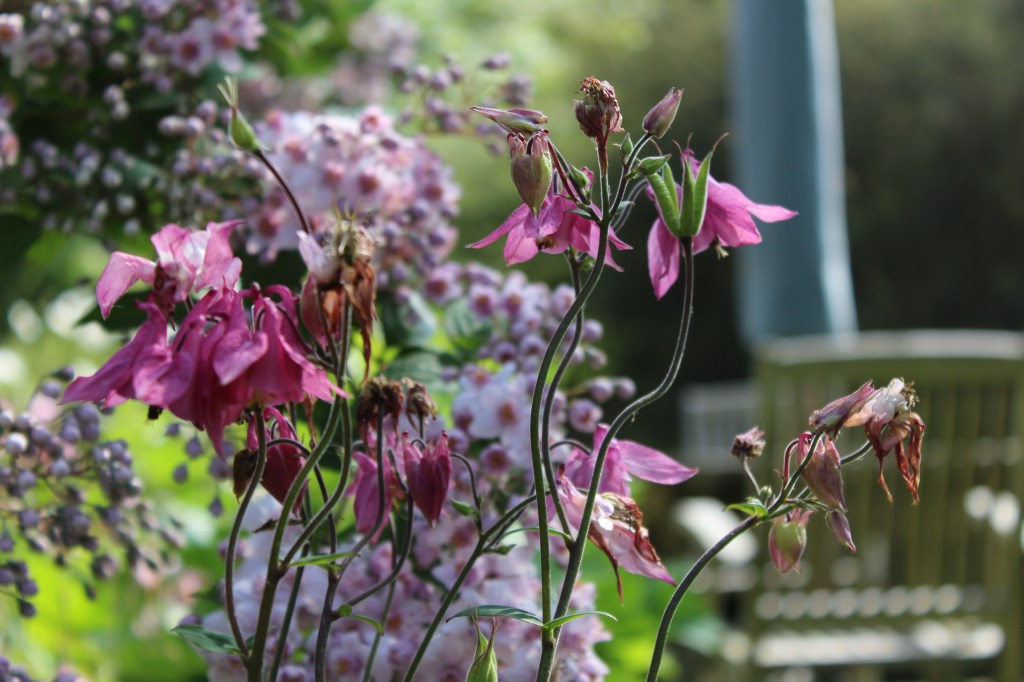
I am sure that all people who have ever tried to tend a garden, or grow crops from the land, are deeply aware of the changeablility of weather, and the vulnerability of their work. This year, I have pretty much given up growing veggies from seed, as the cold and dry has thwarted too many of my efforts.

I’m aware that the work and care I give to my garden can be undone so quickly by the weather. Increasingly, I’m aware how the increased instability of the climate is making it harder than ever to grow things. I seek to work in harmony with the rest of nature, but the rest of nature is unnaturally capricious.

I am feeling the loss of a tree that died a few years ago when the Beast from the East was followed by relentlesly hot and dry weather. I know I could not save it, and cannot save all the plants. Even though I know new things are growing, there is an unease in my tending. I have planted an apple tree in its place, which is flourishing, full of blossom. But this contrast between my nurturing of the place, and the wildness and unpredicatability of the weather has been on my mind.

Elsewhere, I have written about the tree. You can read it here.

And yet, the garden is full of life, it florishes, and changes, and we adapt. Things want to grow, and live, and they do.

A good place

Just now, a buzzard drifted
overhead,
slowly, consideringly.
‘This is a good place’
I whisper, looking up,
as mice quake the
lengthening grass.
She flies on, slowly,
her head turns back

as a blackcap sounds
his golden, limpid song.
This is a good place.
Yet the tree died even so.

The weather blows in weird.
Too hot, too cold,
too much, then not enough, rain.
Things begin their opening,
and close and blacken.

This is a good place.
I tend and nurture.
I make homes for many creatures.
And the tree died even so,
even so the earth shifts
as the ice melts,
the wind veers and changes,
I cannot hold it back –
that endless dry north wind
that burns the soft green growth.

But I stand
with my trowel in my hand,
with dirt under my nails,
and I tend, and I nurture,
even as I look up and watch
the sky change, even as
I look up and see, too, the
high birds drifting across.
And I choose to live tenderly,
tending,
for it is a good place
even so.


Edit/Note 19th May 2023

This evening, I’ll be reading this poem at the final talk of a series organised by Woodbridge Climate Action Centre. The series is entitled Regenerating Living Landscapes. This evening’s talk is Landscape Connectivity: Rivers and Wildlife corridors by Professor Peter Hobson. I’ve made a few small edits to the poem – coming back to things you always see something you’d like to tweak – which I have made here on the blog as well.
It’s been so good to be involved in the talks, and all the conversations and connections that are flowing out of our gatherings. I’m very honoured to be able to contribute in this small way.

Poem: Enough

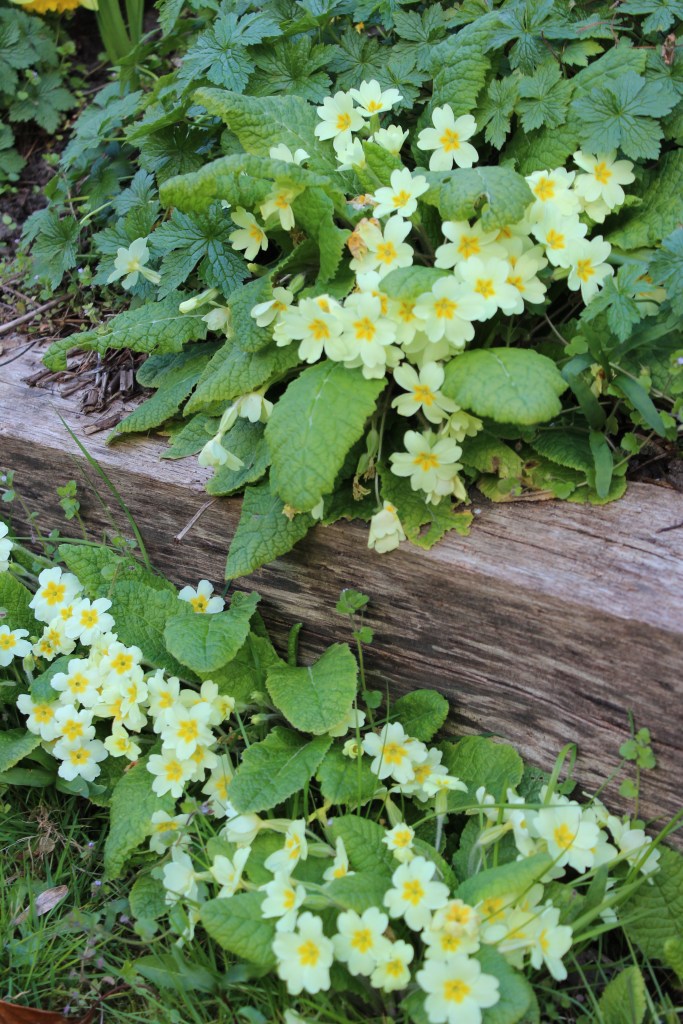
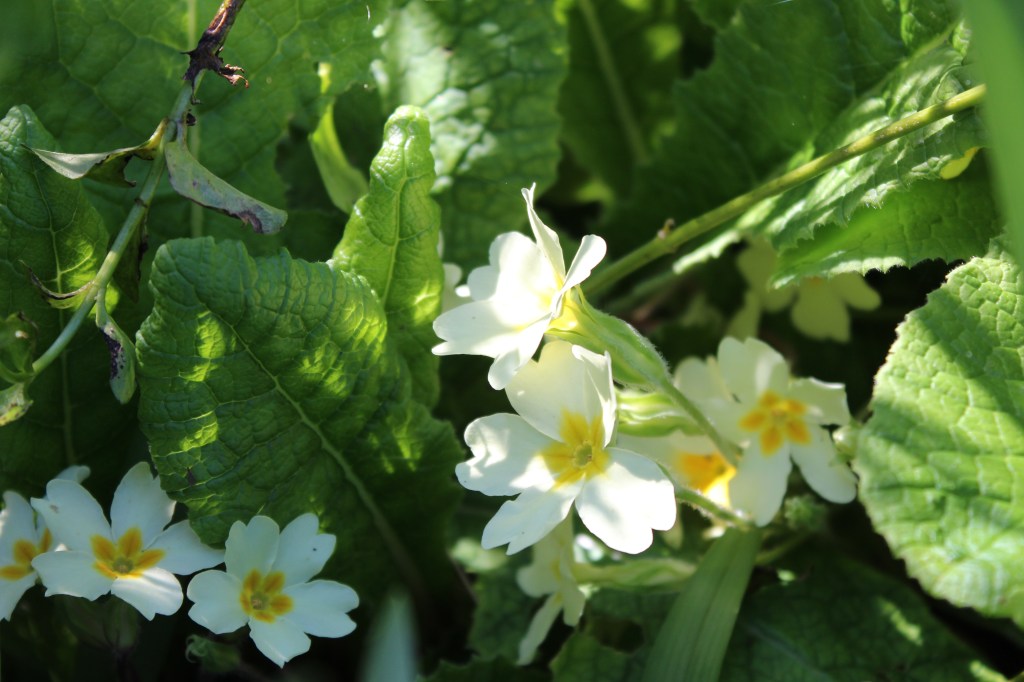
Sitting in one of my sitting-and-thinking spots in the garden, sometimes something catches my eye which brings me joy. In my last post, One hundred and ten years, I talked about the primroses in the garden, and why it mattered to me that they spread. We could have lost them with the blitz of herbicides in the previous century, and their modest presence is still not guaranteed.

Here is a poem then, that draws on their growing brightness in my spring days. Now, we’ve had some warmth, and they are beginning to retreat under the cover of later plants, but here is how I love to see them. Soon, their fine seed will begin to fall again, down over the sleeper into the waiting lawn. I thought about that experience of falling, and how so many things that feel like an end may not be such an ending, after all.

We’ll mow around them, and let them make their way across, amongst the speedwell and the forget me nots that are also growing there.

Enough

Some days, something
as simple as the way
the primroses tumble
over the wooden sleeper
to the grass below
is enough.

It’s enough to see
they fall
and are caught,
nestled between strong
grasses, resting on good earth.

Enough that once there,
they soften and grow.
Enough that they
unclench their
green fists
into open hands
as they spread slowly,
and ever wider,
across the grass
like cold, yellow butter.

They fall. They are caught.
They find a welcome,
a green place, all they need.

May our fallings
be so caught.
May we, after all,
come to rest in some new,
surprising place
where we flourish.

May we find that what
feels like a falling
is, after all, a running
over, an overflowing,
down, to some place
we had not known
before.
And may that
running over
be enough.

Poem: One hundred and ten years

I am delighted to see how even the tiniest glimmer of sun brings out clouds of insects in the garden. I love the way the spring flowers are hungrily visited by bees. I do what I can to encourage butterflies. It cheers me when they come, but sometimes, I remember reading in novels, and poems, of an abundance that I can hardly imagine. It fills me for a kind of nostalgia for something I didn’t know, but nonetheless miss. I feel its lack. I remember as a child hearing older people talk about primroses and cowslips as flowers that were abundant in their youth, but had all but vanished from the countryside. No doubt, these memories are what is behind my cherishing them, and watching them spread through the garden.

So, although it warms my heart to see the growing abundance in our lightly disordered patch of nature, I’m aware of shifting baselines – I know the natural world I experience is diminished compared to that which our ancestors saw and knew. I sometimes feel the presence of a ghost landscape behind what I see – a landscape of what had been. To the best of my knowledge, my place was once an orchard, and my mind’s eye can almost see it, alive in a way I can only dream of.

I was reminded of a book I loved as a child, Tom’s Midnight Garden by Philippa Pearce, where the garden, as it was, becomes visible, even though it had been destroyed and built over. At least here, in this place, there is hope that some of the abundance there was can return, as much as it is within my power.

One hundred and ten years

Despite this cold
there is a shimmer
of life in the air above
the beds, where bluebells
begin their opening.

Tiny flies, and larger,
and bees, and the
occasional, beautiful,
butterfly – look, just there!

I watch them in awe,
all these tiny specks of life.
Each small thing part of
The garden’s constant dance,
each with their own
irreplaceable steps.

I wonder what it was like,
over a hundred years ago now,
before the house was built,
when all this was orchard.
Did butterflies rise in clouds
as you walked through
the long grass?
Could you lie down and hear
the hum of many bees
in the blossom above?
Could you doze in the scent
of wildflowers, the hum
and scratch of insects?

Perhaps, like
Tom’s Midnight Garden,
that place is still here,
in the shadows.
Sometimes, I can
almost glipse it,
as transient as
dawn mist.

And perhaps, I hope,
it is becoming
less ghostly, more embodied,
humming in this shimmer
of life in the air.
Growing stronger,
growing more certain,
after so many years.

A Poem for Earth Day: What might it mean, to live well on a dying Earth?

Yesterday was Earth Day, and, as I have before, I wanted to mark it. I’m a little late, but here is a poem that has been circling my mind, and troubling me, for a couple of weeks now. I heard this question – or something like it – on a podcast, and it rather took my breath away. I do spend time attempting to answer questions such as – What can I do to limit the harm I am doing? or, Is there anything regenerative that I could attempt?, or What can I do about all this plastic in my life?.

The more philosophical question, of what makes a good life, in this time when we are waking up to the way ecosystems are fraying and dying, is harder to attempt. Yet these phrases came to me, and I think there is power in the question. There is some liberation, too. It doesn’t focus on all the things I’m not doing, or are unable to do. Neither does it reassure me by looking at what everyone else isn’t doing either. So the poem is not a list of tasks, but something closer to a way of being, which will, naturally, lead to tasks, and to action.

In some ways the question is offensive. And in the places it rubs against you, there is something to be explored. And perhaps, in finding our own answers to the question, we may find the dying receeds, and the living has more hope and space. But that is not the point just for the moment, just as we approach this question. The point is, to face up to what we are doing, and then find a way of living within that knowledge. It’s quite a task. But I feel there is some merit in the attempt.

I was encouraged that yesterday the virtual Climate Conference that President Biden convened made some positive announcements. As we seek to move from goals to a change in the way we live, maybe this question helps.

The question arose on a Nomad podcast which centred around an interview with Gail Bradbrook, of Extinction Rebellion. It is well worth listening to. You can find a link to it here.

May we live well. May that wellness include all living things.

Consider the lilies of the field, Jesus said.

What might it mean, to live well on a dying Earth?

Who knows?
The worst kind of foolishness,
of absurdity
to even try.
And yet, something sparks,
something kindles,
at the question.
And so, knowing the absurdity,
these words come….

To be tenderhearted,
though afraid.

To know that each
small thing matters.
That even though
it is not enough,
such calculation
is not your task.

To tend the tender plants,
and see their flourishing.
To feed birds.
To stop on your way
and talk to friends,
and those you barely know,
to stand with them
in their griefs,
to laugh within their joys.

To be compassionate
to all, beginning with
yourself.

To do those things
you have found within
your power to do.
To also do those things
your heart whispers.
And both, without
measuring outcomes.

To act as if you have
hope,
even if you do not.

To act boldly when you feel
the call to do so, but
with gentleness and grace.

To look for beauty, and joy,
and love.
To travel through despair
and let its darkness
dissolve about you,
having held you.

To grow food
for yourself, and for
all those you share
your place with.

To stand in awe under
the song of the songbird.
To be merciful to the
worms and the beetles
and the spiders,

To – again and again –
say yes to life, and to joy.

Say yes to all that is good,
while there is so much that
grieves you, and leaves
you despairing.

To know a more beautiful world
is already here,
and yet coming,
and still beyond our grasp,

And to live in it anyway.

The last section of the poem mentions a more beautiful world. That refers to a book by Charles Eisenstein – The more beautiful world our hearts know is possible

Poem: The tenth plague – Exodus poems 11

I feel this is the ending of this sequence of poems, on how the Hebrew people escaped their slavery in Egypt. This poem is a dark sister to the opening one of the sequence, which you can read here. If you have been following this blog, you may see that this last has been a long time coming. It’s been hard, thinking of this last and terrible plague, when the oldest sons of the Egyptians died overnight. I’ll write a post telling the story, with links to the passages, another day.

We normally explore this story from the point of view of the Hebrew slaves, and how they shared the first passover meal, and escaped their slavery. For now, I felt drawn to continue my exploration of these ancient stories from a slightly different place – the place of the Egyptians. As we are beginning to wake up to the ways in which we have exploited the good Earth, and its good people, I have wondered whether we are more like the Egyptians in this story than we would care to admit. I wonder if, as climate disruption and pandemic unfold, we can find some resonance in this story of disasters rolling over the land, one after another.

And of course, this is the worst -the death of the children. It is hard to face up to the possibility that we are leaving a hard future for those who are young now, but that is what we are doing. And we have seen our young people rise up in school strikes, and action to protect their places, seeing that they will pay the price for much of the seemingly endless growth we have attempted. This taking and holding, building and amassing wealth now, seems to rob the future. These thoughts troubled me as I considered the death of the children in this final plague. Of course, there are other meanings, deep and true, but find that I need to consider this one.

There is also a clash of world views – the view of the Egyptians, of empire, wealth, might, and the view of the slaves, who seek freedom, community, worship of God, a different way. In the end, the slaves find their freedom, and the opportunity for living out a different way. As the story of Exodus shows us, there is much hard learning on that road. But, for those who despair of our current difficulties, thinking power and might are bound to win, they may find that power and might carry the seeds of their own destruction, and that hardness of heart will not triumph.

There is no triumph in the Exodus, but there is an exodus. There is an escape from a system that seemed invincible for 430 years. It was not. The world shifted for those slaves at least, and they had the chance of something better. When we, from our place at the beginning of the twenty first century, look back at the systems of thought, and money and power that have dominated for a similar length of time, it’s hard to imagine that they might shift. But I think they are. The shifting is painful, and, as we tend to resist, more painful than it might be. But, perhaps an exodus into a different type of common life is possible. Many of the books of law in the Hebrew scriptures explore what that may be, and they include some radical ideas, for example relating to debt, and land, and these seem radical even now. But that is for another day. For now, we have this hard story, and a costly freedom.

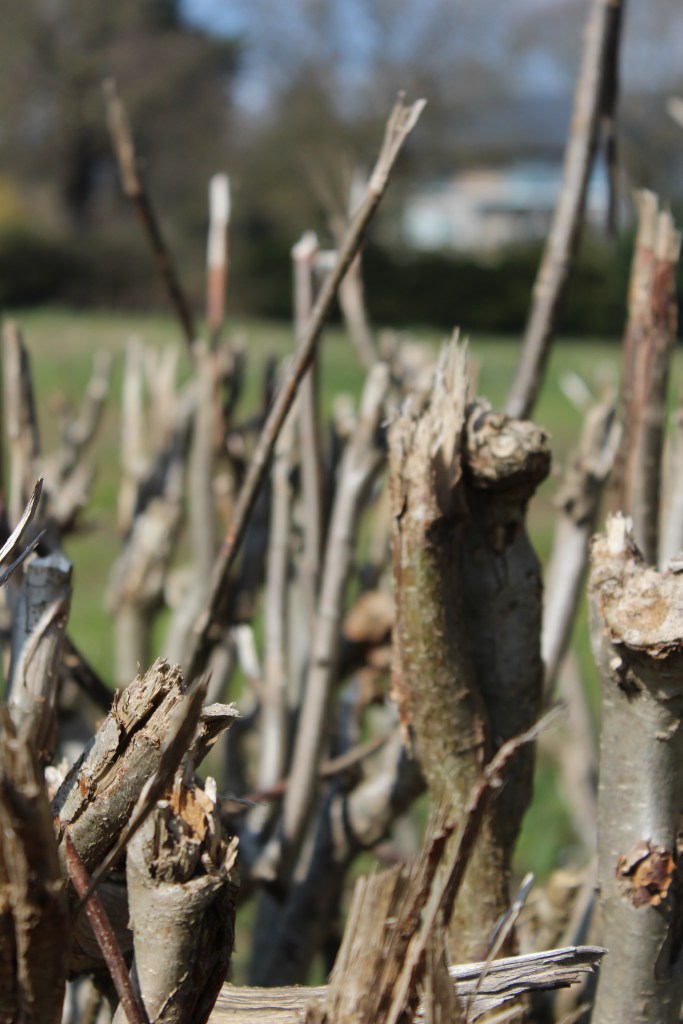
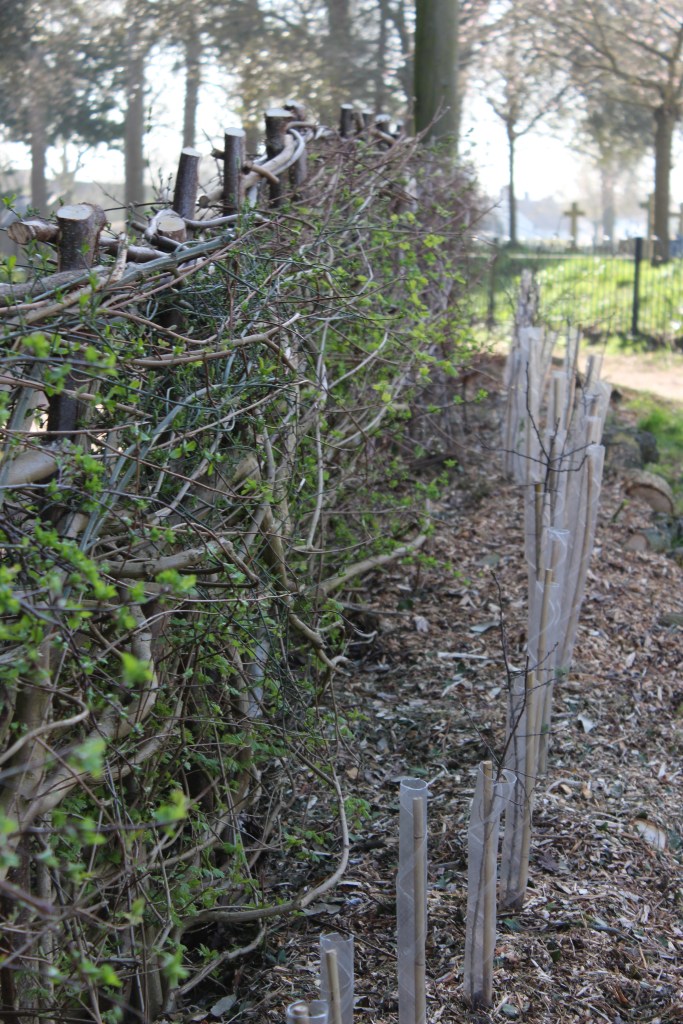
In traditional hedge-laying, the stems are cut and bent to the side, and then they grow vigourously.

The tenth plague – Exodus poems 11

Is this what it takes
for your hand to unclasp?
Your dearest thing,
your dearest one,
taken, even as you
chill your heart
to the warning?

The cold hand
of your son
now lies still.
Do you hold it,
and weep over it?

Your way ahead barred,
flooded by grief,
the future stolen
as the young lie
lifeless.

Lie still, bound by
your hardness of heart,
a fearful echo of
those slave-babes
cast in the Nile – lost
into bloodied waters.

Yet now, in this darkness,
when each hard drawn
breath is a shock,
even now, you cannot
let go,
you chase them still in
fear and rage and grief
with chariots and swords,
as if more death would
fill the chasm broken open
in your land.

And as the sea of reeds
rolls back,
rolls back and floods
over all your might,
your chariots and swords,
as those who were slaves
turn back and watch
from higher ground,
all your grandeur runs
through your clenched
hands like water.

For they stand now, on the
other side, out of your grasp
at last,
with a wild dance,
with song and tambourine,
in this hard and desperate
aftermath of horror,
life pulled up from the
swirling waters,
standing at last
in a new and
strange freedom.

Poem: The flailing of the hazel hedge

Walking, as we do, along paths and lanes, we pass many hedgerows, and the remains of many hedgerows. It grieves me deeply when I see one that has been shredded and flailed by harsh machines, so full of open wounds. This year, we walked past one such act of destruction on the very last day of February, the last legal day. Birds were scattering at the sound of the machines. It grieves me that this seems the best way, perhaps the only way, many landowners can manage their hedges. I expect it grieves them too. I expect they would rather live more harmoniously and gently with their land.

Having been deeply unsettled by the sight so many times, I thought I’d listen to that sadness and unease. I find it is reminding me of our deep connection to our places, and that what we do to them, we are doing to ourselves also. There is one particular remnant of a beautiful hedge I pass often. I have a practice now of turning aside towards it, and, absurd as it may sound and often feels, I give it my attention. I ask forgiveness, I bless the hedge. I often do this within my own heart, but sometimes, when the lane is quiet, I speak out. The result of this purtubation, and practice, is the poem below.

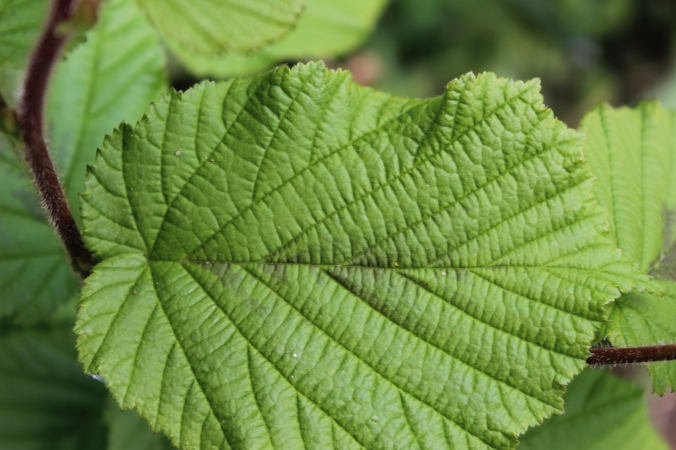
Beneath the poem, I am posting some pictures of a contrasting hedge, which makes my heart sing. Transition Woodbridge are doing wonderful work in our town, planting and tending. Something better is possible.

The flailing of the hazel hedge

In years past, walking
this lane now, in that time
of late-winter-early-spring,
this hedge was hedgerow,
all yellow swinging catkins
and small birds,
all leaves ready to burst,
crinkled like the corners of smiles.

This year, at each passing,
I stop now, and turn aside
the ninety degrees to face it,
to face what we have done.
It is a body-blow,
it is desecration.

Flailed and fractured,
long open wounds
split down through
the grey wood towards
the shocked, gasping root.

It is my practice now
to cross towards it,
lay my open palms
on its open splinters,
and speak –

I ask forgiveness,
we have brought
destruction on you,
beautiful hedge,
home of so much life.
I am sorry that in our world
this violence seemed prudent,
necessary, economic.
Can you forgive us?
For we have abandoned our place
of life-nurture, of life-tending.

I hope for better,
I look at the small buds.
Will they burst this year?
Will this be the year
when the flailing is final,
finally enough,
and this rill of beauty
and cheerfulness dies?

I go on my way,
head bowed, chastened,
we do not know what we do.

In beautiful contrast, we have this…..

In writing this poem, I was drawn to imagery from the Bible, and I have kept the imagery where it grew, as it seem appropriate to the immensity of what we are doing to the natural world. The poem speaks of a kind of anti-burning-bush, where Moses turned aside to the holy. I was reminded of the words of the incomparible Wendell Berry – “There are no unsacred places; there are only sacred places and desecrated places”.

You can read more about the burning bush here: Poem: On fire, but not burned. Exodus poems 5

There is also a gentle allusion to the words Jesus spoke from the cross: “Father, forgive them, for they know not what they do.” It seems that most of the time, we do not understand the wrong we are doing, and need such forgiveness. As I am writing this in Holy Week, these words are very present to me. There is a poem on that theme among those in this post: Poems – Seven Sentences from the Cross. You can read a retelling of Good Friday here.

Poem: Hospitality – Lockdown III

Next week, all being well, the rules will change here in England. We’ll be able to have someone local in the garden again. Having all this time with no human visitors has made me thing about who I’m tending this garden for. It’s been rather nice to leave aside my imaginary visitor who might critisize my rather haphazard and untidy methods, and just go with what I want, and what the garden seems to do. I hasten to say that my dear friends who came and sat with me last year, when inside was out of bounds, are always delighted to be here, and say no such thing! The critic is internal, and I am seeking to encourage her or him not to worry, to look at what is beautiful instead.

I’ve changed my emphasis this year. Previously, I was being quite purist about going for british native plants, wildflowers, and I still do try for those first. However, that did leave a long gap in the latter half of the year when there wasn’t much for the insects, so now I’m going for abundant life – plants and a style of gardening that encourage insects, birds, any other wild creatures that are happy to be here. I am protecting tender things from the muntjac, but the deer is welcome just the same. You can read about my planning for later in the year in my poem, Dreaming of Flowers.

Hospitality, then, in my garden, is the largely hidden from human eyes at the moment. It is fairly unconcerned about what other people might think. It is simply what I, and the wildlife, like. This winter, I’ve done other things to shelter nature. I’ve put up a couple of bird boxes, and made a bee hotel, and had piles of cuttings where ladybirds overwinter. I might write about those later. For now, I’m just rejoicing in a few of the flowers.

An edge of the lawn, left unmown, where the primroses have settled. I planted the crocuses in the autumn lockdown.

Hospitality  Lockdown III

Alone in the garden. Mild.
The early insects stir, hum,
fly slowly towards the flowers
I have planted –
startling yellow aconites,
the shrub honeysuckle,
primroses, crocus –
oh, those two together,
the purple and the yellow,
how they shine,
how they bend their
impossibly thin pale stems
as they follow the sun,
as they accept the
weight of bees.

This garden is still
a welcoming place.
Cut off from friends,
from human hospitality,
from tea and laughter,
from human notice of
these opening buds,
even now
the garden hosts
such a banquet.

It sustains and rejoices
so many –
the hoverflies,
like this one,
resting in the yellow aconite
all this time
as I write.

I have spread a table here,
welcoming all this life,
and together with
all these,
I receive the early warmth,
I rest in the fragrance of flowers.


Just to add – today, I saw the first male brimstone butterfly visiting the primroses. So exciting!

Poem – Like Noah’s raven, and the dove

A few days ago, a minister from a church in Canada got in touch with me to ask if they could use this poem in their worship on Sunday. That’s such a joy, when words take flight and find a new home, a new place to settle. Of course, I said they could.. I reread the poem, and I think it does have something to say in our difficult and strange times.. So I am sharing it again, in case it is of help to you reading it today.

Many churches and people will be turning to the story of Noah this first Sunday of lent, so it may help those who are considering this ancient, and I find quite difficult, passage.

If you too would like to use it in your online worship, please do, just acknowledge me and this blog.

Here is the link to the Canadian Church website. https://www.st-matthias.ca/https://www.st-matthias.ca/

Amyrosemoore

Artwork by Amy Rose Moore

This poem emerged slowly, over weeks, as they sometimes do. I let it sit for a while in the cold and the dark of our late winter. Looking at it again, I haven’t been quite sure whether it’s come to a place of rest, but I feel that now’s the time to let it fly and see if it finds a place to settle.

I’ve always found the story of Noah quite disturbing and unsettling, and although I feel I have made some peace with it now, it’s often these troubling places that drive you to engage with the original story in a different way. This one in particular feels that there are depths to be plumbed, sunk into, with an imaginative and almost intuitive reading, which is what I sought when I did my retelling for Lion

The rains swamped valleys and plains, and crept up the sides of the mountains, until all was swallowed up in black, endless water. As they drifted helplessly over it, Noah and his family knew that all living things left behind on the land had been drowned. They were alone on the ark. When, after 40 days, the rain finally stopped, the silence was as cold as the waters.

Noah’s family loved their precious cargo of animals: the only other living, breathing creatures left on the earth. They fed them, and cared for them. As they did so, a wind blew, and the waters began to sink slowly down. Then, one day, they heard the keel of the ark beneath them scraping and shuddering. The ark juddered to a halt, for it had struck the top of a mountain.

Every day they scanned the horizon, longing for land, and after many weeks they saw distant purple mountains breaking free of the water. Noah waited 40 more days, then set a raven free. It criss-crossed over the waves, looking for somewhere to perch. But there was nowhere.

A week later Noah tried again, sending out a dove. It came back with an olive twig. Noah held the bird tenderly in his hand, hope rising within him.

A week later he sent the dove out again. This time, it did not come back. It must have found somewhere to perch. At last, the flood was drying up! Noah’s face broke into a wide smile as glistening land slowly emerged and dried.

From The Bible Story Retold

The image of releasing the birds from this narrow, confined space stayed with me, drawing on my memory of Emily Dickinson’s wonderful poem Hope, which is well worth having by heart for difficult times.

I thought of the raven, how it is a carrion bird, associated with death. Although reading the symbolism of such a long-ago story is best done humbly, I do wonder if Noah’s releasing of this bird first suggests he was expecting there to be carrion around, that it was a bird released into a imaginative landscape of death, not life. And yet we find, later, there was now something green and growing, something to sustain and anoint and bless – the olive – and that the world that was emerging from all that destruction was peaceable, and hospitable, a place of the dove and the olive. It is a new beginning.

We are not there yet, though, at the moment of this poem. We are at that point of wondering if we dare hope. Wondering if it is worth the costs of hope. Sometimes we have to remind ourselves it’s good to look for signs of hope, even when all seems lost. It takes courage, and discipline, and persistence. But learning to read the signs in our own landscapes, shifting our focus up and out, can begin to lift us. And we can find that, astonishingly, green growing things are appearing.

You can listen to the poem here: https://andreaskevington.podbean.com/e/poem-like-noah-with-the-raven-and-the-dove/

Like Noah’s raven, and the dove

Can I let hope fly, send out birds
to brood and hover
over the chaos,
like Noah, with the raven,
and the dove?

For too long, there
has been nothing
on the horizon,
no fixed point
on the Earth’s
endless circle.
How would you ever know
if the water was falling,
or rising?

So can I now find courage to
cup birds in unsteady hands –
raven-black,
dove-white –
and throw them upwards
one by one?

To let fly a dark hope
even though there is
nowhere for it to rest,
even though it returns
like a gift
that comes back unopened.

Can I try again
and again,
in case something
living and growing has
pierced this water,
until finally a gentle bird
does not return.
Until, at last,
there is somewhere
other than this poor boat
for it to land.

May I have such birds to release.
May I let them fly, like Noah,
with the raven, and the dove.

Lord, purge our eyes to see
Within the seed a tree,
Within the shroud a butterfly.
Till, taught by such we see
Beyond all creatures, thee
And harken to thy tender word
And its “Fear not; it is I”
Christina Rosetti

O God, enlarge within us the sense of fellowship with all living things, our brothers the animals to whom thou gavest the earth as their home in common with us.
Basil the Great

From Prayers and Verses

Poem: Maidens Grove/Grave – Lockdown III

On some maps, especially old ones, part of the wood near where I live is called Maidens Grove, or Maidens Grave. I can’t help wondering what was the fate of the maiden, and how long ago her story may have been told. It feels ancient to me, something passed down and down until it was forgotten – but perhaps not by all, perhaps someone knows the tale, still, and still tells it.

At some point this land seems to have been used as a quarry, and there is an abrupt slope down to the bottom of the wood, which I like to reach via a steep and narrow path through an arch of holly bush – it has the air of a portal, an entrance into a different world. And down here, it is different. The soil and the plants are darker and denser, and the land is crossed by streams. It’s here I gather the ransoms, wild garlic, when they emerge. It’s here I look for snowdrops. The paths are thick mud. You need to think about how the weather was a few days previously to guage how robust your boots need to be, and the trees sometimes suffer from the unstable ground, even though more sheltered from the wind.

The trees that fall are left where they fall, food for so many creatures, giving back to the soil.

And so, down here in Maidens Grove, or Grave, I came across a new loss, a huge straight tree pulled out of the ground. The image of it wouldn’t leave me alone. I’ve been trying to find a way of writing about the vastness of the losses we are all facing with the pandemic, and the desperate sorrow of each one of those losses. This poem isn’t it, nowhere near, but something of the sadness of the time seeps into it. I don’t want to look for signs of hope, for the new life that might come, and yet in the wood at least I found myself noticing such signs, by hopeful reflex, and began wondering if I could accept that they were there, even by the grave of a great tree.

Poems this lockdown aren’t coming so easily. You can read about the very gentle, informal project here. I will continue to share them with you as they emerge. Shared experiences are hard to come by, and I am encouraged to find that we can find connection here, on line, and I hope that with this poem, we can take a walk in the woods, wherever you may be spending this difficult, winter lockdown. So thank you for your time, and your company. I hope we can all find hope, in due season.

Maiden’s Grove/Grave

Here, down in the
sheltered hollow
of Maiden’s Grove,
or Grave,
dark paths
of deep mud
are laid across
with sticks,
marks of the care
and kindness
of those who have
walked this way before.

Here, these paths
are edged with the
first signs of ransoms
emerging, pale and
curved, beckoning
in all this darkness.

Here, as the small stream
cuts slowly, year by year,
through layers
of gravel and clay,
a great tree lies fallen,
stretched back into
the heart of the wood,
green with ivy only,
blocking the water’s flow.

Its fall has splintered many branches,
and about it,
other trees stand wounded,
open, half felled by this great fall.
I feel the moan and the
crash of it,
its life-roots darkly upended,


but here,
the deep bowl its
roots have left
is already filled by
the seep of water,
black with an ash grey sheen,
where a few of last year’s
leaves float,
overshadowed
by this great spread
of root and earth.

The bowl is new
in this old, shifting
landscape,
not yet softened by
new growth –

and yet so soon, so soon,
its surface pits and circles
with movement below,
stirred by some creatures
who have found it, already,
already made it a home.

This dark bowl seems a spring
from which the stream flows now,
a source, a beginning,
down, over stones and branches
and spoilheaps of mud
to here, where I stand,
where the dark
path crosses.

Around it,
a tangle of brambles
and a scatter of birds,
and unseen,
a creep of creatures
comes to this place,
the tree’s root-grave,
sprung open,

rolled away by a mighty wind,
so full of life,
already, and already
that life begins its work,
softening, decaying,
and now,

I am allowing
myself to wait,
to wait and see
who will come here,
what will rise again here,
in Spring.

In a few weeks, the ransoms will be up and fragrant and ready to eat.

Poem: Inside, Outside. Lockdown III

This new lockdown, I am writing in my notebooks again, letting what emerges, emerge. You can read about the Lockdown Poems here – their immediacy, their rootedness in my place.

Once again, I have begun writing what I see, and what is before me in this moment. Whereas the earlier poems, starting in March, are largely written outside, this one is about looking out. Beginning to write is a revealing thing. As I proceeded, I felt that what I was exploring was that sensation of being stuck inside – looking out, but not with longing. I am looking out at a world that is far from inviting. Cold, wet, and darkening as it is. Once again, that small moment, that everyday feeling of watching the rain, seemed to unfold and reveal a wider and deeper difficulty. Not so much of being stuck inside, but of not wanting to venture out into a world that seems alarming, potentially dangerous, as we face the terrible acceleration of the pandemic’s spread. It is truly terrible, the grief that is echoing around our closed rooms, the potential for harm in each interaction.

But venture out I will – the natural world still offers its hospitality and welcome, however cold and dark it seems. The garden and area around still see me tramping about for exercise and refreshment. I had a new waterproof coat for Christmas, which is making all the difference to how I feel about being outside just now – at least from the point of view of the weather. The pandemic is a different matter. My venturing is limited now, circumscribed and circumspect. I notice an increasing tendency to some anxiety at the thought of “out”. That anxiety is well founded. I am listening to it, and taking what precautions I can. As we all are.

It will not always be so, though. We will emerge. For now, the balance and relationship between inside and outside has shifted, profoundly connected to the natural world as we are. We can feel cut off from the winter, we are certainly cut off from each other. But even now, there are tiny wonders to be seen out there, small hopes and shifts, if we can raise our eyes and look.

Inside. Outside   Lockdown III

Inside, looking out,
through golden light
to cold grey,
through glass
and warm air
and stillness,
to where the
cold wind shudders the trees.


Outside, the curved seedpods
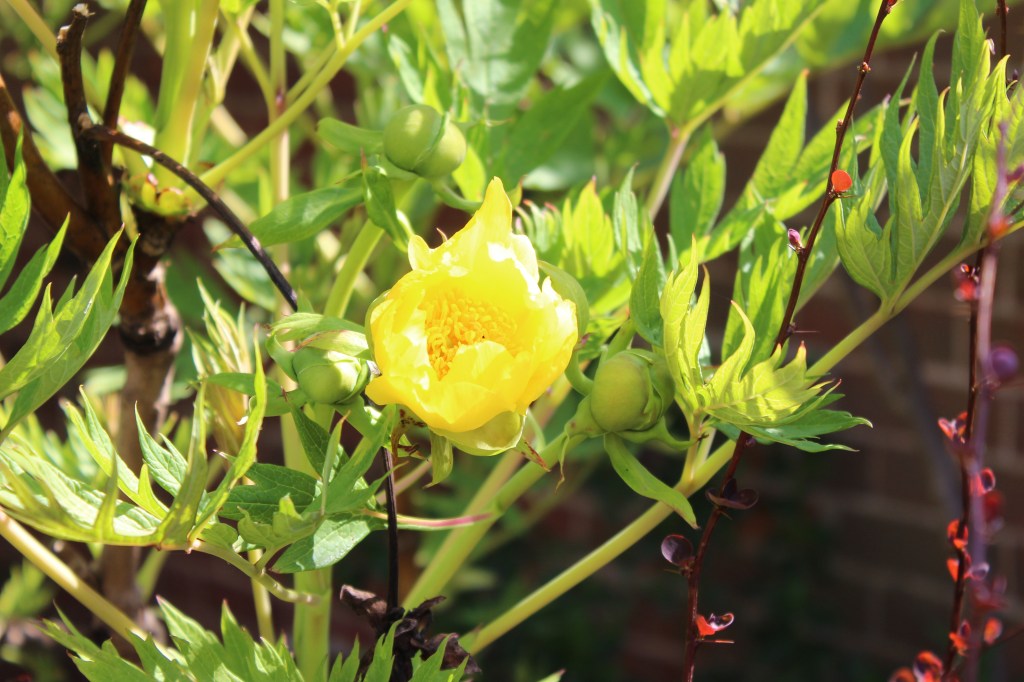
of the tree peony
drip with ice rain,
glittering

While candlelight
and lamplight
are reflected in the glass,
and glow orange in
the darkening grey garden.

And a tumble of birds
comes, and goes,
comes, and goes,
chattering endlessly
on the feeders
that sway in the sharp wind

And if I hold my nerve,
and hold the gardener’s gaze,
even from here I can see
that fuzz of green
on the ice-furzed soil –
Herb Robert, violets,
the tissue-paper yellow
of wet primroses,
and the soft spears
of bulbs just beginning.
Bluebells.  Cerise gladioli.

Outside seems far away.
A different air.
A different light.
But soon my boots
will be on my feet,
and my coat wrapped about me,
and I will feel that frost,
and the cold wind,
and I will feel
the ice rain again.

To keep our spirits up, a reminder of what is to come.