Sunday Retold: Who – The Transfiguration

I’m working away at my collection of poems, The Year’s Circle, weaving together the seasons of the year and the seasons of the readings many churches follow. And we’re coming up to the story we call the Transfiguration – when three of his friends see Jesus in an otherworldly, shining – vision? or what was it? – with Moses and Elijah from the Hebrew Scriptures. It’s a pivot point in the gospel accounts, important and central, and also strange.

Some have interpreted this event as a revelation of Jesus’ true identity, and perhaps a foreshadowing of the resurrection appearances, and perhaps a glimpse of the Universal Christ – a theme explored by Richard Rohr in his book of that name.

As usual, there is no explanation, no interpretation in the gospel accounts. And there’s something about the event which encouraged me to explore the way it asks questions of us – what we think is really real, and really lasting. How we see – do we see glory? Do we see cloud? Those explorations reminded me of the medieval work, The Cloud of Unknowing, and how beneficial it is to be open and patient with things that are beyond our understanding. It feels like a story to sit with in contemplation, expanding our way of seeing, inviting us into a deeper and truer experience.
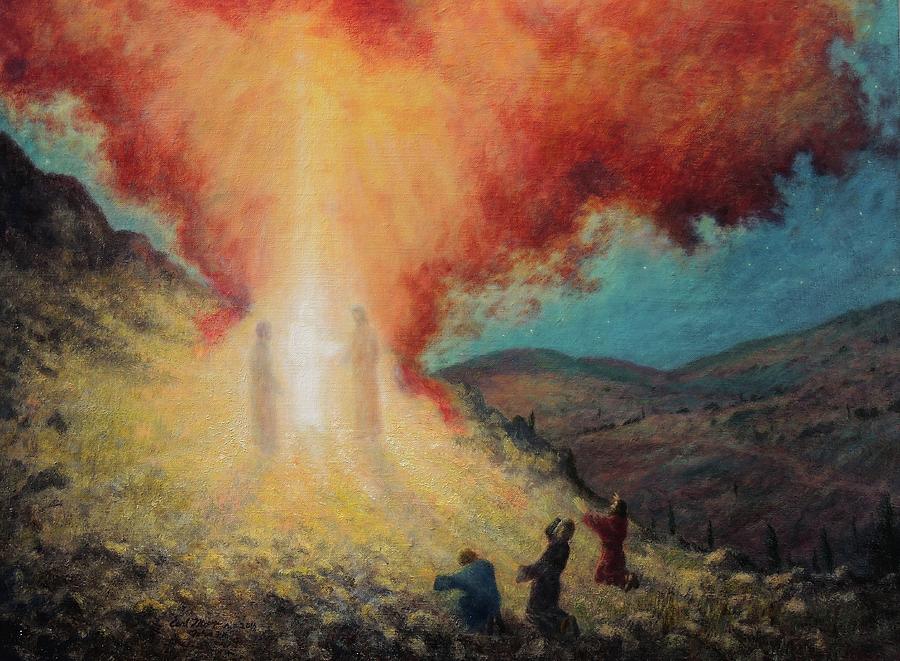
Earl Mott’s painting of the Transfiguration

When I was reading Luke’s account I was struck, as I often am, by his ordering of the events. There seems to be a theme emerging, with questions of who Jesus was, and also, what greatness might mean. And so I wrote a short series picking up those themes and exploring them. There are other events woven through that are not covered by the following sequence of poems – the Feeding of the Five Thousand, for instance – which is developing a sequence all of its own.

If you are looking for something to use in your devotions or public worship for the Feast of the Transfiguration (on 6th August), the parts stand alone, and can be used singly. But I was intrigued by the flow of ideas and wanted some space to ponder them on the page. I began with Herod, troubled and awkward in his guilt, and moved through the stories to the little child, standing in the midst of them.

So, here it is….. four poems following a trail.

Who?
Luke 9, Matthew 16-18

I  Herod

Herod found you a
question he did not
know how to answer.
Perplexed, he heard
whispers that you
were John back from
the dead, a ghost to
stalk his conscience,
shock his dreams,
or the great Elijah,
or another prophet.

He sought you out, he tried
to see you. Perhaps to
ask you who you were.
What might have been,
what could have been,
if he had met you then?

II  Peter’s confession

You asked those who knew you best,
Who do they say I am?
and
Who do you say I am?

To the first, they gave the
answers that blew in the air
like smoke, whispers that
swirled dark around
Herod’s palace, and
through courts and crowds.
John the Baptist, back from the dead.
Elijah. One of the prophets.

And to the second – a moment’s
pause, an intake of breath,
a strangeness rising – to be
asked to name, to more than name,
one they knew daily, and loved,
and still, barely understood.
How to give answer
to such a question?

But Peter did. The vast
words formed in his mouth.
He called you Messiah,
the Christ, the anointed one.


How good it is to be seen,
to be known, to be understood.
How warmed you were by those words.
Enough to give him a new name –
Rock – and a new identity – foundation stone.
For all his impulsiveness, changeability,
you knew him as deeper, and truer.

And yet a sadness enters here.
The anointed one does not
walk in greatness.
The road you will take is
hard and stony. A way of weeping.
And a warning enters too –
those who consider themselves
God’s guardians will subject
you to death, yet death
will not hold you.

Such words cannot
be borne. Such an
upending, a
contradiction,
such pain. 
They fall to the earth
like so many
hard-shelled seeds,
trodden into the dirt
and snatched up by
dark, shining beaks.

III Transfiguration

Sometimes our seeing falls away
and we catch a glimpse of
deeper truth.  We say we see the light

Away from everyday thinking,
on the mountain, in prayer,
weighted with sleep.
Perhaps we see a beloved face
lucent in sudden light.

But here, on this mountaintop,
three friends lifted up their eyes
and saw – what shall we say?
to whom shall we compare him?

Shining like the sun, as white
as light, as bright as lightning –
the one they walked with,
ate with, laughed with.

Was it like the lifting of a veil, or                                                                                                
perhaps a dragonfly splitting his
dark skin to emerge a jewel?
Was it a peering through
the door of heaven, or
coming to see the glory
of things here, and now?
I do not know.
I do know it feels
a moment of endless truth.

And in that moment, Jesus,
Elijah and Moses do
not speak of the glory
that blazes around them,
they talk of the pain that
is to come – as ones
who can understand.
I hope there was some
comfort in it.

Something like comfort
too in the sightless
seeing cloud,
shekinah,
that reveals how we
do not and cannot see –
God is beyond us

And yet is with us,
as close as mist
filling our lungs,
beading on our skin,
as close as one we love.


And then they hear that true voice
speaking tenderly, calling him
beloved, and saying to listen,
to listen to their dazzling friend.

Words they will carry in their hearts,
words which in turn will carry them
on that long wide-eyed walk
down the mountain,
and through all that is to come.

As above, also reference to Isaiah 40

IIII Greatness

It is not what we think.
Greatness is not the pomp,
the power, the show,
the mountaintop.

It is the welcoming of a
little child. It is the being
like a little child.
In doing so, we draw
closer to the one
who calls Jesus
beloved,
the Son I love.

Greatness, a costume
cloak of purple and foil.
Let it slip from your
shoulders. Let it
fall.

As ever, I’m sharing with you work in progress. There may be some tweeks and amendments before things land in the book – Wild Goose, Iona Publishing, next year.
Also, as ever, please feel free to use any of my material that helps, referencing this blog as your source. I love to hear about where my poems fly to, and where they land.

Here is a link to some more I’ve written on the Transfiguration. It includes extracts from my retelling, and some thoughts on how we might come to see more truly. I hope you find it nourishing.

Armando Alemdar Ara, from Liturgy Tools

Sunday Retold, Poem: Ascension

I’m continuing to share with you some poems I’m working on for a new book, The Year’s Circle, which will be out next year – with Wild Goose of Iona Publishing. You can read more about that here.

As I’m settling into the work, I’m finding it so rewarding. I love looking for threads and connections between things, and so I’m weaving together poems which follow the pattern of the church year and poems drawn from nature. I’ve always found the natural world rich with image and meaning, and that is particularly true of the wild beauty of late spring.

This poem has been a bit of a knotty one to unravel, but now I think it’s settled and working. I’m giving it to you a little early, in case anyone is looking for a poem for Ascension (this year, Thursday 29th May) . At the beginning of the book of Acts we find this account of Jesus being taken up, and I have been wondering about what it might mean for us.

I thought first of what it must have been like for his friends, a kind of second losing. They are still caught up in their concerns – they are still thinking of a kingdom with power and borders. And every day, now, we are seeing the pain of kingdoms and borders, the terrible suffering of the people of Gaza and the long history of cause and effect that leads to children, the frail, the displaced and the wounded – starving. It’s shocking and distressing. I find those images fill my inner vision as I read the words of the disciples. And I notice that their nationalistic hopes do not align with the task set them by Jesus.

I have wondered about the complete change in perspective that Jesus seeks to share. I think it might help us, and give us a way of seeing that opens us up to a better way.

He is not speaking of kingdoms with borders. He is sending them out – over borders, without consideration of the divisions between peoples we might make – to the whole earth. A shift in thinking, a higher, more inclusive view. So, in this poem, I try to explore that shift.
The poem has two strands. The experience of Jesus’ friends as he slips away from them, and this wider way of seeing he invites them to share.

Hidden/All things  – Ascension

Perhaps it had seemed a partial
parting, a gradual letting go.

In life, they had lived with him,
travelled dusty roads,
slept under stars,
ate bread and shared a cup.

Then, after that dark Friday,
that bright Sunday, there
came these strange, sudden
meetings, brief comings and goings,
words they found hard
to understand – such
puzzling reassurance.

And still they ate together,
and he spoke of another
presence who would
come to them, be with them.
And despite their questions
of nations and times,
his was always a wider vision.


Always wider and other
Out to the old enemy
and the ends of the earth
Everywhere and everyone

And then at last they came
to this last parting,
and he was taken up
in rolling clouds and
hidden from their sight,
a long perspective
they could not yet share

that saw the whole blue
green turning Earth and all things –
things in heaven and things on earth –
holding together  reconciled
all very good and all beloved.
Above all, beloved.

Acts1:1-11
Colossians 1:15-20

This image is of Gaia by Luke Jerram, when it was at Ely Cathedral. As I’m playing with the arrangement of poems in The Year’s Circle, I’ve placed my poem inspired by this artwork in a group that follows this one on the Ascension – a group that begins to explore our perception of the Earth as an interconnected whole. You can read the Gaia poem here.

And, in the spirit of the original Sunday Retold, here are some passages which might be of interest.

‘The disciples never knew when Jesus would appear among them – but appear he did, telling them more about the kingdom of God, and kindling hope in their hearts.
“Wait in Jerusalem and you will receive God’s gift. You remember how John baptized with water? In a few days, you will be baptized with the Holy Spirit of God.”
Another time they asked him, “Lord, will Israel be a great kingdom again now?”
“That’s not for you to know. The Holy Spirit will come and fill you with power, and then you will tell everyone what you have seen and heard. Start in Jerusalem, and Judea, but then go out beyond Israel to Samaria, and even further – to the whole earth!”
Then Jesus was lifted up, above and beyond the earth, and a cloud hid him…….’

From The Bible Story Retold

Ascension Day
‘Christ has no body now on earth but yours, no hands but yours, no feet but yours…. Yours are the feet with which is to go about doing good, and yours are the hands with which he is to bless us now.’
St Teresa of Avila

From Prayers and Verses

Poems: Seven Sentences from the cross

Elizabeth Frink, at St Edmundsbury Cathedral

Edit: April 2025 I’m sharing this with you again this year, as I’ve noticed that a number of you are turning to these poems as we approach Easter. Thank you. I’m also delighted to let you know that they will be part of my first collection of poetry, The Year’s Circle, which will be out next year. It will be published by Wild Goose. Exciting news!

I do hope these poems are helpful to you as you begin to meditate on Good Friday, and prepare for sharing that time with others – families, groups and congregations. Please do feel free to use and share them, saying where you found them. I love to hear about that.

Below the poems, you’ll find some links to other posts on this blog that you might find helpful too.

Father forgive them, for they know not what they do

We don’t know what we do,
from the careless word that
starts a fire of anger,
to the careless killing
of a butterfly  –
who knows what
wide effects,
what winds and rains,
begin and end with just one death?

We walk in darkness, so often,
and so often, we close our eyes,
we do not wish to know.
And Jesus, seeing this,
that his life would end
with angry shouts,
with fearful washing of hands,
with indifferent playing of dice,
Knowing all this, even so, he bore
our lawful unthinking violence,
our blundering disregard for consequences.
Another would pay for our actions.

Yet as the ripple of our acts flows out,
through the world, who knows where,
so too, now, flows forgiveness,
following on, spreading and transforming,
watering dry ground, lifting burdens
and carrying them away.

2

Truly I say to you today you will be with me in paradise

Even as he hung upon the cross,
even with blood from that false crown
running down, not wiped away,
he saw the two men at his side,

One joined in mocking with the
priests and soldiers,
speaking from his pain,
and one did not, this second kept
his eyes on something else – a hope.

A hope the one he looked on was a king,
and of a kingdom where such things
as crosses are not lifted up,
a hope, even, of an end to death and pain –
this pain, this death.

And, ah, his king begins to speak,
of paradise.
What a world to gift him dying there.
A word of such sweetness, freedom, peace.
See  – clear water flowing, and flowers,
hear the sound of birds, the lazy
buzz of insects, the flutter of their wings.

What a word, at your end, to hold to,
to capture our beginning, once again.
But even more than this,
to be with him, beside the king,
seen and known,
held in the loving gaze of one who
hung up on the cross.
Might this, even this, be paradise?

3

Woman, behold your son. Son, behold your mother

And still he sees, looks down
towards the one who bore him, bearing this,
the pain – not her own pain – worse,
the pain of watching one you love
twisting on those wooden beams,
the nails piercing her own flesh too.

The time has come when all the
treasure of her heart is broken open,
scattered, lying in the dirt.
What use to hold in mind
the words of angels,
the wealthy gifts brought by the wise,
what preparation Simeon’s warning,
when now she sees his agony with her eyes.
But she is not alone, his friend sees too.
John, who writes it down,
bears witness, even here, even so.
They turn their gaze upon each other
and see each other with new eyes –
a mother, and a son.
Gifting them each other –
his one last act of love,
this giving, from an empty cup.
This task of care can be ours too,
to behold each other in our pain,
and in our sorrow, walk each other home

4

My God, My God, why have you forsaken me?

You felt your generous heart forsaken,
you felt the absence of the one who helps,
who was beside you, in the beginning,
who knew you from before first light.

We know too well the sparseness
of your isolation, without light,
and companionless,
in the darkness of our own long night.
And yet, within our dark, we find you there,
Find you have waited for us long days, and years,
while our poor eyes have
grown accustomed to the dark,
have learned at last to see you through our tears.
So as you know our pain and feel it,
you break our separation with your own.
Help us see the forsaken all around us,
invisible and in darkness, but seen by you.
May we seek each other in the dark,
May we have courage to cry out,
like you, and so be found.

5

I thirst

The well is deep, and you have nothing to draw with.
Where now that living water?
Where is that spring within you, gushing up
to fullness of life?
Do you remember, now,
the woman by the well?
Your deepening talk of thirst and water,
as now, again, you humbly ask another for a drink –
this time,
a sponge of sour wine?

Do you remember too, as the taste dries on your lips,
that wedding feast, where water changed to finest wine?
The richness and fullness of that beginning
soured to this cold bitterness.

You are our source, the spring of all our rivers
and still you thirst like us, need help to drink.
And so give us this grace,
that as we do for the least of these,
we may know we do for you.

May we see you
in each thirsty face.

6

It is finished.

All things come to an end.
Even pain like this,
Even the anger and the cruelty of a crowd,
of us all,
even the certainty of those so certain
of God they hang a man upon a tree.
Even the punishment and scapegoating
even violence,
even death.
The work is done.
It has all been borne.
You have poured out your love, your life.
You have carried our sorrows, suffered
under our iniquities.

Your head bowed now, you sink
into the final pain of nails,
your body bears no more,
having borne all.
The work is done.

7

Father, into thy hands I commit my spirit

There is darkness now, deep darkness,
over the face of the deep,
and no hovering like a brooding bird,
instead, the temple curtain torn in two,
from top to bottom,
and the Holy of Holies empty.

God is not found there,
but here, with this dying man
on a tree,
He calls out father, and talks of hands,
and we remember what his own hands have done,
how many were healed by their touch,
raised up and restored from cruelty and death,
and now, he too will be held in loving hands,
a reconciliation beyond our grasp,
a trust even at this moment of last breath.

Dying, he taught us to die,
dying he brought us life.
May we be reconciled, may we know
at our end, the comfort of those hands.

img_0630

The church at Selworthy Green

Bless you


Good Friday Meditation

Other Holy Week readings, prayers and poems

Poem: Water and Dove – Baptism. Sunday Retold

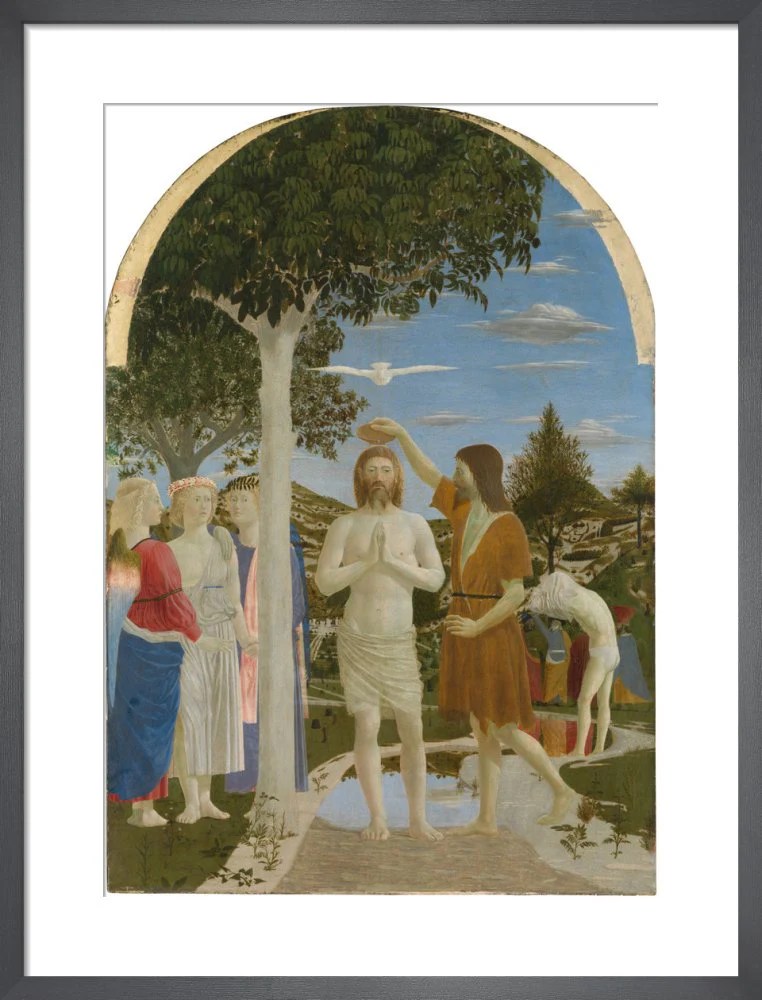
Piero della Francesca, The Baptism of Christ. National Gallery, London.

This coming Sunday many Christian communities are continuing to think of Epiphany, or epiphanies – those moments of clarity, of breakthrough, when you see things anew, or perhaps for the first time. In particular, there are readings to follow which tell us of Jesus’ baptism by John in the Jordan river. It’s a moment when everything seems to change – where we see one who closely resembles a prophet from the Hebrew scriptures, and one who tells us that the Kingdom of God is so close, already among us – standing together in a river. The reading is Luke 3:15-17,21-22. I’m posting a link to the whole chapter, though, as it gives us some very helpful reflections on “What should we do?” as signs of a change of heart, as well as the beautiful and hopeful passage from Isaiah.

I love the picture at the top of this post. I love its lines, its clarity and purity. I have a framed poster very like this one, and see it every day. I’ve often wondered at the river stopping, diverting around this moment of baptism. I assume della Francesca was thinking of the story in the book of Joshua, when the priests carrying the arc of the covenant step into the Jordan, and the waters dry. The people then cross the riverbed. In doing so they leave their time in the wilderness, and it is an echo of the time they entered it by crossing the Red Sea, escaping slavery in Egypt as they did so. This time, crossing the Jordan, God’s presence is suggested by the Arc of the Covenant, rather than the pillar of fire and flame that was with them at the beginning of their journey. It’s quite a change. You can read the story here if you’re interested.

And so, to the poem. As so often, I begin by reading the passage through, several times. I breathe, I wait to see what speaks, what arises, what I feel. And I felt a strong response to the water, and the dove – those natural elements I see myself every day in my own walks by my own river. They moved me. And yet, there was also this background thought of the painting that has formed my imagining of the story. So a poem emerged which is in itself a kind of epiphany, a kind of seeing things in a new way, or perphaps a given insight. I leave that to you, the reader.

If you enjoy following trails, there are some others you might like here, relating to the water and the dove. The first is Jesus’ I am saying – I am the living water. That passage has stayed with me for years. You can read my reflections on it here. And the dove called to mind the story of Noah, and another poem, here. There is more of course, like Jesus washing his friends’ feet. I leave the others to your imagination.

Water and Dove – Baptism

When you stepped into the Jordan,
did the water stop, not daring to
touch your feet – as if
you yourself were the
arc of the covenant,
untouchable, fierce in holiness?
As if you bore within yourself
the whole of the law, the weighty
stones given to Moses? 
The river was in spate then – wild it was,
but it stopped before such fearful holiness.

But I do not see it so. Rather,
I see cool water lapping your feet,
your legs, bathing them clean,
ripples rejoicing, dancing, flowing,
honoured to baptise one
who did not require it,
both water and Son of Man
living out their deep purpose

As the sky opened wide with
tender light, and a white dove
tumbled with the applause
of clattering wings down
to you –  and what then?
Maybe it landed softly
on your shoulder, resting
awhile, heads inclined together,
gently, two wild beings, two beings
overflowing with all love divine.

And so love spoke forth
with delight,
love pouring over you
like the cool water,
river water, living water
like the endless light,
and the softest
brush of feathers
from the wings
of a dove.
Endless,
life-giving
love.

Sunday Retold

If you’ve been joining me here on the blog for a while – thank you, I appreciate your company – you’ll be aware that I have a very occasional series with material from a couple of my books which follow the Sunday readings many Christian communities use. In particular, my retelling, The Bible Story retold in twelve chapters. Recently, I’ve been doing this fresh writing, with a poem, too. But here are some pieces you might find helpful. If you’d like to use any of my material, please feel free to do so, giving this blog as a source. If you’d like to publish it in some form, please do get it touch. Thank you.

For John taught them to hope. In his words, they caught a glimpse of something beyond their everyday lives. They understood that John that Baptist was preparing the way for something, or someone, astonishing.
“I baptize you with water, as a sign of your rependence: your turning back to God and his ways. But wait. There is one coming after me who is so much greater. I am not even worthy to carry his sandals for him. And when he comes, he will baptize you on the inside with the Holy Spirit and with fire. He will sort out the good from the bad, the wheat from the chaff!”

Then Jesus came down from Galilee in the north, and walked through the crowds toward John. John knew Jesus was the one they had been waiting for: the Messiah. Was Jesus really comng forward for baptism like everyone else?
“No!” said John, stepping back. “I need to be baptized by you – and yet you come to me – why?”
Jesus replied, “I must do everything that is right, and it is right to be baptized.”

And so John agreed, and they stepped out into the flow of the Jordan. Jesus went down into the cool water, and was baptised.

As he came up the bright sky broke open, and the Spirit of God came down gently and settled on him like a dove. A voice from heaven said, “This is my Son, the one I love, the one who brings me joy. I am very pleased with him.”
From the Bible Retold

Come, let us follow Jesus, who loves us.
From Prayers and Verses

The picture of birds over water (behind my name) is of the Wash at Snettisham RSPB. You can read more about that here.

Sunday Retold: Christ the King

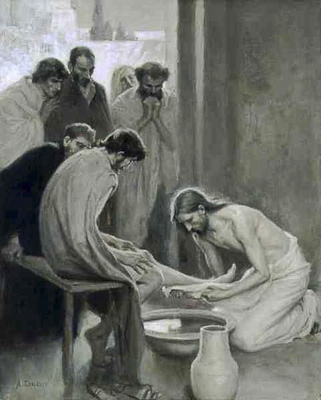
Jesus Washing the Feet of his Disciples, by Albert Gustaf Aristides Edelfelt, (1854-1905)

This week, I thought I’d share with you my retelling of the reading many churches will be following this Sunday, in the spirit of Sunday Retold.

It explores themes of power, and so follows on from last week’s poem, Stones.
This week’s reading is that electrifying encounter between Jesus and Pontius Pilate – a trial of sorts. For the flow of the storytelling, I’ve taken a longer sweep than the set reading.

So here’s the story from The Bible Story Retold

At the same time, as dawn was breaking, the council gathered – elders, chief priests, teachers of the Law – and faced Jesus.
“If you are the Christ, the promised one, then tell us!” one said, rolling the words around his mouth as if they were bitter to his taste.
“If I told you, you would not believe me,” Jesus replied, holding him in his steady gaze.
“Are you the Son of God?” they asked.
“You are right to say so.”
At this they rose to their feet with an angry roar, and carried Jesus off to the palace of Pilate, the Roman governor, who had power to sentence people to death.
“This man is a threat to the peace – he claims to be Christ, a king, and opposes Roman taxes,” the accusers called out as Pilate circled around Jesus.
“Are you the King of the Jews?” he asked. Jesus felt the cold edges of the mosaic under his bare feet.
“Yes,” he replied. “But my kingdom is not like the kingdoms of this world.”
“So, you are a king!” Pilate responded.
“Yes! That is why I came, to speak the truth. Everyone who is on the side of truth will listen to me.”
“But what is truth?” Pilate asked. Then he went out to see the leaders and the people together. “I see no reason to charge him,” Pilate said. “This man has done nothing to deserve death. I will set him free.”
“No, set Barabbas free instead!” they cired. Now, Barabbas was a rebel who had killed a man.
They shouted louder, drowning out Pilate’s words: “He’s done nothing wrong! I will release him!”
But, with rising rage, the mob shouted, “Crucify crucify!” In the end, Pilate gave in: he set Barabbas free and handed Jesus over to the guards.
The guards tormented Jesus, the one called king. They draped a fine, purple robe around him, and twisted him a crown of sharp thorns to wear. They called out, “Hail, King of the Jews!” and fell on their kneeds before him, laughing. They spat on him, and struck his head with a staff. They, they took back the robe, and led him out to be crucified in his own simple clothes

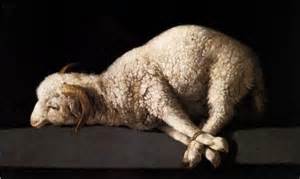
Francisco De Zurbaran

We see how those who held religious power allied themselves with the Imperial power of Rome. I expect they were sure they were being faithful, upholding the law and their traditions, defending their faith as they saw it. Being certain you are right can lead you very astray. And we see too how Pilate saw Jesus very differently, one who had done nothing wrong, and yet seemed to have little power in the face of an angry crowd.

The biggest difference of all, to my mind, is in the understanding of what power is, what a kingdom is, who a king is. Those who are embedded in the power structures of this world, and, to be honest, the rest of us too, find it hard to imagine a different kind of power. One that follows a path downwards, even to death. One that washes the feet of the followers, that does not insist on its own place, but instead works through love, in humility, in radical engagement with the world as it is. We will soon be in Advent, preparing for the coming of Jesus. At that time we think of his unity and solidarity with frail humanity, born in such a humble way, amongst the extraordinary, ordinary, beloved people of Bethlehem.

Lord Jesus,
May our lives bear the mark of love.
As we are kind, as we share, as we are gentle,
may your love be seen in us.
Help us, for this is hard for us.

Dear God,
May I welcome you as my king:
King of peace,
King of love,
King in death,
King of life.

From my book of prayers to accompany The Bible Story Retold, Prayers and Verses


Poem: Stones. Sunday Retold.

The open doorway of St Peter-on-the-Wall (founded about 660 AD). The wall in question is Roman. The chapel was built using some of the old stone from that wall. Bradwell, Essex.

I took a look at the set readings for this coming Sunday (17th November), and they are difficult and unsettling. Something about the Gospel reading caught my attention, and I thought I’d follow where that led.

Mark 13:1-8

 And as he came out of the temple, one of his disciples said to him, “Look, Teacher, what wonderful stones and what wonderful buildings!” And Jesus said to him, “Do you see these great buildings? There will not be left here one stone upon another that will not be thrown down.”

And as he sat on the Mount of Olives opposite the temple, Peter and James and John and Andrew asked him privately, “Tell us, when will these things be, and what will be the sign when all these things are about to be accomplished?” And Jesus began to say to them, “See that no one leads you astray. Many will come in my name, saying, ‘I am he!’ and they will lead many astray. And when you hear of wars and rumours of wars, do not be alarmed. This must take place, but the end is not yet. For nation will rise against nation, and kingdom against kingdom. There will be earthquakes in various places; there will be famines. These are but the beginning of the birth pains.

Once again in our world, we see wars, we see power misused, we see the places where we might put our hope and trust are frail. Just this week, the Church of England has been forced to reckon with terrible abuse that has taken place, and the failure of those in authority to protect the young. And COP 29 has opened with the absence of many leaders, and the presence of corruption – although I have been encouraged to see Kier Starmer taking a lead. Much that has seemed firm has been crumbling, and at the same time, forces which seem to be serving themselves seem very powerful, immovable. It’s a hard place to be for many, and we may need to give time to our fear and grief. We may need to find others with whom to walk through these hard places.

And so, turning to this reading, I see we are invited into something like a practice of deep realism, and a long view. We remember that for Mark’s early readers and listeners, this passage would call to mind the terror and trauma of the destruction of the Temple in AD 70 after a relentless seige by the Romans. The Roman historian Josephus records that 1.1 million people died during that time. It’s hard to imagine the suffering and shock of such loss. It must indeed have felt the end of the world. It was the end of the world for many. Even in the midst of such terror and shock, these words may have offered something to hold on to. Maybe there is some wisdom here about how to live through difficult times, when all seems destroyed, or we fear all may be destroyed. Such wisdom is arrived at through pain and loss, it is not intended as some kind of spiritual bypassing, that eveything is going to be fine. Everything is not fine. That much is clear.

So this poem, written in response to Jesus’ words, is an experiment in that long view. I hope that, if it lands with you at the right moment, it might resonate with you.

Stones

These beautiful stones
This beautiful Temple
all that wealth and power
all Herod’s might and posturing

Always, always can
and will be
thrown down.

And always, always, it is not
the end of all things
although it is the end.
For time still stretches out
among ruins lost to
twilight,
and dust settles, or
blows on the grey wind.

Strength seems invincible.
Stones seem solid, immovable.
The might and ritual of a temple
have such sure foundations
in the mind.

And yet time, wind, whispers,
armies, the running of water,
the roots of trees can and will
undo them all.

So do not be cowed
by these great walls,
for they will fall,
nor by their falling

For fall they must,
and the world will turn
and turn again, and what
was an ending may come
to seem the blowing of dry
leaves in autumn, an absence –
it may even, dare we hope,
begin to be birth-pangs, after all.

Gaia at Ely Cathedral. You can find more about that – including a poem – here.

You might enjoy this gentle conversation(Nomad Podcast) with the the musician Jon Bilbrough, known as Wilderthorn. Towards the end is some music recorded in the chapel pictured at the head of this post, St Peter-on-the-wall.


I’m turning back to that chapel in my mind – imagining how the stones from the old Roman wall, probably a fort, were reused in the building of this – itself ancient – place of peace and prayer.


Swords beaten into ploughshares, and things being made new.

New things can and do emerge, in time. That is something we can gather around, and work for.

From Prayers and Verses These are prayers in response to the stories of Exile we find in the Hebrew Scriptures, and I know that experience will resonate with many today. I hope this helps.

Poem: Jacob’s Dream and Awakening. Sunday Retold.

Hello. This week I’ve been taking a look at the readings many churches follow on Sunday, and found something coming up this week that has sparked my interest, and led to some contemplation. A poem has emerged, as they sometimes do. I’m not sure I can say it’s finished, but it is settled for now, and I’d like to share it with you. Those who have been looking at this blog for a while – thank you – may remember that I’ve a thread running through it called Sunday Retold, which includes extracts from my book, The Bible Story Retold in Twelve Chapters.

Jacob's ladder

This beautiful illustration by Sophy Williams is from another edition of the same text, published as The Lion Classic Bible

Here’s my retelling of Jacob’s dream:

Jacob went alone, travelling until it was dark.  Shivering in the chill of the desert night, he took a stone for a pillow, and lay down to sleep.  As Jacob slept, a dream came to him.  He saw a ladder, with its feet on the ground, stretching up and up to heaven.  In his dream, he watched as God’s bright angels travelled up and down in between heaven and earth.  And in his dream, God himself was there……

Jacob woke with a jolt and looked around.  He was alone.
“God was here and I didn’t know it!  This place is the gate of heaven!” he said  Then he took the stone he had slept upon and set it up as an altar to God. He poured oil on it as an offering, and worshipped there. Starting out once more, he left his homeland far behind.

You can read the original here, Genesis 28: 10-17, it’s the set reading for this week. It’s a story which has spoken to many over the centuries, revealing depths of meaning. For me, this time, I was struck by the way comfort came to one who was a fugitive, who had lost all that was precious to him. It also speaks to me of how our perception can shift, and we can be illuminated with a new understanding, how we can find the simplest things holy.

Jacob’s dream and awakening

Night can fall suddenly
on the road, when alone.
Darkness sweeps in
like a flood,
and one who lived with
others, a dweller
among tents, is out
in open country now.

Alone, he chooses a stone
and rests on cold rock

And finds that to the fugitive,
the lonely, the guilty one,
dreams may come.
And company, too, of sorts –
strange, perhaps luminous –
angels ascending and
descending

And a presence, such a presence,
that is here, and now.
One who is above the angels,
and right beside him, and speaks
with that deep resonance
that comes through dreams.


Perhaps those away
from the knottiness and rush
of their own mind can
know that this stone,
and so every stone,
is the gate of heaven,
shining with oil.
That this place, and so
every place,
is where God is

That this dream-night
can change the day-heart
of one who walks away.
For even the stones have a
sheen of brightness now,
wherever they are.

From my companion collection, Prayers and Verses through the Bible

If you’d like to use any of my material, please feel free to do so, acknowledging this blog as the source. It’s always a great encouragement when people let me know where my writing has been read.

Poem: Empty/Water into Wine, Sunday Retold

Mike Lacey – Glass

Hello, welcome back. This week, I am combining two things I sometimes do: Sunday Retold, and a poem drawn from the reading. For those who follow set Bible readings through the weeks, we’re still in the season of Epiphany, when we look at moments of understanding and revelation. And this Sunday, we’re meditating on the first sign recorded in John’s gospel, which took place at a wedding. As I was reading it, the image of those stone water jars filled my mind, and I’ve attempted to turn my meditation into a poem, below. I thought I would share it with you even though it’s so new, in case it helps you or prompts you in your own reflection. 

So, first the reading, then the poem:
John 2:1-11

On the third day after Jesus called his disciples, Jesus went with them to a wedding in Cana, near Lake Galilee. The whole community was there, eating and drinking, dancing and laughing, blessing the young man and woman who were starting their life together. But Jesus’ mother, Mary, noticed that the wine had run out and said to her son, “They have no more wine!”
“Dear mother, why are you telling me this? Now is not my time.”
But later, Jesus spoke to the servants. “Fill those jars with water!” he said. For there were six large stone water jars nearby – the sort that were used to store the pure, fresh water the Jewish people used to cleanse and purify themselves before worship. The servants filled the jars with water and, puzzled, dipped their serving jugs into the newly filled jars. They poured some out for the host, as Jesus had told them.
Then the host called the bridegroom over, a broad smile on his face. “By now people are usually serving the rough wine – but this wine is really good – wonderful! You’ve kept the best till last.” He gulped another warm mouthful of the wine that had been water as the servants served the wedding guests.
Jesus had taken the water from the stone jars and turned it into fine wine. When his disciples saw what had happened, and saw the servants pouring out new wine for all the guests at the wedding, they gasped in wonder. They had caught a glimpse of Jesus’ glory, and the glory of God’s kingdom. The disciples put their faith in the one who turned water into wine.

The Bible Story Retold

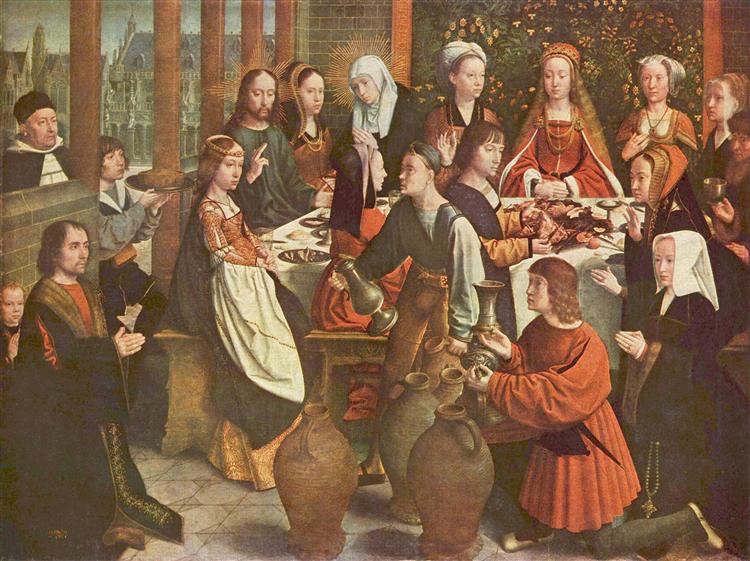
The Marriage at Cana, Gerard David

It’s a beloved story, often shared at weddings, its many layers rich with meaning. I tend to find that something strikes me in particular, draws me in, and this time it was those empty stone jars. So, here is a poem that grew out of turning the image of those empy jars over in my mind. There is much else that could be said, but today, it’s simply this…..

Empty/Water into Wine

Those empty stone jars,
I see them – pale grey,
with a film of dust, leaning
against the wall, overlooked,
unregarded as the wedding
rolls on, music and dancing
and laughter sending tiny
tremors through their hollowness.

Six of them, as empty as
days can be, an emptiness
we know by taste, our dry mouths
rimed with fine powdered stone.

And this is where you began
your work, with these empty jars. 
Had them filled
with cool water –
so far, so expected.
For purification, cleansing,
the couple’s, the town’s,
love and life,
as the wise look on, nodding,
sure that they have your meaning.

Oh, how you delight in upending
expectations, traditions.
What was drawn from these jars
was not water for making pure,
but the red bubbling joy
of good wine, poured and shared,
for the delight of all gathered,
for the blessing of love, and union,
uproariously, and without fanfare.

After three days, this is the glory
revealed, this is what it means
to be full of grace and truth,

To have our days, our beings,
filled with water, only for it
to poured out as fine vintage,
only for it to be transfigured,
transformed, as wondrous
as the grapes on the vine,
as wondrous as a day,
a life, so open to joy.

If you would like to use the poem or reading, please feel free to do so. I’d appreciate it if you mention this blog and my name is doing so.

Sunday Retold: A voice in the darkness – the boy Samuel

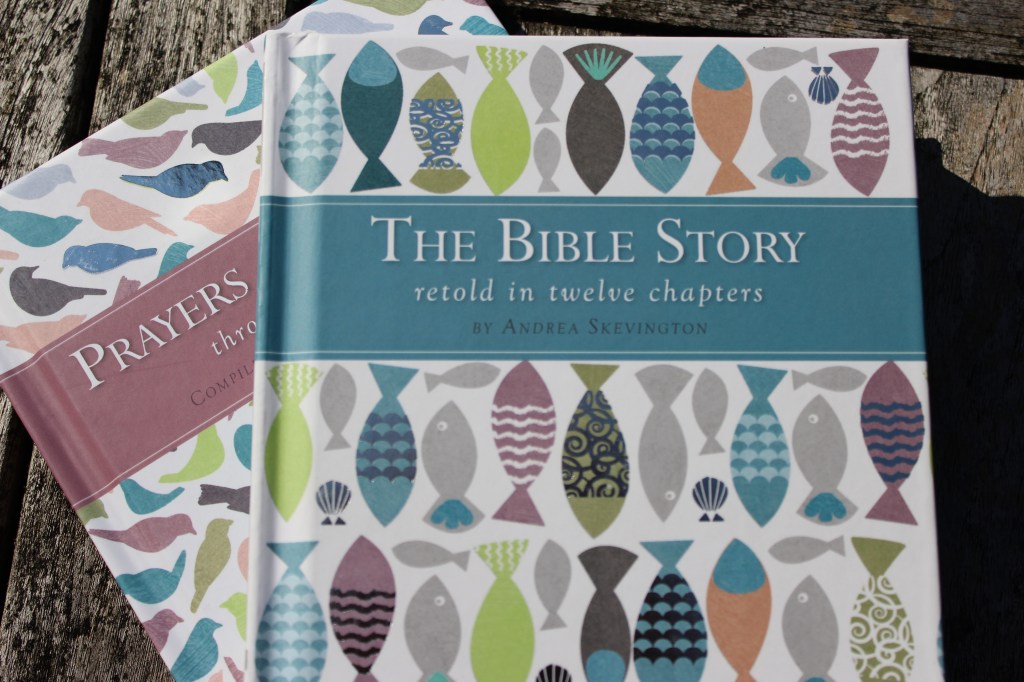
This New Year, I’m picking up the occasional series, Sunday Retold. Many churches follow a set pattern of readings, so communities up and down the country are gathering around the same stories, the same prayers, and meditating on them together. Often, at least one of the passages appears in my retelling of the Bible, The Bible Story Retold, and so it seems a good idea to share that with you. If you’d like to use any of the material on this blog please do, and please say where you got it from. My books should be available to order at all the usual real life and online places.

Samuel Dedicated by Hannah at the Temple by Frank W.W. Topham

Anyway, this week is a story often shared with children – at least in part. The central character is the boy Samuel, son of Hannah. He was a much longed for child, who was given to the service of God in the temple at a very young age. Eli, the priest, was given charge of him.

The set reading is 1 Samuel 3:1-10, and here is my retelling:

The boy Samuel learned how to serve God in the shrine. And he slept by the lamp of God’s presence, close to the holy ark of the covenant. One night, in the darkness before dawn a voice called out,
“Samuel, Samuel!” So Samuel got up and went to Eli, who was ond, with failing eyes.
“Here I am! You called me!” Samuel said. Eli stirred.
“I didn’t call you! Go back to sleep!” So he did. But there was the voice again.
“Samuel, Samuel!” The boy got up again and went to Eli.
“You called, and I came!”
“No I didn’t call you. Go back to sleep.” But, when Samuel woke Eli a third time, he wondered what this voice could mean. Perhaps God was speaking.
“Go back and lie down. If you are called again, say, ‘Speak, Lord, your servant is listening.'” So Samuel went back to bed and lay there, waiting, hardly daring to breathe.
“Samuel, Samuel!” came the voice. Samuel remembered Eli’s words.
“Speak, Lord, your servant is listening!” And so God spoke to Samuel. God said that the right to be priests would be taken away from Eli’s family, because his sons had donw wrong, and Eli had not stopped them. They would be punished. In the morning, Samuel had to tell his tacher what God had said. ”God is God, and will do what is best!” Eli sighed.

From The Bible Story Retold in Twelve Chapters

Often, when this passage is shared, the empasis falls on listening to God’s voice, and being ready to respond. We’ll get back to that in due course, but for now I’m following my immediate reaction to this passage today, and how it might help us navigate this difficult new season we’re in.

Samuel in the Temple by David Wilkie

What a message for a child to have to deliver to their high-status, powerful teacher – you and your line have fallen short of the standards expected of you, and your position will be taken away from you. It must have been terrifying for Samuel to have to speak up, even with Eli’s encouragement. I can imagine him shaking in his sandals. Although this story is often a Sunday School favourite, I don’t think many teachers and others in authority would be bold enough to encourage youngsters actively speaking up in condemnation of their elders. And yet, as so often, these stories show God’s leaning towards the powerless, the young, the outsider. So often, the perils of power, and the shortcomings of those who practice it, are central to this counter-cultural narrative. Indeed, as we follow on with Samuel’s story, of how the people of Israel ended up with a king, we see that pattern all the more strongly.

As a story of a child challenging conventional ideas of power, and who has it, the story of the boy Samuel sits well in the season. It’s one of the Epiphany stories in which the rich, the wise, the powerful humbly bow before a mother and child in a simple, working house. It also follows on well from Mary’s radical song in the early stages of her pregnancy, which in turn draws on the words of Hannah, Samuel’s mother, when she leaves her son in Eli’s care. I love the dense connections which imaginatively weave all this together, so rich patterns emerge from the threads. I love the way the lectionary puts things near each other, and then sees what connections and conversation arise like a good host.

And so, back to what struck me today on reading this passage – the wisdom of the child, the going astray of the elders and those in power. I thought of the prophesy “And a little child will lead them” (Isaiah 11.6), and how, today, the young who lives will stretch out far into this century are trying to shake us awake, to speak to us of those things which they care about and will affect their lives and the lives of their children. They see that the way we are living is doing harm, they see the injustice and the destruction more clearly than those of us who may have become immured to it. They see that the structures of power seem to protect the powerful and ride roughshod over those whom the scriptures speak highly of – the widow, the orphan, the outsider, the poor, the young, the old. We need those in power to be humble enough, like Eli, to hear their voices, and to act in their interests. Intergenerational justice is a concept that is coming alive now – especially in terms of debt, and the damage to the ecosystems on which we all depend. We need to pay attention to those who have no voice, and give due respect to the rest of the natural world, as well as to the young. Can we, at the beginning of this year, resolve to notice our natural bias towards the rich and powerful, and seek to listen to the young and the powerless? I think that would be good for us all.

Gaia at Ely Cathedral

Here in the UK, many have been moved, outraged, saddened and stirred to speak up by the ITV drama, Mr Bates vs The Post Office. It was a powerful drama, compassionately acted. I am always curious, though, about things which really catch the public mood – why this, why now? And I think part of it is the theme of people with power who feel immune and distant from the consequences of their actions, who listen to each other rather than to ordinary people – in this case their employees. I think there is a rising sense of injustice about how some are gathering so much to themselves, while others are stripped of what they have, and what they might come to have in the future too. And this injustice reminds me of the words of the prophets, including the child Samuel.

Of course, this passage carries many meanings, and this critique of power is one amongst many – but it is one that chimes with the biblical narrative as a whole. When we’re thinking of how we might live by it, another question naturally arises – how do we know, in a world of so many voices, which ones to heed? In this passage it is Eli who wonders whether the voice might be God. Yet history is littered with terrible tales of those who were convinced they were acting for God, or doing what was right, and going horribly wrong. Often the very worst things are done by those who claim good motives. And that should give us all pause. I touched on an exploration of this theme in my book, “Jesus said, I Am. Finding life in the everyday” in the chapter on Jesus, the good shepherd, when he talks about the flock knowing his voice.

Of course, knowing the voice, and distinguishing it from the voices of those who would lead us to harm, is no easy thing. I think it helps to come to a place where we don’t see the path ahead of us as a narrow tightrope – one false move and we are lost – but that we look for the relationship, and recognise the freedom to walk behind the shepherd, listening for the voice.
…….
History is full of the mistakes people have made, thinking they are doing the right thing but going terribly wrong. I do not ee us going so wrong when we seek to follow the way of love, seeking to keep our eyes fixed on Jesus, and learning from him.

And so, noticing the topsy-turvy nature of the gospel, the way things are not what they seem, let’s be ready to listen, be ready to respond to those promptings and quiet voices which would guide us better than the pomp and power and authority which make so much noise and show.

Dear God,
When we hear a mighty wind, strong enough to shatter roci,
when the ground underneath us shakes like an earthquake,
when fire comes from mountains,
help us to know these sounds of power and anger are not your voice.
Help us to listen in the silence for your whisper.
Help us to wait for your whisper

Prayers and Verses

The third Sunday in Advent – Joy

Ely Cathedral’s powerful statue of Mary, by David Wynne

As we approach the third sunday of Advent, the word we turn to is Joy. And, as part of that turning to joy, many also remember Mary. In particular, her response to the angel’s message when she was invited to participate in this story of “God-with-us”… but more on that later.

As I look at this statue, I find Mary’s stance compelling. It is open and powerful, it feels like a “yes” which accepts and trusts what will be, even if it is beyond the mind’s understanding. Pictures of Mary often show her looking more afraid, more passive. This work captures a moment of glorious, positive choice. But there is something else. The slight downward tilt of her head seems to acknowledge the difficulties caught up in this acceptance, and the enormity of that choice. There is awe and vulnerability here too – vulnerability captured in that bare foot peeking out.

Here is the story, from my book The Bible Retold

Among the fields and vineyards of Nazareth, in Galilee, lived a girl named Mary.  She was soon to be married to Joseph, a carpenter, who could trace his family back to David, the shepherd king.

Then, one day, astonishing news burst into Mary’s quiet, hopeful life.  The angel Gabriel came to her with a message.
“God is with you, Mary!” Mary gasped, and fell to her knees.  “Don’t be afraid. God smiles on you!” The angel spoke the astounding words gently, lovingly. “You will have a son and name him Jesus.  He will be called great – the Son of the Most High God! The Lord God will give him the throne of his ancestor David, and his kingdom will never end!”

For a moment there was silence, as Gabriel’s words filled the air – and Mary’s mind. “But how can this be, as I am not yet married?” Mary asked.
“God’s Holy Spirit will enfold you.  Your child will be holy.  Even Elizabeth, from your own family, is going to have a child, despite her age! She is now in her sixth month.  So you see, nothing is impossible with God!”

Mary raised her eyes to Gabriel’s face. “I am God’s servant. Let it be as you say.” And the angel let her alone, her mind spinning with the strange words.

Then Mary thought of Elizabeth. “The angel knew all about her – I must go to her.” She got ready, and set off quickly for Elizabeth’s home in Judea to the south, near Jerusalem.

As soon as she arrived at the house, she hurried to Elizabeth and took her hands.  At the sound of Mary’s voice, the baby leaped inside Elizabeth, and the Holy Spirit filled her.  She understood at once what had happened to Mary.

“You are blessed among all women, and blessed is your unborn child!” she said. “Why have I been so honoured? Why should the mother of my Lord God come to visit me?” Elizabeth laughed, and put Mary’s hand on her belly. “You see how my child leaps for joy at the sound of your voice?”

Then, Mary speaks out extraordinary words, which in turn echo the words of Hannah when she said goodbye to her long-awaited son, Samuel (I Samuel 2) . You can read Mary’s words – the Magnificat – in my version here, and also more about Mary and Elizabeth’s time together.

img_0773

It strikes me how deeply Mary entered into uncertainty, with her acceptance despite her questions – “how can this be?” She is setting out on a path that will cause her pain, but the angel’s words focus on a bigger picture, an unknowably big picture. There is a vision of what will be, the good that will come from her choice. There is tenderness and reassurance here as she asks the question, honouring her uncertainty, the impossibility of comprehending what this may mean. And there is also a gentle, tactful suggestion of a path to be taken. A path to her cousin Elizabeth – who is also caught up in this great bursting through of hope and joy into a world marked with difficulty and pain. And that path will bring her companionship with someone who will believe her, and will support her, and to whom she can offer love and encouragement in turn.

Sometimes, during Advent, we are also reminded of John the Baptist – Elizabeth’s son – and his question to Jesus when he was in prison: “Are you the one who is to come, or should we expect someone else?” You can read the account here. What I love about this reading is the way Jesus reassures John in a way he will understand, echoing the prophet Isaiah. There is a tenderness and deep compassion here too. We can almost hear an echo of their mothers’ relationship in this question, this uncertainty, and this reassurance. Jesus then goes on to speak to those listening who may, we presume, be shaken by John’s question – or critical of him for doubting. The compassion of Jesus’ response can reassure all of us. It is hard for us to understand, and doubt and question and uncertainty are here embraced and not feared.

So our focus on joy is one where joy can be experienced despite our frailties and uncertainties. It does not come with knowing the answers, having things all neatly wrapped up, but in the courage to enter into the mysterious life of something beyond and greater than ourselves. Perhaps here is the only place it can be found.

We mentioned Isaiah above. Here is part of the passage paired with the reading about John in the Church of England readings for this week. You can read it all here.

The desert and the parched land will be glad;
    the wilderness will rejoice and blossom.
Like the crocus,  it will burst into bloom;
    it will rejoice greatly and shout for joy.
The glory of Lebanon will be given to it,
    the splendor of Carmel and Sharon;
they will see the glory of the Lord,
    the splendor of our God.

 Strengthen the feeble hands,
    steady the knees that give way;
 say to those with fearful hearts,
    “Be strong, do not fear;
your God will come,
    he will come with vengeance;
with divine retribution
    he will come to save you.”

 Then will the eyes of the blind be opened
    and the ears of the deaf unstopped.
 Then will the lame leap like a deer,
    and the mute tongue shout for joy.
Water will gush forth in the wilderness
    and streams in the desert.
 The burning sand will become a pool,
    the thirsty ground bubbling springs.
In the haunts where jackals once lay,
    grass and reeds and papyrus will grow.

 And a highway will be there;
    it will be called the Way of Holiness;
    it will be for those who walk on that Way.

Once again, we have a vision of how the world could be, restored and flourishing. A highway through the wetlands bursting with life, and even those who lack strength and steadiness will walk it.

We so need this vision of restoration and abundance. We need this vision of life and joy, of a better way of being in the world. And then we need to walk into it. We can be part of bringing it into being.

We thank you for being born among us,
sharing with us what it is to be human.
we thank you for showing us a way to live,
full of grace and truth.
Light up our path, and let us walk with you.

From John 1

From Prayers and Verses

This image has an empty alt attribute; its file name is img_0942.jpg

I’ve just discovered the beautiful Waterlands podcast from the Wildfowl and Wetlands Trust, which is relevant to the greening of barren places. Why not listen?