Barns

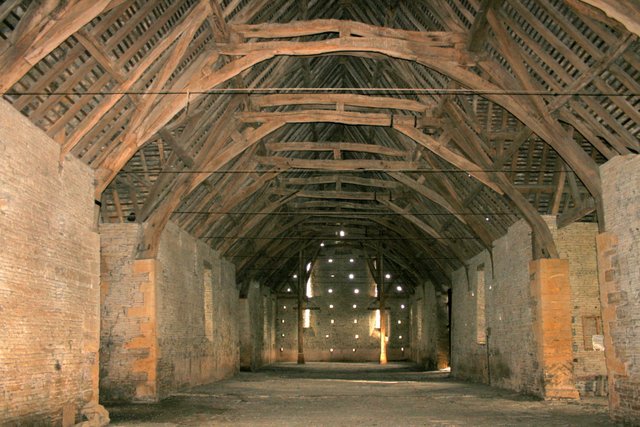
Middle Littleton Tithe Barn

Middle Littleton Tithe Barn, National Trust

barleyfield

Lectionary reading for Sunday, 31st July – Luke 12:13-21

The fields are golden now, and the recent heat has ripened the grain.  The barley is being harvested, the wheat waits a little longer.  It is good to see food grown and treated with care. Full barns help through the winter, as they have for generations.

So, now, as harvest is happening, as barns are being filled, as heavy machines trundle through the Suffolk lanes, the Church calendar gives us this story to consider – a warning against greed.
This story is a profound challenge to those of us now with full cupboards, stuffed wardrobes, too many shoes.  It is unique to Luke, where it is followed by “do not worry….”, reminding us that the ravens have no barns, and yet are fed.  The two together form a call to a simplicity of life, and a reliance on God, that is at odds not only with our society, but with our instinct.

Let’s go back to the beginning of the story.  Jesus is asked to intervene in a quarrel between two brothers – and, characteristically, does not. It is interesting to note how many times Jesus is invited to act as judge, and declines.  Instead, he often shines a light on the motives of the one asking him to do so, the one who is sure he is right.  In this case, the motive seems to be greed.  Greed needs to be guarded against, to be actively resisted.  Jesus seeks to turn on its head our notion that life is measured in the abundance of possessions, that life consists of stuff.  We often talk as if this were a new, modern phenomena, this way of looking at life.  Clearly, it is not.

Clearly, though, it is a danger we are facing this day, now, as we are besieged from the outside by the call of so many things, and experience within ourselves the desire for them, as well as the tendency to judge and measure and compare our things with the things of others. I am not sure we have a contemporary word which quite  expresses the old idea of”covet” – the last of the ten commandments prohibits it, even so.

From The Bible Story Retold

One day, when Jesus was speaking to the crowds, someone stood up and said “Teacher, tell my brother to share our inheritance – to divide up the family land fairly!”  Jesus said “Who made me an umpire in your squabbling match?”  Then, he said to the crowd, “Watch out for greed – it can sneak up on you.  Your life is about much more than what you own.

“Once there was a rich man, whose fields were full of ripe, golden grain, ready to harvest.  When it was gathered in, there was so much grain that his barns were creaking and straining with the weight of it.  He couldn’t store any more.  This troubled the farmer – for he wanted to keep it all. ‘I know!’ he said to himself with a smile. ‘I’ll tear down these barns and build big new ones, then I’ll live the high life! I’ll fill my belly and drink my wine and have a good time!’

But God didn’t see it like that. ‘You fool!  You are going to die tonight – then what will happen to all your fine things? They won’t be any use to you then!’” Jesus looked at the people gathered around him. “That’s how it is for anyone who stores up things for themselves, leaving no room for God!”


The distribution of the harvest is an essential matter of social justice.  We remember the story of Ruth, the provision of gleaning rights for the poor and the foreigner. We remember the bias towards the hungry we encounter in the Hebrew Scriptures.  Full barns can be a blessing for the whole community.

Jesus reminds his listeners of the purposes of plenty, and of the life-corroding effects of greed.  It is not easy – but wherever we are, we can begin.  We can begin to hold things lightly, to remember that all belongs to God, that where we have, we can give, and bless, and meet the needs of those who have less.  We can begin to pass on something, one thing.  We can come to know the lightness and freedom of this generous, open way of living.

To give is an act of resistance against our own capacity for greed. Giving, sharing, and working for justice, are powerful.  They can transform all involved. Perhaps, as we enact this different way of living, we can begin to see how it can make room for God – God who is love – generous, gift-giving, open-handed love.

I wrote the following prayer in response to the feeding of the five thousand, where the crowds were fed far from shops and barns.  It seems to follow on from this story, too.

From Prayers and Verses

Lord Jesus, who broke bread beside the lake and all were fed,
thank you for feeding us.
Lord Jesus, who asked his disciples to pass food to the crowds,
may we do the same.
Lord Jesus, who saw to it that all the spare food was gathered,
may we let no good thing go to waste.
Lord Jesus, who gave thanks,
we thank you now.

If you would like to use the reading and the prayer, please do so, mentioning the source.

The Good Samaritan

The good samaritan

The Good Samaritan  Vincent van Gogh

So, this week, we are surrounded by political and economic uncertainty after the  UK’s Brexit vote.  In a national climate of increasing distrust, and anger, and division, many churches will be given this reading to consider on Sunday – the parable of the good Samaritan.  It is strong medicine – at least, I find it so.  It challenges me deeply, differently each time.  Reading it again, now, its force comes home anew.

From The Bible Story Retold

WHO IS MY NEIGHBOUR?  (Luke 10:25-37)

The teacher of the Law stood up, narrowing his eyes in the bright sun.  He had heard people talk about Jesus, now he wanted to test him out.

He pitched his opening question: “Teacher, what must I do to inherit eternal life?”

But Jesus offered the question back to him, giving him the chance to show his knowledge. “What is written in the Law?  How do you interpret it?” The teacher’s answer was to quote the scriptures word-for-word: “’Love the Lord your God with all your soul, strength and mind’, and ‘Love your neighbour as you love yourself’.”

Jesus smiled.  “It’s a good answer.  If you do all that, then you’ll have eternal life!”  “But….” the teacher of the Law added in a loud voice,  “but who is my neighbour?”  Jesus answered him with a story.

“Once, a man was travelling from Jerusalem to Jericho.” The crowd could imagine this journey – the road’s steep rocky sides, its twists and turns, its dust and heat. “As he made his way along,  a band of robbers crashed down the rocky slope onto the road – they had him surrounded.  The man gasped, horrified, but there was nowhere for him to run. They stripped off his clothes and beat him to the ground.  They left him lying in the dust, half-dead, while they went to gloat over their takings.

“So there he was, lying helpless in the heat of the sun, when a priest came by.  The priest did not stop, he gave the man a wide berth, crossing quickly to the other side.  A priest can not touch blood, or a body – that would make him “unclean” by Law, unable to work in the Temple, wouldn’t it?” Jesus nodded towards the teacher of the Law, then carried on. “Next came another religious man: a Levite.  He, too, saw the man lying bleeding, and still.  He, too, walked by on the other side, lifting his robes a little to avoid touching the blood on the road, and peering anxiously into the rocky shadows.

“Then, in the distance, came the steady clop of a donkey’s hooves.  The donkey carried a third man, but this time, he had nothing to do with the Temple.  He was a Samaritan.” Again he turned to the teacher, who was looking smug now.  Samaritans didn’t keep to the law – so he wouldn’t know the right thing to do. “The Samaritan saw the broken figure lying bleeding on the road, and his heart was filled with pity. He leaped down, cleaned and soothed his wounds with wine and oil, and tore strips of cloth to make bandages.  He slipped his arms under the man and heaved him onto his donkey, leading him gently to an inn.  He sat with him all night, giving him sips of water and wine.  The next day, he spoke to the innkeeper. ‘Here are some silver coins.  Look after him, and if you spend more, I’ll pay you on my return.’

For a third time Jesus looked at the teacher of the Law and asked him  “Now, you answer my question.  Which one was a neighbour to the injured man?”

The teacher of the Law shifted uncomfortably. “The one who was kind to him.” He answered quietly.  Jesus replied, “So go, and do likewise!”

It seems that the teacher of the law was opening a theoretical debate about what constitutes rightness in God’s eyes.  It doesn’t seem to have that much to do with God, or people, even though he correctly identified the commands to love as the highest ones.  Perhaps his question, “who is my neighbour”,  was an attempt to place a limit on the breadth of the command to love.  Perhaps this person is one I should love, but I can overlook another.

As was his custom, Jesus does not respond in kind, in debate, which can often stimulate the mind and bypass the heart.  Instead, he tells a powerful story.  Stories can change us.  They can reframe the way we see things, they can stir up powerful responses – outrage, pity, compassion, love.

And love is the aim, the way, the goal.   The teacher of the law was right about that.  Here, it trumps other laws – those who seek to maintain their personal holiness and safety while leaving a bleeding man in the road  are seen in sharp focus.

It is a foreigner who loves, and is commended.  So often, groups praise the good deeds of those who are the same as them, in nationality, or creed, or other ways, and overlook goodness where it is found elsewhere.  Jesus does not do that. Jesus, in word and deed, shows us what love looks like, and it is resourceful, and strong, and relentless even in the face of death. It overrides boundaries and borders.  Jesus commends the goodness of one outside the Jewish tradition, and asks the expert in Jewish law to learn from him, to be more like him. The teacher of the law seems to be open to the lesson, too.

If some in our national debate are speaking words that divide people from their neighbours, we can remember that each of us can seek to live differently, demanding as that is. It is a humbling thing.  There is no room for pride in the face of such a call to love – it is so often beyond our own resources.   But, what seems quite astonishing to me is how little it can take to make a difference. I am sure we can all remember people, known or unknown to us, whose gestures of love and solidarity, whose practical kindness, whose simple acknowledgement helped us when we were in trouble.  We can pray for open-hearted courage, we can pray for eyes to see the needs of those we walk past as we go about day by day. If we dare, we can ask God to move us to pity. But if that seem too much for us today,  we can remember that the smallest gift of lovingkindness bears the hallmark of God.

How good it is when we remember that each human being has dignity, infinite worth, and so offer to all our respect and compassion.  We can look for good in others, wherever they are from and whatever our differences. We can seek to overstep boundaries, and reach out a hand, remembering that love is from God.
Another way is possible.

Beloved, let us love one another, for love is from God, and whoever loves has been born of God and knows God.  1 John 4:7

From Prayers and Verses

Lord Jesus,
Make me as kind to others as I would want to be to you.
Make me as generous to others as I would want to be to you.
May I take time to help them as I would want to take time to help you.
May I take trouble to help them as I would want to take trouble to help you.
May I look into the faces of those I meet and see your face.

BASED ON MATTHEW 25:37–40

Prayers and Verses – 3 The burning bush

prayers and verses cover

UK publication date – Friday 17th June 2016

bible retold cover

It’s nearly here!  the official publication date for Prayers and Verses!
I thought I would share something from Chapter Three of both books – Prayers and Verses and The Bible Retold.
The story of Moses, and how people escaped from slavery, is absolutely central to our understanding of the story of the Bible as a whole. It is truly remarkable.  Written records usually tell the story of the victor, of the rich and powerful.  This ancient narrative tells the story of the slaves, the powerless, the people pushed to the edges.  It says that God is listening to them, and is sending someone to bring them out of slavery, into freedom.

Prayers for those who labour under heavy loads, who bear much sorrow, are included at the opening of the chapter in the prayer book.  The Hebrew scriptures are full of reminders to be compassionate, to remember the hardship, and to let it soften your heart towards others that suffer – strangers in a strange land.  That is why the story is recalled again and again, because it has the capacity to centre us once more on love, on justice, on humility.  It builds our faith that God does listen, and then respond. The faithfulness of God is spoken of again and again. And the turning point of the story is when Moses is stopped in his tracks by the burning bush, and the experience of God he has there.  At a time when he must have felt he had blown all his chances, and had let down his people, this prince of Egypt encountered God when he was simply living out his own life on the edges, as a humble shepherd.  This encounter changed everything, as encounters with God tend to do.

To go alongside this snippet of story, I have chosen an extract from Prayers and Verses which will, I hope, encourage us to open our eyes to the possibility of God being present with us as we go about our daily lives.

Then, one day, as the sheep grazed on the slopes of Mount Sinai, Moses saw something: it was bright flames leaping up from within a bush.  He began walking towards the burning bush, curious, because he saw that although it was crackling with flames, the bush was not being burned up. And then a voice called from within the flames.
“Moses, Moses!”
“Yes?”
“Don’t come any closer.  Take off your shoes, for you are on holy ground!”  Moses obeyed the voice.
“I am the God of your forefathers: the God of Abraham and Isaac and Jacob…”

Moses hid his face, afraid to look on God.

“… and I have heard the cries of my people.  I have seen their suffering, and felt their pain.  I want to pull them out from under their slave masters’ whips and bring them to a good, gentle land: a land of plenty.  You are the man I have chosen to send to Pharaoh.  You will rescue my people form Egypt.”


Grant us a heart wide open to all this beauty; and save our souls from being so blind that we pass unseeing when even the common thornbush is aflame with your glory, O God our creator, who lives and reigns for ever and ever.
WALTER RAUSCHENBUSCH (1861–1918)


Dear Lord, Help us to see you today in all the ordinary things when we walk, and talk, and play; help us to know that the whole earth is full of your glory, and that the ground is holy. Amen
The world is charged with the grandeur of God. It will flame out, like shining from shook foil.
GERARD MANLEY HOPKINS (1844–89)


The Spirit Comes

bible retold cover

We celebrate Pentecost this weekend, and the story continues its extraordinary movement outwards.  Last week, it was Ascension, when the disciples were still thinking in terms of their own people, and Jesus showed them an ever widening perspective (Acts 1:6-8).
Now, we see how God continues to open and include.  It seems that all those gathered together (1:14-15) were part of the great outpouring of the Spirit, and the impact on the listeners suggests God was at work beyond even those.  The barriers between us of race, gender, nationality, language, youth and age, are being broken down, moving us towards a deep unity (Col 1:17, Gal 3:28). No wonder the whole house was filled with a great sound! This is powerful and much needed work.

We notice how the barrier of language is overcome.  We notice that God’s priority is not to change the listeners so they can understand, but change the words (and the speakers) so people can hear – directly, in a way that makes sense to them as they are.
The words are an overflow of joy.

Below is my version of the story, from The Bible Story Retold

If you wish to use it this weekend, please do, saying where it is from.  I hope it helps.


From the fields it came: the first sheaf of barley cut for that year’s harvest.  It was carried high through streets crammed with visitors, and on to the Temple. And then the priest offered it to God, giving thanks for the good land, and for the gift of harvest. For that day was the celebration of the first fruits.  It was Pentecost.

Meanwhile, the disciples were all together, waiting.  Then, suddenly, it began.  It stared with sound – a sound like the wind – but this was no gentle harvest breeze.  This was a shaking and a roaring: a sound of power, whooshing and howling about the house, rattling every door and shutter.  The sound seemed to come down from heaven itself, and filled the house as the wind fills sails.  Then, the disciples watched wide-eyed as something that looked like fire came down, and tongues of flame peeled off it and rested on each of them without burning them.  All of them were filled, for the Holy Spirit had come.  And as it happened, their tongues were loosened, and they began to speak as the Spirit gave them words.  These words were not Aramaic, their own language, but in languages that were unknown to them.
A crowd had gathered by the house because of the extraordinary sound, but then they heard voices. There were pilgrims in Jerusalem from all over the known world, and they recognized the words the disciples were speaking.
“He’s talking Egyptian!” said one.
“That one’s talking my language,” said a visitor from Crete – and the same was true for all.  Each person heard God’s praises in their own tongue.
“What can it mean?” they asked each other.  But others among the crowd joked that the disciples had been drinking.
The Twelve heard what they were saying, so Simon Peter stood up to speak to the crowds.
“Listen, I’ll tell you what’s happening.  We’re not drunk! It’s too early in the day for that! This is God’s promise come true.  Do you remember what one of the prophets wrote long ago?
I’ll pour out my Spirit on everyone – young and old.
Your sons and daughters will prophesy,
young men will have visions, and old men dreams.
All who follow me – men and women – will
be given my Spirit, and there will be wonders!

Bless you this weekend, and always.

IMG_0478.JPG

Seeing what the Father does

bible retold cover

One of this Sunday’s readings is an account of a healing, stopping short of the controversy that follows.  Retellings have to be more concise, so my version below sketches it out – another example of people missing the point.  The religious leaders were so concerned about policing sabbath observance, making sure law was kept, that they overlooked the astonishing things that were right before their eyes –  healing, and mercy.
What Jesus says in response outrages his listeners, and as we reach the end of the exchange we come to one of those extraordinary phrases of Jesus that stop you short, and stay with you, changing the way you see things.
He is doing what he sees the father do…
If we pay attention to what Jesus does, we might learn something of God’s heart.
It’s helpful to remember that the Greek word we translate disciple – mathetesmeans both pupil and apprentice.  I am drawn to the idea of apprenticeship – of watching and making fumbling first attempts to imitate.  It is an adventure, and I am still working out what it means.
(John 5).

The extract below is from my retelling, The Bible Story Retold, published by Lion.  Also available here and your local bookshop.

One sabbath, Jesus was in Jerusalem.  He came to the pool of Bethesda, which means “House of Mercy”.  The pool, with its steep steps, was surrounded by covered colonnades. Under their shade lay many who were sick, waiting to enter the water when it welled up, for they believed that the water could heal them.  Jesus went and sat down by one man, and asked him “Do you want to be healed?”
“Sir, there’s no one to help me down into the pool.  I’ve been an invalid for 38 years.  How can I reach the water?”
So Jesus said, “Just get up! Take your mat and walk away!” – and he did so.
Some teachers of the Law stopped him. “What do you think you’re doing, carrying a mat on the sabbath?  Don’t you know that’s work, and forbidden?” And the man told them what had happened.  How angry they were at Jesus – a sabbath-breaker, they called him.
“My Father is always at work, so I, too, am working!” Jesus said.  The teachers of the Law gasped, shocked.  He was talking as if he were God’s equal!
“I don’t do anything by myself,” Jesus went on. “I see what my Father is doing and do the same!”

I hope it helps.  If you wish to use this reading, please say where it is from.