Sunday Retold: Who – The Transfiguration

I’m working away at my collection of poems, The Year’s Circle, weaving together the seasons of the year and the seasons of the readings many churches follow. And we’re coming up to the story we call the Transfiguration – when three of his friends see Jesus in an otherworldly, shining – vision? or what was it? – with Moses and Elijah from the Hebrew Scriptures. It’s a pivot point in the gospel accounts, important and central, and also strange.

Some have interpreted this event as a revelation of Jesus’ true identity, and perhaps a foreshadowing of the resurrection appearances, and perhaps a glimpse of the Universal Christ – a theme explored by Richard Rohr in his book of that name.

As usual, there is no explanation, no interpretation in the gospel accounts. And there’s something about the event which encouraged me to explore the way it asks questions of us – what we think is really real, and really lasting. How we see – do we see glory? Do we see cloud? Those explorations reminded me of the medieval work, The Cloud of Unknowing, and how beneficial it is to be open and patient with things that are beyond our understanding. It feels like a story to sit with in contemplation, expanding our way of seeing, inviting us into a deeper and truer experience.
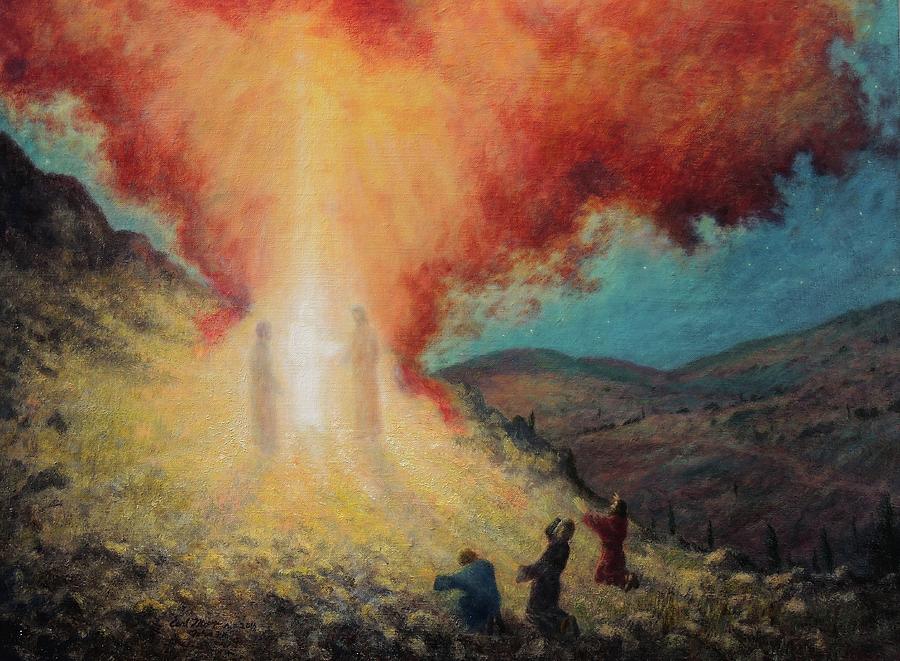
Earl Mott’s painting of the Transfiguration

When I was reading Luke’s account I was struck, as I often am, by his ordering of the events. There seems to be a theme emerging, with questions of who Jesus was, and also, what greatness might mean. And so I wrote a short series picking up those themes and exploring them. There are other events woven through that are not covered by the following sequence of poems – the Feeding of the Five Thousand, for instance – which is developing a sequence all of its own.

If you are looking for something to use in your devotions or public worship for the Feast of the Transfiguration (on 6th August), the parts stand alone, and can be used singly. But I was intrigued by the flow of ideas and wanted some space to ponder them on the page. I began with Herod, troubled and awkward in his guilt, and moved through the stories to the little child, standing in the midst of them.

So, here it is….. four poems following a trail.

Who?
Luke 9, Matthew 16-18

I  Herod

Herod found you a
question he did not
know how to answer.
Perplexed, he heard
whispers that you
were John back from
the dead, a ghost to
stalk his conscience,
shock his dreams,
or the great Elijah,
or another prophet.

He sought you out, he tried
to see you. Perhaps to
ask you who you were.
What might have been,
what could have been,
if he had met you then?

II  Peter’s confession

You asked those who knew you best,
Who do they say I am?
and
Who do you say I am?

To the first, they gave the
answers that blew in the air
like smoke, whispers that
swirled dark around
Herod’s palace, and
through courts and crowds.
John the Baptist, back from the dead.
Elijah. One of the prophets.

And to the second – a moment’s
pause, an intake of breath,
a strangeness rising – to be
asked to name, to more than name,
one they knew daily, and loved,
and still, barely understood.
How to give answer
to such a question?

But Peter did. The vast
words formed in his mouth.
He called you Messiah,
the Christ, the anointed one.


How good it is to be seen,
to be known, to be understood.
How warmed you were by those words.
Enough to give him a new name –
Rock – and a new identity – foundation stone.
For all his impulsiveness, changeability,
you knew him as deeper, and truer.

And yet a sadness enters here.
The anointed one does not
walk in greatness.
The road you will take is
hard and stony. A way of weeping.
And a warning enters too –
those who consider themselves
God’s guardians will subject
you to death, yet death
will not hold you.

Such words cannot
be borne. Such an
upending, a
contradiction,
such pain. 
They fall to the earth
like so many
hard-shelled seeds,
trodden into the dirt
and snatched up by
dark, shining beaks.

III Transfiguration

Sometimes our seeing falls away
and we catch a glimpse of
deeper truth.  We say we see the light

Away from everyday thinking,
on the mountain, in prayer,
weighted with sleep.
Perhaps we see a beloved face
lucent in sudden light.

But here, on this mountaintop,
three friends lifted up their eyes
and saw – what shall we say?
to whom shall we compare him?

Shining like the sun, as white
as light, as bright as lightning –
the one they walked with,
ate with, laughed with.

Was it like the lifting of a veil, or                                                                                                
perhaps a dragonfly splitting his
dark skin to emerge a jewel?
Was it a peering through
the door of heaven, or
coming to see the glory
of things here, and now?
I do not know.
I do know it feels
a moment of endless truth.

And in that moment, Jesus,
Elijah and Moses do
not speak of the glory
that blazes around them,
they talk of the pain that
is to come – as ones
who can understand.
I hope there was some
comfort in it.

Something like comfort
too in the sightless
seeing cloud,
shekinah,
that reveals how we
do not and cannot see –
God is beyond us

And yet is with us,
as close as mist
filling our lungs,
beading on our skin,
as close as one we love.


And then they hear that true voice
speaking tenderly, calling him
beloved, and saying to listen,
to listen to their dazzling friend.

Words they will carry in their hearts,
words which in turn will carry them
on that long wide-eyed walk
down the mountain,
and through all that is to come.

As above, also reference to Isaiah 40

IIII Greatness

It is not what we think.
Greatness is not the pomp,
the power, the show,
the mountaintop.

It is the welcoming of a
little child. It is the being
like a little child.
In doing so, we draw
closer to the one
who calls Jesus
beloved,
the Son I love.

Greatness, a costume
cloak of purple and foil.
Let it slip from your
shoulders. Let it
fall.

As ever, I’m sharing with you work in progress. There may be some tweeks and amendments before things land in the book – Wild Goose, Iona Publishing, next year.
Also, as ever, please feel free to use any of my material that helps, referencing this blog as your source. I love to hear about where my poems fly to, and where they land.

Here is a link to some more I’ve written on the Transfiguration. It includes extracts from my retelling, and some thoughts on how we might come to see more truly. I hope you find it nourishing.

Armando Alemdar Ara, from Liturgy Tools

Sunday Retold, Poem: Ascension

I’m continuing to share with you some poems I’m working on for a new book, The Year’s Circle, which will be out next year – with Wild Goose of Iona Publishing. You can read more about that here.

As I’m settling into the work, I’m finding it so rewarding. I love looking for threads and connections between things, and so I’m weaving together poems which follow the pattern of the church year and poems drawn from nature. I’ve always found the natural world rich with image and meaning, and that is particularly true of the wild beauty of late spring.

This poem has been a bit of a knotty one to unravel, but now I think it’s settled and working. I’m giving it to you a little early, in case anyone is looking for a poem for Ascension (this year, Thursday 29th May) . At the beginning of the book of Acts we find this account of Jesus being taken up, and I have been wondering about what it might mean for us.

I thought first of what it must have been like for his friends, a kind of second losing. They are still caught up in their concerns – they are still thinking of a kingdom with power and borders. And every day, now, we are seeing the pain of kingdoms and borders, the terrible suffering of the people of Gaza and the long history of cause and effect that leads to children, the frail, the displaced and the wounded – starving. It’s shocking and distressing. I find those images fill my inner vision as I read the words of the disciples. And I notice that their nationalistic hopes do not align with the task set them by Jesus.

I have wondered about the complete change in perspective that Jesus seeks to share. I think it might help us, and give us a way of seeing that opens us up to a better way.

He is not speaking of kingdoms with borders. He is sending them out – over borders, without consideration of the divisions between peoples we might make – to the whole earth. A shift in thinking, a higher, more inclusive view. So, in this poem, I try to explore that shift.
The poem has two strands. The experience of Jesus’ friends as he slips away from them, and this wider way of seeing he invites them to share.

Hidden/All things  – Ascension

Perhaps it had seemed a partial
parting, a gradual letting go.

In life, they had lived with him,
travelled dusty roads,
slept under stars,
ate bread and shared a cup.

Then, after that dark Friday,
that bright Sunday, there
came these strange, sudden
meetings, brief comings and goings,
words they found hard
to understand – such
puzzling reassurance.

And still they ate together,
and he spoke of another
presence who would
come to them, be with them.
And despite their questions
of nations and times,
his was always a wider vision.


Always wider and other
Out to the old enemy
and the ends of the earth
Everywhere and everyone

And then at last they came
to this last parting,
and he was taken up
in rolling clouds and
hidden from their sight,
a long perspective
they could not yet share

that saw the whole blue
green turning Earth and all things –
things in heaven and things on earth –
holding together  reconciled
all very good and all beloved.
Above all, beloved.

Acts1:1-11
Colossians 1:15-20

This image is of Gaia by Luke Jerram, when it was at Ely Cathedral. As I’m playing with the arrangement of poems in The Year’s Circle, I’ve placed my poem inspired by this artwork in a group that follows this one on the Ascension – a group that begins to explore our perception of the Earth as an interconnected whole. You can read the Gaia poem here.

And, in the spirit of the original Sunday Retold, here are some passages which might be of interest.

‘The disciples never knew when Jesus would appear among them – but appear he did, telling them more about the kingdom of God, and kindling hope in their hearts.
“Wait in Jerusalem and you will receive God’s gift. You remember how John baptized with water? In a few days, you will be baptized with the Holy Spirit of God.”
Another time they asked him, “Lord, will Israel be a great kingdom again now?”
“That’s not for you to know. The Holy Spirit will come and fill you with power, and then you will tell everyone what you have seen and heard. Start in Jerusalem, and Judea, but then go out beyond Israel to Samaria, and even further – to the whole earth!”
Then Jesus was lifted up, above and beyond the earth, and a cloud hid him…….’

From The Bible Story Retold

Ascension Day
‘Christ has no body now on earth but yours, no hands but yours, no feet but yours…. Yours are the feet with which is to go about doing good, and yours are the hands with which he is to bless us now.’
St Teresa of Avila

From Prayers and Verses

Poems: Seven Sentences from the cross

Elizabeth Frink, at St Edmundsbury Cathedral

Edit: April 2025 I’m sharing this with you again this year, as I’ve noticed that a number of you are turning to these poems as we approach Easter. Thank you. I’m also delighted to let you know that they will be part of my first collection of poetry, The Year’s Circle, which will be out next year. It will be published by Wild Goose. Exciting news!

I do hope these poems are helpful to you as you begin to meditate on Good Friday, and prepare for sharing that time with others – families, groups and congregations. Please do feel free to use and share them, saying where you found them. I love to hear about that.

Below the poems, you’ll find some links to other posts on this blog that you might find helpful too.

Father forgive them, for they know not what they do

We don’t know what we do,
from the careless word that
starts a fire of anger,
to the careless killing
of a butterfly  –
who knows what
wide effects,
what winds and rains,
begin and end with just one death?

We walk in darkness, so often,
and so often, we close our eyes,
we do not wish to know.
And Jesus, seeing this,
that his life would end
with angry shouts,
with fearful washing of hands,
with indifferent playing of dice,
Knowing all this, even so, he bore
our lawful unthinking violence,
our blundering disregard for consequences.
Another would pay for our actions.

Yet as the ripple of our acts flows out,
through the world, who knows where,
so too, now, flows forgiveness,
following on, spreading and transforming,
watering dry ground, lifting burdens
and carrying them away.

2

Truly I say to you today you will be with me in paradise

Even as he hung upon the cross,
even with blood from that false crown
running down, not wiped away,
he saw the two men at his side,

One joined in mocking with the
priests and soldiers,
speaking from his pain,
and one did not, this second kept
his eyes on something else – a hope.

A hope the one he looked on was a king,
and of a kingdom where such things
as crosses are not lifted up,
a hope, even, of an end to death and pain –
this pain, this death.

And, ah, his king begins to speak,
of paradise.
What a world to gift him dying there.
A word of such sweetness, freedom, peace.
See  – clear water flowing, and flowers,
hear the sound of birds, the lazy
buzz of insects, the flutter of their wings.

What a word, at your end, to hold to,
to capture our beginning, once again.
But even more than this,
to be with him, beside the king,
seen and known,
held in the loving gaze of one who
hung up on the cross.
Might this, even this, be paradise?

3

Woman, behold your son. Son, behold your mother

And still he sees, looks down
towards the one who bore him, bearing this,
the pain – not her own pain – worse,
the pain of watching one you love
twisting on those wooden beams,
the nails piercing her own flesh too.

The time has come when all the
treasure of her heart is broken open,
scattered, lying in the dirt.
What use to hold in mind
the words of angels,
the wealthy gifts brought by the wise,
what preparation Simeon’s warning,
when now she sees his agony with her eyes.
But she is not alone, his friend sees too.
John, who writes it down,
bears witness, even here, even so.
They turn their gaze upon each other
and see each other with new eyes –
a mother, and a son.
Gifting them each other –
his one last act of love,
this giving, from an empty cup.
This task of care can be ours too,
to behold each other in our pain,
and in our sorrow, walk each other home

4

My God, My God, why have you forsaken me?

You felt your generous heart forsaken,
you felt the absence of the one who helps,
who was beside you, in the beginning,
who knew you from before first light.

We know too well the sparseness
of your isolation, without light,
and companionless,
in the darkness of our own long night.
And yet, within our dark, we find you there,
Find you have waited for us long days, and years,
while our poor eyes have
grown accustomed to the dark,
have learned at last to see you through our tears.
So as you know our pain and feel it,
you break our separation with your own.
Help us see the forsaken all around us,
invisible and in darkness, but seen by you.
May we seek each other in the dark,
May we have courage to cry out,
like you, and so be found.

5

I thirst

The well is deep, and you have nothing to draw with.
Where now that living water?
Where is that spring within you, gushing up
to fullness of life?
Do you remember, now,
the woman by the well?
Your deepening talk of thirst and water,
as now, again, you humbly ask another for a drink –
this time,
a sponge of sour wine?

Do you remember too, as the taste dries on your lips,
that wedding feast, where water changed to finest wine?
The richness and fullness of that beginning
soured to this cold bitterness.

You are our source, the spring of all our rivers
and still you thirst like us, need help to drink.
And so give us this grace,
that as we do for the least of these,
we may know we do for you.

May we see you
in each thirsty face.

6

It is finished.

All things come to an end.
Even pain like this,
Even the anger and the cruelty of a crowd,
of us all,
even the certainty of those so certain
of God they hang a man upon a tree.
Even the punishment and scapegoating
even violence,
even death.
The work is done.
It has all been borne.
You have poured out your love, your life.
You have carried our sorrows, suffered
under our iniquities.

Your head bowed now, you sink
into the final pain of nails,
your body bears no more,
having borne all.
The work is done.

7

Father, into thy hands I commit my spirit

There is darkness now, deep darkness,
over the face of the deep,
and no hovering like a brooding bird,
instead, the temple curtain torn in two,
from top to bottom,
and the Holy of Holies empty.

God is not found there,
but here, with this dying man
on a tree,
He calls out father, and talks of hands,
and we remember what his own hands have done,
how many were healed by their touch,
raised up and restored from cruelty and death,
and now, he too will be held in loving hands,
a reconciliation beyond our grasp,
a trust even at this moment of last breath.

Dying, he taught us to die,
dying he brought us life.
May we be reconciled, may we know
at our end, the comfort of those hands.

img_0630

The church at Selworthy Green

Bless you


Good Friday Meditation

Other Holy Week readings, prayers and poems

Book News! Early notice, poetry book on the way.

I’m so delighted to be able to share with you that I’ve just popped a contract in the post for my first published collection of poetry. Some of you will know the publisher, Wild Goose of Iona, and they’ve been so kind and efficient in coming to an agreement about what we’d like to do together. It should be out next year.

We plan to call it The Year’s Circle, and I intend it as a collection to accompany you through the year. It will weave together poems drawn from Bible stories marking the seasons, such as upcoming Easter, with poems drawn from nature – so the two main strands of work you will find on this blog. I hope it will be good for your own reading and also sharing together with others in groups, churches and festivals. I know many of you already use the poems you find here in those ways.

The Celtic tradition has an idea of God’s two books – the Bible and Creation – and I’m intrigued by that idea and am looking forward to exploring what it might mean.

The collection will include some of the poems you’ll find here as well as new work. I intend to share progress with you as I go along – giving you tasters of the new poems, as well as some insight into the process.

I want to thank you all for being here, for your support and encouragement. It’s played a huge part in making this new venture possible, and I really look forward to including you in the process.

I’m blown away by this opportunity, it’s so good, and I’m really looking forward to getting going with drawing together something beautiful and nourishing in these difficult times. I really hope it helps.