Poem: Pharaoh’s daughter, and the child. Exodus poems 1

img_0212

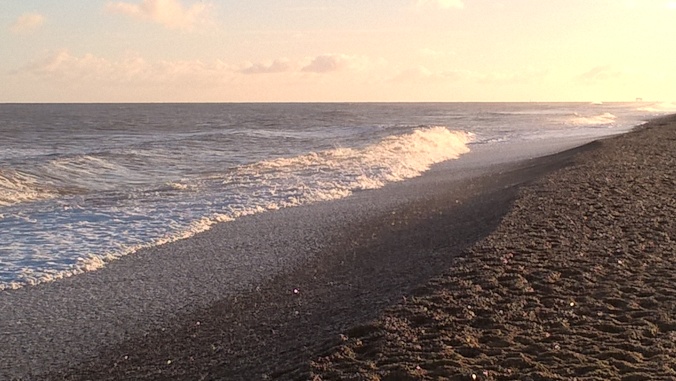
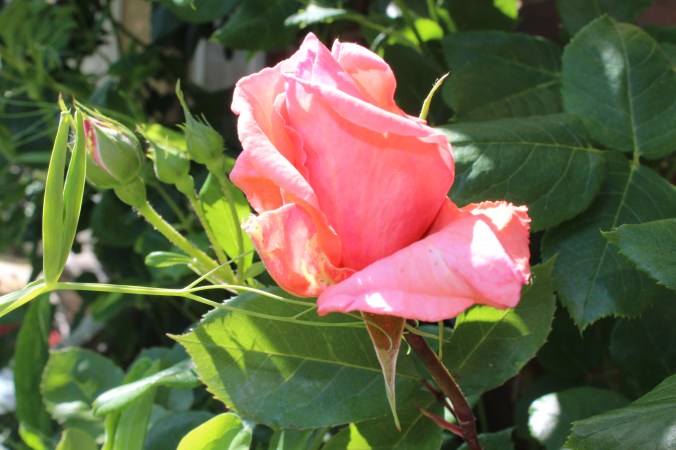
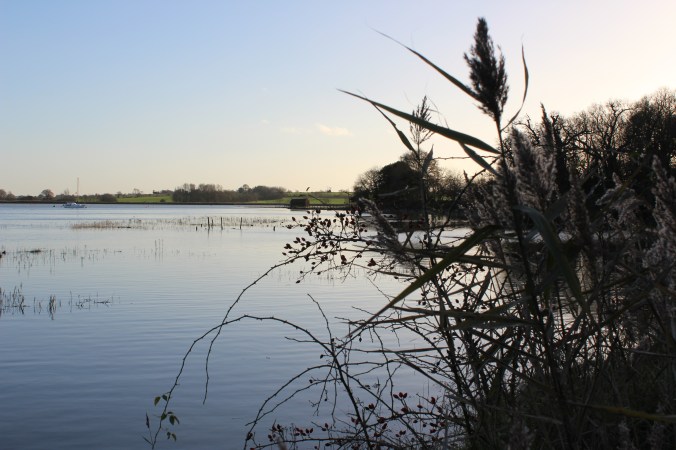
The banks of the Deben, high tide

As I was coming to the end of writing the Lockdown Poems, a couple of things were tugging at my attention.  One was the thought of doing a series of poems on the I Am sayings, revisiting some of the prose and prayer from my book.  The other was the huge sweep of the cry for justice that is circling the world – the cry for racial, environmental, and economic justice.  One of the things the coronavirus crisis has done has been, as we’ve said before, to reveal painful things – to draw back the veil and show aspects of society that many of us have been fortunate enough to be able to overlook.

As I was looking at the origins of the I Am sayings – Moses’ experience with the burning bush – I was deeply struck by the relevance of the Exodus story  to our current world situation.  I would encourage you to read Exodus Chapters 1-3 to start with, if you can, and see what strikes you.  Many things opened up for me, and I intend to explore them imaginatively and prayerfully, inhabiting the story, and asking for wisdom. I hope I’ll return to the I Ams again, but for now, these matters seem too pressing to ignore.

We can see how the story of Exodus progresses.  It begins with forgetfulness.  Forgetfulness of the way Joseph, ex-slave, ex-prisoner, had saved the country from famine with his vision and good management, forgetfulness of how we are all interconnected, and bring gifts to our situation.  The Egyptians forgot, and were afraid.  Their enslavement of the Hebrew people is told as an act of weakness, not strength.  How that fear led to justifying the terrible law for the slaughter of baby boys – a story echoed in the Gospel here, where the baby boys of Bethlehem were killed, and Jesus’ family escaped to Egypt.  At the time of Exodus this was the known world’s richest and most powerful empire, and the process of unravelling that power and wealth seems to be begun within that unjust law. So contrary to all that is good and right in human relations was it, that it carried the seeds of its own undoing. And maybe that sheltering of the infant Jesus was, knowingly or unknowingly done, a kind of restitution.

In this story of Exodus, I’m powerfully struck how the action of one young woman changed nations. Her compassion was the point of turning. That is not to say that we measure our small acts of kindness by their global impact, or only do them if we feel there will be some kind of payback, but that this story reveals the hidden power of compassion, and can offer encouragement to us to not think better of our moments of better feeling, but to act on them – to reach out and help, offer what we can.  What those feelings and acts accomplish is, in many ways, not our business. We can offer them, release them, and what happens happens.  If we praying people, we can simply offer them to God, with no thought of future benefipayback. They can cease to be our own. Of course, we can try to be mindful of unintened negative consequences, but we seek to act from love and goodness independent of outcome for ourselves. For Pharoah’s daughter, if she survived to the time of the plagues and freedom for the slaves, this mercy to Moses may not have seemed such a good act after all.

The other thing which struck me forcibly was the fact that she acted from a place of safety, and privilege.   She did something that would have brought swift punishment if someone else had done it.  She seems to have used her safety almost without thought of the consequences, to help this one child.  We don’t know any surrounding information – what her attitude to her father’s law was before, or after.  All we know is this one thing about her. This one act.  Maybe it can encourage us to listen to one another, in different circumstances, to speak of our difficulties when we experience them, and to speak and act for others when they cannot do so for themselves.
And here is another thing our current crisis has revealed – deep wells of compassion and community, the capacity of people to act to help and support people they know, and don’t know.  The veil drawn back has shown us good, too. There is hope in this deeper reality.

The ending of this poem carries an echo of William Blake’s The Divine Image, which is incredibly apt for our current situation. It was published in 1789, and carries its message of equality in language of the time.  It’s a powerful read.

Songs_of_Innocence_copy_G_object_12_The_Divine_Image

There are major shifts happening in the world right now, and I am attempting to listen, to keep my mind open, to pray, and to understand, and to act.
AA037808

Taken from Exodus Chapter 2

Pharaoh’s Daughter, and the child.  Exodus poems 1

You named him Moses,
drew him out of
that small ark,
a precious cargo.
Out of the Nile-reeds,
where crocodiles wait,
out of the flood and the snakes
and the hum of mosquitoes,
out of the sentence of death
your father had passed.
In that moment, your heart responded,
the moment when you heard him cry
hungry, closed in the dark
and the silence
of his pitch-black basket,
in a moment, you reached out your hand,
and touched – not a slave-child,
but simply a hungry one, alone.

From your place, at your father’s side,
standing in his love for you,
you saved one small life
from his fearful stony heart’s rage,
from the might of law and empire.

Marvellous princess, you did more.
You paid a slavewoman wages,
you acted with justice and mercy,
you saw a child, and not an enemy.

And so you are remembered,
you are thanked by generations
yet unborn
For an act of kinship with one
from a feared race,
as golden Nile-waters
swirled and eddied and
rippled outwards, outwards
from the place where you stood,
shining in the light of dawn.
Mercy bore, in you,
the beauty of a human face.

Poem: Snake, not in the grass

Since my series of Lockdown Poems came to an end, my new notebook is filling up with different things…. I’ll share more with you another day, when I’ve worked up something more shareable, perhaps more complex.

This, though, was what happened yesterday, and I wanted to share it with you now.  If anything, it’s an unlockdown poem, reflecting the impact that increased traffic has had on one creature.  Once again, I feel pulled in different directions.  I am glad our local businesses are cautiously open again, but I miss the quiet roads and the space for nature.  I wonder how many creatures had become used to safely crossing, and have lost the habit of caution.

IMG_0980

The road earlier in the Spring, quiet in lockdown.

I am not particularly keen on snakes.  I don’t recall seeing a grass snake in this area before, and certainly I’ve never seen one in or so close to the garden..  That the first one I have a chance to look at closely should be dead saddens me.  It has troubled me, and I still can’t shake the image from my eyes. We can hold more than one impression – I am a little afraid of this snake, but I see its beauty, and feel its loss.

Our garden continues to be full of life.  The newts are back sheltering under the red watering can, and there are small frogs among the strawberries – I hope they are growing larger on the slugs.  Maybe this snake was on its way to our small sanctuary, and didn’t make the crossing.  Maybe I’ve run over things myself, and not even noticed – I must have done.

This one dead creature seems to be weighty with significance, so, as ever, I have explored that with words.


grass snake animalia

Grass snake from Animalia on Pinterest


Snake, not in the grass

There’s a coil of something
long, with a faint gleam,
on the road by our drive.

A prickle crosses my neck.
The heat rising from tar
brushes my legs as
I take a slow step nearer.
Silver underside, dark stripes.
Snake.

Its tail is flat,
its pale interior exposed
to this drying sun,
It doesn’t move.

Its shape is burned
in my mind.
I can’t forget it,
can’t settle.
Such beauty,
such strangeness,
dead.

The road must not be
its resting place,
unnatural with the
hardness of cars
and the smell of tar.
Its long fluid form,
its pale green and grey,
the strip of yellow brightness
by its intelligent head,
these things call for
softness, and respect.

I do what I can do.
Not enough.
Scoop it as tenderly
as I can with my
cautious spade,
and lay it in the long grass
where I try to grow wildflowers.


I am so sorry this was your end,
beautiful creature,
beneath wheels,
you, the first snake seen here,
in this place.
It’s a strange welcome,
but welcome you are.
May you rest in this pale
dry grass,
be part of this land,
thank you for your life,
your part in the life
of this place.
We are the poorer
for your loss.

Poem: Grandiflora – Lockdown 35

When I wrote this next poem, as the volume of traffic increases, as the number of people we encounter while out walking near our home increases, I felt that it was the last one.  The last one named and numbered for lockdown.  This series had come to a resting place, I felt.  The lockdown was ending, possibly disintegrating.

And there are all the mixed emotions that go with everything to do with the covid crisis.  Of course, it is such good news that fewer people are afflicted with this terrible disease.  I am glad my little local shops are beginning to trade again, and people in my community are able to support their families.  I worry that this is a lull, and not an end.  I worry that we are missing an opportunity to make things better in our scramble to make things normal.

But also, I have really enjoyed this method of writing, and then sharing with you.  Thank you for your company.  I hope these poems have given moments of peace, or thoughtfulness, or connection, or beauty – as they are, and as you need.  I will continue writing like this, and also seeing what else calls to be written.  I think there are new things.  So, there are 35 of these, in this series.  I also wrote seven poems for Good Friday.
That’s quite productive for me, and some recharging of my creative batteries, some reading and thinking and seeing, is required.  Having said that, I may miss doing this so much there’ll be something tomorrow!

This last poem seems to say some things that had been rising up in me for a while.  I am finding, in my response to the multiple crises that are unfolding, that I am trying to understand what is going on, rather than value my own opinion so much.  There is a letting go for me here, which is the first step of learning.  It’s seeking to adopt a beginners mind, or seeking to become like a little child.  There is a reference to the wonderful piece of Medieval mysticism, The Cloud of Unkowing, in the poem, and you can read a bit more about that here.

Thank you again for your time, for sharing your time and virtual comany with me, and for your attention, and bless you.

IMG_1883

IMG_0818


Grandiflora  Lockdown 35

I am tired of argument,
although curious,
and seeking understanding.
I am done with the
certainty of knowing.

There is so much more
to be explored in unknowing,
so much awaits
in that soft mist
that rests on the skin.

These magnolia leaves,
rattling in the breeze,
some yellow, and falling,
some green, and shining,
do they know the flowers
will begin to open soon?

The flowers will open,
known or not,
releasing their
creamysweet
scent above me –
joining with
the honeysuckle,
with the rose –
revealing their strange
strong hearts.

Each day,
a new flower
will open.
Each day,
I will receive
their beauty,
and, in turn,
pour out tea leaves
for their dark roots.
I am finding
it is enough.
It is enough.


IMG_1051

Poem: The company of bees – Lockdown 34

IMG_1035 (1)

This is the last but one of the Lockdown Poems. Something will continue on after, but whatever it is, it’s not quite this.  Whatever strange time we are in now, it’s not quite lockdown, although I know that many are still keeping at home, and we are all missing those we love and haven’t seen for months.  Thank you for your time and company as we’ve been watching this season unfold.

At times during this strange spring, I think we’ve had some painful space in which to consider the ways we live, and the injustices and destruction we have thought were inevitable.  In seeing those injustices and destructive forces stripped bare, and also in seeing the great machine of Mammon halted briefly, we’ve had a glimpse of the hope that lies at the bottom of the well of all that is not hopeful.  Nadia Bolz-Weber’s sermon to prisoners this week speaks so powerfully into the nature of hope, it’s short, and so well worth listening to. I think what we are beginning to see is the struggle of a vision of a more beautiful world, the birthpangs of something more whole and holy, that are real and painful and require effort and will.

So, this next poem started off as a morning contemplation of what was before me, and moved to a brief touching on the tragedy, or tragedies, we are facing and facing up to at present.  There is a folklore that you should tell the bees the news of those who have died, and that seems a hard task right now.

IMG_1885

I had a problem with the memory card in my camera, and by the time I sorted it out, the bees had gone deeper into the bush, and I couldn’t catch them.  Here are the tiny flowers they love. In the winter, the birds will eat the white berries.

IMG_1888


The company of bees  Lockdown 34

I will quieten my spirit
in the company of bees –
so many.
Honeybees to my right,
filling the snowberry bush with
their eager hum,
the tiny flowers constantly
visited, endlessly
searched.

Bumbles – white tailed, and red,
carder, and buff –
to my left,
climbing up the steep
slope of the gladioli flowers.

You should tell the bees
news, they say,
tell them the news
of who has died.
There are so many,
so many now.
We must speak
our sorrows,
even though such
speaking is beyond us.
These lives
must be more than
numbers –
loves and hopes
and the seemingly
endless tide of
breath, ended.
So much had been
lost.

And what do the bees
do with our sorrows?
can they carry those
heavy loads away?
And those bees,
when do they speak
of their own loss,
the meadows stripped bare,
the poison they
bring back to
their hives,
their place of
safety and plenty
dying too?

This small place
of nectar and
kindness, it’s
all I can offer,
for both.

IMG_1889

A mown path through the wild flowers – it’ll be full of yellow when the sun comes round.  What sort of path do we wish to walk, what sort of path do we wish to make? Maybe there is a choice before us.  Can we choose life?


Poem: Beans coiling uncoiling – Lockdown 33

Welcome to another small moment of noticing – this time we’re back to the veggies. These lockdown poems are often a celebration of paying attention, noticing the small wonders that are before us every day. Since we’ve had some rain, the beans have been racing ahead.  I seem to have managed to keep the pigeons off them for now, but, with all the little seedlings, they are strutting around looking interested.

I am intrigued by the way the stems search out their supports, and coil around them.  It’s beatiful to come back day by day and see what progress they are making.  All from a small bean, and the earth, and the rain, and the sun.  No wonder they inspired fairy tales.

IMG_1880

IMG_1881

IMG_1882


Beans coiling uncoiling – Lockdown 33

How does the bean know
to twist itself so perfectly
around these tall sticks?

How does the stem grow
close on one side, where
it touches, stretched
out on the other,
open to the air
and the sun?

I uncoil it tenderly
from where it has
strayed.
How long until it
cleaves to its
new home?
How long until
it feels safe,
and thrives?

Poem: Longing for Rain – Lockdown 32

IMG_1059

We had an intensely hot, dry stretch of weather, in May, which was a time when the few miles to the sea was an impossible journey.  Even as the lockdown eased, and journeys became more possible, we’ve been tentative in our outings, and sought out remote and deserted stretches of coast.  I have been recalling the longing for rain, and the longing for the sea, even as the garden revives, and we’ve heard and smelled the sea.  I’ve been turning those two things over in my mind.

This poem expresses some of the longings of lockdown, and is part of the series of poems that are emerging at this time.  I feel we may be getting closer to the end of that series, and then, it may be time for something new to emerge.

wp_20170102_14_12_07_pro


Longing for Rain  Lockdown 32

The sea has felt so far away,
here, in this sheltered space.
The sound of water lapping,
lapping, seems miles of
dry ground from here,
while the little strawberries
are hard and intense,
like jelly sweets,
and the grass begins to yellow,
and leaves curl,
under a white sky

There is a symmetry
to this longing.
The journey I long to make –
to the sea, to the
spume and the sea mist,
the grey stones and the brown waters,
and the journey I long for
those waters to make –
to visit us here
on this drying land,
blown by the wind
on rivers of cloud,
then falling softly –
hissing, hot-earth-smelling
rain.

May our paths cross,
our journeys
be completed,
may the life-giving waters
soak and soothe us.
May it be so.

Little Free Pantry update

This is just a quick post to thank the wonderful people of Melton and Woodbridge for keeping the Little Free Pantry well stocked during the coronavirus crisis.

It’s in the porch of St Andrew’s church, and is opened by volunteers every day.  We aim to have it available from 10 am to 5 pm seven days a week.

IMG_0812

IMG_0813


Thank you to Elaine for the photos, and keeping an eye on things.  Thank you to everyone who has participated, either by giving or by taking food.


It’s very simple.

Give what you can, take what you need.

The porch is open, and unstaffed, so you are free to come and visit the pantry if there is no one else there, without coming in to contact with anyone else. You are free to bring food, or take food, or both. It’s free, and freely available.  It’s a sign of neighbours loving each other, and of the love of God which holds us all.


It’s so good that our community is working together in this way, taking care of each other.  A hopeful sign.


Poem: Pink – Lockdown 31

This next Lockdown Poem is far more exuberant.  I love the way the dominant colours of the garden change as the season rolls on.  We start with yellows, add blues, and by the time we get to early June it’s a festival of pink – fragrant pink at that.  I presume the different insects who are around at different times of year favour these colours and scents.  Whatever the reason, the things that seed and spread, as well as the things that are planted, do adopt a certain pallette of colours.

I hope you enjoy a brief tour.  I hope it refreshes your eyes on this grey day, especially if you are somewhere away from these changes in the natural cycle, or the view from your window is particularly damp.

IMG_1035 (1)

IMG_1040

IMG_1041

IMG_1043

Pink  Lockdown 31

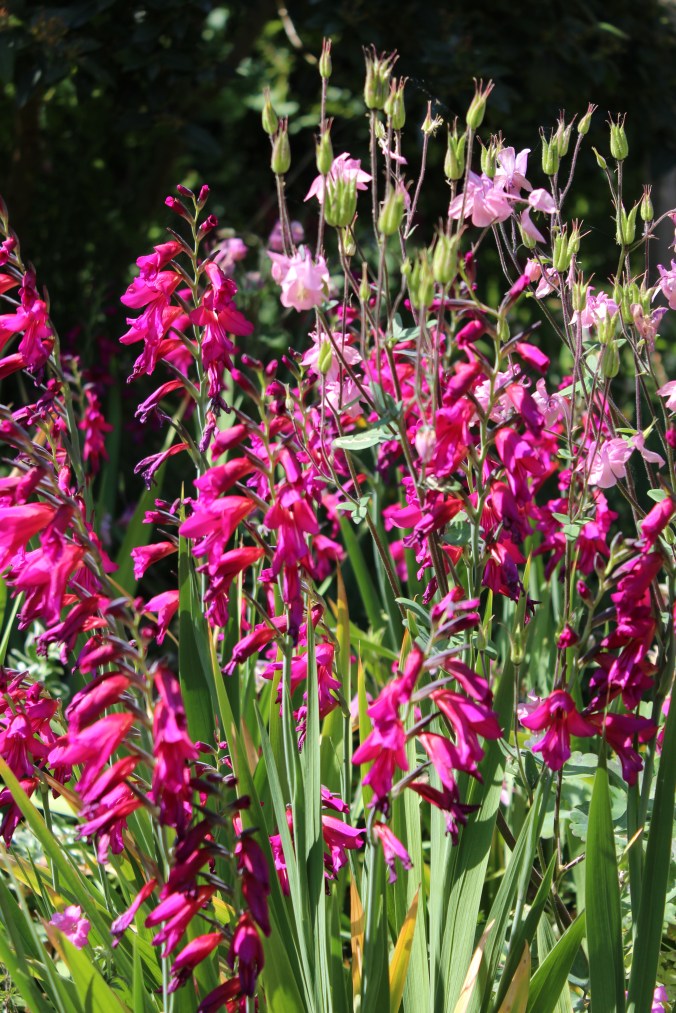
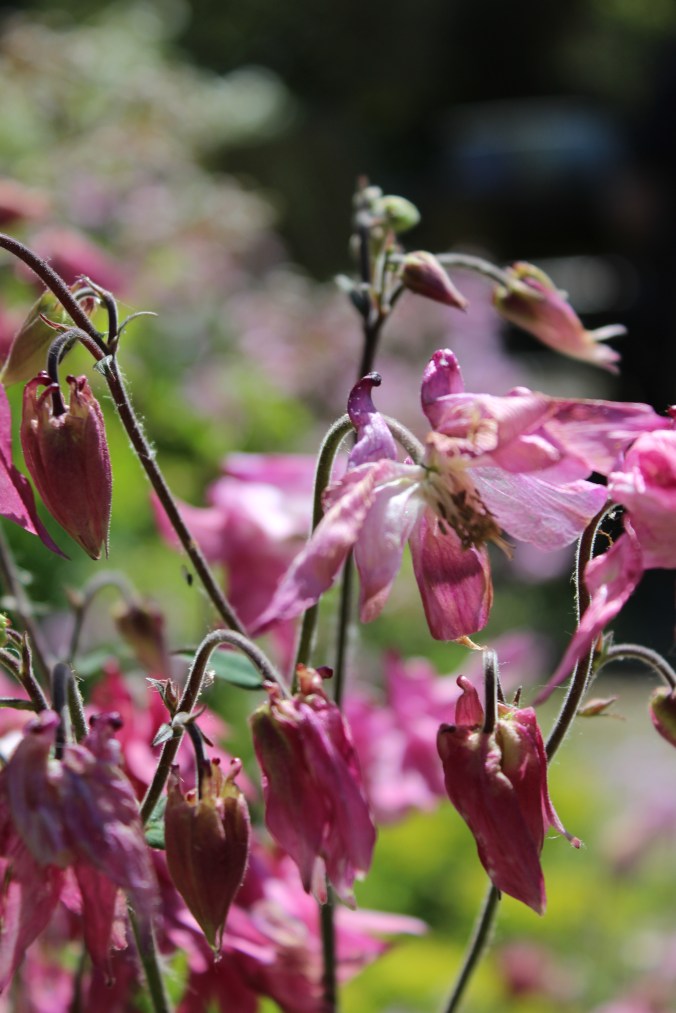
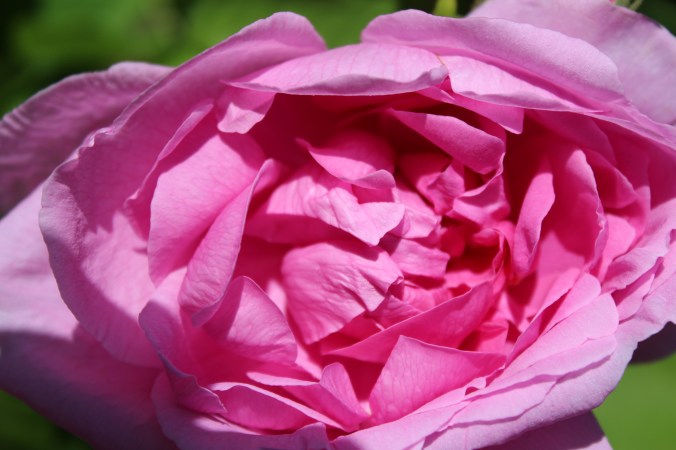
Roses, columbines, geraniums,
the arresting gladioli.
Suddenly its all pink,
and fragrant,
a boudoir from the age gone by,
a powderpuff of loveliness,

Rejoicing and loud
and with absolutely
no subtlety,
calling to that
eager hum of insects
to come, taste,
drown in sweetness.

Life.  Glorious,
singing, life.
It’s here.
It’s now.
Come, taste.

IMG_1049 (1)

This rose is a gift from friends.  It’s planted by the door, and called Blessings.

Poem: Beetle – Lockdown 30

Like yesterday’s poem, this next is an observation of an insect.  There are so many insects in the garden.  Most days, I see one I don’t recognise, and this beetle is one of those.  I did not have my camera to hand to take a photo, but I hope you can imagine it.

IMG_1871

I really value the way writing these snatches of life in the garden has encouraged me to be on the look out for all the huge diversity of plants and creatures that I share my home with.
The frame through which we see anything is shaped and coloured by the thoughts we bring with us, of course. And this poem, like many of the others, carries something of that knowledge of the loss and sadness of our communities around its edges, and in its ending.

Perhaps these snatches of writing are an encouragement to acknowledge those feelings, gently and compassionately, accepting them as we are able, at that moment.

IMG_0987

This pencil case was made an appearance in an earlier poem.


Beetle  Lockdown 30

Here, a long black beetle
rearranges its wings,

Black as funeral veils
that cannot be worn,
opening
and closing its
hard shell.

So fragile, the wings –
impossibly so,
folded precisely
as it moves along the
edge of my blanket,
then, with the breeze,
it flies, is gone,
lost to the shadows.
Out of sight, not out of mind.

Poem: The consolation of watching a spider – Lockdown 29

IMG_0486

IMG_1871

This next Lockdown Poem is a return to recording the moment, and the deepening sense of connection, and of something like mutual care, I am feeling with my place.  This growing sense of awe, and respect, and interdependence, is one of the things I hope to take forward from this time.  It’s one of the themes that is emerging from the Lockdown Poems.

Being in this strange space – a mixture of inaction and anxiety, peace and distress – may in time lead to a surer sense of purpose, and direction.  Not yet, though.  For now, we are in this threshold space, living with the pain of so much upended, so much loss, so many of our culture’s injustices and troubles revealed. It is challenging work, this learning how to“dwell in possibility” as Emily Dickinson says.  What might be possible if we increasingly experienced a deeper connection to the places where we live, and the communities of people and others we share them with? Can we be humble enough to recognise how dependent we all are on each other?


The pictures show some of the parts of our lawn we have left grow, down amongst the stems.  While not doing the full “no mow May” we have, as we did last year, noticed where the wild flowers are coming through, and left patches.  These patches are full of life.  I wasn’t able to catch a photo of the tiny spider, but you can at least see a little of a small creature’s perspective from down here!


IMG_1869

IMG_1868

IMG_1874


The consolation of watching a spider  Lockdown 29

Morning.  Some sun,
and white clouds
like eiderdowns
stitched with blue.
I move on my mat
under the tree,
my movement patterned,
sequenced, releasing.

For a while,
I let the sadness
seep into the ground,
my face close to the earth,
let it seep into the earth
which then upholds me,
supports me.

I feel the gentle patter of
sycamore flowers falling
on my back,
shaken by the breeze.
I breathe where I am,
smell earth, and grass,

I look, and there
before my eyes is a
tiny spider, yellow,
with a black point
curving the end
of its abdomen,
spinning a web
between these
blades of grass,
back and forth,
back and forth,

Complex,
many limbed,
weaving and weaving
like Persephone,
light and dark,
yet tiny next to the ant
and the aphids.

And I think, there
will be smaller things,
too, smaller than I can
see, worlds of strangeness
and complexity in this soil.
All this life,
I rest on all this life,
here, with me.


I have written about spiders, and weaving, before.  You can read those poems by following the links below.

Poem- Spider

Poem: Weaving – Unweaving

Spiders

Silk