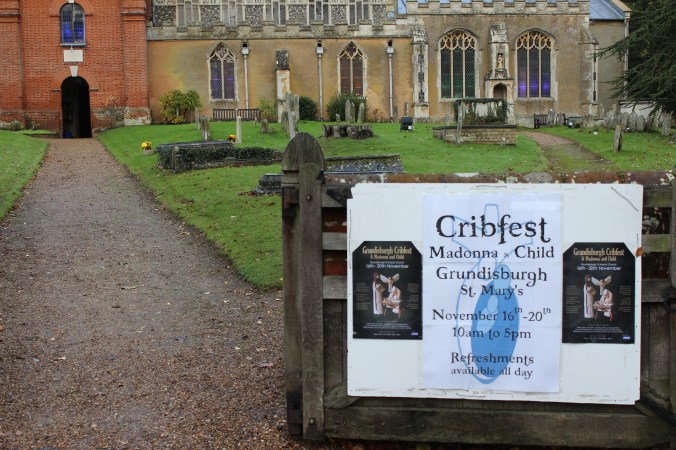
Grundisburgh Cribfest, and The Little Christmas Tree

img_0739

img_0741

Rev Wendy Gourlay’s beautiful collage

img_0749

from the Polish mountains

img_0748

Cardboard City Crib – some interesting characters here.

img_0745

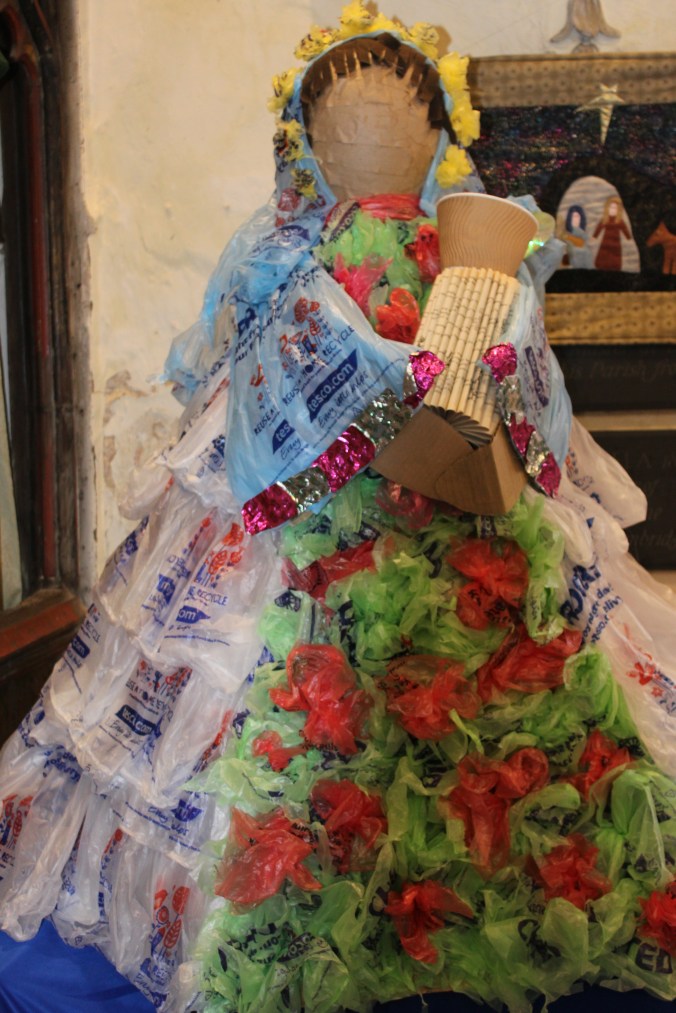
Angel from recycled materials – Jesus is made from a book, among other things….have a look! by St Mary’s School, Woodbridge

I have just spent a beautiful morning at St Mary’s Church, Grundisburgh, Suffolk.  Rev Canon Clare Sanders and her team were putting the finishing touches to their Cribfest, which opens tomorrow November 16th.  The church is full of Christmas cribs from around the world, with such variety of figures and materials.  It glitters with precious things made from sweet papers, it is full of wood and stone in its natural state, of Russian eggs, of tiny figures and huge angels.  Each one has a story to share, something to tell us.
There is also artwork from the village art club on display in the choir, and two large pieces made of Christmas cards.  The faces and hands are cut from the inside, showing the words of love and greeting that people have sent.

The more you look, the more you see.

I was there to read The Little Christmas Tree to children from the local school which was such a joy.  One half of the class was looking at the cribs, while the other listened to the story.

Do go to visit the Cribfest if you are in the area, it is well worth it.

christmas tree

Sorrows

IMG_0658.JPG

IMG_0682.JPG

IMG_0683.JPG

Much has happened this week.  Today, Remembrance Day in the UK, I am acutely aware of the importance of keeping peace between the nations, of reconciliation and forgiveness between us, of acceptance and inclusion for all.     Reconciliation, and an acknowledgement of the sacred worth of each individual human, seem further away now than they did.
This poem is a personal one, expressing something of an attempt to keep perspective among sorrows.  I know that for many, and for all of us from time to time, any such attempt can be impossible.  I wrote to try and express  what can feel like the constant task of not being overwhelmed, and to remind myself that when I can, it is worth the attempt.

I hope it also contains a gleam of hopeful truth.  Not a truth that ignores the darker realities, but that is prepared to see the possibility of light coming in the darkness. Both are real, but I find that if I can stay with the hope of dawn, even the darkness can take on a different quality.  Actions that lead to hope seem more possible, more achievable.  It is worth living for hope, not because the things we hope for will necessarily come, but at least in part because if we set our eyes on a kind and generous future, we are more likely to live in a kind and generous way now.  At least, I find that to be the case.
To all of you who are feeling a weight of sorrow, I hope this helps. May dawn come soon.

Sorrows

I carry stones in my arms.
They are grey,
and powder me
with dry dust.
They have sharp edges
my fingers find like
a tongue with a tooth.

When I notice,
I put them down,
stand up straight

Look, the sky is full of blue,
of high white clouds,
the trees chime with
golden pennies,
and a buzzard soars,
weightless, with its thin cry.

Look, there is one last flower
growing in the cracks,
and one last bee.

Who would have thought that losses
could be so heavy?
I find them lying on my eyes
in the dark, heavy and hot,
and on my heart and stomach,
heavy and cold.

I put them down.
Seventy times seven.
The work of Sisyphus.
Again. Again.

Look, there are stars in the darkness,
a whole Milky Way of them,
there is the softness of dawn light
coming, coming.
Take courage.
Begin again.

WP_20161027_10_12_18_Pro.jpg

Photographs are from the woods above Selworthy Green, Exmoor, and the coast at Watchet.

The reference seventy times seven is to something Jesus said when asked how often we need to forgive.  I used it here for any work where painful memory or thought keeps on surfacing, and we keep laying it down. Sisyphus  refers to the Greek myth of one who repeatedly rolls a boulder up a hill, only watch it roll down again.

Sunday Retold – Zacchaeus and the tree

IMG_0053.JPG

IMG_0167

This week’s Sunday Retold follows the Gospel reading set for many churches this week: Luke 19:1-10

A story about climbing trees, and looking up – among other things!

Jesus is making his way towards Jerusalem for the last time – and people still don’t understand.  They are still claiming him as theirs, and keeping out people they consider not good enough.  This man was a tax collector – a collaborator with the Roman invaders, and it would seem a cheat. We don’t know what has drawn him to Jesus, what has made him so determined to catch a glimpse of this teacher despite the hostility he faced, but we do know that Luke’s account of Jesus’ life pays attention to the way Jesus included, accepted, those who were outside – outside what was considered respectable, righteous, good.  He welcomed those others called sinners.  Perhaps the tax collector had heard this.  Perhaps there was something magnetic, attractive, full of life about Jesus.  Perhaps Zacchaeus had heard he healed people.

Here, again, we see it happening.  Jesus looks up.  He sees the unexpected – a wealthy man in a tree.  Trees contain all kinds of riches! When I read this story, I am reminded of the Genesis 3  story – where trees are important, and Adam and Eve hide in the greenery.  Perhaps there are echos here….

We see that Jesus did not berate Zacchaeus with all his cheating thieving treacherous ways, he did not confront him with his sin, he asked this man for hospitality.  He called out his goodness, he treated him as worthy, he accepted him.  If the disapproval of others had the power to make him make amends, there was disapproval enough in Jericho to do it.  He did not need to be reminded of what was wrong, but of what was right.  Jesus reminded him of his essential, elemental goodness.  He treated him as good, with kindness and respect.  He did it publicly, in the face of criticism.  He sat down with him, shared food with him.  The table is a powerful place of deep sharing.  Jesus uses the image of a banquet, a feast, again and again to show us what the Kingdom of God is like.

And see what sharing a table did for Zacchaeus – it gave him the courage to turn his life upside down, to change everything. We can imagine what it must have been like to have Jesus there, next to him, willing him on!

How good it is to know that Jesus shows us what God is like – like this.  We need not be afraid, we need not hide.  God reaches out to find, to love those people who are rejected, who perhaps reject themselves.   God’s power is at work to transform, to change lives, to make new- for all.

trees

The gospels are full of encounters between Jesus and individual people, as well as crowds and groups.  When I read the conversations Jesus has with individuals, I can’t help noticing that each one is different.  He has no formula – he deals with each person as they need. Each one is precious.

You might like to use the picture above, with the trees and the fence, as a way into prayer. What do you see?
Think about the story of Zacchaeus.  Can you remember a time when someone just accepted you as you were?  What was that like?
Have you been in a situation where you have accepted someone else like that, or seen it happen?  What was that like?
Has sharing food with someone been a memorable experience for you?  What happened?
In this story, what did God’s saving power do?  Is there more than one way of answering that?

Here is an extract from The Bible Retold
If you would like to use any of my material, you are welcome to do so, saying where it comes from.

Jesus made his way steadily towards Jerusalem. On his way he passed through Jericho, with its date palms and fragrant balsam trees.  Crowds poured out to see him, and to see the blind beggar who had been healed by the roadside.

“What’s all the commotion – come away from there and get on with your work!” Zacchaeus, the chief tax collector of the region, called out to his assistants.  They scurried back to their work, and the quiet clink of gold coins.  But Zacchaeus could not concentrate – the joy of the crowd had unsettled him.   He swept neat heaps of gold into his purse and went out.

The sounds got louder and louder.  The crowds were calling out for Jesus.  Zacchaeus tried to catch a glimpse of the Teacher, but he could not, for he was a short man, and the people would not let him through.  He ran on ahead and shinned up the stout trunk of a sycamore fig tree, sliding out along one of the branches that shaded the road.  Then he waited, watching Jesus getting closer, as he talked and laughed with the people.  Suddenly, quite close to the tree, Jesus stopped, and looked up.   Zacchaeus gasped, and tried to hide among the leaves.  Everyone was looking now.
“Zacchaeus, isn’t it?” Jesus said “You’d better hurry down from there.  I’d like to stay at your house today!”  So the chief tax collector swung down, rubbing green smears from his fine robes.  They set off together, and Zacchaeus threw open his doors to Jesus and his friends, beaming with joy.

But, the crowds were spitting with anger “Did you see that? He’s gone to be a guest of that thief, that collaborator with the Romans!”

Zacchaeus stood up before them all, and spoke to Jesus. “Look, Lord, right now I’ll give half of everything to the poor! And if I’ve cheated anyone, I’ll pay them back four times over!”
Jesus answered “God’s power is at work in this house today – the power to rescue and to change.  This man, too, is one of God’s children.  For the Son of Man came to seek, and to save, those who have lost the way to God!”

And some prayers from Prayers and Verses
to help us pray through this wonderful story

Grant me to recognise in others, Lord God,
the radiance of your own face.

Pierre Teilhard de Chardin, 1881-1955

Help me, Lord Jesus, learn who you are.
Help me learn as I try to love, and forgive,
and help others as you did.
Thank you most of all for loving me just as I am.

Jesus told us:
You are blessed when you know how poor you are inside,
for then you are open to God and his ways.
You are blessed when you are sad,
for then you will feel a loving hand on your shoulder.
You are blessed when you are gentle and humble;
you will see all of earth’s good things, there for you.
You are blessed when you hunger for what is right;
you will be satisfied.
You are blessed when you live generously and kindly,
for you will be treated with kindness, too.
You are blessed when you are wholeheartedly good;
nothing will stand between you and God.
You are blessed when you work for peace;
you will be called one of God’s children.

IMG_0609.JPG

Sunday Retold – Jacob wrestles

The next installment of Sunday Retold , with the readings Genesis 32:3-31  and Luke 18:1-8
An ancient, strange, and powerful story from Genesis.
My retelling , from The Bible Retold, follows:

For there it was, gnawing away at the back of Jacob’s mind: the memory of how he had cheated his twin brother, and how Esau had been angry enough to wish him dead.  He could hardly expect Esau to give him a happy homecoming after so long.  Jacob thought hard about the best thing to do.

He sent this message ahead of him: “A message to Esau from his servant Jacob.  I’ve been staying with our uncle Laban, and haven’t been able to get away until now.  I’ve prospered – with flocks and herds, and been blessed with wives and children.”  When the messengers returned they told him “Esau is on his way to meet you – with four hundred men!” Jacob blanched.   It was worse than he feared.  Quickly, he divided up his camp.  “Esau won’t get them both!” he thought to himself.  And he prayed to God, asking for help.  He also prepared presents for Esau.  They were some presents!

Two hundred female goats, and twenty male goats
Two hundred ewes, and twenty rams
Thirty camels with their young
Forty cows and ten bulls
Twenty female donkeys and ten male donkeys.

Each had a servant in charge of them.  He sent them on ahead, one after another,  to meet Esau with a rich procession of gifts – peace offerings.  Then, he took his wives and children and helped them back across the ford, to keep them safe.  That night, he wrestled with a stranger, not letting him go until he received a blessing from the man who came from God.  And the man called him Israel, which means God-wrestler.

Then, as the cool dawn began to warm, he saw Esau and the four hundred men coming towards him,  He bowed down seven times, but his brother ran to him and held him, weeping.  Esau had forgiven him, and welcomed him and his family with open-hearted love.  “Seeing your face was like seeing God smiling at me!” Jacob said.

Please feel free to use my material if it helps you, saying where it comes from.

The Genesis story is part of the ongoing family saga of Jacob and Esau, which, in itself, fits into a longer pattern of favouritism and rivalry, feuding and dysfunction.  Here, the twins are about to meet again after a long separation.  Jacob had run from Esau, whom he had wronged, and it seems he has felt the weight of that wrong ever since.  He had stolen from his brother, taken his identity and his blessing, hidden his true self in his brother’s clothes.  What would happen now they were going to meet again?

Jacob’s generosity is driven by fear, by self-interest, but nevertheless, it reveals his intent – his intent is for peace, for reconciliation if that is possible.  Perhaps, in his relations with Laban’s family, he has come to appreciate the advantages of harmony and fair dealings. After the experience of his wedding night, he now knew what it was like to be deceived with false clothing. The onslaught of gifts he sends out, each one with a servant and a message, foreshadow the relentless wresting with God that follows in the night. He does not give up trying to show his brother his good intent, he does not wait for an answer before he sends the next gift, he keeps on suing for peace.  He seems to adopt the same approach in the night vision that follows.  All night long he wrestles, he will not stop until he gets a blessing.

Maybe he thinks God is like the angry brother he has wronged.  Maybe he thinks God needs wrestling.  Perhaps, thought, this prayer is more about changing him than about changing God. He stole a blessing, and now he is fighting for one. He is still in the mindset of struggle and fight. Perhaps he still thinks there is only one blessing to be had between him and his brother, perhaps he still needs to grasp that God is generous, and has enough to go round.

He is seeking to obtain a blessing in his own right from God – and he does. Did he need to fight? Maybe he did, but I do not think God needed him to.  I think he found it hard to accept from God, after all he had done. Sometimes it takes us a long time  before we come to see the truth about our situation, our selves, before we are ready to receive the blessing.  God is not a reluctant giver, and even they give eventually.  God longs to bless, but sometimes, it is hard for us to receive.

Take some time to contemplate picture below.  What do you notice?  Might you use this picture to help your prayers?

jacob-wrestling-with-the-angel-of-god

Jacob Wrestles by Jack Baumgartner

Notice the way the hands pull back the curtain, or the night.  What do you notice about them?
There are many references to Jacob’s past. You can read the story by flicking back in Genesis – perhaps back to 25:21.  Notice, even before they are born, how the brothers wrestle.
Can you make out who Jacob is wrestling here?  Might the uncertainty be important?
The figure Jacob wrestles grips his heel – might the artist see this story as going back to the beginning of the trouble?
What do you make of the tumble of ladders behind?

Jacob's ladder

Sophy Williams, fromThe Lion Classic Bible

Jacob and Esau found reconciliation in the end, and Jacob was reminded of this night for the rest of his life by the damage to his hip.  Both brothers were blessed as a result of this determination to put things right.
Are there people we can work to be reconciled with?  Are there family disagreements we can pray for the courage and strength and wisdom to help end?
Do we dare ask for a blessing?

Some prayers for our families, and prayers of blessing, from Prayers and Verses

O Loving God,
May you bless our family,
may you keep us safe from harm,
may you protect us from anger that
leads to quarrels and unhappiness,
may you help us to forgive each other.
As we go out into the world,
may we bring with us your love and your peace.

Dear Lord,
help us to be honest and kind.
Help us to be our true selves.
Help us not to do things for our
own gain, but to work
together, and learn to put each
others’ needs before our own.

May God make safe to you each steep,
May God make open to you each pass,
May God make clear to you each road,
And may he take you in the clasp of his own two hands.
From Carmina Gadelica

Wherever you go,
May God the Father be with you.
Wherever you go,
May God the Son be with you.
Wherever you go,
May God the Spirit be with you.

May the Lord bless you,
may the Lord take care of you;
May the Lord be kind to you,
may the Lord be gracious to you;
May the Lord look on you with favour,
may the Lord give you peace.
From Numbers 6:24-26

IMG_0609.JPG

Sunday Retold – Naaman and the river

IMG_0211.JPG

It’s time for the next Sunday Retold, and this week’s readings include the story of Naaman from Aram.
You can find all the readings following these links:

2 Kings 5: 1-3, 7-15;2 Timothy 2.8-15; Luke 17:1-19.

The story of Naaman is rich in so many ways.  Reading it alongside the Luke passage – the healing of the ten lepers – brings two aspects into particular focus:  how we view those not of our tribe, or group, or belief system; and the practice of gratitude.

It’s easy to favour people who are like us, who are part of our group, whatever that may be. It’s easy too for us to slide into hostility, a feeling of superiority, a certainty that we alone are right.  In both of these stories, we see God not limited by our categories and barriers, but working in the lives of two people who were regarded as outsiders, enemies even.

Naaman was leader of the armies who were fighting against Israel – as clear an enemy as you could imagine.  Yet, he was a human being with a secret need, and a secret fear – of leprosy, which would have put an end to his military career, and made him an outcast.  That the enemy of God’s people should be stricken in this way might be something to  rejoice over – but not for the young slave he had captured.  She had reason to ill-wish her master, but she did not.  She conspired to bless him instead.  It was three servants, or slaves, who play a key role in this story.  They are the ones who move the narrative forward, who nudge the powerful towards right action.  The general does well to listen to the one who apparently has no power.

Naaman, who arrived in great power and pomp, causing a diplomatic incident, was not greeted by the prophet in the way he expected – but by a servant.  He was asked to take off his robes, his armour, his signs of status, and expose his vulnerable flesh.  He had to wash in a foreign river, when he had fine waterways of his own. He would have to bend down, bow into the water.
And then, he was healed, and then, what ripples flowed out from that action. The fates of nations hinged on this act which began with the words of a slave-girl.

One of the ripples was gratitude.  And that is the theme of the Gospel story.  The gratitude of one who was not part of Israel, had a different theology, different worship practices.  Nonetheless, he sought and found healing with Jesus, and was the only one of the ten who returned to say thank you.  The nine who were on home territory did not.  Perhaps the foreigner could teach us something, here.

Gratitude is a powerful and life-affirming discipline – and it is a discipline.  Gratitude sometimes flows naturally, but most of the time, we need to remind ourselves to be thankful.  We are so used to problem-solving, that we only see the things we think are broken, and cease to see what is good.  When we do, things shift.  Gratitude to God and to others can transform things – and not just for us, but for those around us, too.

And, to pick up the earlier theme again, perhaps we can consider how to bless those we think of as not like us, how to break down hostility – even if we find it in our own hearts – and do good to others.  Perhaps, like Namaan, we can also learn to receive good from the foreigner, the one we might regard as of low status.

What would the world be like if more of us lived out these two disciplines – blessing the other, and gratitude?

The following extract is from The Bible Retold

Please feel free to use these extracts if they help you, saying where they are from.

  NAAMAN FROM ARAM (2 Kings 5)

The little Israelite slave-girl was brushing out the hair of her mistress – the wife of Naaman, whose armies had captured her and brought her to Aram.
“My lady, why are you sad?” she asked.
“My husband the general’s skin is growing worse.  It must be leprosy.” She replied, weeping.
“If only my master would visit the prophet of Samaria – he would be cured!”  So Naaman went in great state, with his horses and chariots, attendants and guards, through enemy territory to Elisha’s house.  But Elisha did not go to greet his mighty guest.  He sent a slave with a message “Go and wash in the Jordan seven times, and you’ll be healed.”  Naaman shook with fury.
“What kind of service is this from a holy man?  I expected prayers and the laying on of hands!  But he just sends this puny messenger!  I could have washed at home!”  And he turned on his heels to leave.  But his servant intervened
“My lord, if the prophet had asked something hard of you, would you not have done it?  So why not do this simple thing?”  And so Naaman did.  He washed in the Jordan seven times, and as he came out into the bright sunlight, he looked down at his skin.  It was smooth, perfect, like that of a child.  Beaming, he rushed back to Elisha, opening his treasure chest. “Now I know that the God you serve is the true one.  Nothing else comes close.” “That is reward enough – you may keep your gold!” Elisha replied.  And Naaman went home, telling everyone of God’s great goodness.


And, from Prayers and Verses

May we learn to appreciate different points of view:

To know that the view from the hill is
different from the view in the valley;
the view to the east is different from the
view to the west;
the view in the morning is different from
the view in the evening;
the view of a parent is different from the
view of a child;
the view of a friend is different from the
view of a stranger;
the view of humankind is different from
the view of God.

May we all learn to see what is good, what is true,
what is worthwhile.


O God, help us not to despise or oppose what we do not understand.
William Penn 1644-1718

The olive tree I thought was dead
has opened new green leaves instead
and where the landmines tore the earth
now poppies dance with joy and mirth.

The doves build nests, they coo and sigh
beside the field where corn grows high
and grapes hang heavy on the vine,
and those who fought share bread and wine.


Lord, because you have made me, I owe you the whole of my love;
because you have redeemed me, I owe you the whole of myself;
because you have promised so much, I owe you all of my being.
I am wholly yours by creation: make me all yours, too, in love.

Anslem, 1033-1109

May we enter into God’s conspiracies of blessing this week.
Keat’s Autumn is on my mind at the moment, with the wonderful phrase, “conspire to bless”!

Publication Day – USA and Canada

IMG_0609.JPG

Publication day – it’s officially here!  Today’s the day these two books, The Bible Story Retold, and Prayers and Verses, are launched in the USA and Canada.

I would like to thank the many wise and kind friends who have helped me complete both of these books – they grew out of the life of a community, and I hope they will nourish communities in their turn.Thank you to all who have talked through ideas, lent me books, answered historical questions, entered into discussion on many subjects, and shared tea and prayer with me.  I appreciate it so much – as I also appreciate the long-distance, virtual community we are developing online.

I hope these books will be of use, both as individual texts and together .

I hope they will help youngsters, families, and churches share the wonderful stories of a people discovering the love of God. I hope they will be a blessing to many.

Here is a little snippet from Prayers and Verses

In all my thinking and speaking and doing
this day,
Help me be loving,
help me be peaceful,
help me be kind.

It’s coming! Publication day – USA and Canada – Bible Retold, Prayers and Verses

bible retold cover

prayers and verses cover

For our friends in the USA and Canada, these two titles are out on September 28th, and are available for pre-order now!

Over the next few days and weeks I’ll share some extracts from both books, but here is a little snippet to begin with.

From The Bible Story Retold:

THE SMALL, AND THE HIDDEN

“God’s kingdom is like the yeast a woman used in baking.  She took a little pinch, and mixed it into a great mound of flour.  And the yeast worked its way right through the flour, making well-risen dough, and making all the bread good.”  The crowds smiled at the thought of the warm smell of baking.

“Imagine buried treasure – just under the ground in a field.  That’s what the kingdom of heaven is like.  One day, someone was working in the field when they spotted something glinting in the sun.  They dug away until they uncovered it all – gold, silver, precious stones.  Then, they and sat back on their heels and laughed with joy.  It was a fortune!  Quickly, they buried it again and went away.  They sold everything they had and bought that one field.
“Or think of a trader looking out for fine pearls.  At last, he found the one he had been searching for.  It was large, and smooth, and glowed with all the colours of the rainbow.  It was the best pearl he had ever seen. He went and sold everything he had, and came back with a heavy purse of gold to buy it.”

From Prayers and Verses:

Help me to be patient as I wait for your kingdom
and your righteousness:
as patient as a farmer who trusts that the rains
will come in their season
and that the land will produce its harvest.
Keep my hopes high.
Help me to pray to you and to praise you.


I wait eagerly for the Lord’s help
and in his word I trust.
I wait for the Lord
more eagerly than watchmen wait for the dawn.

Psalm 130:5–6

The Kingdom of God is very near.
from Luke 10:9


Some links to Amazon are below – of course, if you have local bookshops, they will order it in for you if it’s not in stock.

Canada Bible Retold here

Canada Prayers and Verses here

USA Bible Retold here

USA Prayers and Verses here


Day of Prayer for Creation – a Parable


IMG_0171.JPG


IMG_0174.JPG


IMG_0178.JPG

IMG_0167.JPG

Photos of a walk taken near Wandlebury Ring and the old Roman Road, Cambridgeshire

September 1st is a day when we make Creation the focus of our prayers, knowing that others around the word are doing so. It is the first day of the Season of Creation, which ends on October 4th.  As I was praying for our hurting world, the story below came into my mind. I hope it may help you, as it has helped me, focus my prayers with urgency, and consider how I can live in a way which respects the beauty and glory of Creation, and the love of God for it all.  I have found, over recent years, my eyes and my heart have been opened to both the pain and beauty of the world around me, and the many ways the natural world is honoured in Scriptures, particularly in the prophets.

Jesus invited us to consider the flowers of the field, and the birds of the air, and learn from them the heart and mind of God.

If it helps you, please feel free to use and share it, saying that you found it here.


The parable of the good craftsman

Once there was a craftsman who had two children. As you might expect, he had built a beautiful house out of seasoned wood, with wide windows that looked out over his lush green fields, his flocks and herds.  He had made fine, carved furniture for his house, and he had smiled when he made it, and said, “That’s good!”  He had made beautiful plates and cups and jugs out the red clay near his house, he had smiled when he made those, too, and said, “That’s good!”  He had made a sheepfold to keep his flocks safe, and smiled, then, too.  In fact, all that was around him was good and flourishing and abundant, and as he looked at it all, he laughed out loud and said, “That is all so good!”

The day came when he needed to go on a journey, as the people in these stories often do.  He thought, “My children are old enough to be left in charge now.  They have watched what I did, some of the time, and I have told them how good it is.”  And so he left, and the children looked around, and they, too, saw that it was good.  So good, in fact, that they started to think how much it was all worth.  So they sold the furniture, and the plates and cups and jugs, for a fortune.  They were made by a master craftsman, after all.  The plastic ones they bought to replace them were good enough. They looked at the lush green fields and thought, “We could rear more animals in pens.”  So they did: twice as many, three and four times even, the poor creatures.  They sold the pasture they no longer needed, and a factory and a car park grew there, large and grey and ugly.  The water from the well their father had dug became bitter, but they bought water in bottles with all the money that they had made.

Then, the time came for the father to return.  As he drew near the house, he noticed the trees along the road were withered and dying, and his smile left him.  He came across a bird trapped in plastic that blew across the fields, and he set it free.  Then, near the house, he found a thin child sitting by the side of the road.
“What is the matter?” he asked.
“I drank water from the stream that flows from over there, by that factory.  It tasted bad. Now I’m sick.”  The father gave the child water from his own flask, and picked up the child to take home. He had herbs for medicine there.

But when he got even nearer, he could see that the factory was on his own land, and that where his own fields should be was all noise and smoke.  He could see the plastic rubbish spilling over from his own front garden, from where the flowers and the vegetables and the herbs had been.  He saw his own children, with grey, indoor faces, and said, “what have you done?”
“Father, we are so pleased to see you!  Come inside, we will bring you the accounts and you will see what we have made!”
“That is not the kind of making I intended you for!” replied the father. “And see, see this child, poisoned! How will you enter that in these books of yours?  What have you done with all that I have made – do you not know that I love it all?”


Some prayers from the first chapter of Prayers and Verses


Lord, purge our eyes to see
Within the seed a tree,
Within the glowing egg a bird,
Within the shroud a butterfly.
Till, taught by such we see
Beyond all creatures, thee
And harken to thy tender word
And hear its “Fear not; it is I”.
Christina Rosetti 1830-94


O God, enlarge within us the sense of fellowship with all living things, our brothers the animals to whom thou gavest the earth as their home in common with us.
Basil the Great c330-379


He prayeth best, who loveth best
All things both great and small;
For the dear God who loveth us,
He made and loveth all.
Samuel Taylor Coleridge 1772–1834


IMG_0713.JPG

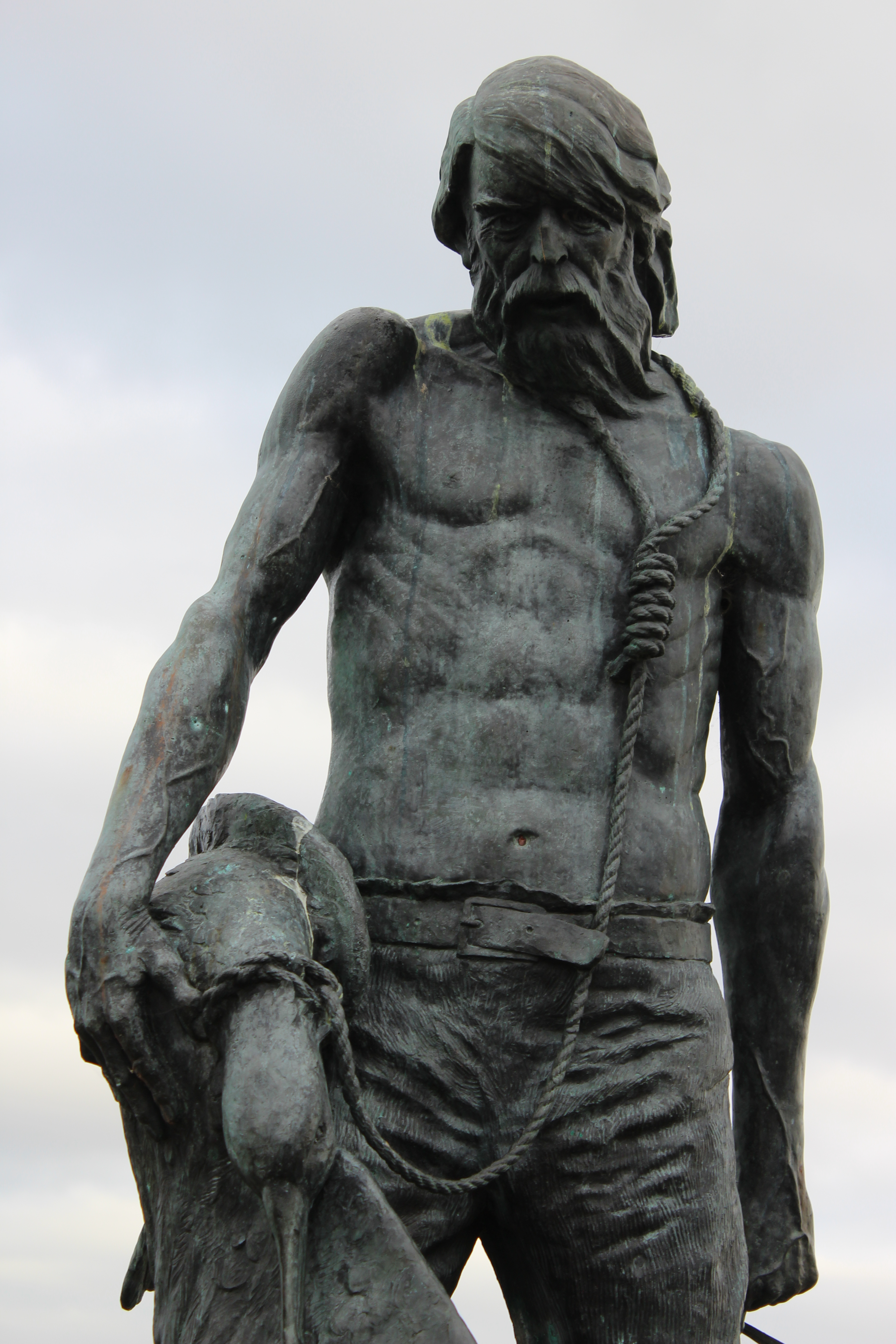
Coleridge’s Ancient Mariner – at Watchet, the place that inspired him.

prayers and verses cover


The Good Samaritan

The good samaritan

The Good Samaritan  Vincent van Gogh

So, this week, we are surrounded by political and economic uncertainty after the  UK’s Brexit vote.  In a national climate of increasing distrust, and anger, and division, many churches will be given this reading to consider on Sunday – the parable of the good Samaritan.  It is strong medicine – at least, I find it so.  It challenges me deeply, differently each time.  Reading it again, now, its force comes home anew.

From The Bible Story Retold

WHO IS MY NEIGHBOUR?  (Luke 10:25-37)

The teacher of the Law stood up, narrowing his eyes in the bright sun.  He had heard people talk about Jesus, now he wanted to test him out.

He pitched his opening question: “Teacher, what must I do to inherit eternal life?”

But Jesus offered the question back to him, giving him the chance to show his knowledge. “What is written in the Law?  How do you interpret it?” The teacher’s answer was to quote the scriptures word-for-word: “’Love the Lord your God with all your soul, strength and mind’, and ‘Love your neighbour as you love yourself’.”

Jesus smiled.  “It’s a good answer.  If you do all that, then you’ll have eternal life!”  “But….” the teacher of the Law added in a loud voice,  “but who is my neighbour?”  Jesus answered him with a story.

“Once, a man was travelling from Jerusalem to Jericho.” The crowd could imagine this journey – the road’s steep rocky sides, its twists and turns, its dust and heat. “As he made his way along,  a band of robbers crashed down the rocky slope onto the road – they had him surrounded.  The man gasped, horrified, but there was nowhere for him to run. They stripped off his clothes and beat him to the ground.  They left him lying in the dust, half-dead, while they went to gloat over their takings.

“So there he was, lying helpless in the heat of the sun, when a priest came by.  The priest did not stop, he gave the man a wide berth, crossing quickly to the other side.  A priest can not touch blood, or a body – that would make him “unclean” by Law, unable to work in the Temple, wouldn’t it?” Jesus nodded towards the teacher of the Law, then carried on. “Next came another religious man: a Levite.  He, too, saw the man lying bleeding, and still.  He, too, walked by on the other side, lifting his robes a little to avoid touching the blood on the road, and peering anxiously into the rocky shadows.

“Then, in the distance, came the steady clop of a donkey’s hooves.  The donkey carried a third man, but this time, he had nothing to do with the Temple.  He was a Samaritan.” Again he turned to the teacher, who was looking smug now.  Samaritans didn’t keep to the law – so he wouldn’t know the right thing to do. “The Samaritan saw the broken figure lying bleeding on the road, and his heart was filled with pity. He leaped down, cleaned and soothed his wounds with wine and oil, and tore strips of cloth to make bandages.  He slipped his arms under the man and heaved him onto his donkey, leading him gently to an inn.  He sat with him all night, giving him sips of water and wine.  The next day, he spoke to the innkeeper. ‘Here are some silver coins.  Look after him, and if you spend more, I’ll pay you on my return.’

For a third time Jesus looked at the teacher of the Law and asked him  “Now, you answer my question.  Which one was a neighbour to the injured man?”

The teacher of the Law shifted uncomfortably. “The one who was kind to him.” He answered quietly.  Jesus replied, “So go, and do likewise!”

It seems that the teacher of the law was opening a theoretical debate about what constitutes rightness in God’s eyes.  It doesn’t seem to have that much to do with God, or people, even though he correctly identified the commands to love as the highest ones.  Perhaps his question, “who is my neighbour”,  was an attempt to place a limit on the breadth of the command to love.  Perhaps this person is one I should love, but I can overlook another.

As was his custom, Jesus does not respond in kind, in debate, which can often stimulate the mind and bypass the heart.  Instead, he tells a powerful story.  Stories can change us.  They can reframe the way we see things, they can stir up powerful responses – outrage, pity, compassion, love.

And love is the aim, the way, the goal.   The teacher of the law was right about that.  Here, it trumps other laws – those who seek to maintain their personal holiness and safety while leaving a bleeding man in the road  are seen in sharp focus.

It is a foreigner who loves, and is commended.  So often, groups praise the good deeds of those who are the same as them, in nationality, or creed, or other ways, and overlook goodness where it is found elsewhere.  Jesus does not do that. Jesus, in word and deed, shows us what love looks like, and it is resourceful, and strong, and relentless even in the face of death. It overrides boundaries and borders.  Jesus commends the goodness of one outside the Jewish tradition, and asks the expert in Jewish law to learn from him, to be more like him. The teacher of the law seems to be open to the lesson, too.

If some in our national debate are speaking words that divide people from their neighbours, we can remember that each of us can seek to live differently, demanding as that is. It is a humbling thing.  There is no room for pride in the face of such a call to love – it is so often beyond our own resources.   But, what seems quite astonishing to me is how little it can take to make a difference. I am sure we can all remember people, known or unknown to us, whose gestures of love and solidarity, whose practical kindness, whose simple acknowledgement helped us when we were in trouble.  We can pray for open-hearted courage, we can pray for eyes to see the needs of those we walk past as we go about day by day. If we dare, we can ask God to move us to pity. But if that seem too much for us today,  we can remember that the smallest gift of lovingkindness bears the hallmark of God.

How good it is when we remember that each human being has dignity, infinite worth, and so offer to all our respect and compassion.  We can look for good in others, wherever they are from and whatever our differences. We can seek to overstep boundaries, and reach out a hand, remembering that love is from God.
Another way is possible.

Beloved, let us love one another, for love is from God, and whoever loves has been born of God and knows God.  1 John 4:7

From Prayers and Verses

Lord Jesus,
Make me as kind to others as I would want to be to you.
Make me as generous to others as I would want to be to you.
May I take time to help them as I would want to take time to help you.
May I take trouble to help them as I would want to take trouble to help you.
May I look into the faces of those I meet and see your face.

BASED ON MATTHEW 25:37–40
Prayers and Verses – how this book can work together with The Bible Story Retold

prayers and verses cover

Today, I am sharing some more extracts from my new book, which is due for publication next Friday, 17th June (UK), and September 28th (USA and Canada).  The Bible Retold is also available on Kindle.

I thought I would show you how this book of prayers could be used alongside  The Bible Retold – the two books can be read independently, of course, but I hope you will see that they could be quite helpful, powerful even, read together.  I am drawing some examples from the second chapter.  In the retelling, this chapter covers most of the well known stories from the later part of the Bible book of Genesis

img_0225

The story opens with Abram setting out on a journey, called away from all he had known before.  The prayers focus on our new beginnings, on uncertain ways, on “Life’s journey”.

From The Bible Story Retold:

Abraham took one last look behind him at the great city of Ur, with its narrow, crowded streets, and cool buildings made of hard-baked mud.   It was his birthplace, but it would no longer be his home. His father was leaving for the distant land of Canaan, and Abraham was going with him.  So they set off, with Abraham’s wife Sarah, who was childless, and his nephew Lot, who was an orphan. When they had travelled as far as Haran, they stopped and settled: their dreams of reaching Canaan fading with the passing years.

“Get up! It’s time to go!” God said to Abraham.

From Prayers and Verses:

As Abraham set off for an unknown land, so we begin each day, and each journey, knowing you are with us. Bless us on our way, and make us a blessing to those we meet.
Dear God, Help me to find the right way to go, even though the gate to it be narrow, and the path difficult to walk.

As the retelling of Genesis continues, we encounter squabbles and rivalry, deceit and betrayal in the families whose story we are following.  The prayers turn to our own families, how we can live together with love, peacefully.

From The Bible Story Retold:

Esau boiled with anger against his brother. He fumed and stormed among the tents.  “As soon as my father is dead, Jacob will be a dead man, too!” he roared.  Rebecca heard him, and urged Jacob to flee to his uncle Laban’s lands.  Isaac blessed him again before he left, and told him to find a wife among his Laban’s family.

He went alone, travelling until it was dark.  Shivering in the chill of a desert night, he took a stone for a pillow, and lay down to sleep.  As Jacob slept, a dream came to him.  He saw a ladder, with its feet on the ground, stretching up and up to heaven.  In his dream, he watched as God’s bright angels travelled up and down it between heaven and earth.  And in his dream, God himself was there.

From Prayers and Verses

Help us, like Jacob, dream of angels.
Help us, wherever we wake,
know that you are there, too.
Help us to see with new eyes.


I give thanks for the people who are my home: we share a place to shelter; we share our food; we share our times of work and play and rest.
May we provide one another with love, encouragement, respect, and wisdom: through laughter and celebration, through tears and troubled times.
May we be to one another roof and walls, floor and hearth, windows and doors.


Dear God,
Give us the courage
to overcome anger
with love.


I hope these extracts give you a little flavour of how the stories can flow into prayers.
If it helps, please do use them, saying where they are from.