Poem: Jesus washes Judas’ feet.

Jesus Washing Feet 11

Jesus Washing the Feet of his Disciples, 1898 (oil and grisaille on paper) by Edelfelt, Albert Gustaf Aristides (1854-1905)© Nationalmuseum, Stockholm, Sweden Finnish, out of copyright

Why did Judas do what he did?


We can’t know, of course.
Can we seek to imagine what motivated something so terrible?
Might it help to do so?

It is a truly terrible thing to betray a friend, but maybe Judas was expecting a very different outcome.  Maybe.

Maybe he  thought there was a good to be served by doing what he did. He must have felt he had a reason. Maybe he was trying to force Jesus’ hand, make him reveal and initiate the Kingdom in a dramatic burst.  Maybe, an idealist, he was disillusioned with small progress, maybe the way things were turning out was not what he expected or felt he signed up for.

Having wondered this, having thought, too, how well Jesus knew Judas, and that he knew what Judas was intending to do, I imagined that instead.  I wrote a response.

Here it is.


Jesus washes Judas’ feet.

That moment, when you knelt before him,
took off his sandals, readied the water,
did you look up?  Search his eyes?
Find in them some love, some trace
of all that had passed between you?

As you washed his feet, holding them in your hand,
watching the cool water soak away the dirt,
feeling bones through hard skin,
you knew he would leave the lit room,
and slip out into the dark night.

And yet, with these small daily things –
with washing, with breaking and sharing bread,
you reached out your hand, touched, fed.
Look, the kingdom is like this:

as small as a mustard seed, as yeast,
a box of treasure hidden away beneath the dirt.
See how such things become charged,
mighty, when so full of love. This is the way.

In that moment, when silence ebbed between you,
and you wrapped a towel around your waist;
when you knew, and he knew,  what would be,
you knelt before him, even so, and took off
his sandals, and gently washed his feet.
Judas Norwich.png

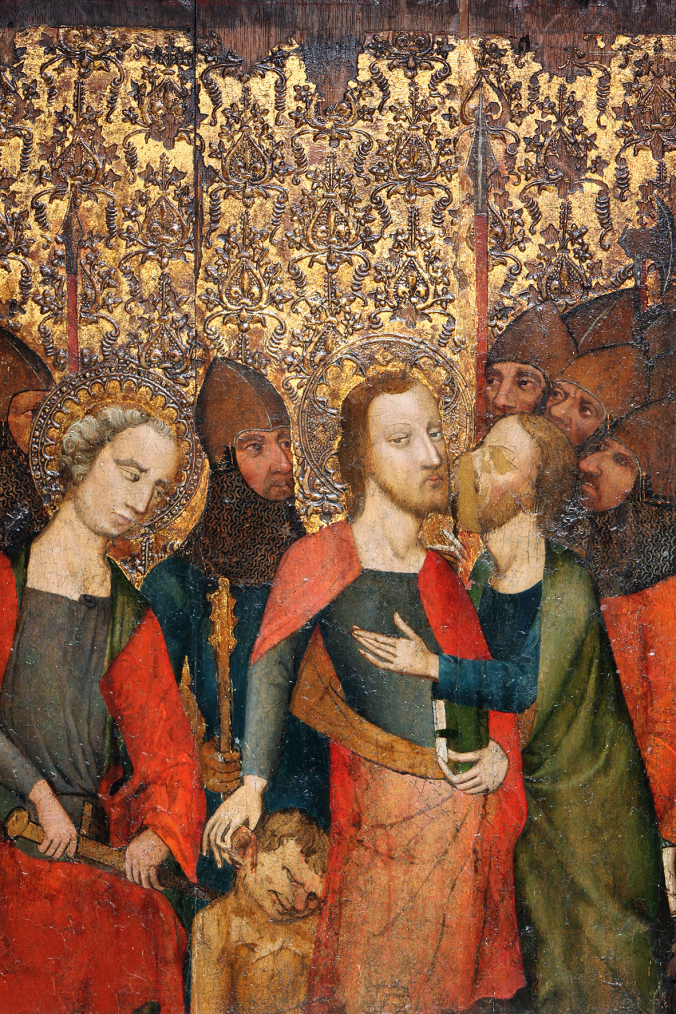
This is a picture that was in display at the Chapel of the Holy Innocents, Norwich Cathedral.  It shows the Jesus being betrayed, and healing, at the same moment.
I write about it in the last chapter of Jesus said, I am – finding life in the everyday
You might like to read the gospel story in John 13

Lent: Jesus said I Am….. Week 6, The Way, Truth, and Life

WP_20180507_20_33_10_Pro

WP_20180507_12_31_38_Pro

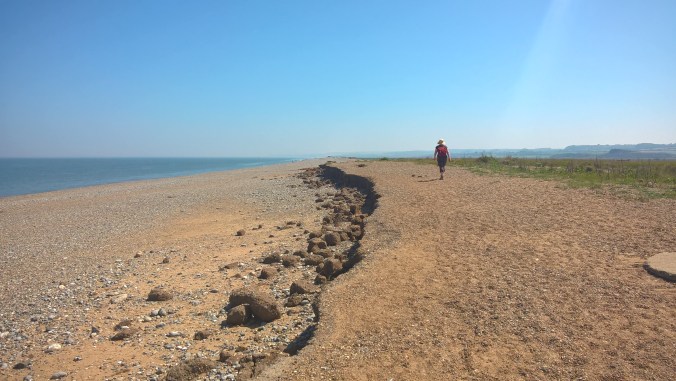
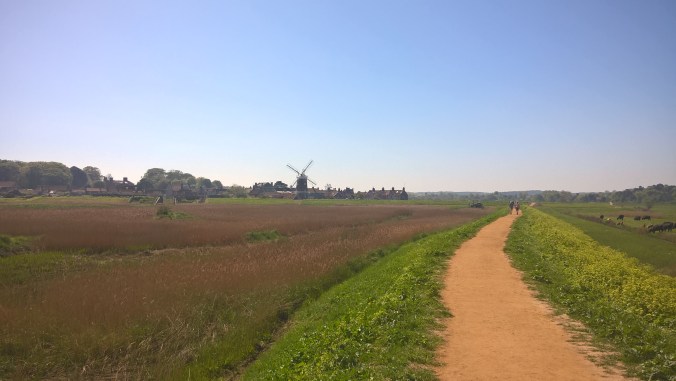
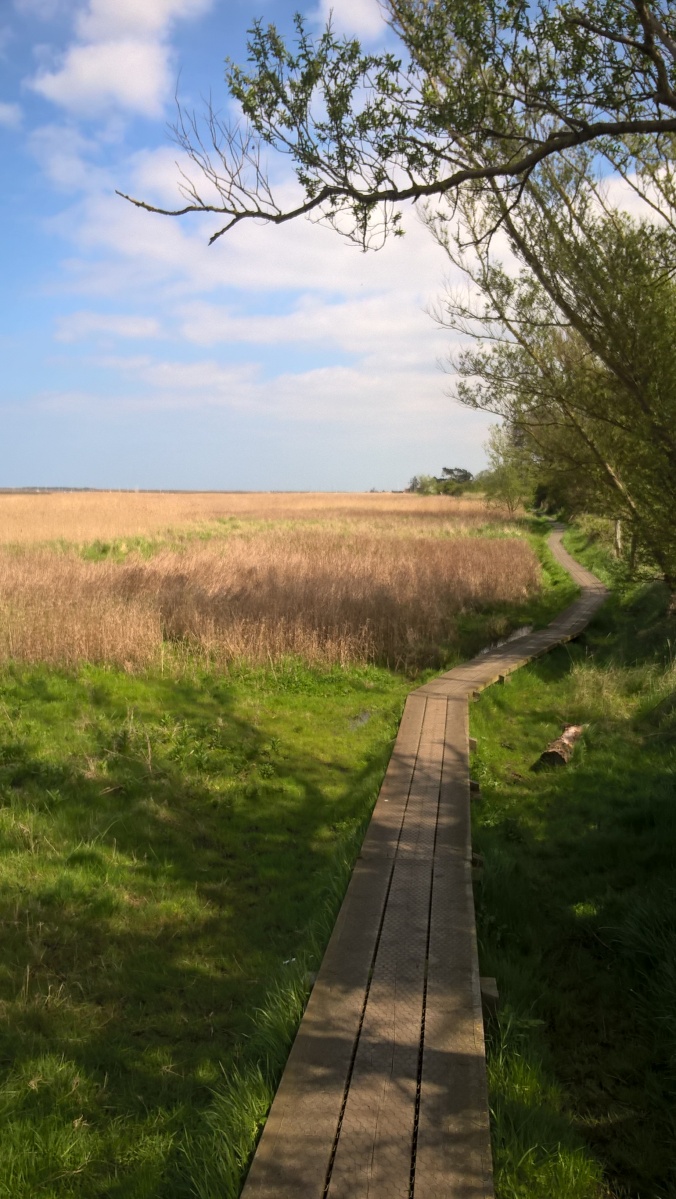
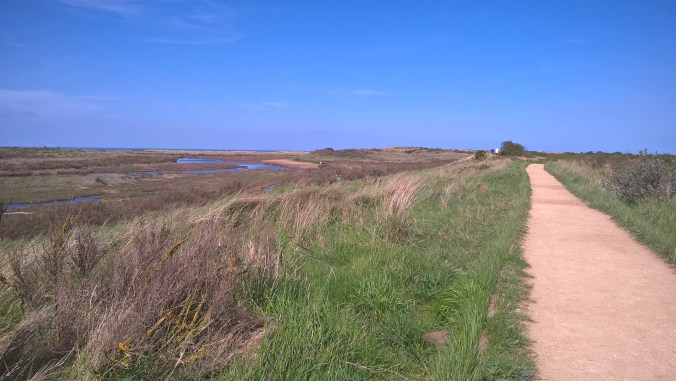
The photos in this post were taken last year, as the very short spring warmed up suddenly into summer.  We were walking the Norfolk Coast Path, which was my first long distance path – flat, and easy to navigate with the sea on one side.  It took us through many lovely, varied landscapes and small settlements.
WP_20180507_11_17_46_Pro

It helps to have an image in your mind when thinking about the Way, as we are this week.

As we enter the traditional season of Passiontide, drawing closer to the Cross, we enter too, in our reading, an intense dialogue between Jesus and his friends, in which Jesus seeks to explain the terrible thing that is going to happen.  To prepare them, and to show them the necessity for it.

We will touch on the themes of Way, Truth and Life here, and seek to work them into our days.
We are continuing this Lent series drawing on my book, Jesus said, I am – finding life in the everyday.

John 13- 14
WP_20180504_13_18_15_Pro

Jesus knows that the time when he will be abandoned and betrayed by his friends, and then crucified, is getting close now.  Knowing this, despite this, he loves them to the end.  Knowing that the Father had put all things into his hands, he strips and kneels and washes their feet.  He gives them bread.  In doing so and by what he says, he tries to prepare his friends for what will come – must come.  He does so with sadness and compassion.  These are dark and difficult words.  But, there is more.  There is also a vision of love, service and life itself – the way of the Spirit, the Comforter. It offers them a way they can live when Jesus is no longer with them  They do not want to see ahead to such a time.  This next ‘I am’ saying is part of all this preparation – showing them a way forward – a way that will endure.  Jesus is that way.  He will remain that way, even after.

We are not there yet, though.  We need to stand back a little and see more clearly.
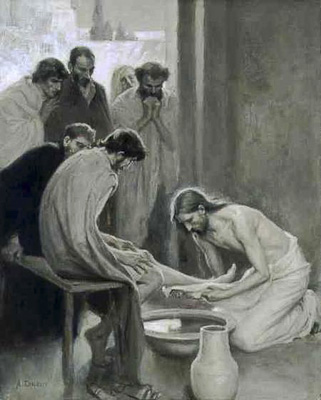
Jesus Washing Feet 11

Jesus Washing the Feet of his Disciples, 1898 (oil and grisaille on paper) by Edelfelt, Albert Gustaf Aristides (1854-1905)

© Nationalmuseum, Stockholm, Sweden
Finnish, out of copyright

The towel

Jesus gets up from the table, strips off his outer clothes, wraps a towel around his waist and kneels to wash his friends’ feet.  This is part of the way ahead – the way of love and service.  It is an instruction for how they are to live when he is gone.  They are to imitate this act – and a concrete task can help us through a difficult time.  It is hard for them to receive it.  This kneeling and washing, acting like a humble servant, is part of the self-emptying way that Jesus is following, a small foreshadowing of the self- emptying of the cross.  The way of love and life passes through the darkness of death.

………

Glory

No wonder it was hard to grasp.  This is what glory looks like: tying a towel around your waist, a friend leaving to betray you with the taste of bread still in his mouth, being lifted up on a cross.

What might it mean for us, to know there is glory even here?

This encounter between Jesus and Judas – as he washed his feet, as he shared bread with him – has given me much to think about.  I wrote about it here.

However much they did not understand, his friends did seem to grasp that he was going to leave them.  That this leaving would be for them – that it would bring them the greatest good  – was beyond them.  The loss of Jesus could not be but terrible in their eyes.

And so, he tries to frame it for them.

Something profoundly essential is happening – terrible as it is – that will ultimately work for the good.

This is the only way.

A spacious home

Jesus gives them a picture of what the good will be – a picture of the host going on ahead to prepare rooms, or dwelling places. This is why he must leave, to unlock the door, to get things ready, to open and air the rooms.  It is a large and spacious illustration, one that would conjure up Middle-Eastern principles of hospitality and welcome…..

There is an expansion in these pictures, and a deep sense that Jesus will go to considerable pains, even to the loss of his life, to bring home the sheep, to make a place in the Father’s house.  Images of hospitality abound in the other three gospels, for the kingdom – images of banquets and wedding feasts and wide tables. Here, we find these: a large and hospitable house, a generous sheepfold.

It is entirely understandable that Thomas replies, “We don’t know where you are going, so how can we know the way?”  Now is the ‘I am’ moment: “I am the way, the truth, and the life”.  Can we think of a person as a destination? For that is what we are invited to do. ….

As we seek to walk along the way of love and service, we walk along with Jesus.  We remember that the earliest name given to Jesus’ people was not Christians, but followers of the Way.  We walk with Jesus, and with each other, on this path.  That is the way.

It is Jesus who is Way, Truth and Life all. That begins to shift us to a different way of understanding what these things might be.

The reality behind it all, the reality we can trust, is love.  That is why Jesus goes on ahead through what we cannot, and then comes back for us again.

The way of love is not soft, comfortable or secure.  It will take Jesus to hell and back.  It will take him to the very worst that can be done to a human being. This is the way that humanity will see God’s outstretched arms, and be liberated to enter abundant, overflowing life.  Jesus is making the way.

Way, truth and life are here.

“In him was life, and the life was the light of all people.” John 1:14

Reflection and response

John often has parallels, patterns in his Gospel.  You might like to think about Mary kneeling to anoint Jesus’ feet (see last week’s post) and Jesus kneeling before the disciples.  You can use the pictures in each post to imagine what it would have been like to be there. You might like to think about what they have in common.

jesus-washing-his-disciples-feet1

Further Study

Exodus 12:1-28
Consider more deeply these themes of the Passover: slavery and servanthood; a meal overshadowed by death and departing. Do these help your reading of the last supper?

I am struck by the fact that the Passover celebrates liberation from slavery, and this newly formed Passover – the Last Supper – includes a command to imitate the actions of a slave – washing feet – in free loving generosity.
How do you respond?

Creative Response

Foot washing
You will need: water, washable pens, paper, kitchen paper.

Imagine Jesus kneeling before you to wash your feet.  Imagine you are there, in that upper room. What do you feel at first? What do you feel at the end? You might like to paint your response.

You could use washable pens on your hands, remembering things that do not fit with the command to love.  Then dip your hands in water and watch them become clean.

Thank Jesus for his loving sacrifice and his example.  Thank him for the gift of forgiveness.

Remember a time when someone offered you love, and practical service. What was that like? Remember a time when you did the same for someone else.

Think of what it means to be a leader like this.  Where do you have opportunities to lay aside status and simply serve?


Life and Service

Love
In every situation today, take this as your starting point: how can I best love and serve this person, these people?

My Father’s House
Think about times you have received hospitality, and given it.  What stays in your mind?
Can you expand your current practices of hospitality – even a small step?


Pilgrimage

You may wish to go on a journey with a spiritual purpose and particular destination in mind.  You could travel far or go on a walking tour of local places of worship and ancient holy sites. You could use maps and photos to imagine yourself on such a journey if mobility is an issue.  You can go with friends, or alone.
WP_20180503_15_07_04_Pro


In the current state of our news and social media, I think this one is particularly relevant.  I would add to it now, as we are all empowered to generate our own content, and to share stories….. what are we spreading?  Is it true, loving, kind? Does it promote understanding or division?

Truth

Be on the lookout this week for where and how you learn about the world.  Look at your news sources.  Consider how you listen to more personal news from friends and colleagues.  Whom do you trust and believe? If you do not already do so, consider fact-checking, and reading and viewing things from perspectives that differ from your own.  What do you find out?

Be particularly alert to this question: does this presentation of the facts encourage love and peace between people, or fear, hatred and hostility?
Does it help or hinder me in loving God and loving others?


Thank you for reading.

Please feel free to share any of the material you find helpful, saying where it is from.

If you’d like a copy of the book, you can ask your local bookshop, or order online.

Here are a few suggestions:

The publishers, BRF

Amazon
img_20181130_114736372319885.jpg


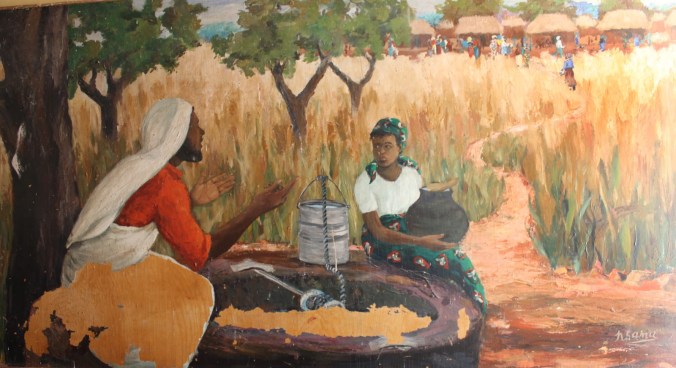
Lent: Jesus said, I Am ….. Week 1, The Woman at the Well


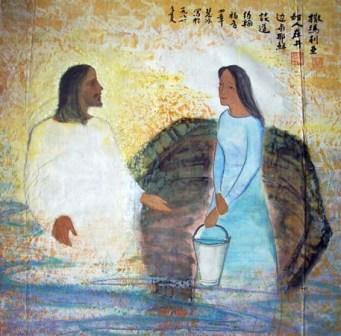
The bible scene with Jesus at the well with the Samaritan woman shows signs of damage and peeling of paint

Mural by  Emmanuel Nsama

If you are following my Book for Lent, welcome! I hope you find it helps.
If you’d like to begin at the very beginning, you could take a look at the chapter on Moses, and the burning bush – the first I Am. You can find a link to my post about that here.


IMG_0864

John 4:1-30, 39-42

It may seem a strange place to start, with this deep conversation that is not normally mentioned as one of the I AM sayings – and indeed, it isn’t one of the classic seven.  However, it is a story which has intrigued me for years, and when I found that this is the place where Jesus first says “I am”, I wanted to explore it more fully.  It is the longest recorded conversation Jesus has with one other person – and it is with someone who was on the other side of so many cultural barriers.

At a time when our politics is increasingly divided and divisive, where people box each other into categories, and make some lesser than others, this is a particularly relevant conversation.

John the Evangelist prepares us for this story very carefully, for it is profoundly counter-cultural. Jesus stops to rest near the plot of ground that Jacob gave his son Joseph. Jacob’s other name was Israel – one who wrestles with God. We are going back to Israel’s common spring, common source, at Jacob’s well. We are being reminded of a time long ago, before the time when and the Jews and Samaritans became peoples who saw themselves as separate. It is a place that holds meaning and memory for Jews and Samaritans – of their common father, and their common salvation story. John is placing us on common ground……

I think it is no coincidence that John begins this story by setting it against an atmosphere of potential conflict – between cousins, between related nations. We see Jesus acting out his mission to be a peacemaker, a reconciler. “For he is our peace; in his flesh he has made both groups into one and has broken down the dividing wall, that is, the hostility between us” Eph 2:14. Jesus himself is common ground, and his presence changes things. If we look carefully at how we are prepared for this encounter, we can see that we are being led away from conflict, towards reconciliation, to inclusion, and to hope…….

And so, as Jesus waits by the well in the heat of the day, a woman approaches.  We can only imagine what it must have been like for her, in a culture where a woman could be divorced “for any and every reason” (Matt 19:3). We often think of her as one utterly disgraced in her community, having to visit the well at such a time.  That may be so, but we must remember that at this time divorces were easy for a man to come by and early death not uncommon.  Whatever her circumstances, she must have known more than her share of tragedy and disappointment.  She may have known deep shame and disgrace.  She may well have been a rejected member of a rejected community.

And yet she, like everyone else, gets thirsty and needs water to drink and water to wash with.  She is as human as everyone else.  So often, we do not see people like this.  So often, we make quick judgements, build fences, wonder about people’s worthiness and, in our own pride and insecurity, seek to feel superior, chosen, righteous in some way.  Not so Jesus.

His question bursts through all our categories and barriers in its gentleness, its humanity.  It is a question that changes everything for this woman, and for her community.

“Will you give me a drink?”

Jesus humbly admits his own thirst, his own need.  If we have heard the parable of the sheep and the goats (Matt 25:31-46), this question may have a deep resonance for us, for there Jesus says that whoever gives a thirsty person water, gives it to him.  This story in John gives us a way of thinking about the needs before us.  How would we respond – how do we respond – if a stranger asks us for a drink?

overflowing_glass_5

And from the Reflection and Response section.

Pour out a jug of water and set it before you, together with a glass.
Ask yourself what you thirst for.  Allow honest answers to emerge and note them.  Where does your life feel dry and unproductive?  What would help?


“I was thirsty and you gave me a drink”
….If you buy drinks out, perhaps you could fast from one or two a week, and give the money to a charity instead………

You could carry extra bottles of water to give to the homeless or buy tea or coffee for those you encounter and drink with them.  I have gift vouchers for coffee shops in my bag to pass on………


trees

Think about this picture – look at the two trees, and the fence.
Where do you find connection in your life, and where separateness?
Are there ways you can reach across divides?
Pray for wisdom.  Remember how Jesus slipped away from potential conflict with the religious leaders.

“For he is our peace; in his flesh he has made both groups into one and has broken down the dividing wall, that is, the hostility between us” Eph 2:14.
What comes to mind as you meditate on this verse? Does it speak into an particular situation for you?


If you’d like a copy of the book, you can ask your local bookshop, or order online.

Here are a few suggestions:

The publishers, BRF

Amazon
img_20181130_114736372319885.jpg

This blog post also draws on the Sunday Retold series.

Thank you for sharing this time with me.


A book for Lent – Jesus said I Am …. getting started.

IMG_0452

Here in the UK, our late winter weather seems brutal.  This is not what we expect for February, and many people are beginning this season with the heartbreak of seeing their homes flooded.  This Lent, the Archbishop is encouraging us to take seriously the call to tend and care for the living earth.

WP_20171016_16_18_46_Pro
I am very pleased that various groups, churches, and groups of churches are going to use my book as guide through Lent, and, if you would like to follow, you can find a suggested programme here.

IMG_0790

Getting Started: Chapter 1, Moses and Abraham.  This is a shortish introductory chapter – you could fit it in the week before Lent, or as an extra piece of reading as Lent begins.


IMG_0871.JPG
That means that this week is a good time for me to share with you a little of the first chapter – I am: Moses and Abraham.  It’s short, so I hope you’ll be able to include it in your readings.
Exodus 3:1-14


John’s gospel looks back to Moses’ ancient story, recording for us how Jesus called himself by this name – “I am”.  This name, which emerged from a burning bush so long ago, is one of the most identifiable features of John’s account. It resonated with his early readers and listeners in Greek Ephesus, and it stirs our imagination even today, millennia later.  Before we go deep into John’s account, and explore why that may be, we will look back to Moses’ story and see what we understand of this earliest “I am”.

…….

Nothing is wasted in God’s economy.  God used the rubbish – and the good – in Moses’ upbringing and his life as a shepherd.  He became ideally suited to his task.  As well as his circumstances and experience, God used his character; in this case, a sense of justice and an indignation at bullies.  What must have felt like failure and a downwards path was the place where Moses encountered God.

We do not know if he was seeking God when God appeared.  We do know that he was in the middle of his everyday, working life, and that God did something strange to arrest his attention, awaken his curiosity, draw him nearer.  Attention and curiosity can guide you, can awaken you to God in the burning bushes we pass every day.

Moses certainly didn’t seem to looking for a job, let alone a great mission.  It is easy to read his rather thin excuses and wonder why he spent so long arguing.  His unwillingness to respond seems to come from uncertainty.

Moses is uncertain about himself, and he is uncertain about God.

“Nothing is wasted in God’s economy” – can we live from this realisation?  Can we acknowledge that even very difficult things can be fuel for something better?
Can we work to eliminate wasteful ways of living?

And from the Reflection and Response section

Earth’s crammed with heaven,
And every common bush afire with God.
But only he who sees, takes off his shoes.
Elizabeth Barrett Browning

As you start your day, pray for open eyes to see where God may be at work, or may be seeking to catch your attention today.  Set off with open eyes, a camera and a notepad.  Record anything that draws your attention.  At the end of the day, mull over what you have recorded in prayer.  What did you see?

IMG_0866.JPG

If you’d like a copy, you can ask your local bookshop, or order online.

Here are a few suggestions:

The publishers, BRF

Amazon
 

img_20181130_114736372319885.jpg

Thank you for joining me in your reading.  There is more to come…..

Publication Day! Jesus said, I Am

img_20181130_114736372319885.jpg

The day has arrived!  If you have ordered a copy, it should be on its way to you – online retailers dispatched it yesterday.

Thank you for your kindness and support.

Another little snippet, this time from Reflection and Response:

Good Shepherd, you know what lies before me today.
Help me to hear your voice, and remain close to you.
Guide me beside still waters, keep me at peace.
Nourish me with your presence, let me have enough to give.
Let me follow you this day, and always.


If you’d like a copy, you can ask your local bookshop, or order online.

Here are a few suggestions:

The publishers, BRF

Amazon


WP_20171016_16_17_36_Pro

Jesus said I Am – finding life in the everyday….. Light

Just a few days to go now until the launch on Friday!

So, here is another snippet.  This one draws on a talk I gave a few years ago, the Sunday after Easter, when this memory seemed to speak of resurrection, of new life for things that were broken.  Beauty can be made out of even the most unpromising materials.

It tells of how we went to Wells Cathedral, and how the stained glass in the Lady Chapel was made of thousands of broken fragments, gloriously put together, after the windows had been destroyed centuries before.


They were a vibrant kaleidoscope of shape and colour, exuberant and abstract, scattered with recognisable pieces of face and clothing.  But this was nothing to the beauty of the light that poured through them, for they turned the morning light to wild splashes of colour, transforming all it touched – all that old stone and wood and metal – to vibrant life.

…….

All those broken pieces, all those jagged edges, all those lost pictures were put together in a new way, transformed into something glorious.  Something new was made out of the discarded, useless pieces.  And the light of the morning sun poured through them, making everything within shine, lit up with glorious colour.

I saw a parable in this glass, a kingdom story of the new creation.  We, broken and discarded and small as we may be, can be held up to the light…….
Christ, in whom all things hold together, can indeed hold us together.


Wells-Cathedral-5492.jpg


If you’d like a copy, you can ask your local bookshop, or order online.

Here are a few suggestions:

The publishers, BRF

Amazon

img_20181130_114736372319885.jpg

Jesus said I Am – finding life in the everyday -The woman at the well

It’s only a week till publication day – 18th January.  It is a strange that these thoughts that have been circling round my head for quite a few years now, will soon be released, to make their own way in the world, launched. They will have different work to do then, and will be enriched by the responses of those who read them.

I’ve already shared with you some of my thinking on this chapter in the Sunday Retold series – a while ago now.  You can read that here.  If you do, you  will find some suggestions which have become items in the Reflection and Response section of the chapter, and get a flavour of that, too.

Although we tend not to notice in our translations, it seems to me very significant that the first time John records Jesus saying I Am is here, in Samaria, to someone outside our usual narrative of God’s favour.

So, here is a small snippet from the story of the unnamed woman who met Jesus in the heat of the day.

overflowing_glass_5


Perhaps she will come to see that Jesus is the gift, and he has living water. We are going deeper now.  Living, life-giving, flowing water in a hot land, to a parched and weary soul, is life itself.  It is a daily necessity and a joy.  We know that in John, there is often an association between water and Spirit.  Jesus’ previous encounter, with Nicodemus, reveals that.  The Spirit can be to us as water on a parched land, softening, enlivening, refreshing and freeing the seeds locked in dry husks, so they grow and flourish and flower.

……..

This encounter, which stared with a request for water, has become the source, the spring, of transformation that changed a whole community.  Jesus gives value to a person, and to a whole people, who were despised.  Here, in the heat of the day, they were offered fresh, life-giving water.  And they drank from this new well


samaritan-woman


If you’d like a copy, you can ask your local bookshop, or order online.

Here are a few suggestions:

The publishers, BRF

Amazon


Jesus said I AM – finding life in the everyday ……… Bread

Publication date is nearly here!
Friday 18th January is the day.

Thanks so much for your support and encouragement.

I thought I’d share with you a few snippets from the book, starting with something on Bread.

bread


And, so, the people all ate.  There was enough.  One of the many things this sign does is take our natural fear of ‘not enough’ and offer God’s ‘enough’ instead.  We find it hard to be generous when there are only a few small loaves and fish, and so many hungry people. With Jesus we see a picture of what it means to shift our perspective, to reframe our notions.

…….

What if we began seeing what we had – not in terms of what it was not, but in terms of what it was? Of seeing things not as our resource, but as a kingdom resource? This is food, these people need food, that’s what we’ll do – give.  Of course, the rational counting and measuring parts of our minds are not satisfied with that, and we are grateful for the stock control systems and emergency relief manages who count well enough to make sure all can be fed, but perhaps this is a different kind of lesson: one that turns our minds from what we see to a God of abundance.  Perhaps even this small act of generosity is magnified, amplified by a God who loves and longs to be generous.  What if each small act in the direction of goodness has consequences beyond our imagining?

….

And so, we see what Jesus does with the little he has been given by a child: he takes it in his hands, gives thanks, and then gives it away.


img_20181130_114736372319885.jpg

If you’d like a copy, you can ask your local bookshop, or order online.

Here are a few suggestions:

The publishers, BRF

Amazon


I’ll share a few more snippets as we go along!

barleyfield


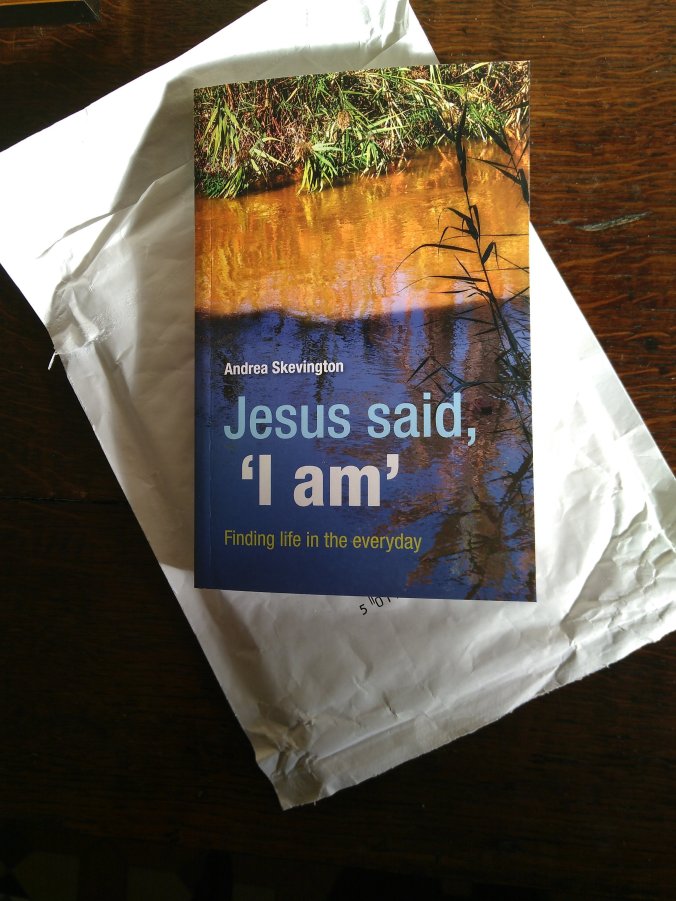
A new book on the doorstep!

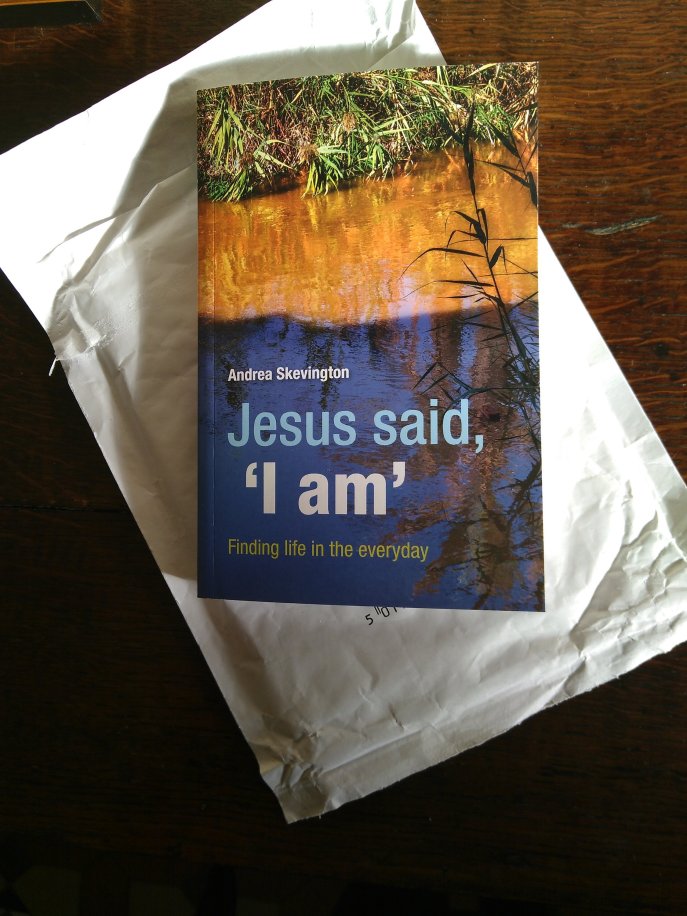
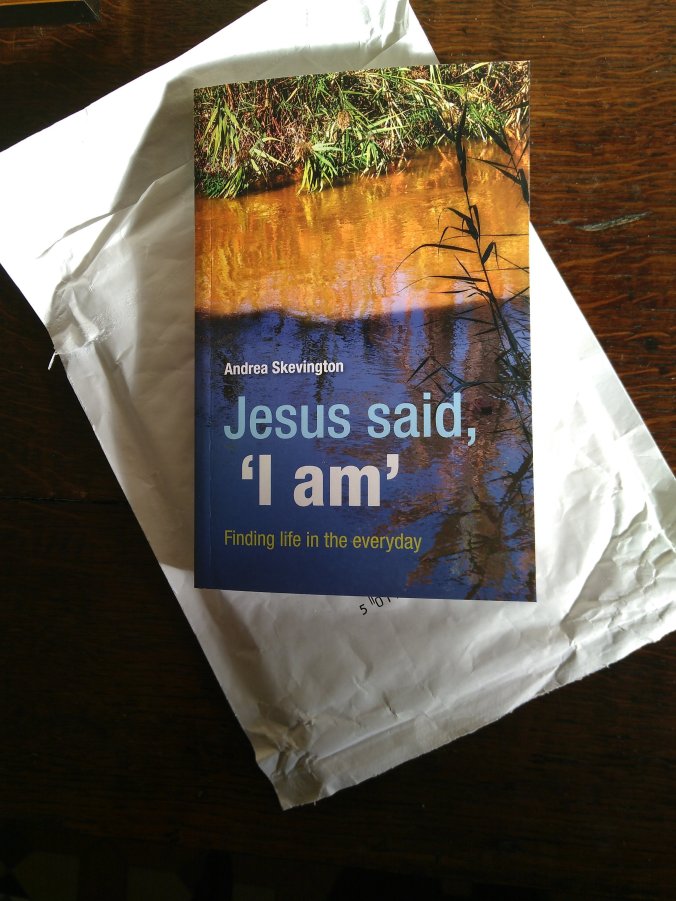
This morning, I was nursing a head cold in my own style – sitting on a bench in the sunny bit of the garden, wrapped up in a large blanket, and reading poetry. I thought I heard our postie so I pottered round to the front of the house, and saw this white envelope on the doorstep.

It’s always exciting opening something with the publisher’s frank on it, and this was very exciting! It’s the first copy of my new book, and BRF have done a lovely job of it. It’s a good size and weight in the hand, and the type and paper are crisp and clear. It’s a lovely thing. It’s particularly strange when something that began as a rather nebulous set of thoughts and hunches and feelings progresses through various birthing stages until it is an actual physical object you can hold in your hand. Wonderful! The joy of it seems to have lifted my coldy symptoms remarkably effectively – I hope it lasts!

The very physical bookness of the book has now been realised. I hope that those thoughts and feelings which have crystalised into the content may be equally real and tangible and helpful to those who read it. I’ve had a quick flick through and read a few snippets, too, and all seems well. The late amendments have gone in very efficiently, including an extract from one of the The ‘Mary, at your feet’ poems I had a yen to include.

You can pre-order it on most internet bookshops, and it should be available to order in high street bookshops in the New Year – but it might be worth asking before that just in case some distributors are ahead of the game. The publication date is 18th January 2019.

Here are a few online suggestions, in case you would like your postie to deliver one for you, too:

BRF – the publisher

Waterstones

Amazon UK

Thank you for your support and encouragement.