
I’m working away at my collection of poems, The Year’s Circle, weaving together the seasons of the year and the seasons of the readings many churches follow. And we’re coming up to the story we call the Transfiguration – when three of his friends see Jesus in an otherworldly, shining – vision? or what was it? – with Moses and Elijah from the Hebrew Scriptures. It’s a pivot point in the gospel accounts, important and central, and also strange.
Some have interpreted this event as a revelation of Jesus’ true identity, and perhaps a foreshadowing of the resurrection appearances, and perhaps a glimpse of the Universal Christ – a theme explored by Richard Rohr in his book of that name.
As usual, there is no explanation, no interpretation in the gospel accounts. And there’s something about the event which encouraged me to explore the way it asks questions of us – what we think is really real, and really lasting. How we see – do we see glory? Do we see cloud? Those explorations reminded me of the medieval work, The Cloud of Unknowing, and how beneficial it is to be open and patient with things that are beyond our understanding. It feels like a story to sit with in contemplation, expanding our way of seeing, inviting us into a deeper and truer experience.
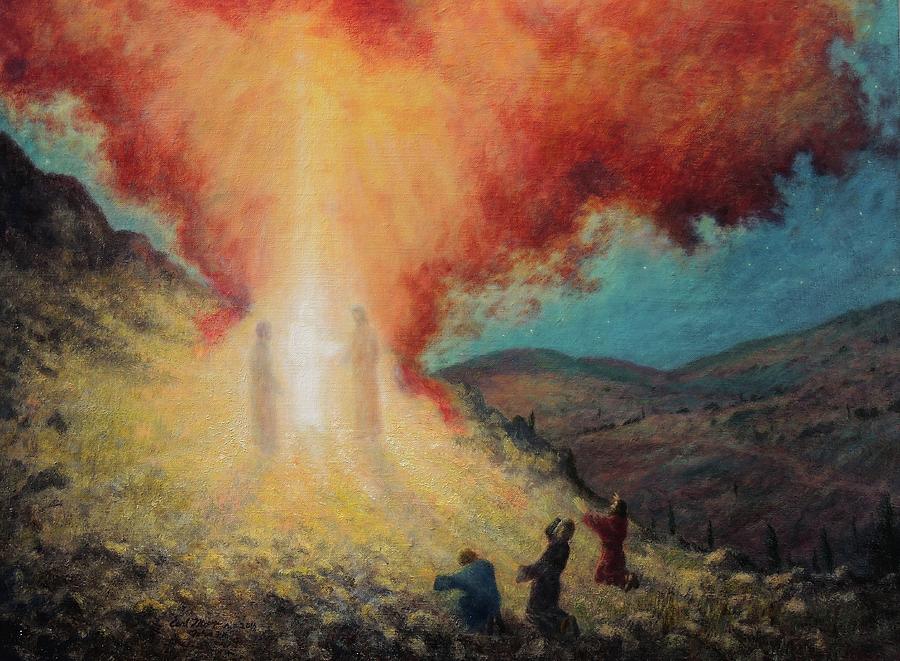
Earl Mott’s painting of the Transfiguration
When I was reading Luke’s account I was struck, as I often am, by his ordering of the events. There seems to be a theme emerging, with questions of who Jesus was, and also, what greatness might mean. And so I wrote a short series picking up those themes and exploring them. There are other events woven through that are not covered by the following sequence of poems – the Feeding of the Five Thousand, for instance – which is developing a sequence all of its own.
If you are looking for something to use in your devotions or public worship for the Feast of the Transfiguration (on 6th August), the parts stand alone, and can be used singly. But I was intrigued by the flow of ideas and wanted some space to ponder them on the page. I began with Herod, troubled and awkward in his guilt, and moved through the stories to the little child, standing in the midst of them.
So, here it is….. four poems following a trail.
Who?
Luke 9, Matthew 16-18
I Herod
Herod found you a
question he did not
know how to answer.
Perplexed, he heard
whispers that you
were John back from
the dead, a ghost to
stalk his conscience,
shock his dreams,
or the great Elijah,
or another prophet.
He sought you out, he tried
to see you. Perhaps to
ask you who you were.
What might have been,
what could have been,
if he had met you then?
II Peter’s confession
You asked those who knew you best,
Who do they say I am?
and
Who do you say I am?
To the first, they gave the
answers that blew in the air
like smoke, whispers that
swirled dark around
Herod’s palace, and
through courts and crowds.
John the Baptist, back from the dead.
Elijah. One of the prophets.
And to the second – a moment’s
pause, an intake of breath,
a strangeness rising – to be
asked to name, to more than name,
one they knew daily, and loved,
and still, barely understood.
How to give answer
to such a question?
But Peter did. The vast
words formed in his mouth.
He called you Messiah,
the Christ, the anointed one.
How good it is to be seen,
to be known, to be understood.
How warmed you were by those words.
Enough to give him a new name –
Rock – and a new identity – foundation stone.
For all his impulsiveness, changeability,
you knew him as deeper, and truer.
And yet a sadness enters here.
The anointed one does not
walk in greatness.
The road you will take is
hard and stony. A way of weeping.
And a warning enters too –
those who consider themselves
God’s guardians will subject
you to death, yet death
will not hold you.
Such words cannot
be borne. Such an
upending, a
contradiction,
such pain.
They fall to the earth
like so many
hard-shelled seeds,
trodden into the dirt
and snatched up by
dark, shining beaks.
Sometimes our seeing falls away
and we catch a glimpse of
deeper truth. We say we see the light
Away from everyday thinking,
on the mountain, in prayer,
weighted with sleep.
Perhaps we see a beloved face
lucent in sudden light.
But here, on this mountaintop,
three friends lifted up their eyes
and saw – what shall we say?
to whom shall we compare him?
Shining like the sun, as white
as light, as bright as lightning –
the one they walked with,
ate with, laughed with.
Was it like the lifting of a veil, or
perhaps a dragonfly splitting his
dark skin to emerge a jewel?
Was it a peering through
the door of heaven, or
coming to see the glory
of things here, and now?
I do not know.
I do know it feels
a moment of endless truth.
And in that moment, Jesus,
Elijah and Moses do
not speak of the glory
that blazes around them,
they talk of the pain that
is to come – as ones
who can understand.
I hope there was some
comfort in it.
Something like comfort
too in the sightless
seeing cloud,
shekinah,
that reveals how we
do not and cannot see –
God is beyond us
And yet is with us,
as close as mist
filling our lungs,
beading on our skin,
as close as one we love.
And then they hear that true voice
speaking tenderly, calling him
beloved, and saying to listen,
to listen to their dazzling friend.
Words they will carry in their hearts,
words which in turn will carry them
on that long wide-eyed walk
down the mountain,
and through all that is to come.
As above, also reference to Isaiah 40
IIII Greatness
It is not what we think.
Greatness is not the pomp,
the power, the show,
the mountaintop.
It is the welcoming of a
little child. It is the being
like a little child.
In doing so, we draw
closer to the one
who calls Jesus
beloved,
the Son I love.
Greatness, a costume
cloak of purple and foil.
Let it slip from your
shoulders. Let it
fall.

As ever, I’m sharing with you work in progress. There may be some tweeks and amendments before things land in the book – Wild Goose, Iona Publishing, next year.
Also, as ever, please feel free to use any of my material that helps, referencing this blog as your source. I love to hear about where my poems fly to, and where they land.
Here is a link to some more I’ve written on the Transfiguration. It includes extracts from my retelling, and some thoughts on how we might come to see more truly. I hope you find it nourishing.

Armando Alemdar Ara, from Liturgy Tools








 Andrea Skevington