Poem: After the storm – October ’23

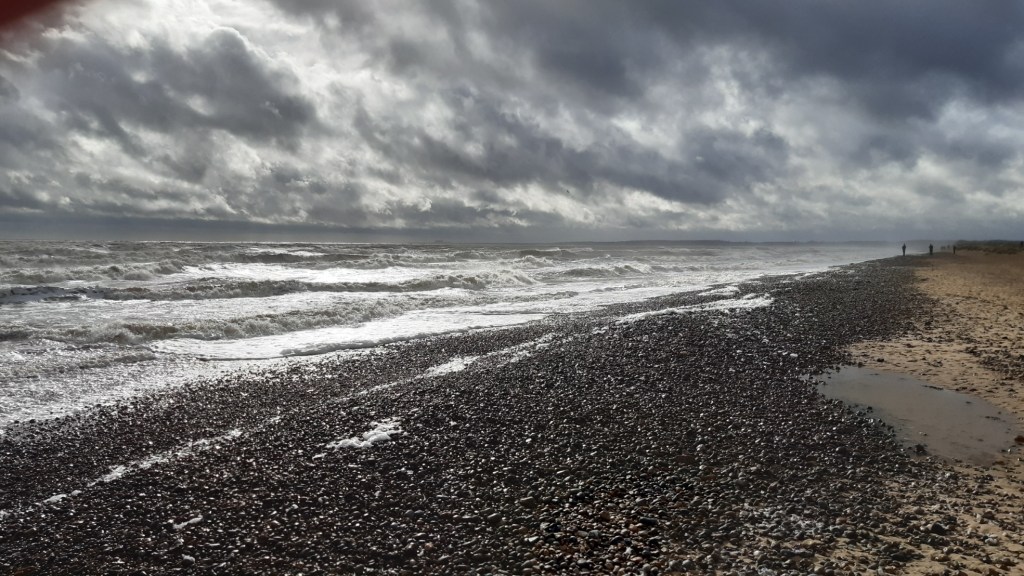
Last Friday, during storm Babet, Suffolk experienced some of the most severe flooding in England. It was good to be able to stay home and keep in touch with friends, making sure they were safe. Many people have lost their homes, their businesses and their posessions. Tales of help and rescue are still emerging. Places that have not flooded in living memory have been badly effected. We are used to threats from the sea in this part of the world, but think of ourselves as living in a dry place, unused to severe storms. The climate is changing, and it is unsettling.

As I’m writing this, the next storm is about to arrive, with a weather warning for wind beginning this evening. The mild, even warm, air holds so much moisture, the trees are still in leaf, the roots in soft soil. This morning I hurried to pot up a whole load of tree seedlings for a friend of a friend who is planting a small wood nearby, and I marvelled at how easily they slid out of the earth.

This strangely perturbed and perturbing season of weather is full of beauty, plants and flowers still growing vigorously on the first day of November. The air is full of insects and birdsong. Frogs are hopping whenever I disturb the plants in the garden. As I sat in a patch of warmth I remembered some words of Robin Wall Kimmerer which I love, from a book I treasure:

“Even a wounded world is feeding us. Even a wounded world holds us, giving us moments of wonder and joy. I choose joy over despair. Not because I have my head in the sand, but because joy is what the earth gives me daily and I must return the gift.”
― Robin Wall Kimmerer, Braiding Sweetgrass: Indigenous Wisdom, Scientific Knowledge and the Teachings of Plants

And as I began to write, that idea seemed particularly rich and right for the moment, and for always. What gifts we receive. I hope we can return such prodigal generosity, and care for the Earth. We do need the Earth to continue to care for us.

After the storm, October ‘23

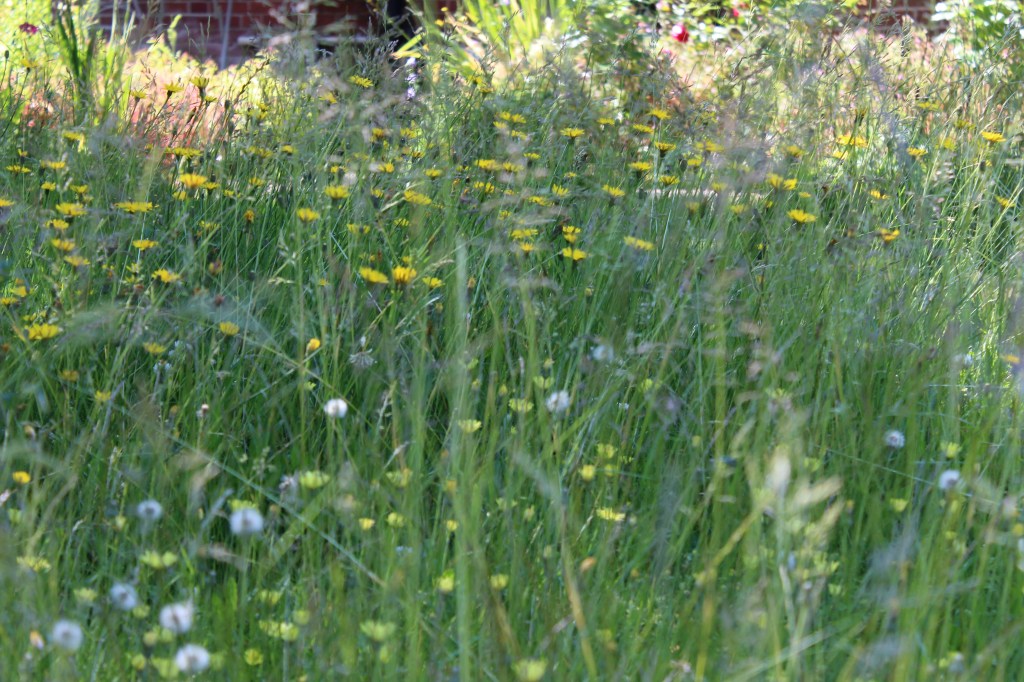
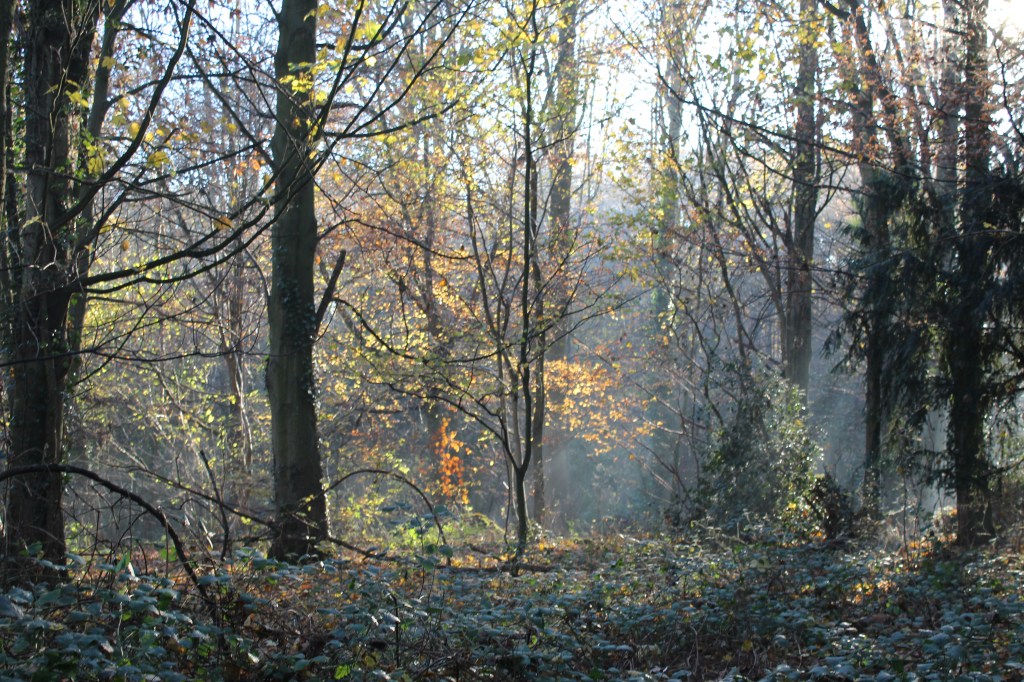
There is a low sun
slanting gold across
all this humming green,
all this hidden life
whispering through
each bending blade,
and the birds sing loud
after the silence of the storm,
as loud and full as spring.

And the sun warms my skin
after the floods and the
rain and the rising dark waters,
and my skin is soothed and comforted
even as my mind is troubled.

What will become of us, what will
become of us all, as the air
heavies again with water, burdened,
and that water, fallen, heavies,
burdened, with brown earth,
for each year brings more strangeness.

And yet, even so, the light
drips with gold, shining
through translucent wings,
insects swaying in those
wailful choirs, in many
tiny flocks, rising and
falling in the gusting warmth,
more and more each year.

It feels so small, this heart-response
to so much perplexity. And small it is.

And yet it is something
to marvel at the beauty that
is still offered, daily,
to say yes, and thank you,
for the green overflowing of all
this life, and to tend within my reach.
To receive, to love, to speak,
to tell you even of these
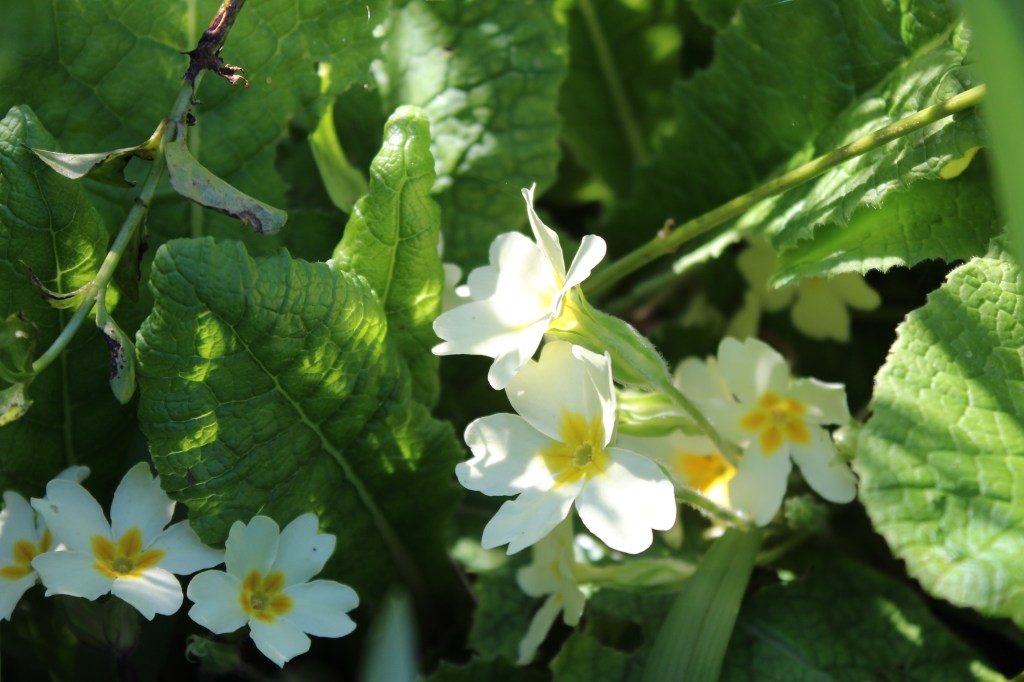
rain-drenched dripping flowers –
look, heavy and ripe and bowing –
and dare to hope that in some
deep and barely discernible way
this care, this love, this joining of eyes
upon beauty, is the softest whisper,
almost beyond hearing, of
mending and healing and
knitting together,
stitched through with
golden, endless light.

This poem also owes a debt to John Keats, and his incomparable Ode to Autumn.

Poem: The grace of seeds

As we come to the end of the Season of Creation, I offer a harvest of seeds.

I love the way seeds spread in the garden, finding new nooks and crannies to settle, new places where plants will grow and in their turn offer flowers to the insects, seeds to the wind and the birds.

As I was watching fluffy seedheads catch the breeze a few weeks ago, I felt my attention catch on the seeds. I felt that insistent “look!” which comes sometimes, and alerts me to some depth, some beauty, some meaning. It’s always worth attending to. And this time I saw the reckless generosity, the persistence of seeds, unfolding to me a truth about creation’s blythe insistence on hope. Each offering of seeds represents so many second chances, fresh starts, try agains. And the word forgiveness came to mind – as if the seeds were offering a chance of Spring despite, in the face of, the ways we continue to undermine and deplete the natural world. The seeds a sign of forgiveness, a chance to try again, an ever repeating offer of new life.

Some of you who have been good enough to follow this blog for a while may remember that I return often to the themes of the parables – the stories Jesus told – especially the ones that speak of the natural world. I love the way Jesus quotes the psalms to explain this mysterious teaching method – “I will open my mouth in parables; I will utter things hidden from the foundation of the world.” (Matthew 13:35) The Hebrew Scriptures tell of a vibrant world saturated with the glory of God, of living things being animated, and full of wisdom, if we will but pay attention. I hope to write more about that another time, but for now, I’ll return to seeds. If you’d like to read more about the parables and the seeds on this blog, you can look here and here to begin with.

The poem I’m sharing with you today is full of touches from the Gospels, and another day, if I can, I might unpack them for any of you who are interested. I felt the call to “look” was an invitation into all sorts of deep truths……But I hope the piece stands on its own, open to all who look with wonder.

But for now, below, the poem. It’s been one of those pieces that has revealed its meaning to me in the process of writing, that has felt like a discovery or an uncovering. I wanted to share it with you today, this last day of the Season of Creation. I hope I haven’t hurried it along too much – it’s been taking its time. I hope it is ready. We’ll see!

The grace of seeds.

Seeds are blowing in the breeze,
gentle, white and light.
Fairies, I used to call them as a child,
back when the world was full of seeds,
and butterflies, and glimmers of enchantment.

I breathe slowly and long
into all this ripening.
All this, all, glows with a deeper life –
light and colour under the skin,
shining with a song
of greening and ripening.

Each seedhead releasing a kind of
forgiveness that falls with the seed,
falls to the earth bearing
new beginnings, seventy times seven.
Life wills to live, despite all we have done.
Life uncoils again, and again.
I am humble before it.
Before the caterpillars on the toadflax,
the frog stirring beneath the strawberries.

The world is indeed full of grace.
We do not deserve these chances, again,
and again, and again. And yet,
deserving is not the point. Seeds fall,
it is the very nature of things,
and blow on the breeze. Each one
offering multitudes. It is the way of seeds.

Might this grace, one day, even today,
catch us in its loving web as the trumpets of
bindweed blaze out a song of liberation,
and the blackbirds tumble fearlessly,
hungrily, in the hedge’s ripeness?

For the seeds float still, and
the air is still full of enchantment.
Life whispers, it calls us, it sings to us.
Does it know we will turn towards it,
at last, wooed and wonderstruck,
and learn we belong, have belonged
all along?
We might, we may, we can.
Those dry seeds show us how.

All the pictures are from the garden – and the narrow strip outside the wall by the road, where I’ve been sprinkling seeds for years.

Exodus poem on Diana Butler Bass

A couple of years ago, during lockdown, I felt drawn to explore the stories of Moses and the Exodus.

One of these was inspired by Moses and the burning bush, where he takes off his shoes because the ground is holy. This poem now finds itself at Diana Butler Bass’ The Cottage, as part of her marking of the season of creation. It’s so good to be part of this beautiful musing on an important season, to be marking a shift in awareness as we begin to pause and reconsider our relationship with the rest of life on this dear blue-green planet.

I hope the link below will take you to her rich and thoughtful exploration of this theme.

https://open.substack.com/pub/dianabutlerbass/p/sunday-musings-f9a?r=46vqv&utm_campaign=post&utm_medium=email

You can find my original post and poem here.

Gaia at Ely Cathedral. You can find out more about that here.

Previous visits to The Cottage can be found ..
The Sower and the Soil
Mary, at your feet
Jesus washes Judas’ feet

Poem: The Wash, high tide, knots rising

RSPB Snettisham

Last month we took a few days to visit Norfolk, staying by the Wash. UK viewers of Winter Watch and others may have seen some awe-inspiring film of one of the UK’s greatest wildlife events – sometimes called the Snettisham Spectacular. Maybe you’ve been lucky enough to see it for yourself. We decided we’d go and try and catch this sight, when a very high tide drives the birds off the mix of saltmarsh and water, into the air in huge flocks, and down into lagoons cared for by the RSPB. Their website (linked above) will help you get a taste of what its like, as well as some information about when these high tides happen.

Of course, there are never any guarantees with nature, but we got up very early and went to Snettisham in the dark, on a cold February morning, full of anticipation. I’d decided on flasks of coffee – which turned out to be an excellent idea! It was the most moving experience, deeply awe-inspiring, to see a landscape so full of life, and the wildness behaving freely as it should. I am sure that there have been times when there were more birds, and more wild, here, but it was nonetheless a glimpse of a more beautiful world, the world closer to how it should and can be.

You may also be aware that this precious landscape is vulnerable, and a new development could have a huge impact. If you want to find out more about that, you could begin here.

I wanted to try and capture the beauty of what we saw, and also the depth of experience that aroused in us and the others perhaps who were gathered there, and so this poem recounts the journey through the dark, and into the dawn-light of this beautiful sight.

C and A Wild Images Knots

High tide, the Wash, knots rising.

Out in the Wash-marsh,
the dark-before-dawn,
we walked
uncertainly, deeper in,
listening warily for water
sounds, mud sounds,
as we heard, out on our right,
the loudness of bird and tide.
Restless, growing, imminent.

The path seemed so long
in the dark, unknowing and
unseeing as we were.
On and on until at last we came out of
hedge-shadows and reed rustles,
out on the open bank of shingle,
with a chill wind blowing,
with the dark softening into the grey of
mist and ice-fret, as out of the
greyness emerged
a gathering crowd, moving, looking,
watching that density of black birds
emerging too, out there on the
mudbanks and sandbanks,
crowding as the water was rising,
All prickling with anticipation,
all readying for flight.

Through a lens you could see the
black backs of oystercatchers,
tens of thousands, all facing one way,
bright beaks aligned like many compasses.

And further out, paler knots,
rippling over the shrinking land,
their voices sounding together
as water lapped and lapped ever deeper,
full of fish washed in on this rapid tide,
followed by the hungry seals,
heads up, and hunting.

The bird noise grows, and the waders
begin their great lift,
A few at first, tip toed,
up and down like dancers
performing the perfect jete. Then,
as waves pour over their islands
and there is no room for all these birds,

They lift and stay lifted, from the edges,
like a great cloth, swirling now
above fast running water
rilled with small waves.

And then the oystercatchers
begin to pour like dark smoke,
like sentient smoke, as one,
all to the right, pour down
into the lagoons behind us.

While the knots, catching
the rising light, rise too,
turning pale now, loud with cries
and loud too with wings,
like a great crowd running joyously,
like a shining cloud swirling in the wind
but with mind, with being, with will,
a great pale creature rustling
and winding through the air over us,
close and low, and then down
in a whispering snake’s head behind.

And again, and again, rise up more
swirls of birds, faster and wider by
the tens of thousands, of wings
all together, birds turning together,
a miracle of unity,

As wings beat like hurried feet
as more people rush to look up,
and the waves take more and more
ground from under us all.

And I cannot tell you
what joy, what exultation –
And I write from longing to tell
you what joy, what exultation,
we humans, standing, feel
in this wide and wild abundance,
this wild and wide abandon.
This deep unity, this wide-wild-eyed
seeing into the communion of things.

As a sudden sound is added even to
all this loud crescendo,
like thunder, like jets,

The rise and beating of great wings –
pink footed geese
beyond number, beyond measure,

filling the sky with clouds of
moving birds, spinning fast now into
great skeins that wind over the deep
distance, loud and louder
bright on the dawn,

Bright with the wonder of wings lifting,
Bright in this new, steady,
giddying light.
A light that washes through us all
A light that holds us all
As dawn breaks us wide open.

If you search online, you’ll find some films of the birds, like this one.

I hope this gives you a glimpse of how beautiful a sight it was, and how transformative.

Yesterday evening I had the great privilege of reading this poem to open a series of talks organised by the Woodbridge Climate Action Centre. Local friends, tickets are free, and are going fast. The series is called Regenerating Living Landscapes, Working with Nature.

It is possible that a recording of last night’s event may become available. If it does, I’ll make sure there’s a link to it here.

19th May Note:
As you can see from the list above, tonight is the last talk in the series. Once again I’m delighted to have been asked to read something, and the poem I’m going to read is A Good Place, which is also on this blog. As usual, click through to read it.

Poem: Pigeons in the Blossom – early March

Our wild cherry plum blossom on a sunnier day.

Hello again! Thank you so much for joining me here. I’ve been taking a break from blogging, if not from writing, for a few winter months. But as the days are lengthening and the sap is rising I’m emerging from winter hibernation by the fire.

Yesterday, for #International Women’s Day, I joined some of the wonderful women and men who make our small town such a special place. We’d been invited by Counsellor Caroline Page, who organised the very special gathering despite seriously failing health. There was cake and poetry, an old wind-up gramaphone, and Suffragette colours – a celebration of women who had lived in the town in years gone by as well as those we know and love today. It was full of life and joy and friendship. Many people shared, and I hope to be able to put a link up in time to more details about the poems and stories that we read and heard together.

That morning, I’d been watching the pigeons in the trees in front of our house – a remnant of an ancient hedgerow we’re gradually restoring – and took inspiration from their eagerness and their clatter. So although this is not a poem about women, it’s a poem about life, for all of us I hope, and the awaking of spring. It was my contribution to the feast.

I’m sharing it as part of my inclination to awaken and to clatter, to be hungry for spring and for life. I hope you enjoy it.

Pigeons in the blossom – Early March

Now that the cherry plum
is blossoming – hedgerows
white and frothy,
flowers pale, bark dark –

pigeons come through
the grey sky, clattering as they
land opposite my window,
their collars brighter than
the blossom where they
perch and peck.

Sometimes one, often
more – armfuls – they
balance across the scrubby tree
like vintage decorations,
nodding their blushed heads
hungrily, pecking so many buds.

The top of the tree is almost
stripped bare – no fruit high up then,
no precarious balancing
on shaky ladders
in the summer to come.

Lower, thinner, branches are tested
again and again by fat feasting
pigeons, hungry for rich bitterness.

I feel inclined to join them,
to taste that blossom too.
I know the hunger for spring,
bone-cold and weary as I am.
And I am coming to see their wisdom
as I too feel the urge
to awaken and to clatter,
to feast on life with its bright blossom,
its green buds, again and again.

Pigeons seem to be a bit of a theme. Not the most popular bird, I know, but I do enjoy watching them. I do hope to be an equal opportunities appreciator of nature, and to celebrate all the creatures who share this patch of garden wild.

Here’s a few more poems, if you’d like to read on.

Sheringham Park Pigeons

The courtesie of Pigeons

The wings of Gabriel’s wood

Poem: On Looking Up

This is a poem, in two parts, drawing on my morning practice of yoga in the garden. It’s patchy at this time of year, depending on rain, and sometimes cold, but there are some mornings where you catch a break in the changing weather, and know why this is a good way to begin.

I took no photos at the time, being lost – or found – in the moment, and so I include for you here some other pictures filled with light, and dark, hoping they will fill your eyes with something good. This morning, as I breathed in the light and the air, I was aware of gratitude rising within me, gifted to me. I know that American friends are turning their attention to Thanksgiving at this time of year, and so, even as winter begins its approach, I am reminded to hold on to the practice of gratitude in darkening days.

I wasn’t sure quite where to go with this poem. There were two things – the experience of suddenly becoming aware of the beauty of the sky – and that beauty itself. So I’ve noodled around with it until it sits in two parts. So, this is where it is at the moment.

On looking up

So this is how it was, this morning:
Early, feet bare on cold grass,
I raised my head, stretched my arms,
and as I did so, I remembered
to look up – to open my eyes wide.
I remembered to took up
and breathe in deep and full,
breathe in that cool
morning air, early,
before the smell of  
road runs through it.

Or maybe, it was more like this:
Raising my head, stretching
my arms, breathing deep of
the cold clear air,
my mind beginning to
steady and settle,
my eyes opened –
all at once – to the strange
dazzling luminosity of the sky.
And that sight filled me
as surely as the cold air.
For a moment, hands high,
my smile broke open
as wide as my gaze,
open as it was to this sky.

Sky as dizzying,
vertiginous depth, and falling. 
Sky, too, as ever-present wonder,
and catching. I do not know
which it was, but I know
that the beauty of it
fills me, nourishes me,
changes me.
And I am thankful.

******

For in looking up, I saw
the sky’s unknowable
dizzying depths,
its many layers, its films
of light moving across each other,
and for a moment I held
a cool breath in wonder,
and in looking, and what felt
like falling.

Highest, or deepest, the moon,
partial and pale, and floating
beyond the crumpled
white-blue linen of high clouds
and new sky. And below,
moving fast across them,
hurried and bright, the rapid
soft pink and orange of clouds
blowing in from the north.

And holding up my gaze
with each deepening breath
I see, below the clouds,
how the dark lines of birds
begin their overflight.
Gulls, risen from their
night-roost on the river,
coming inland to forage
in harrowed field,
overflowing bins,
wherever they find
what they need.
And below them,
the crowd of starlings,
chattering, still holding
a loose shape
of past murmurations,
trailing after from their
hushing reedbeds.

Each layer of sky
lower, closer, faster,
sliding against each
other in wild reckless
beauty as my body fills
with north wind,
lungs as cool as
fresh water on
a summers day.
The morning beginning
at one with these things,
with joy in these things,
with yes to these things,
with thankfulness for
all these daily
wondrous things.

Sunday Musings – by Diana Butler Bass – The Cottage

https://dianabutlerbass.substack.com/p/sunday-musings-e24

I’m so delighted to have one of my poems included in the wonderful Diana Butler Bass’ blog. I love her work and am currently feeling quite excited! It’s almost like I’m participating in the Wild Goose Festival from my rather hot garden.

Here’s a link to the whole poem – the first of a series.

The ‘Mary, at your feet’ poems – One

I was thinking of the small, wind-carried seeds that now fill the meadow patch of our lawn, and how we never know where our words will blow to, how they will land, or what future flowers they may bear.

Edit: 19th July.
I’ve just listened to Diana Butler Bass’ sermon on All the Marys. Wow. It’s extraordinary. Some astonishing new scholarship and some powerful rethinking of the Mary and Martha texts. I’ll do some pondering, and find out more, but here it is. If you have access to Substack, listen and be astonished.
What if this is a valid interpretation?

https://dianabutlerbass.substack.com/p/all-the-marys?utm_source=podcast-email&utm_medium=email#details


Peter the Rock, Mary the Tower.

Woodbridge Climate Action Event

I was so delighted to be asked to be involved in this local event. Our town council has a thoughtful and dedicated Climate Emergency Committee, who invited a range of speakers and exhibitors who could talk about what they are doing, and what we could do, to work more harmoniously with nature to tackle the double and linked emergencies of biodiversity loss and climate change.

If you’ve been reading this blog, you may recall that last autumn I gathered a community poem, November Leaves, and read it out at a council meeting. You can find out more about that here and here. It was following on from reading that poem at a council meeting that I was invited to begin each of the two days with a poem. As I looked through the programme, and wondered what to share, I was struck by the breadth and depth of the experience covered by the speakers.

I’d just like to briefly share with you the poems I read.

Waldringfield Saltmarshes – Seal

This thin strip of solid ground
turns away from the shore,
snaking through saltmash –
sea lavender, sea purslane,
samphire glowing
in the fading light,
the saltsmell of algae –
until we are far from
ploughed earth,
far out on this wide,
flat, dizzying
land-water-scape.

Pools of infinite grey mud,
the hiss of water receding,
we walk just as the tide
turns to ebb,
this winding path our
thin line of safety,
draped with a strand-
crust of drying weed,
studded with hundreds
of tiny white crab-shells,
oysters, mussels.
How fragile I feel myself
to be.  How quick to be lost.

After many turns further,
and further out,
we come to the place
the path stops.
On the other bank,
we can see the woods
where great white egrets nest.
At my feet, the red of a
spent cartridge hurts
my eyes
as I hear oystercatchers,
and sweet skylarks,
and water,
and wind scuffing the water.

There, at the end,
the limit of where we could go,
we saw, in the water,
the seal –
a low flat head,
intelligent eyes,
sleek and fat,
as grey and rounded
as the mudbanks –
swimming.
We crouched, concealing
our profiles from the
luminous sky,
we held our breath,
and watched its dive,
and breath, dive,
and breath.

And as it swam upstream,
we turned to go back,
retracing our steps exactly,
watching its joy,
its contentment,
as we grew closer to solid
ground, the smell of ripe
barley after rain,
and mallows,
and sweet chamomile
carried on the breeze,
welcoming us.

But the taste of the saltmash
sustained us,
sustains us,
the peace of the seal
stayed with us,
stays with us.
And the cry of the curlew
remains.


One hundred and ten years

Despite this cold
there is a shimmer
of life in the air above
the beds, where bluebells
begin their opening.

Tiny flies, and larger,
and bees, and the
occasional, beautiful,
butterfly – look, just there.

I watch them in awe,
all these tiny specks of life.
Each small thing part of
The garden’s constant dance,
each being knowing
their own irreplaceable steps.

I wonder what it was like,
over a hundred years ago now,
before the house was built,
when all this was orchard.
Did butterflies rise in dense
bright clouds as you walked
through the long grass?
Could you lie down softly
and hear the loud hum of bees
in the speckled blossom above?

Perhaps, like
Tom’s Midnight Garden,
that rich place is still here,
in the shadows.
And perhaps, I hope,
it is becoming
less ghostly, more embodied,
more visible, humming
in this shimmer of life in the air.
Growing stronger
after so many years,
as if seen with eyes
as clear and sure
as a dreaming child’s.

As the emphasis of the weekend was on action, and in particular localism, I came away feeling greatly encouraged to keep doing the apparently small things I am doing. To shop locally and seasonally, to allow the garden to grow with the aim of increasing its abundance of life, to buy less and what I buy to be as thoughtful as I can, to connect to others who are seeking to support nature and create networks where life can flourish.

The news about the climate emergency is pretty dire, but I’m trying to look at what I can do, and what we can do, and seeking to add my voice to those who are calling for change.

November Leaves Community Poem – Update!

Last time, I shared a wonderful piece of work with you. It emerged from the people of our town during the Global Day of Action for the Environment, at the mid-point of COP 26 earlier this month.

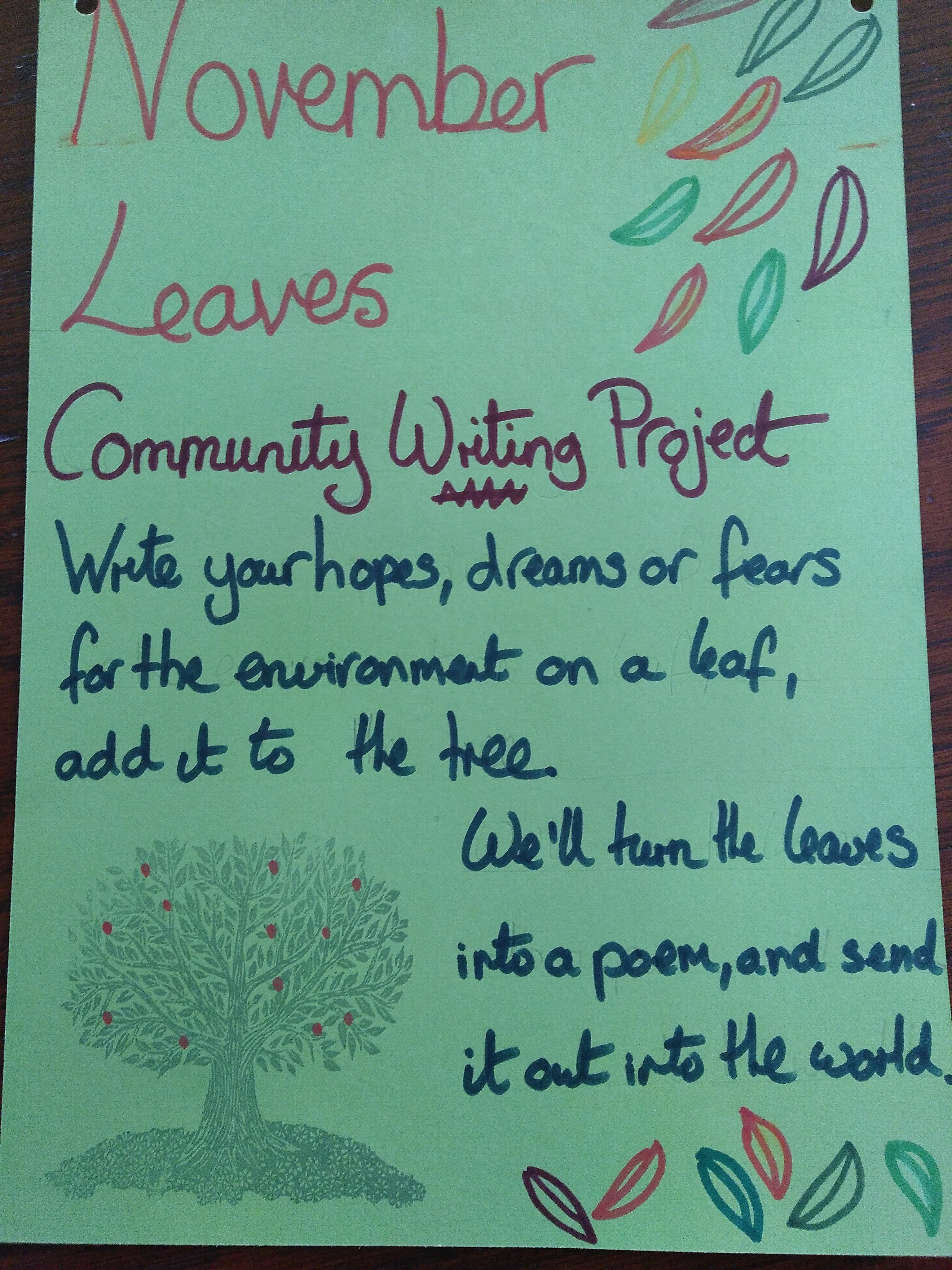
You may remember that we invited people to write down their hopes and fears for the environment on cardboard leaves, which we tied to a tree in the main shopping street, The Thoroughfare. I then wove those words together into a poem. You can read it, and more about it, here.

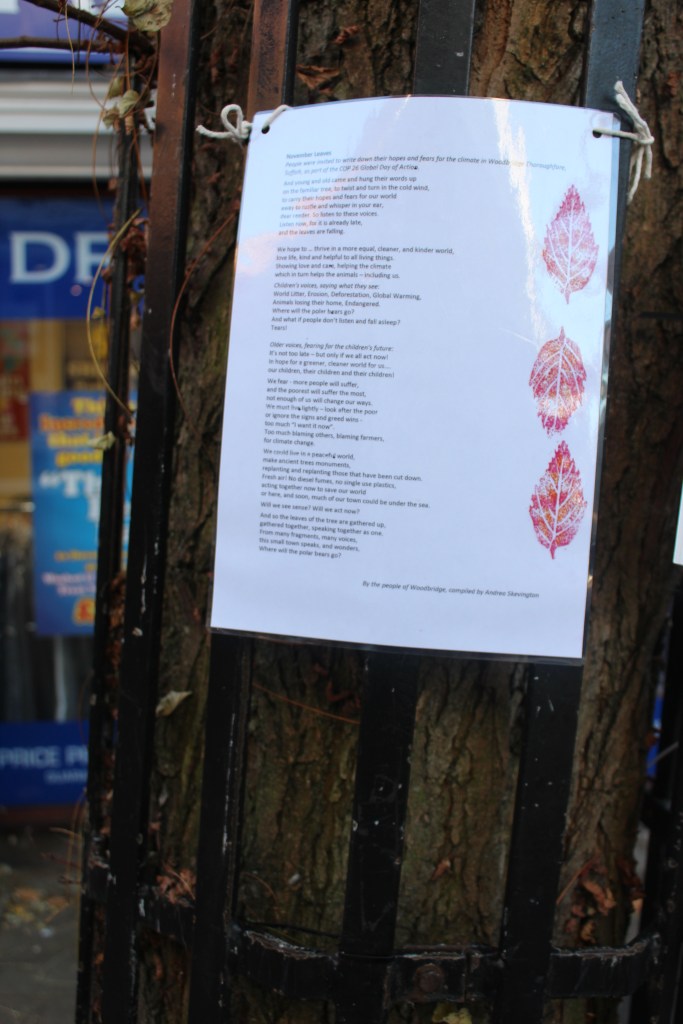
Now, the finished poem is itself tied to the tree where it began. It felt like a homecoming, tying the people’s words to the tree.

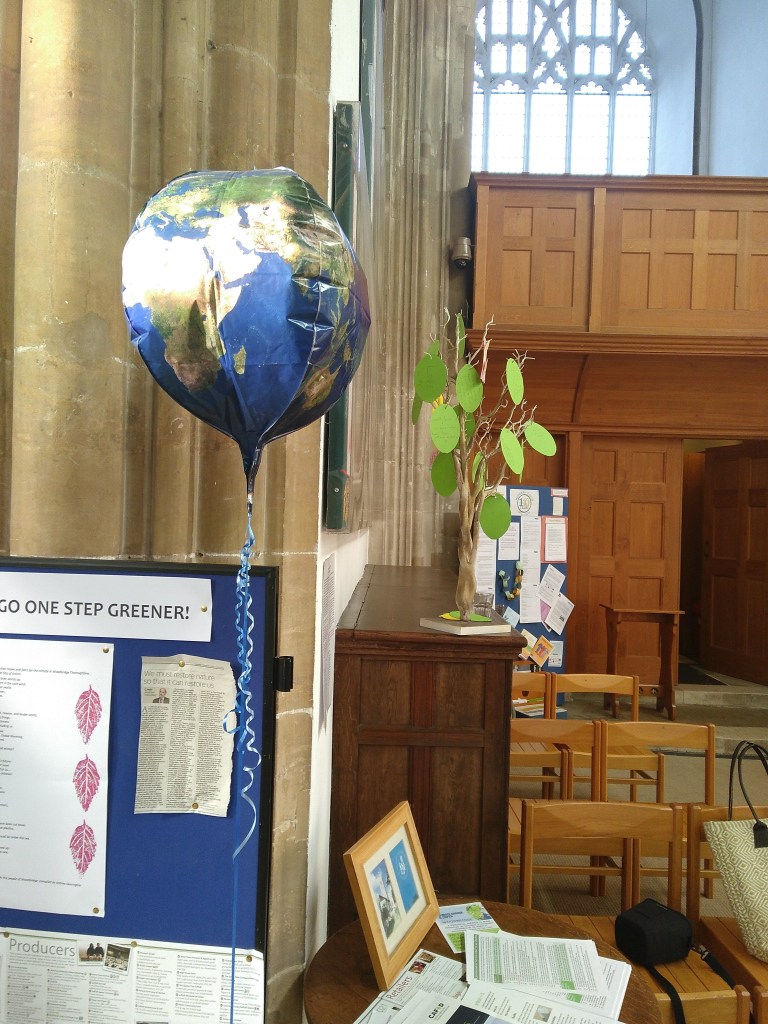
The leaves themselves seemed to precious to discard, carrying as they did such heartfelt words. St Mary’s Church in the town is taking care of them. They are hanging up near the back, as part of their display on caring for the world. It’s full of helpful, thoughtful suggestions and reflections.

There are some extra leaves so you can add your own contribution to the tree, too, as well as encouragement to “Go one step Greener”. The church is open for prayer and contemplation between 10 and 4 Monday to Saturday, unless there is a special event. Local people, it’s well worth a visit.

St Mary’s Church Woodbridge. You can see the poem on the noticeboard, and the leaves on the tree in the background.

I’ve sent a copy to our MP, Dr Therese Coffey, too.
Edit note 13th December: I’ve received a letter from Dr Coffey, with thanks for the poem and some information on what the government has done and hopes to do for the environment.

Last night, I was able to share the poem with the Town Council – reading it out and giving a physical copy. It seemed a very good, hopeful way for the meeting to start. They listened attentively and appreciatively, and responded with applause and real enthusiasm. So, if you were one of the local people who contributed their hopes and fears to the poem, do know that our local representatives have heard you, and will keep a record of your words in their minutes too.

It was so good to be able to do that. Our council are doing a great deal to take care of the beautiful place where we live, and are keen to do more. It’s good to be able to give voice to the hopes and dreams of people in the town, to share them in places where they will be heard, and will, in turn, do their work in other minds and hearts.

Each small thing matters. You never know what will grow from even these leaves.

Community Poem – November Leaves

Photo by Jacquie Tricker

Last time, I shared with you about what happened in my town for the Global Day of Action for the Environment, the mid point of COP 26. It was so good to work together with friends. Thank you, you know who you are!
You can read about that here.

This time, I’d like to share with you about the leaves hung up on the tree – you can see them fluttering in the photo above. We invited people to write down their hopes and fears for the climate on cardboard leaves, which we gathered together at the end of the morning.

I’ve turned the fragments into a found poem, and have begun the process of sending out a few copies – the first to our local MP.

I’ve decorated these copies with a lino print I did, in the spirit of craftivism. This is their philosophy, and I like it….


“If we want our world to be more beautiful, kind and fair, can we make our activism be more beautiful, kind and fair?”

It’s getting dark – apologies for the photo quality!

And so, here it is. The poem made of words written by the people of Woodbridge, supported by Jacquie and David Tricker and friends. Put together by me, with invaluable editorial support from Tracy Watson-Brown. I’d also like to thank the early years teachers who helped me read some of the contributions from our very young writers.

A special thanks goes to all the people who stopped and talked to us, and wrote down their hopes and fears for us to share with you.

November Leaves
People were invited to write down their hopes and fears for the climate in Woodbridge Thoroughfare, Suffolk, as part of the COP 26 Global Day of Action.  

And young and old came and hung their words up
on the familiar tree, to twist and turn in the cold wind,
to carry their hopes and fears for our world
away to rustle and whisper in your ear,
dear reader. So listen to these voices.
Listen now, for it is already late,
and the leaves are falling.

We hope to … thrive in a more equal, cleaner, and kinder world,
love life, kind and helpful to all living things.
Showing love and care, helping the climate
which in turn helps the animals – including us.

Children’s voices, saying what they see:
World Litter, Erosion, Deforestation, Global Warming,
Animals losing their home, Endangered.
Where will the polar bears go?
And what if people don’t listen and fall asleep?
Tears!

Older voices, fearing for the children’s future:
It’s not too late – but only if we all act now!
In hope for a greener, cleaner world for us….
our children, their children and their children!

We fear – more people will suffer,
and the poorest will suffer the most,
not enough of us will change our ways.
We must live lightly – look after the poor
or ignore the signs and greed wins –
too much “I want it now”.
Too much blaming others, blaming farmers,
for climate change.

We could live in a peaceful world,
make ancient trees monuments,
replanting and replanting those that have been cut down.
Fresh air! No diesel fumes, no single use plastics,
acting together now to save our world
or here, and soon, much of our town could be under the sea.

Will we see sense? Will we act now?

And so the leaves of the tree are gathered up,
gathered together, speaking together as one.
From many fragments, many voices,
this small town speaks, and wonders,
Where will the polar bears go?


                                                                      By the people of Woodbridge, compiled by Andrea Skevington