Poem: Gaia at Ely Cathedral

I’m sharing this post again, September 2025 as part of the Season of Creation some Christian traditions are marking at this time. Meanwhile, I’m continuing to work on a collection of poems for Wild Goose, The Year’s Circle – and this poem is part of that work. I’ll be sharing more on that as we go along.

I hope you find this post a helpful starting point for contemplation.

Additional note, 24th September 2023. I am delighted that this post has appeared at The Cottage, Diana Butler Bass’ rich and thought-provoking Substack, this morning. I’ve admired her work for many years, and it’s such an honour, and very exciting for me, to find myself in her company today, under Inspiration. It’s a profound exploration of envy and gratitude, and a reflection on the deep drivers of our climate and ecological crisis. It’s well worth reading and allowing it to do its inner work on us. You can do so here.

Original post, published 12th July 2021, emerging from lockdowns:

As we are beginning to venture out a little more, we thought we would pay a visit to Ely, and the vast indoor space of its ancient cathedral. They often have contemporary art there, which helps the old stones continue to sing, giving a new perspective on ancient truths. We knew that Gaia, an installation by Luke Jerram, was going to be there in July, and so we went and saw this beautiful, astonishing sight. The comparative emptiness of the cathedral space made it all the more powerful as it floated above us.

And as the space is vast, and it takes time to walk up to, around and beyond the piece, you do have time and space in which to allow the work to speak to you, to stir up responses, and to pray. I am sure that one of the intentions is to give us all an opportunity to experience something like “earthrise”, when the astronauts first saw the whole of the Earth from space, and how that shifted their perspective, and began to change the way all of us are able to see our home. The staggering, indescribable beauty of the whole called out my sense of awe, which sat uncomfortably alongside my awareness of the damage we are doing to our precious, unique home.

In the setting of the cathedral, as Gaia hangs in the nave under the painted ceiling which tells the long stretch of the Bible’s story, I found the language of repentance surprisingly, and helpfully, came to mind. Repentance both in our more familiar understanding of sorrow for wrongdoing, and desire to amend, and in the possibly more ancient meanings carried in the old texts, of returning home, and of undergoing a profound change of mind – a paradigm shift in the way you see.

Much of my writing celebrates the beauty of the natural world, how lovely, precious, and vulnerable it is. But sometimes, that love spills over into grief. So the old stones, and the old story, seemed illuminated by our current crisis, and, in turn, those ancient words seemed to express something necessary, and powerful, and, in the end, with the potential for hope.

You can listen to the poem here.

Gaia at Ely Cathedral

She seems to float, lit up with her own light,
slowly turning, blue and blooming with clouds
as we walk up, look up, small before her.

While above our steps,
the familiar painted roof
rolls on, telling its painted story,
from the tree, and the garden,
on towards this

fathomless shining beauty,
the ‘all’ that was so very good
in that beginning.
Now as she turns
we see how she hangs
below the story’s last scenes –
the gift of a beloved child
held on his mother’s lap,
held forward towards us,
loved and given and giving,
and the wounded golden king,
who gives still.

And below, below hangs the whole shining Earth,
dazzling, vast with sea,
turning and flowering with clouds
from the southern ice-shine,
melting although we do not see her weep,

And the land, those small green swathes
and swags, are dressed in white too,
a veil of vapour,
while the deserts spread brown
and red above our eyes.

The lands are small, countries
seem tales we tell.
What is certain is this one great
flow – ocean and ice and cloud –
and the unseen winds that bear them
through our blue, breathing air.

And the people stand beneath her,
lit by ice, and hold up their hands
as if to carry her, or hold her,
or save her from falling.

How beautiful it is.
How strange and wondrous
that we should be creatures
who live within so much living perfection.

And as she turns slowly
under the child and the king,
I wonder, what do those
familiar words mean now,
‘the sins of the world’,
as the stain of our reckless harm
seeps through the blue and green,
through all this living glory,

And is there any hope in our
waking up to beauty with grief
and loss, even as dust and ashes
float across the sky,
across us all, late as we are
in our repenting?


And is there hope,
hope that we might be granted
this grace – time
for amendment of life,
to tend the garden
with its leaves and fruit,
shining and greening,
to take part in the work
of loving and healing,
of restoration,
of making all things new.

Looking at Gaia from behind the communion table brought to mind the words of repentance from that service, and I was aware of my sense of what “the sins of the world” might mean was creaking open a little wider.

Poem: Poured out and overturned – Sunday Retold: Turning the tables

Christ chasing the money changers from the temple Raymond Balze

Hello again.
Here’s another post combining a look at the reading many churches will be following on Sunday, and a poem which emerged as I read it and read it again. So it draws on my occasional series Sunday Retold, and my practice of dwelling imaginatively with the story, meditating on it, and seeing what arises.

Firstly, the Gospel reading from my retelling The Bible Story Retold in Twelve Chapters.

Jesus went into the Temple courts, and found them choked up with stalls and salesmen, ringing with the shouts of hawkers and hagglers. People were not gathering for worship: they were changing their money into special Temple coins, and buying birds for Temple offerings. Jesus grabbed the traders’ tables and threw them over. The money changers and the dove sellers shouted angrily while the coins clattered and rolled across the stone floor. “You’ve taken ‘the house of prayer’ and turnind it into a ‘den of thieves’!” Jesus said, and all fell silent at his words.
Then, the blind and the lame came to him and were healed. And children came, too, running and shounting, “Hosanna to the Son of David!” The Temple was filled with joy, and the priests and teachers of the Law drew back, muttering angrily.

From The Bible Story Retold, based on Matthew 21

One of the things I found while working on this retelling was that there was always so much more I wanted to explore – so much depth and meaning hinted at, or concealed by years and culture and translations. My practice in writing the book was to read widely, and then to meditate on the passages in the style of Lectio Divina – imagine myself into the story, and allow it to unfurl in my mind – a mind with questions, open to prompting I hope. So with this one, there was so much here about Jesus’ rage at the commodification of the things of God, making what was freely given into a commercial venture. We are so used to everything falling into the realm of money it can be hard to imagine how things could be any different, or how the realm of God might offer a radically different Way. Jesus spoke more about money than about prayer, and yet it’s a difficult subject to explore for us. So many of the ills and injustices and exploitation of the natural world we are currently experiencing suggest to me that something has gone wrong with the way we view and use money. Can we begin to dip into the realm of gift, generosity, and finding ways to do what is necessary and right? I hope so.

The Little Free Pantry at St Andrew’s Church, Melton. An example of gift, of sharing. Apologies for the soft focus!

And so, to the poem which came out of my reflections. The meaning of gift and the exchange that arose in my imagination on reading the passage was many layered, and I hope the poem can be read a number of ways depending on what chimes with you the reader. It draws from the Mattew 21 passage, as above, but also the passage early in John’s gospel (John 2).

Poured out and Overturned

Some things cannot be bought
and yet, they are. See
those neat piles of coins,
counted carefully, those inkmarks
methodically made, those
animals sold for sacrifice,
coins given for prayers, for favour,
for the words and work of God.

His carpenter’s hands gripped
the smooth grained tables and
upended them.  Poured out the
shimmering piles of coins
rolling and chiming
over the stone floor.

Some things, perhaps, once, all
are freely given – life, air, water,
growing things for food, breath,
beauty, favour, love.  So many
things we lay out in rows,
so many tables, so many
neat marks of ink or light.

Bound, we see no alternative,
cannot imagine another way,
and yet, here is a man throwing
coins to the floor, with a whip
to drive out money changers
while wooden tables lie
groaning on their sides.

Set free, then, what happens in
this space, this chaos,
with all our reckoning upended?
The blind and the lame come,
and are healed.
And the children run and shout
Hosanna.
And what is, and what will be
is all gift.
So it is, and may it be so.

John 2:13-22, Matthew 21:12-17

Elisabeth Frink, Chapel of the Transfiguration, St Edmundsbury Cathedral.

I notice that some of you good people are looking up resources for Easter on this blog. Thank you for considering my work. If it helps, here’s a link to a summary……
Please feel free to use my writing in any way that helps, mentioning my name and this blog. And do feel free to let me know, I do love to hear where it gets to!

Edit: Sunday 3rd March.

I’m absolutely delighted to find my poem below at Diana Butler Bass’ The Cottage.  She shares an informative piece on this passage which I’ve found has helped me understand what can be a puzzling story. Do read it if you haven’t already. I hope this link will take you there…..

https://open.substack.com/pub/dianabutlerbass/p/sunday-musings-b9b?utm_source=share&utm_medium=android&r=46vq

Further edit… I seem to be having difficulty clicking through on this link. She has included one of my Mary of Bethany poems in another recent post if I’ve whetted your appetite and you can’t find Overturned…. try this.

If you search for her name on this blog, you will find other poems and other links.

Poem: Gaia at Ely Cathedral

I’m sharing this post again, September 2023, as part of the Season of Creation some Christian traditions are marking at this time. So many of us have experienced extreme weather conditions this summer. I write in exceptional September heat, surrounded by welcome green from earlier rain.

I hope you find this post a helpful starting point for contemplation.

Additional note, 24th September. I am delighted that this post has appeared at The Cottage, Diana Butler Bass’ rich and thought-provoking Substack, this morning. I’ve admired her work for many years, and it’s such an honour, and very exciting for me, to find myself in her company today, under Inspiration. It’s a profound exploration of envy and gratitude, and a reflection on the deep drivers of our climate and ecological crisis. It’s well worth reading and allowing it to do its inner work on us. You can do so here.

Original post, published 12th July 2021, emerging from lockdowns:

As we are beginning to venture out a little more, we thought we would pay a visit to Ely, and the vast indoor space of its ancient cathedral. They often have contemporary art there, which helps the old stones continue to sing, giving a new perspective on ancient truths. We knew that Gaia, an installation by Luke Jerram, was going to be there in July, and so we went and saw this beautiful, astonishing sight. The comparative emptiness of the cathedral space made it all the more powerful as it floated above us.

And as the space is vast, and it takes time to walk up to, around and beyond the piece, you do have time and space in which to allow the work to speak to you, to stir up responses, and to pray. I am sure that one of the intentions is to give us all an opportunity to experience something like “earthrise”, when the astronauts first saw the whole of the Earth from space, and how that shifted their perspective, and began to change the way all of us are able to see our home. The staggering, indescribable beauty of the whole called out my sense of awe, which sat uncomfortably alongside my awareness of the damage we are doing to our precious, unique home.

In the setting of the cathedral, as Gaia hangs in the nave under the painted ceiling which tells the long stretch of the Bible’s story, I found the language of repentance surprisingly, and helpfully, came to mind. Repentance both in our more familiar understanding of sorrow for wrongdoing, and desire to amend, and in the possibly more ancient meanings carried in the old texts, of returning home, and of undergoing a profound change of mind – a paradigm shift in the way you see.

Much of my writing celebrates the beauty of the natural world, how lovely, precious, and vulnerable it is. But sometimes, that love spills over into grief. So the old stones, and the old story, seemed illuminated by our current crisis, and, in turn, those ancient words seemed to express something necessary, and powerful, and, in the end, with the potential for hope.

You can listen to the poem here.

Gaia at Ely Cathedral

She seems to float, lit up with her own light,
slowly turning, blue and blooming with clouds
as we walk up, look up, small before her.

While above our steps,
the familiar painted roof
rolls on, telling its painted story,
from the tree, and the garden,
on towards this

fathomless shining beauty,
the ‘all’ that was so very good
in that beginning.
Now as she turns
we see how she hangs
below the story’s last scenes –
the gift of a beloved child
held on his mother’s lap,
held forward towards us,
loved and given and giving,
and the wounded golden king,
who gives still.

And below, below hangs the whole shining Earth,
dazzling, vast with sea,
turning and flowering with clouds
from the southern ice-shine,
melting although we do not see her weep,

And the land, those small green swathes
and swags, are dressed in white too,
a veil of vapour,
while the deserts spread brown
and red above our eyes.

The lands are small, countries
seem tales we tell.
What is certain is this one great
flow – ocean and ice and cloud –
and the unseen winds that bear them
through our blue, breathing air.

And the people stand beneath her,
lit by ice, and hold up their hands
as if to carry her, or hold her,
or save her from falling.

How beautiful it is.
How strange and wondrous
that we should be creatures
who live within so much living perfection.

And as she turns slowly
under the child and the king,
I wonder, what do those
familiar words mean now,
‘the sins of the world’,
as the stain of our reckless harm
seeps through the blue and green,
through all this living glory,

And is there any hope in our
waking up to beauty with grief
and loss, even as dust and ashes
float across the sky,
across us all, late as we are
in our repenting?


And is there hope,
hope that we might be granted
this grace – time
for amendment of life,
to tend the garden
with its leaves and fruit,
shining and greening,
to take part in the work
of loving and healing,
of restoration,
of making all things new.

Looking at Gaia from behind the communion table brought to mind the words of repentance from that service, and I was aware of my sense of what “the sins of the world” might mean was creaking open a little wider.

Exodus poem on Diana Butler Bass

A couple of years ago, during lockdown, I felt drawn to explore the stories of Moses and the Exodus.

One of these was inspired by Moses and the burning bush, where he takes off his shoes because the ground is holy. This poem now finds itself at Diana Butler Bass’ The Cottage, as part of her marking of the season of creation. It’s so good to be part of this beautiful musing on an important season, to be marking a shift in awareness as we begin to pause and reconsider our relationship with the rest of life on this dear blue-green planet.

I hope the link below will take you to her rich and thoughtful exploration of this theme.

https://open.substack.com/pub/dianabutlerbass/p/sunday-musings-f9a?r=46vqv&utm_campaign=post&utm_medium=email

You can find my original post and poem here.

Gaia at Ely Cathedral. You can find out more about that here.

Previous visits to The Cottage can be found ..
The Sower and the Soil
Mary, at your feet
Jesus washes Judas’ feet

The Sower and the Soil, finding myself at Wild Goose unexpectedly!

Once again, I am astonished, delighted and honoured to find something I wrote has made its way in the world, and is keeping the most excellent company with Diana Butler Bass as she shares from the last day of the Wild Goose Festival in The Cottage.

Please do take the time to read her reflections, and those she has gathered. It is a rich feast, with much to refelect on. The theme of Sower and Soil seems more relevant than ever as our soils become depleted on many levels. I am very struck by Cathleen Falsani’s reflections on the parable of the Sower from Matthew’s Gospel, which really resonate with me.

You can follow the link to Diana’s post here.

Van Gough’s The Sower

The parable is one I’ve returned to again and again, it seems to carry richer and different meanings whenever I encounter it. Here are some links to posts on the subject, in case you’d like to follow today’s readings.

My retelling of the parable is here.

More here

And the post with the blessing that Diana Butler Bass shared is here.

Thank you for joining me here on the blog. May all our soils be fertile, may we tend and care for them.

My Last Supper poem on Diana Butler Bass

I am delighted and very honoured that my poem, Jesus washes Judas’ feet, has been featured on today’s edition of The Cottage, by Diana Butler Bass.

You should be able to access the whole rich piece here..

https://dianabutlerbass.substack.com/p/thursday-in-holy-week-washing-feet

It’s always good to know that our words are part of an online community. So thank you to all who are joining me here, and I do hope the poem helps bless your Easter.

Little free pantry

Jesus washes Judas’ feethttps://andreaskevington.com/2019/04/09/poem-jesus-washes-judas-feet/

Mary, at your feet – the first time

A few years ago, in May, when everything was rich and green, I was reading in my garden, imagining myself into the story of Mary and Martha as told by Luke.  I was thinking of Mary sitting at the feet of Jesus, how that was an expression used elsewhere in the New Testament for receiving teaching as Paul did from Gamaliel (Acts 22:3).

I could not recall reading this story in the other gospels, but as my memory searched, I remembered how John writes of this family.  Into my mind came powerful pictures of Mary at Jesus’ feet in those stories – firstly I  imagined her as she ran to Jesus after her dear brother Lazarus had died, and I saw her in black speaking from her knees before him. I heard her voice as heartbroken, perhaps with an edge of disappointment, or even accusation.  Then, I thought of the feast they had to celebrate Lazarus’ renewed life, and how once again Mary was at Jesus feet, this time in extravagant thanksgiving.

Such different occasions, with such different emotion about them, but all springing from the depth of love and relationship between Mary and Jesus.  She shows Jesus, and us, who she is and how she reverberates with the sadness and joy of her life.  She comes across to me as a rich and spontaneous character, fully alive.  So in some ways it is strange that we celebrate her, in Luke’s story, for her stillness.  How hard it is for us to sit and listen, and I suspect it would have been hard for Mary too, had it not been the desire of her heart, had not that stillness have been active, charged with love.

It is a good poem to read for Sabbath rest.  It reminds us that all are welcome at the feet of Jesus, and that it is a high good to be as we are and receive.  I do not always desire this as Mary seemed to.  My mind is often scattered by worries and things which, in the end, are of little value. We are so distracted, so pulled by so many things. We can end up feeling that those things are what define us. That it is what we do, or think, or believe, or  how people view us that makes us who we are. Just being doesn’t seem enough, but our efforts to be more or different or better than we are can be life-sapping.
Acceptance can be hard to accept!

I am attempting to learn to be still, and that love, however thin it may be on our side, is enough.

God’s love is enough.

In writing this poem, I hoped to create a place of stillness. The kind of place where contemplative prayer begins.  A place where we can open up a little to love, and light. A place where we know we are welcomed.

I read early versions of these poems at a local Christian festival, Alive, and as the festival time of year comes around again, I find I am remembering them, and going back to those thoughts.  I share the first one with you today.

The photograph is taken in the Chapel of St Peter on the Wall, Bradwell on Sea, Essex.

IMG_0366.JPG

Mary, sister of Martha, at your feet for the first time

You came in search of rest
away from the road,
that bright, shadeless road,
where so many came,
and you gave so much.

You came and sat down
in the cool room,
the shutters pulled
against the heat,
and Mary sat, too,
and it was enough.
Just sat, quietly, at your feet,
her face turned up to
yours as she listened.
And you saw how the light
fell across her,
as if for the first time.

And this is what you want,
what you long for.
Not the elaborate
preparations we would make,
not ourselves swept and
scrubbed to perfection,
our acts and our
thoughts impeccable
in lifeless rows,
but to be,  here in this light,
to be, here at your feet,
Luke 10:38-42

You can read the second poem here

and the third one here

Edit: 19th July 2022

The last stanza of this poem was quoted by the inspirational Diana Butler Bass in her Sunday Musings this week.  If you don’t know her work, I’m finding it’s helping me a great deal. She combines deep scholarship with passionate lived experience.  You can find a link to this work, and her reference to my poem, here.

Ash Wednesday – a blessing for the soil, and some thoughts on the parable of the Sower.

I was chatting to a friend the other day – via screens, of course – and we were mulling over what Lent might look like this year. We were thinking that so many of us have given up so much, and experienced various levels of loss and renunciation over the past year, that we wondered if we could reframe our thinking about Lent. Maybe this year we need something more plainly hopeful, and nurturning of new growth. This ties in with what I have been drawn to doing this late winter season, which is contemplating the parable of the sower, with its hopeful scattering of seed, its false starts, disappointments, failures, and as the seasons roll on, hope and fruitfulness.

So I thought I’d share with you some mediations drawn from the parable as we go through Lent, and find our way through this season of preparation for Easter in our strange new pandemic world. Other nature parables may find their way in too.


Firstly, here is the parable, from my retelling.

Once, when Jesus was surrounded by a crowd of eager listeners, he told them this story.

“One dry, bright day, when the wind was still, a farmer went out to sow seed.  He took handfuls of grain from the flat basket he carried and, with a flick of the wrist, scattered seed, hopeful for its growth.  But some of the seed fell on the path, where the passing of many feet trampled it, and the birds swooped down and ate it.  Some fell on dry rock.  After the soft rains, it swelled and sprouted.  But then it withered, for its roots could find no water.  Some landed among the thorns, which grew so fast that they soon smothered the tender new shoots.  But some landed on good soil, where it grew up, and ripened. When the time was right, the farmer came back and harvested a crop from it, a hundred times more than was sown.”

After the crowds had gone, and Jesus was left with the disciples, they asked him “What does that story mean?” And Jesus answered:

“The seed is the word – God’s word.  The seed that fell on the path is like the seed that falls in some hearts – it’s snatched away by the devil before it takes root, before those people begin to believe. The seed that falls on the rocks is seed that falls where there is little depth – at first, God’s words bring joy to those people, but there are no roots, and when trouble comes their faith withers away.  The thorny places are like hearts choked up with worry, with riches and pleasures.  There’s no space for God’s word to grow. But some seed does fall on good soil – the word takes root in hearts that are ready, and they hold on to it.  In time, the word gives a rich crop in people’s lives, and they are fruitful.”

From The Bible Story Retold

As we’ve been in enforced separation, and isolation, and solitariness, I’ve felt my need for conneciton more than ever. I’ve become increasingly aware of our interdependence, interbeing even, our bonds to the whole order of things as well as to other humans. The soil is our hearts, we read, so can we find our way back to a deeper understanding of soil, and our own natures?

Last year, before the lockdowns began, when we could still travel and meet and share, I gave a talk at my old college on this parable. I’d been thinking about how Jesus invites us to consider the flowers of the field, and the birds of the air, and to learn of God from them. Aware of how much damage humanity has done to the wildflowers and the birds, I was struck by what meanings we might learn now.

Here is a small extract:

But in this story, Jesus invites us to see ourselves as soil.  Our hearts are soil. Often here we rush into wondering what kind of soil we are, whether we are good soil or  bad soil – whether we measure up to some fruitfulness criteria, or not.

I’d like to linger awhile, though, with this ancient and unattractive idea that we are simply soil. I feel it may hold a glimmer of hope.
Our language teaches us that humans are humus, made of the same stuff as earth.
And from the Hebrew Genesis story – Adam is the one formed from the earth, and the earth is Adamah: dark clay.  
Ash Wednesday reminds us of this in the context of our sin and death. Today, I want to think of how it relates to our growth, our life. We are brothers and sisters of the earth, made of the same stuff. Can we see ourselves, and the earth, like that?

If we can, we might catch at something important, an antidote to what ails us.
Perhaps the crisis we have wrought upon the life of Earth may have its root in seeing ourselves as too separate, too superior to listen to the soil, and the birds, and the weeds. 

We can learn much from soil, and we can begin with a simple truth: soil is precious, and it is being lost and degraded – possibly like the human heart.  Possibly both need a more tender and wise handling than they are getting in our culture.  Soil, whether it is under our feet, or our own hearts substance, can be improved, tended, nurtured back to health.

This Lent, I feel drawn to practices that are nurturing and hopeful, rather than austere. Even so, there is another way of looking at Lent which may be part of this hopefulness. Maybe our ancient practices of restraint, and simplicity, may have wisdom we need in our current difficulties.

In times gone by, Lent was a lean time of year, as the winter was ending.  It was a time when the world was waking up to life, when eggs were laid and young were born and cows produced milk again.  Without some restraint, this fragile new life would not have had a chance to develop.  Humanity chose to  wait until the fullness of spring, after Easter, before relieving the winter’s hunger.  This calls to mind the ancient Hebrew practice of the year of Sabbath.  As well as having a day, once a week, when people refrained from economic and agricultural activity, there were also whole years when the land was permitted to rest, and the people dependend on what the land produced. These times of rest for the land were an important practice for God’s people, nurturing their awareness of their dependence on God.  For land was less a possession to be used, more as a gift to be shared for the blessing and feeding of all.  Perhaps we can look again at this quiet, gentle living with the land.  Perhaps as we enter Lent, we can consider whether there are ways in which we can practice restraint for a season, to ensure the future flourishing of the land, and of the earth.  To see restraining our desires as a spiritual discipline is something we can turn to once again. 

As we face the degradation of ecosystems, and the loss of so much life, we can construct a form of Lenten fasting to protect and nurture the Earth, to bless the earth and all its communities of being. We are already engaged in abstaining from our pleasures and normal lives to save the lives of others, perhaps more vulnerable than us. We know how hard and necessary it is. Perhaps we can learn from this experience, and gently, kindly, nurture other Lenten practices of simplicity to promote the flourishing of all.

And so, as we reflect on the possibility of new growth as the deep snow melts, of spring and hope and lengthening days, I’d like to share with you this reflection as I put myself in the place of the sower, walking over the land. I am brought up sharp by hearing how degraded our soil has become, how future harvests are threatened by the thinning out of the complex life of the soil. I am greatful that the soil I have here is good, and that a careful spade will unearth many myriad of living things. So this reflection has meandered away from the parable, drawing on my own awareness of how dependent we are on the soil. I hope to continue to share these snatches of meditation with you as we go through Lent. I hope you will join me.

A blessing for the soil.

I bless the soil I walk on
I bless the richness of the life
I can neither see
nor understand.


I give thanks for the fruitfulness
of the earth.
I give thanks for the falling and rising of green things.
I greet the creatures, many legged, single celled,
that do the work of life-from-death.
May we protect and cherish this foundation.
May we nurture good soil.
May it be sheltered by plants,
free from rocks and thistles.

May we learn in humility what it needs.

More on Ash WednesdayRemember you are dust. This year, we have all had cause to think of our frailty. To know that we, and those we love, are fragile beings. The words of the traditional Ash Wednesday service have a new and sadder resonance this year.

If you’d like to follow my book, Jesus said I am, for Lent, you can find out more here. There’s lots of material on this blog.

Note, 25th March. This note is by way of apology. I was intending to make this a series running through Lent this year, and haven’t done so. I had a commission for New Daylight – I haven’t done anything for them before, and it took me a little while to get into the groove. That series of meditations will be published next year, also on parables. I wrote on the relationship rather than nature parables, and I couldn’t quite get my head around doing both things! I’ll tell you more about the New Daylight work nearer the time.

The Sower keeps calling to me though, there’s more to explore, and I’ll find a way of doing that with you in due course. Thank you for your patience!

Note, September 2023:

I’m delighted that this blessing for the soil has found its way to a piece Diana Butler Bass shared for this year’s Wild Goose Festival. Please do take a look at her gathering of deep and nurturing wisdom, here.

The ‘Mary, at your feet’ poems – Three

mary-anoints-the-feet-of-jesus-by-frank-wesley

Artist – Frank Wesley

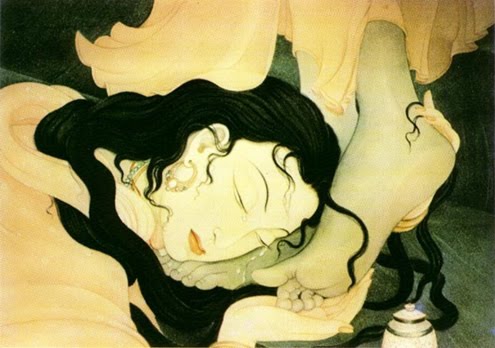
This is the third and final ‘Mary, at your feet’ poem, which tells of an evening in Bethany, at the home of Martha, Mary and Lazarus. Jesus is there, too. They are holding a feast to celebrate Lazarus coming back from the dead, and, it being near Jerusalem, they are joined by many others.

I found some spikenard on line, the closest I could find to nard, the rare perfume Mary pours over Jesus, and burnt it as I meditated on the story. It is pungent and earthy, an intense fragrance. As I meditated, I remembered all the times that Jesus had told stories of the Kingdom involving feasting, and banquets, and how he left us a shared meal to remember him. This particular banquet, celebrating a man coming back from the dead, seems like that.

I thought of Mary giving something so costly out of love, I thought of the other story of a woman anointing Jesus’ feet (Luke 7:36-50). And I remembered that Messiah means anointed one, and that the only earthly anointing Jesus receives is like this, at a feast, in an outpouring of love and gratitude.

This poem, too, was read at the Alive festival 2014, and I used it as a starting place for prayerful writing with a group of people. We burned spikenard, and imagined ourselves into the story. Some beautiful work resulted. People were able to connect with times when their life had been restored to them in some way, with times they were grateful, and wanted to pour our love and thanksgiving. For others, they felt they were outside, looking in at the feast.
In this poem I see the doors wide open, like the gates of the city in the book of Revelation (21:25).

You can read the first poem here
and the second one here

Mary, of Bethany, at your feet a third time

And so you come once more to Bethany,
and share a meal with Lazarus,
a resurrection feast,
foreshadowing, foreshining
all those kingdom feasts you told of:
wedding banquets with long tables
set wide with good things,
with room enough for all,
welcome at your table.

Now, in Bethany, the house is ablaze with light,
shutters and doors thrown open,
all wide open with joy unspeakable,
music, laughter, dancing, wild thanksgiving
for one who was dead is alive again,

And all night, while crowds pour in from Jerusalem,
the feast goes on, and on,
as Mary enters now, cheeks glistening with joy,
past her brother at your side, back from the grave.

She kneels at your feet again,
pours out extravagant nard,
scandalous anointing of your warm, living feet,
unbinds her hair and lets it flow like water
over them, wiping them in such reckless
and tender thanksgiving.
Fragrance fills the room, the house, the night,
as more people pour from Jerusalem to you,
to you, who comes to us in our weeping,
who shares our bread with us,
and brings us to such joy as this.

John 12:1-11

I am greatly honoured that this poem was read at the Good Friday Service of the Riverside Church, New York.
The whole service is recorded. The poem appears at about 21:50
You can see it here

Note, March 2024:

I am delighted this poem was shared by Diana Butler Bass on her substack.

https://open.substack.com/pub/dianabutlerbass/p/halfway-through-lent-mary-magdalene?utm_source=share&utm_medium=android&r=46vqv