I’m sharing another poem from my collection-in-preparation with you, as promised. I started gathering and writing poems last March, and so this Easter poem – and the one to follow – were amongst the first new ones I wrote. So, quite simply, here it is….
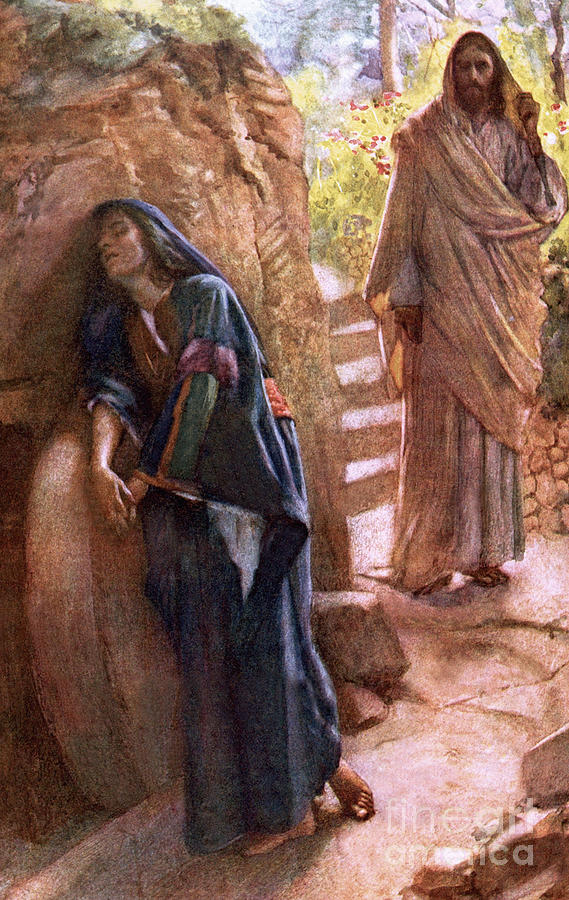
Mary Magdalene at the Sepulchre by Harold Copping
Mary in the garden
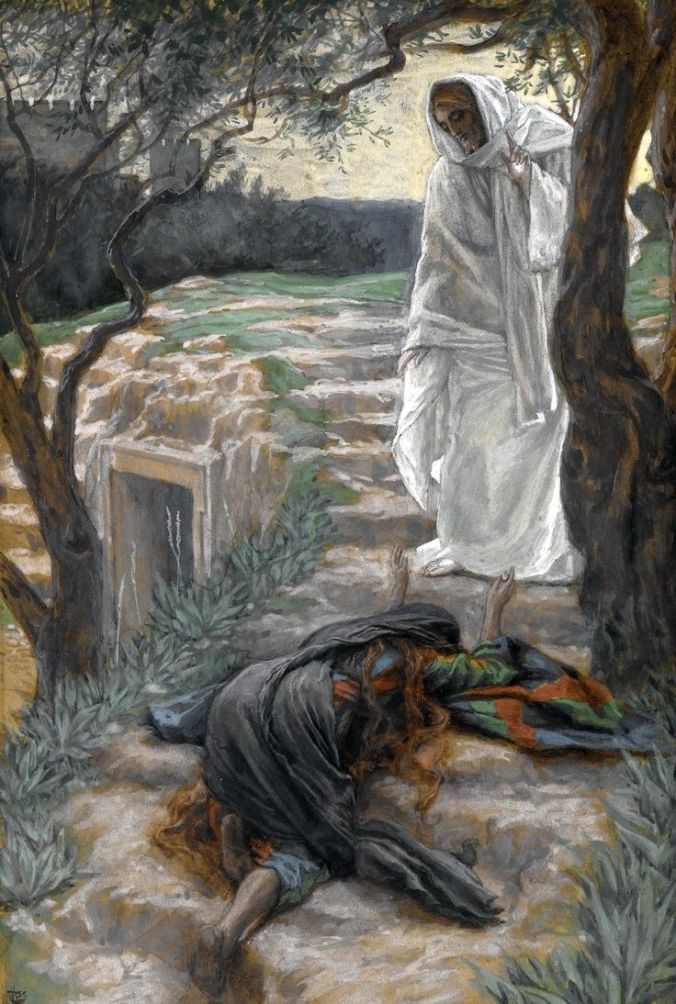
It was in the garden that Mary stood weeping. First light, first flush of green spreading over the warming stones. A quiet place, now.
Alone, shocked, bewildered, she did not see the flowers opening at her feet, or hear the song of the turtledoves.
For she is one who stands by a tomb lost, deserted, heavy-burdened with grief – the weight of a million tears – as if this grief might carry the pain of us all.
And seeing you, she did not see, thought you were like a second Adam, tending the garden in this strange new dawn.
Then, you spoke out a name – her own name. Mary. She knew you then. What must have risen up in that broken heart, touched as she was by your tenderness. Yet as your eyes met, her hand stopped in the warming air between you, singing with birdsong, shining with light.
John 20:11-18, 1 Corinthians 15:21-22
If you would like to read the story, you can find more in the link below….
I’m sharing another poem from my collection-in-preparation with you, as promised. I started gathering and writing poems last March, and so this Easter poem – and the one to follow – were amongst the first new ones I wrote. So, quite simply, here it is….
Mary Magdalene at the Sepulchre by Harold Copping
Mary in the garden
It was in the garden that Mary stood weeping. First light, first flush of green spreading over the warming stones. A quiet place, now.
Alone, shocked, bewildered, she did not see the flowers opening at her feet, or hear the song of the turtledoves.
For she is one who stands by a tomb lost, deserted, heavy-burdened with grief – the weight of a million tears – as if this grief might carry the pain of us all.
And seeing you, she did not see, thought you were like a second Adam, tending the garden in this strange new dawn.
Then, you spoke out a name – her own name. Mary. She knew you then. What must have risen up in that broken heart, touched as she was by your tenderness. Yet as your eyes met, her hand stopped in the warming air between you, singing with birdsong, shining with light.
John 20:11-18, 1 Corinthians 15:21-22
If you would like to read the story, you can find more in the link below….
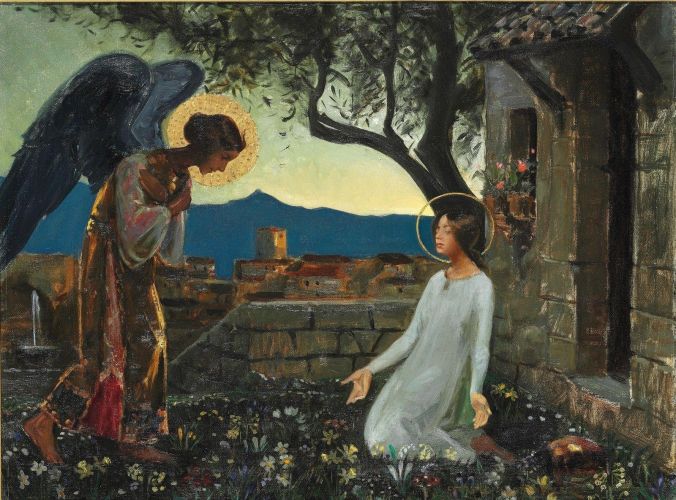
The Proclamation of the Virgin Mary by Harald Slott-Moller
Hello blog readers! It’s been a while since posted. I’ve been working on my collection of Poetry for Wild Goose, Iona Publishing, and have now submitted it. It’s been a huge project, taking me just under a year, and I’ve loved immersing myself in weaving together a pattern of words and images. I’ll let you know when I have news of a publication date, but I know it’ll be a little while before they get to it. As a quick reminder, it’s called The Year’s Circle, and it follows the seasons of the year – celebrating the unfolding natural world and the seasons some churches follow in their prayers and readings.
As many celebrate the Annunciation on 25th March, I thought I’d share with you the poem I’ve written for the new book. A meditation on the angel’s visit to Mary. In the book, I’ve placed it in Advent, at the time when we often celebrate Mary. It certainly suits spring too, with the stirrings of new life we see all around. I hope it also reminds us that new beginnings are often hidden, small, and in unexpected places. It reminds us to look beyond the surface of Empire and power, and see what is happening elsewhere. Those things may be more important than we think.
Anunciation
I see her standing at the doorway of her home as the earth quickens at her feet, awakening.
A sudden shaft of light falls on her and she raises her face to feel it warm on her winter skin
For one joins her there, on the threshold, with great wings folded. An indication, if one were needed, that he comes from another place, is made of other matter.
And so this strange meeting begins at the threshold of Earth and Spirit, Word and Flesh, Eternity and youth. The shining one greets her with a song of God’s favour, of one-to-be-born of her – as she draws back a breath into her accustomed room, afraid,
Tests the future with a question. For this high favour will take her down a dark path, and a dangerous one, with sanction and scorn and incomprehension – her own too.
Yet, even so, she takes that tentative step forward, towards the light, gives her Yes to all this, to being a God-bearer, carrying the Anointed One in the closed blood-dark room of her womb.
And so begins this strange folding of the infinite, the Alpha and Omega, into a single cell within a slight girl, the most vulnerable of forms, this Mary, full of grace. What strange and troubling gifts are these to stir the brightening air.
Luke 1: 26-38
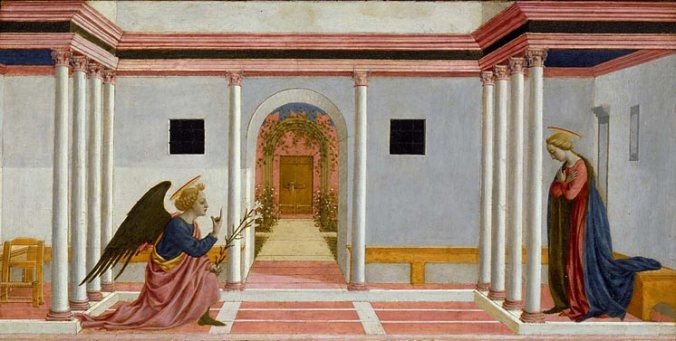
The Annunciation by Domenico Veneziano – Fitzwilliam Museum collection
Many paintings of this scene are strong on architecture. Artists, like Domenico Veneziano, were experimenting with their newly developed techniques of managing perspective. This one has a tiny pinprick in the centre, the vanishing point on which all lines converge. They ususally place Mary inside, or in some kind of indeterminate space like this one – a sheltered, nearly outdoor space. As I was meditating on the passage, I was struck by the image of thresholds, of liminal space, tentative and uncertain but open to possibility. In these early paintings, you often find the angel and Mary facing each other, like this, across the space, and then your eye is drawn to another line directly from the viewer to the background of the image. A window with a glimpse of a view, a door – in this case the door is closed. The closed door is a symbol of virginity, but here, I can’t help thinking of another collection of symbols – the closed off way back to the Garden of Eden, a way out of the confines of law and punishment, a door out into the freedom of a rich and green landscape. This line, front to back, out of the picture, forms a cross with the direction of gaze between the two figures, and that intrigues me. It does seem like an invitation to walk that path out towards the spring, towards new and abundant life.
I notice that many of you good readers are looking at my blog for poems on the themes of Holy Week, so here is a link that will help. I have a couple of new pieces for Easter Sunday, I’ll try to get those up here in the next week. Please do feel free to use my work, crediting me and this blog. It’s so good to know my work is being read in different parts of the world. Thank you for your support.
This poem has arrived on the blog a little late. It became marooned in my notebook for a while, until I flicked through the pages and found it again. And although crowds of bees are no longer buzzing among the ivy, there are still a few, here and there.
I hope, though, that although this poem arose out of a particular time, it has something to say in other times, too. About stillness. About the restorative power of simply being, and paying attention. About finding our breath again. We all need that. We all need to feel that connection to the rest of the natural world (oh, how I wish we had better language for these things – bear with, it will emerge) which grounds us, and from which we can rise. For those reading this blog who need a little peace right now, I hope it helps. I’m thinking particularly of dear readers in America, where the election atmosphere seems turbulent. I wish you well over the next days and weeks.
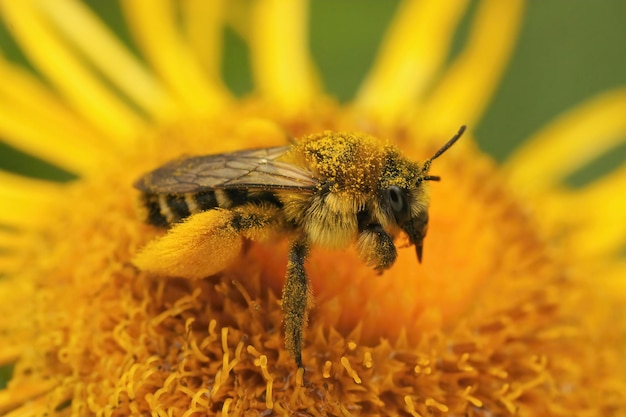
The old hedgeline in front of our house has, in places, been overcome by ivy, which has formed its own structures and patterns of flowering and fruiting. Cutting some of it back to make space for other plants to grow, I was careful to leave the ivy flowers for the bees – which will become fruit for the birds in time. Accidentally, I created a little bower, where I put a chair and sat for a while. As I sat I gradually heard the road less and less, as my attention was taken up with the many bees who were enjoying the feast. And so, this poem emerged.
thebiologist.rsb.org
September. Bees. Ivy.
It is taking a while, this sitting in a carved out cave in the ivy. Just sitting, stilling, breathing. A bower of green leaves above, and above that blue sky, white clouds.
In time, the hum of bees, and their intricate woven patterns of flight, come to replace thoughts, become another form of thought. So too the birds – that wren shaking the leaves, and the pipping robin.
And this grey and green lacework of wild is all that separates me from the roar of the road – those black lines we make, always going somewhere….
And yet, here is a marvel. More bees than I have seen all year. A hum that soothes the soul. The darkness of butterflies.
These strands of green woven through the world – not enough, by no means enough –
But they shelter the bees, and me. A space for the soft and alive, breathing, green in spirit. We can be here, the bees and me. We can be, in this hollowed out hedge, in a cloud of lightfilled wings.
After some cold damp days, and flooding in some parts of the country, it’s warm and mild – about 6oC above recent average for this time of year. I find myself to be both delighted and unsettled by this lovely soft warmth. I’ve been able to get on with a bit of clearing and composting in patches, it feels like time this year, and making space to ensure the ivy doesn’t take over completely.
I’ve been able to sit in the sun and watch the rising and falling of insects. After the desolate summer of so little life on the wing, this has been such a joy. It is also an encouragement to keep a wild diversity of flowers in the garden, native and from further south, as the insects appear unexpectedly, at strange times. This autumn it feels time, having left it for a few years, to introduce some disturbance and give a chance for a variety of plants to grow. But apart from enjoying the welcome rays, I have also been aware of the wind and rains this extra warmth carries in its wake. So this poem is an exploration of this turbulence of feeling.
Mid October heat
The sun shines long and low, as warm as sudden laugher, a broadening smile blown in from the south and damp with oceans, I can almost smell the tropics on its strange soft breath.
What do you do with so much disquieting beauty – with a day like this, shining, wild and hot, damp with fever?
The low sun holds too much warmth. The green around me hums and sings with growth, rejoicing, even as the leaves of the trees fade a little, and tumble across the grass on this wild hot wind.
I am afraid. I look up at the strange flows of air and water above me, shifting and changing, heavy and thick, as the dragonflies rise still, hunting among gnats, and the bees hum in this late flowering – at last, the bees, and here a hummingbird moth, and red admirals, all drunk with sweetness in these late days. These late days.
Monday is Earth Day, when many of us especially remember the gifts of the Earth, its fragility, and our responsibilities towards it. Today (Saturday) in my town we’re having a bit of a celebration down by our river, focusing on good local food and organisations which are seeking to care for our patch of Earth. There’s music and friendship and crafts and storytelling, and local businesses who are doing things differently – beautiful local bread and saffron and wild venison and plants and flour ground by our tide-mill among other things. It’s a good way to mark the occasion.
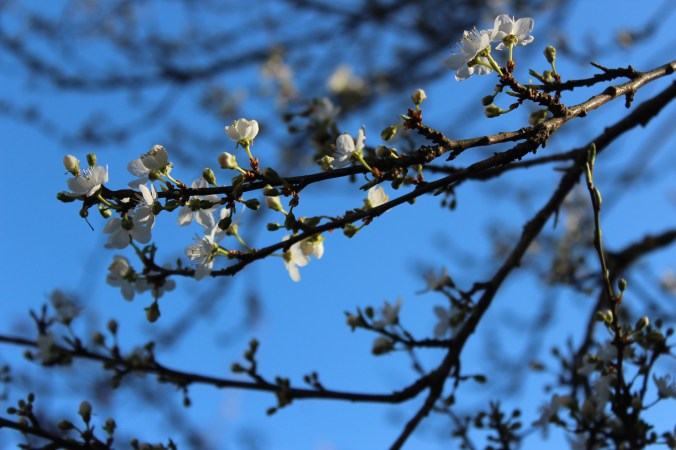
This spring, I’ve been enjoying Simon Armitage’s beautifully illustrated new collection, Blossomise, in collaboration with the National Trust. I highly recommend it. It’s a celebration of the blossom season, transient and determined, which for us starts in February with this lovely cherry plum, or mirabelle, and is carrying on from one tree to another in our growing collection of fruit trees. We have one apple who is always alarmingly late, but the buds are beginning to swell. Maybe by mid May, if its mild, it may offer the season’s swansong. I also highly recommend the beautiful Orchard by Benedict McDonald and Nicolas Gates – I sent a copy to my MP as a gift when she was Secretary of State for the Environment.
I have been thinking of the Japanese love of blossom, and how it’s fleeting ephemeral nature makes it so precious to them, and to the rest of us. In some ways, it’s a modest theme for such an expansive day – when we consider the whole of this green Earth, but I kept being drawn back to it, so here we go. I think what draws me to it is twofold: there’s something about the dazzling beauty of blossom which is so transient, so easily lost which reminds me of the beauty of all the trees, and oceans, and rivers, the great all of the good Earth which we love and are harming and are called to tend and care for. And secondly, there is the draw of the particular. When I look at the big picture, I am often overwhelmed and frequently despairing, and so I choose to focus on the small, the local, the actions I can take for the trees in my area, the bats who will soon be flying over my garden, the sorry state of my – of our – local river. So this poem I’m sharing with you for this day is, like blossom, small and light.
The most beautiful thing
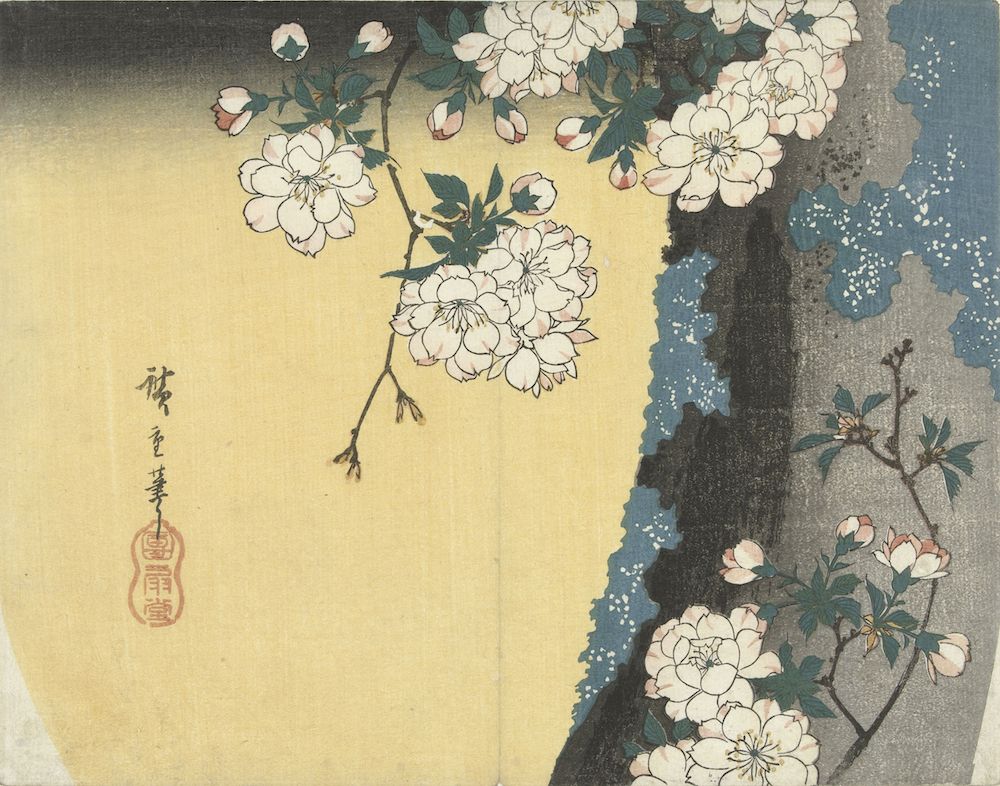
Outside, the blossom is in full glory now, white star-flowers, delicate as tissue, on black, angled branches – like a print by Hiroshige.
I gathered a blown branch from the ground, and brought it in to shimmer on my mantelpiece in a tall green bottle. It is the loveliest thing in the room, the loveliest thing I might call mine – mine, perhaps, not as possession, but in relation – as in sister of mine, the dancing blossom tree.
For dance she does as the cold wind blows, gusting and wild, in a snowstorm of petals that dress the air about her.
And sister she is too, although the resemblance is slight. We share kinship in chilly breezes and soft rain, nourished alike by this deep dark soil, and made of it, depending on the same gifts of Earth for our brief time of flourishing. This felt kinship, truly the most beautiful thing,
As like her, I dance in the gusting wind, and like her, I look for tomorrow and the promise of sun, and birdsong, and I too hope for the gentle buzz of bees and the fruit that is to come.
Hiroshige blossom
If you are looking for readings for Earth Day, you might find something on this blog to suit. Please feel free to use my work, saying where you found it.
Here are a few suggestions, but if you search by Nature, Creation, Green, there will be many others
I thought I might mention here a few podcasts I like to listen to – I’ll just name them as there are so many different podcast providers. A thing I am noticing amongst those who are working with the land and especially the rewilders is the most deep sense of joy, purpose and accomplishment. There is a rising change in our relation to the rest of the natural world, and perhaps a thing we can all do is cultivate a love and practical care of our place, and find others to work with. So, here are some listening suggestions….
The Jane Goodall Hopecast The Knepp Wildlands Podcast Rewilding the World with Ben Goldsmith The Rewild Podcast with James Shooter Learning How to See with Brian McLaren – latest season is Seeing Nature Wild Podcast by Grange Project How to Save a Planet (for a more North American emphasis)
A little tree rehoming scheme……Some of the saplings dug up from my garden and very kindly donated by others. I’ve passed on about 270 now to local people who are planting woods, orchards and hedgerows. Strangely, it seems to be a notion that has found its moment!
Happy Earth Day. May the place where you live flourish. May the places your food grows be bountiful. May your air and water be clean and life-giving.
I must admit to feeling disheartened in the run up to another COP, where the oil and gas companies seem to be seeing the talks as an opportunity to do business, rather than prioritise moving to cheaper and cleaner and more local alternatives. The powers that be sometimes seem especially powerful.
So here’s a tiny, smaller-than-David-vs-Goliath idea which is currently happening in my drive. Just in case any of you good readers feel similarly, and are looking for small but meaningful actions. There’s a lot of us who care, who want to leave the world in as good a state as we can. So, rather than despairing over what isn’t happening, here’s something that is. Mighty oaks from little acorns and all that…..
It all started a couple of weeks ago, when my husband came across one of our old neighbours digging tiny tree seedlings out of a council flowerbed. Unsuprisingly, he asked her what she was doing. She replied that a friend of hers had two acres she was trying to replant as woodland, and was looking for trees. Now, I express unease on a regular basis about the number of tree seed- and saplings I pull out of our garden. The squirrels are very keen on planting nuts, which germinate remarkably well for instance….. So, he mentioned it to me, and I got in touch with the lady with the two acres. I dug out all the readily available saplings, and began to collect them from other people. The first load of about 100 trees went to her, and to someone else who has twelve acres they’re rewilding.
I wondered if other people might have spare trees in their garden, so emailed my friends at Transition Woodbridge, who passed the message on. Trees are arriving most days, and another person has expressed a need for small native trees, especially ones suitable for growing in a hedge. Another friend also has a number of oaks springing up in her allotment. So we have more sources of trees, and more places where they can go. It’s always good when actions become collective, when people gather together and all do the little bit they can.
Now, who knows where this will go, but for now, I reckon we’ve easily been able to provide a new home for getting on for 200 infant trees. That’s not nothing. That is something. It’s food for insects and birds, it’s shelter, it’s improved soil fertility and water management, it’s less carbon and more oxygen. It’s one in the eye for despair, too.
So, here’s to taking the small actions we can. You never know where they might lead. In 100 years from now, those nine tiny oaks might be home to many creatures, having a profoundly positive impact on soil, air and water …. And carbon. Nearly all life on the planet is carbon based, after all.
The practice of wandering – often around the garden – contines to be a a helpful one for me, quieting and contemplative. The practice of standing still and looking, too. Quite a lot of apparent “nothing” seems to be fertile ground, after all. Something catches my attention, as if it is saying: ‘look, here is something, a marvel, a meaning, a glimpse of beauty’. I am coming to think they are happening all the time, and what makes the difference is my openness to seeing, hearing and knowing them.
And so, when the sun broke through after the rain, I went outside, and sat on my coat, and looked. Some distance across the lawn, I saw a bright red light, flashing, and, curious, saw a drop of rain acting as a prism. I watched it for as long as the angle of light made it shine with colour. It called to mind two ancient stories – the burning bush, and the flood – from the Hebrew Scriptures. How the world is full of epiphanies. And again, I was in awe of the way the natural world – of earth and fire, water and air – invites us to listen, to pay attention, to wonder.
A solitary shining drop
Just now, I saw the sun catching a raindrop as it rolled so slowly down a sedum stem, fleshy and green.
It shone through red, rich, neon and ruby, flashing as the stem swayed in the breeze, taking the drop through that one ray of light, back and forth.
Then it suddenly changed to the dazzling blue of cobalt and lapis lazuli – oh, heavenly blue. Heavenly blue.
Just now, for a moment, this treasure made of light and rain, this solitary shining drop becomes a tiny shard of promise, a slim fragment of the arc that holds the sun and the rain.
It all speaks. All speaks. In the mind’s quiet, and in a flash of brilliance that turns your head. A gentle whisper and a burning bush, both. A drop and a rainbow. The world shines with meaning, murmuring, as the green earth is drenched by sun and rain.
Last Friday, during storm Babet, Suffolk experienced some of the most severe flooding in England. It was good to be able to stay home and keep in touch with friends, making sure they were safe. Many people have lost their homes, their businesses and their posessions. Tales of help and rescue are still emerging. Places that have not flooded in living memory have been badly effected. We are used to threats from the sea in this part of the world, but think of ourselves as living in a dry place, unused to severe storms. The climate is changing, and it is unsettling.
As I’m writing this, the next storm is about to arrive, with a weather warning for wind beginning this evening. The mild, even warm, air holds so much moisture, the trees are still in leaf, the roots in soft soil. This morning I hurried to pot up a whole load of tree seedlings for a friend of a friend who is planting a small wood nearby, and I marvelled at how easily they slid out of the earth.
This strangely perturbed and perturbing season of weather is full of beauty, plants and flowers still growing vigorously on the first day of November. The air is full of insects and birdsong. Frogs are hopping whenever I disturb the plants in the garden. As I sat in a patch of warmth I remembered some words of Robin Wall Kimmerer which I love, from a book I treasure:
“Even a wounded world is feeding us. Even a wounded world holds us, giving us moments of wonder and joy. I choose joy over despair. Not because I have my head in the sand, but because joy is what the earth gives me daily and I must return the gift.” ― Robin Wall Kimmerer, Braiding Sweetgrass: Indigenous Wisdom, Scientific Knowledge and the Teachings of Plants
And as I began to write, that idea seemed particularly rich and right for the moment, and for always. What gifts we receive. I hope we can return such prodigal generosity, and care for the Earth. We do need the Earth to continue to care for us.
After the storm, October ‘23
There is a low sun slanting gold across all this humming green, all this hidden life whispering through each bending blade, and the birds sing loud after the silence of the storm, as loud and full as spring.
And the sun warms my skin after the floods and the rain and the rising dark waters, and my skin is soothed and comforted even as my mind is troubled.
What will become of us, what will become of us all, as the air heavies again with water, burdened, and that water, fallen, heavies, burdened, with brown earth, for each year brings more strangeness.
And yet, even so, the light drips with gold, shining through translucent wings, insects swaying in those wailful choirs, in many tiny flocks, rising and falling in the gusting warmth, more and more each year.
It feels so small, this heart-response to so much perplexity. And small it is.
And yet it is something to marvel at the beauty that is still offered, daily, to say yes, and thank you, for the green overflowing of all this life, and to tend within my reach. To receive, to love, to speak, to tell you even of these rain-drenched dripping flowers – look, heavy and ripe and bowing – and dare to hope that in some deep and barely discernible way this care, this love, this joining of eyes upon beauty, is the softest whisper, almost beyond hearing, of mending and healing and knitting together, stitched through with golden, endless light.
This poem also owes a debt to John Keats, and his incomparable Ode to Autumn.
As we come to the end of the Season of Creation, I offer a harvest of seeds.
I love the way seeds spread in the garden, finding new nooks and crannies to settle, new places where plants will grow and in their turn offer flowers to the insects, seeds to the wind and the birds.
As I was watching fluffy seedheads catch the breeze a few weeks ago, I felt my attention catch on the seeds. I felt that insistent “look!” which comes sometimes, and alerts me to some depth, some beauty, some meaning. It’s always worth attending to. And this time I saw the reckless generosity, the persistence of seeds, unfolding to me a truth about creation’s blythe insistence on hope. Each offering of seeds represents so many second chances, fresh starts, try agains. And the word forgiveness came to mind – as if the seeds were offering a chance of Spring despite, in the face of, the ways we continue to undermine and deplete the natural world. The seeds a sign of forgiveness, a chance to try again, an ever repeating offer of new life.
Some of you who have been good enough to follow this blog for a while may remember that I return often to the themes of the parables – the stories Jesus told – especially the ones that speak of the natural world. I love the way Jesus quotes the psalms to explain this mysterious teaching method – “I will open my mouth in parables; I will utter things hidden from the foundation of the world.” (Matthew 13:35) The Hebrew Scriptures tell of a vibrant world saturated with the glory of God, of living things being animated, and full of wisdom, if we will but pay attention. I hope to write more about that another time, but for now, I’ll return to seeds. If you’d like to read more about the parables and the seeds on this blog, you can look here and here to begin with.
The poem I’m sharing with you today is full of touches from the Gospels, and another day, if I can, I might unpack them for any of you who are interested. I felt the call to “look” was an invitation into all sorts of deep truths……But I hope the piece stands on its own, open to all who look with wonder.
But for now, below, the poem. It’s been one of those pieces that has revealed its meaning to me in the process of writing, that has felt like a discovery or an uncovering. I wanted to share it with you today, this last day of the Season of Creation. I hope I haven’t hurried it along too much – it’s been taking its time. I hope it is ready. We’ll see!
The grace of seeds.
Seeds are blowing in the breeze, gentle, white and light. Fairies, I used to call them as a child, back when the world was full of seeds, and butterflies, and glimmers of enchantment.
I breathe slowly and long into all this ripening. All this, all, glows with a deeper life – light and colour under the skin, shining with a song of greening and ripening.
Each seedhead releasing a kind of forgiveness that falls with the seed, falls to the earth bearing new beginnings, seventy times seven. Life wills to live, despite all we have done. Life uncoils again, and again. I am humble before it. Before the caterpillars on the toadflax, the frog stirring beneath the strawberries.
The world is indeed full of grace. We do not deserve these chances, again, and again, and again. And yet, deserving is not the point. Seeds fall, it is the very nature of things, and blow on the breeze. Each one offering multitudes. It is the way of seeds.
Might this grace, one day, even today, catch us in its loving web as the trumpets of bindweed blaze out a song of liberation, and the blackbirds tumble fearlessly, hungrily, in the hedge’s ripeness?
For the seeds float still, and the air is still full of enchantment. Life whispers, it calls us, it sings to us. Does it know we will turn towards it, at last, wooed and wonderstruck, and learn we belong, have belonged all along? We might, we may, we can. Those dry seeds show us how.
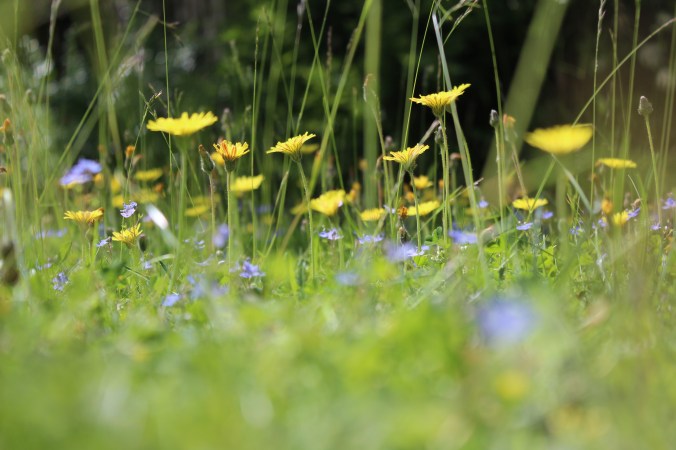
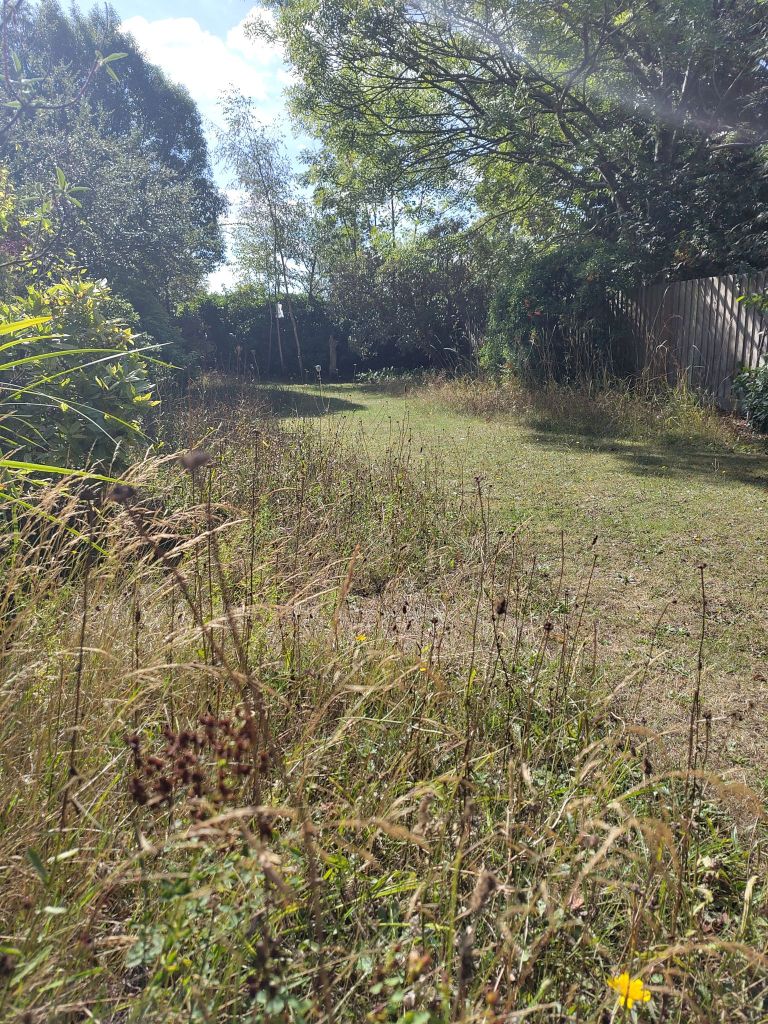
All the pictures are from the garden – and the narrow strip outside the wall by the road, where I’ve been sprinkling seeds for years.