Poem: Easter 2020 Lockdown poems 9

I have been writing this lockdown, and am sharing this poem with you first, although it is not the first I have written.  I am sharing it while we are still in the season of Easter – a strange, isolated Easter it’s been.

I wonder, though, if it is more like the first Easter than our usual celebrations, in many ways.  I wonder how it will seem, when we look back at it.

seed


Easter 2020  Lockdown 9

It wasn’t loud, or triumphant,
that first Easter.
The worship places were not full
of people shouting, together,
Alleluia.

I wonder if it was,
strangely, more like this.
Strange.  Shut away
for fear, for love,
behind closed doors,

quiet, while the world
fell apart, while dreams
lay cast aside, a coat
for a long-gone season.

And you came like a gardener,
maybe smelling of soil, with
sap-stains on your un-white,
un-shining clothes.  You brought
earth and growth with you

to Mary, who could not touch you,
to others, behind those doors
closed against the world. You
met them in their shut away places.

Maybe you will meet us too,
in our scattered homes, afraid,
untouched,  and working in shops,
and bending in fields, that we may
all eat in this wilderness,

maybe exhausted by
the work of healing,
and still holding the hands of those
who are passing into the darkness
of the tomb,
speaking softly in their ear.
Maybe these are the places you
are to be found, this year,
every year.

Jesus said, I Am – For Lent. Chapter 7, Vine

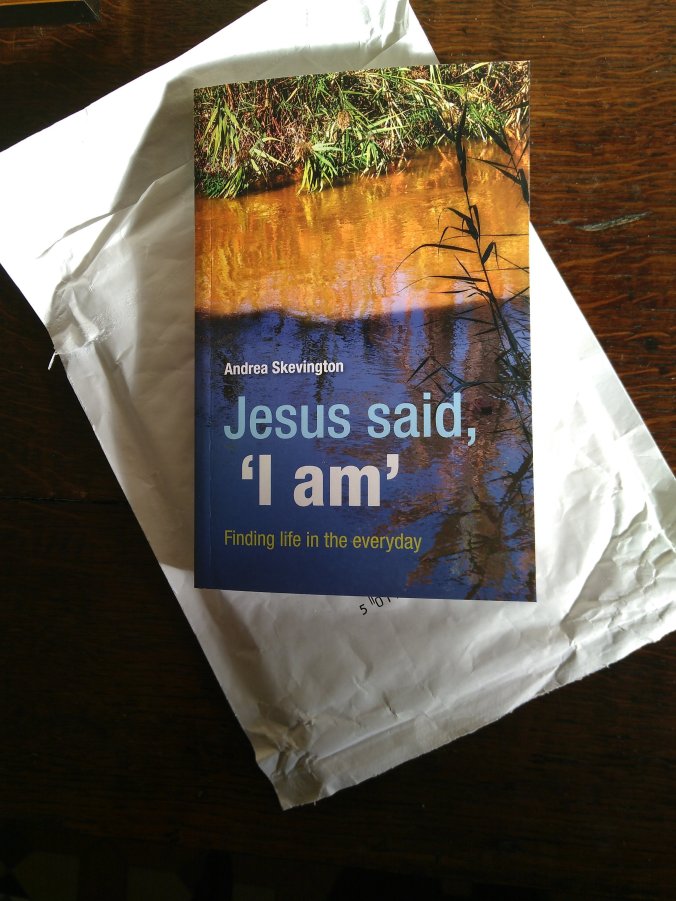
This post – for Holy Week – is the next in the series based on my book, Jesus said, I am – finding life in the everyday.

It’s also Palm Sunday, when we think of the crowds laying down palm leaves. This year, such crowds seem very far away from our experience, as we are isolating at home.  It’s a time when churches often fill with people, or process with branches.  This year, we can’t do that.  Instead, some are making palm crosses, or gathering greenery, to decorate their doors as a sign in participation in this time.  It’s part of how we are all adapting to our situation, and finding ways of connecting, and marking times corporately.  These things help.

IMG_0967

My Palm Sunday leaves.

IMG_0968


Back to another growing thing, to the Vine.

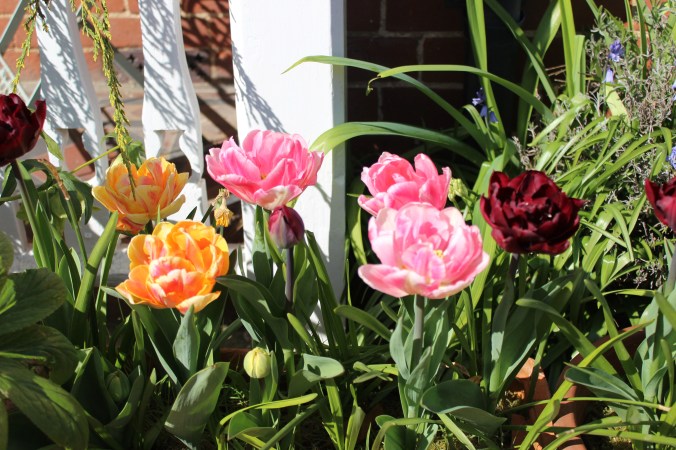
I do not have a vine in my garden, but I have so many other plants that are just opening up to new life.

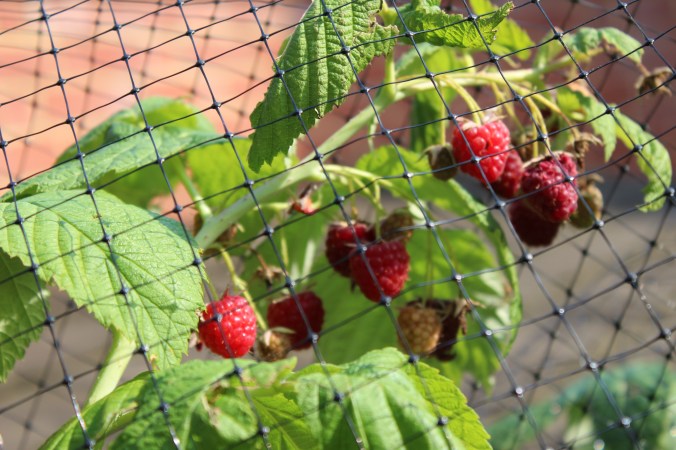
I have been planting seeds.  My veggie beds, rebuilt a few years ago by my son and a friend, have not been productive in the past, but this year, there are signs of hope.  There are a few little shoots coming up, and raspberry canes beginning to grow.  I hope that we’ll have fresh salad leaves before too long.

IMG_0877.JPG

I’ve also been thinking of the wisteria, and the corkscrew hazel, in the light of this reading which tells of vines and gardeners.

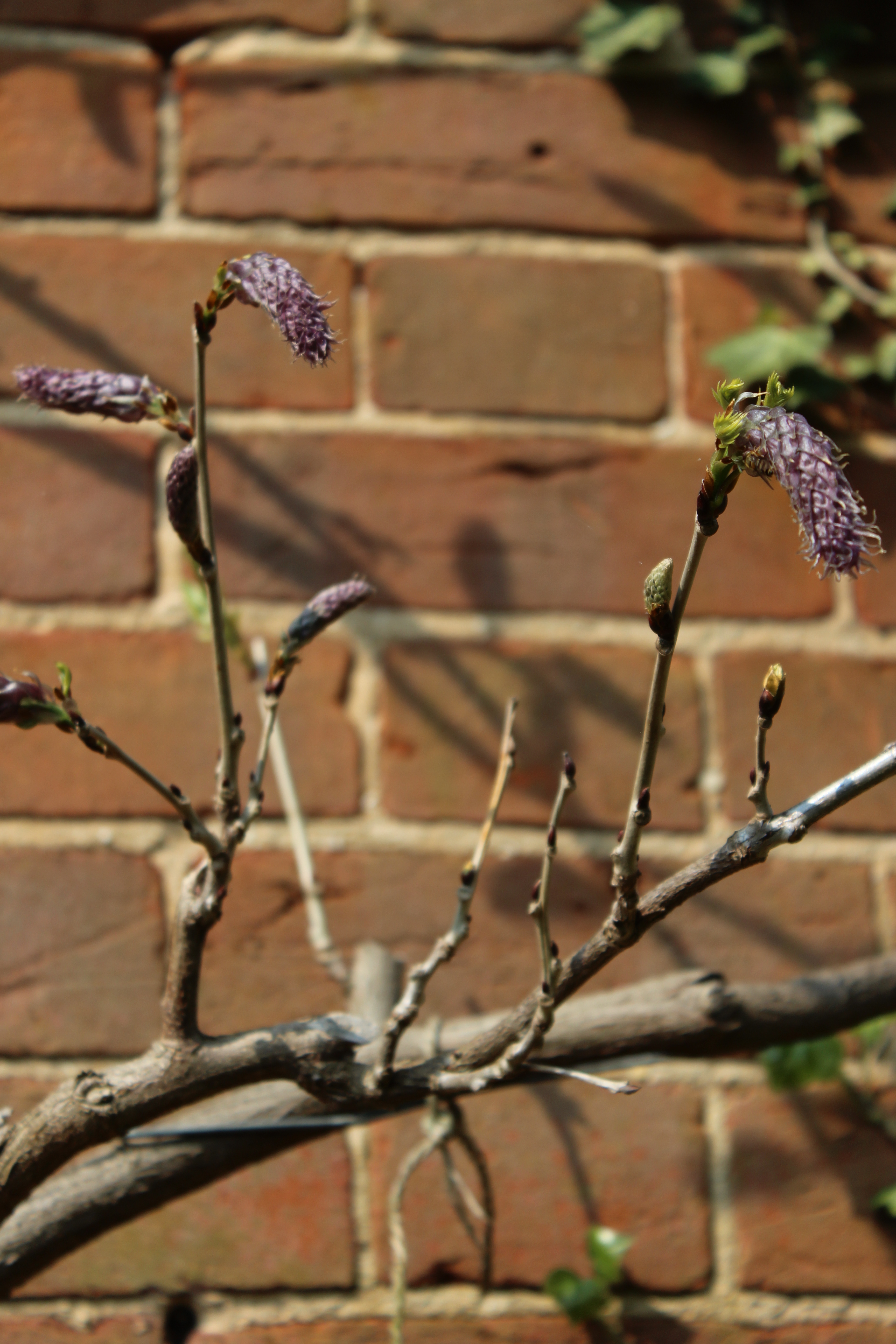
This year, the wisteria is covered in long purple buds, and will soon be heady with scented flowers.  Last year, my gardener worked hard to cut back the unproductive growth, to focus the plant’s attention on the buds of  this year’s flowering.

IMG_0885.JPG

The corkscrew hazel requires less skilled intervention – I can manage to tell which stems are coming up straight, and need removing so the wild disarray of the corkscrew can grow freely.

These moments of intervention  are part of what happens here – I also love the wild flowers – or weeds, I love to watch what happens, what grows of its own accord. It is a hospitable place.  I love the rhythm of managed and wild.  I love the crowds of birds, the insects, the butterflies and bees that seem to thrive here.

This year, many are noticing and valuing the gradual creep of spring, the morning birdsong, the clearing skies, in a way they haven’t before.  These small joys are opening up to us, and we find they are deeply satisfying.  If we have a windowbox, or a garden, or a view, the subtle changes we see bring us joy.

Our Father is a gardener, we read.

John 15:1-17

Once again, we will just touch on some of the themes this image opens up for us.  There is always more.  Here are a few things, offered for your reflection – and some suggestions of how we might live inside this  song of the vineyard.

There is a way of seeing the overarching narrative of the Bible that looks like this: three gardens – the garden of Eden in Genesis, the garden tomb of the resurrection and the garden city of Revelation.  If we hold this narrative in our minds, we see a story of flourishing, of hope, of new growth despite the winters we encounter.  Gardens and their gardeners are a theme that runs through the whole Bible text.  Gardens are both beautiful and necessary, a sign of a settled life, a sign of peace and security, a promise of plenty.  And within the garden, the vine winds and trails its way through scripture, a sign of the people of God in both testaments, their frailty and fruitfulness, their need of a gardener to bring out their best flourishing, their provision of fruit and, more especially, wine to gladden the heart, wine soon to be poured out.

We are invited to be part of this fruitfulness and flourishing.  We are invited to be part of something bigger than ourselves, joined to others as well as to Jesus. We are invited to participate, and to contribute, to give and to receive.

As Jesus and his friend walked in the dark past vineyards, the image of the vine was real, fragrant, touchable.  This song was no distant allegory.  It was before them.  What would they have glimpsed, in the thin light?

A winter vineyard looks as dead as dead can be.  The bark flakes and pulls away.  But, here, in the spring, buds would have been bursting out.  What appeared dead was returning to life, throwing out tendrils, leaves, maybe blossoms.  They knew the importance of the vine, and the care and wisdom needed to tend it and make it fruitful. Passover required the drinking of four cups of wine…. Their blood was warmed with wine as they walked through the chill of night.

…..

And in the spring, sap runs through its veins like blood – it pours through, swelling the hidden buds.  This is a kingdom vine.  The way life flows through it is like the way the Spirit will sustain Jesus’ followers after he has gone.  The vine is loved and cared for by the Father.  God alone is the gardener of this vine.


Remain

To a group of people who will soon be scattered in the darkness, who will abandon him, Jesus talks of remaining, abiding.  He talks to them, assuring them they are already connected to the vine, already clean.  What will happen does not change that for them  He says this first, at the beginning of the song.  All else that follows is held within the certainty that they are part of the vine.

Here is the melody of the song, and this is what we need to treasure – that we are also part of this vine, the sap flows through us.

The heart of it all is remaining in Jesus, as Jesus remains in the Father; remaining because of love, so that joy may be complete.  We may not understand, but we an hold open the possibility of this love and grace and belonging.

IMG_0607


Fruit

We have talked about abiding, remaining, but the purpose of the vine is the fruit and the purpose of the pruning is to increase the vine’s capacity to bear fruit.  As Jesus continues his song of the vineyard, we see this fruit linked to a circular pattern of love – it begins with the Father for the Son, flows from the Son to humanity, who are then, for the second time, commanded to love in their (our) turn. The outcome of all this is joy – Jesus’ joy will be in us and our joy will be complete.

Love, joy… from there, we are naturally drawn to another mention of fruit in the New Testament – the fruit of the Spirit.

By contrast, the fruit of the Spirit is love, joy, peace, patience, kindness, generosity, faithfulness, gentleness and self-control.  There is no law against such things.
Galatians 5:22-23

The branches attached to the vine have the life of the Spirit flowing through them.  There is beauty in a fruitful vine, with its leaves, blossom and, in time, the ripening fruit.  Our lives, filled ith the flow of the Spirit, can have such beauty.  The life of Jesus, flowing through us, is transformative.  Maybe Jesus is telling us here how the Spirit works, how our lives can be part of something greater.  Connection to the soure of all life and love leads to flourishing.  We are not isolated, purposeless, lonely individuals.  We are part of the something greater, and we can live out our lives fruitfully.

Reflection and Response

Further Study

Read the account of the wedding at Cana (John 2:1-12). Reflect on the symbolic meaning of the empty jars used for religious cleansing, here filled with fine wine at a wedding.
……

Colossians 1:15-20.  How does this image of Christ connect with your thoughts on the vine? How do all things hold together in Christ?

Prayer and Meditation
Lectio divina
meditation – rooted and grounded in love
Read Ephesians 3:14-16, asking God to speak to you by drawing your attention to a word or phrase.  Read the passage out loud, slowly, twice, leaving silence between and around the readings.  See where your attention snags, what strikes you, and ponder that.  If you are with others, hold a time of silence, then share your words or phrases.

Read again.  On the last reading, be alert to anything that applies to you or your situation directly, any place where the Holy Spirit may be moving or guiding you.  Thank God for what you have learned.

As the Father has loved me, so have I loved you.  Now remain in my love.  John 15:9


When you dwell on the idea of all being connected, and held together in Christ, does that help as you navigate this world in which we are more physically separate than we would wish?

Have you ever experienced anything that felt like pruning?  What happened? What was that like?  Offer any loss, any gain, through that process to God in prayer.  Be alert to signs of new life that may emerge.
Our lives are seriously curtailed at present.  Might there be, even in this real difficulty, some space where something new and better might emerge?


How can we connect in a time of disconnection? How can we show solidarity, and offer help, when the normal means of being together are not available for us?

Life and service

Connection and community
Take some time to connect with people in your community.  Be on the lookout today, this week, for ways you can build connection with those around you.  It can be as simple as taking a few minutes to speak to a neighbour, smiling at a passer by or something more.

ways you might be part of making a stronger community.  Ideas could include:

  • using local shops
  • walking or cycling where you can.
  • with others, notice the needs in your community, and finding ways to bless and reach out – the elderly or housebound may require help, or young families, etc.
  • litter picking the streets around you, or clearing snow or leaves as appropriate

……..

Care for a garden, or a piece of land near where you are.  Collaborate with others to enrich and bless growing and living things nearby.

Further reading – I recommend Richard Rohr’s book, The Divine Dance – the Trinity and your Transformation

rublevtrinityicon.jpg

The Rublev icon


img_20181130_114736372319885.jpg

A Poem for a time of isolation – Rooted

Update: 3rd April 2020.
While out for our household proscribed exercise this evening, we saw a pair of water voles playing in the stream where I saw the one in the poem.  We stayed still for quite a while, and watched them in and out of holes in the bank, and back and forth across the stream.  It was such a joyous thing to see!  That, and the loud birdsong, and clear air, made a simple walk deeply satisfying.

I wrote this poem some time ago, after the joy of seeing a water vole in meadows near our home.  It’s an experience I think about a lot.  I thought about it today…. I will get back to the poem later, I promise, but I can’t go there yet.  I can’t get to that place of stillness right away, I have to look at the things immediately before us as far as I can. Here is today, this morning, a very small beginning of a change in how we live…..

IMG_0773.JPG

It’s so sad, this keeping away from ones you love.  I, like many of you, have cried at the thought of keeping away from family and friends, and also cried when I have heard of doctors cancelling their weddings, and keeping separate from their own families, and working in such difficult conditions, to try to treat those suffering from the effects of coronavirus.

I thought about this on a small trip to the corner shop – not sure whether even this is a good idea, with the slightest of sore throats.  I put on some old leather gloves, thin, so you can still open a purse, and pick things up,  an old fashioned form of contactless.

There were hardly any cars, which was pleasant, and made it easier for us pedestrians to step into the road to avoid each other.  I am grateful to those who counterbalanced this distance with a smile, and a hello. Two items only, for everything, in the shop, and even so, there was little. I knelt on the floor to retrieve the second last loaf of bread from the back of the lowest shelf, and thought that tomorrow, I would start baking my own as I felt so bad taking it. There was someone I knew in the shop, and our distant conversation, and distant air kissing, seemed to start a ripple of laughter, as others avoiding contact found they could still smile and wave to counterbalance the dance of solitariness, of avoiding each other, we were all keeping up, without music.

IMG_0866

As an antidote, back home, I planted three rows of veggies – borlotti beans, butter lettuce, red chard – these gentle things help.  What also helped was doing something that might help someone else….Yesterday, I tended the Little Free Pantry .  It’s a perfect way for people still out, but who want to avoid crowded shops, to pick up or donate some food. I also added my name to the list of local volunteers happy to put things on the doorstep of others isolated inside.  A little of this can help with anxiety.  It can help us be reconciled to the distance we have to keep from loved ones.

If we have to slow down, if we have to disengage, then maybe, having felt the anxiety, we can see if we can find some gifts within it.

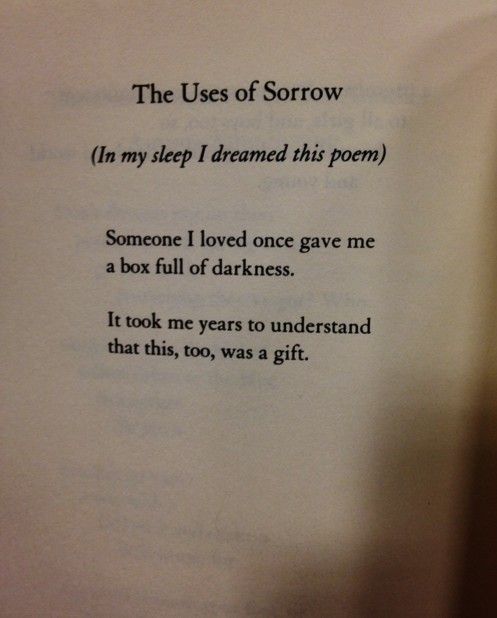
814b5d7fb683fa9a622570a639addec8--mary-oliver-quotes-darkness-quotes

Mary Oliver

Maybe, even as we acknowledge the weightiness and pain of the current crisis, we can begin to imagine how the world might emerge, how we might emerge, differently, from it.

Have you heard that dolphins have returned to Venice, and that those living in Wuhan report that the sky is blue, and full of birdsong now?   Maybe, if we live more quietly, we will live more rootedly, more connected to our place and its people.  Maybe, given time, a less frenetic, more sustaining way of being might be made.  Maybe, we have an opportunity now, for some kind of a beginning, if not anew, then perhaps differently.

What would you like it to be? What kind of world, what kind of way of living, do we want?

IMG_0473

HOW TO BE ROOTED

First, you must suspend
all effort, all purpose.

Simply crouch in the damp,
thick grass, and feel your
sense of self seep through
your skin, your feet, into the
air – the earth – the water.

And as the muscles
around your eyes slacken,
and you let in light,
you become aware
of a nuzzling in the
grass, an earth-dark
water vole sliding
into green water.

As your heart slows
a pheasant walks by,
bright among the grasses,
and three ducks fly low
under the oaks, the
beat of  wings
all about you.

Stay still, and you will
sense the scrape
of the crickets through
the back of your hand,
and the tiny spiders,
yellow with newness,
weaving through your hair.
So that, when the
strong green tendrils
of the earth begin to
creep about your feet,
you will know in wonder
that rare thing –
how the world is,

unseen.


May you be blessed, and well.  May you breathe deeply, and freely, may you know you are loved and connected to all, may you feel peace.


Jesus said, ‘I Am’ – for Lent. Chapter 3, Light

foamylipmikelacey

Mike Lacey Photography.

Welcome, and welcome back if you are following this Lent journey with me.  Whoever you are, I hope you find something that helps here.  We are now beginning week three by my schedule, and turning our attention to Jesus, the light of the world.  We’ll be continuing to draw on my book, Jesus said, I am – Finding life in the everyday
WP_20171016_16_03_37_Pro

“What has come into being in him was life, and the life was the light of all peoples.  The light shines in the darkness, and darkness did not overcome it.” John 1:3-4


IMG_0871

The days grow longer – each day, we are tipping a little more from darkness to light. I’m watching the plants respond to that light. I even have a few tiny seedlings coming up in my veggie patch.  At this time of year, the connection between light and life is clear, and fills us with hope.

Life and light.

It is often a good idea, particularly in John’s gospel, to look at the first mention, first use of a word or idea.  And often the roots of his themes are found in his opening words, the prologue.  But that prologue in itself carries echoes of something earlier, it takes us back to the very beginning of Genesis, where light is the first form spoken into being.

It starts with light. The things that live and grow on the Earth, our home, all depend on  light.  We cannot live without it.

And so when Jesus says he is the light of the world, we have a sense that these words are life-giving, momentous.  They speak of something we need every day, and yet the physics of light  – what light is – is hard for most of us to grasp.

“The true light, which enlightens everyone, was coming into the world” John 1:9.
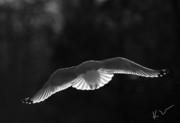
wings-karol-livote

As the gospel stories are told, we hear Jesus saying I am the light of the world twice, and both times it’s at a turning point for someone, a moment which changes everything for them.  So once again we see that something that seems perhaps high and exalted, beyond our understanding, is revealed in the deep reality of our lived experience.

Jesus first says, “I am the light of the world”, in a very dark place.  The setting was the Feast of Tabernacles, or Booths, when the huge candlestick was lit at the temple, and the light from it was seen in Jerusalem’s streets……..

They [the religious leaders] seem to be policing the celebrations while Jesus is teaching in the temple, an eager crowd listening to him.  The religious leaders bring a woman before Jesus, caught in adultery, and ask Jesus if she should be stoned as the law demands.  The woman, whose life hangs in the balance, doesn’t seem to be of much concern. At this this challenge, Jesus does something remarkable. He shows us a different way of seeing, a different way we can think about the law.

The law can be used to judge and condemn another, or it can be used to throw light on our own hearts and motives.

“”Let anyone among you who is without sin be the first to throw a stone at her.”” John 8:7

…….

with the stones lying on the ground, Jesus says, “I am the light of the world.  Whoever follows me will never walk in darkness, but will have the light of life” for the first time. It is an active sentence – of following and walking, and even the light is the light of life.

It is easier to walk forward, into new life, when we can see the way.

The second time Jesus said it is better known – and that’s in a conversation before the man born blind.

“It was not that this man sinned, or his parents, but that the works of God might be displayed in him.  We must work the works of him who sent me while it is day; night is coming when no one can work. As long as I am in the world, I am the light of the world” John 9:3-5

We see some parallels between this story and that of the woman who was not stoned – in both cases, people seem most concerned about pointing the finger, apportioning blame.  Jesus does not do this.  He sees with clear-sighted compassion, not naively, but looking with the light of love, and looking for God’s work of healing and restoring.

Jesus did not go looking for sin and guilt, and did not apportion blame.  Human pain is, rather, the place where God’s work is to be done.

…..

God seems to specialise in the transformation of bad things. It is the resurrection power, to redeem, restore, make new.  What is more, it seems that the work is not God’s alone:  ‘We must work the works of him who sent me while it is day; night is coming when no one can work’.
There is a ‘we’ in that sentence…. So the challenge is not to judge, but to join in with God’s work.  God longs for us to act, as partners.  What an extraordinary thought! The hope is that when we are in hopeless and most desperate situations, like the man born blind, like the woman, we can encounter the glory and mercy of God.  We are open to the possibility of transformation.  Once again, Jesus’ language is full of action. ‘Work’ is the key repeated word.


Night is coming for Jesus, and this is his response – to give sight to the blind.


candles_flame_in_the_wind-other

We act now to lift the darkness we can.  We work while it is light.  This theme emerges again in the story of the raising of Lazarus (11:9-16). Light and work go together – and the work is the transformation of suffering and death, sin and despair, into hope and life.  It is the bursting out of a new dawn, a new light to live by. This is the life-light in action: the glory-light that is found in the strangest places.

Can we notice this life-light, the light of Christ?  Can we learn to see in its loving clarity? We know that if we turn towards light, like the plants, we will grow and grow well.


Reflection and Response

Oh, God, who spoke and light came into being, may we forever dwell in the brightness of knowing you.

May we bring the light of Christ to those in darkness,
may we chase away the shadows with hope and love,
may we hold a lamp for feet that stumble,
may we too be lights in the world.


The account of the woman and the stones we considered briefly above invites us to look at our own hearts and behaviour.  Lent is a good time for self-examination.

Quaker light meditation

The light of love and grace transforms our seeing.

The Society of Friends have various pamphlets available to help introduce the practices of meditation and silent prayer.  These are usually undertaken together, as a group, and the meditation below can be done alone or with others.  The words in inverted commas are those of George Fox, founder of Quakers, 1624-1691.  Many of the others are a paraphrase.  Again, you may wish to begin this in darkness, or use a small light or candle to focus.

Look Inside  “Your teacher is within you.  Mind what is pure in you to guide you to God” – remember the work of the Spirit within you.

2 Identify the light  “Now this is the Light with which you are lighted, which shows you when you do wrong.”  When you bring yourself into the light, you see your troubles, your temptations and your wrongdoings.

3  Let the light show you yourself “Mind the pure light of God in you” which shows the things in you that are not light: let your conscience be stirred.  Let the light of Jesus Christ search you.  Do not be afraid.  It is the light of love.

Trace the light to its source  Stand in God’s counsel, learn from the light that “you may be led forth in his life and likeness.” God is restoring God’s image in you.

5 Trust the light to show you the alternative.  Have courage to stand still in the light: it is the light of your saviour.  If you look at your sin, you are swallowed up in it, so look to the light by which you see it instead, and let your focus be on the source.

Feel the new life grow  “He who follows the light comes to have the light of life.” The Lord has sown a seed in you that lies shut up in the darkness, with winter storms about it.  He sends his light to the seed, that with time the new life will grow.

7 See other people in the light  “As you abide in the light, the life-light, you will see the kinship that is amongst you, for in the light no self-will, no mastery can stand.”  We are all equal before the light.

See the world in the light  This light lets you see all the world as it is, and keeps you mindful of God.

Learn to love in the light  Standing in the eternal power and light of God, we have strength to love those who persecute and wrong us; we have light enough to shed light on the paths of those who are against us.  This is how we learn to love.

Prayerful reading – for yourself or others
If you find yourself in a dark place, read through the stories again –  the woman with the stones, the man born blind.  Notice the depth of the pain these two were experiencing, and the easy condemnation.  Notice how Jesus responds. Notice how his presence transforms things.  Bring your situation into the light of life,  inviting Jesus, the light of the world, into your dark place.  Allow yourself to lay aside worry, and be lit and warmed by the love that waits for you. Stay in that place for a while.
You can bring someone you love, or a situation, before God in this same way.

Creative
Not knowing when the dawn will come, I open every door.  Emily Dickinson
Photography, light-writing.  Why not take on a photography project, perhaps one of these every day for a week, or take a camera/phone with you wherever you go.
Light-sources in your home/community
Reflections and light effects
the same object or view at different times, in different light.
The same subject using various filters.
You could print off any you like, to pin up, or make into “sending you light” cards.

Living from a place of light.

Jesus calls us not to judge, and yet reminds us to know a tree by its fruit.

Can we develop the discipline of looking at ourselves and others with a clear-sighted vision, which sees truly and yet does not condemn?
This week, seek to lay aside harsh judgements.  Perhaps we can seek to learn lovingkindness even in situations of hostility.  Kindness to ourselves means we can keep ourselves safe, kindness to others means we do not need to condemn or retaliate.
Perhaps we can begin our own move towards light in the way we interact with each other on line.

Social Media .  Think about the arguments  in these chapters [of John’s gospel], and compare them to those you encounter on social media and comments sections online.  How can we respond in a way which is more like Jesus?  How can we be light in this particular dark place?

wells-cathedral-5492

Scatter the darkness in our hearts, that we may be children of light.


I wrote a poem as darkness fell while I was sitting on the beach.  You can read the poem, Light, here.

A prayer for the opening of the eyes (to be said throughout the day)
May I see signs of your kingdom springing up like seeds, working like yeast in the dough.

Thank you.  Next week, we’ll be looking at the Shepherd and the Gate.


Please feel free to use any of this material that helps, saying where it is from.

Remember you are dust….. Ash Wednesday, for life.


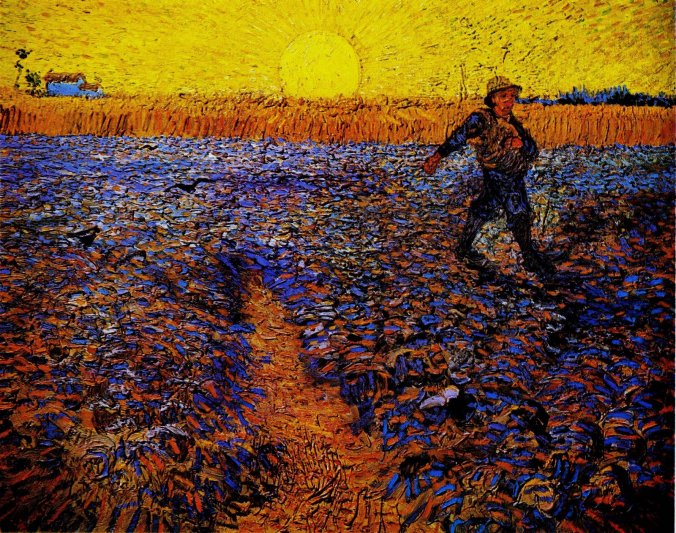
van-gogh-the-sower

I’ve been thinking a lot about being the same stuff as the earth as I’ve been pottering around in the garden watching spring emerge, and reflecting on the parable of the sower, and other stories Jesus told.

IMG_0773.JPG

img_0786

Ransoms, or wild garlic – as I made dumplings with them, and enjoyed them, I felt part of our local wood.

Today, Ash Wednesday, I emptied our Baxi grate, and carried the ash to the compost heap, getting covered in the stuff as a gust of wind blew.  It was a far more comprehensive ashing than we normally receive in church, and it felt given to me, a reminder of my state as dust, ash, earth.  As I stirred them into the first grass clippings of the year, and yesterday’s lemon peel from Shrove Tuesday, I thought about the beloved tree that we lost in our garden, and how it’s kept us warm this winter. I gave thanks for it. I thought too about Malcolm Guite’s Sonnet for Ash Wednesday, that speaks of the burning of the world’s forests.  I though how complex and delicate our relationship with the rest of the natural world is, and how easy it is to abuse and neglect its care.

It’s good we have these days and seasons – Ash Wednesday is right for penitence, and even lament, as we consider how separately we have tried to live from all that is good and true and sustaining.  How we have broken the Shalom, the peace and harmony of God’s intent for us and for all things.

It holds its own remedy, too.   People are normally given a cross of ash at a communion service, the great reminder and restorer of our unity with God, with each other, with the gifts of the earth in the form of bread and wine.  With the gift of Jesus.  Also, a reminder that we are one with the earth puts us in our place, and that place, if we stay with it long enough,  is a deep unity and kinship.  And that circled my thinking back to the parables, back to the talk I gave at Girton College ten days ago. It might help in the context of the burning of our world, and our state of being ash and soil.  Jesus told stories that speak deeply to our nature, and the nature of God and the world.  As we are made of the same stuff as earth, we can rediscover that connection, and in it find hope for an amendment of life, living more fully and abundantly, more joyfully and humbly and thankfully.

As we enter this season of Lent, may we be quiet enough to hear the whisperings, and the stirrings, of – not just new life, but a new way of living. We can repent – the Hebrew word normally translated such carries a meaning of turning back home, the Greek of having a change of mindset.  Both of these carry great hope – the reign of God is very close, all around, within us, if we but look and see.

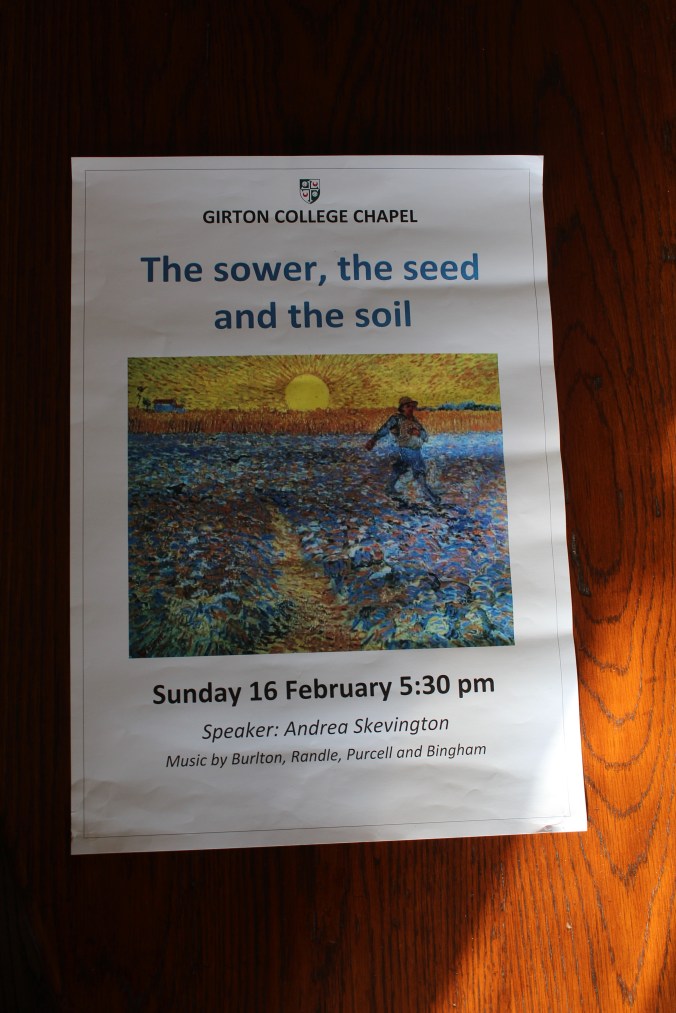
The sower, the seed, and the soil. A talk at Girton College Chapel.


IMG_0956

Last Sunday, I had the enormous privilege of speaking at Girton College Chapel. Malcolm Guite, the chaplain and poet, invited me to speak.  I’d been for the 150th anniversary celebrations last year, and Malcolm is continuing to invite Old Girtonians back this year too.

220px-Girton_College_Chapel_Window

It was so good to be back, and in the chapel which was good to me as a student.  It’s a beautiful, safe, nurturing space, and it also has a superb acoustic, which means that at evensong, you feel immersed in the roll of the music.  The choir are excellent, well worth hearing, and it was particularly good to have music by another Old Girtonian, Rhiannon Randle.  Her new work, Our Burning World, was performed on Monday.  You can read about it on her website linked above.

van-gogh-the-sower

One of Vincent van Gogh’s astonishing paintings of The Sower

Malcolm very generously gave me some flexibility to talk about what was on my mind, and I decided to follow where my thoughts, readings and prayers are taking me and talk about one of the parables.  I’ve been particularly drawn to Jesus’ parables of the natural world, curious to find out how he noticed to the flowers of the field, the birds of the air, and the work of tending soil for food.

Having driven to Cambridge through the tail end of a storm, it seemed very appropriate to be speaking from a parable of the soil. It is good to return to the gospels for wisdom, especially as humanity seems to be on the brink of a crisis in our relationship with the rest of creation.

Malcolm has kindly published the text of the talk on the College Website.  You can read it
here.

My thoughts on the parables are gradually taking shape into something, I hope it will be another book.  Sometimes, I know that there is some treasure to be dug, but I’m not sure what it will be until the digging is well underway.  So, I shall return to my digging, and see what good things I unearth along the way.


If you’d like to read more about seeds and sowing, you can look elsewhere on my blog, as below.

Sunday Retold – The Sower and the Seed 16th July 2017

November Sowing

Sunday Retold – Small Seeds, from Luke 17


Jesus said, ‘I Am’ Finding life in the everyday. Readings for Lent

IMG_0864

Last year, I shared with you some suggestions for how to use my book – Jesus said, ‘I Am’ –  for Lent reading.  I know that individuals and groups, including groups of churches, did so, and I thought it would be good to share these resources again this year, with a few additions and amendments.  I hope you find it helpful.

IMG_0866

I’ve made a couple of tours round the garden this morning, checking the emerging plants after another weekend of major storms, and it astonishes me how well these fragile early plants have survived.  The blackthorn blossom, in particular, tissue-paper thin, has withstood an absolute pounding.   The birds are very busy on the feeders, and singing, and popping in and out of the thicker shrubs looking for nest sites.  The days are stretching out now, and it feels good to be outside, for a little while at least!

Lent is on the way with the lengthening days, and some of you may be looking for some reading, or a spiritual practice, for this time.  Many people seek to deepen their prayer, and commit to some physical discipline, and would like some company and support along the way. My book might be what you are looking for.

Each chapter begins with a short reading from John’s account of the life of Jesus, which is followed by some reflections, and then proceeds to offer suggestions for further study, and prayer, and creative response, as well as possible practical and community actions. You may be part of a small group or spiritual community, who might like to read it together.  If you might follow it on your own, I intend to publish a little something every week on this blog so that we can take this walk together, and keep each other company here.


IMG_0790


It might help you to see how it would work, so, below you’ll find a suggested calendar of how we could proceed – although of course it’s entirely up to you.  Each week I’ll post some readings and suggestions for things to do here on this blog.

Getting Started: Chapter 1, Moses and Abraham.  This is a shortish introductory chapter – you could fit it in this week, or as an extra piece of reading as Lent begins.

The woman at the well: week beginning Sunday 23rd February 2020.  Ash Wednesday is 26th February this year.

I am the bread of life: week beginning 1st March.

I am the light of the world:  week beginning 8th March.

I am the good shepherd, I am the gate for the sheep: week beginning 15th March.

I am the resurrection and the life: week beginning 22nd March.

I am the way, the truth and the life: week beginning 29th March.

I am the true vine: week beginning 5th April, Holy Week.

I am he: Maundy Thursday, 9th April, or another day this week.

It seems to fit well, I hope you agree.
If you want to find out a bit more about the book, there are extracts elsewhere on the blog, for instance here and here.

You can order the book from any bookshop, or online.
Amazon
Waterstones
and all the usual places.

This could be good!


img_20181130_114736372319885.jpg

Poem – Red Kite/Y Barcud


Red Kite.jpg

Photo by Gracie Oneil

Like many of us in the UK, I’ve been watching David Attenborough’s Seven Worlds, One Planet which is full of so much beauty, and also heartbreakingly poignant as an awareness of the danger so many creatures and systems of life face seeps through the glory we are watching.  The Earth is so very good.

I wonder if you can remember the first time you became aware of extinction – that humans were causing an animal, or a plant, to be threatened?  It’s a very powerful moment for many, as it was for me.  My own creature was a bird of prey, the red kite, which, of course, I had never seen.  I remember the tears I cried as a child on hearing its story.  Below are a couple of links to video clips where Charles Eisenstein talks of the sense of loss we can experience, and how we respond.

Charles Eisenstein Horseshoe Crabs

Charles Eisenstein Passenger Pigeons

In my own case, the kites have made a welcome return, spreading far beyond the places in Wales where they have been nurtured and protected.  Someone, some people, took time and effort, engaged in research and action, to bring these beautiful birds back from the brink of extinction.  There is hope, just, for so many.


Red Kite /Y Barcud

A warm Sunday afternoon,
I lay on the grass, sleepy,
watching the few light clouds
against the blue,
when, suddenly, a swift shadow
passed over me.

A red kite – wide, graceful wings,
forked tail turning and turning to
catch the wind – the wind that
ruffled my own hair.
I stood, in wonder, and whooped,
in joy.  Here she is, at last!
She has been gone all my life.

And sadness I felt as a child
came back to me then,
when I had listened to the story
of the red kites – large and graceful,
that glided over the hills and forests
of Wales

And were hunted – perhaps all gone.
Perhaps every one. Never seen.
Shot. Trapped. Poisoned
by chemicals spread on the land,
sickening the whole web of life.

I remember I wept for them then,
ashamed. How could we?
Make a creature, with a name,
unknown, gone forever,
as if it had never been.
Make a myth out of a living
breathing thing.

Since then, I have looked up,
looked up at the sky,
waiting for them to return.
I have watched them spreading east,
now, all my life, and, at last,
at long last they are here.
I wept again.  I wept for the loss, and the joy.

May you be safe here,
Y Barcud,
May you thrive, and be blessed,
May your young fly in these skies,
May the morning sun rise on your wings.

The first Little Free Pantry in the UK!

Some good news from this corner of Suffolk…..

I’d like to share with you an article hot off the press at the Melton Messenger – the local parish magazine. I’ve tweaked it ever so slightly for the internet. In it, I talk about our open, freely accessible community food project, which we hope will be a sign of love and welcome, as well as practical help, to anyone who wishes to participate by either receiving or giving. Anyone is free to use the pantry, with no questions asked.

It’s such a simple idea, maybe it’s something you, or a community you belong to, could consider? It might be very welcome in the run-up to Christmas, and in the leaner days that follow. In the article is a link to the Little Free Pantry website, which is full of delightful and helpful things.

litte free pantry 3

Sharing the Harvest – New Community Food Project Launched!

We’re delighted to tell you that St Andrew’s new community food project is now up and running!

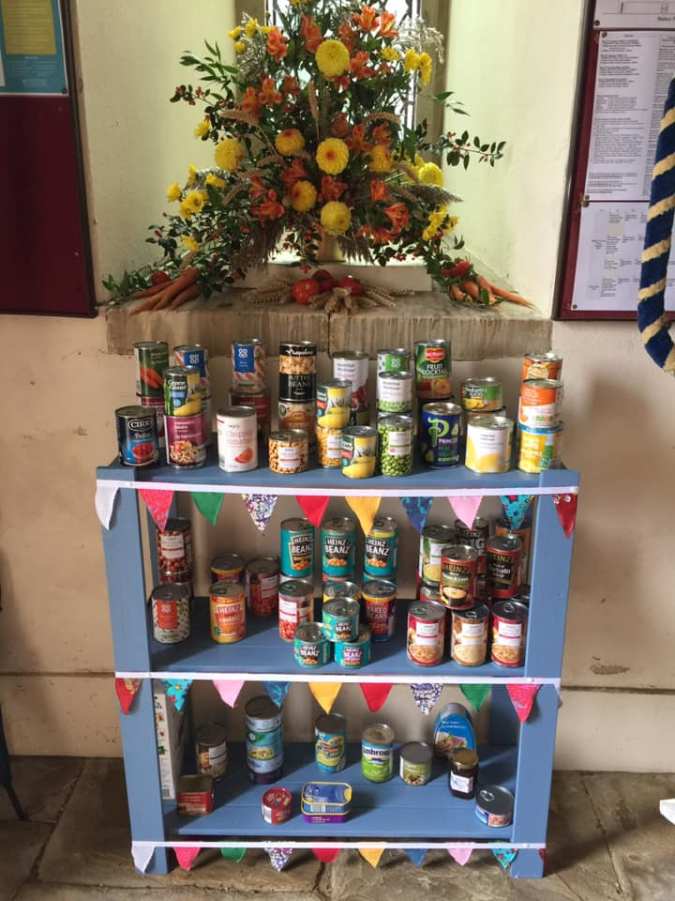
It’s a Little Free Pantry – a set of shelves in the Church porch which are freely accessible. Anyone can leave some tins, and anyone can take some. The ethos of the project is:

“Take what you need, give what you can”.

We are quite excited to be able to announce that we have successfully registered our shelves with the Little Free Pantry movement. It is now, officially, the first in the UK! You can find out more about the movement, and see St Andrew’s Melton on the map, at their website: http://mapping.littlefreepantry.org/

Back to the launch….. it was at our Harvest Festival. The Church was looking beautiful, decked out with orange autumn flowers, and wheat, and apples. It smelt as good as it looked. During the first hymn, as we gave thanks for the harvest, we all brought up our gifts of tins and packets and gave them to Rev Paul, who piled them on the altar. Later in the service, we joined hands to pray a blessing on the shelves, and for all who would use them. The shelves were stacked with the tins that had been brought. The surplus will go to the Salvation Army’s food bank. It felt that we were participating in something very ancient – giving thanks for, and sharing, the Harvest – in a way that was new to us, visibly opening our Harvest Thanksgiving to whole parish.

For we hope that Melton neighbours will want to join in. It’s a way we can all participate in the generosity of Harvest, whether we are giving, or receiving. We hope it will be a year-round sign of God’s love in a very practical, daily-bread way – with tins of beans, and soup, and such. We hope it will help to strengthen the sense of community in Melton. It’s so good that we can keep the Church and its garden open and accessible to the neighbourhood, and we hope this project will be a further sign of welcome, and of the inclusive community we are seeking to build here.
As people are free to take and leave when they like, the stocks may be variable, but we’ll do our best to keep an eye on things and make sure the shelves aren’t empty!

So, why not come along and take a look? Why not come along and join in?

Small acts, when multiplied by millions of people, can change the world — Howard Zinn

We have a tradition of sharing produce in the congregation – many people have productive gardens with gluts of tomatoes and apples. We now have a basket above the shelves where we can extend that sharing to all our neighbours – subject to the vagaries of harvest and weather!

IMG_0606.JPG

If you’d like to think some more about Bread, and hunger, you might like to read my Lent post on “I am the bread of life”, here.

A lament – I hear the song of the Earth #EverybodyNow

I’m posting a series of pieces as my small way of joining Extinction Rebellion’s protests this week and next.

IMG_0887

This is something I wrote for myself, in the summer.  I was thinking about what I wanted to say in what may become my next book, I was thinking of what was on my heart, and I gave my heart some space to speak.  What came was this – I’ve tweaked it a tiny bit, and it may well turn into something else in time – this, though, was a felt rather than thought expression of my growing sadness as I attempt to follow those words from Job –

But ask the beasts, and they will teach you,
the birds of the heavens, and they will tell you:
or the bushes of the earth, and they will teach you;
and the fish of the sea will declare to you.

Job 12:7,8

I have called it a lament for now.  I am not sure what to call it.  I have tried to resist my natural urge to say something soothing, and, as in the parable I shared on Monday, let the piece be what it is.  Lament is powerful, and important.  We need to give space to it, and then in time we may find we can move through it, knowing what we love, what we risk losing, empowered by it to act, to cherish, to tend our beautiful Earth.


I hear the song of the Earth

I hear the song of the Earth –
so good and green,
in June, when the whole world sings,
and the fledgling birds walk fearlessly,
and the young badger sits on the grass.
I hear the song so poignantly
so ebbingly,
at the great green flood tide of the year.
For I hear within the bassnote of loss
of grief of absence,
of all the creatures
that are not,
are no more.
I hear the clatter
of plastic as it
rattles through
the web of life.

I hear the whales
that have thrown themselves
ashore as I wonder
what would they sing
if they still could.

I hear the forests burning
and splintered, the roar of
the orang-utan
fighting the gripper that
tears down the tree.

I hear silence, absence,
the butterflies I do not see
and the hedges that are gone.

The Earth cries out
and these are not birthpangs

Or if they are they are pangs
for our waking, awakening,
coming to our senses
and listening to the teaching
of the plants and the animals,
The water and the air.

It may or may not be too late.
we may or may not be able
to turn away from destruction.

That is no longer the point for me.
The point is that my voice must join
with the cry of the beached whale,
and the turtle laying her eggs
in trash,
and the hare chased by dogs,
and the young albatross
with a belly full of plastic.

That is my task, as a
being on the Earth.
my task is to feel the Earth’s pain,
and speak, and speak,
And cry out in a tongue we understand.

And so, I sing a song of the Earth,
in winter, when life ebbs.
I remember the good, and the green,
the fledgling birds and the young badger,
the butterflies and the hedgerows full of blossom.
I will sing of them still.

IMG_0752.JPG