Sunday Retold: Who – The Transfiguration

I’m working away at my collection of poems, The Year’s Circle, weaving together the seasons of the year and the seasons of the readings many churches follow. And we’re coming up to the story we call the Transfiguration – when three of his friends see Jesus in an otherworldly, shining – vision? or what was it? – with Moses and Elijah from the Hebrew Scriptures. It’s a pivot point in the gospel accounts, important and central, and also strange.

Some have interpreted this event as a revelation of Jesus’ true identity, and perhaps a foreshadowing of the resurrection appearances, and perhaps a glimpse of the Universal Christ – a theme explored by Richard Rohr in his book of that name.

As usual, there is no explanation, no interpretation in the gospel accounts. And there’s something about the event which encouraged me to explore the way it asks questions of us – what we think is really real, and really lasting. How we see – do we see glory? Do we see cloud? Those explorations reminded me of the medieval work, The Cloud of Unknowing, and how beneficial it is to be open and patient with things that are beyond our understanding. It feels like a story to sit with in contemplation, expanding our way of seeing, inviting us into a deeper and truer experience.
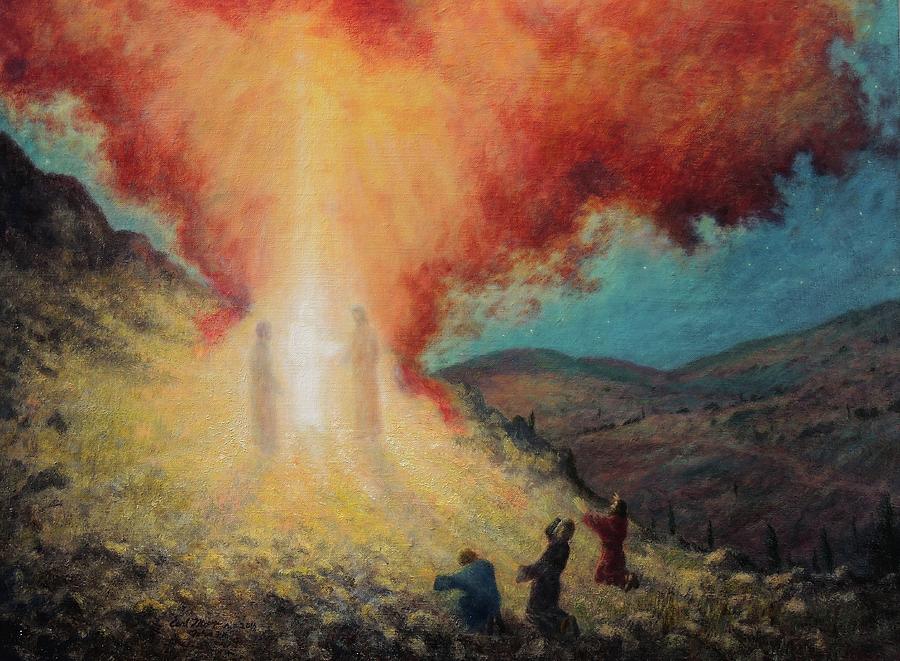
Earl Mott’s painting of the Transfiguration

When I was reading Luke’s account I was struck, as I often am, by his ordering of the events. There seems to be a theme emerging, with questions of who Jesus was, and also, what greatness might mean. And so I wrote a short series picking up those themes and exploring them. There are other events woven through that are not covered by the following sequence of poems – the Feeding of the Five Thousand, for instance – which is developing a sequence all of its own.

If you are looking for something to use in your devotions or public worship for the Feast of the Transfiguration (on 6th August), the parts stand alone, and can be used singly. But I was intrigued by the flow of ideas and wanted some space to ponder them on the page. I began with Herod, troubled and awkward in his guilt, and moved through the stories to the little child, standing in the midst of them.

So, here it is….. four poems following a trail.

Who?
Luke 9, Matthew 16-18

I  Herod

Herod found you a
question he did not
know how to answer.
Perplexed, he heard
whispers that you
were John back from
the dead, a ghost to
stalk his conscience,
shock his dreams,
or the great Elijah,
or another prophet.

He sought you out, he tried
to see you. Perhaps to
ask you who you were.
What might have been,
what could have been,
if he had met you then?

II  Peter’s confession

You asked those who knew you best,
Who do they say I am?
and
Who do you say I am?

To the first, they gave the
answers that blew in the air
like smoke, whispers that
swirled dark around
Herod’s palace, and
through courts and crowds.
John the Baptist, back from the dead.
Elijah. One of the prophets.

And to the second – a moment’s
pause, an intake of breath,
a strangeness rising – to be
asked to name, to more than name,
one they knew daily, and loved,
and still, barely understood.
How to give answer
to such a question?

But Peter did. The vast
words formed in his mouth.
He called you Messiah,
the Christ, the anointed one.


How good it is to be seen,
to be known, to be understood.
How warmed you were by those words.
Enough to give him a new name –
Rock – and a new identity – foundation stone.
For all his impulsiveness, changeability,
you knew him as deeper, and truer.

And yet a sadness enters here.
The anointed one does not
walk in greatness.
The road you will take is
hard and stony. A way of weeping.
And a warning enters too –
those who consider themselves
God’s guardians will subject
you to death, yet death
will not hold you.

Such words cannot
be borne. Such an
upending, a
contradiction,
such pain. 
They fall to the earth
like so many
hard-shelled seeds,
trodden into the dirt
and snatched up by
dark, shining beaks.

III Transfiguration

Sometimes our seeing falls away
and we catch a glimpse of
deeper truth.  We say we see the light

Away from everyday thinking,
on the mountain, in prayer,
weighted with sleep.
Perhaps we see a beloved face
lucent in sudden light.

But here, on this mountaintop,
three friends lifted up their eyes
and saw – what shall we say?
to whom shall we compare him?

Shining like the sun, as white
as light, as bright as lightning –
the one they walked with,
ate with, laughed with.

Was it like the lifting of a veil, or                                                                                                
perhaps a dragonfly splitting his
dark skin to emerge a jewel?
Was it a peering through
the door of heaven, or
coming to see the glory
of things here, and now?
I do not know.
I do know it feels
a moment of endless truth.

And in that moment, Jesus,
Elijah and Moses do
not speak of the glory
that blazes around them,
they talk of the pain that
is to come – as ones
who can understand.
I hope there was some
comfort in it.

Something like comfort
too in the sightless
seeing cloud,
shekinah,
that reveals how we
do not and cannot see –
God is beyond us

And yet is with us,
as close as mist
filling our lungs,
beading on our skin,
as close as one we love.


And then they hear that true voice
speaking tenderly, calling him
beloved, and saying to listen,
to listen to their dazzling friend.

Words they will carry in their hearts,
words which in turn will carry them
on that long wide-eyed walk
down the mountain,
and through all that is to come.

As above, also reference to Isaiah 40

IIII Greatness

It is not what we think.
Greatness is not the pomp,
the power, the show,
the mountaintop.

It is the welcoming of a
little child. It is the being
like a little child.
In doing so, we draw
closer to the one
who calls Jesus
beloved,
the Son I love.

Greatness, a costume
cloak of purple and foil.
Let it slip from your
shoulders. Let it
fall.

As ever, I’m sharing with you work in progress. There may be some tweeks and amendments before things land in the book – Wild Goose, Iona Publishing, next year.
Also, as ever, please feel free to use any of my material that helps, referencing this blog as your source. I love to hear about where my poems fly to, and where they land.

Here is a link to some more I’ve written on the Transfiguration. It includes extracts from my retelling, and some thoughts on how we might come to see more truly. I hope you find it nourishing.

Armando Alemdar Ara, from Liturgy Tools

Poem: Overflowing – Sunday Retold

The beach at Walberswick.

So, this Sunday Retold is a little different. The retelling is a poem, which you’ll find below. Some of you may remember that I’m absolutely delighted to be bringing out a book of poems next year, based on the cycle of the seasons – both in nature and in the readings that many churches follow. You can find out a little more about that here. Wild Goose, the publishers, are happy for me to share some pieces in progress with you here as I work on the book.

It seems good to start with Easter, and this week – of the poems I’ve been working on – the one that seems most nearly there is one that happens to tell the story of this week’s gospel reading, John 21:1-19.

It’s such a rich passage, and there is so much that could be and has been said. I think the reason this poem has come most readily is connected to the warmth and tenderness I felt when reading the story. Although we often focus on the extraordinary elements – and they are there, sure enough – I warmed to the ordinary. Once again, Jesus is feeding his friends. He knows they have been working all night, and he anticipates the depth of their hunger, their cold, their disappointment, and their need for this breakfast. It is a feature of these Easter stories, how often eating together is involved, how simple and reassuring the talk.

And here, we see the dance of grace – forgiveness for Peter, yes – but there is also the simple lifegiving grace of sharing food, of receiving, and giving. Of giving, and receiving. It is a revolutionary gift economy in fishing and sharing, in forgiveness and purpose, and its something I’ve missed before…. Perhaps I’ve been too caught up in the strangeness, or the textural intricacies, or the story being about Peter, to see how this new life is also about cooking breakfast for hungry people, and them having enough – strength, fish, new beginnings – to feed others in turn.

I love Wendell Berry’s phrase, “practice resurrection”, and this Easter, I’m wondering what that might mean….

But here is the poem.

Overflowing

Gathered around the fire,
dripping with lake-water
and morning chill,
they warmed themselves
in quiet, not asking who it was
who cooked them breakfast
on charcoal and hot stones.

After such a night, such an empty-
netted night of no-going-back
to the old life, of cold,
of hunger, of ropes
against skin,
they sat on the shore
with the smokesmell
of griddled fish and fresh
bread filling their senses.

In the dawn shadows –
the last stars fading,
the first light gleaming –
you handed them this
feast – loaves and fishes,
bread broken – you fed them
and warmed them.

This is how it flows,
the dance of new life.

We may be fisherfolk with
empty nets, but you
guide our hands. And we are
overflowing. You cook breakfast,
and we share a feast.

And then, and then,
the invitation, the instruction,
the grace to Peter and perhaps to all –
Feed my lambs,
Feed my sheep, my sheep.


We receive, and we give,
we give, and receive, for
there is enough.
There is grace enough to
break the nets and yet
the nets are whole, and look,
still the sea is full of fish

Overflowing
Dancing
In the new light of dawn.

The Little Free Pantry at St Andrew’s Church, Melton – one of many now springing up.

This story, of the miraculous catch of fish, and Peter’s restoration, is included in my retelling pictured above.

Poems: Seven Sentences from the cross

Elizabeth Frink, at St Edmundsbury Cathedral

Edit: April 2025 I’m sharing this with you again this year, as I’ve noticed that a number of you are turning to these poems as we approach Easter. Thank you. I’m also delighted to let you know that they will be part of my first collection of poetry, The Year’s Circle, which will be out next year. It will be published by Wild Goose. Exciting news!

I do hope these poems are helpful to you as you begin to meditate on Good Friday, and prepare for sharing that time with others – families, groups and congregations. Please do feel free to use and share them, saying where you found them. I love to hear about that.

Below the poems, you’ll find some links to other posts on this blog that you might find helpful too.

Father forgive them, for they know not what they do

We don’t know what we do,
from the careless word that
starts a fire of anger,
to the careless killing
of a butterfly  –
who knows what
wide effects,
what winds and rains,
begin and end with just one death?

We walk in darkness, so often,
and so often, we close our eyes,
we do not wish to know.
And Jesus, seeing this,
that his life would end
with angry shouts,
with fearful washing of hands,
with indifferent playing of dice,
Knowing all this, even so, he bore
our lawful unthinking violence,
our blundering disregard for consequences.
Another would pay for our actions.

Yet as the ripple of our acts flows out,
through the world, who knows where,
so too, now, flows forgiveness,
following on, spreading and transforming,
watering dry ground, lifting burdens
and carrying them away.

2

Truly I say to you today you will be with me in paradise

Even as he hung upon the cross,
even with blood from that false crown
running down, not wiped away,
he saw the two men at his side,

One joined in mocking with the
priests and soldiers,
speaking from his pain,
and one did not, this second kept
his eyes on something else – a hope.

A hope the one he looked on was a king,
and of a kingdom where such things
as crosses are not lifted up,
a hope, even, of an end to death and pain –
this pain, this death.

And, ah, his king begins to speak,
of paradise.
What a world to gift him dying there.
A word of such sweetness, freedom, peace.
See  – clear water flowing, and flowers,
hear the sound of birds, the lazy
buzz of insects, the flutter of their wings.

What a word, at your end, to hold to,
to capture our beginning, once again.
But even more than this,
to be with him, beside the king,
seen and known,
held in the loving gaze of one who
hung up on the cross.
Might this, even this, be paradise?

3

Woman, behold your son. Son, behold your mother

And still he sees, looks down
towards the one who bore him, bearing this,
the pain – not her own pain – worse,
the pain of watching one you love
twisting on those wooden beams,
the nails piercing her own flesh too.

The time has come when all the
treasure of her heart is broken open,
scattered, lying in the dirt.
What use to hold in mind
the words of angels,
the wealthy gifts brought by the wise,
what preparation Simeon’s warning,
when now she sees his agony with her eyes.
But she is not alone, his friend sees too.
John, who writes it down,
bears witness, even here, even so.
They turn their gaze upon each other
and see each other with new eyes –
a mother, and a son.
Gifting them each other –
his one last act of love,
this giving, from an empty cup.
This task of care can be ours too,
to behold each other in our pain,
and in our sorrow, walk each other home

4

My God, My God, why have you forsaken me?

You felt your generous heart forsaken,
you felt the absence of the one who helps,
who was beside you, in the beginning,
who knew you from before first light.

We know too well the sparseness
of your isolation, without light,
and companionless,
in the darkness of our own long night.
And yet, within our dark, we find you there,
Find you have waited for us long days, and years,
while our poor eyes have
grown accustomed to the dark,
have learned at last to see you through our tears.
So as you know our pain and feel it,
you break our separation with your own.
Help us see the forsaken all around us,
invisible and in darkness, but seen by you.
May we seek each other in the dark,
May we have courage to cry out,
like you, and so be found.

5

I thirst

The well is deep, and you have nothing to draw with.
Where now that living water?
Where is that spring within you, gushing up
to fullness of life?
Do you remember, now,
the woman by the well?
Your deepening talk of thirst and water,
as now, again, you humbly ask another for a drink –
this time,
a sponge of sour wine?

Do you remember too, as the taste dries on your lips,
that wedding feast, where water changed to finest wine?
The richness and fullness of that beginning
soured to this cold bitterness.

You are our source, the spring of all our rivers
and still you thirst like us, need help to drink.
And so give us this grace,
that as we do for the least of these,
we may know we do for you.

May we see you
in each thirsty face.

6

It is finished.

All things come to an end.
Even pain like this,
Even the anger and the cruelty of a crowd,
of us all,
even the certainty of those so certain
of God they hang a man upon a tree.
Even the punishment and scapegoating
even violence,
even death.
The work is done.
It has all been borne.
You have poured out your love, your life.
You have carried our sorrows, suffered
under our iniquities.

Your head bowed now, you sink
into the final pain of nails,
your body bears no more,
having borne all.
The work is done.

7

Father, into thy hands I commit my spirit

There is darkness now, deep darkness,
over the face of the deep,
and no hovering like a brooding bird,
instead, the temple curtain torn in two,
from top to bottom,
and the Holy of Holies empty.

God is not found there,
but here, with this dying man
on a tree,
He calls out father, and talks of hands,
and we remember what his own hands have done,
how many were healed by their touch,
raised up and restored from cruelty and death,
and now, he too will be held in loving hands,
a reconciliation beyond our grasp,
a trust even at this moment of last breath.

Dying, he taught us to die,
dying he brought us life.
May we be reconciled, may we know
at our end, the comfort of those hands.

img_0630

The church at Selworthy Green

Bless you


Good Friday Meditation

Other Holy Week readings, prayers and poems

Sunday Retold: Christ the King

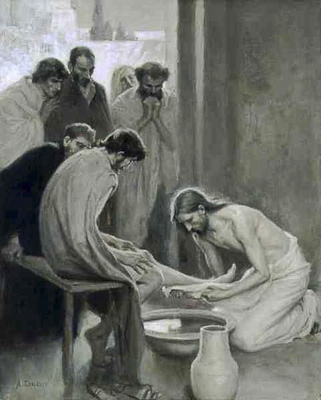
Jesus Washing the Feet of his Disciples, by Albert Gustaf Aristides Edelfelt, (1854-1905)

This week, I thought I’d share with you my retelling of the reading many churches will be following this Sunday, in the spirit of Sunday Retold.

It explores themes of power, and so follows on from last week’s poem, Stones.
This week’s reading is that electrifying encounter between Jesus and Pontius Pilate – a trial of sorts. For the flow of the storytelling, I’ve taken a longer sweep than the set reading.

So here’s the story from The Bible Story Retold

At the same time, as dawn was breaking, the council gathered – elders, chief priests, teachers of the Law – and faced Jesus.
“If you are the Christ, the promised one, then tell us!” one said, rolling the words around his mouth as if they were bitter to his taste.
“If I told you, you would not believe me,” Jesus replied, holding him in his steady gaze.
“Are you the Son of God?” they asked.
“You are right to say so.”
At this they rose to their feet with an angry roar, and carried Jesus off to the palace of Pilate, the Roman governor, who had power to sentence people to death.
“This man is a threat to the peace – he claims to be Christ, a king, and opposes Roman taxes,” the accusers called out as Pilate circled around Jesus.
“Are you the King of the Jews?” he asked. Jesus felt the cold edges of the mosaic under his bare feet.
“Yes,” he replied. “But my kingdom is not like the kingdoms of this world.”
“So, you are a king!” Pilate responded.
“Yes! That is why I came, to speak the truth. Everyone who is on the side of truth will listen to me.”
“But what is truth?” Pilate asked. Then he went out to see the leaders and the people together. “I see no reason to charge him,” Pilate said. “This man has done nothing to deserve death. I will set him free.”
“No, set Barabbas free instead!” they cired. Now, Barabbas was a rebel who had killed a man.
They shouted louder, drowning out Pilate’s words: “He’s done nothing wrong! I will release him!”
But, with rising rage, the mob shouted, “Crucify crucify!” In the end, Pilate gave in: he set Barabbas free and handed Jesus over to the guards.
The guards tormented Jesus, the one called king. They draped a fine, purple robe around him, and twisted him a crown of sharp thorns to wear. They called out, “Hail, King of the Jews!” and fell on their kneeds before him, laughing. They spat on him, and struck his head with a staff. They, they took back the robe, and led him out to be crucified in his own simple clothes

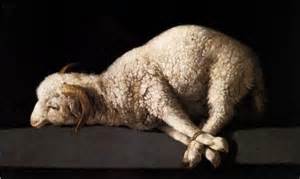
Francisco De Zurbaran

We see how those who held religious power allied themselves with the Imperial power of Rome. I expect they were sure they were being faithful, upholding the law and their traditions, defending their faith as they saw it. Being certain you are right can lead you very astray. And we see too how Pilate saw Jesus very differently, one who had done nothing wrong, and yet seemed to have little power in the face of an angry crowd.

The biggest difference of all, to my mind, is in the understanding of what power is, what a kingdom is, who a king is. Those who are embedded in the power structures of this world, and, to be honest, the rest of us too, find it hard to imagine a different kind of power. One that follows a path downwards, even to death. One that washes the feet of the followers, that does not insist on its own place, but instead works through love, in humility, in radical engagement with the world as it is. We will soon be in Advent, preparing for the coming of Jesus. At that time we think of his unity and solidarity with frail humanity, born in such a humble way, amongst the extraordinary, ordinary, beloved people of Bethlehem.

Lord Jesus,
May our lives bear the mark of love.
As we are kind, as we share, as we are gentle,
may your love be seen in us.
Help us, for this is hard for us.

Dear God,
May I welcome you as my king:
King of peace,
King of love,
King in death,
King of life.

From my book of prayers to accompany The Bible Story Retold, Prayers and Verses


Christmas Retold – the hope of light in the darkness

The solstice has come, the longest night, and we are now in those few days when light and darkness are poised together, equal. Here, the clouds have blown away, and the wind is mild, if wild. In the garden I see new shoots beginning, green and bright, and tiny catkins, and there is light, at least for a few hours, and a promise of lengthening days. For now, though, it’s a time for fires and gathering. It’s a hard time of year, where we need shelter and warmth and companionship – powerful and beautiful in its own right, and also full of the promise of light to come. I hope that what follows can offer you a moment of reflection and mystery as we think of Jesus, entering the world so precariously, helplessly vulnerable. The Prince of Peace born into dark times, with the strangest of fanfares, the most unpromising of resting places.

I’m not quite in a place of tinsel and jollity, though. I’ve been haunted by an image from Bethlehem this year - Christ in the Rubble – where the Lutheran church there has replaced its more traditional nativity scene with one that vividly demonstrates the reality for babies being born in Gaza now. We need the message of Christmas, with its offer of healing, love, forgiveness, presence, as much now as we ever did. The wonder of One laying aside power, and emptying himself for the sake of all.

Photo from The Print

Let’s pray for Peace on Earth this Christmas, peace for all, for the healing of the nations, for the healing of our world.

May you have a peaceful and blessed Christmas, wherever you are.

Caravaggio Adoration of the Shepherds.jpg
Caravaggio – Adoration of the Shepherds

From The Bible Story Retold

The Roman Emperor, Caesar Augustus, had ordered a census throughout the whole empire, when all the people would be counted, and taxed.  The orders spread along straight Roman roads, and were proclaimed first in the white marble cities and ports, and then in the towns and villages of the countryside.

Even quiet Nazareth heard the news, and Mary and Joseph began to gather together their belongings, ready to travel to Bethlehem.  That was Joseph’s family home:  he was descended from King David, of Bethlehem. They set off south on the crowded road, for the whole empire was travelling.  But, for Mary, the journey was especially hard, and the road seemed never ending. It was nearly time for her baby to be born.

At last they came to Bethlehem, but it was not the end of their troubles.  The city was noisy, bustling, and heaving with crowds, and Joseph searched anxiously for somewhere quiet for Mary to rest – her pains were beginning, and the baby would be born that night.  The inn was already full of travellers, and the only place for them was a stable.  There, among the animals, Mary gave birth to her firstborn son, and wrapped him up tightly in swaddling bands and laid him in a manger full of hay.  Then, she rested next to the manger, smiling at the baby’s tiny face.

There were shepherds who lived out on the hills nearby – the same hills where King David had once watched over the flocks, long ago.  The sheep were sleeping in their fold under the shining stars, while the shepherds kept watch.  Their fire flickered and crackled, and the lambs would bleat for their mothers, but they were the only sounds. All was peaceful.  All was well.

Suddenly, right there in the shepherd’s simple camp, appeared and angel of the Lord, shining with God’s glory and heaven’s brightness.  The shepherds gripped each other in terror, their skin prickling with fright.
“Don’t be afraid, I’m bringing you good news – it will bring joy to all people!”  The shepherds listened, awestruck, their faces glowing with the angel’s light.  “This is the day the good news begins, and this is the place.  In the town of David, a saviour has been born.  He is Christ, the Anointed One, the one you have been waiting for.  And this is the sign that these words are true: you will find a baby wrapped tightly in swaddling bands, lying in a manger.”

The shepherds watched as light was added to light, voice to voice, until they were surrounded by a dazzling, heavenly host of angels, all praising God and saying
“Glory! Glory to God in the highest,
And on the earth be peace!”

And then, in an instant, the angels were gone, and the shepherds were left in dark night shadows, listening to the sound of a distant wind. But their eyes still shone with heaven’s light.
“Let’s go and see for ourselves!” they called to one another as they raced over the dark, rocky fields to Bethlehem.  There, they found Mary and Joseph, and, just as the angel had said, they found the baby wrapped tightly in swaddling bands and lying in a manger.  They saw him with their own eyes, and spread the angel’s message to all they met.
“The Promised One has come! The Christ, the Anointed One, has been born!” The angel’s words were on everyone’s lips that night in Bethlehem.  And, as the shepherds made their way back to their sheep, bursting with good news, Mary kept their words safe, like treasures, in her heart.

And from Prayers and Verses

What can I give Him,
Poor as I am?
If I were a shepherd
I would bring a lamb;
If I were a wise man
I would do my part;
Yet what I can, I give Him –
Give my heart.
Christina Rosetti 1830-1894

Also from Prayers and Verses, a poem I wrote as a child.

The dawn is breaking, the snow is making
everything shimmer and glimmer and white.

The trees are towering, the mist is devouring
all that is in the reaches of sight.

A bell is ringing, the town is beginning,
slowly, gradually, to come to life.

A candle is lighted, and all are excited,
for today is the ending of all man’s strife.

5b Walter Launt Palmer (American painter, 1854-1932) Winter's Glow

The light is coming into the world.

Please feel free to use the extracts, saying where they are from.

The fourth Sunday in Advent – Love

Caravaggio – Adoration of the Shepherds.

It’s getting closer to Christmas.  This year, The fourth Sunday in Advent is rather overshadowed, falling as it does on Christmas Eve – the day when, for so many, and for so many years, the season of Christmas began. But its themes are precious, and the heart of the feast. It’s worth making a little space amongst the cooking and present wrapping and welcoming and general getting ready to hold the truth of Love coming among us at Christmas.

As it’s hard to make that little bit of space, here are the words to a carol that can perhaps sound in your mind whatever you’re doing in the moment…… to transform the activity into something holy and generative. A contemplation for busy hands.

Love came down at Christmas,
Love all lovely, Love Divine,
Love was born at Christmas,
Star and Angels gave the sign.

Worship we the Godhead,
Love Incarnate, Love Divine,
Worship we our Jesus,
But wherewith for sacred sign?

Love shall be our token,
Love shall be yours and love be mine,
Love to God and all men,
Love for plea and gift and sign

Christina Rosetti 1840-1894
One of the beautiful lyrics included in my Prayers and Verses.

There is a mystery we can enter into as we draw close to the year’s midnight, in this darkness where something hopeful and joyous is emerging.  And the sign of it is love.  Simply love: the token and the gift and the sign.  As we approach Christmas, we can reaffirm that gift of love.  We can consider what it might mean this week, for us, to live from a place and awareness of love.  If Love came down at Christmas, what would that look like for me, at this time? Can we accept the gift and sign of this love? Can we receive it and allow it to change us, so we too are part of the new growth of this silent, midwinter spring?

One of the readings for today, from Isaiah 7, includes the name for the one to be born….. Immanuel, translated as God with us.

It’s a profound promise. That God is with us.  Even when we are unsure what we mean by God, even when we lose sight of what might seem clear in clear daylight, maybe we can come to know that we are held and accompanied in love.  This, to me, is increasingly the heart and core and hope I hold onto.  That God is indeed with us.  And it is good to become alive to this in the bleak midwinter – as Christina Rosetti also wrote.

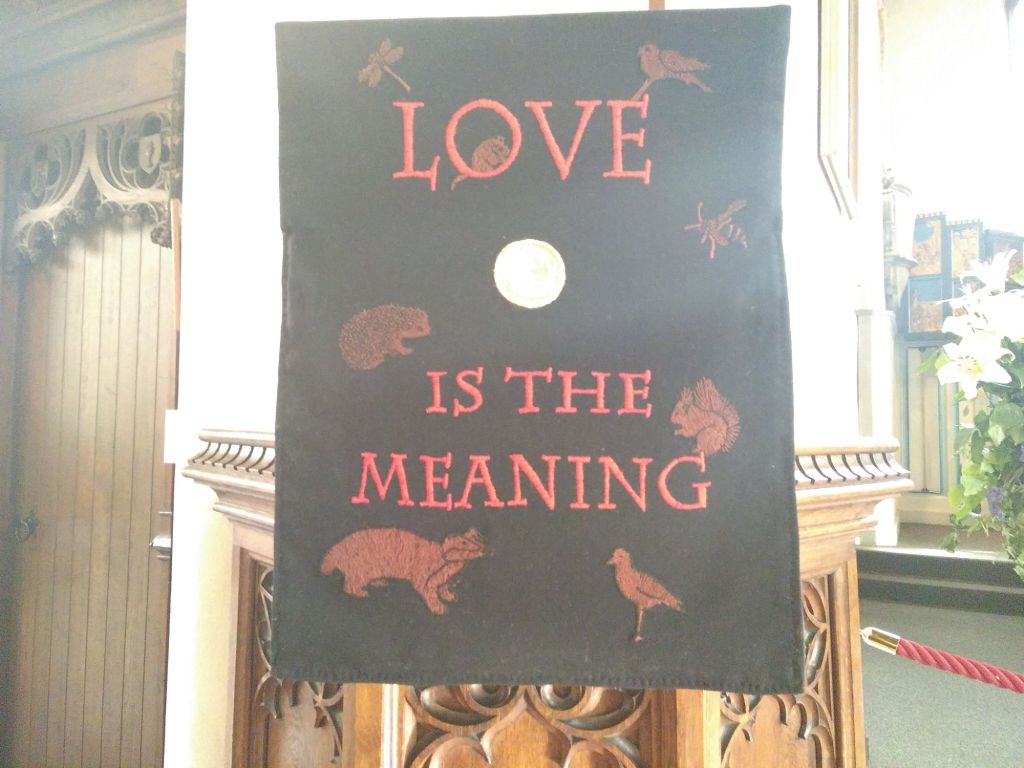
This autumn, we went to a beautiful celebration of Julian of Norwich’s wisdom and words by contemporary artists. It’s her 650th anniversary. The exhibition was held in three churches in the city. The title was ‘Love is the meaning’, taken from the revelation that Jesus’s meaning is indeed love. It is so restoring and freeing to know that love is the heart of the good news of Christmas.

With apologies for the poor photo quality! They are very fine works.

Marja Almquist

‘And in this he showed me a little thing, the quantity of a hazel nut, lying in the palm of my hand, as it seemed. And it was as round as any ball. I looked upon it with the eye of my understanding, and thought, ‘What may this be?’ And it was answered generally thus, ‘It is all that is made.’ I marveled how it might last, for I thought it might suddenly have fallen to nothing for littleness. And I was answered in my understanding: It lasts and ever shall, for God loves it. And so have all things their beginning by the love of God.

In this little thing I saw three properties. The first is that God made it. The second that God loves it. And the third, that God keeps it.’

Julian of Norwich

Alex Egan

Julian’s insight reminds us of the inextinguishable love of Jesus born among us, and dying among us too. A deep hope springs from that love for us, and for all that has been made. It gives us a way to walk in the world, secure enough to be bold in the love we give, for we have received. It doesn’t overlook the pain of the world, but provides a profound companionship and meaning in the midst of it.

The gospels are full of hardship and difficulty, and love, companionship and healing.  I am increasingly valuing the questions and uncertainties in the story – where things that seem bad, are turned to the good, and that which seems good, turns out to be less so. We can see instead how these things might work towards love, friendship, wholeness. It is easy to lose sight of how hard it must have been to be birthing in such hard conditions, but that very difficulty gives us hope in our own upturned places.

You might like to scroll up to the Caravaggio picture above – intensely beautiful even in its portrayal of an exhausted Mary and ill clad shepherds. It’s worth following the eyes in this picture, to notice where everyone is looking, and what those looks communicate. There is something in the space between – the space between mother and child, held in the gaze of the shepherds – the love, the deep bond, which means so much. The artists were right to value it. There is a fine net of love and wonder being spun here, despite the destitution of the setting. This is deep looking indeed.

Some years ago I attempted a paraphrase of the beginning of John’s gospel. A friend read it last Sunday at a contemplative carol service, where it opened the dark evening.  I thought I’d share it with you today.

Beginning

It started with the Word, who was there before the dawn of time –
before the earth, the waters, the stars – there with God, was God. 
For in the beginning, there was simply nothing else.

But then, the Word began to work.  When the Word spoke,
the universe spun into song, and all things came into being.
Without the Word there was only empty blankness.

For the Word, the universe burst into life like a desert after rain.
This was the Word’s work – unleashing life and light –
glorious and radiant, warming our lives like the sun in spring.

This is the light which shines through our darkness – cold, smothering darkness
where nothing can grow.  And the darkness draws back at its touch,
not understanding a light that cannot be put out. 

Then, the Word, source of life and light, came into the world he made,
but the world hid its face in its hands.  It did not recognise him.
He reached out to his people, and they turned away.

Yet to all who welcome him, believed in him, he held out his hands
to give them such a gift – to know that they are a child of God,
Born of God.

So the Word, the One who was there from the beginning
became flesh and blood and chose to make a home
with us in this fragile, changing world.

He came with open hands to bless, brimming over
with words of truth. He has unlocked Heaven’s storerooms
and poured down gift after gift for us.

We saw his glory with our own eyes – we saw him shining
with life and light, we saw the very One who came to us
from the Father.

For no one has ever seen God. But this Jesus,
the One and Only, who was there at the beginning,
has made God known.

Gaia at Ely Cathedral

The blossom buds are already there, tiny flowers formed, asleep and waiting for the days to begin lengthening just a little. They burst early, in February often. It’s all there, waiting, at this darkest time of year. How wonderful to celebrate light and birth now, when hope may be faltering. Maybe, we can treasure this lesson of darkness. We may be able to catch a glimpse of the love that came down at Christmas, and the love that received him.

Thank you for joining me in these readings and ponderings.
May you have a blessed, peaceful and loving time as we draw close to Christmas.

Many blessings to you and those you love.