Poem: Aldeburgh Beach, January

wp_20170102_14_12_07_pro

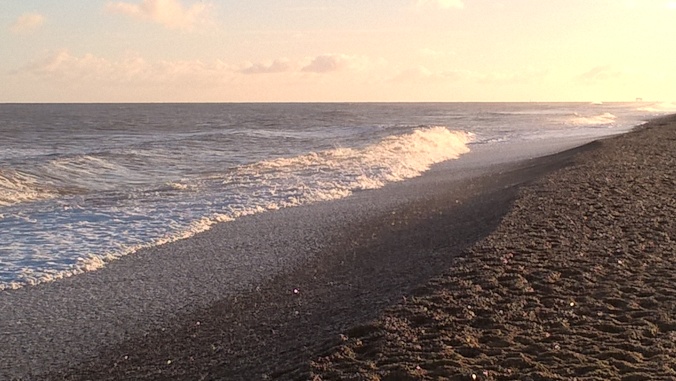
Photos taken at Dunwich Heath beach, a little along the coast, by Peter Skevington

wp_20170102_14_12_27_pro

WP_20170102_14_10_47_Pro.jpg

I love the North Sea in winter – its wild brown, its keen winds.  The coast is unstable here, lumps of WWII concrete, of building materials, and old fragments of glass  are thrown onto the shore.  The pebbles hiss in the breaking waves.  The waves in turn sound like a vast heartbeat.

The wind blows you alive, if you wrap up warm!

The photos above were taken this Christmas holiday, with my husband and son, as we stood on the beach and let the waves chase us.  We were not far, here at Dunwich, from Aldeburgh, where I went with a dear friend for a walk on a different day.

I am so grateful for my friends, and my family.  It is so good to be able to spend time with people you can be real and true with.  I feel very blessed to be able to count quite a few people as those whose company is as free as solitude, but enriched by their unique ways of seeing and being and insight.  The poem below attempts to capture something of my walk with one of these dear people, and I hope it can also say something bigger about the power of friendship.

I have been reading Bandersnatch, a Christmas gift from my son, which explores the relationships which formed the basis for the Inklings group, including Lewis and Tolkien, and it has clarified for me how much I need the encouragement and shared thinking and being a close group of friends can provide.  Our differences can give new vision and perspective, our mutual support can get us through difficulties that are too much for us alone.

Thank you to all my friends, and may you, reading this, have such sources of goodness in your life.

Aldeburgh Beach – January

We stood there, friends, on the beach,
facing into the east wind,
being blown full of cold,
icy and alive,
by a wind strong enough to lean on.

We stood on a cliff of pebbles
new thrown up by storms,
near the edge,
where stones rattled down,

while the sea, high and brown,
roared and crashed,
mist and foam flung
with the generosity of joy,
into our faces.
Our lips were salt with it.

In the sound of the wind we brought
our heads close enough to speak –
of the breath of God, alive,
breathing into us,
the glory of God in the brown shining.
The power of each small thing,
each small thing,
as the spray and the pebbles
danced wild around us.

Epiphany Retold – Looking out for stars

Part of the Sunday Retold series, with my version of the reading Matthew 2:1-12

Please feel free to use any of my material that helps, saying where it is from.

Last time, I shared with you the story of Christmas Retold – Escape to Egypt, where we read of the terrible suffering that resulted from Herod’s fear and jealousy and love of power.  This time, I have been thinking smaller, more hopeful, something that might help today, and tomorrow, and the next.  We need to see the darkness, and the light.

IMG_0773.JPG

Epiphany – the new season we enter on 6th January – can mean  a sudden encounter with God, an intuition into the heart and meaning of things, a burst of enlightenment, an event which shows things as they really are at their deepest level.  As a season, it covers some key turning points in the story of God wooing us, seeking us, expanding our always limited understanding as much as we can bear at any time.  As such, it carries on from the Christmas narratives well.  After all, the good news here is that God has come, God is with us. The Message tells John’s words like this:
The Word became flesh and blood,
    and moved into the neighborhood.
We saw the glory with our own eyes,
    the one-of-a-kind glory,
    like Father, like Son,
Generous inside and out,
    true from start to finish.
John 1:14

So, how might we see this glory?  How might we experience this generosity and truth now?

One of the things that always strikes me about the Christmas narratives, including this one, is the great variety of ways they record people receiving a revelation, an epiphany, from God.  There are dreams, visions of angels, and here, a star.  There are other ways God seems to be at work.  Elizabeth feels the child growing in her womb, and then feels the child dance.  Simeon and Anna, too, are prompted and moved.  In each case, the way the person senses, or hears, or experiences the promptings of God seems to be appropriate for them.  The gospel writers seem to have slightly different emphases in how they record what these revelations from God are like – it is hard to talk about.

I remember once standing at the front of church and trying to give an account of what had felt a real encounter with the love of God, and been very aware that my words were so inadequate.  I remember too how, many years ago, our church hosted firemen and their families from Chernobyl, following the terrible nuclear accident, and gave them a holiday by the sea.  One of the firemen wrote a song.  I wish I could remember it all, but the meaning of it, as far as I can recall, was –

I long to tell you about the love of God, what it is like to know the love of God, but my song cannot hold the meaning.  It is like, when I go home from here, I will try to tell people about the sea, how wild and salty and cold it is, and all I have to show them is a bucket of murky water I have carried away with me.

All our words cannot carry the full meaning, but they can hint at it, stir up a hunger for such love and depth of encounter, and reassure each other that we are not alone when we think there is more than the surface, more than “getting and spending” (Wordsworth)

As we enter a new season, maybe it will help to look at the stories we encounter of epiphanies, of experiencing a revelation, a seeing clearly, noticing how varied they are.  Perhaps God is seeking to gain our attention, and maybe that happens differently for different people at different times.  It is easy to think there is a way we should do it, but it seems that God is unconstrained, generous, abundant.  We need to be open.

My own experience of encounters with God, with new insights, is varied. I sometimes have little epiphanies in prayer and worship, reading the Scriptures moves me to a place where I can go deeper, but  I also hear through nature, through poetry, through art, and – perhaps most especially – through the love and kindness of people around me, including strangers I encounter.  It’s worth looking, I think, as we go about our days, doing our normal things, expecting that maybe our lives have something to teach us, to tell us about the love of God and the love of neighbour.  Our lives can speak to us like parables, and they can contain moments of transforming beauty and clarity, that open us up to something far bigger than we can comprehend.

These Magi, probably Astrologers – we do not know how many, or what gender they all were – do not have a straightforward time of it trying to find the new king.  God is not always found the places we expect.  Who would look for a king in a small town away from centres of power and wealth?  God tends to surprise us all by being in the small, the outside, the unexpected, the unimportant places.   I chose the Witz picture (between the two extracts below) because it places the family in a fairly ordinary setting.  Traditionally, they sit in the ruins of a Greek or Roman temple, showing how the old beliefs are crumbling and dying as something new and glorious takes place.  This one is quite an early example of a more small-scale setting, but even so, it is rich in meaning and symbol.  You might like to take some time to look at it carefully.

Herod’s palace was a desolate place to look for this new king. This child would indeed be a king of a different type. We can see, too, that although Herod used the scribes and the scriptures to find out information, he used that for his own ends.  It did not lead to encounter, or worship, or knowing God. There is a lesson here, too.
IMG_0592

As we look out for our own moments of epiphany, it might be worth looking for treasure buried in the dirt (Small Seeds, from Luke 17), and for unexpected people, such as a young girl, or an old widow, or a carpenter.  Epiphanies can burst in on us whatever we do, but my experience is that small, daily steps towards seeing God work their slow transforming changes in us, and that for these, we need to be open, we need to engage in a  quiet, contemplative way of praying and seeing as we live out our lives.  And then, in that new light, we find our lives begin to change, we better learn love, and compassion, and patience, and joy.  As we begin a new year, I am turning my attention to this way of thinking and being.

The Magi were doing what they did – studying the stars.  And they noticed something.

There may be stars out there that would guide us, if we looked.

What might your stars be?

From The Bible Retold

They Followed a Star

Far away from Jerusalem, in a land to the east, wise men looked up at the clear night skies above the desert and saw a star rising.  For years they had studied the movements of the stars and planets, and they had never seen anything like this before.  They unrolled their charts and plotted its path.
“This means a new king has been born to the Jews!” they said to each other, as they gave hurried orders to their servants to prepare for a journey.
When these strangely dressed foreigners arrived in Jerusalem, they began to ask “Where is the one who has been born king of the Jews?” Troubled rumours spread through the city, for there had been no proclamation of any birth.
King Herod the Great’s advisors approached him nervously.
“Your Majesty, strangers from the east have arrived in the city. They are searching for a child who they say has been born King of the Jews.  They saw a sign in the heavens!”  Herod caught his breath, and turned white with fear. He had been given that title himself by the authority of Rome, building palaces and the great Temple to spread his fame.  What kind of king was coming to challenge him?
Then he asked his advisors “Where is the Messiah, the Anointed One, to be born?”  The scholars unrolled the scroll of the prophet Micah, and read out loud:
“Bethlehem will no longer be
the least important of the towns.
For from it will come a leader
who will rule my people Israel
like a shepherd-king.”

“Bethlehem, eh?” murmured Herod. He gave orders for the wise men to be invited to the palace.  He listened to their tale of the star with keen interest, nodding and smiling as if he were delighted at the news.  He told them all about Bethlehem.  “Go and find the child, then please send a message so I can join you in your worship.  What wonderful times these are!” Herod hid his crooked smile.
As the wise men set off from the cool marble and mosaics of the palace, they looked up at the sky once more.  And there was the star, guiding them to Bethlehem.  They followed, and found the child with his mother, Mary.  She was astonished to receive such guests – who bowed low, and spoke of her son with reverence, and unwrapped precious gifts to lay at their feet.

She unclasped the caskets one by one.  The first shone, it was full of gold.  The second opened to a rich, sweet smell.  “The smell of the Temple,” Mary murmured to herself.  It was frankincense, used in worship. The third contained an earthy, dark, resin.  It was myrrh, more valuable than gold, used in burials, and for healing.  Mary looked up at her visitors, and thanked them for these extraordinary, extravagant gifts as the smell of the incense and the myrrh hung in the air about them.

The wise men did not send word to Herod in Jerusalem, for that night, they were troubled in their dreams about him.  They paid attention to the warning, as they had to the star.  So they slipped away, avoiding the city, to cross the desert once more.

the-magi-konrad-witz

The Adoration of the Magi, by Konrad Witz

And from Prayers and Verses

Gifts

Lord Jesus,
The wise men brought you gold:
Let us use our riches to do good.

The wise men brought you frankincense:
Let our prayers rise like smoke to heaven.

The wise men brought you myrrh:
Let us seek to comfort those who are sad and grieving.

Let there be little Christmases
throughout the year,
when unexpected acts of kindness
bring heaven’s light to earth.

What can I give Him,
Poor as I am?
If I were a shepherd
I would bring a lamb;
If I were a wise man
I would do my part;
Yet what I can, I give Him –
Give my heart.
Christina Rosetti 1830-1894

Love came down at Christmas,
Love all lovely, Love Divine,
Love was born at Christmas,
Star and Angels gave the sign.

Worship we the Godhead,
Love Incarnate, Love Divine,
Worship we our Jesus,
But wherewith for sacred sign?

Love shall be our token,
Love shall be yours and love be mine,
Love to God and all men,
Love for plea and gift and sign.
Christina Rosetti 1830-1894

From Frederick Buechner:
“Listen for Him

The question is not whether the things that happen to you are chance things or God’s things because, of course, they are both at once. There is no chance thing through which God cannot speak — even the walk from the house to the garage that you have walked ten thousand times before, even the moments when you cannot believe there is a God who speaks at all anywhere. He speaks, I believe, and the words he speaks are incarnate in the flesh and blood of our selves and of our own footsore and sacred journeys. We cannot live our lives constantly looking back, listening back, lest we be turned to pillars of longing and regret, but to live without listening at all is to live deaf to the fullness of the music. Sometimes we avoid listening for fear of what we may hear, sometimes for fear that we may hear nothing at all but the empty rattle of our own feet on the pavement. But be not affeard, says Caliban, nor is he the only one to say it. “Be not afraid,” says another, “for lo, I am with you always, even unto the end of the world.” He says he is with us on our journeys. He says he has been with us since each of our journeys began. Listen for him. Listen to the sweet and bitter airs of your present and your past for the sound of him.”

~ from The Sacred Journey and Listening to Your Life
Advent – a poem


img_0157


img_0212


As we are close to the darkest time of year, it’s good to go and snatch what moments of light we can find.  Sometimes, I have to sit still, in the face of the cold wind, and allow my eyes to be open, just looking, before I begin to see the hope, the life, the turning of light’s tide.

We need the light now.


Advent

Now, at the turning of the tide,
when the days shrink small,
and night seeps through shadows,
the river flows with palest light.

Now, when light and life seemed frail,
and failing, the tide turns, water returns,
eddying and rippling the  slow, chilled, flow,
a river new filled with salt, with wide sea.

And the white gulls dive, and lift their heads,
and rise, quicksilver water
pouring off their opening wings,
beaks full of flailing, silver fish.

And here, on these grey banks,
flowers are open again: stems
split and burst with green leaves and
yellow petals, new touched with life.


The Little Christmas Tree and Mary’s Song

IMG_0752.JPG

IMG_0755.JPG

Today was the first really frosty day of the winter,  so I took my camera out for a walk with me, through the woods to the river.  As I walked, I was thinking about the story of The Little Christmas Tree, and how it connects with the story of Mary, mother of Jesus.  It had been on my mind since going to a talk by Rowan Williams at Grundisburgh Church (you can listen to the talk here , it is well worth listening to).

The Little Christmas tree is not strong and proud, thinking itself important.  It knows it is smaller than the other trees, and far less imposing.  What it does have to offer is shelter, hospitality, for the small animals and birds who are blown about in the storm.  It also has a song to sing, a lullaby, at which “even the wind hushed to listen”.

Early in her pregnancy, Mary escapes from the storm that is brewing about her, to visit her cousin Elizabeth, who offers her refuge, caring for her as she shelters her growing child.  They, two women with unexpected pregnancies, offer the profoundest hospitality to each other, that of love and acceptance. On her arrival, Mary pours out her joy in a song traditionally called The Magnificat

Here it is from The Bible Retold

I’m so full of joy my spirit is dancing
before God, my Lord, my Saviour.
God did not turn away from me
because I am poor, and now
I will be called blessed by
all the generations yet to come
God, the great, the holy,
has done so much for me.
God brings down the powerful,
but lifts up the weak.
The well fed are empty,
and the table of the hungry
is piled high with good things.

God looks at us with kindness,
giving hope to the hopeless,
caring for those who trust him,
remembering his promises to our people.

You can read Luke’s account here

And from Prayers and Verses

O God,
be to me
like the evergreen tree
and shelter me in your shade,
and bless me again
like the warm gentle rain
that gives life to all you have made.
Based on Hosea 14:4-8

Let there be little Christmases
throughout the year,
when unexpected acts of kindness
bring heaven’s light to earth

Earlier this year we spent a few nights in Canterbury, and made evensong at the Cathedral part of of daily practice.  It was as glorious as you might imagine!  One thing that made a profound impression was hearing Mary’s song, the Magnificat, every day.  It felt a powerful reminder how God does not favour the rich, even in the richest of cathedrals, but the poor.  It helped me to see the homeless, those lacking shelter, on the streets of Canterbury, it helped to soften my heart.  I picked up a stack of gift cards from various cafes to pass on to people, after I had sat with them a little and asked them their names and their stories.  A very small gesture, I know,  but perhaps a beginning.

Cold nights make me think of those who have no shelter.Perhaps it can be part of our Advent preparations to support those who do not have a room, and have to take shelter in the most inhospitable of places.  Some suggestions are below.

Hope into Action

Ipswich Night Shelter

Porchlight in Canterbury

Salvation Army

Shelter

Habitat for Humanity

christmas tree

November Sowing


sowing


We have a couple of small veggie patches in our garden.  Maybe, when the garden was planned and the trees were smaller, they were in the perfect place.  Now, they are rather shady, and need just the right weather for things to thrive.  Leaves will grow, though, and sometimes surprisingly.

There are often some seeds left over by the end of the season, and sometimes, I feel inclined to plant anyway.  Maybe, with a mild winter, and some protection, they’ll get a head start in the spring, before the trees are in full leaf.  As I was planting, I thought about all the times when it can feel too late, hopeless.  When we can feel too old to start something, or as if we have blown our chances.  Whatever it was we dreamed of, it can seem like there isn’t enough warmth for our dreams to grow.  It can feel like planting in November with chilly fingers.

I love the defiance of November sowing.  What is wasted by taking a chance, anyway?  A few leftover seeds… and who knows? Come the spring, my veggie patch may be full of little green plants.  I may have good things to eat, and to share.


It is not too late!


 November Sowing

I planted seeds today, scraping my fingernail
into the corners of old packets:
cavolo nero, romanesco, mizuna –
such names – exotic, full leaved, sharp.

I sowed them where I sowed before,
under tall trees thick and damp with falling leaves,
remembering how spring was baked dry,
and summer was pitted with rain, lightless.

But now, today, this low slanting sun is warm.
Now, in this out of season sowing
with leftover seed, I am surprised
to find myself hopeful, joyful
even, at this extravagant gesture.

I know full well that they may never grow,
But maybe, just maybe they will.
Each day is a day for sowing,
it is not too late.


From Prayers and Verses

Help me to be patient as I wait for your kingdom
and your righteousness:
as patient as a farmer who trusts that the rains
will come in their season,
and that the land will produce its harvest.
Keep my hopes high.
Help me to pray to you and to praise you.


Mud from Coleridge’s Garden

IMG_0713.JPG

The Ancient Mariner, at Watchet harbour, where the poem unfolded in Coleridge’s mind. The rope is particularly powerful.


On our Somerset holiday, we visited Coleridge Cottage.  I was not expecting to be so overcome by the place.  Each room was full of connections to his life and work.  Each room echoed with the poems – they flowed across the walls, they came out of the earphones by easy chairs, they whispered to me out of the leaves of books.  To be in the room where he wrote Frost at Midnight  and to sit in the Lime Tree Bower  were deeply moving experiences.  I still remember my marvelous English teacher, Miss Rowlat, talking to us about the Lyrical Ballads, with its paradigm shift of a Prologue, and then to be in the place where Coleridge and Wordsworth met and talked and where these ideas came into being – was beyond words. The Ancient Mariner found voice here, too.  So much wonder in one small, simple cottage. It is not often that I am left speechless.  I was here.

Mud from Coleridge’s Garden

I picked up my muddy shoe –
an unfamiliar pale grey clay,
a leaf stuck to the instep –
and slipped my hand inside
like a glove
as I looked for a cloth

and then I stopped.
It was that leaf,
I remembered the shape –
a jasmine leaf from
the Lime Tree Bower
where I had sat speechless
as I listened to that poem
so full of leaves,

and the pale grey clay
from the damp paths,
from that grassy space
so full of ordinary beauty
it filled me, too,
despite my already full heart.

I walk with muddy shoes now,
each day,
hoping to be rooted to that same earth,
leaving a sprinkling of
Coleridge’s garden
in this lighter, sandier soil.


Sorrows

IMG_0658.JPG

IMG_0682.JPG

IMG_0683.JPG

Much has happened this week.  Today, Remembrance Day in the UK, I am acutely aware of the importance of keeping peace between the nations, of reconciliation and forgiveness between us, of acceptance and inclusion for all.     Reconciliation, and an acknowledgement of the sacred worth of each individual human, seem further away now than they did.
This poem is a personal one, expressing something of an attempt to keep perspective among sorrows.  I know that for many, and for all of us from time to time, any such attempt can be impossible.  I wrote to try and express  what can feel like the constant task of not being overwhelmed, and to remind myself that when I can, it is worth the attempt.

I hope it also contains a gleam of hopeful truth.  Not a truth that ignores the darker realities, but that is prepared to see the possibility of light coming in the darkness. Both are real, but I find that if I can stay with the hope of dawn, even the darkness can take on a different quality.  Actions that lead to hope seem more possible, more achievable.  It is worth living for hope, not because the things we hope for will necessarily come, but at least in part because if we set our eyes on a kind and generous future, we are more likely to live in a kind and generous way now.  At least, I find that to be the case.
To all of you who are feeling a weight of sorrow, I hope this helps. May dawn come soon.

Sorrows

I carry stones in my arms.
They are grey,
and powder me
with dry dust.
They have sharp edges
my fingers find like
a tongue with a tooth.

When I notice,
I put them down,
stand up straight

Look, the sky is full of blue,
of high white clouds,
the trees chime with
golden pennies,
and a buzzard soars,
weightless, with its thin cry.

Look, there is one last flower
growing in the cracks,
and one last bee.

Who would have thought that losses
could be so heavy?
I find them lying on my eyes
in the dark, heavy and hot,
and on my heart and stomach,
heavy and cold.

I put them down.
Seventy times seven.
The work of Sisyphus.
Again. Again.

Look, there are stars in the darkness,
a whole Milky Way of them,
there is the softness of dawn light
coming, coming.
Take courage.
Begin again.

WP_20161027_10_12_18_Pro.jpg

Photographs are from the woods above Selworthy Green, Exmoor, and the coast at Watchet.

The reference seventy times seven is to something Jesus said when asked how often we need to forgive.  I used it here for any work where painful memory or thought keeps on surfacing, and we keep laying it down. Sisyphus  refers to the Greek myth of one who repeatedly rolls a boulder up a hill, only watch it roll down again.

Silk


matthew-spidersilk1

c 2016 Matthew Ling

matthew-spidersilk2

c 2016 Matthew Ling


WP_20161025_18_15_59_Pro.jpg

Selworthy Green, Peter Skevington

A November poem for today –
when the days are growing darker, a poem which tells of a moment of brilliant light.

When the sun is low, and when dawn and dusk happen at times when we are more likely to be about, we can sometimes catch a moment of pure glory, like this one.
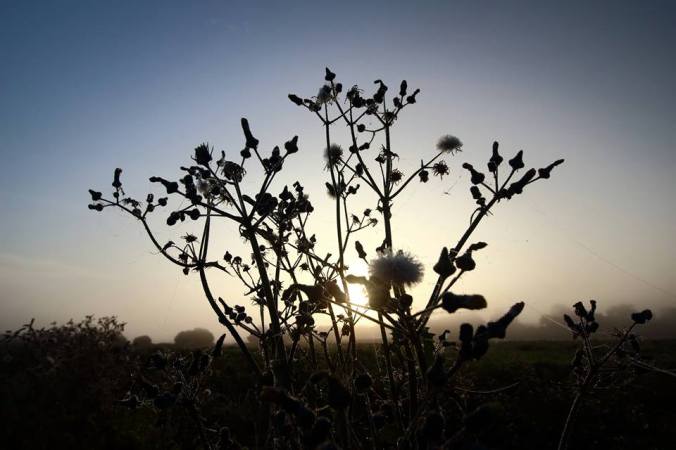
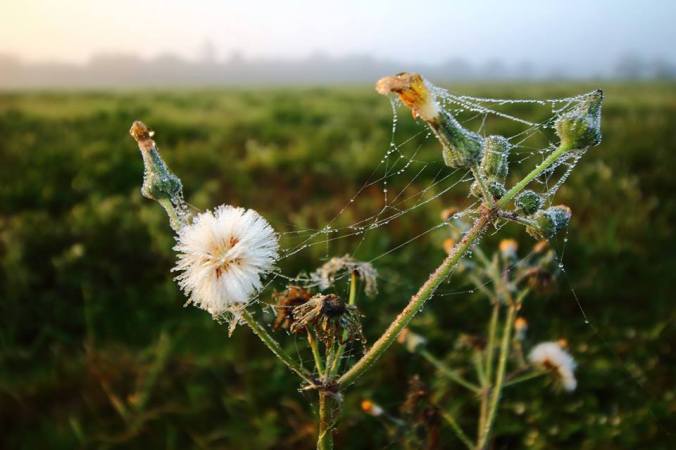
The sun hit an angle which not only illuminated the spidersilk that covered everything, but transformed it – the silk acting like a prism and splitting the light into its rainbow colours.
Everything in that plain muddy field shook with all the colours, all the light.
Even an unremarkable morning stroll can leave you breathless with wonder.
Even in dark times, we can look for the light.
Keep looking.


SILK

November – early morning –
clear sky – rising mist.
You note details, how it was
when it began,
when the spidersilk hummed with light,
the way a wire hums in the wind.

Just one or two threads at first,
then each blade of grass, each reed,
joined in strands of brilliant light.

Silver shakes and splits
into red, blue, violet.  Threads
shuddering into colours of such
brightness, such purity.

Even backs of crows
are iridescent white,
and heavy water-drops
that bend the reeds
flash indigo and orange

for a moment –
a long held breath
Then the silk turns silver again,
and then it vanishes.
Brown mud. Green grass.
A field where cows swish slow tails,
and the curlew and the heron
walk through reeds.

 
With thanks to Matthew Ling and Peter Skevington for the use of their beautiful photographs.

Selworthy Green

IMG_0667.JPG

WP_20161021_16_28_38_Pro.jpgIMG_0673.JPG


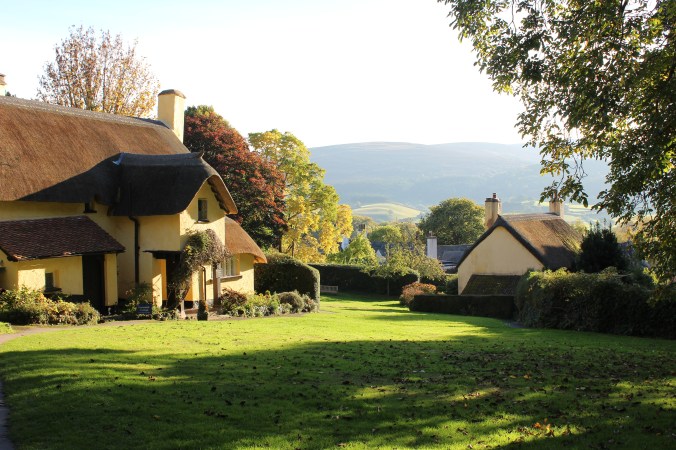
We’ve recently come back from a very tranquil holiday in Exmoor, at Selworthy Green.  Thatched cottages stand around the Green, while a little lane winds alongside towards the church.  It has views out over a valley to the moors, but itself is sheltered in beautiful, steep woodlands.  The cottages were built for pensioners, who were responsible for maintaining the woodland paths.  The tiny cottage where we stayed was home to the maid who took care of them.

Our first full day was bright and clear, and we spent all of it outside walking from our quiet base in the Green.  As the sun was beginning to go down, we sat at its highest point, and watched the light change over the hills.  My notebook came out, and I wrote this first:


Selworthy Green

Green is the colour of a stillness,
the kind of stillness
that is round and full
with a whole bellyful of life

like those apples over there,
clustered in shining handfuls
on the branch,
and the yellow green of the ash behind,
and behind that the olive of the holm oak,
and above and beyond that
the black green of the tall pines.

Breathe its sweetness,
its clearness,
as easy to a fragile body
as an oxygen mask
but with all this, all this, too.
You can’t take a breath,
can’t live,
without such gratitude
to the trees.

The Little Christmas Tree – a few pictures!

IMG_0624.JPG

img_0626

IMG_0627.JPG
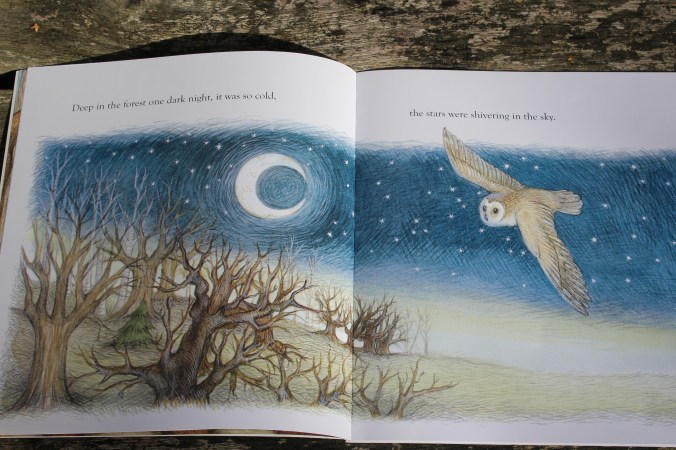
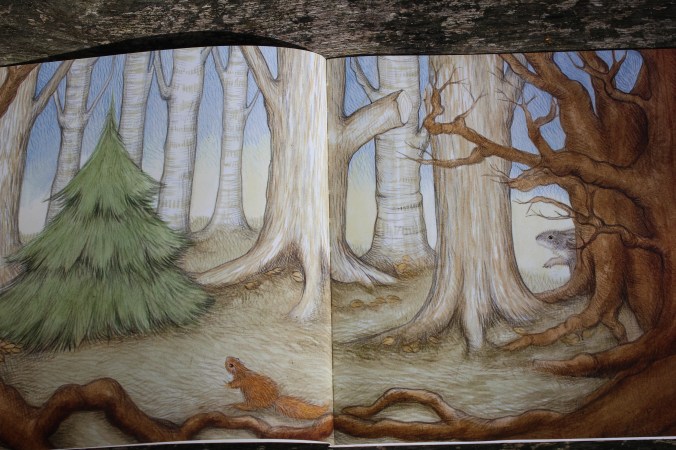
I love the illustrations for my first book by the fabulous Lorna Hussey, so I thought I would take it out on a sunny day and snap a few pictures to share with you.  She draws out the different characters of the trees so well, and the animals are delightful.  I am particularly fond of some of the minor characters, such as this beautiful owl, and the badger who appears later.

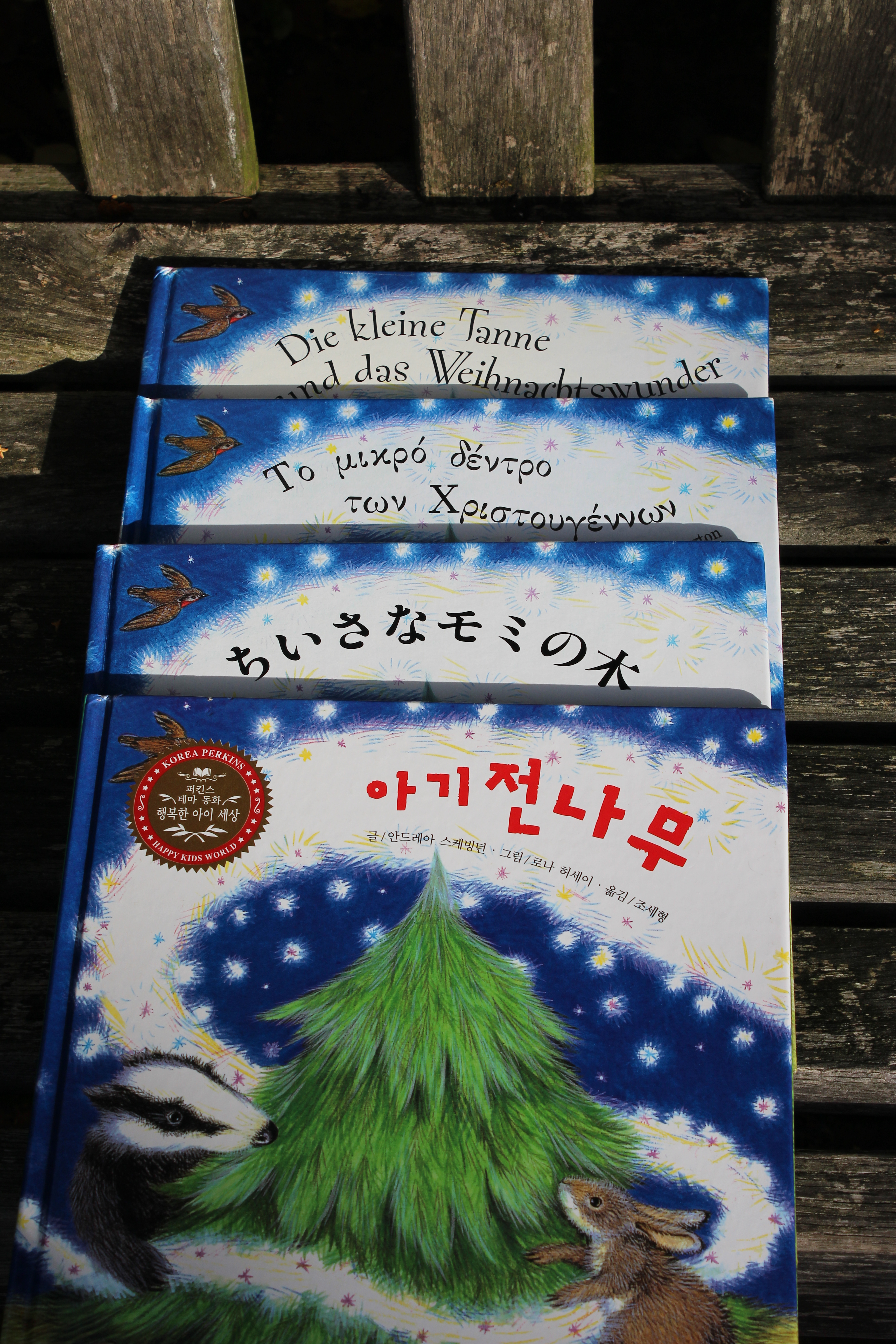
Whenever I take the book to schools, I always take the foreign editions.  The children enjoy trying to work out the different languages – and are particularly intrigued by the different scripts.  It’s a wonderful thought that the book has found  homes so far away.

I am very grateful for the way young readers have taken this book to their hearts.

The Little Christmas Tree remains a favourite of mine, too.
It is selling quite fast on Amazon at the moment, but other on-line shops and actual shops have it too if that’s your usual and it’s out of stock!  Here is a link to the publisher’s online shop