A Poem for a time of isolation – Rooted

Update: 3rd April 2020.
While out for our household proscribed exercise this evening, we saw a pair of water voles playing in the stream where I saw the one in the poem.  We stayed still for quite a while, and watched them in and out of holes in the bank, and back and forth across the stream.  It was such a joyous thing to see!  That, and the loud birdsong, and clear air, made a simple walk deeply satisfying.

I wrote this poem some time ago, after the joy of seeing a water vole in meadows near our home.  It’s an experience I think about a lot.  I thought about it today…. I will get back to the poem later, I promise, but I can’t go there yet.  I can’t get to that place of stillness right away, I have to look at the things immediately before us as far as I can. Here is today, this morning, a very small beginning of a change in how we live…..
IMG_0773.JPG

It’s so sad, this keeping away from ones you love.  I, like many of you, have cried at the thought of keeping away from family and friends, and also cried when I have heard of doctors cancelling their weddings, and keeping separate from their own families, and working in such difficult conditions, to try to treat those suffering from the effects of coronavirus.

I thought about this on a small trip to the corner shop – not sure whether even this is a good idea, with the slightest of sore throats.  I put on some old leather gloves, thin, so you can still open a purse, and pick things up,  an old fashioned form of contactless.

There were hardly any cars, which was pleasant, and made it easier for us pedestrians to step into the road to avoid each other.  I am grateful to those who counterbalanced this distance with a smile, and a hello. Two items only, for everything, in the shop, and even so, there was little. I knelt on the floor to retrieve the second last loaf of bread from the back of the lowest shelf, and thought that tomorrow, I would start baking my own as I felt so bad taking it. There was someone I knew in the shop, and our distant conversation, and distant air kissing, seemed to start a ripple of laughter, as others avoiding contact found they could still smile and wave to counterbalance the dance of solitariness, of avoiding each other, we were all keeping up, without music.

IMG_0866

As an antidote, back home, I planted three rows of veggies – borlotti beans, butter lettuce, red chard – these gentle things help.  What also helped was doing something that might help someone else….Yesterday, I tended the Little Free Pantry .  It’s a perfect way for people still out, but who want to avoid crowded shops, to pick up or donate some food. I also added my name to the list of local volunteers happy to put things on the doorstep of others isolated inside.  A little of this can help with anxiety.  It can help us be reconciled to the distance we have to keep from loved ones.

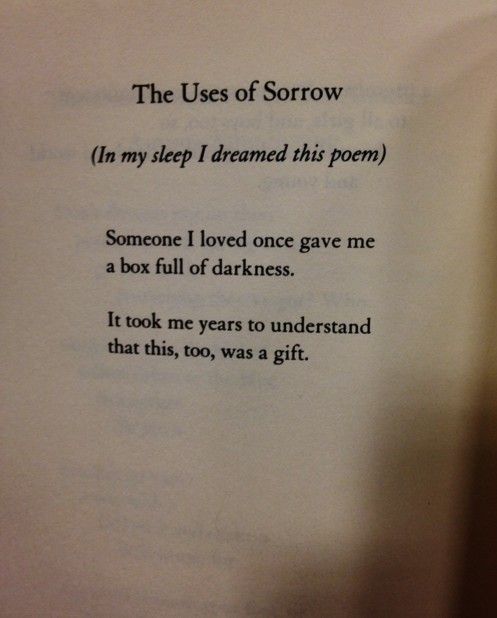
If we have to slow down, if we have to disengage, then maybe, having felt the anxiety, we can see if we can find some gifts within it.
814b5d7fb683fa9a622570a639addec8--mary-oliver-quotes-darkness-quotes

Mary Oliver

Maybe, even as we acknowledge the weightiness and pain of the current crisis, we can begin to imagine how the world might emerge, how we might emerge, differently, from it.

Have you heard that dolphins have returned to Venice, and that those living in Wuhan report that the sky is blue, and full of birdsong now?   Maybe, if we live more quietly, we will live more rootedly, more connected to our place and its people.  Maybe, given time, a less frenetic, more sustaining way of being might be made.  Maybe, we have an opportunity now, for some kind of a beginning, if not anew, then perhaps differently.

What would you like it to be? What kind of world, what kind of way of living, do we want?

IMG_0473

HOW TO BE ROOTED

First, you must suspend
all effort, all purpose.

Simply crouch in the damp,
thick grass, and feel your
sense of self seep through
your skin, your feet, into the
air – the earth – the water.

And as the muscles
around your eyes slacken,
and you let in light,
you become aware
of a nuzzling in the
grass, an earth-dark
water vole sliding
into green water.

As your heart slows
a pheasant walks by,
bright among the grasses,
and three ducks fly low
under the oaks, the
beat of  wings
all about you.

Stay still, and you will
sense the scrape
of the crickets through
the back of your hand,
and the tiny spiders,
yellow with newness,
weaving through your hair.
So that, when the
strong green tendrils
of the earth begin to
creep about your feet,
you will know in wonder
that rare thing –
how the world is,

unseen.


May you be blessed, and well.  May you breathe deeply, and freely, may you know you are loved and connected to all, may you feel peace.
 

Remember you are dust….. Ash Wednesday, for life.


van-gogh-the-sower

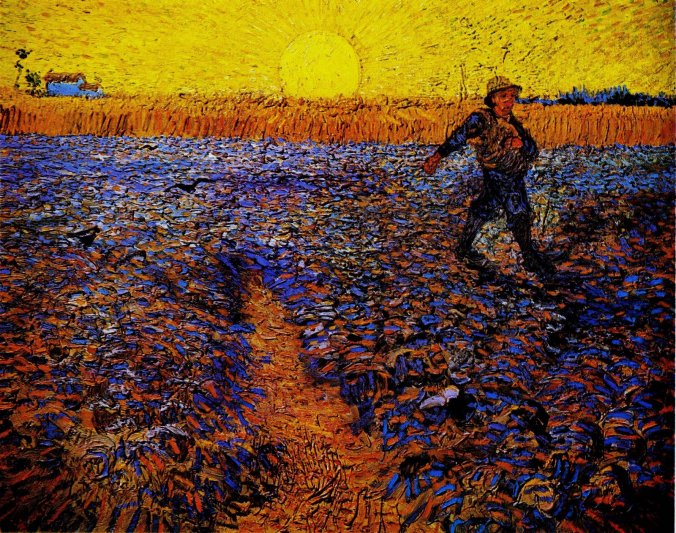
I’ve been thinking a lot about being the same stuff as the earth as I’ve been pottering around in the garden watching spring emerge, and reflecting on the parable of the sower, and other stories Jesus told.

IMG_0773.JPG

img_0786

Ransoms, or wild garlic – as I made dumplings with them, and enjoyed them, I felt part of our local wood.

Today, Ash Wednesday, I emptied our Baxi grate, and carried the ash to the compost heap, getting covered in the stuff as a gust of wind blew.  It was a far more comprehensive ashing than we normally receive in church, and it felt given to me, a reminder of my state as dust, ash, earth.  As I stirred them into the first grass clippings of the year, and yesterday’s lemon peel from Shrove Tuesday, I thought about the beloved tree that we lost in our garden, and how it’s kept us warm this winter. I gave thanks for it. I thought too about Malcolm Guite’s Sonnet for Ash Wednesday, that speaks of the burning of the world’s forests.  I though how complex and delicate our relationship with the rest of the natural world is, and how easy it is to abuse and neglect its care.

It’s good we have these days and seasons – Ash Wednesday is right for penitence, and even lament, as we consider how separately we have tried to live from all that is good and true and sustaining.  How we have broken the Shalom, the peace and harmony of God’s intent for us and for all things.

It holds its own remedy, too.   People are normally given a cross of ash at a communion service, the great reminder and restorer of our unity with God, with each other, with the gifts of the earth in the form of bread and wine.  With the gift of Jesus.  Also, a reminder that we are one with the earth puts us in our place, and that place, if we stay with it long enough,  is a deep unity and kinship.  And that circled my thinking back to the parables, back to the talk I gave at Girton College ten days ago. It might help in the context of the burning of our world, and our state of being ash and soil.  Jesus told stories that speak deeply to our nature, and the nature of God and the world.  As we are made of the same stuff as earth, we can rediscover that connection, and in it find hope for an amendment of life, living more fully and abundantly, more joyfully and humbly and thankfully.

As we enter this season of Lent, may we be quiet enough to hear the whisperings, and the stirrings, of – not just new life, but a new way of living. We can repent – the Hebrew word normally translated such carries a meaning of turning back home, the Greek of having a change of mindset.  Both of these carry great hope – the reign of God is very close, all around, within us, if we but look and see.

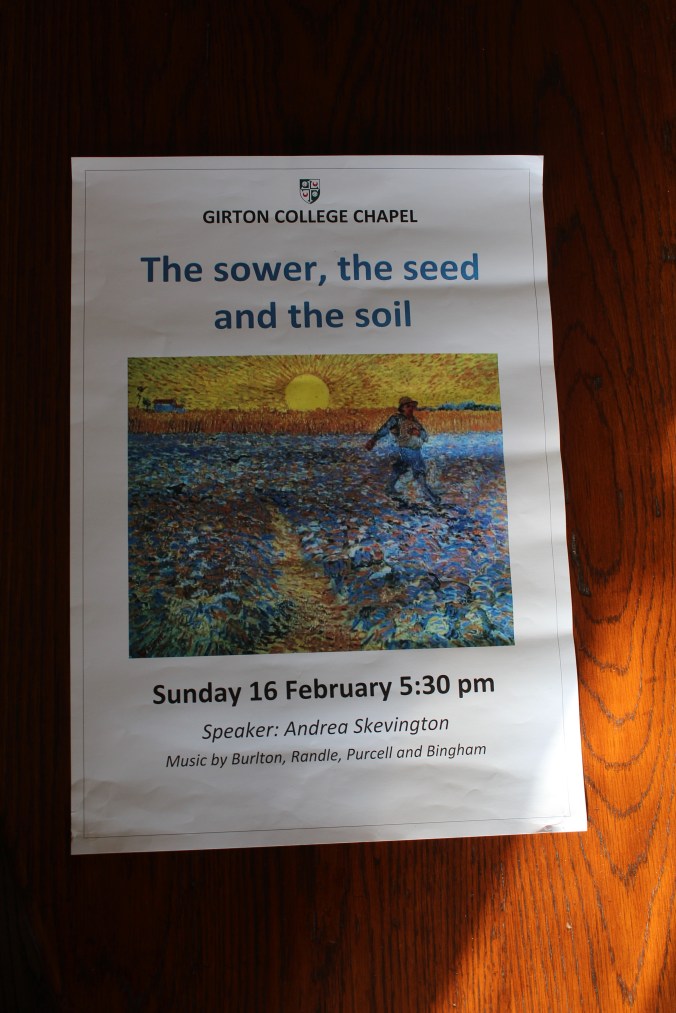
The sower, the seed, and the soil. A talk at Girton College Chapel.


IMG_0956

Last Sunday, I had the enormous privilege of speaking at Girton College Chapel. Malcolm Guite, the chaplain and poet, invited me to speak.  I’d been for the 150th anniversary celebrations last year, and Malcolm is continuing to invite Old Girtonians back this year too.

220px-Girton_College_Chapel_Window

It was so good to be back, and in the chapel which was good to me as a student.  It’s a beautiful, safe, nurturing space, and it also has a superb acoustic, which means that at evensong, you feel immersed in the roll of the music.  The choir are excellent, well worth hearing, and it was particularly good to have music by another Old Girtonian, Rhiannon Randle.  Her new work, Our Burning World, was performed on Monday.  You can read about it on her website linked above.

van-gogh-the-sower

One of Vincent van Gogh’s astonishing paintings of The Sower

Malcolm very generously gave me some flexibility to talk about what was on my mind, and I decided to follow where my thoughts, readings and prayers are taking me and talk about one of the parables.  I’ve been particularly drawn to Jesus’ parables of the natural world, curious to find out how he noticed to the flowers of the field, the birds of the air, and the work of tending soil for food.

Having driven to Cambridge through the tail end of a storm, it seemed very appropriate to be speaking from a parable of the soil. It is good to return to the gospels for wisdom, especially as humanity seems to be on the brink of a crisis in our relationship with the rest of creation.

Malcolm has kindly published the text of the talk on the College Website.  You can read it
here.

My thoughts on the parables are gradually taking shape into something, I hope it will be another book.  Sometimes, I know that there is some treasure to be dug, but I’m not sure what it will be until the digging is well underway.  So, I shall return to my digging, and see what good things I unearth along the way.


If you’d like to read more about seeds and sowing, you can look elsewhere on my blog, as below.

Sunday Retold – The Sower and the Seed 16th July 2017

November Sowing

Sunday Retold – Small Seeds, from Luke 17


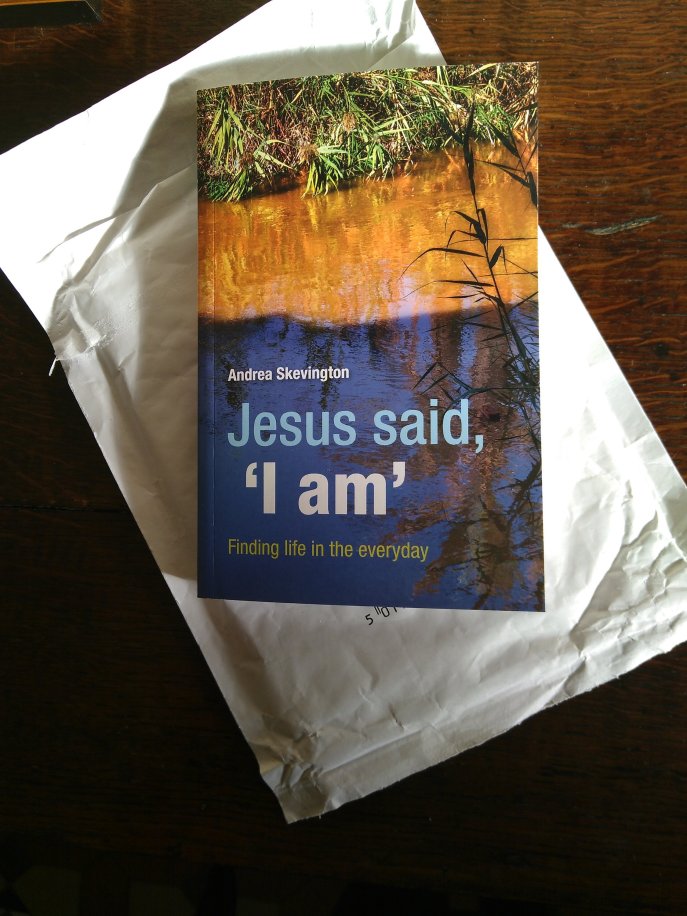
Jesus said, ‘I Am’ – for Lent. Getting started


Featured Image -- 5148

Here in the UK, our late winter weather seems brutal.  This is not what we expect for February, and many people are beginning this season with the heartbreak of seeing their homes flooded.  This Lent, the Archbishop is encouraging us to take seriously the call to tend and care for the living earth.

WP_20171016_16_18_46_Pro
We are all increasingly aware of the fragility of the natural world, as well as its beauty, and the response sections of my book pick up these themes and give some practical suggestions for ways we can move towards greater connection, and greater care, of the living earth.  I am so glad to hear various groups, churches, and groups of churches are going to use my book as guide through Lent, and, if you would like to follow, you can find a suggested programme here.

IMG_0790


IMG_0871.JPG
Each week I’ll share with you a little from the relevant chapter.  This week, it’s from the first – I am: Moses and Abraham.  It’s short, so I hope you’ll be able to find time to read it together.  If not, we’ll begin next week with The Woman at the Well.

Moses and I Am
Exodus 3:1-14


John’s gospel looks back to Moses’ ancient story, recording for us how Jesus called himself by this name – “I am”.  This name, which emerged from a burning bush so long ago, is one of the most identifiable features of John’s account. It resonated with his early readers and listeners in Greek Ephesus, and it stirs our imagination even today, millennia later.  Before we go deep into John’s account, and explore why that may be, we will look back to Moses’ story and see what we understand of this earliest “I am”.

…….

Nothing is wasted in God’s economy.  God used the rubbish – and the good – in Moses’ upbringing and his life as a shepherd.  He became ideally suited to his task.  As well as his circumstances and experience, God used his character; in this case, a sense of justice and an indignation at bullies.  What must have felt like failure and a downwards path was the place where Moses encountered God.

We do not know if he was seeking God when God appeared.  We do know that he was in the middle of his everyday, working life, and that God did something strange to arrest his attention, awaken his curiosity, draw him nearer.  Attention and curiosity can guide you, can awaken you to God in the burning bushes we pass every day.

Moses certainly didn’t seem to looking for a job, let alone a great mission.  It is easy to read his rather thin excuses and wonder why he spent so long arguing.  His unwillingness to respond seems to come from uncertainty.

Moses is uncertain about himself, and he is uncertain about God.

“Nothing is wasted in God’s economy” – can we live from this realisation?  Can we acknowledge that even very difficult things can be fuel for something better?
Can we work to eliminate wasteful ways of living?

And from the Reflection and Response section

Earth’s crammed with heaven,
And every common bush afire with God.
But only he who sees, takes off his shoes.
Elizabeth Barrett Browning

As you start your day, pray for open eyes to see where God may be at work, or may be seeking to catch your attention today.  Set off with open eyes, a camera and a notepad.  Record anything that draws your attention.  At the end of the day, mull over what you have recorded in prayer.  What did you see?

IMG_0866.JPG

If you’d like a copy, you can ask your local bookshop, or order online.

Here are a few suggestions:

The publishers, BRF

Amazon


img_20181130_114736372319885.jpg

Thank you for joining me in your reading.  There is more to come…..

The Little Christmas Tree – I’ve been thinking ….

I was checking availability of my Christmas book, and was very pleased to see that Amazon had rustled up a few more copies, when I looked at the cover, and started thinking…..

christmas tree

I was thinking of how much more I know now about how precious woodland is to all the life of the planet.  The story came to me years ago now. I have always loved woods, but this year the urgent necessity of protecting the natural world – and forests in particular – has really come home to many of us.  Including me.

And so as I read this simple story again, I read it with a deeper awareness of the peril all us creatures face, and how vital it is that trees remain to shelter the creatures of the wood – and indeed all of us, one way or another. The kindness, the interconnection, the sanctuary provided by one small fir tree  provides safety for all the other creatures in the storm.  That kindness is blessed by the smaller stars of Christmas night, and the angels who fill the sky with their songs.

Now, as well as a tale of Christmas night, and Christmas itself, I see it as a story of hope for all of us who are trying to feed and shelter nature over the winter – in our own gardens, or in the wider countryside. A story of hope for all of us who are trying to do small and simple things to make the world safer and better for all its inhabitants – whether it’s reducing plastic, or taking the bus. These small acts matter, the Little Christmas Tree shows us.  They matter a great deal.

I hope that children, and their parents, will feel that message of hope, and the love of natural places, running through the words and beautiful pictures of this storybook.


img_0627


You can, of course, ask your local bookshop to order you a copy, or order one from any number of online book places.

Poem – Red Kite/Y Barcud


Red Kite.jpg

Photo by Gracie Oneil

Like many of us in the UK, I’ve been watching David Attenborough’s Seven Worlds, One Planet which is full of so much beauty, and also heartbreakingly poignant as an awareness of the danger so many creatures and systems of life face seeps through the glory we are watching.  The Earth is so very good.

I wonder if you can remember the first time you became aware of extinction – that humans were causing an animal, or a plant, to be threatened?  It’s a very powerful moment for many, as it was for me.  My own creature was a bird of prey, the red kite, which, of course, I had never seen.  I remember the tears I cried as a child on hearing its story.  Below are a couple of links to video clips where Charles Eisenstein talks of the sense of loss we can experience, and how we respond.

Charles Eisenstein Horseshoe Crabs

Charles Eisenstein Passenger Pigeons

In my own case, the kites have made a welcome return, spreading far beyond the places in Wales where they have been nurtured and protected.  Someone, some people, took time and effort, engaged in research and action, to bring these beautiful birds back from the brink of extinction.  There is hope, just, for so many.


Red Kite /Y Barcud

A warm Sunday afternoon,
I lay on the grass, sleepy,
watching the few light clouds
against the blue,
when, suddenly, a swift shadow
passed over me.

A red kite – wide, graceful wings,
forked tail turning and turning to
catch the wind – the wind that
ruffled my own hair.
I stood, in wonder, and whooped,
in joy.  Here she is, at last!
She has been gone all my life.

And sadness I felt as a child
came back to me then,
when I had listened to the story
of the red kites – large and graceful,
that glided over the hills and forests
of Wales

And were hunted – perhaps all gone.
Perhaps every one. Never seen.
Shot. Trapped. Poisoned
by chemicals spread on the land,
sickening the whole web of life.

I remember I wept for them then,
ashamed. How could we?
Make a creature, with a name,
unknown, gone forever,
as if it had never been.
Make a myth out of a living
breathing thing.

Since then, I have looked up,
looked up at the sky,
waiting for them to return.
I have watched them spreading east,
now, all my life, and, at last,
at long last they are here.
I wept again.  I wept for the loss, and the joy.

May you be safe here,
Y Barcud,
May you thrive, and be blessed,
May your young fly in these skies,
May the morning sun rise on your wings.

The Little Christmas Tree – some copies still available!

christmas tree


In case you were interested in a copy of my Christmas children’s book, it’s available at the moment, although stocks are quite low.  You should be able to order it from your local bookshop, or online – for instance at Eden Books , Waterstones or Amazon.

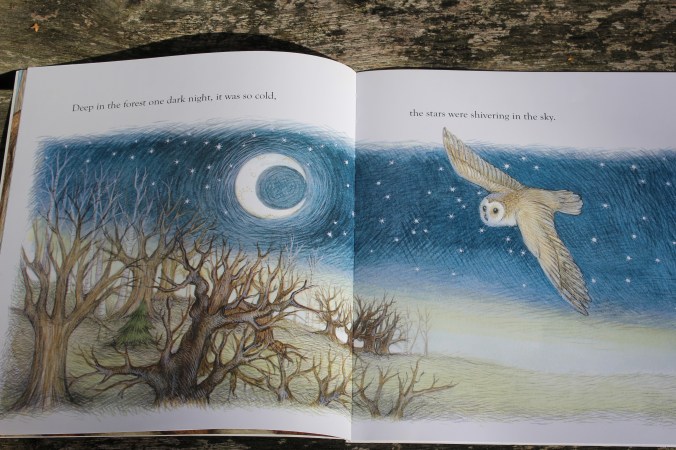
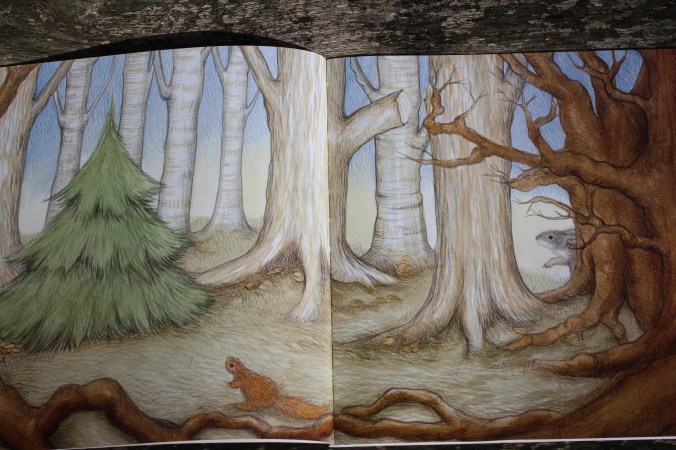
Here’s some pictures to give you an idea of Lorna Hussey’s beautiful illustrations.  I took the pictures in my garden – the book is clearer and lovelier.
This is how it begins……

img_0627

Here is the wood, and the little Christmas tree……


Featured Image -- 5469

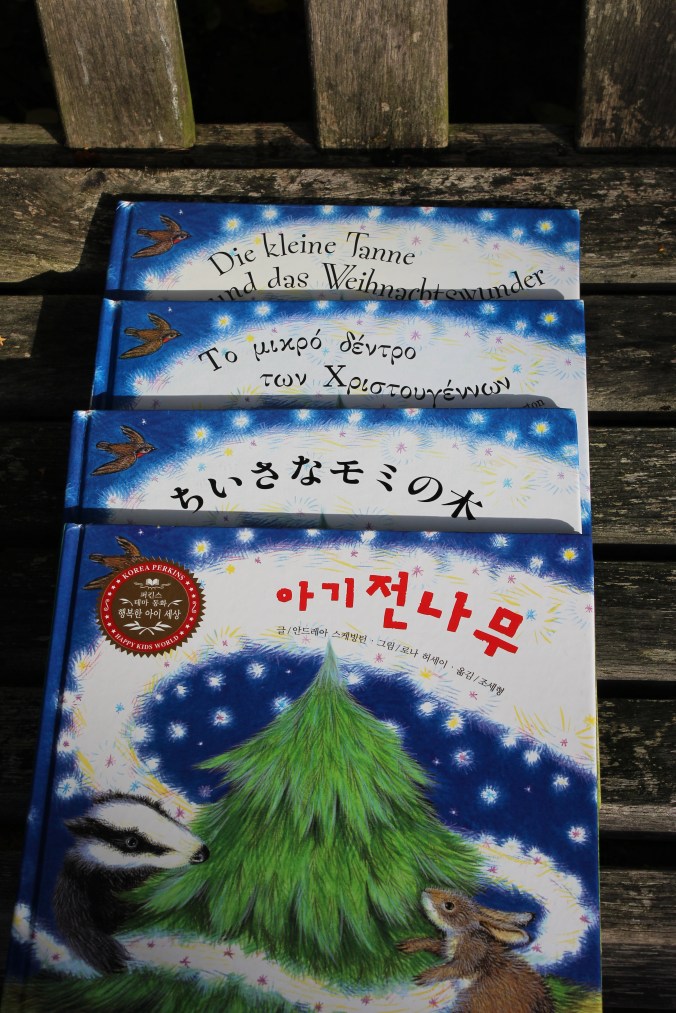
Here are some foreign language editions – I don’t think you can get any of these in the UK!

img_0624


Poem – Poldhu Cove #EverybodyNow

I’m carrying on with this season of posting work which speaks of Earth’s beauty, and at times my sadness as that beauty, the very life of the Earth, is under threat. As the Extinction Rebellion protests continue in London and elsewhere, I hope that some of these short pieces will help remind us of the astonishing loveliness, variety and vulnerability of the systems of earth and ocean, forest and animal that nurture us all.

We need to reconnect, to feel again a love and delight in the goodness of it all. All the good earth. I hope what I am sharing with you today, words and pictures, will help.

Today, I am sharing with you a poem wrote on a Cornish beach just over a week ago, some of the time sheltering under a towel from the rain, all of the time completely in awe of the vast waves. While we were in Cornwall, we discovered the work of the extraordinary photographer Mike Lacey, whose work captures the beauty and the power of the sea. His work is well worth exploring, and supporting. All the pictures on this post are his. His work shows you what, in the words of my poem, I wish I could show you.

EmeraldMikeLacey.jpg

glassmikelacey

Poldhu Cove

I wish I could show you
the turquoise water,
rolling and rising high above,
rolling from the wide sea
into the dark arms of this cove,

With its little stream crossing the beach,
sandy, dune-grassy,
with piles of grey shingle, lined with quartz,
and the crosswaves that meet there
at the stream bed as the water rolls
back from the rocks that welcome it.

I wish you could feel how warm the water is, here,
where it’s shallow, and the longing,
and the fear, to go out deeper.
And I wish I could show you the light folded into
those great waves, like glass as they rise above you,
above the line of the horizon,
as you feel, with a strange joy,
your smallness, your body’s softness,
how easy it would be to be tumbled in this light
overturned in this water,
upended –

And the cold wind prickling the skin of your
outstretched arms,
open to welcome this Atlantic, nonetheless,
as your damp hair whips,
as you are part of all this,
knowing your place,
feeling your place.

foamylipmikelacey

This is one of the poems I have uploaded onto the lovely Places of Poetry map. If you are in the UK, why not see what’s been added where you are?

A lament – I hear the song of the Earth #EverybodyNow

I’m posting a series of pieces as my small way of joining Extinction Rebellion’s protests this week and next.

IMG_0887

This is something I wrote for myself, in the summer.  I was thinking about what I wanted to say in what may become my next book, I was thinking of what was on my heart, and I gave my heart some space to speak.  What came was this – I’ve tweaked it a tiny bit, and it may well turn into something else in time – this, though, was a felt rather than thought expression of my growing sadness as I attempt to follow those words from Job –

But ask the beasts, and they will teach you,
the birds of the heavens, and they will tell you:
or the bushes of the earth, and they will teach you;
and the fish of the sea will declare to you.

Job 12:7,8

I have called it a lament for now.  I am not sure what to call it.  I have tried to resist my natural urge to say something soothing, and, as in the parable I shared on Monday, let the piece be what it is.  Lament is powerful, and important.  We need to give space to it, and then in time we may find we can move through it, knowing what we love, what we risk losing, empowered by it to act, to cherish, to tend our beautiful Earth.


I hear the song of the Earth

I hear the song of the Earth –
so good and green,
in June, when the whole world sings,
and the fledgling birds walk fearlessly,
and the young badger sits on the grass.
I hear the song so poignantly
so ebbingly,
at the great green flood tide of the year.
For I hear within the bassnote of loss
of grief of absence,
of all the creatures
that are not,
are no more.
I hear the clatter
of plastic as it
rattles through
the web of life.

I hear the whales
that have thrown themselves
ashore as I wonder
what would they sing
if they still could.

I hear the forests burning
and splintered, the roar of
the orang-utan
fighting the gripper that
tears down the tree.

I hear silence, absence,
the butterflies I do not see
and the hedges that are gone.

The Earth cries out
and these are not birthpangs

Or if they are they are pangs
for our waking, awakening,
coming to our senses
and listening to the teaching
of the plants and the animals,
The water and the air.

It may or may not be too late.
we may or may not be able
to turn away from destruction.

That is no longer the point for me.
The point is that my voice must join
with the cry of the beached whale,
and the turtle laying her eggs
in trash,
and the hare chased by dogs,
and the young albatross
with a belly full of plastic.

That is my task, as a
being on the Earth.
my task is to feel the Earth’s pain,
and speak, and speak,
And cry out in a tongue we understand.

And so, I sing a song of the Earth,
in winter, when life ebbs.
I remember the good, and the green,
the fledgling birds and the young badger,
the butterflies and the hedgerows full of blossom.
I will sing of them still.

IMG_0752.JPG


Poem – The wings of Gabriel’s Wood #EverybodyNow

Today I’m sharing another poem to mark Extinction Rebellion’s actions in London and elsewhere.
There’s a long tradition of poetry helping us to see both more clearly and more deeply – it can help us linger on those moments of beauty and connection with the natural world that remind us of our proper place, and inspire us to love and to act.

This poem was a scrap in my notebook for some time.  It describes the experience of entering Gabriel’s Wood on the Golden Cap (Dorset) estate in the path of the remains of a hurricane.  The living things that gathered there seemed less disturbed by my presence while seeking shelter from the coming storm.  We had a commonality of purpose, and a connection.

WP_20171015_17_37_36_Pro

The Wings of Gabriel’s Wood

Far above the wood fly buzzards –
I can see four,
or five –
young who have grown
and ready to fly,
their thin cries
carry on the wind.

They are harried by crows,
dark, gyring to keep moving
as the wind booms in the trees,
as their feathers twist.

Entering under the dome of trees,
into a loud stillness, I join
pheasants who are sheltering,
and a tiny wren who skirts
the ground like a mouse,
and fat pigeons picking up acorns
that clatter like hail,
and warblers who snatch notes,
not risking a song.

The wood is full of wings,
folded, sheltering.
And I too take my shelter here,
a creature, too, before the storm,
in this loud wood,
among the falling leaves.