This New Year, I’m picking up the occasional series, Sunday Retold. Many churches follow a set pattern of readings, so communities up and down the country are gathering around the same stories, the same prayers, and meditating on them together. Often, at least one of the passages appears in my retelling of the Bible, The Bible Story Retold, and so it seems a good idea to share that with you. If you’d like to use any of the material on this blog please do, and please say where you got it from. My books should be available to order at all the usual real life and online places.
Samuel Dedicated by Hannah at the Temple by Frank W.W. Topham
Anyway, this week is a story often shared with children – at least in part. The central character is the boy Samuel, son of Hannah. He was a much longed for child, who was given to the service of God in the temple at a very young age. Eli, the priest, was given charge of him.
The set reading is 1 Samuel 3:1-10, and here is my retelling:
The boy Samuel learned how to serve God in the shrine. And he slept by the lamp of God’s presence, close to the holy ark of the covenant. One night, in the darkness before dawn a voice called out, “Samuel, Samuel!” So Samuel got up and went to Eli, who was ond, with failing eyes. “Here I am! You called me!” Samuel said. Eli stirred. “I didn’t call you! Go back to sleep!” So he did. But there was the voice again. “Samuel, Samuel!” The boy got up again and went to Eli. “You called, and I came!” “No I didn’t call you. Go back to sleep.” But, when Samuel woke Eli a third time, he wondered what this voice could mean. Perhaps God was speaking. “Go back and lie down. If you are called again, say, ‘Speak, Lord, your servant is listening.'” So Samuel went back to bed and lay there, waiting, hardly daring to breathe. “Samuel, Samuel!” came the voice. Samuel remembered Eli’s words. “Speak, Lord, your servant is listening!” And so God spoke to Samuel. God said that the right to be priests would be taken away from Eli’s family, because his sons had donw wrong, and Eli had not stopped them. They would be punished. In the morning, Samuel had to tell his tacher what God had said. ”God is God, and will do what is best!” Eli sighed.
From The Bible Story Retold in Twelve Chapters
Often, when this passage is shared, the empasis falls on listening to God’s voice, and being ready to respond. We’ll get back to that in due course, but for now I’m following my immediate reaction to this passage today, and how it might help us navigate this difficult new season we’re in.
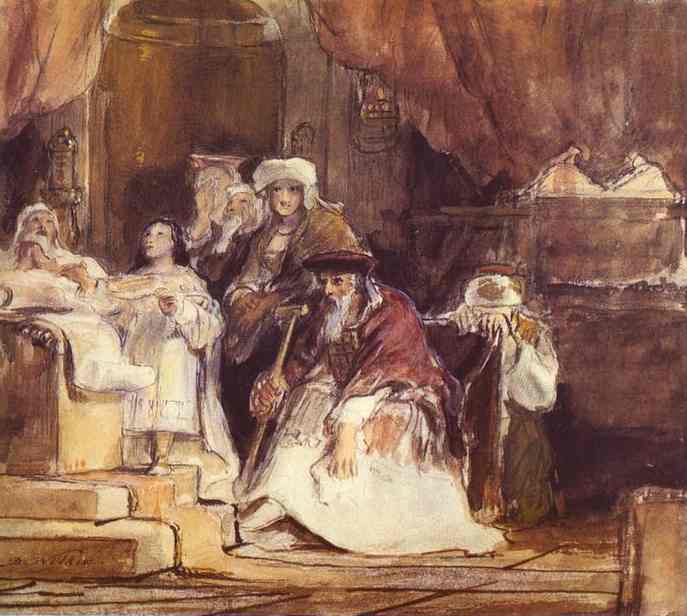
Samuel in the Temple by David Wilkie
What a message for a child to have to deliver to their high-status, powerful teacher – you and your line have fallen short of the standards expected of you, and your position will be taken away from you. It must have been terrifying for Samuel to have to speak up, even with Eli’s encouragement. I can imagine him shaking in his sandals. Although this story is often a Sunday School favourite, I don’t think many teachers and others in authority would be bold enough to encourage youngsters actively speaking up in condemnation of their elders. And yet, as so often, these stories show God’s leaning towards the powerless, the young, the outsider. So often, the perils of power, and the shortcomings of those who practice it, are central to this counter-cultural narrative. Indeed, as we follow on with Samuel’s story, of how the people of Israel ended up with a king, we see that pattern all the more strongly.
As a story of a child challenging conventional ideas of power, and who has it, the story of the boy Samuel sits well in the season. It’s one of the Epiphany stories in which the rich, the wise, the powerful humbly bow before a mother and child in a simple, working house. It also follows on well from Mary’s radical song in the early stages of her pregnancy, which in turn draws on the words of Hannah, Samuel’s mother, when she leaves her son in Eli’s care. I love the dense connections which imaginatively weave all this together, so rich patterns emerge from the threads. I love the way the lectionary puts things near each other, and then sees what connections and conversation arise like a good host.
And so, back to what struck me today on reading this passage – the wisdom of the child, the going astray of the elders and those in power. I thought of the prophesy “And a little child will lead them” (Isaiah 11.6), and how, today, the young who lives will stretch out far into this century are trying to shake us awake, to speak to us of those things which they care about and will affect their lives and the lives of their children. They see that the way we are living is doing harm, they see the injustice and the destruction more clearly than those of us who may have become immured to it. They see that the structures of power seem to protect the powerful and ride roughshod over those whom the scriptures speak highly of – the widow, the orphan, the outsider, the poor, the young, the old. We need those in power to be humble enough, like Eli, to hear their voices, and to act in their interests. Intergenerational justice is a concept that is coming alive now – especially in terms of debt, and the damage to the ecosystems on which we all depend. We need to pay attention to those who have no voice, and give due respect to the rest of the natural world, as well as to the young. Can we, at the beginning of this year, resolve to notice our natural bias towards the rich and powerful, and seek to listen to the young and the powerless? I think that would be good for us all.
Here in the UK, many have been moved, outraged, saddened and stirred to speak up by the ITV drama, Mr Bates vs The Post Office. It was a powerful drama, compassionately acted. I am always curious, though, about things which really catch the public mood – why this, why now? And I think part of it is the theme of people with power who feel immune and distant from the consequences of their actions, who listen to each other rather than to ordinary people – in this case their employees. I think there is a rising sense of injustice about how some are gathering so much to themselves, while others are stripped of what they have, and what they might come to have in the future too. And this injustice reminds me of the words of the prophets, including the child Samuel.
Of course, this passage carries many meanings, and this critique of power is one amongst many – but it is one that chimes with the biblical narrative as a whole. When we’re thinking of how we might live by it, another question naturally arises – how do we know, in a world of so many voices, which ones to heed? In this passage it is Eli who wonders whether the voice might be God. Yet history is littered with terrible tales of those who were convinced they were acting for God, or doing what was right, and going horribly wrong. Often the very worst things are done by those who claim good motives. And that should give us all pause. I touched on an exploration of this theme in my book, “Jesus said, I Am. Finding life in the everyday” in the chapter on Jesus, the good shepherd, when he talks about the flock knowing his voice.
Of course, knowing the voice, and distinguishing it from the voices of those who would lead us to harm, is no easy thing. I think it helps to come to a place where we don’t see the path ahead of us as a narrow tightrope – one false move and we are lost – but that we look for the relationship, and recognise the freedom to walk behind the shepherd, listening for the voice. ……. History is full of the mistakes people have made, thinking they are doing the right thing but going terribly wrong. I do not ee us going so wrong when we seek to follow the way of love, seeking to keep our eyes fixed on Jesus, and learning from him.
And so, noticing the topsy-turvy nature of the gospel, the way things are not what they seem, let’s be ready to listen, be ready to respond to those promptings and quiet voices which would guide us better than the pomp and power and authority which make so much noise and show.
Dear God, When we hear a mighty wind, strong enough to shatter roci, when the ground underneath us shakes like an earthquake, when fire comes from mountains, help us to know these sounds of power and anger are not your voice. Help us to listen in the silence for your whisper. Help us to wait for your whisper
Waking up this morning, on the first day of Advent, there’s the lightest dusting of snow on the ground. The sun shines, and late autumn leaves glow even as the wind blows down from the north with its biting edge and splinters of ice. Apparently, short eared owls have been blowing in from Scadinavia, but I don’t think they’ve got as far south as Suffolk yet. So, it does feel like the seasons are changing, that Winter is here, and Advent comes along with its glimpses of Hope. Tradition has it that’s the theme of the first Sunday of this season, and that seems a good place to start. Our current Decembers are some distance from the old practices of having Advent as a time of quiet, reflective, waiting – a little like Lent before Easter. It’s so at odds with the flashing lights and loud shops and busyness, that understanding, but we can perhaps catch moments where those wintering practices are possible, and might help us….. pools of quiet light where we can breathe and think, where the cold sharpens our perceptions.
I’m also intrigued by the more medieval practice of putting yourself in the place of the people of Israel as they waited, not quite knowing what they were waiting for. Of not naming Jesus and Christmas, but instead allowing what we long for to be recognised and owned and prayed and worked for. In our context we join so many people throughout history who have felt the future to be shifting and uncertain, and who have longed for a kinder, gentler and more beautiful world. Taking some time to know and feel what we lack, what kind of world and lives we desire, might help us too face a troubling future with some courage and determination.
So Hope is a good place to begin.
Ah, hope. I’ve been turning over in my mind what it means to nurture hope in a world which seems increasingly unstable in climate and economics and culture. I’ve settled, for now, on making a distiction between hope and optimism. So, for me, I’m thinking of optimism as an opinion that things will work out. Something tied to outcomes. I see hope as a stance, an attitude of the heart and spirit, that it’s always worth looking for what brings life, for what is good. It does not require us to be naive about the dangers and difficulties around and within us. We are called to be as wise as serpents, and as gentle as doves – Matthew’s gospel.
Nonetheless, it’s worth working as if the world-as-it-could/should-be is here, emerging amongst us, small as the signs and growth may be. Not a glib avoidance strategy that it’s all fine, really, it’s all going to be fine…. but as a deliberate and courageous stance. I remember being very struck, on reading the Gospels at school as a teenager, with how the message I heard was about how the Kingdon of God was already here, or close at hand, or within and among us – a real and emerging presence, despite the very real difficulties. With the cost of living crisis bringing fear and hardship, and with the climate noticiably more unstable, we need courageous hope that’s prepared to work to refashion things around us in defiance of what we see. There is real power in such acts.
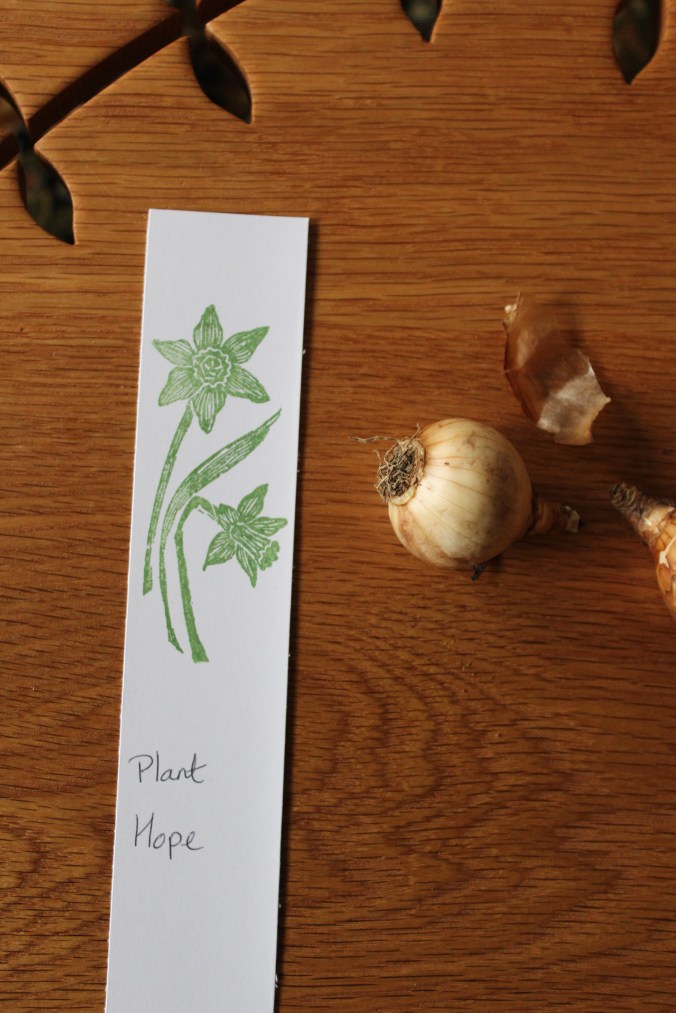
The picture of the bulbs and the bookmark at the top of this post relates to an action I took with some friends in our local high street to coincide with COP 26. We handed out bulbs and bookmarks, and encouraged people to think about ways they could plant hope. You can read more about that here. My last post shares a sliver of a project which is coincing with this year’s conference.
As Advent begins, we re-read the words of the prophets together. They often spoke into desperate, unpromising circumstances with a mixture of a vision to hold in our hearts, and actions for our hands to do. Those actions can be prophetic themselves, speaking out and making plain God’s dream for the world – a beautiful, hopeful vision strong enough to withstand hard times – brave enough to choose to be born to a poor family, who sheltered in a stable, and had to run from a murderous tyrant. This is how hope was offered to the world, in the infant Jesus.
During this Advent series, I’ll share with you some extracts from my books. Here’s something from The Bible Retold , as the retelling of the Hebrew scriptures comes to an end, and we look forward..
As the walls were rebuild, so were the people. For God was building them into a new kind of kingdom. Isaiah the prophet wrote: “This is how to truly serve me: unbind people who are trapped by injustice, and lift up those who are ground down. Share your food with the hungry, and clothe the cold – that is how to live in the light!”
The people listened to his words of bright hope. “There is much darkness in the world, but your light is coming! All nations will be drawn to you, and they, too, will shine!” ….
“A child is born to us, a son is given. Authority will rest on his shoulders, and his names will be Wonderful Counsellor, Mighty God, Everlasting Father, Prince of Peace. His kingdom, his peace, will roll across the lands, and he will reign on the throne of David for ever.”
We give thanks for the work that is being done right now, in our communities, to clothe, and feed, and seek justice. May we have the courageous vision to join with that work of light.
The days are dark, Dear God, give us your true light.
The days are dark, Dear God, give us your true life.
The days are dark. Dear God, give us your true love.From Prayers and Verses
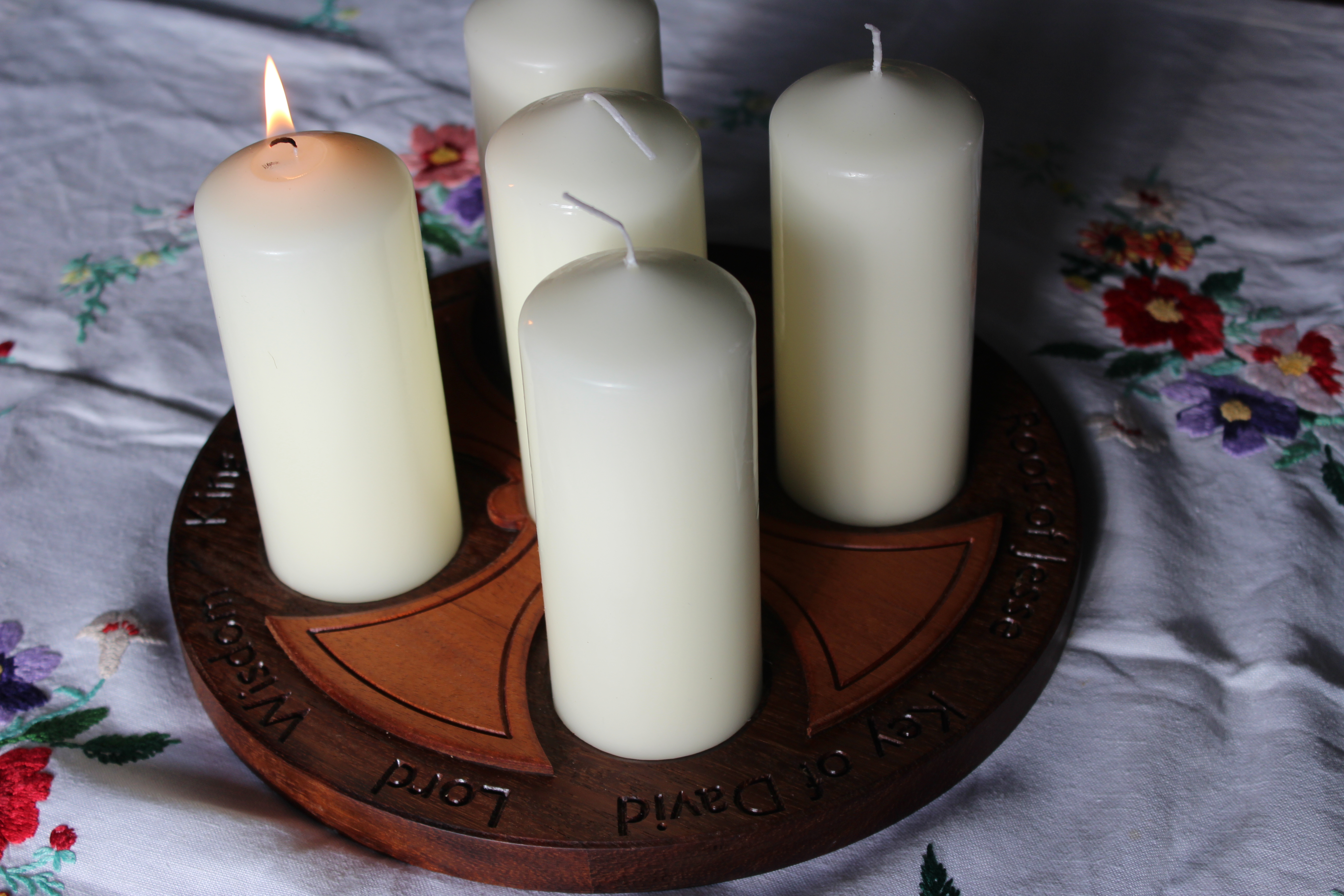
The Advent Candle Ring is from the good people at The Chapel in the Fields It gives me great pleasure to know that the oak at the base was once a lectern, and the lighter wood on top a dining table. The words written around it are from the ancient chants, the “O” Antiphons. These chants came into being when people did not call for Jesus to come at Christmas, but instead used names from the Prophets – like Emmanuel, God with us – to name their hopes. The first few centuries of the Christian Era saw these great prayers, the “O” Antiphons, sung during Advent, calling on Christ to come now, and to come again. You can listen to the old chant, and read Malcolm Guite’s sonnet which draws on it, and much more, here.
This coming week, let’s hold on to hope, look for signs of the life of God breaking through, and see where we can be part of that move towards a more beautiful, loving, hopeful world.
I must admit to feeling disheartened in the run up to another COP, where the oil and gas companies seem to be seeing the talks as an opportunity to do business, rather than prioritise moving to cheaper and cleaner and more local alternatives. The powers that be sometimes seem especially powerful.
So here’s a tiny, smaller-than-David-vs-Goliath idea which is currently happening in my drive. Just in case any of you good readers feel similarly, and are looking for small but meaningful actions. There’s a lot of us who care, who want to leave the world in as good a state as we can. So, rather than despairing over what isn’t happening, here’s something that is. Mighty oaks from little acorns and all that…..
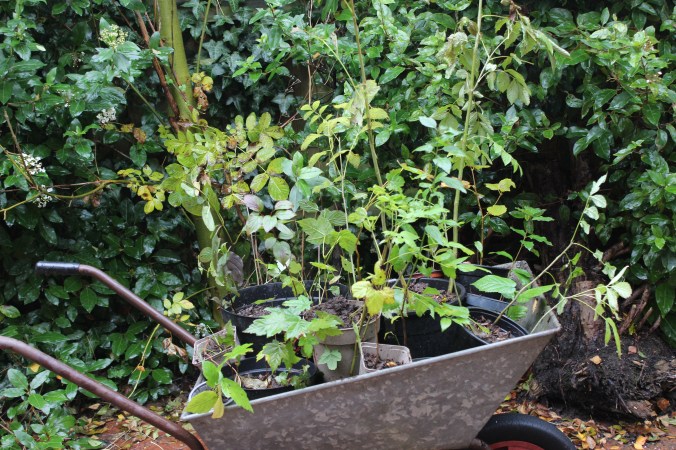
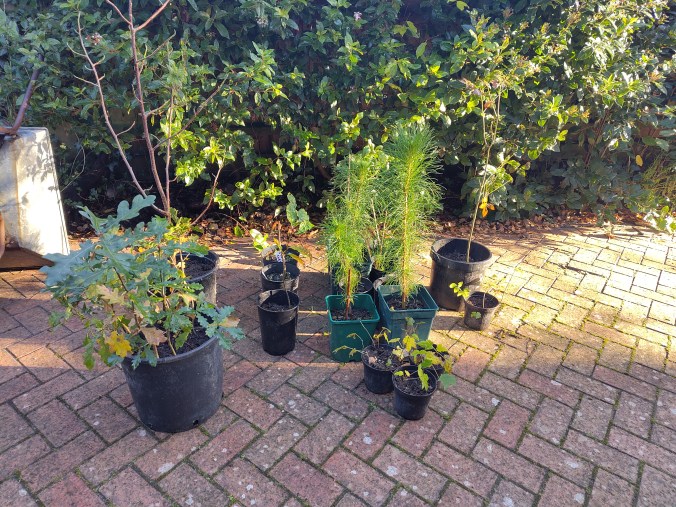
It all started a couple of weeks ago, when my husband came across one of our old neighbours digging tiny tree seedlings out of a council flowerbed. Unsuprisingly, he asked her what she was doing. She replied that a friend of hers had two acres she was trying to replant as woodland, and was looking for trees. Now, I express unease on a regular basis about the number of tree seed- and saplings I pull out of our garden. The squirrels are very keen on planting nuts, which germinate remarkably well for instance….. So, he mentioned it to me, and I got in touch with the lady with the two acres. I dug out all the readily available saplings, and began to collect them from other people. The first load of about 100 trees went to her, and to someone else who has twelve acres they’re rewilding.
I wondered if other people might have spare trees in their garden, so emailed my friends at Transition Woodbridge, who passed the message on. Trees are arriving most days, and another person has expressed a need for small native trees, especially ones suitable for growing in a hedge. Another friend also has a number of oaks springing up in her allotment. So we have more sources of trees, and more places where they can go. It’s always good when actions become collective, when people gather together and all do the little bit they can.
Now, who knows where this will go, but for now, I reckon we’ve easily been able to provide a new home for getting on for 200 infant trees. That’s not nothing. That is something. It’s food for insects and birds, it’s shelter, it’s improved soil fertility and water management, it’s less carbon and more oxygen. It’s one in the eye for despair, too.
So, here’s to taking the small actions we can. You never know where they might lead. In 100 years from now, those nine tiny oaks might be home to many creatures, having a profoundly positive impact on soil, air and water …. And carbon. Nearly all life on the planet is carbon based, after all.
As we come to the end of the Season of Creation, I offer a harvest of seeds.
I love the way seeds spread in the garden, finding new nooks and crannies to settle, new places where plants will grow and in their turn offer flowers to the insects, seeds to the wind and the birds.
As I was watching fluffy seedheads catch the breeze a few weeks ago, I felt my attention catch on the seeds. I felt that insistent “look!” which comes sometimes, and alerts me to some depth, some beauty, some meaning. It’s always worth attending to. And this time I saw the reckless generosity, the persistence of seeds, unfolding to me a truth about creation’s blythe insistence on hope. Each offering of seeds represents so many second chances, fresh starts, try agains. And the word forgiveness came to mind – as if the seeds were offering a chance of Spring despite, in the face of, the ways we continue to undermine and deplete the natural world. The seeds a sign of forgiveness, a chance to try again, an ever repeating offer of new life.
Some of you who have been good enough to follow this blog for a while may remember that I return often to the themes of the parables – the stories Jesus told – especially the ones that speak of the natural world. I love the way Jesus quotes the psalms to explain this mysterious teaching method – “I will open my mouth in parables; I will utter things hidden from the foundation of the world.” (Matthew 13:35) The Hebrew Scriptures tell of a vibrant world saturated with the glory of God, of living things being animated, and full of wisdom, if we will but pay attention. I hope to write more about that another time, but for now, I’ll return to seeds. If you’d like to read more about the parables and the seeds on this blog, you can look here and here to begin with.
The poem I’m sharing with you today is full of touches from the Gospels, and another day, if I can, I might unpack them for any of you who are interested. I felt the call to “look” was an invitation into all sorts of deep truths……But I hope the piece stands on its own, open to all who look with wonder.
But for now, below, the poem. It’s been one of those pieces that has revealed its meaning to me in the process of writing, that has felt like a discovery or an uncovering. I wanted to share it with you today, this last day of the Season of Creation. I hope I haven’t hurried it along too much – it’s been taking its time. I hope it is ready. We’ll see!
The grace of seeds.
Seeds are blowing in the breeze, gentle, white and light. Fairies, I used to call them as a child, back when the world was full of seeds, and butterflies, and glimmers of enchantment.
I breathe slowly and long into all this ripening. All this, all, glows with a deeper life – light and colour under the skin, shining with a song of greening and ripening.
Each seedhead releasing a kind of forgiveness that falls with the seed, falls to the earth bearing new beginnings, seventy times seven. Life wills to live, despite all we have done. Life uncoils again, and again. I am humble before it. Before the caterpillars on the toadflax, the frog stirring beneath the strawberries.
The world is indeed full of grace. We do not deserve these chances, again, and again, and again. And yet, deserving is not the point. Seeds fall, it is the very nature of things, and blow on the breeze. Each one offering multitudes. It is the way of seeds.
Might this grace, one day, even today, catch us in its loving web as the trumpets of bindweed blaze out a song of liberation, and the blackbirds tumble fearlessly, hungrily, in the hedge’s ripeness?
For the seeds float still, and the air is still full of enchantment. Life whispers, it calls us, it sings to us. Does it know we will turn towards it, at last, wooed and wonderstruck, and learn we belong, have belonged all along? We might, we may, we can. Those dry seeds show us how.
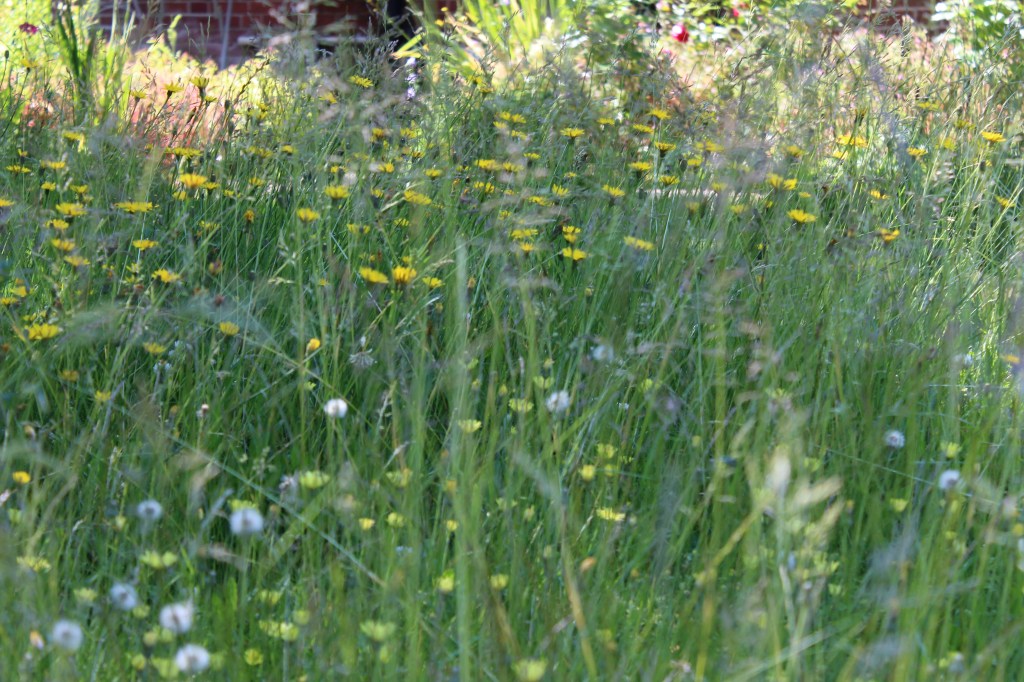
All the pictures are from the garden – and the narrow strip outside the wall by the road, where I’ve been sprinkling seeds for years.
Last time, I shared with you about what happened in my town for the Global Day of Action for the Environment, the mid point of COP 26. It was so good to work together with friends. Thank you, you know who you are! You can read about that here.
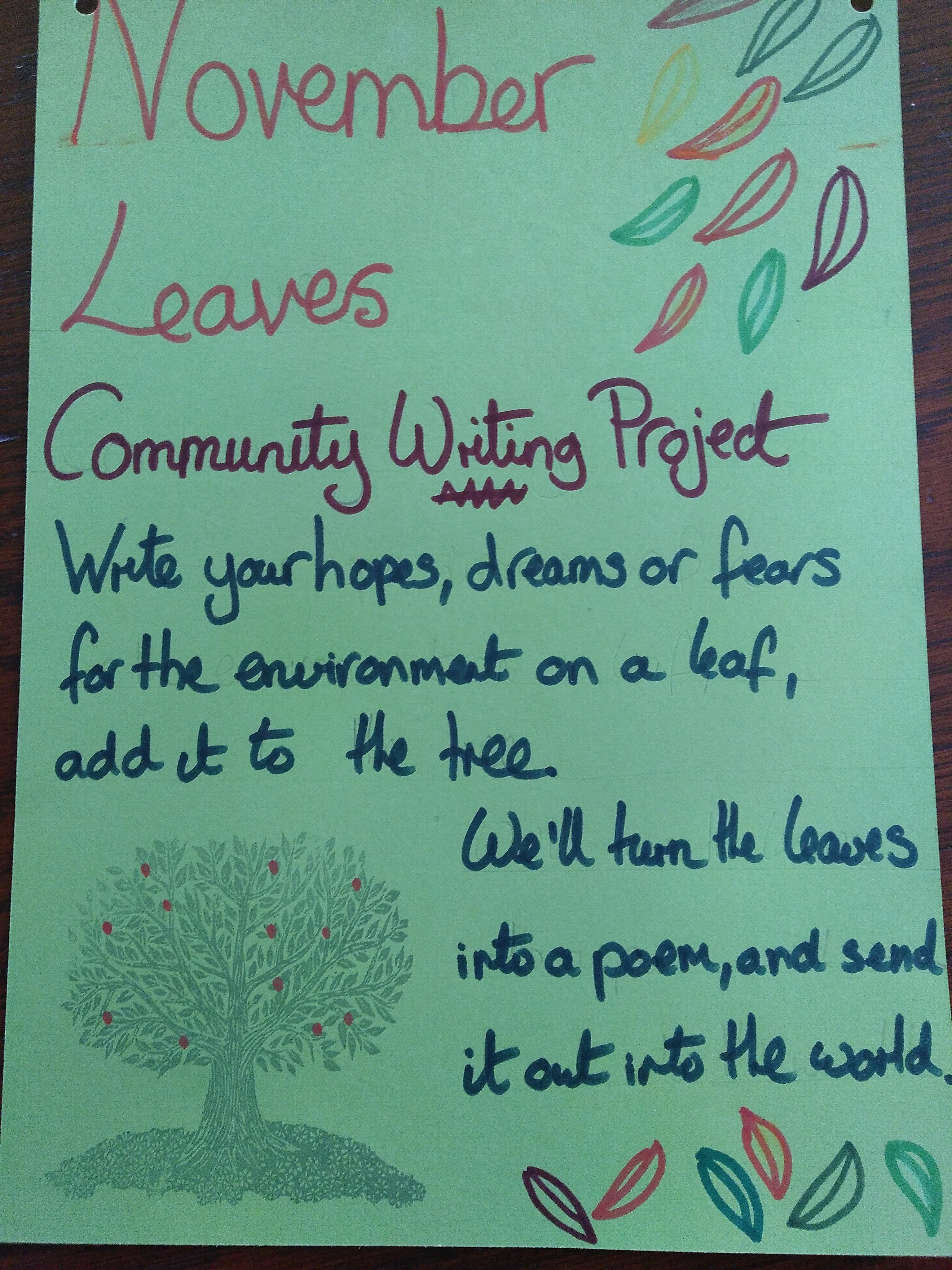
This time, I’d like to share with you about the leaves hung up on the tree – you can see them fluttering in the photo above. We invited people to write down their hopes and fears for the climate on cardboard leaves, which we gathered together at the end of the morning.
I’ve turned the fragments into a found poem, and have begun the process of sending out a few copies – the first to our local MP.
I’ve decorated these copies with a lino print I did, in the spirit of craftivism. This is their philosophy, and I like it….
“If we want our world to be more beautiful, kind and fair, can we make our activism be more beautiful, kind and fair?”
It’s getting dark – apologies for the photo quality!
And so, here it is. The poem made of words written by the people of Woodbridge, supported by Jacquie and David Tricker and friends. Put together by me, with invaluable editorial support from Tracy Watson-Brown. I’d also like to thank the early years teachers who helped me read some of the contributions from our very young writers.
A special thanks goes to all the people who stopped and talked to us, and wrote down their hopes and fears for us to share with you.
November Leaves People were invited to write down their hopes and fears for the climate in Woodbridge Thoroughfare, Suffolk, as part of the COP 26 Global Day of Action.
And young and old came and hung their words up on the familiar tree, to twist and turn in the cold wind, to carry their hopes and fears for our world away to rustle and whisper in your ear, dear reader. So listen to these voices. Listen now, for it is already late, and the leaves are falling.
We hope to … thrive in a more equal, cleaner, and kinder world, love life, kind and helpful to all living things. Showing love and care, helping the climate which in turn helps the animals – including us.
Children’s voices, saying what they see: World Litter, Erosion, Deforestation, Global Warming, Animals losing their home, Endangered. Where will the polar bears go? And what if people don’t listen and fall asleep? Tears!
Older voices, fearing for the children’s future: It’s not too late – but only if we all act now! In hope for a greener, cleaner world for us…. our children, their children and their children!
We fear – more people will suffer, and the poorest will suffer the most, not enough of us will change our ways. We must live lightly – look after the poor or ignore the signs and greed wins – too much “I want it now”. Too much blaming others, blaming farmers, for climate change.
We could live in a peaceful world, make ancient trees monuments, replanting and replanting those that have been cut down. Fresh air! No diesel fumes, no single use plastics, acting together now to save our world or here, and soon, much of our town could be under the sea.
Will we see sense? Will we act now?
And so the leaves of the tree are gathered up, gathered together, speaking together as one. From many fragments, many voices, this small town speaks, and wonders, Where will the polar bears go?
By the people of Woodbridge, compiled by Andrea Skevington
Saturday 6th November was the mid point of COP 26, and a Day of Action where we could add their voices to the thousands gathered in Glasgow. Here in Woodbridge, a few organisations had got together to plan a march, and it soon became apparent that many were interested in joining them. So, Woodbridge Churches Together, Transition Woodbridge and the local Womens Institute did an excellent job – all working together to organise and hold a peaceful, purposeful, inspiring community action.
Photo by Charmian Berry
There were about 300 of us, which is quite a turn out for a small town. The atmosphere was energising and determined and also celebratory. There was music and speeches to inspire, and to remind us of some of the things that are already going on in the town, and the much more that could be done. We looked forward for ways to proceed, to work locally for a better and fairer place for all, as well as how to continue to let our voices be heard.
As is becoming a tradition in our town, people could leave their banners to be tied to the railings of the Shire Hall, reminding the Town Council of the strength of feeling.
Photo by Councillor Caroline Page
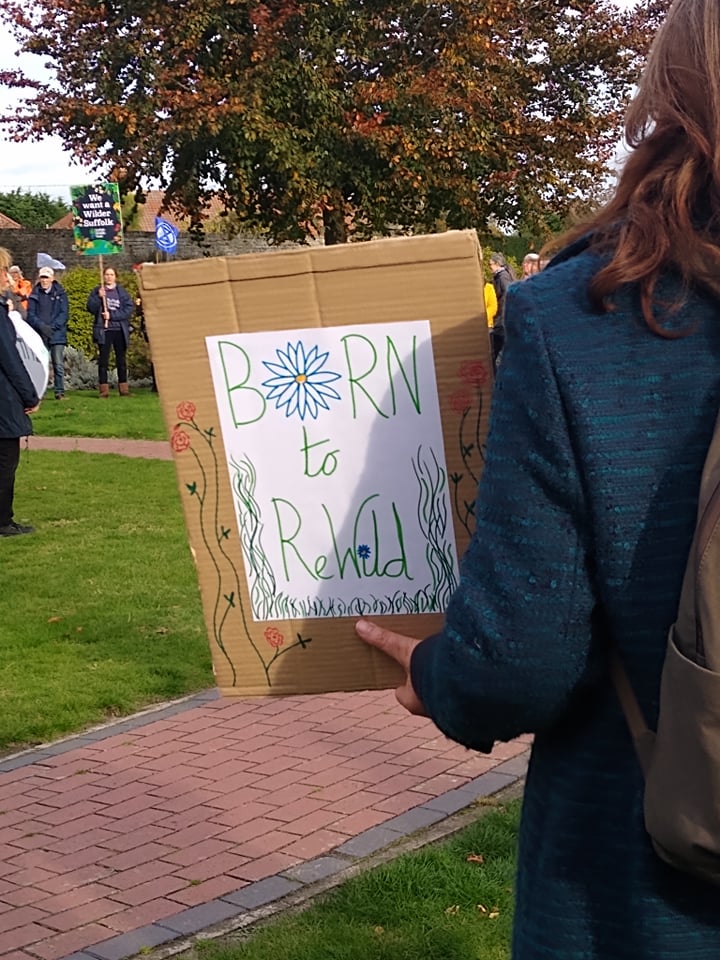
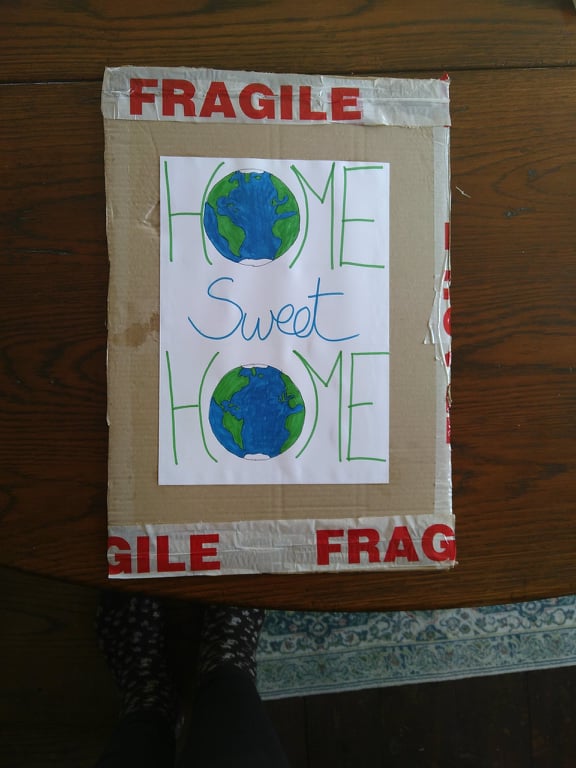
My home-made placard was double sided. Here’s the front… you might be able to see it hanging up.
One of the very positive things about a march in your local commuity is that many of us knew each other. Already, I’ve been having conversations with old friends and acquaintances who were there, and beginning to nudge forward to what we might want to do together to help green our local place even more.
All this was in the afternoon. In the morning, I, and a few friends, were in the Thoroughfare, our main shopping street, having a small happening. Some of you who have followed this blog for a while may remember that last year I had an idea of giving out bulbs and bookmarks, inviting people to Plant Hope. You can read about it following the link. It’s so good that this year, the time seemed right to do it. Having the support of a few friends made all the difference. It was so good having the chance to talk to people about hope in difficult times, about the power of plants and nature to help us in our crisis. A very moving morning.
Photo by Jacquie Tricker
As you can see, by the time we got round to taking a photo, nearly all the bulbs and bookmarks had gone!
There was another aspect to our happening though. If you look at the tree, you’ll see some cardboard leaves. We invited passers by to write down their hopes, dreams and fears for the environment and hang them on the tree. We’ve gathered them up, and are in the process of turning them into a poem to send to our politicians, both local and national, and to others. It’s very moving to see what people young and old have written. It’ll be called November Leaves, and I’ll be sharing more with you on that in due course.
It was a wonderful, hopeful, sad day, a day of coming together in community, which is a thing I’ve missed very much.
It also felt like the beginning of closer engagement for many, with many organisation coming together for the common good.
Last year, I just made this one bookmark. This year, I could have given away twice as many as I made. How things grow.
My friend Jacquie has published an excellent article about eco anxiety and anger, and the power of finding your tribe – people you can work with to take some action. It talks about this march and action, which we did together. You can find it by following the link here.













 Andrea Skevington