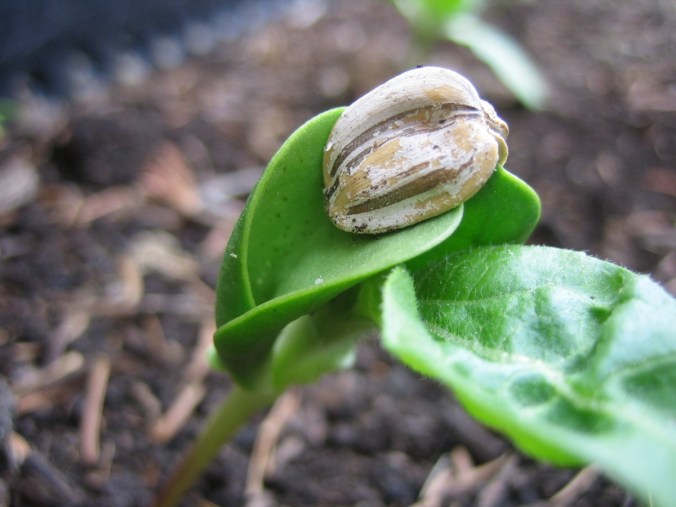
Here is another poem of resurrection – this one exploring the deep, unwitnessed moment of awakening. I’m intrigued by the stirring of seeds, the quiet power of life returning in Spring, and the imagery of spring filled my mind as I thought about Easter resurrection. My forthcoming book – The Year’s Circle, publisher Wild Goose – weaves together poems from the church seasons and the Earth’s seasons. In this piece, I hope, the presence of spring hums through.
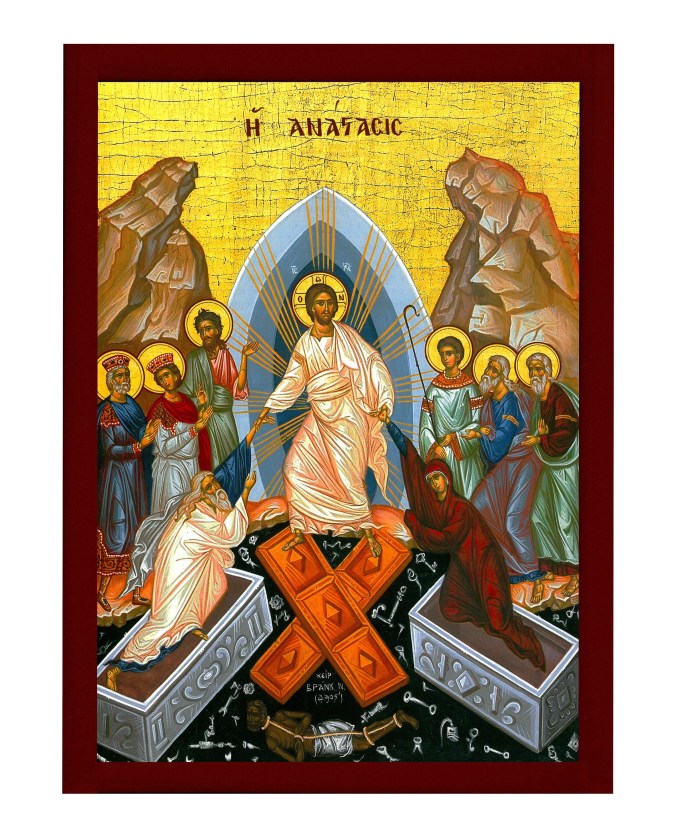
I love the way Eastern Orthodox icons celebrate resurrection not as an event involving one alone, but as something including all those needing to be set free…. and gives us an insight into the pattern of life out of death, hope out of despair, new out of old.
Before first light
Out of the earth, the grave, the tomb, the darkness, life steps out into a shining spring dawn.
Out of the seed, the grain, the stone, the pip, life uncurls in a shimmer of new green.
We do not see the moment of breaking, of rising, it is hidden in the dark womb of the Earth.
But perhaps the ground shakes, a tremor in the deep, as the stone rolls away and death’s imperial seal is broken.
Then, out of a cave humming with clear morning light – no need of grave clothes, no need of husk and shell and stone and seal,
No need of the linen napkin for it is finished, and folded –
Out of the earth who tends her dead, there is a great greening, an awakening, a rising up. Life, and life, and life is stronger even than the grave, and love is stronger than death.
And look, and see, all things are being made new. Now, and now, and now.
Matthew 27:65-7, Mark 16:1-7, Luke 24:1-11, John 20:1-10
If you would like to use this poem, please do so, giving my name and this blog as reference.
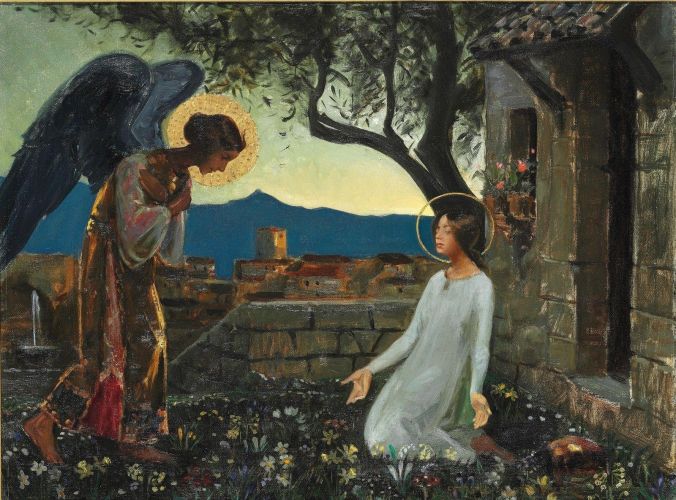
The Proclamation of the Virgin Mary by Harald Slott-Moller
Hello blog readers! It’s been a while since posted. I’ve been working on my collection of Poetry for Wild Goose, Iona Publishing, and have now submitted it. It’s been a huge project, taking me just under a year, and I’ve loved immersing myself in weaving together a pattern of words and images. I’ll let you know when I have news of a publication date, but I know it’ll be a little while before they get to it. As a quick reminder, it’s called The Year’s Circle, and it follows the seasons of the year – celebrating the unfolding natural world and the seasons some churches follow in their prayers and readings.
As many celebrate the Annunciation on 25th March, I thought I’d share with you the poem I’ve written for the new book. A meditation on the angel’s visit to Mary. In the book, I’ve placed it in Advent, at the time when we often celebrate Mary. It certainly suits spring too, with the stirrings of new life we see all around. I hope it also reminds us that new beginnings are often hidden, small, and in unexpected places. It reminds us to look beyond the surface of Empire and power, and see what is happening elsewhere. Those things may be more important than we think.
Anunciation
I see her standing at the doorway of her home as the earth quickens at her feet, awakening.
A sudden shaft of light falls on her and she raises her face to feel it warm on her winter skin
For one joins her there, on the threshold, with great wings folded. An indication, if one were needed, that he comes from another place, is made of other matter.
And so this strange meeting begins at the threshold of Earth and Spirit, Word and Flesh, Eternity and youth. The shining one greets her with a song of God’s favour, of one-to-be-born of her – as she draws back a breath into her accustomed room, afraid,
Tests the future with a question. For this high favour will take her down a dark path, and a dangerous one, with sanction and scorn and incomprehension – her own too.
Yet, even so, she takes that tentative step forward, towards the light, gives her Yes to all this, to being a God-bearer, carrying the Anointed One in the closed blood-dark room of her womb.
And so begins this strange folding of the infinite, the Alpha and Omega, into a single cell within a slight girl, the most vulnerable of forms, this Mary, full of grace. What strange and troubling gifts are these to stir the brightening air.
Luke 1: 26-38
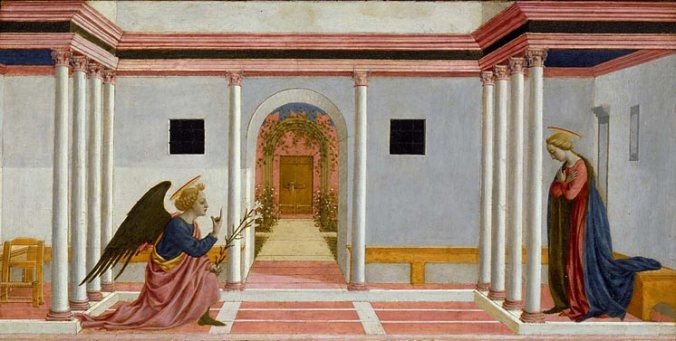
The Annunciation by Domenico Veneziano – Fitzwilliam Museum collection
Many paintings of this scene are strong on architecture. Artists, like Domenico Veneziano, were experimenting with their newly developed techniques of managing perspective. This one has a tiny pinprick in the centre, the vanishing point on which all lines converge. They ususally place Mary inside, or in some kind of indeterminate space like this one – a sheltered, nearly outdoor space. As I was meditating on the passage, I was struck by the image of thresholds, of liminal space, tentative and uncertain but open to possibility. In these early paintings, you often find the angel and Mary facing each other, like this, across the space, and then your eye is drawn to another line directly from the viewer to the background of the image. A window with a glimpse of a view, a door – in this case the door is closed. The closed door is a symbol of virginity, but here, I can’t help thinking of another collection of symbols – the closed off way back to the Garden of Eden, a way out of the confines of law and punishment, a door out into the freedom of a rich and green landscape. This line, front to back, out of the picture, forms a cross with the direction of gaze between the two figures, and that intrigues me. It does seem like an invitation to walk that path out towards the spring, towards new and abundant life.
I notice that many of you good readers are looking at my blog for poems on the themes of Holy Week, so here is a link that will help. I have a couple of new pieces for Easter Sunday, I’ll try to get those up here in the next week. Please do feel free to use my work, crediting me and this blog. It’s so good to know my work is being read in different parts of the world. Thank you for your support.
I’m so delighted to be able to share with you that I’ve just popped a contract in the post for my first published collection of poetry. Some of you will know the publisher, Wild Goose of Iona, and they’ve been so kind and efficient in coming to an agreement about what we’d like to do together. It should be out next year.
We plan to call it The Year’s Circle, and I intend it as a collection to accompany you through the year. It will weave together poems drawn from Bible stories marking the seasons, such as upcoming Easter, with poems drawn from nature – so the two main strands of work you will find on this blog. I hope it will be good for your own reading and also sharing together with others in groups, churches and festivals. I know many of you already use the poems you find here in those ways.
The Celtic tradition has an idea of God’s two books – the Bible and Creation – and I’m intrigued by that idea and am looking forward to exploring what it might mean.
The collection will include some of the poems you’ll find here as well as new work. I intend to share progress with you as I go along – giving you tasters of the new poems, as well as some insight into the process.
I want to thank you all for being here, for your support and encouragement. It’s played a huge part in making this new venture possible, and I really look forward to including you in the process.
I’m blown away by this opportunity, it’s so good, and I’m really looking forward to getting going with drawing together something beautiful and nourishing in these difficult times. I really hope it helps.
This poem has arrived on the blog a little late. It became marooned in my notebook for a while, until I flicked through the pages and found it again. And although crowds of bees are no longer buzzing among the ivy, there are still a few, here and there.
I hope, though, that although this poem arose out of a particular time, it has something to say in other times, too. About stillness. About the restorative power of simply being, and paying attention. About finding our breath again. We all need that. We all need to feel that connection to the rest of the natural world (oh, how I wish we had better language for these things – bear with, it will emerge) which grounds us, and from which we can rise. For those reading this blog who need a little peace right now, I hope it helps. I’m thinking particularly of dear readers in America, where the election atmosphere seems turbulent. I wish you well over the next days and weeks.
The old hedgeline in front of our house has, in places, been overcome by ivy, which has formed its own structures and patterns of flowering and fruiting. Cutting some of it back to make space for other plants to grow, I was careful to leave the ivy flowers for the bees – which will become fruit for the birds in time. Accidentally, I created a little bower, where I put a chair and sat for a while. As I sat I gradually heard the road less and less, as my attention was taken up with the many bees who were enjoying the feast. And so, this poem emerged.
thebiologist.rsb.org
September. Bees. Ivy.
It is taking a while, this sitting in a carved out cave in the ivy. Just sitting, stilling, breathing. A bower of green leaves above, and above that blue sky, white clouds.
In time, the hum of bees, and their intricate woven patterns of flight, come to replace thoughts, become another form of thought. So too the birds – that wren shaking the leaves, and the pipping robin.
And this grey and green lacework of wild is all that separates me from the roar of the road – those black lines we make, always going somewhere….
And yet, here is a marvel. More bees than I have seen all year. A hum that soothes the soul. The darkness of butterflies.
These strands of green woven through the world – not enough, by no means enough –
But they shelter the bees, and me. A space for the soft and alive, breathing, green in spirit. We can be here, the bees and me. We can be, in this hollowed out hedge, in a cloud of lightfilled wings.