Poems: Seven Sentences from the cross

Elizabeth Frink, at St Edmundsbury Cathedral

Edit: April 2025 I’m sharing this with you again this year, as I’ve noticed that a number of you are turning to these poems as we approach Easter. Thank you. I’m also delighted to let you know that they will be part of my first collection of poetry, The Year’s Circle, which will be out next year. It will be published by Wild Goose. Exciting news!

I do hope these poems are helpful to you as you begin to meditate on Good Friday, and prepare for sharing that time with others – families, groups and congregations. Please do feel free to use and share them, saying where you found them. I love to hear about that.

Below the poems, you’ll find some links to other posts on this blog that you might find helpful too.

Father forgive them, for they know not what they do

We don’t know what we do,
from the careless word that
starts a fire of anger,
to the careless killing
of a butterfly  –
who knows what
wide effects,
what winds and rains,
begin and end with just one death?

We walk in darkness, so often,
and so often, we close our eyes,
we do not wish to know.
And Jesus, seeing this,
that his life would end
with angry shouts,
with fearful washing of hands,
with indifferent playing of dice,
Knowing all this, even so, he bore
our lawful unthinking violence,
our blundering disregard for consequences.
Another would pay for our actions.

Yet as the ripple of our acts flows out,
through the world, who knows where,
so too, now, flows forgiveness,
following on, spreading and transforming,
watering dry ground, lifting burdens
and carrying them away.

2

Truly I say to you today you will be with me in paradise

Even as he hung upon the cross,
even with blood from that false crown
running down, not wiped away,
he saw the two men at his side,

One joined in mocking with the
priests and soldiers,
speaking from his pain,
and one did not, this second kept
his eyes on something else – a hope.

A hope the one he looked on was a king,
and of a kingdom where such things
as crosses are not lifted up,
a hope, even, of an end to death and pain –
this pain, this death.

And, ah, his king begins to speak,
of paradise.
What a world to gift him dying there.
A word of such sweetness, freedom, peace.
See  – clear water flowing, and flowers,
hear the sound of birds, the lazy
buzz of insects, the flutter of their wings.

What a word, at your end, to hold to,
to capture our beginning, once again.
But even more than this,
to be with him, beside the king,
seen and known,
held in the loving gaze of one who
hung up on the cross.
Might this, even this, be paradise?

3

Woman, behold your son. Son, behold your mother

And still he sees, looks down
towards the one who bore him, bearing this,
the pain – not her own pain – worse,
the pain of watching one you love
twisting on those wooden beams,
the nails piercing her own flesh too.

The time has come when all the
treasure of her heart is broken open,
scattered, lying in the dirt.
What use to hold in mind
the words of angels,
the wealthy gifts brought by the wise,
what preparation Simeon’s warning,
when now she sees his agony with her eyes.
But she is not alone, his friend sees too.
John, who writes it down,
bears witness, even here, even so.
They turn their gaze upon each other
and see each other with new eyes –
a mother, and a son.
Gifting them each other –
his one last act of love,
this giving, from an empty cup.
This task of care can be ours too,
to behold each other in our pain,
and in our sorrow, walk each other home

4

My God, My God, why have you forsaken me?

You felt your generous heart forsaken,
you felt the absence of the one who helps,
who was beside you, in the beginning,
who knew you from before first light.

We know too well the sparseness
of your isolation, without light,
and companionless,
in the darkness of our own long night.
And yet, within our dark, we find you there,
Find you have waited for us long days, and years,
while our poor eyes have
grown accustomed to the dark,
have learned at last to see you through our tears.
So as you know our pain and feel it,
you break our separation with your own.
Help us see the forsaken all around us,
invisible and in darkness, but seen by you.
May we seek each other in the dark,
May we have courage to cry out,
like you, and so be found.

5

I thirst

The well is deep, and you have nothing to draw with.
Where now that living water?
Where is that spring within you, gushing up
to fullness of life?
Do you remember, now,
the woman by the well?
Your deepening talk of thirst and water,
as now, again, you humbly ask another for a drink –
this time,
a sponge of sour wine?

Do you remember too, as the taste dries on your lips,
that wedding feast, where water changed to finest wine?
The richness and fullness of that beginning
soured to this cold bitterness.

You are our source, the spring of all our rivers
and still you thirst like us, need help to drink.
And so give us this grace,
that as we do for the least of these,
we may know we do for you.

May we see you
in each thirsty face.

6

It is finished.

All things come to an end.
Even pain like this,
Even the anger and the cruelty of a crowd,
of us all,
even the certainty of those so certain
of God they hang a man upon a tree.
Even the punishment and scapegoating
even violence,
even death.
The work is done.
It has all been borne.
You have poured out your love, your life.
You have carried our sorrows, suffered
under our iniquities.

Your head bowed now, you sink
into the final pain of nails,
your body bears no more,
having borne all.
The work is done.

7

Father, into thy hands I commit my spirit

There is darkness now, deep darkness,
over the face of the deep,
and no hovering like a brooding bird,
instead, the temple curtain torn in two,
from top to bottom,
and the Holy of Holies empty.

God is not found there,
but here, with this dying man
on a tree,
He calls out father, and talks of hands,
and we remember what his own hands have done,
how many were healed by their touch,
raised up and restored from cruelty and death,
and now, he too will be held in loving hands,
a reconciliation beyond our grasp,
a trust even at this moment of last breath.

Dying, he taught us to die,
dying he brought us life.
May we be reconciled, may we know
at our end, the comfort of those hands.

img_0630

The church at Selworthy Green

Bless you


Good Friday Meditation

Other Holy Week readings, prayers and poems

Book News! Early notice, poetry book on the way.

I’m so delighted to be able to share with you that I’ve just popped a contract in the post for my first published collection of poetry. Some of you will know the publisher, Wild Goose of Iona, and they’ve been so kind and efficient in coming to an agreement about what we’d like to do together. It should be out next year.

We plan to call it The Year’s Circle, and I intend it as a collection to accompany you through the year. It will weave together poems drawn from Bible stories marking the seasons, such as upcoming Easter, with poems drawn from nature – so the two main strands of work you will find on this blog. I hope it will be good for your own reading and also sharing together with others in groups, churches and festivals. I know many of you already use the poems you find here in those ways.

The Celtic tradition has an idea of God’s two books – the Bible and Creation – and I’m intrigued by that idea and am looking forward to exploring what it might mean.

The collection will include some of the poems you’ll find here as well as new work. I intend to share progress with you as I go along – giving you tasters of the new poems, as well as some insight into the process.

I want to thank you all for being here, for your support and encouragement. It’s played a huge part in making this new venture possible, and I really look forward to including you in the process.

I’m blown away by this opportunity, it’s so good, and I’m really looking forward to getting going with drawing together something beautiful and nourishing in these difficult times. I really hope it helps.

Poem: Water and Dove – Baptism. Sunday Retold

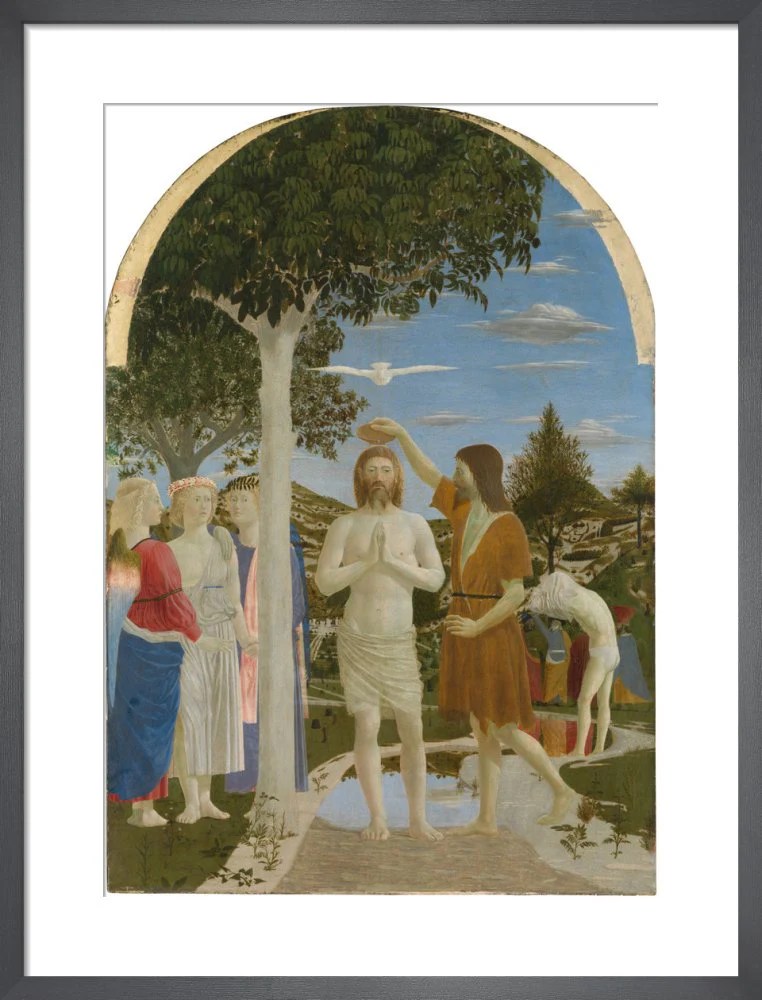
Piero della Francesca, The Baptism of Christ. National Gallery, London.

This coming Sunday many Christian communities are continuing to think of Epiphany, or epiphanies – those moments of clarity, of breakthrough, when you see things anew, or perhaps for the first time. In particular, there are readings to follow which tell us of Jesus’ baptism by John in the Jordan river. It’s a moment when everything seems to change – where we see one who closely resembles a prophet from the Hebrew scriptures, and one who tells us that the Kingdom of God is so close, already among us – standing together in a river. The reading is Luke 3:15-17,21-22. I’m posting a link to the whole chapter, though, as it gives us some very helpful reflections on “What should we do?” as signs of a change of heart, as well as the beautiful and hopeful passage from Isaiah.

I love the picture at the top of this post. I love its lines, its clarity and purity. I have a framed poster very like this one, and see it every day. I’ve often wondered at the river stopping, diverting around this moment of baptism. I assume della Francesca was thinking of the story in the book of Joshua, when the priests carrying the arc of the covenant step into the Jordan, and the waters dry. The people then cross the riverbed. In doing so they leave their time in the wilderness, and it is an echo of the time they entered it by crossing the Red Sea, escaping slavery in Egypt as they did so. This time, crossing the Jordan, God’s presence is suggested by the Arc of the Covenant, rather than the pillar of fire and flame that was with them at the beginning of their journey. It’s quite a change. You can read the story here if you’re interested.

And so, to the poem. As so often, I begin by reading the passage through, several times. I breathe, I wait to see what speaks, what arises, what I feel. And I felt a strong response to the water, and the dove – those natural elements I see myself every day in my own walks by my own river. They moved me. And yet, there was also this background thought of the painting that has formed my imagining of the story. So a poem emerged which is in itself a kind of epiphany, a kind of seeing things in a new way, or perphaps a given insight. I leave that to you, the reader.

If you enjoy following trails, there are some others you might like here, relating to the water and the dove. The first is Jesus’ I am saying – I am the living water. That passage has stayed with me for years. You can read my reflections on it here. And the dove called to mind the story of Noah, and another poem, here. There is more of course, like Jesus washing his friends’ feet. I leave the others to your imagination.

Water and Dove – Baptism

When you stepped into the Jordan,
did the water stop, not daring to
touch your feet – as if
you yourself were the
arc of the covenant,
untouchable, fierce in holiness?
As if you bore within yourself
the whole of the law, the weighty
stones given to Moses? 
The river was in spate then – wild it was,
but it stopped before such fearful holiness.

But I do not see it so. Rather,
I see cool water lapping your feet,
your legs, bathing them clean,
ripples rejoicing, dancing, flowing,
honoured to baptise one
who did not require it,
both water and Son of Man
living out their deep purpose

As the sky opened wide with
tender light, and a white dove
tumbled with the applause
of clattering wings down
to you –  and what then?
Maybe it landed softly
on your shoulder, resting
awhile, heads inclined together,
gently, two wild beings, two beings
overflowing with all love divine.

And so love spoke forth
with delight,
love pouring over you
like the cool water,
river water, living water
like the endless light,
and the softest
brush of feathers
from the wings
of a dove.
Endless,
life-giving
love.

Sunday Retold

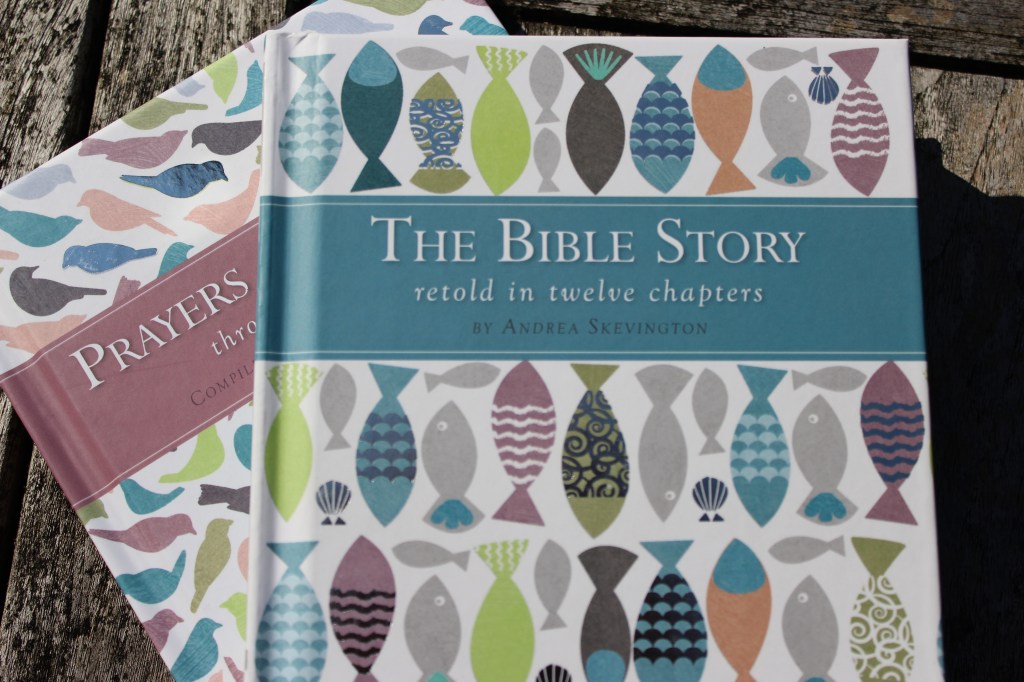
If you’ve been joining me here on the blog for a while – thank you, I appreciate your company – you’ll be aware that I have a very occasional series with material from a couple of my books which follow the Sunday readings many Christian communities use. In particular, my retelling, The Bible Story retold in twelve chapters. Recently, I’ve been doing this fresh writing, with a poem, too. But here are some pieces you might find helpful. If you’d like to use any of my material, please feel free to do so, giving this blog as a source. If you’d like to publish it in some form, please do get it touch. Thank you.

For John taught them to hope. In his words, they caught a glimpse of something beyond their everyday lives. They understood that John that Baptist was preparing the way for something, or someone, astonishing.
“I baptize you with water, as a sign of your rependence: your turning back to God and his ways. But wait. There is one coming after me who is so much greater. I am not even worthy to carry his sandals for him. And when he comes, he will baptize you on the inside with the Holy Spirit and with fire. He will sort out the good from the bad, the wheat from the chaff!”

Then Jesus came down from Galilee in the north, and walked through the crowds toward John. John knew Jesus was the one they had been waiting for: the Messiah. Was Jesus really comng forward for baptism like everyone else?
“No!” said John, stepping back. “I need to be baptized by you – and yet you come to me – why?”
Jesus replied, “I must do everything that is right, and it is right to be baptized.”

And so John agreed, and they stepped out into the flow of the Jordan. Jesus went down into the cool water, and was baptised.

As he came up the bright sky broke open, and the Spirit of God came down gently and settled on him like a dove. A voice from heaven said, “This is my Son, the one I love, the one who brings me joy. I am very pleased with him.”
From the Bible Retold

Come, let us follow Jesus, who loves us.
From Prayers and Verses

The picture of birds over water (behind my name) is of the Wash at Snettisham RSPB. You can read more about that here.

A poem for New Year’s Eve – Crossing the Blyth at sunset, at the turn of the year

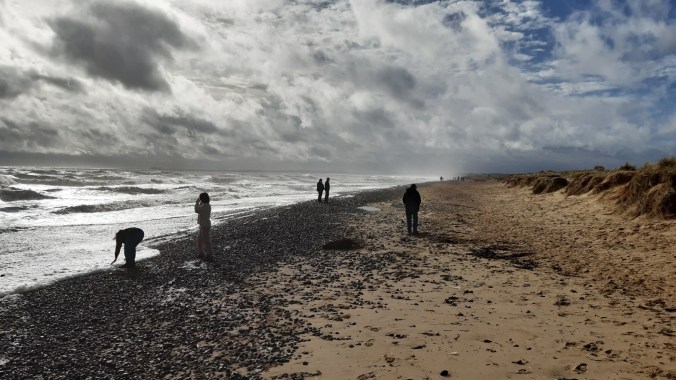
All the photos in this post were taken by my husband on a wild and stormy day at Walberswick.

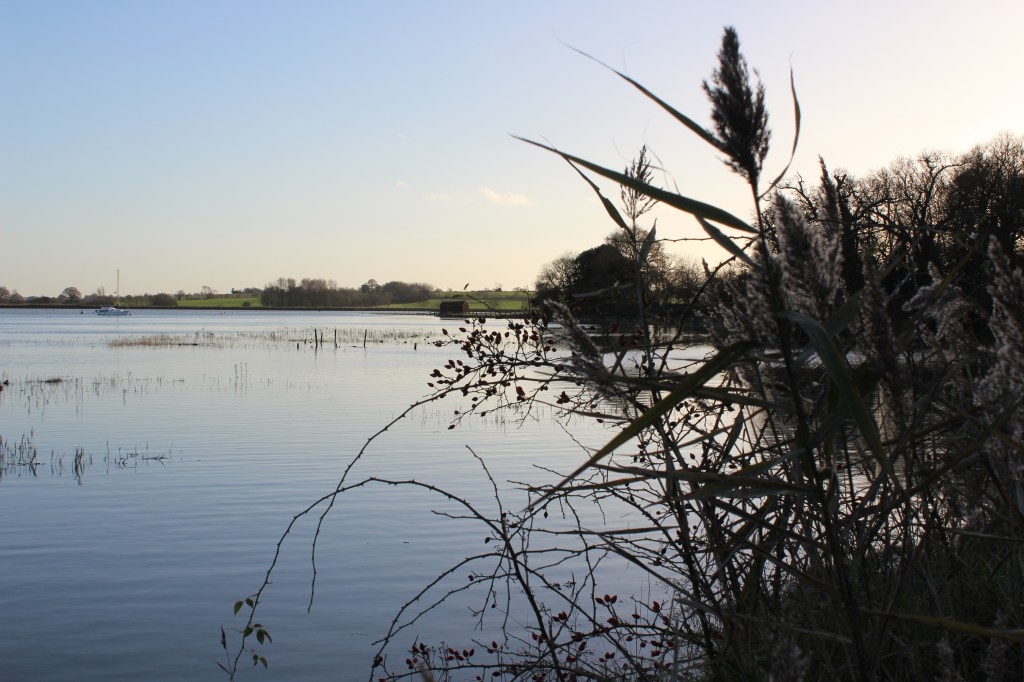
The poem I’m sharing with you today was written at a previous New Year. We nearly missed the foot ferry between Southwold and Walberswick while out on a long winter’s walk with our family. It ran till sunset – and sunset was upon us. Today, I’m glad for this poem, glad I wrote it and by it am able to remember this magical evening at the turn of the year, the time we spent together on this Walberswick walk, and the strange feeling of being suspended between the two shores, the two closed gates, in the hands of the ferryman whose course was sure even though it seemed to slant so across the water.

So too with time, in the space between two years, when we look back at what has been, and look forward to what will be. We are glad to spend time with those we love, and perhaps especially miss those who are not with us. Love glimmers in this golden limpid darkness between times.

Perhaps in this space we can dream of a shore with warm, welcoming lights, with togetherness, with hope. Perhaps we may find we can be such a shore for each other, and keep lights of hope and welcome burning in the long cold nights.

May you have a blessed, happy new year. Thank you so much for your time and company on this blog. I value that gift very much.

I’ve shared with you another poem about winter walking along this shore, and a murmuration of starlings. Such an awe inspiring dance of togetherness. You can read that here.

Crossing the Blyth at sunset, at the turn of the year.

We walked fast towards the ferry –
nearly too late –
and saw the ferryman on the other side,
the gate closed behind him.
But we waved, and he came,
his blue boat a long wide
curve across the river.

Behind him the setting sun,
the treeshapes
black against the orange sky,
How beautiful it is.
He helps us on board,
offering me his hand
with nautical courtesy,
and then shuts the gate
firmly behind us.

So we thank him, and our blue boat
begins to churn those golden waters
rippling with a fast tide,
as we seem to hang for a time
between those two closed gates,
between those two jetties,
in neither one space, nor the other.
We are somewhere else instead,
where all is gold,
where darkness lies behind,
where the lights of the houses and
the wide-open pub are ahead of us,
lights that warm with the hope of welcome.

We are suspended for a while
in this Adnams-blue boat
with the diesel and the saltsmell
and the cry of the birds,
bathed in light, trailing
an ice hand in water
the same colour
as the light.
Here we are.
This moment.
Between two moments.
How beautiful it is.

Hope – the first Sunday in Advent

I’ve noticed a few of you good readers have been searching out this post, so here it is again, for Advent Sunday 2024.

As the days have grown darker, and colder, I’ve been thinking about Advent, and hope. Traditionally, Hope is the theme of the first Sunday of the season, the first Sunday of the Church year too. Autumn seems to have been long, and restorative, and I’m not quite ready for winter. But here we are, nonetheless. And winter has its consolations.

I think there is wisdom in the old practices of having Advent as a time of quiet, reflective, waiting – a little like Lent before Easter. It’s so at odds with the flashing lights and loud shops and busyness, that understanding, but we can perhaps catch moments where those wintering practices are possible, and might help us….. pools of quiet light where we can breathe and think.

I’m also intrigued by the more medieval practice of putting yourself in the place of the people of Israel as they waited, not quite knowing what they were waiting for. Of not naming Jesus and Christmas, but instead allowing what we long for to be recognised and owned and prayed and worked for. In our context we join so many people throughout history who have felt the future to be shifting and uncertain, and who have longed for a kinder, gentler and more beautiful world. Taking some time to know and feel what we lack, what kind of world and lives we desire, might help us too face a troubling future with some courage and determination.

So Hope is a good place to begin.

Ah, hope. I’ve been turning over in my mind what it means to nurture hope in a world which seems increasingly unstable in climate and economics and culture. I’ve settled, for now, on making a distiction between hope and optimism. So, for me, I’m thinking of optimism as an opinion that things will work out. Something tied to outcomes. I see hope as a stance, an attitude of the heart and spirit, that it’s always worth looking for what brings life, for what is good. It does not require us to be naive about the dangers and difficulties around and within us. We are called to be as wise as serpents, and as gentle as doves – Matthew’s gospel.

Nonetheless, it’s worth working as if the world-as-it-could/should-be is here, emerging amongst us, small as the signs and growth may be. Not a glib avoidance strategy that it’s all fine, really, it’s all going to be fine…. but as a deliberate and courageous stance, holding on to a vision of how things could be.  With the cost of living crisis bringing fear and hardship, and with the climate noticiably more unstable, we need courageous hope that’s prepared to work to refashion things around us in defiance of what we see.  There is real power in such acts.

The picture of the bulbs and the bookmark at the top of this post relates to an action I took with some friends in our local high street to coincide with last year’s COP. We handed out bulbs and bookmarks, and encouraged people to think about ways they could plant hope. You can read more about that here.

Little Free Pantry at St Andrew’s Church, Melton

As Advent begins, we re-read the words of the prophets together.  They often spoke into desperate, unpromising circumstances with a mixture of a vision to hold in our hearts, and actions for our hands to do.  Those actions can be prophetic themselves, speaking out and making plain God’s dream for the world – a beautiful, hopeful vision strong enough to withstand hard times – brave enough to choose to be born to a poor family, who sheltered in a stable, and had to run from a murderous tyrant.  This is how hope was offered to the world, in the infant Jesus.

During this Advent series, I’ll share with you some extracts from my books.  Here’s something from The Bible Retold , as the retelling of the Hebrew scriptures comes to an end, and we look forward..

As the walls were rebuild, so were the people.  For God was building them into a new kind of kingdom.  Isaiah the prophet wrote: “This is how to truly serve me: unbind people who are trapped by injustice, and lift up those who are ground down.  Share your food with the hungry, and clothe the cold – that is how to live in the light!”

The people listened to his words of bright hope.  “There is much darkness in the world, but your light is coming!  All nations will be drawn to you, and they, too, will shine!”
….

“A child is born to us,
a son is given.
Authority will rest
on his shoulders,
and his names will be
Wonderful Counsellor,
Mighty God,
Everlasting Father,
Prince of Peace.
His kingdom, his peace,
will roll across the lands,
and he will reign on the
throne of David for ever.”

We give thanks for the work that is being done right now, in our communities, to clothe, and feed, and seek justice.  May we have the courageous vision to join with that work of light.

From Prayers and Verses

Scatter the darkness from before our paths.

(Adapted from the Alternative Service Book)

IMG_0930.JPG

The days are dark,
Dear God, give us your true light.

The days are dark,
Dear God, give us your true life.

The days are dark.
Dear God, give us your true love.

From Prayers and Verses

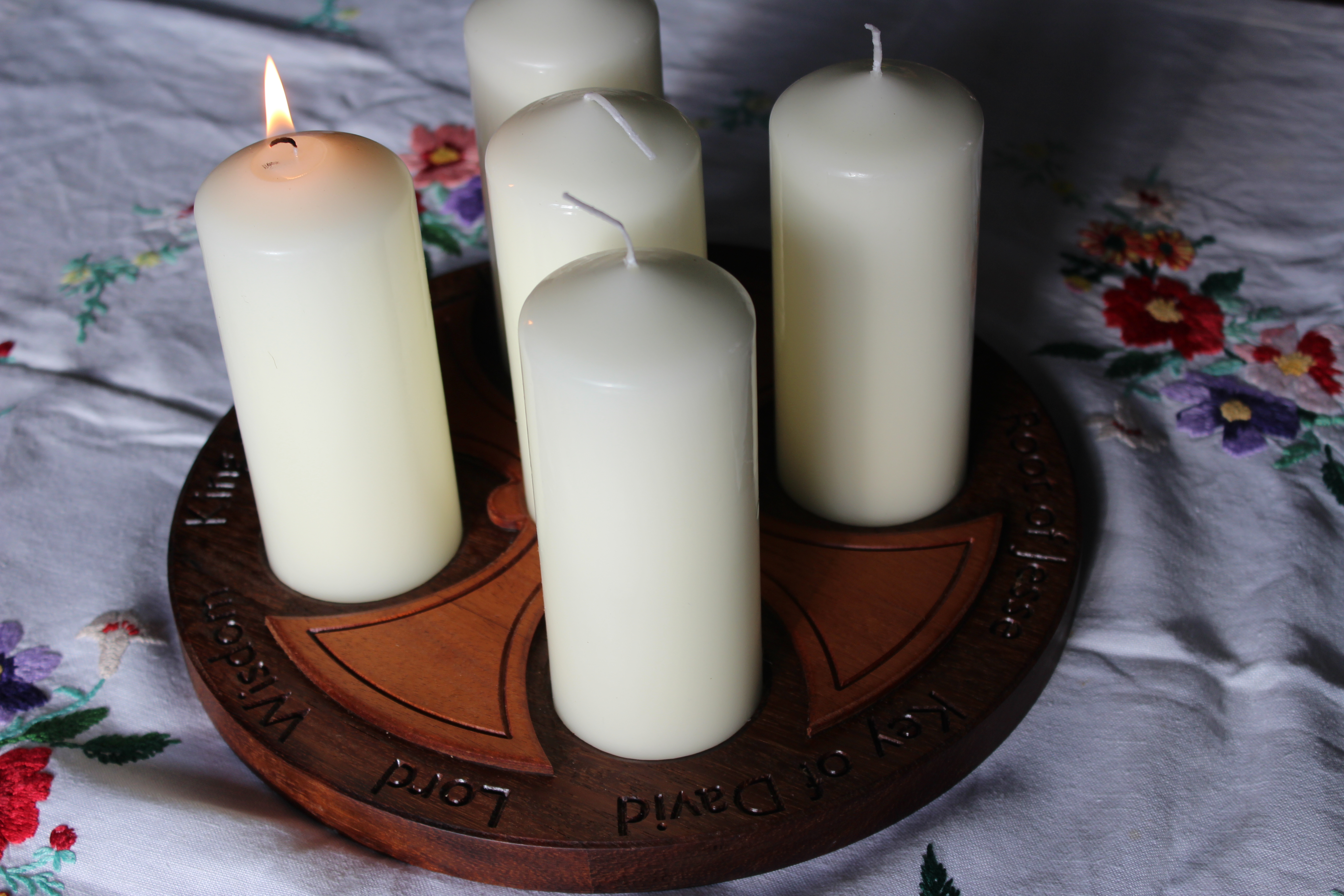
The Advent Candle Ring is from the good people at The Chapel in the Fields
It gives me great pleasure to know that the oak at the base was once a lectern, and the lighter wood on top a dining table.  The words written around it are from the ancient chants, the  “O” Antiphons. These chants came into being when people did not call for Jesus to come at Christmas, but instead used names from the Prophets – like Emmanuel, God with us – to name their hopes.  The first few centuries of the Christian Era saw these great prayers, the “O” Antiphons, sung during Advent, calling on Christ to come now, and to come again.
You can listen to the old chant, and read Malcolm Guite’s sonnet, and much more, here.

This coming week, let’s hold on to hope, look for signs of the life of God breaking through, and see where we can be part of that move towards a more beautiful, loving, hopeful world.

From the top photo…..

I made my bookmark with a stamp by the lovely Noolibird.

The plastic free bulbs are from Farmer Gracy

And the table is from Hannah Dowding Furniture

Sunday Retold: Christ the King

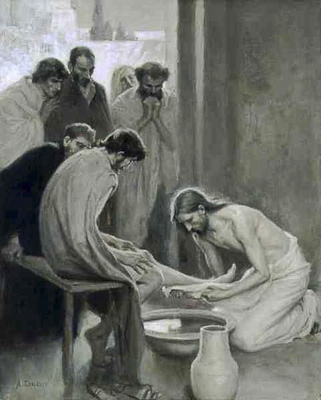
Jesus Washing the Feet of his Disciples, by Albert Gustaf Aristides Edelfelt, (1854-1905)

This week, I thought I’d share with you my retelling of the reading many churches will be following this Sunday, in the spirit of Sunday Retold.

It explores themes of power, and so follows on from last week’s poem, Stones.
This week’s reading is that electrifying encounter between Jesus and Pontius Pilate – a trial of sorts. For the flow of the storytelling, I’ve taken a longer sweep than the set reading.

So here’s the story from The Bible Story Retold

At the same time, as dawn was breaking, the council gathered – elders, chief priests, teachers of the Law – and faced Jesus.
“If you are the Christ, the promised one, then tell us!” one said, rolling the words around his mouth as if they were bitter to his taste.
“If I told you, you would not believe me,” Jesus replied, holding him in his steady gaze.
“Are you the Son of God?” they asked.
“You are right to say so.”
At this they rose to their feet with an angry roar, and carried Jesus off to the palace of Pilate, the Roman governor, who had power to sentence people to death.
“This man is a threat to the peace – he claims to be Christ, a king, and opposes Roman taxes,” the accusers called out as Pilate circled around Jesus.
“Are you the King of the Jews?” he asked. Jesus felt the cold edges of the mosaic under his bare feet.
“Yes,” he replied. “But my kingdom is not like the kingdoms of this world.”
“So, you are a king!” Pilate responded.
“Yes! That is why I came, to speak the truth. Everyone who is on the side of truth will listen to me.”
“But what is truth?” Pilate asked. Then he went out to see the leaders and the people together. “I see no reason to charge him,” Pilate said. “This man has done nothing to deserve death. I will set him free.”
“No, set Barabbas free instead!” they cired. Now, Barabbas was a rebel who had killed a man.
They shouted louder, drowning out Pilate’s words: “He’s done nothing wrong! I will release him!”
But, with rising rage, the mob shouted, “Crucify crucify!” In the end, Pilate gave in: he set Barabbas free and handed Jesus over to the guards.
The guards tormented Jesus, the one called king. They draped a fine, purple robe around him, and twisted him a crown of sharp thorns to wear. They called out, “Hail, King of the Jews!” and fell on their kneeds before him, laughing. They spat on him, and struck his head with a staff. They, they took back the robe, and led him out to be crucified in his own simple clothes

Francisco De Zurbaran

We see how those who held religious power allied themselves with the Imperial power of Rome. I expect they were sure they were being faithful, upholding the law and their traditions, defending their faith as they saw it. Being certain you are right can lead you very astray. And we see too how Pilate saw Jesus very differently, one who had done nothing wrong, and yet seemed to have little power in the face of an angry crowd.

The biggest difference of all, to my mind, is in the understanding of what power is, what a kingdom is, who a king is. Those who are embedded in the power structures of this world, and, to be honest, the rest of us too, find it hard to imagine a different kind of power. One that follows a path downwards, even to death. One that washes the feet of the followers, that does not insist on its own place, but instead works through love, in humility, in radical engagement with the world as it is. We will soon be in Advent, preparing for the coming of Jesus. At that time we think of his unity and solidarity with frail humanity, born in such a humble way, amongst the extraordinary, ordinary, beloved people of Bethlehem.

Lord Jesus,
May our lives bear the mark of love.
As we are kind, as we share, as we are gentle,
may your love be seen in us.
Help us, for this is hard for us.

Dear God,
May I welcome you as my king:
King of peace,
King of love,
King in death,
King of life.

From my book of prayers to accompany The Bible Story Retold, Prayers and Verses


Poem: Stones. Sunday Retold.

The open doorway of St Peter-on-the-Wall (founded about 660 AD). The wall in question is Roman. The chapel was built using some of the old stone from that wall. Bradwell, Essex.

I took a look at the set readings for this coming Sunday (17th November), and they are difficult and unsettling. Something about the Gospel reading caught my attention, and I thought I’d follow where that led.

Mark 13:1-8

 And as he came out of the temple, one of his disciples said to him, “Look, Teacher, what wonderful stones and what wonderful buildings!” And Jesus said to him, “Do you see these great buildings? There will not be left here one stone upon another that will not be thrown down.”

And as he sat on the Mount of Olives opposite the temple, Peter and James and John and Andrew asked him privately, “Tell us, when will these things be, and what will be the sign when all these things are about to be accomplished?” And Jesus began to say to them, “See that no one leads you astray. Many will come in my name, saying, ‘I am he!’ and they will lead many astray. And when you hear of wars and rumours of wars, do not be alarmed. This must take place, but the end is not yet. For nation will rise against nation, and kingdom against kingdom. There will be earthquakes in various places; there will be famines. These are but the beginning of the birth pains.

Once again in our world, we see wars, we see power misused, we see the places where we might put our hope and trust are frail. Just this week, the Church of England has been forced to reckon with terrible abuse that has taken place, and the failure of those in authority to protect the young. And COP 29 has opened with the absence of many leaders, and the presence of corruption – although I have been encouraged to see Kier Starmer taking a lead. Much that has seemed firm has been crumbling, and at the same time, forces which seem to be serving themselves seem very powerful, immovable. It’s a hard place to be for many, and we may need to give time to our fear and grief. We may need to find others with whom to walk through these hard places.

And so, turning to this reading, I see we are invited into something like a practice of deep realism, and a long view. We remember that for Mark’s early readers and listeners, this passage would call to mind the terror and trauma of the destruction of the Temple in AD 70 after a relentless seige by the Romans. The Roman historian Josephus records that 1.1 million people died during that time. It’s hard to imagine the suffering and shock of such loss. It must indeed have felt the end of the world. It was the end of the world for many. Even in the midst of such terror and shock, these words may have offered something to hold on to. Maybe there is some wisdom here about how to live through difficult times, when all seems destroyed, or we fear all may be destroyed. Such wisdom is arrived at through pain and loss, it is not intended as some kind of spiritual bypassing, that eveything is going to be fine. Everything is not fine. That much is clear.

So this poem, written in response to Jesus’ words, is an experiment in that long view. I hope that, if it lands with you at the right moment, it might resonate with you.

Stones

These beautiful stones
This beautiful Temple
all that wealth and power
all Herod’s might and posturing

Always, always can
and will be
thrown down.

And always, always, it is not
the end of all things
although it is the end.
For time still stretches out
among ruins lost to
twilight,
and dust settles, or
blows on the grey wind.

Strength seems invincible.
Stones seem solid, immovable.
The might and ritual of a temple
have such sure foundations
in the mind.

And yet time, wind, whispers,
armies, the running of water,
the roots of trees can and will
undo them all.

So do not be cowed
by these great walls,
for they will fall,
nor by their falling

For fall they must,
and the world will turn
and turn again, and what
was an ending may come
to seem the blowing of dry
leaves in autumn, an absence –
it may even, dare we hope,
begin to be birth-pangs, after all.

Gaia at Ely Cathedral. You can find more about that – including a poem – here.

You might enjoy this gentle conversation(Nomad Podcast) with the the musician Jon Bilbrough, known as Wilderthorn. Towards the end is some music recorded in the chapel pictured at the head of this post, St Peter-on-the-wall.


I’m turning back to that chapel in my mind – imagining how the stones from the old Roman wall, probably a fort, were reused in the building of this – itself ancient – place of peace and prayer.


Swords beaten into ploughshares, and things being made new.

New things can and do emerge, in time. That is something we can gather around, and work for.

From Prayers and Verses These are prayers in response to the stories of Exile we find in the Hebrew Scriptures, and I know that experience will resonate with many today. I hope this helps.

Poem: September. Bees. Ivy.

This poem has arrived on the blog a little late. It became marooned in my notebook for a while, until I flicked through the pages and found it again. And although crowds of bees are no longer buzzing among the ivy, there are still a few, here and there.

I hope, though, that although this poem arose out of a particular time, it has something to say in other times, too. About stillness. About the restorative power of simply being, and paying attention. About finding our breath again. We all need that. We all need to feel that connection to the rest of the natural world (oh, how I wish we had better language for these things – bear with, it will emerge) which grounds us, and from which we can rise. For those reading this blog who need a little peace right now, I hope it helps. I’m thinking particularly of dear readers in America, where the election atmosphere seems turbulent. I wish you well over the next days and weeks.

The old hedgeline in front of our house has, in places, been overcome by ivy, which has formed its own structures and patterns of flowering and fruiting. Cutting some of it back to make space for other plants to grow, I was careful to leave the ivy flowers for the bees – which will become fruit for the birds in time. Accidentally, I created a little bower, where I put a chair and sat for a while. As I sat I gradually heard the road less and less, as my attention was taken up with the many bees who were enjoying the feast. And so, this poem emerged.

thebiologist.rsb.org

September. Bees. Ivy.

It is taking a while,
this sitting
in a carved out cave
in the ivy.
Just sitting,
stilling, breathing.
A bower of green leaves
above, and above that
blue sky, white clouds.

In time, the hum of bees,
and their intricate woven
patterns of flight,
come to replace thoughts,
become another form
of thought.
So too the birds –
that wren shaking
the leaves, and
the pipping robin.

And this grey and green lacework
of wild is all that separates
me from the roar of the road –
those black lines we make,
always going
somewhere….

And yet, here is a marvel.
More bees than I have
seen all year.  A hum that soothes
the soul. The darkness of butterflies.

These strands of green woven
through the world – not enough,
by no means enough –

But they shelter the bees,
and me. A space for
the soft and alive,
breathing, green in spirit.
We can be here, the bees and me.
We can be, in this hollowed out
hedge, in a cloud of lightfilled wings.

Poem: Mid October Heat

After some cold damp days, and flooding in some parts of the country, it’s warm and mild – about 6oC above recent average for this time of year. I find myself to be both delighted and unsettled by this lovely soft warmth. I’ve been able to get on with a bit of clearing and composting in patches, it feels like time this year, and making space to ensure the ivy doesn’t take over completely.

I’ve been able to sit in the sun and watch the rising and falling of insects. After the desolate summer of so little life on the wing, this has been such a joy. It is also an encouragement to keep a wild diversity of flowers in the garden, native and from further south, as the insects appear unexpectedly, at strange times. This autumn it feels time, having left it for a few years, to introduce some disturbance and give a chance for a variety of plants to grow. But apart from enjoying the welcome rays, I have also been aware of the wind and rains this extra warmth carries in its wake.
So this poem is an exploration of this turbulence of feeling.

Mid October heat

The sun shines long and low,
as warm as sudden laugher,
a broadening smile
blown in from the south
and damp with oceans,
I can almost smell the tropics
on its strange soft breath.

What do you do with so much
disquieting beauty – with a day
like this, shining, wild and hot,
damp with fever?

The low sun holds too much warmth.
The green around me hums
and sings with growth, rejoicing,
even as the leaves of the trees fade
a little, and tumble across the grass
on this wild hot wind.

I am afraid.
I look up at the strange flows
of air and water above me,
shifting and changing,
heavy and thick,
as the dragonflies rise still,
hunting among gnats,
and the bees hum in this late flowering –
at last, the bees, and here a
hummingbird moth, and
red admirals, all
drunk with sweetness
in these late days.  These late days.

Poem: Jacob’s Dream and Awakening. Sunday Retold.

Hello. This week I’ve been taking a look at the readings many churches follow on Sunday, and found something coming up this week that has sparked my interest, and led to some contemplation. A poem has emerged, as they sometimes do. I’m not sure I can say it’s finished, but it is settled for now, and I’d like to share it with you. Those who have been looking at this blog for a while – thank you – may remember that I’ve a thread running through it called Sunday Retold, which includes extracts from my book, The Bible Story Retold in Twelve Chapters.

Jacob's ladder

This beautiful illustration by Sophy Williams is from another edition of the same text, published as The Lion Classic Bible

Here’s my retelling of Jacob’s dream:

Jacob went alone, travelling until it was dark.  Shivering in the chill of the desert night, he took a stone for a pillow, and lay down to sleep.  As Jacob slept, a dream came to him.  He saw a ladder, with its feet on the ground, stretching up and up to heaven.  In his dream, he watched as God’s bright angels travelled up and down in between heaven and earth.  And in his dream, God himself was there……

Jacob woke with a jolt and looked around.  He was alone.
“God was here and I didn’t know it!  This place is the gate of heaven!” he said  Then he took the stone he had slept upon and set it up as an altar to God. He poured oil on it as an offering, and worshipped there. Starting out once more, he left his homeland far behind.

You can read the original here, Genesis 28: 10-17, it’s the set reading for this week. It’s a story which has spoken to many over the centuries, revealing depths of meaning. For me, this time, I was struck by the way comfort came to one who was a fugitive, who had lost all that was precious to him. It also speaks to me of how our perception can shift, and we can be illuminated with a new understanding, how we can find the simplest things holy.

Jacob’s dream and awakening

Night can fall suddenly
on the road, when alone.
Darkness sweeps in
like a flood,
and one who lived with
others, a dweller
among tents, is out
in open country now.

Alone, he chooses a stone
and rests on cold rock

And finds that to the fugitive,
the lonely, the guilty one,
dreams may come.
And company, too, of sorts –
strange, perhaps luminous –
angels ascending and
descending

And a presence, such a presence,
that is here, and now.
One who is above the angels,
and right beside him, and speaks
with that deep resonance
that comes through dreams.


Perhaps those away
from the knottiness and rush
of their own mind can
know that this stone,
and so every stone,
is the gate of heaven,
shining with oil.
That this place, and so
every place,
is where God is

That this dream-night
can change the day-heart
of one who walks away.
For even the stones have a
sheen of brightness now,
wherever they are.

From my companion collection, Prayers and Verses through the Bible

If you’d like to use any of my material, please feel free to do so, acknowledging this blog as the source. It’s always a great encouragement when people let me know where my writing has been read.