Pulling up trees

An autumnal version of this is happening in today’s golden sunshine. Quickly, before the seedlings lose their leaves and are just little brown sticks.!

andreaskevington's avatarAndrea Skevington

IMG_0442IMG_0444

I am sure that all of us who are have responsibility for a little bit of land know what it is to turn your back for a while, then find  it is growing with such glorious, irrepressible speed that you have no hope of getting it back to whatever plan you had.  If, like me, you have a secret preference for wildflowers and woods, it can be hard to pull things up.  I keep the runaway primroses and bluebells – but runaway trees!  Much as I love a wood, I have to remove them. The tension, wanting but not wanting order, is something I explore in this small poem.  I also touch on the more-than-reality of fairy tales, so often expressing some of the deeper workings of our spirits.

Pulling up trees

How quickly this place becomes a wood!
Last year, while I was sleeping,
seeds fell and grew, fell…

View original post 111 more words

Sunday Retold -from The Road of Tears and the Place of the Skull – 20th November


WP_20161022_14_05_46_Pro.jpg

WP_20161022_16_43_49_Pro.jpg

This week’s readings include
Colossians 1:11-20
Luke 23:33-43

The next in the occasional series Sunday Retold

Please feel free to use anything that is of help to you, saying where it is from.

For one person hanging on a Roman cross to say to another  -” remember me when you come into your kingdom” – as if this was not the end, as if the story still goes on, is astonishing.  No wonder that this man is remembered for his faith.  To be in the midst of pain and suffering of such unimaginable magnitude and yet to have hope, to try to look  to something beyond,  is too much for most of us to comprehend. Perhaps, though, it could encourage us in our own dark places to cultivate hope, and a deeper sense of deeper purposes.

The Colossians reading puts this exchange in a bigger, more cosmic, context.  Something world-changing is being accomplished in this terrible moment.  The reconciliation of all things is underway.  A new kind of life and kingdom is possible, is emerging, is beginning even here.  Signs of it are springing up in the most unpromising seeming ground.

Is there light in the darkness?  Is there hope in impossible things?  The Luke reading draws our attention to a lone voice calling out for hope when all around are voices of anger and despair.  He is just one person -but that one person is heard, and his voice echoes through the centuries.  Who knows the impact this exchange had on those who witnessed it.

One voice, speaking for the kingdom.  One voice, speaking for something bigger than the current moment.  One voice,asking for hope, believing in hope.  Never doubt the courage or the power of one voice speaking out above the chorus of anger, mockery and despair.

Could that voice be yours? Are there situations where your hope is needed?

You might like to use the pictures above to lead you into prayer.  What do they say to you?

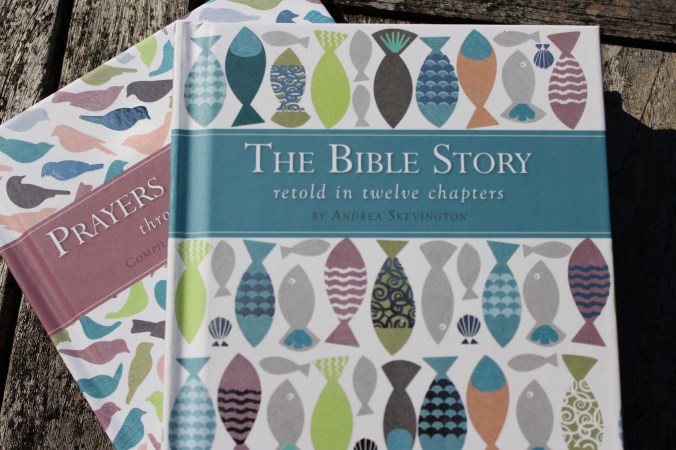
From The Bible Retold

Two other me were led out to be crucified with Jesus at Golgotha, the Place of the Skull: one on his left, and one on his right.  So Jesus was nailed to the cross, and a sign was hung above him, saying: “This is the King of the Jews.”
From the cross, Jesus spoke slowly, painfully.”Father, forgive them, for they do not know what they are doing.”
But some among the crowd sneered, “Save yourself if you really are chosen by God.  You saved others!”
The soldiers joined in, as did one of the men being crucified with Jesus. But the other said, “Don’t you fear God, at the hour of your death?  We are guilty, but this man has done nothing wrong.”  He turned his head towards Jesus. “Jesus, remember me when you come into your kingdom!”

And from Prayers and Verses

Dear God,
May I welcome you as my king:
King of peace,
King of love,
King in death,
King of life.

Jesus, who walked to the cross,
be with us when we feel abandoned.

Jesus, who walked to the cross,
be with us when we face danger.

Jesus, who walked to the cross,
be with us when we are suffering.

When sorrow threatens to defeat us,
Jesus, who rose from the dead, be with us.

Come, O Joy:
Let heaven break into my dark night of sorrow
like the early dawn of a summer morning.


Photos by my husband Peter Skevington, with thanks.
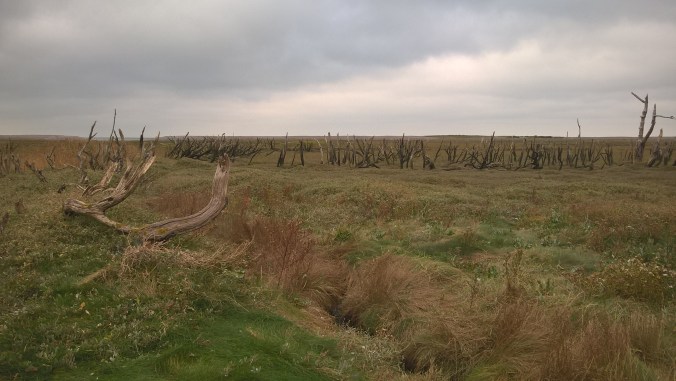
Top – marshes by Porlock, Exmooor.
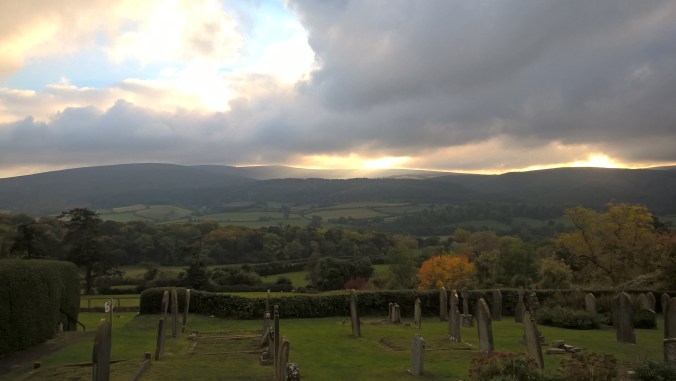
Bottom – the view from Selworthy, Exmoor.
 

img_0609

Mud from Coleridge’s Garden

IMG_0713.JPG

The Ancient Mariner, at Watchet harbour, where the poem unfolded in Coleridge’s mind. The rope is particularly powerful.


On our Somerset holiday, we visited Coleridge Cottage.  I was not expecting to be so overcome by the place.  Each room was full of connections to his life and work.  Each room echoed with the poems – they flowed across the walls, they came out of the earphones by easy chairs, they whispered to me out of the leaves of books.  To be in the room where he wrote Frost at Midnight  and to sit in the Lime Tree Bower  were deeply moving experiences.  I still remember my marvelous English teacher, Miss Rowlat, talking to us about the Lyrical Ballads, with its paradigm shift of a Prologue, and then to be in the place where Coleridge and Wordsworth met and talked and where these ideas came into being – was beyond words. The Ancient Mariner found voice here, too.  So much wonder in one small, simple cottage. It is not often that I am left speechless.  I was here.

Mud from Coleridge’s Garden

I picked up my muddy shoe –
an unfamiliar pale grey clay,
a leaf stuck to the instep –
and slipped my hand inside
like a glove
as I looked for a cloth

and then I stopped.
It was that leaf,
I remembered the shape –
a jasmine leaf from
the Lime Tree Bower
where I had sat speechless
as I listened to that poem
so full of leaves,

and the pale grey clay
from the damp paths,
from that grassy space
so full of ordinary beauty
it filled me, too,
despite my already full heart.

I walk with muddy shoes now,
each day,
hoping to be rooted to that same earth,
leaving a sprinkling of
Coleridge’s garden
in this lighter, sandier soil.


Grundisburgh Cribfest, and The Little Christmas Tree

img_0739

img_0741

Rev Wendy Gourlay’s beautiful collage

img_0749

from the Polish mountains

img_0748

Cardboard City Crib – some interesting characters here.

img_0745

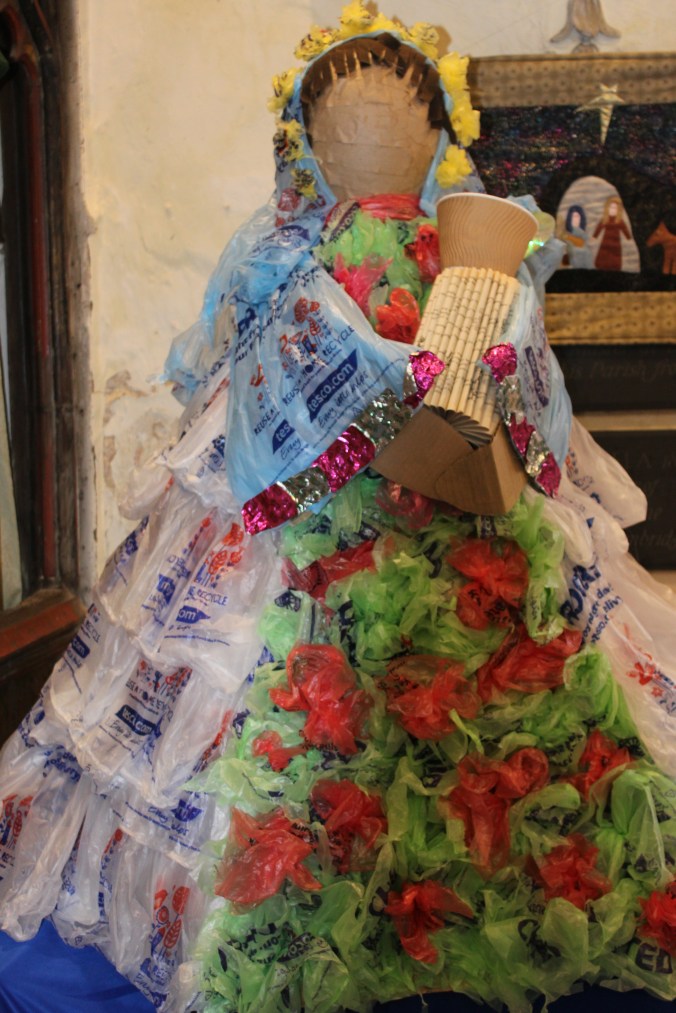
Angel from recycled materials – Jesus is made from a book, among other things….have a look! by St Mary’s School, Woodbridge

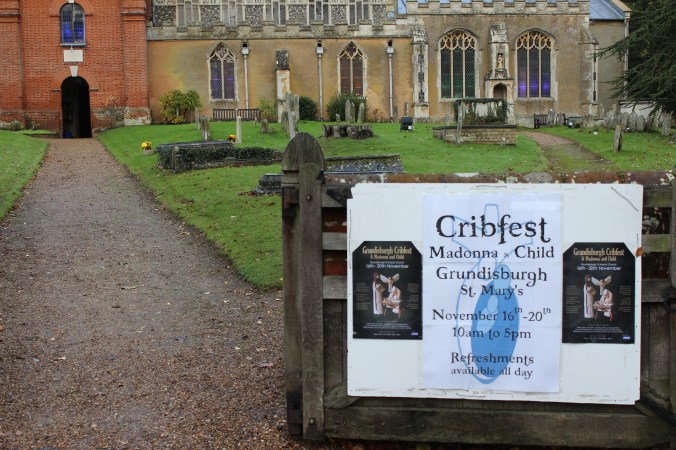
I have just spent a beautiful morning at St Mary’s Church, Grundisburgh, Suffolk.  Rev Canon Clare Sanders and her team were putting the finishing touches to their Cribfest, which opens tomorrow November 16th.  The church is full of Christmas cribs from around the world, with such variety of figures and materials.  It glitters with precious things made from sweet papers, it is full of wood and stone in its natural state, of Russian eggs, of tiny figures and huge angels.  Each one has a story to share, something to tell us.
There is also artwork from the village art club on display in the choir, and two large pieces made of Christmas cards.  The faces and hands are cut from the inside, showing the words of love and greeting that people have sent.

The more you look, the more you see.

I was there to read The Little Christmas Tree to children from the local school which was such a joy.  One half of the class was looking at the cribs, while the other listened to the story.

Do go to visit the Cribfest if you are in the area, it is well worth it.

christmas tree

Sorrows

IMG_0658.JPG

IMG_0682.JPG

IMG_0683.JPG

Much has happened this week.  Today, Remembrance Day in the UK, I am acutely aware of the importance of keeping peace between the nations, of reconciliation and forgiveness between us, of acceptance and inclusion for all.     Reconciliation, and an acknowledgement of the sacred worth of each individual human, seem further away now than they did.
This poem is a personal one, expressing something of an attempt to keep perspective among sorrows.  I know that for many, and for all of us from time to time, any such attempt can be impossible.  I wrote to try and express  what can feel like the constant task of not being overwhelmed, and to remind myself that when I can, it is worth the attempt.

I hope it also contains a gleam of hopeful truth.  Not a truth that ignores the darker realities, but that is prepared to see the possibility of light coming in the darkness. Both are real, but I find that if I can stay with the hope of dawn, even the darkness can take on a different quality.  Actions that lead to hope seem more possible, more achievable.  It is worth living for hope, not because the things we hope for will necessarily come, but at least in part because if we set our eyes on a kind and generous future, we are more likely to live in a kind and generous way now.  At least, I find that to be the case.
To all of you who are feeling a weight of sorrow, I hope this helps. May dawn come soon.

Sorrows

I carry stones in my arms.
They are grey,
and powder me
with dry dust.
They have sharp edges
my fingers find like
a tongue with a tooth.

When I notice,
I put them down,
stand up straight

Look, the sky is full of blue,
of high white clouds,
the trees chime with
golden pennies,
and a buzzard soars,
weightless, with its thin cry.

Look, there is one last flower
growing in the cracks,
and one last bee.

Who would have thought that losses
could be so heavy?
I find them lying on my eyes
in the dark, heavy and hot,
and on my heart and stomach,
heavy and cold.

I put them down.
Seventy times seven.
The work of Sisyphus.
Again. Again.

Look, there are stars in the darkness,
a whole Milky Way of them,
there is the softness of dawn light
coming, coming.
Take courage.
Begin again.

WP_20161027_10_12_18_Pro.jpg

Photographs are from the woods above Selworthy Green, Exmoor, and the coast at Watchet.

The reference seventy times seven is to something Jesus said when asked how often we need to forgive.  I used it here for any work where painful memory or thought keeps on surfacing, and we keep laying it down. Sisyphus  refers to the Greek myth of one who repeatedly rolls a boulder up a hill, only watch it roll down again.

Day of Prayer for Creation – a Parable

In the light of the USA’s election result, and Donald Trump’s views on Climate Change and the environment, I wanted to share this story with you again.

andreaskevington's avatarAndrea Skevington

IMG_0171.JPG

IMG_0174.JPG

IMG_0178.JPG

IMG_0167.JPG Photos of a walk taken near Wandlebury Ring and the old Roman Road, Cambridgeshire
September 1st is a day when we make Creation the focus of our prayers, knowing that others around the word are doing so. It is the first day of the Season of Creation, which ends on October 4th.  As I was praying for our hurting world, the story below came into my mind. I hope it may help you, as it has helped me, focus my prayers with urgency, and consider how I can live in a way which respects the beauty and glory of Creation, and the love of God for it all.  I have found, over recent years, my eyes and my heart have been opened to both the pain and beauty of the world around me, and the many ways the natural world is honoured in Scriptures, particularly in the prophets.

Jesus invited…

View original post 766 more words

Silk


matthew-spidersilk1

c 2016 Matthew Ling

matthew-spidersilk2

c 2016 Matthew Ling


WP_20161025_18_15_59_Pro.jpg

Selworthy Green, Peter Skevington

A November poem for today –
when the days are growing darker, a poem which tells of a moment of brilliant light.

When the sun is low, and when dawn and dusk happen at times when we are more likely to be about, we can sometimes catch a moment of pure glory, like this one.
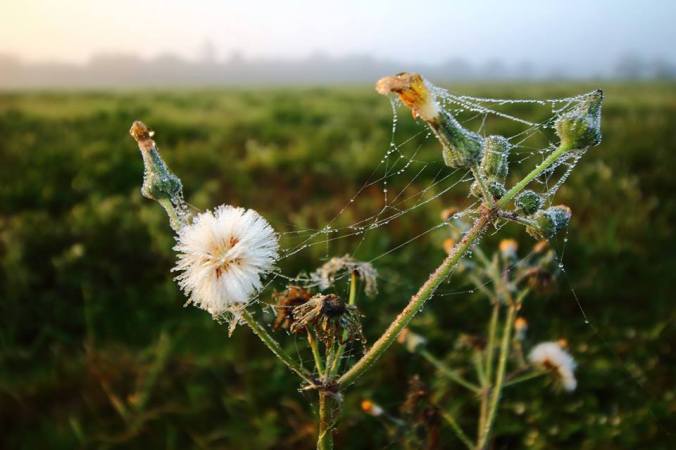
The sun hit an angle which not only illuminated the spidersilk that covered everything, but transformed it – the silk acting like a prism and splitting the light into its rainbow colours.
Everything in that plain muddy field shook with all the colours, all the light.
Even an unremarkable morning stroll can leave you breathless with wonder.
Even in dark times, we can look for the light.
Keep looking.


SILK

November – early morning –
clear sky – rising mist.
You note details, how it was
when it began,
when the spidersilk hummed with light,
the way a wire hums in the wind.

Just one or two threads at first,
then each blade of grass, each reed,
joined in strands of brilliant light.

Silver shakes and splits
into red, blue, violet.  Threads
shuddering into colours of such
brightness, such purity.

Even backs of crows
are iridescent white,
and heavy water-drops
that bend the reeds
flash indigo and orange

for a moment –
a long held breath
Then the silk turns silver again,
and then it vanishes.
Brown mud. Green grass.
A field where cows swish slow tails,
and the curlew and the heron
walk through reeds.

 
With thanks to Matthew Ling and Peter Skevington for the use of their beautiful photographs.

Selworthy Green

IMG_0667.JPG

WP_20161021_16_28_38_Pro.jpgIMG_0673.JPG


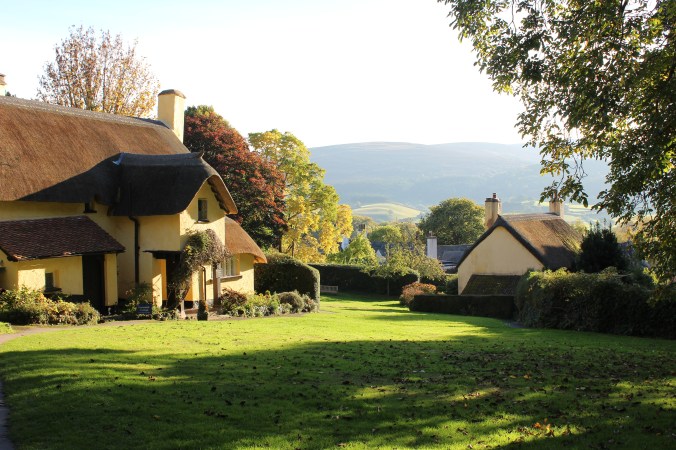
We’ve recently come back from a very tranquil holiday in Exmoor, at Selworthy Green.  Thatched cottages stand around the Green, while a little lane winds alongside towards the church.  It has views out over a valley to the moors, but itself is sheltered in beautiful, steep woodlands.  The cottages were built for pensioners, who were responsible for maintaining the woodland paths.  The tiny cottage where we stayed was home to the maid who took care of them.

Our first full day was bright and clear, and we spent all of it outside walking from our quiet base in the Green.  As the sun was beginning to go down, we sat at its highest point, and watched the light change over the hills.  My notebook came out, and I wrote this first:


Selworthy Green

Green is the colour of a stillness,
the kind of stillness
that is round and full
with a whole bellyful of life

like those apples over there,
clustered in shining handfuls
on the branch,
and the yellow green of the ash behind,
and behind that the olive of the holm oak,
and above and beyond that
the black green of the tall pines.

Breathe its sweetness,
its clearness,
as easy to a fragile body
as an oxygen mask
but with all this, all this, too.
You can’t take a breath,
can’t live,
without such gratitude
to the trees.

The Little Christmas Tree – a few pictures!

IMG_0624.JPG

img_0626

IMG_0627.JPG
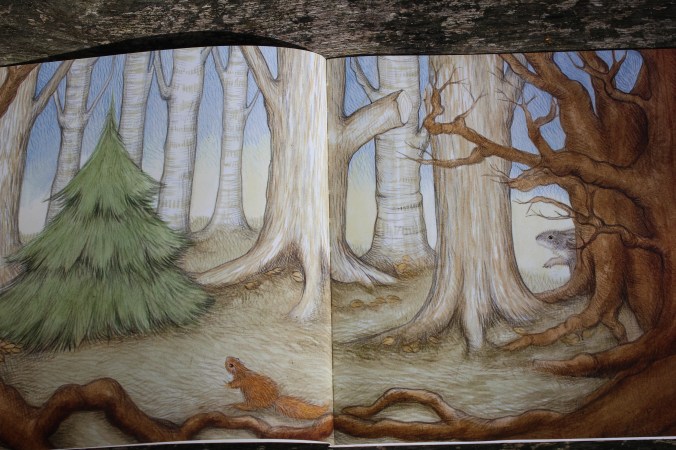
I love the illustrations for my first book by the fabulous Lorna Hussey, so I thought I would take it out on a sunny day and snap a few pictures to share with you.  She draws out the different characters of the trees so well, and the animals are delightful.  I am particularly fond of some of the minor characters, such as this beautiful owl, and the badger who appears later.

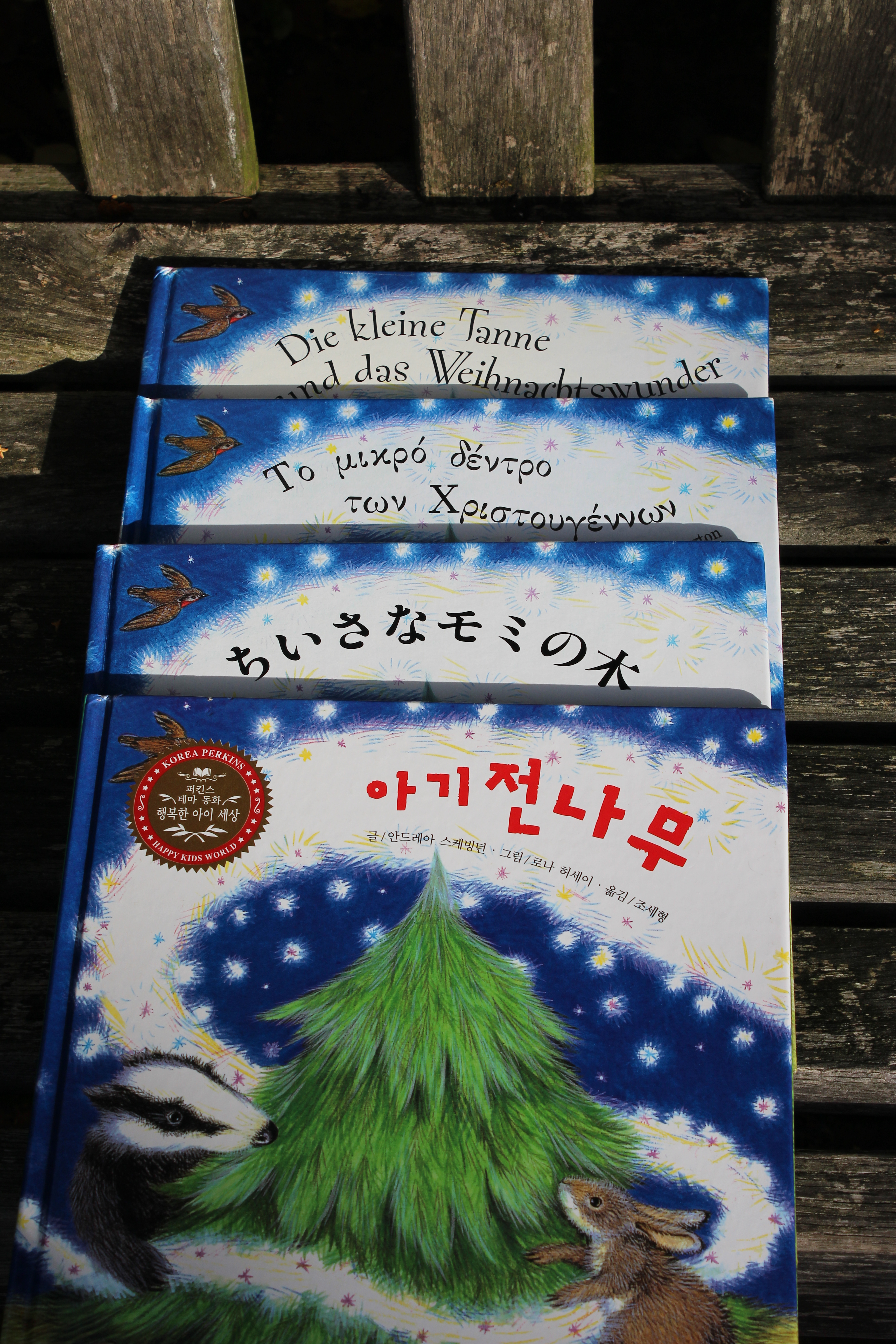
Whenever I take the book to schools, I always take the foreign editions.  The children enjoy trying to work out the different languages – and are particularly intrigued by the different scripts.  It’s a wonderful thought that the book has found  homes so far away.

I am very grateful for the way young readers have taken this book to their hearts.

The Little Christmas Tree remains a favourite of mine, too.
It is selling quite fast on Amazon at the moment, but other on-line shops and actual shops have it too if that’s your usual and it’s out of stock!  Here is a link to the publisher’s online shop

Sunday Teatime Penygroes – for All Souls Day

carmarthenshire-penygroes-emlyn-colliery

The second of November is marked as All Souls Day by many churches, following on from All Saints Day the day before.  As the nights close in, we remember those who have gone before us.  We honour their memory, and remember that we are not alone, that there is a cloud of witnesses in those who have gone before.  We treasure their wisdom and their memory.

I wrote this poem as I remembered a childhood visit to my great grandparents in South Wales.  I remember the sensation of going back in time, of encountering an entirely different age, it seemed to me.  I remembered their kindness, their gentle laughter, the way they switched between English and Welsh.

Recently I discovered something about my great grandfather that makes me immensely proud.  During the General Strike of 1926, he was arrested and imprisoned for leading out 800 miners in support of their colleages who were suffering terrible hardship.  He was a man of honour and principle, a man of deep faith.

There are many others who have gone before us, whose lives we may barely know.  Today, we remember those we do know, we remember them in the love of God.


SUNDAY TEATIME –  PEN-Y-GROES

I remember that room so clearly.
My last visit,
although I didn’t know, then.
The room was dark,
peaceful among voices.
Rich browns of paint and polish.
The black kettle over the fire.
The tick of a clock.
Two voices speaking in
two tongues of
times far back,
tunnel-dark under the earth.
The smell of coal.
The smell of baking,

The table spread.
A gold-brown velvet cloth
topped with creamy-white lace.
Best china – edged with
gold like an open Bible.  Quiet.
While through the window were
row after row of cabbages and leeks
and tomatoes, waiting in the green sun.
The henhouse was empty.
They used to scratch and cluck
they said, and smiled.
So much, so much is left behind.
This poem was first published in Poems to help you through the Week