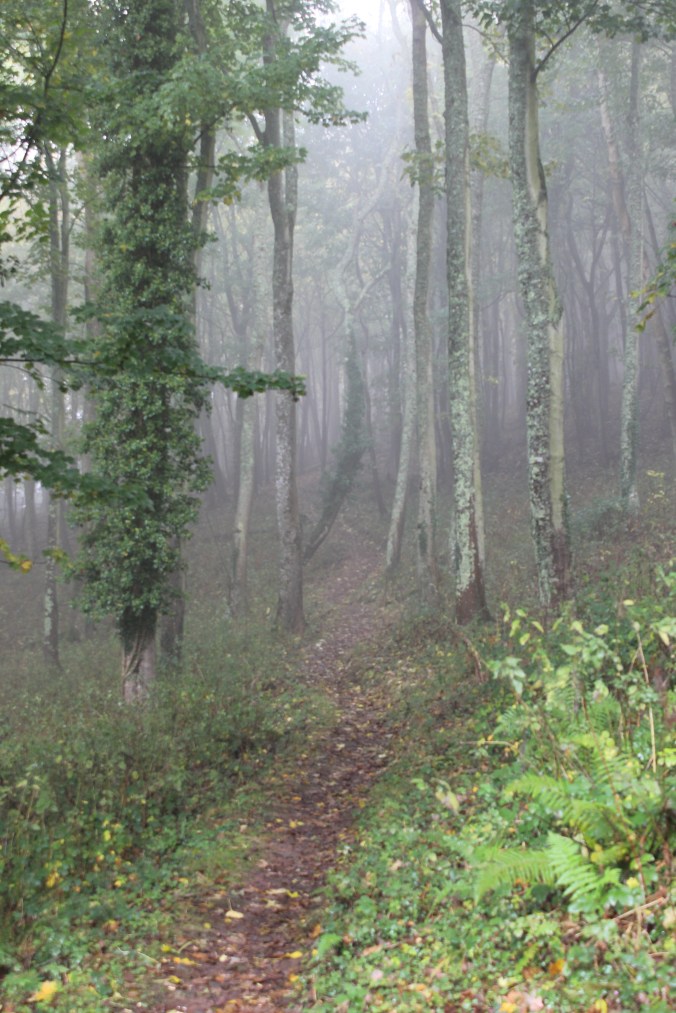
I wrote this when it was darkening fast – by the end I could not see the marks my pencil was making in my notebook. Darkness comes so early now, but that change into night is beautiful, and, if we can take a moment to notice it, has things to teach us too.
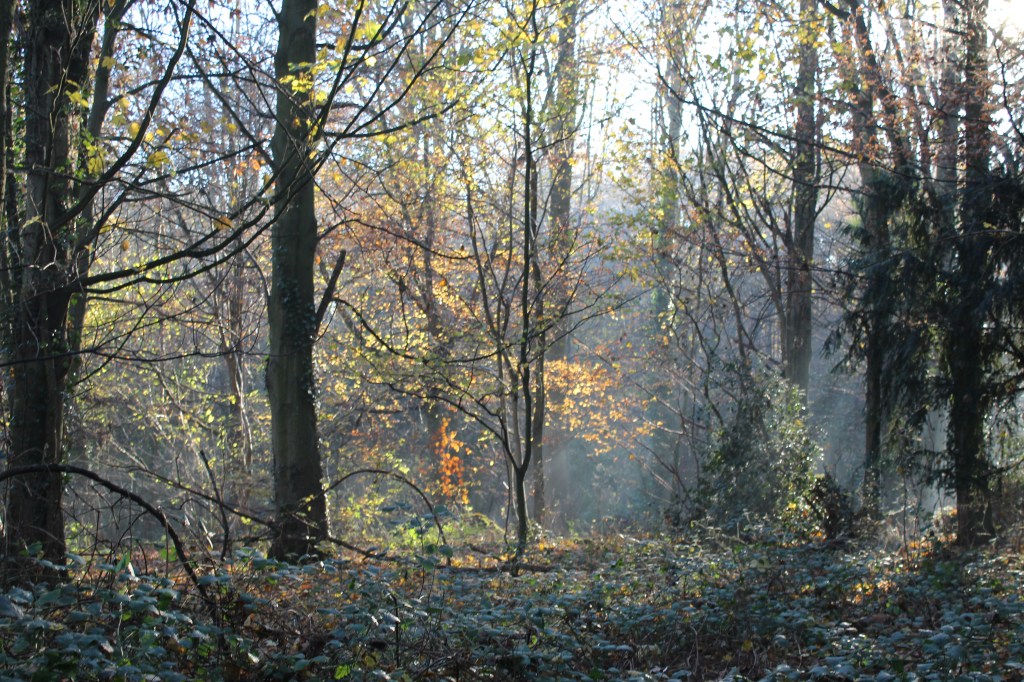
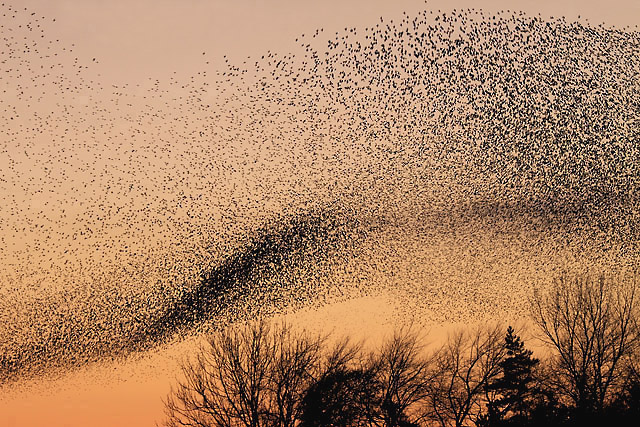
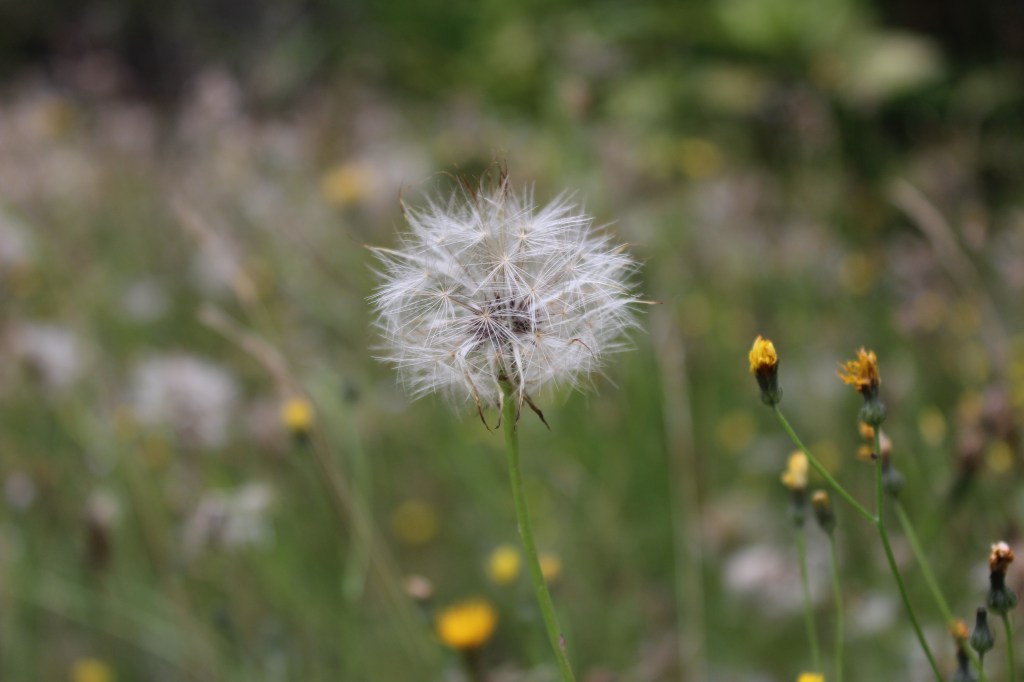
So I have no photo of this moment, but am offering you others from autumn, and hope that you will have a chance to look out of the window, or walk through darkening paths, and see the trees as they settle for the winter, and the birds as they settle for the night.
November trees – twilight
It grows dark. The trees are black lines against a yellow sky which shines, illuminating through a net of ink, and the last birds drift overhead to their roosts by the river, and the last birds murmur and settle in those darkening trees,
And quiet sadness creeps like frost across the grass, as the last flowers bow their rimy heads.
And suddenly, the question – What are we to do? seems a different kind of puzzle. Not one to solve, but one to lay down, in its many pieces, on the cold grass, slowly, in wonder.
All this before me knows what to do, and does it. Rooted, patient, receiving the weather like weather – whatever comes, comes.
From this place, it will act when action stirs it with the unsettling brightness of spring. When the ink stirs once more with green sap.
Until then, the cold trees will net the light, and wait, and deepen, the darkness will spread as I am learning to be grateful for this breath, to watch this red leaf spin on a thread of spiders web, to feel the cold sting me alive.
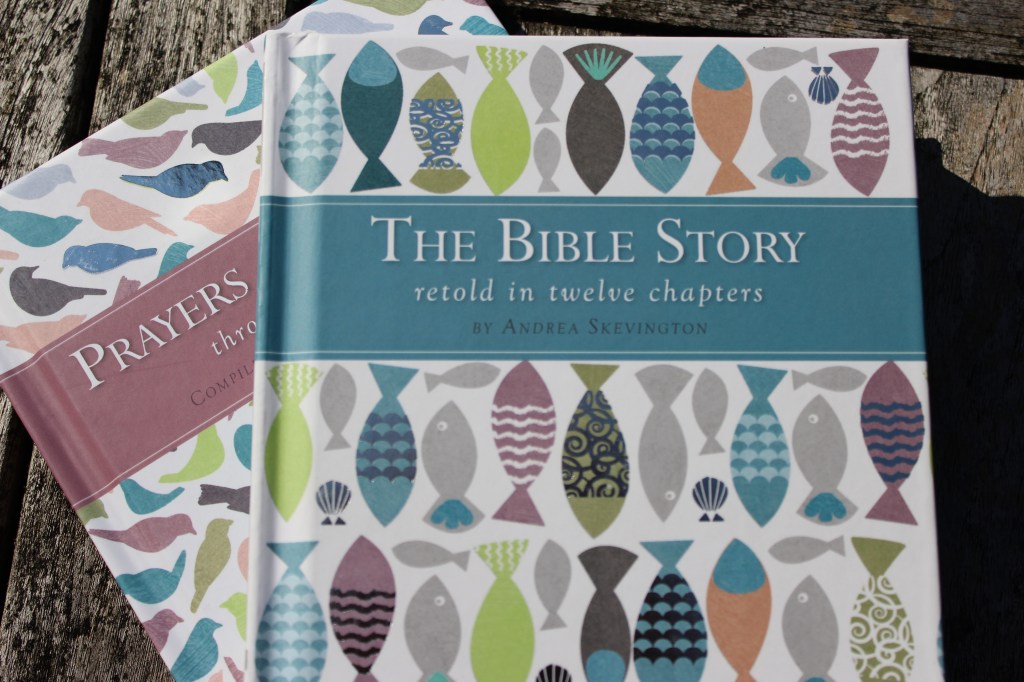
Sitting alongside my series of poems drawn from Exodus, I’m sharing retellings from my book, The Bible Story Retold. I hope this gives some shape and context to the poems, which are free meditations, drawing on what has come up as I’ve spent time in prayer with the stories. This, on the plagues, is a companion to the most recent poem, Stone Heart/Let Go.
This is a hard story. The journey to liberation for the Hebrew people passes through great difficulty. The new beginning comes after a terrible ending. It is a story of the stubborn refusal of Pharaoh to let go, to release the people. It is the story of catastrophies piling up, one on another, or of a cascade of difficulty. Some of the Hebrew scholarship I’ve looked at in researching this section of the story invites us to consider how we can usefully refect on this section as environmental disaster, where exploiting the land and labour leads to these terrible consequences. One of the traditions of Hebrew scholarship is that of midrash, where different ways and levels of reading the story are held, each one having some light to shine for us. So there are, of course, other ways of seeing things, but for me, now, this one is speaking, and illuminating a path to action..
What if we, as individuals and as a culture, let people go, released them, allowed people to do something as apparently unproductive as to journey into the wilderness, and worship? What if we acknowledged that God desires justice, and mercy, and humble walking? I wonder what that would mean for us. Perhaps there is some hope for us, as we find ourselves at a time when difficulties mount up, when things are falling apart,that this could be a turning point, part of the process necessary for things to change.
It’s a long extract, so I’ll leave it to say what it says. You can find the Exodus account from Chapter 7 to Chapter 12, if you would like to read the original. I hope to write about the last plague, but now doesn’t seem the right time. Now, I’m turning my attention to Advent, and hope. When I do write the end of the Exodus series, I’ll share it with you here, and put together a post to help find all the Exodus material together.
Ten Blows for Egypt
Moses and Aaron warned Pharaoh of the terrible things that would happen if he did not set the slaves free, but he would not listen. And so, it began.
First, they spoke to Pharaoh by the Nile as he went down to bathe. Moses and Aaron stood by the banks of the river and said, “This is what our God says: you must free our people to go to the wilderness. If you won’t listen, the river will become blood red, undrinkable, stinking. Egypt will be thirsty.”
Pharaoh turned away and carried on toward the bathing place. Then Aaron raised his staff and brought it down on the water with a mighty splash. The water swirled, thickened, and reddened, like blood, and gave off a foul smell. Fish floated gasping to the surface and died. But Pharaoh’s magicians could change water too, so he simply went back to the palace, unimpressed. He would not let the people go.
Second came the frogs. Once again Moses and Aaron warned Pharaoh, and once again he ignored them. So Aaron went around the land, stretching his staff over the Nile and all of the pools and ditches. They heaved and swarmed with frogs. The frogs came up into people’s houses, hopping on beds, clustering together on the plates.
Pharaoh was disgusted. “Yes, yes, I’ll let them go!” he said, and Moses prayed to God, and the frogs died. The Egyptians swept them into festing heaps. But then Pharaoh changed his mind.
Third came the gnats. There was the warning, and the refusal, and then gnats rose up in clouds like the dust of the destert. All people and animals were covered with bloodsucking insects. There was no relief. Pharaoh’s magicians had never seen anything like it; “This is God’s doing,” they warned him. But Pharaoh’s heart was hard and stubborn. He would not let the people go.
Fourth came the flies. “Go and confront Pharaoh on his way to his bathing place. Tell him he must let my people go. Warn him of what will happen next – the air will be thick with flies. But they will not come to Goshen, the place where my people live.” God’s words were clear, but Pharaoh did not listen. Soon the air was loud with buzzing, and every surface was crawling with flies – all the food was speckled and black. Only Goshen was free from them.
“Go on, then,” said Pharaoh. “Go to the wilderness.” But then he changed his mind.
Fifth came the animals. Moses and Aaron warned Pharaoh, but his heart was as hard as ever. All the livestock sickened and died; all the cattle, the sheep, the horses that pulled the chariots, and the traders’ camels – all dead. Only the animals in Goshen were spared.
Sixth came boils. The warning was ignored once again, and Moses threw soot up in the air right in front of Pharaoh. The soot blew onto the people, and they were covered with red, pus-filled boils. The boils spread, but Pharaoh remained as hard and cold as stone.
Seventh came hail. “This is what God says,” Moses told Pharaoh. He’s warning you: ‘You’re still building your kingdom on the backs of my people. You do not recognize my power, and so you will see more of it. I will send hail. Get everything under cover, for nothing will survive.'”
Pharaoh’s servants heard these words, and some hurried to hide their families and animals. Then the sky boiled with clouds and shuddered with angry thunder, and the hail come down. Huge white hailstones bounced on the earth, smashing everything. Nothing could survive in the open – and the crops were pummelled to a sodden pulp. But in Goshen, the sky stayed clear.
Eighth came locusts. When Pharaoh’s court heard the terrible warnings, they said, “Why don’t you listen to these men and let the slaves go? Can’t you see that the whole country is being ruined?” But Pharaoh’s stony heard would not soften, and so a terrible army of locusts marched across the ground, hungrily devouring everything that had been smashed by the hail. Not a tree, not an ear of grain, was spared.
Ninth came a heavy, suffocating darkness. The air was thick and hard to breathe. Such was the darkness that for three days and nights no one could leave their homes. All sat and talked in whispers under its weight. except in Goshen, for there was light in Goshen.
Tenth was death. Terrible, terrible were the warnings that God gave, heavy with the knowledge that Pharaoh would not listen, for his heart was set against God and the Israelites.
“This is it: get ready. After the tenth blw, Pharaoh will beg you to leave,” God said. And so Moses and Aaron went to Pharaoh and warned him of the grief that would crush Egypt if he did not let the slaves go.
“This is the final message from God, your last chance to change your mind. Listen now to God’s last warning: ‘Every firstborn son will die. From Pharaoh’s son to the son of the lowest slave woman who grinds the grain by hand, no one will be spared if you do not spare my people. When this terrible thing happens, all our people, courteirs and servants alike, will beg on their knees that you let my people go.'”
Pharaoh listened in stony silence. He would not relent
From my book, “The Bible Story retold in twelve chapters”.
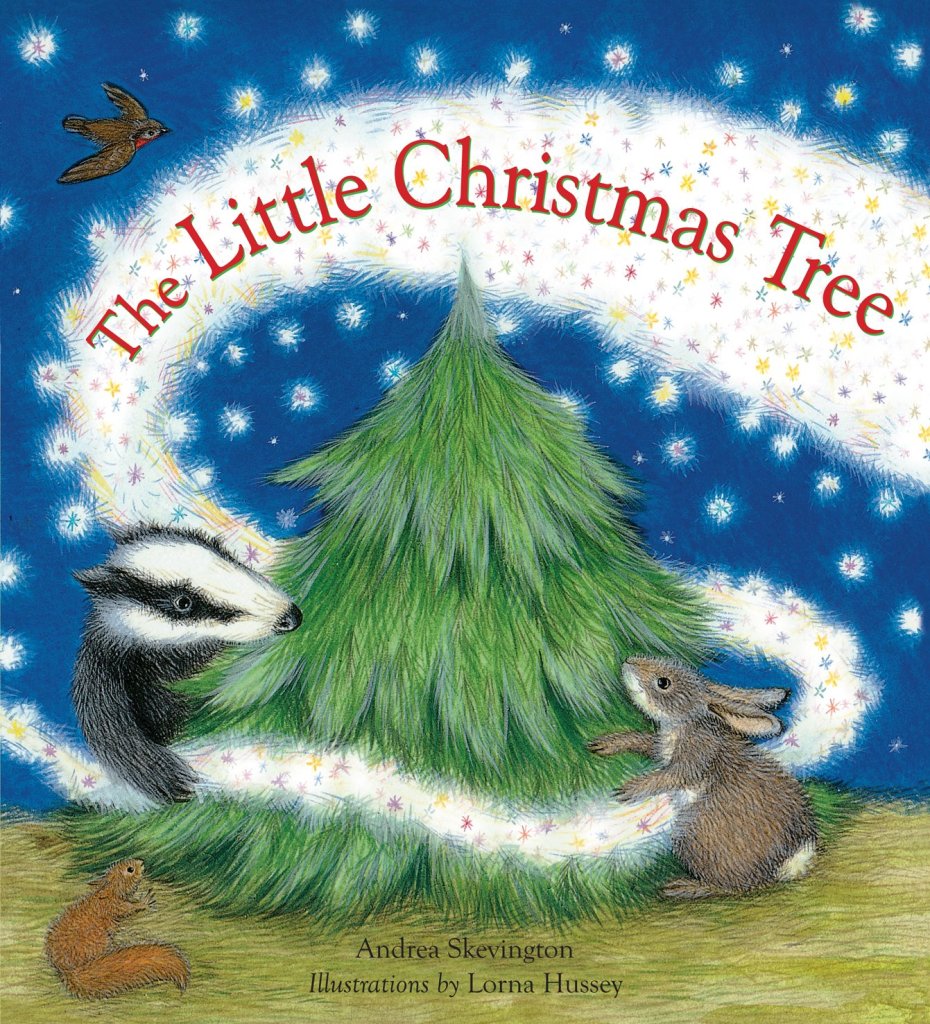
Last year, I shared with you how my children’s Christmas book had taken on a new resonance as we considered the need to protect our wild spaces – the home of so many beautiful creatures. The story is set in a wood, and the characters are the woodland animals. You can read more about it in last year’s post here. As we’ve been in lockdown, many of us have experienced a closer bond with nature, realising how important the natural world is to us. In simple ways, we can deepen that bond. I am finding it helps to care for the creatures I share my garden with – in the last few weeks I’ve built – or assembled – a hedgehog house, and put up a new bird feeding station. It gives me joy to watch the birds through my window, even as I’m typing away here.
This year, the story’s themes of kindness and hospitality, of gentleness and welcome, matter greatly. At a time when so many people in our community are facing loneliness and hardship, considering how we can best help when our usual practices of hospitality are not possible is very important. For instance food banks, and our Little Free Pantry, are a good way of giving and sharing if we can. A reverse advent calendar, where you add something to a box for every day leading up to Christmas, can be a way of sharing.
So that’s a couple of ideas that draw on the themes of the book. They might be appropriate for Advent this year, things we can do as individuals, households, or maybe schools. I’d like to share with you some ideas from other people, too…
I’m finding it’s really hard to think about Christmas this year – what might be possible, and what might be wise. It’s hard to think of not seeing those we love as we would wish, and it’s hard not being able to plan ahead. But we can begin. I am greatly encouraged that people are making plans, and beginning to get in touch and share how they’d like to use my books this year.
Here is the sparkly paperback edition
I’ll share something else about The Little Christmas Tree here, and then, an idea for another book another day!
The first idea comes from Janeene Streather, who makes engaging Youtube videos using BSL. Her videos are for the deaf community, their families, and schools – many of whom integrate some BSL into their classrooms and assemblies. You can find a link to her channel here.
She would like to make a BSL video of The Little Christmas Tree, as part of her series of stories for children. Once again, I’ll post more details when I have them. I hope to share the link with you, so you can easily watch Janneene.
For all of us, we are used to being able to visit schools, or churches, or share our work with communities in other ways, and are unable to do so this year. But we can share here.
Please do use these ideas and resources, acknowledging the source. If you’d like to use my book, I’d love to hear your ideas from you, and share them on here if you’d like me to.
If you’d like a copy, you may well be able to order through your local bookshop even if it’s closed. Alternatively, there are the usual online places. I’m particularly excited about this new venture, though, and commend it to you….
Bookshop.org is a new enterprise which supports local bookshops while selling online. It’s applying for B corporation status in the UK, which means it operates to high ethical standards and makes a positive contribution to communities. You can read a newspaper article about it here.
You can also find it on Eden bookshops, and all the other online shops.
Note and Correction:
In an earlier version of this post, I shared an idea for an outside nativity. I’d got my wires crossed and thought it was using The Little Christmas Tree. It will be using another of my books, The Bible Story Retold. You can read all about that here. Apologies for the muddle!
This week, as the darkness and the weather continue to close in, and the news is full of sadness and anger, I’ve been doing something I have never done before – as so many of us are.
I’ve been participating in an online retreat, by zoom, with the Community of Aiden and Hilda, which should have been at Lindisfarne – Holy Island. I’ve never been to such a retreat before, and had not planned to go, but I was encouraged by a friend to try, and dip my toes into those North Sea waters from further south. The week’s subject is The Way of Three, exploring the Celtic love of Trinity.
Celtic prayers and blessings are full of references to this threefold presence of God – not as inscrutable doctrine, but as a deep way of experiencing God, and indeed, all things. Its participatory, and dwells in the dance of interconnection. I have had a growing awareness of this other way of seeing, and just begin to explore it in the chapter on the True Vine in my book, Jesus said “I Am” – finding life in the everyday. You can read a little from that chapter here.
It’s a beautiful and wise retreat, full of welcome and love. I am so glad I joined. On the morning of the second day, I woke with a really strong sense of how everything is bound together, held together in love, and how our new understandings of interconnectedness in ecology and physics and computing and economics are opening our eyes to a new way of seeing and being in the word. As we see reality as interconnected, it gives us a picture, a frame, to help us see God as participating in a dance of love. We find it hard to open up our understanding of God, and these new ways of looking at the world can work as metaphors, helping us picture what is hard to comprehend. What was, at least to me, a doctrinal puzzle, from a perspective of separateness, is now something liveable, relevant, and joyful. It’s taking me a while to find a way of articulating and knowing more deeply this sense, but in the meantime, here is a poem, which I wrote that morning – the day before yesterday. I hope it helps.
One and many
In my garden, I greet the birds as they slow to land, and hop amongst the plants, and the feeders.
I greet too the plants, arriving more slowly still. I work with what is. I seek to welcome what grows, and as things come to the end, I thank them for their presence, their work in the garden.
This space is encircled with green, protected, so the sharing and flourishing is open, free. And within, and without, all is joined together in the air, the light, the rain, and the soil, the pale threads, deep, deep in the dark earth that join under fences and hedges.
Sometimes, I look and see this bird, this tree, and flower, and butterfly. And then my eyes widen, my focus shifts and I see the whole, bound together in all that is. I see one loud singing green, and that glorious, and that, welcoming me.
Be the eye of God dwelling with you, The foot of Christ in guidance with you, The shower of the Spirit pouring on you, Richly and generously.
This morning, I watched and listened to this beautiful piece by David Whyte – another blessing.
And a quote from today’s notes….
Maximus the Confessor (6th century theologian): “To contemplate the smallest object is to experience the Trinity: the very being of the object takes us back to the Father; the meaning it expresses, its logos, speaks to us of Logos; its growth to fulness and beauty reveals the Breath, the Life-giver.”
Over the summer, I had some dreams of what I might do come the autumn. I wasn’t too foolhardy in my dreaming, I knew that the pandemic was likely to bite back by winter, but I wasn’t anticipating it being quite so soon, or feel so much like tipping into darkness and confusion.
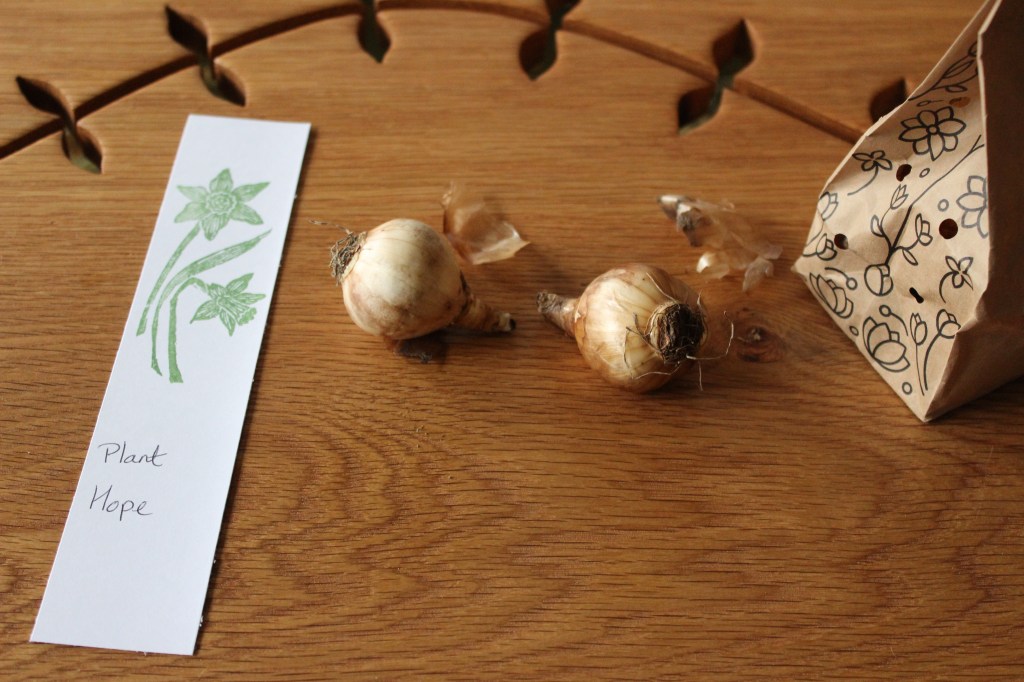
One of my dreams was to “do something” by way of creative protest in support of the environment, something small and local that would perhaps offer hope, and a touch of beauty. I had dreamed of a creative, peaceful presence in my town’s shopping street, giving out bookmarks and daffodil bulbs, encouraging people to #PlantHope. Somehow, I never quite got to the place where I felt brave enough to do it on my own, and I miss the collective gatherings where we can encourage and support each other to do things together. I miss church community, I miss other communities too of friends and likeminded people.
But I am thinking, it’s not too late to start something. And, as local people, and people far away, join me on this blog, I thought I’d share the idea with you, and see what happens. Release it, or plant it, and see what grows.
As the seasons are turning, I’m suprised to find how urgently I’m seeking to prepare for winter, and plant for spring. As news from the pandemic, the economy, the natural world feels grim, I am looking to the natural world to help me through this coming time, as it helped in the spring with the Lockdown Poems. And so the idea of #PlantHope began to grow in my mind. Maybe some would like to pick up the idea of giving out bulbs, observing social distancing. Maybe we can also all do some hopeplanting, or planthoping, in our gardens or windowsills, seeking to nurture and care for something green and growing over the winter, and into the spring.
A reminder not to give up. A reminder that nature is resillent, relentless in its capactity to grow and flourish in even the most difficult situations. It only needs a little light, a little water, and some hope.
Shall we give this a go? Shall we plant hope?
I made my bookmark with a stamp by the lovely Noolibird.
Yesterday was the Autumn Equinox, and now, today, there is more dark than light. Yesterday, too, in the UK, there were announcements from politicians about measures to slow the spread of the virus. We are still experiencing pandemic, and six months to the day the first lockdown began. Many will be feeling anxious about the thought of the winter ahead. It feels as if the world grows smaller again.
I’ve been exploring some aspects of our crisis in my meditations on Exodus. You can read the latest poem in that series here. In those reflections, I’ve had at the back of my mind how we hold on to hope in difficult times, and I’ve been thinking of hope as an act of defiance, a radical act. Today’s poem looks at joy in a similar way. As well as looking at the difficulties we face, I am seeking to cultivate joy too as an act of defiance, a radical posture that looks deeper than circumstance, real and pressing though that may be. Of course, it is not always possible. Sometimes, we sit with our sorrows, or our sorrows sit with us, and are reluctant to leave.
Often, though, we can take this stance. Maybe, we can receive both the gift and the grace of joy when it comes, and maybe we can also work to cultivate it as a habit, a practice, a spiritual discipline, a work.
Can we do that? Can we, at least some of the time, choose to take joy where we find it? And even cultivate it, and treasure it?
When that is too hard, perhaps even such beauty as this poem seeks to share will be some help.
On related themes, you might like to read two other poems: Moment/Joy Sorrows
Boyton marshes. Both photos by Peter Skevington
Wings
Boyton salt-marshes, Autumn Equinox
The hot lane is full of wings, rising over the sand-blown tar, spiralling together with the urgency of life.
Dragonflies, dozens – red, blue-green, yellow, joined or unjoined, flying with rainbows caught in their light, clear wings – I have never seen so many.
And large white butterflies dancing, spiralling, looking like great white poppies caught in the breeze, seeking each other, dazzling in the dazzling light.
How it lifts you to see them, how it lifts you to feel the warmth of the sun on your skin as it turns on its balance point towards sleep, and coldness.
And then, down past the foot ferry and the wild swimmers it all opens up – the great windy marsh-weave of river and saltwater, island and marshland, blue of the sky rippling in water, shining mud, and the hiss of rushes in the north wind
Which carries other wings. Long skeins and lines of loud geese, endlessly joined by threads of sound – the strong echoing call, the beat of thousands of wings that bring dark with them on their dark flight feathers, racing with cold at their backs.
And we know how winter comes, we know the night lengthens with its endless stars, we know our days grow short
Even as this joy rises, even as it rises up, bears you up like wings that beat with such effort of heart, with effort of voice to cry out, cry out like this – look, look how good it is, how good.
Here we are, then, in this series of poems drawn from my meditations on the book of Exodus – we have reached the first plague. The first of ten terrible blows to strike at the stony heart of Egypt, when Pharaoh refused to release his slaves from their labour.
You can read this section of the story, and reflections on its meaning for us, now, in our time of crisis, in my previous blog post here. As I’ve said, I find the story of the plagues hard to read, hard to understand in the terms it is set out. What I do see is a picture of God who longed for this people to be free, who cared for their suffering, and who asked their oppressors, through Moses, to release them. I see that the slaves found it hard to hold on to hope, as did Moses. I see how Moses and Aaron persist at risk to themselves, and their people, in asking for freedom, and to warn of the consequences if freedom is not granted.
It seems to me, that in the Hebrew scriptures, plagues and national disaster are linked to injustice – especially towards the vulnerable, and even to the land itself. We see this in the book of Amos especially, but it runs through the words of many prophets. However we interpret these stories, the ancient wisdom gives us connections between not following the ways of justice, and mercy, and peace, and the unravelling of nations.
This poem, like others in the series, is uncertain. We are part way through a story, and if we are to honour the story, we can acknowledge the confusion, the fear, that must have been felt by those who lived it. We are used to reading stories in the pages of scripture, and they can become, in time, stories we know well. We can forget that these people’s stories were full of deep uncertainty, fear, and confusion, as we find our own lives to be. But if we remember, and enter into them compassionately and prayerfully, we may see where they found their hope, and how they lived even when hope was not to be found. Perhaps we can draw some encouragement from their ancient wisdom.
This poem echoes the first in the series, Pharaoh’s daughter, and the child. It draws out the parallels between the beginning of Moses’ story, and this moment when the plagues begin. That seems significant to me.
Thank you for joining me on this walk through this most foundational of the Hebrew Scriptures. I hope it helps as we navigate our way through difficult times.
Moses waits by the Nile for Pharaoh. Exodus poems 9
Here you stand, by the place where your mother left you in a basket, where your sister stood watch, all those long, restless years ago.
In the place where a Princess’ attendant drew you out from the water, crying, out from the Nile-reeds, where crocodiles waited, out from the flood and the snakes and the hum of mosquitoes, out from the sentence of death – instead, adopting you, making you her own.
And now, all these long, restless years later, another from the royal house makes his way to the bathing place, just as she did, and will find you there
as you stand, with your brother by your side, as golden Nile-waters swirl and eddy and ripple outwards, outwards from the place where you stand, shining and fearful in the dawn light.
And, as there was no freedom to be granted that day, You raised high your staff, brought it down to strike that golden water which thickened and reddened and turned to blood.
And the Nile, which should be the life-blood of the land, became instead the blood of death. Death like that of newborns cast without help or mercy into these waters, long restless years ago, at the time when you were saved.
Judgement, could this be judgement, stretching out like darkness over a dark land?
Where is peace, and mercy, and life to be found now? Where a soft heart in this dry land? Where freedom?
I’m working on a poem based on the first of the ten plagues of Egypt, where the River Nile was turned to blood. It’s not easy, this whole business of plagues, as I’ve said before. It feels an ancient interpretation of events, and I’m seeking to be honest about the unease that interpretation stirs in me. At the same time, a series of catastrophies befalling a nation, even as great an empire as ancient Egypt, seems so current, so in line with our daily news broadcasts, that I’m sticking with it, and seeking to be open to the movement of the Spirit, to show us what wisdom, what help, there may be for us. One of my guiding principles when I find a passage difficult is to ponder – if all scripture is useful for teaching us goodness, then what use is this scripture? What goodness might be learned from it?
As I’ve been allowing my mind to inhabit the story, a number of things have come to mind, and won’t be shaken. The first is the symmetry of the story. The story most people remember about Moses – if they are familiar with the narrative at all – is how he was found by Pharaoh’s daughter in a basket concealed among the reeds in the Nile, found in the morning when she went to bathe. This new Pharaoh seems to keep to the same tradition, of visiting the river at dawn to bathe, accompanied by attendants. Moses therefore finds himself standing near the place where he was left by his mother, and found by the princess, waiting to challenge Pharaoh. The symmetry is so striking I’ll copy the retelling from my earlier post Retold : On the banks of the Nile.
“On the Banks of the Nile.
Jochebed and her daughter Miriam slipped out just before dawn. They walked silently, shapes blending into the darkness. At every sound they stopped, afraid the slave mastrs might hear them. They crept down to the green banks of the Nile, the great river that was the lifeblood of all Egypt. There, by the trembling papyrus, they stopped and set down their load. It was a tightly woven basket, a tiny boat, contaiing Jochebed’s three-month-old baby son. She lifted the lid and leaned down to kiss him, splashing him with her tears. Miriam said, “I’ll stay nearby and try to keep him safe….” Jocobed slid the little boat into the reeds, and ran back to her cramped mud-walled slave house. “May God protect and keep him!” she prayed. She knew Pharaoh wished her son dead, along with all the other Israelite baby boys. For the Egyptians hated the Israelites now. The Egyptians had forgotten how Joseph had saved them from starvation many generations ago. In Egypt, the Israelites had grown in number and strength, and the Egyptians looked at them with fear in their eyes. So they made them slaves, but they could not crush them. In his anger Pharaoh summoned the two midwives who delivered the Israelite babies, and gave them a terrible order: “When the babies are born, let the girls live, but kill the boys.” The midwives bowed as they left, but they would not do such a terrible thing! The baby boys continued to live, and grow strong. Then Pharaoh commaned everyone. Throw all the baby boys into the Nile!”
Miriam stayed by the Nile, hidden among the reeds near her tiny brother’s basket, and waited. Then she heard the sound of singing, and saw the princess, Pharaoh’s daughter, coming towards the river with her maids. Miriam hardly dared to breathe. Would the Egyptians find her brother? The princess and her attendants were so close now. Miriam watched the princess take off her jewels and glide into the water. It shimmered like gold in the early morning light. Then the princess stopped. She had seen the basket in the reeds, and sent one of the slave girls to fetch it. Peering inside, the princess saw the baby crying. Her heart melted. “This is one of the Israelite babies!” she said. Miriam seized her chance. She scrambled out of the reeds, and bowed down before the princess. Swallowing her fear, she spoke. “Your Highness, shall I find one of the Israelite women to nurse this baby for you?” “Why yes, go as quick as you can!” For the baby was crying very hungrily indeed. Miriam ran back home to get her mother. “Care for this child, and bring him back to me when he is weaned. I’ll pay you for your trouble!” said the princess, gently placing the baby in Jochebed’s arms. Jochebed’s heart nearly burst with joy. She had her son back! So she sang him Hebrew songs, the songs of the Israelites, and told him of thier God, and his promises, while he was a young child. She prayed for him, and cared for him tenderly until it was time to give him up to Pharaoh’s daughter. The princess called him Moses, and adopted him as her own son. He grew up as an Egyptian prince, educated by the best tutors and trained to rule.” From The Bible Story Retold
Within this symmetry is also a terrible symmetry of justice. This is the subject of the poem I’m still working on, so I’ll say more when I share that with you. But I’m sure you’ll note, if you read the story above, that the river at this time was a place of death for the baby boys born to the Hebrew slaves. The river that was the life-blood of Egypt had become for them a place of death. On doing a bit of research, it seems that some ancient commentators suggest that this first plague was a punishment of the Egyptians for that terrible act, and that ties in with description of the plagues as judgement. My previous poem, The space in between, also holds this possibility.
Others see the plagues as a challenge to the Egyptian gods, and this one is a challenge to Hapi, often seen as a symbol of life and fertility brought by the river’s floods. As we’ve seen, the cruelty of the command to throw the babies into the Nile is in itself a serious undermining of that understanding of the river as a source of life and fertility, and perhaps an offence to those principles even under the Egyptian’s own belief system.
If there is some truth in these understandings, then this first plague might also be a foreshadowing, a forewarning of the last and most terrible – the death of the firstborn boys. We shall explore further.
For now, here is the fragment of story we are dealing with, taken, as they all are, from my book, The Bible Story Retold.
Moses and Aaron warned Pharaoh of the terrible things that would happen if he did not set the slaves free, but he would not listen. And so, it began.
First they spoke to Pharaoh by the Nile as he went down to bathe. Moses and Aaron stood by the banks of the river and said, “This is what our God says: you must free our people to go to the wilderness. If you won’t listen, the river will become blood red, undrinkable, stinking. Egypt will be thirsty.”
Pharaoh turned away and carried on toward the bathing place. Then Aaron raised his staff and brought it down on the water with a mighty splash. The water swirled, thickened, and reddened, like blood, and gave off a foul smell. Fish floated gasping to the surface and died. But Pharaoh’s magicians could change water too, so he simply went back to the palace, unimpressed. He would not let the people go.
From “The Bible Story Retold in Twelve Chapters”, published by Lion
The next thing I’ve been thinking about in the light of this passage, is our own waterways, and whether they bring life, or death. If this difficult passage is useful, and I believe it is, one of the things that it may be teaching us is that actions have consequences. We can live harmoniously with God, with each other, with creation, or not. And those choices have consequences.
Yesterday, it was revealed that not a single one of Britain’s rivers met water quality standards. This is terrible, a tragedy for all the life that depends on rivers. And all life does depend on water. As we reflect on the ancient story of the Nile, the lifeblood of the country, turning undrinkable, we can remember how important our own rivers are, and how the actions of people, and corporations, may make them instruments of harm, rather than good. If this passage is to train us in goodness, and perhaps rebuke us, this is one way we can permit it to do so.
We can seek to become aquainted with our own rivers, our own watershed, and seek to care for it – perhaps with a litter pick, or perhaps with simply our respect and affection. Maybe, as we explore, we may notice things that spoil – outlet pipes, plans for unsympathetic development – and then take action. We may notice things that help – conservation efforts, stands of trees, efforts to clean up rubbish – and wish to join in. We’ve been walking our river the Deben over the lockdown, and you can read a poem about that here. If we start with love, and respect, then our care may lead to different action.
Perhaps you can see why it’s taking me a while to write my poem about this first plague! There has been much for me to think about, to prayerfully mull over. I’ll share it when it’s ready, and I hope that’ll be soon. Thank you for joining me on this Exodus journey.
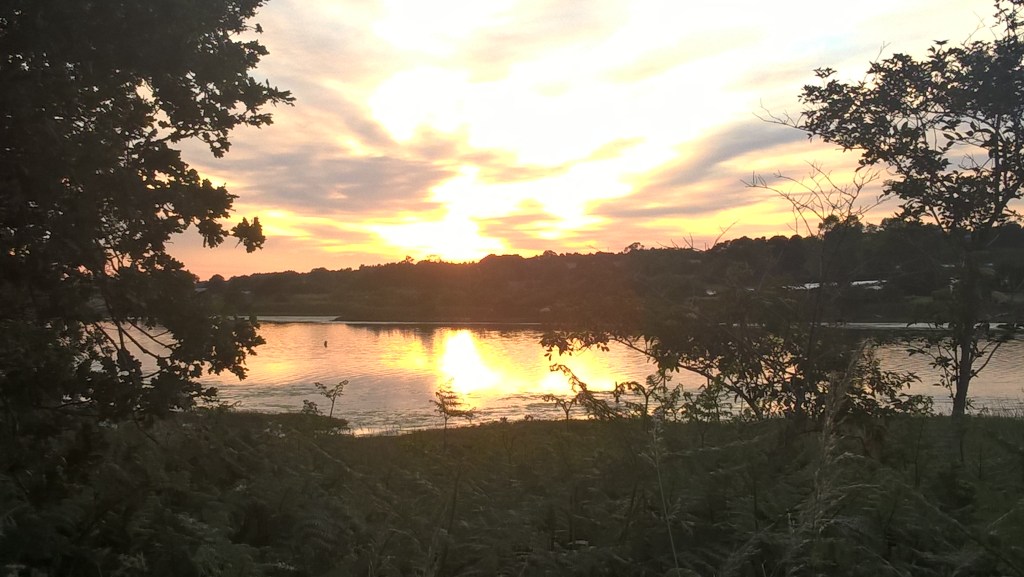
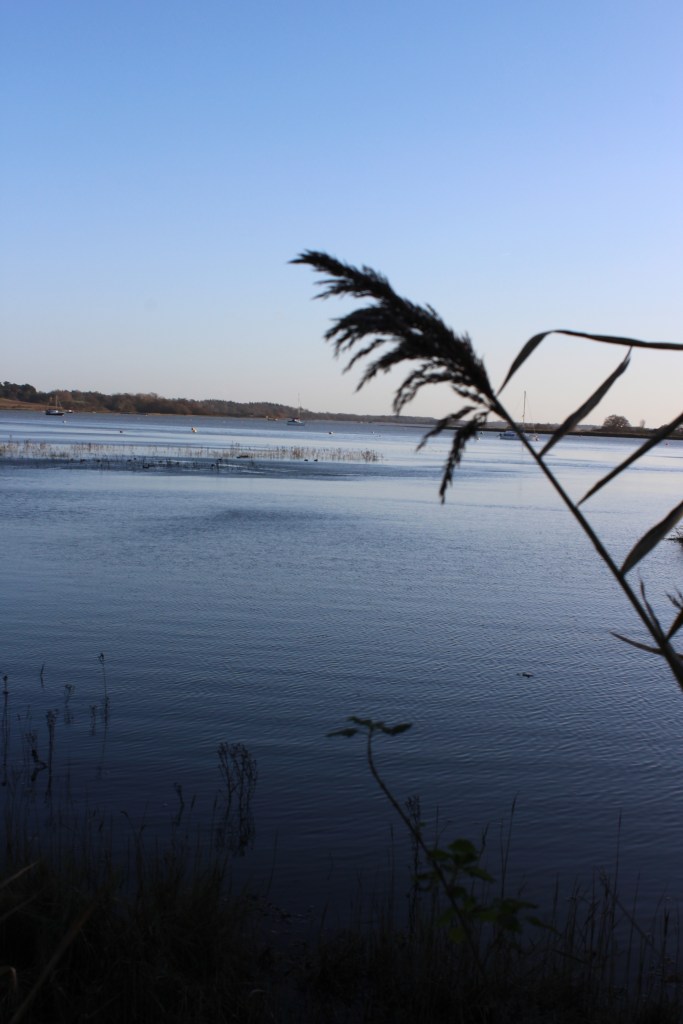
Photos of the River Deben, dusk – an in-between time.
Welcome to this continuing series of poems drawn from the ancient account of Exodus. I’m finding some common ground with current events, and much wisdom, in that story. It’s an account, from the perspective of the slaves, of their journey to freedom from the Egyptians. Both Hebrew and Egyptian suffer on that journey.
It’s taking me a little time to come to meditating on the plagues that beset Egypt. In many ways, it seems to raw, too close in the time of pandemic and climate upheaval, as well as a challenge of interpretation. What does it mean, to speak of God acting in these ways?
If you’d like to read more about the story so far, you can do so here.
For now, I feel I am standing on the brink of the time of plagues. Still in the space in between, between the request Moses makes – Let my people go – and the beginnings of the consequences for Pharaoh of his stony and cruel response. But I’m nearly there. Watching the news yesterday evening, I felt like I was watching something like it beginning to unfold in real time. The pandemic is accelerating once more, beginning to break away from attempts to manage it, and many are now enduring the related sorrows of environmental destruction with Atlantic hurricanes, wildfires, and difficulties with harvest. In response, we have the understandable political upheavals that arise at a time of fear and uncertainty. On Sunday, in the UK, we watched David Attenborough’s remarkable programme on Extinction, which helped us see a little more clearly how these different elements are related, related to our lack of care for the Earth, and for each other. Even those of us who live in what we may regard as a developed country, with a tradition of plentiful resources, can see this does not protect us from the common fate. Being a great and long-lasting empire did not protect the Egyptians. We are all connected.
In some ways, this gives me hope, as we can work together on deep-level solutions to all of these, by seeking to love and tend the earth, and to act with justice and mercy towards all – all creatures, all humans. It gives me hope that we will not be stony-hearted in the face of all this difficulty, not turn to fear, but instead, to compassion, justice, mercy, and the pursuit of the welfare of all. And where we cannot work together, we can take small steps ourselves. Jesus offers abundant life, God’s call is to live with peace – shalom, justice and mercy.
For now, we are in a space in between, where there is time – but we too are faced with questions about where we will stand at this moment, and also, how we will respond to the call for justice and freedom, just as Pharaoh was.
May we, this day, seek to live within God’s shalom, within abundant life, and justice, and mercy, for ourselves and for all.
The space in between – Exodus poems 8
You stood in the space in between palace and shanty, power and poverty, ease and despair, slavery, and freedom.
Knowing the language of both, being of-them but not-of-them both, you stand, now, and with such reluctance, such unquenchable fear, in this dark no-mans-land, this swirling God-space
You make in the court of Pharaoh as you ask for mercy, and freedom. It is holy ground, where you speak with the voice of the silenced, speak with the very voice of God, but no-one takes off their shoes.
You spoke to power, and it paid no heed.
And so, YHWH, breath, life, being, I am that I am, will stretch out a hand in justice. What follows will be strange justice, A steady unfolding of consequence, stretched out like darkness over the dark land.
This is the next poem in the series, continuing to stand in that difficult moment after Moses and Aaron had asked Pharaoh to let the people go, and before they reached their freedom.
At this point, as the slaves began to stand tall, and to hope, and to make their presence felt as fully human rather than cogs in the power machine of empire, things grew worse for them. Their labour was made harder. The first poem of this pair explores the moment more, and you can read it here.
It can be hard to see the way forward…..
Here in the UK, our steps towards returning to more normal patterns of work and school, of re-invigorating the bonds of family and community, are faltering, as we see that the virus is on the rise once more. Hope deferred is hard. Steps towards “building back better” seem to be faint and hard to find. Once again, we see those calling for a better world, for respect for all people and all living things, opposed.
But, but…… we know the right dwelling place for hope is in these dark and difficult times. Hope does not belong with blind and sunny optimism, but with the courage to walk along hard and stony ways, and to act from the faith that there is a movement towards goodness and justice and flourishing in the world. What is more, by acting, we can help bring such things about. We can know that Spirit broods over the face of chaos, seeking to nurture something new, and calls forth balance, harmony, and the flourishing of life.
So, as we reflect on how hard it must have been for the slaves, to see their hopes seemingly dashed, perhaps we can draw courage for our own situations, and know that this is part of the process, and that vision, and persistence, are powerful even in the face of those who seem to hold all the power.
If you would like to read more of the story, you can do so here.
Bricks without straw II Exodus Poems
Hope. The people hoped when they knew that God had heeded their pain
Spoken through fire and thorn, Spoken to Moses – the one placed between palace and slave, of-them, but not of-them.
Shown Signs – The staff-snake, the whitened skin, and its healing.
So long, so long looked for – through four long centuries of silence and slavery.
But see now how this hope has shattered. Their deliverers, Moses and Aaron have roused Pharaoh’s wrath put a sword into his hand.
Now, the people scour the fields bent double, gathering straw to make bricks out of mud. A cruel reversal of their old story, when God moulded the first human, in God’s own image, out of the very earth.
Instead of hope’s promise – liberation, a new land, they were crushed, broken breathed. They could no more hear the consolation of the prophet.
They dared not hope. Their state was worse than before.









 Andrea Skevington