Poem for Pentecost, and some readings

candles_flame_in_the_wind-other

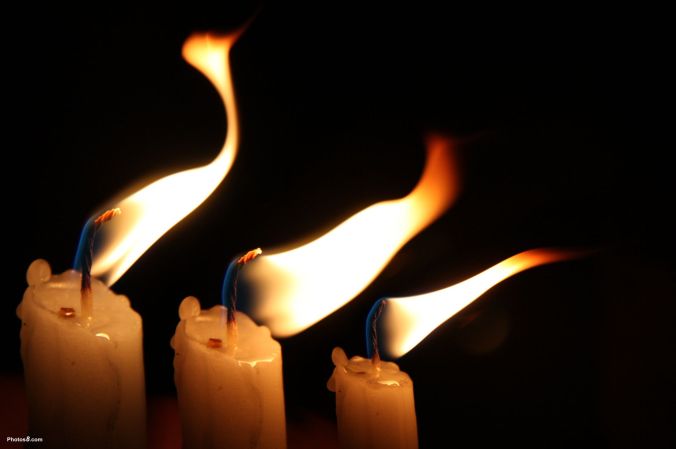
Wind and fire – two of the ways people have tried to describe the Spirit.

As we approach Pentecost Sunday, I am sharing with you some readings and a poem.  Please feel free to use them if they help you, saying where they are from.

Firstly, a reading from my book The Bible Retold


From the fields it came: the first sheaf of barley cut for that year’s harvest.  It was carried high through streets crammed with visitors, and on to the Temple. And then the priest offered it to God, giving thanks for the good land, and for the gift of harvest. For that day was the celebration of the first fruits.  It was Pentecost.

Meanwhile, the disciples were all together, waiting.  Then, suddenly, it began.  It stared with sound – a sound like the wind – but this was no gentle harvest breeze.  This was a shaking and a roaring: a sound of power, whooshing and howling about the house, rattling every door and shutter.  The sound seemed to come down from heaven itself, and filled the house as the wind fills sails.  Then, the disciples watched wide-eyed as something that looked like fire came down, and tongues of flame peeled off it and rested on each of them without burning them.  All of them were filled, for the Holy Spirit had come.  And as it happened, their tongues were loosened, and they began to speak as the Spirit gave them words.  These words were not Aramaic, their own language, but in languages that were unknown to them.
A crowd had gathered by the house because of the extraordinary sound, but then they heard voices. There were pilgrims in Jerusalem from all over the known world, and they recognized the words the disciples were speaking.
“He’s talking Egyptian!” said one.
“That one’s talking my language,” said a visitor from Crete – and the same was true for all.  Each person heard God’s praises in their own tongue.
“What can it mean?” they asked each other.  But others among the crowd joked that the disciples had been drinking.
The Twelve heard what they were saying, so Simon Peter stood up to speak to the crowds.
“Listen, I’ll tell you what’s happening.  We’re not drunk! It’s too early in the day for that! This is God’s promise come true.  Do you remember what one of the prophets wrote long ago?
I’ll pour out my Spirit on everyone – young and old.
Your sons and daughters will prophesy,
young men will have visions, and old men dreams.
All who follow me – men and women – will
be given my Spirit, and there will be wonders!


4epenb-jyoti-sahi-pentecost

And in response, some prayers from Prayers and Verses

Christ has no body now on earth but yours,
no hands but yours, no feet but yours…
Yours are the feet with which he is to go
about doing good,
and yours are the hands with which he is to
bless us now.
St Theresa of Avila 1515-82


Pentecost

Spirit of God
put love in my life.
Spirit of God
put joy in my life.
Spirit of God
put peace in my life.
Spirit of God
make me patient.
Spirit of God
make me kind.
Spirit of God
make me good.
Spirit of God
give me faithfulness.
Spirit of God
give me humility.
Spirit of God
give me self-control.

From Galatians 5:22–23

When I’m retelling stories from the Bible, I often spend time before them quietly, sinking into the story, wondering what it would have been like to have been there, to have seen and heard and felt…..  As well as the retelling, this poem emerged from that process of contemplation.

SPIRIT

How would it feel, then, to live
in that God-shaken house?
To feel the wind,
like the very breath of life,
like the stirring of the
deep before time,
gusting through these small
daily rooms, clattering and pressing
against doors and shutters,
not to be contained?

How would it feel to look up, eyes
dried by wind-force,
and see fire falling, flames bright
and crackling, and resting with
heat that does not burn on each
wondrous head?

To be blown open
lock-sprung
lifted
with wild reckless joy
as words tumble out into
the clear singing light?

It would feel like this,
it feels like this,
and it is still only morning.


Acts 2 1-4
This post draws on the series Sunday Retold


IMG_0557


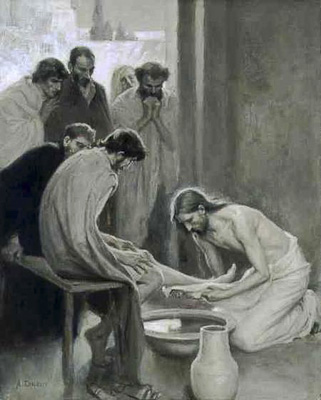
Poem: Jesus washes Judas’ feet.

Jesus Washing Feet 11

Jesus Washing the Feet of his Disciples, 1898 (oil and grisaille on paper) by Edelfelt, Albert Gustaf Aristides (1854-1905)© Nationalmuseum, Stockholm, Sweden Finnish, out of copyright

Why did Judas do what he did?


We can’t know, of course.
Can we seek to imagine what motivated something so terrible?
Might it help to do so?

It is a truly terrible thing to betray a friend, but maybe Judas was expecting a very different outcome.  Maybe.

Maybe he  thought there was a good to be served by doing what he did. He must have felt he had a reason. Maybe he was trying to force Jesus’ hand, make him reveal and initiate the Kingdom in a dramatic burst.  Maybe, an idealist, he was disillusioned with small progress, maybe the way things were turning out was not what he expected or felt he signed up for.

Having wondered this, having thought, too, how well Jesus knew Judas, and that he knew what Judas was intending to do, I imagined that instead.  I wrote a response.

Here it is.


Jesus washes Judas’ feet.

That moment, when you knelt before him,
took off his sandals, readied the water,
did you look up?  Search his eyes?
Find in them some love, some trace
of all that had passed between you?

As you washed his feet, holding them in your hand,
watching the cool water soak away the dirt,
feeling bones through hard skin,
you knew he would leave the lit room,
and slip out into the dark night.

And yet, with these small daily things –
with washing, with breaking and sharing bread,
you reached out your hand, touched, fed.
Look, the kingdom is like this:

as small as a mustard seed, as yeast,
a box of treasure hidden away beneath the dirt.
See how such things become charged,
mighty, when so full of love. This is the way.

In that moment, when silence ebbed between you,
and you wrapped a towel around your waist;
when you knew, and he knew,  what would be,
you knelt before him, even so, and took off
his sandals, and gently washed his feet.
Judas Norwich.png

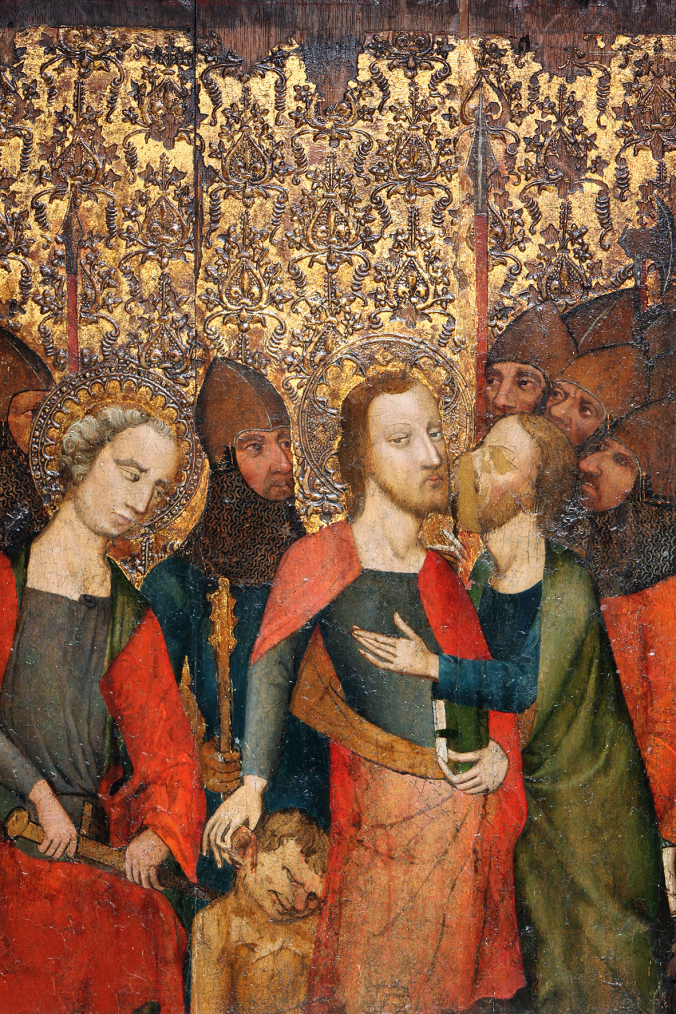
This is a picture that was in display at the Chapel of the Holy Innocents, Norwich Cathedral.  It shows the Jesus being betrayed, and healing, at the same moment.
I write about it in the last chapter of Jesus said, I am – finding life in the everyday
You might like to read the gospel story in John 13

A Poem for the road – Returning

WP_20161106_12_24_49_Pro.jpgWP_20161113_16_45_08_Pro.jpgWP_20170114_10_57_06_Pro.jpg

As we enter into Lent, I have been thinking about pilgrimage, journeys, wandering in a wilderness, being unsure of the way and the destination.  I have been reading Malcolm Guite’s wonderful Word in the Wilderness anthology of poetry, and I turned back to this poem of mine, and looked at it through the eyes of the wanderer in the desert.

The poem was written a few years ago for the Alive Festival, which used to run here in Suffolk, UK.  We were looking for something for our Sunday morning gathering, something which spoke of our sense of longing for home. Something that would help with the journey.  As I was searching, these words began to circle in my mind  They would not leave me alone.  I had to walk them out, pacing restlessly until the poem below took its form.

It draws from many of the stories in the Bible which help us make sense of our life’s journey.  They filled my mind as I paced.  Imagery from Genesis 3 which many churches read together as we prepare for Easter, seemed the starting point.  I moved on to homesickness and exile, which are threads that run through much of the Hebrew scriptures, and also of the discomfort of wilderness, which seems very good to remember now, as we think of Jesus in the wilderness.   But I did not stay there.  My imagination circled round to images drawn from the very end of the book of Revelation  All these images flowed together, as part of a larger, arching story.

I read this poem that morning at the Alive festival, set to  astonishingly beautiful music – Arvo Paart’s Spiegel im Spiegel , played then by Andrew Lord and Jonathan Evans.  The music still moves me to tears.

I hope this poem helps you today, as you walk, whether the way seems hard, or gentle.  May you come to a place of home.


Returning

We left the garden long ago,
Do you remember, though,
still, the trees heavy with fruit,
and how sweet it was?
To stretch out your hand was to be blessed.
Do you remember the cool waters of that deep river
silver with fish, alive and shining in the splashing sun?
And the flowers, bending and bending with the
weight of bees, the low hum of the land
that flowed with milk and honey?
He walked with us then, in the garden.

We have been wanderers for so long
in strange lands, wanderers looking
for a place of shelter, a place to lay down
the heavy loads we gathered at the gate,
when we left the garden. The pain we bear
so hard to bear for it is borne alone.

Our songs dried on our lips, the echoes of the
garden growing distant, and small:
the rhymes of the children playing in the apple tree,
the laughter and the ease of love,
hope’s courage    failing as the long dry road
wound through high and rocky passes
where nothing grows.

The path home is long, but that it what it is,
the path home to the garden,
to return to that place so distant
it has become the place of dreams.
And the gate stands before us,
terrible and splashed with blood,
the gate love made to bring us home.
And the gate is always open,
and beyond, beyond the Tree grows strong,
its green leaves fresh and full of light,
And the river flows deep and wide,
Deep, and wide, and always.
And you know the voice,
you have heard the voice say
Come, all you who have been thirsty for so long,
Come and lay your burdens down,
rest, and drink from these bright waters.
I am your home, your refuge, your song.

You can listen to the poem here.

IMG_0790.JPG

The ‘Mary, at your feet’ poems – Three

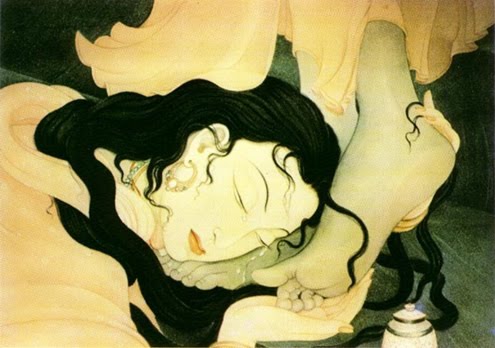
mary-anoints-the-feet-of-jesus-by-frank-wesley

Artist – Frank Wesley

This is the third and final ‘Mary, at your feet’ poem, which tells of an evening in Bethany, at the home of Martha, Mary and Lazarus. Jesus is there, too. They are holding a feast to celebrate Lazarus coming back from the dead, and, it being near Jerusalem, they are joined by many others.

I found some spikenard on line, the closest I could find to nard, the rare perfume Mary pours over Jesus, and burnt it as I meditated on the story. It is pungent and earthy, an intense fragrance. As I meditated, I remembered all the times that Jesus had told stories of the Kingdom involving feasting, and banquets, and how he left us a shared meal to remember him. This particular banquet, celebrating a man coming back from the dead, seems like that.

I thought of Mary giving something so costly out of love, I thought of the other story of a woman anointing Jesus’ feet (Luke 7:36-50). And I remembered that Messiah means anointed one, and that the only earthly anointing Jesus receives is like this, at a feast, in an outpouring of love and gratitude.

This poem, too, was read at the Alive festival 2014, and I used it as a starting place for prayerful writing with a group of people. We burned spikenard, and imagined ourselves into the story. Some beautiful work resulted. People were able to connect with times when their life had been restored to them in some way, with times they were grateful, and wanted to pour our love and thanksgiving. For others, they felt they were outside, looking in at the feast.
In this poem I see the doors wide open, like the gates of the city in the book of Revelation (21:25).

You can read the first poem here
and the second one here

Mary, of Bethany, at your feet a third time

And so you come once more to Bethany,
and share a meal with Lazarus,
a resurrection feast,
foreshadowing, foreshining
all those kingdom feasts you told of:
wedding banquets with long tables
set wide with good things,
with room enough for all,
welcome at your table.

Now, in Bethany, the house is ablaze with light,
shutters and doors thrown open,
all wide open with joy unspeakable,
music, laughter, dancing, wild thanksgiving
for one who was dead is alive again,

And all night, while crowds pour in from Jerusalem,
the feast goes on, and on,
as Mary enters now, cheeks glistening with joy,
past her brother at your side, back from the grave.

She kneels at your feet again,
pours out extravagant nard,
scandalous anointing of your warm, living feet,
unbinds her hair and lets it flow like water
over them, wiping them in such reckless
and tender thanksgiving.
Fragrance fills the room, the house, the night,
as more people pour from Jerusalem to you,
to you, who comes to us in our weeping,
who shares our bread with us,
and brings us to such joy as this.

John 12:1-11

I am greatly honoured that this poem was read at the Good Friday Service of the Riverside Church, New York.
The whole service is recorded. The poem appears at about 21:50
You can see it here

Note, March 2024:

I am delighted this poem was shared by Diana Butler Bass on her substack.

https://open.substack.com/pub/dianabutlerbass/p/halfway-through-lent-mary-magdalene?utm_source=share&utm_medium=android&r=46vqv

The ‘Mary, at your feet’ poems – Two

Lazarus

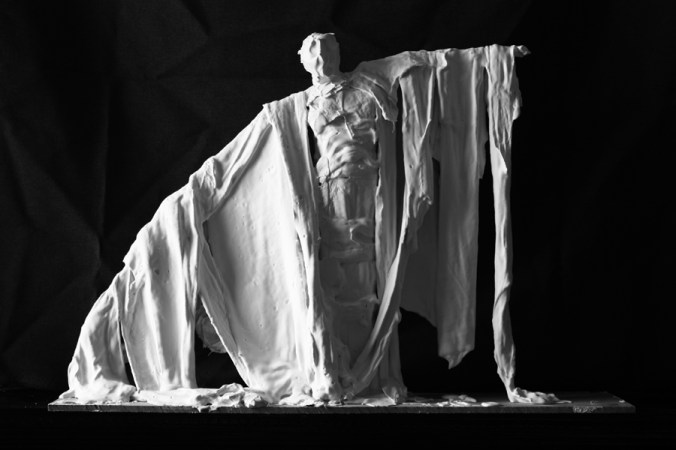
Lazarus, by Jacquie Binns, with her permission.

We come to the second in the ‘Mary, at your feet’ sequence.  This, too, was read at the Alive festival, 2014.  It contains a bigger reversal than a poem can hold – from death to life, for it draws on Mary’s response to the death and raising of her brother Lazarus.

Martha went out to meet Jesus when he finally arrived, and their exchange is sorrowful and powerful and contains words of life and hope.  Mary stays inside, and when she finally goes to Jesus, we feel the depth of their mutual grief. In John’s gospel, where we find this account, the raising of Lazarus plays a crucial role in the events that lead to the crucifixion – the themes of death and life, life from death sound like a returning motif in a piece of music. Here, standing by Lazarus’ tomb, Jesus weeps with Mary, in the company of many who also grieve there.  And then, everything changes.

I am very grateful to Jacquie Binns for permission to use this photograph of her work. She is a textile artist and sculptor of rare vision, and it was an honour to meet her a few years ago, when I saw this piece. It is haunting and breathtaking.  I was particularly struck by the whiteness of the bindings, the light and whiteness seem so cold.  The set plaster holds the fabric grave-clothes in this one moment when the viewer sees Larazus for the first time, before we begin to know the power of what it is we see.

You can read the first poem in this sequence here.


Mary, sister of Lazarus, at your feet a second time

She sits in the shuttered room,
the room where her brother had laid,
dying, dead, the messengers sent out
returning empty, with no reply,
like prayers that bounce  off ceilings
or stick to the roof of the mouth,
choking with sorrow.
When you stay by the Jordan
that shuttered room is where Mary stays.

This is her shadowed valley, the dark forest of her path,
foreshadowing yours, it is all foreshadowing you.
The room where her brother had laid,

how can she ever leave it now?

But leave she did, at last, when you called for her,
she came quickly, running, trailing darkness behind
her weeping.  Mary, once more at your feet,
and when you saw her weeping, you wept too.

You know us in our grief.  You come to us, call to us.
In our darkest, most shuttered places,
your spirit moves, breaks with ours.
Death lay heavy upon you, too, and all the sooner for
this, what you do now, standing before that tomb.

For now, you who are Life,
Word made warm and beating flesh,
and weeping,
call Lazarus out,
You, who are life, and will rise,
call out one who is dead from the cold tomb.
You watch as they run to free him from the graveclothes,
pull darkness from him, calling in strange bewildered delight,
and you see Mary’s face as she sees now,
her brother, who was dead, once more in light,
astonished, seeing your glory, part of your glory,
as she weeps again, is weeping again
breathless with joy.


John 11:1-50

You can read the third poem here


The ‘Mary, at your feet’ poems – One


Two years ago, in May, I was thinking about the three times Mary of Bethany was at Jesus’ feet.  One story is recounted in Luke, the other two in John, where they are a part of the extraordinary Lazarus narrative.  I wanted to explore them more, and I did so in what turned into a series of three poems.  I read early versions of these poems at a local Christian festival, Alive, and as the time of year comes around again, I find I am remembering them, and going back to those thoughts.  I share the first one with you today, and the others will come in their own time, over the next week or so, as I continue to turn them over in my mind.

This first one draws on the story in Luke’s gospel where Jesus visits the home of Martha and Mary, and Mary sits at his feet.  I have not referred to Martha directly, except for in the title.  I do feel her lack. I wonder, in particular, what happened next.  Maybe there are some poems to write about her, too.

There is so much to ponder in this story, but what caught my attention was how hard it is for us to be still, to be.  We are so distracted, so pulled by so many things. We can end up  feeling that those things are what define us. That it is what we do, or think, or believe, or  how people view us that makes us who we are. Just being doesn’t seem enough, but our efforts to be more or different or better than we are can be life-sapping.
Acceptance can be hard to accept!

In writing this poem, I hoped to create a place of stillness. The kind of place where contemplative prayer begins.  A place where we can open up a little to love, and light. A place where we know we are welcomed.

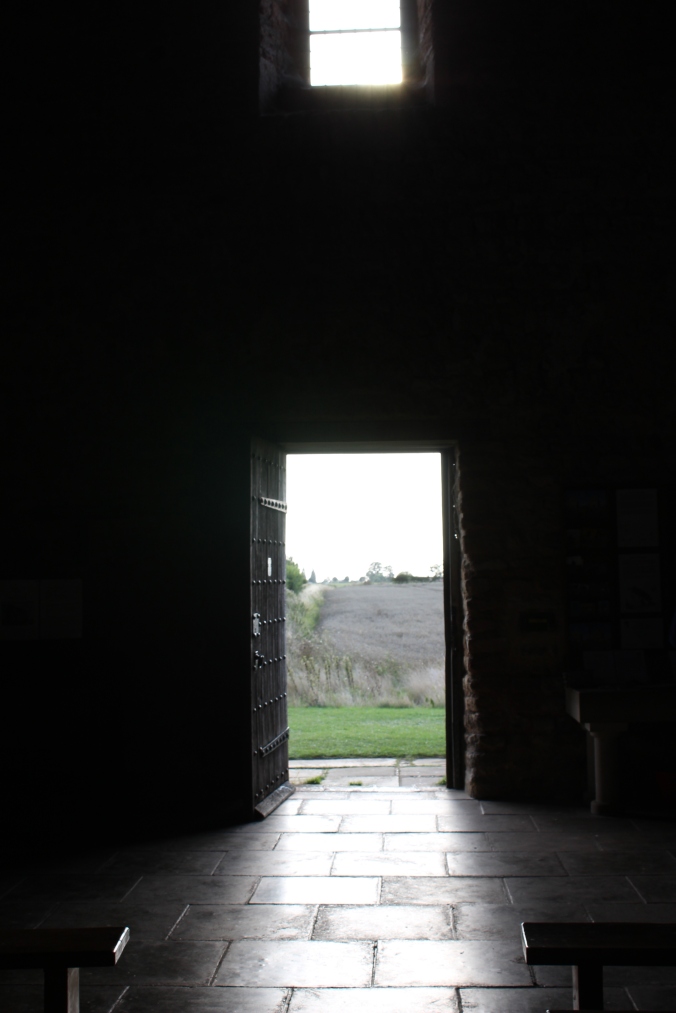
The photograph is taken in the Chapel of St Peter on the Wall, Bradwell on Sea, Essex.

IMG_0366.JPG

Mary, sister of Martha, at your feet for the first time

You came in search of rest
away from the road,
that bright, shadeless road,
where so many came,
and you gave so much.

You came and sat down
in the cool room,
the shutters pulled
against the heat,
and Mary sat, too,
and it was enough.
Just sat, quietly, at your feet,
her face turned up to
yours as she listened.
And you saw how the light
fell across her,
as if for the first time.

And this is what you want,
what you long for.
Not the elaborate
preparations we would make,
not ourselves swept and
scrubbed to perfection,
our acts and our
thoughts impeccable
in lifeless rows,
but to be,  here in this light,
to be, here at your feet,
Luke 10:38-42


You can read the second poem here

and the third one here