Poem: A change of heart/asters

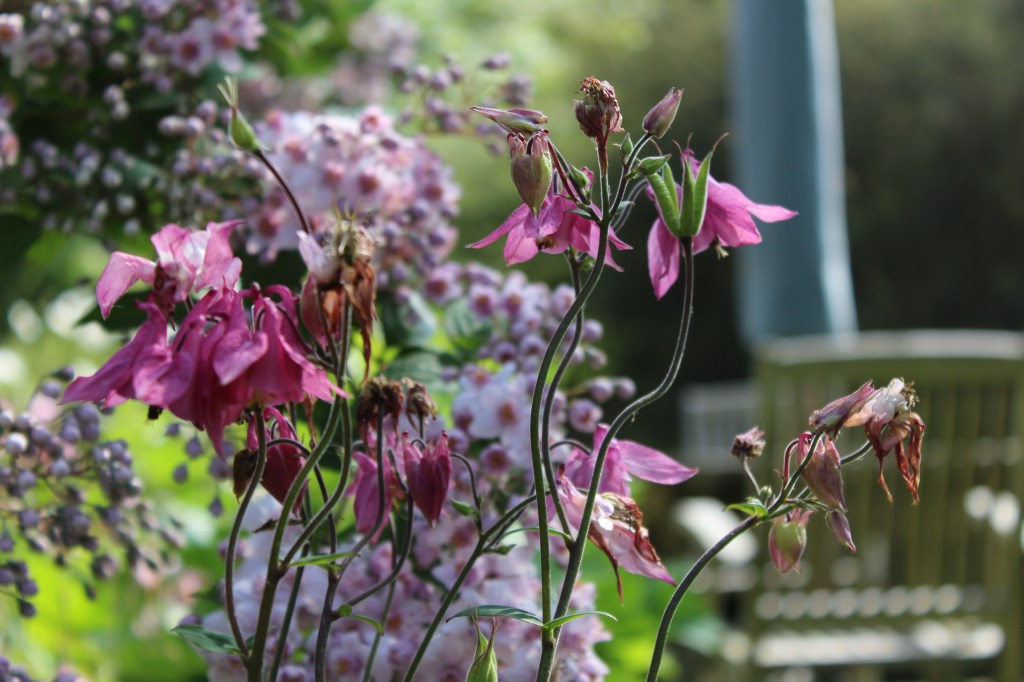
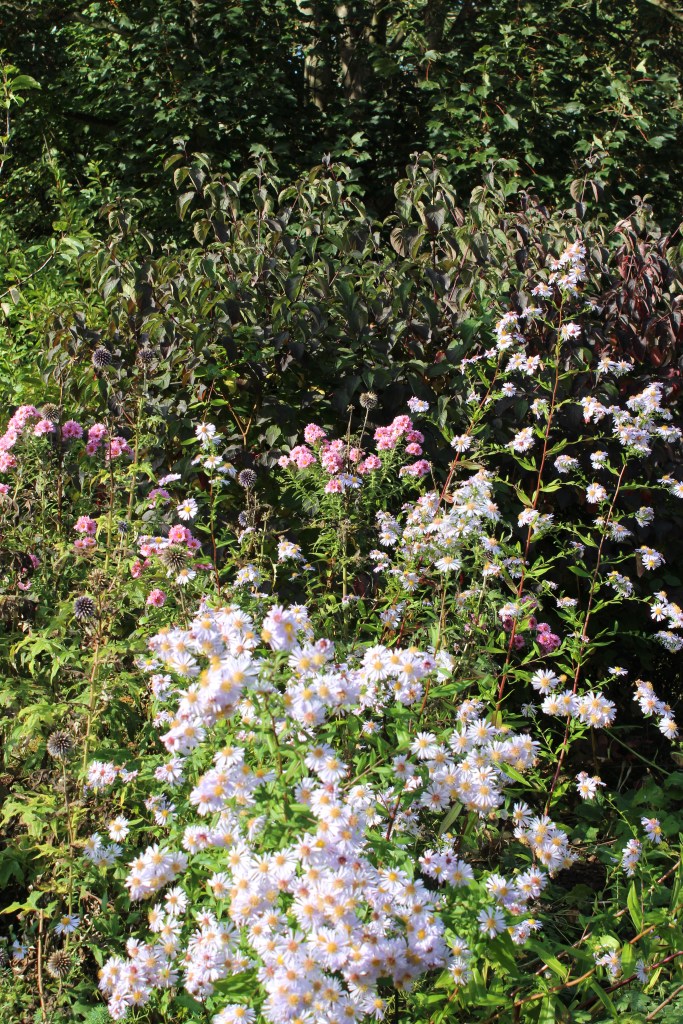
As things grow and spread in the garden, I sometimes feel a plant is no longer thriving, or no longer fits the mood. The colours and textures change constantly, and sometimes something can seem stranded, suddenly out of place. I felt that way about these tall, pale asters last year. I moved some, and find they are thriving in their new homes, but the rest, I thought I’d dig up.

Lack of energy or time or poor weather means that I often don’t carry out my plans, leave them for another season. But increasingly, I am not acting on an impulse to remove, I am giving myself another chance to look at things differently. I am so glad that I left these, for this year, the asters are the loveliest thing I see.

I thought about their transformation, or rather, the transformation I experienced in how I saw them. I realised that the plants that are around them, and the increased light now the old tree has died, have made them appear transformed, lit up. Seeing things in isolation, out of context, we can miss their beauty, their true qualities. Kindly companions change everything.

A change of heart/asters

I wanted to dig them up, these pale asters.
They looked grey under clouds grey enough.
Shaded and overshadowed, they spread,
moved forward towards the light.
In their advance, they bound cyclamen
as tight as a vice.
They are no good, I though.

But, it seems, they needed that light,
and more than that, the right company –
this new rich pink, the purple leaves
turning deep red behind them,
the pale chaos of ammi running to seed –
all this has transformed them, or rather
transformed my seeing, revealed their beauty –
a delicacy of colour,
a generous abundance.

In this new light,
the bees and the butterflies
crowd them for their late nectar
as the sun shines on them,
finding in them a sweetness
I had missed.

I will not be so hasty.
I will give myself time to look again.
I will step back, take in the whole,
and remember that
kindly companions change everything.
I will look to add, befriend,
seeking the right company.


I will remember
the value of light,
and seeing each thing
not for itself alone, but
as part of a wider abundance.
And so, I have had
a change of heart
and I see now,
yes I see now,
that none of this
pale, unassuming flourishing
is wasted.
Poem: Wild Strawberries – a gift

It’s been a while since I’ve shared a poem with you, so thank you for finding me again! Sometimes, it’s good to simply be over the summer, to rest in warmer days, and fill up notebooks with things for later.

And so, this next poem comes to you a little out of season. There are still a few wild strawberries hanging on in there in sheltered spots, but now the autumn storms are upon us, and they don’t last long. So this is from a few weeks ago – it feels longer, like a different, sunnier world. The fruit ripening now is the apples – but I hope to write about them another time.

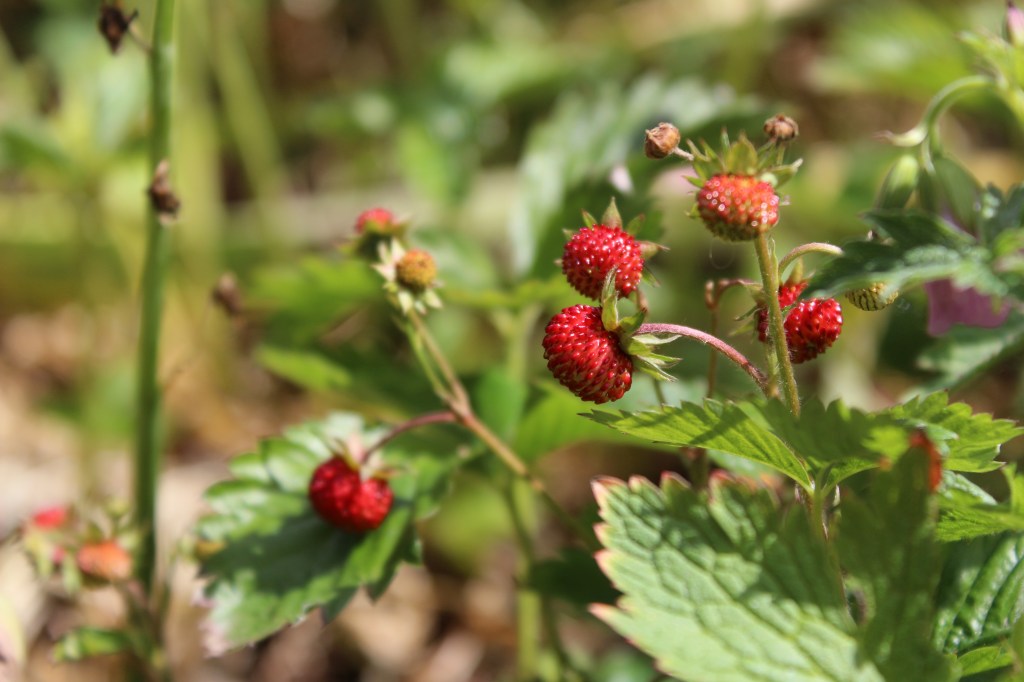
As I was harvesting wild strawberries, I was thinking how good it is, the way they just spread around the garden, making a home for frogs and newts and slugs, how good it is they choose their places to flourish and thrive. Much in the garden is self-willed, and it does seem to be thriving, if a little scruffy at this time of year.

I do tend them, by looking after the soil, and they tend me with their sweet goodness. As I was turning over this circle in my mind, this poem came, with a basket of fruit.

Wild strawberries – a gift

Each day now, I bend,
send my hand through thick leaves,
under undergrowth,
searching for that flash of fruit.

Finding trove after trove,
tiny, sweet-sharp,
intense, lingering
on the tongue.

They grow rapidly,
self-willed, under my
delighted gaze,
spreading over rich soil
thick with compost,
nourishing the slugs
and me.

And as I stretch and gather,
gather and stretch,
I feel a sudden wash
of gratitude,
precarious, and abundant,
thankful for each tiny fruit.

For a moment,
I feel part of a
rich goodness
beating steady
and deep,
a full base note
under the sweetness –
the endless life-circle  
of gift and gratitude,
gratitude and gift,


and of mutual care –
I care for the plants,
and they care for me,
gently, sweetly,
with a taste never
to be forgotten.

Poem: Gaia at Ely Cathedral

As we are beginning to venture out a little more, we thought we would pay a visit to Ely, and the vast indoor space of its ancient cathedral. They often have contemporary art there, which helps the old stones continue to sing, giving a new perspective on ancient truths. We knew that Gaia, an installation by Luke Jerram, was going to be there in July, and so we went and saw this beautiful, astonishing sight. The comparative emptiness of the cathedral space made it all the more powerful as it floated above us.

And as the space is vast, and it takes time to walk up to, around and beyond the piece, you do have time and space in which to allow the work to speak to you, to stir up responses, and to pray. I am sure that one of the intentions is to give us all an opportunity to experience something like “earthrise”, when the astronauts first saw the whole of the Earth from space, and how that shifted their perspective, and began to change the way all of us are able to see our home. The staggering, indescribable beauty of the whole called out my sense of awe, which sat uncomfortably alongside my awareness of the damage we are doing to our precious, unique home.

In the setting of the cathedral, as Gaia hangs in the nave under the painted ceiling which tells the long stretch of the Bible’s story, I found the language of repentance surprisingly, and helpfully, came to mind. Repentance both in our more familiar understanding of sorrow for wrongdoing, and desire to amend, and in the possibly more ancient meanings carried in the old texts, of returning home, and of undergoing a profound change of mind – a paradigm shift in the way you see.

Much of my writing celebrates the beauty of the natural world, how lovely, precious, and vulnerable it is. But sometimes, that love spills over into grief. So the old stones, and the old story, seemed illuminated by our current crisis, and, in turn, those ancient words seemed to express something necessary, and powerful, and, in the end, with the potential for hope.

You can listen to the poem here.

Gaia at Ely Cathedral

She seems to float, lit up with her own light,
slowly turning, blue and blooming with clouds
as we walk up, look up, small before her.

While above our steps,
the familiar painted roof
rolls on, telling its painted story,
from the tree, and the garden,
on towards this

fathomless shining beauty,
the ‘all’ that was so very good
in that beginning.
Now as she turns
we see how she hangs
below the story’s last scenes –
the gift of a beloved child
held on his mother’s lap,
held forward towards us,
loved and given and giving,
and the wounded golden king,
who gives still.

And below, below hangs the whole shining Earth,
dazzling, vast with sea,
turning and flowering with clouds
from the southern ice-shine,
melting although we do not see her weep,

And the land, those small green swathes
and swags, are dressed in white too,
a veil of vapour,
while the deserts spread brown
and red above our eyes.

The lands are small, countries
seem tales we tell.
What is certain is this one great
flow – ocean and ice and cloud –
and the unseen winds that bear them
through our blue, breathing air.

And the people stand beneath her,
lit by ice, and hold up their hands
as if to carry her, or hold her,
or save her from falling.

How beautiful it is.
How strange and wondrous
that we should be creatures
who live within so much living perfection.

And as she turns slowly
under the child and the king,
I wonder, what do those
familiar words mean now,
‘the sins of the world’,
as the stain of our reckless harm
seeps through the blue and green,
through all this living glory,

And is there any hope in our
waking up to beauty with grief
and loss, even as dust and ashes
float across the sky,
across us all, late as we are
in our repenting?


And is there hope,
hope that we might be granted
this grace – time
for amendment of life,
to tend the garden
with its leaves and fruit,
shining and greening,
to take part in the work
of loving and healing,
of restoration,
of making all things new.

Looking at Gaia from behind the communion table brought to mind the words of repentance from that service, and I was aware of my sense of what “the sins of the world” might mean was creaking open a little wider.

Poem: Sorrows II

A few years ago now, I wrote a poem called Sorrows. You can read it here, it might be a good place to start. In it, I describe the endless task of attempting to lay sorrows down, to look for what is good, to notice the beauty even in dark times.

That task does seem to be endless. It can get you through when things seem too heavy, it can help minute by minute, but, before you know, you find there they are, back in your arms, needing to be carried still. I have not found it helps as much as it used to. I have been learning a different way, a way of welcoming, of caring for each apparently unwelcome guest as if it were a child, or an elder with wisdom to offer, or both. I am seeking to learn to be gentle, and tender, with myself, as I would be to another. In this I have been influenced by, among other things, the beautiful and challenging Rumi poem, The Guest House, and Mary Oliver’s small treasure of a poem, The Uses of Sorrow. I include it here.

The Uses of Sorrow, by Mary Oliver.
(In my sleep I dreamed this poem)

Someone I loved once gave me
a box full of darkness.

It took me years to understand
that this, too, was a gift.

And so I have written a sister poem to the first, one which expresses more roundedly what I seek to attempt now. I hope it speaks to you, too. I leave it up to you to wonder who is speaking the words of the final stanza.

Sorrows II

I carry sorrows in my arms.
They are heavy, and my arms
grow heavy with them.
I ache with the weight
of both.

When I look up, away,
they seem lifeless,
and grey, but this day
I choose to look down.

I find, to my surprise,
a weeping child
in my arms, a child
who has known
no consolation.

What if I cradle her gently?
What if I ask her to
tell me her sorrows,
and stroke her hair,
while the blue sky
and the clouds
and the trees
bend softly to listen?

What if the high buzzard
joins in with her cry,
and the flower bends too,
even while watered
by her tears?
I rock from side to side,
the sway of a mother
strong with love,

And in time, in time,
I say “hush,
I am holding you,
I have heard you,
rest now, sweet child.”

And she raises her bright head,
full of wisdom, quiet with beauty,
and looks at the darkening sky,
and the golden trees
where a white owl wakes.

Look, there are stars in the darkness,
a whole Milky Way of them,
there is the softness of dawn light
coming, coming.
Take courage.
I am carrying you.
We go together.

Poem: The apple tree, having grown in shadow

Things change, yet leave their mark. I was thinking about this as I looked at one of our apple trees, grown curved in its search for light. You can see the shape of the trunk most clearly in the shadow it leaves on the fence. It grew like this to adapt to the dense shade of a neighbouring shrub which grew faster than it, and cast it in shadow. That shrub died, it is gone now. Yet even as light returns, the curve remains. Grown like this, the tree has given us apples in autumn, and beauty all year. I thought about how the tree found a way of flourishing despite the shade, and admired its resilience. So, the poem is mainly about the tree, but also, murmuring away underneath, was an awareness of the tree as teacher, making visible something that is often hidden within us.

The tree adapted to its setting, and as the setting changed, the adaptation remains even though there is more light. We all do this, whether it’s growing accustomed to living quietly and distantly during a pandemic, or learning from a young age how to live in difficult emotional or physical circumstances. Even when things are better, lighter, more friendly, we can find ourselves living as if they are not. Patterns of mind can be changed, new growth can happen, but it takes noticing, with compassion, and stretching ourselves a little into the new, more open space.

As lockdown eases, we can go gently with ourselves as we try to asses what is safe, and what has become a habit that is no longer needed – and those assesments are far from easy. We can be gentle with each other, too, as we all navigate our way into more open living. The changes in how we respond may be, in part, due to patterns of being which were laid down long ago. These, too, can be nurtured into more helpful shapes that keep us safe and help us flourish, both. I believe we can become free from patterns that no longer serve us, and grow with full vigour.

All these things I thought about, as I looked at the apple tree. But mainly, I though how beautiful it was, and how much blossom it bore this year.

The apple tree, having grown in shadow

I follow the curve with my eyes,
the way the thin trunk
arches back, seeking light.
On that side, the branches
grow thicker, surer.

It bends away from the dense shade
that was there, only weeks ago,
a dark shrub that outgrew it,
then died. Now, the blossomy
branches lean back,
away, from open
light-filled space.

Cast in shadow, it grew thus,
leafing and flowering,
supple, adapting to shade,
and seeking light.

I wonder, what will happen now?
Now we have cut down that
dense, dry growth?
The thin branches on this side
will fill out, strengthen,
divide, reaching into the place
that was once too dark,
heavy, in time, with fruit.

But what of the trunk?
Will it bear, one hundred
years from now, that curve,
lessened, perhaps, by
years of thickening growth?
The adaptation no longer
serves it, yet the tree
may still bear it,
And the tree’s beauty
is held in the grace
of this curve.


Such shapes of growth
and thought persist,
gently, strangely,
known or unknown.
We make allowance
for the ghost
of a shadow
no longer seen.

Poem: Strange Birds II

Last time, I shared a poem with you written in response to a day’s walking in Norfolk, close to Wild Ken Hill. More especially, it was about the birds we encountered. It was so uplifting to hear, and to see, so many creatures that were unknown to us, and most especially to hear songs we had never heard before. It’s an awe-inspiring, hopeful place. I’m not suprised that Springwatch chose it as their base this year.
You can read the poem, and find links to interesting stuff, here.

That night, as I drifted off to sleep, I heard more. This is a falling-asleep snippet as I drifted off to the sound of more strange birds. I hear owls at home, from time to time, but a nightjar was beautiful and new to me. I’d found out about them while we were doing another walk, nearer home. The Sandlings walk takes the nightjar as its waymarker, and has artwork showing the nightjar – and its food the moth – to search for as you walk.

We never heard one – unsurprisingly, as we walked that route by day. One of the magical things of staying near the sanctuary of Wild Ken Hill is that we heard these night-creatures, at last. It seemed a fitting end to a day in which we had encountered so much richness, so much abundant life.

I was half wondering if a nightingale would join in. Not this time, but I have heard them near home before, and you can read about that here.

Photo from the Woodland Trust

Strange Birds II

I lie awake, head full of
the sound of daybirds,
and slowly, slipping over
these new songs
now known by heart,
come night cries –
such life as lives
in darkness.

First the owl, mottled
and shadowed in leafing trees,
and then the night-jar’s
churning and rumbling
down low, in rough ground

and as I drift into dreams
with these strange guides,
these gentle sounds and soft,
there is a moment
when I can wonder –

Where will they lead me,
through unseen nightscapes,
both strange and new,
and strangely old –
where will they take me –
through what dreams
of hope,
both green and dark,
will they carry me
on their brown wings?

Poem: A good place

I am sure that all people who have ever tried to tend a garden, or grow crops from the land, are deeply aware of the changeablility of weather, and the vulnerability of their work. This year, I have pretty much given up growing veggies from seed, as the cold and dry has thwarted too many of my efforts.

I’m aware that the work and care I give to my garden can be undone so quickly by the weather. Increasingly, I’m aware how the increased instability of the climate is making it harder than ever to grow things. I seek to work in harmony with the rest of nature, but the rest of nature is unnaturally capricious.

I am feeling the loss of a tree that died a few years ago when the Beast from the East was followed by relentlesly hot and dry weather. I know I could not save it, and cannot save all the plants. Even though I know new things are growing, there is an unease in my tending. I have planted an apple tree in its place, which is flourishing, full of blossom. But this contrast between my nurturing of the place, and the wildness and unpredicatability of the weather has been on my mind.

Elsewhere, I have written about the tree. You can read it here.

And yet, the garden is full of life, it florishes, and changes, and we adapt. Things want to grow, and live, and they do.

A good place

Just now, a buzzard drifted
overhead,
slowly, consideringly.
‘This is a good place’
I whisper, looking up,
as mice quake the
lengthening grass.
She flies on, slowly,
her head turns back

as a blackcap sounds
his golden, limpid song.
This is a good place.
Yet the tree died even so.

The weather blows in weird.
Too hot, too cold,
too much, then not enough, rain.
Things begin their opening,
and close and blacken.

This is a good place.
I tend and nurture.
I make homes for many creatures.
And the tree died even so,
even so the earth shifts
as the ice melts,
the wind veers and changes,
I cannot hold it back –
that endless dry north wind
that burns the soft green growth.

But I stand
with my trowel in my hand,
with dirt under my nails,
and I tend, and I nurture,
even as I look up and watch
the sky change, even as
I look up and see, too, the
high birds drifting across.
And I choose to live tenderly,
tending,
for it is a good place
even so.


Edit/Note 19th May 2023

This evening, I’ll be reading this poem at the final talk of a series organised by Woodbridge Climate Action Centre. The series is entitled Regenerating Living Landscapes. This evening’s talk is Landscape Connectivity: Rivers and Wildlife corridors by Professor Peter Hobson. I’ve made a few small edits to the poem – coming back to things you always see something you’d like to tweak – which I have made here on the blog as well.
It’s been so good to be involved in the talks, and all the conversations and connections that are flowing out of our gatherings. I’m very honoured to be able to contribute in this small way.

Poem: Enough

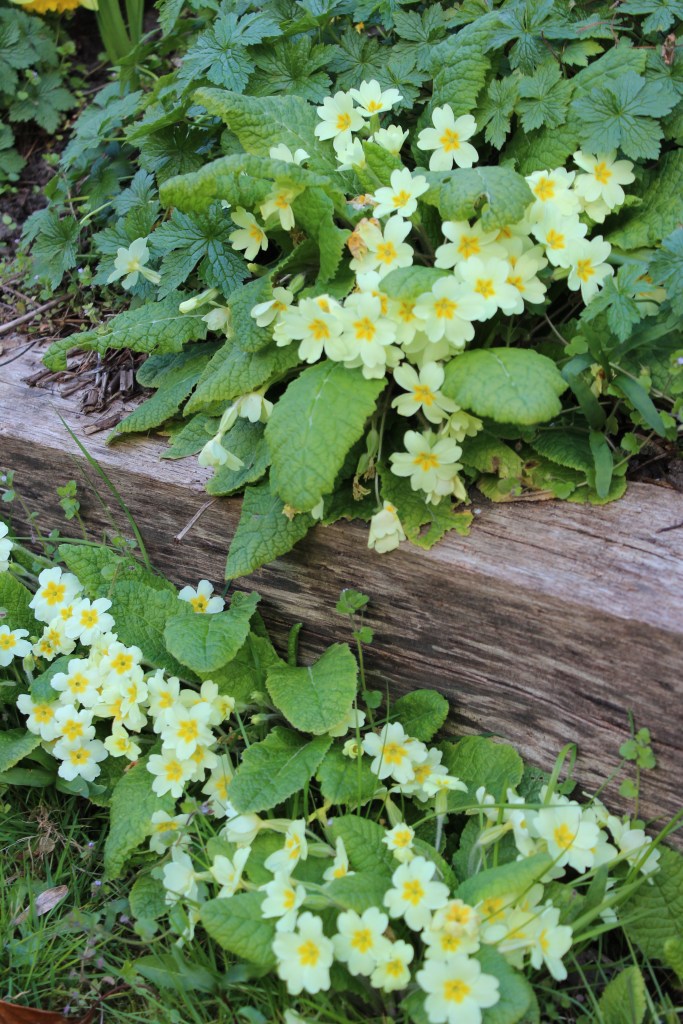
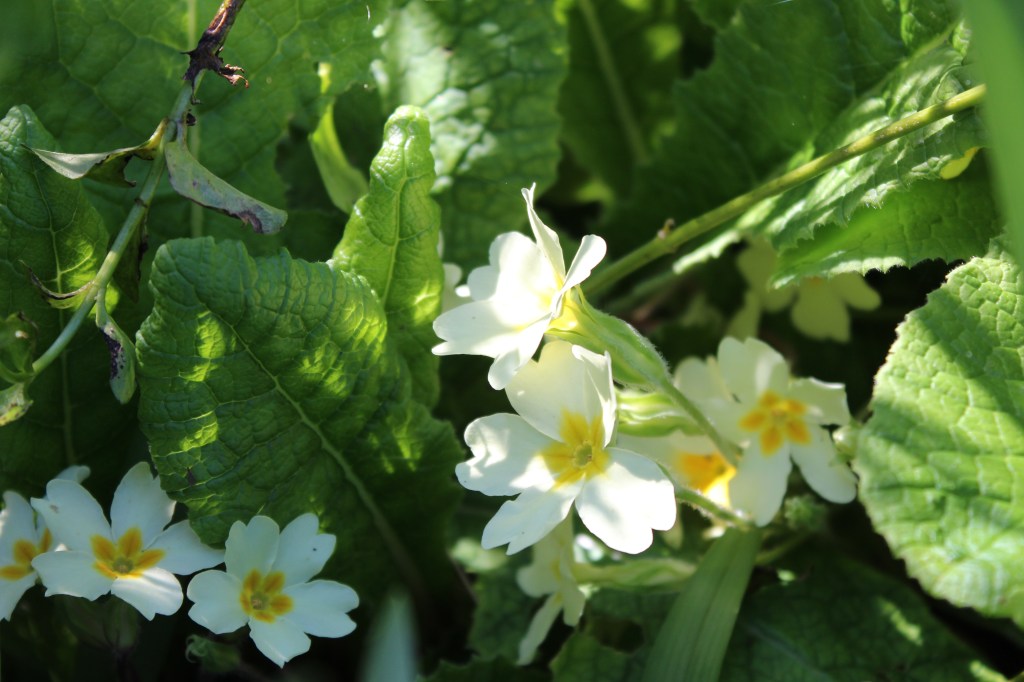
Sitting in one of my sitting-and-thinking spots in the garden, sometimes something catches my eye which brings me joy. In my last post, One hundred and ten years, I talked about the primroses in the garden, and why it mattered to me that they spread. We could have lost them with the blitz of herbicides in the previous century, and their modest presence is still not guaranteed.

Here is a poem then, that draws on their growing brightness in my spring days. Now, we’ve had some warmth, and they are beginning to retreat under the cover of later plants, but here is how I love to see them. Soon, their fine seed will begin to fall again, down over the sleeper into the waiting lawn. I thought about that experience of falling, and how so many things that feel like an end may not be such an ending, after all.

We’ll mow around them, and let them make their way across, amongst the speedwell and the forget me nots that are also growing there.

Enough

Some days, something
as simple as the way
the primroses tumble
over the wooden sleeper
to the grass below
is enough.

It’s enough to see
they fall
and are caught,
nestled between strong
grasses, resting on good earth.

Enough that once there,
they soften and grow.
Enough that they
unclench their
green fists
into open hands
as they spread slowly,
and ever wider,
across the grass
like cold, yellow butter.

They fall. They are caught.
They find a welcome,
a green place, all they need.

May our fallings
be so caught.
May we, after all,
come to rest in some new,
surprising place
where we flourish.

May we find that what
feels like a falling
is, after all, a running
over, an overflowing,
down, to some place
we had not known
before.
And may that
running over
be enough.

Poem: One hundred and ten years

I am delighted to see how even the tiniest glimmer of sun brings out clouds of insects in the garden. I love the way the spring flowers are hungrily visited by bees. I do what I can to encourage butterflies. It cheers me when they come, but sometimes, I remember reading in novels, and poems, of an abundance that I can hardly imagine. It fills me for a kind of nostalgia for something I didn’t know, but nonetheless miss. I feel its lack. I remember as a child hearing older people talk about primroses and cowslips as flowers that were abundant in their youth, but had all but vanished from the countryside. No doubt, these memories are what is behind my cherishing them, and watching them spread through the garden.

So, although it warms my heart to see the growing abundance in our lightly disordered patch of nature, I’m aware of shifting baselines – I know the natural world I experience is diminished compared to that which our ancestors saw and knew. I sometimes feel the presence of a ghost landscape behind what I see – a landscape of what had been. To the best of my knowledge, my place was once an orchard, and my mind’s eye can almost see it, alive in a way I can only dream of.

I was reminded of a book I loved as a child, Tom’s Midnight Garden by Philippa Pearce, where the garden, as it was, becomes visible, even though it had been destroyed and built over. At least here, in this place, there is hope that some of the abundance there was can return, as much as it is within my power.

One hundred and ten years

Despite this cold
there is a shimmer
of life in the air above
the beds, where bluebells
begin their opening.

Tiny flies, and larger,
and bees, and the
occasional, beautiful,
butterfly – look, just there!

I watch them in awe,
all these tiny specks of life.
Each small thing part of
The garden’s constant dance,
each with their own
irreplaceable steps.

I wonder what it was like,
over a hundred years ago now,
before the house was built,
when all this was orchard.
Did butterflies rise in clouds
as you walked through
the long grass?
Could you lie down and hear
the hum of many bees
in the blossom above?
Could you doze in the scent
of wildflowers, the hum
and scratch of insects?

Perhaps, like
Tom’s Midnight Garden,
that place is still here,
in the shadows.
Sometimes, I can
almost glipse it,
as transient as
dawn mist.

And perhaps, I hope,
it is becoming
less ghostly, more embodied,
humming in this shimmer
of life in the air.
Growing stronger,
growing more certain,
after so many years.

A Poem for Earth Day: What might it mean, to live well on a dying Earth?

Yesterday was Earth Day, and, as I have before, I wanted to mark it. I’m a little late, but here is a poem that has been circling my mind, and troubling me, for a couple of weeks now. I heard this question – or something like it – on a podcast, and it rather took my breath away. I do spend time attempting to answer questions such as – What can I do to limit the harm I am doing? or, Is there anything regenerative that I could attempt?, or What can I do about all this plastic in my life?.

The more philosophical question, of what makes a good life, in this time when we are waking up to the way ecosystems are fraying and dying, is harder to attempt. Yet these phrases came to me, and I think there is power in the question. There is some liberation, too. It doesn’t focus on all the things I’m not doing, or are unable to do. Neither does it reassure me by looking at what everyone else isn’t doing either. So the poem is not a list of tasks, but something closer to a way of being, which will, naturally, lead to tasks, and to action.

In some ways the question is offensive. And in the places it rubs against you, there is something to be explored. And perhaps, in finding our own answers to the question, we may find the dying receeds, and the living has more hope and space. But that is not the point just for the moment, just as we approach this question. The point is, to face up to what we are doing, and then find a way of living within that knowledge. It’s quite a task. But I feel there is some merit in the attempt.

I was encouraged that yesterday the virtual Climate Conference that President Biden convened made some positive announcements. As we seek to move from goals to a change in the way we live, maybe this question helps.

The question arose on a Nomad podcast which centred around an interview with Gail Bradbrook, of Extinction Rebellion. It is well worth listening to. You can find a link to it here.

May we live well. May that wellness include all living things.

Consider the lilies of the field, Jesus said.

What might it mean, to live well on a dying Earth?

Who knows?
The worst kind of foolishness,
of absurdity
to even try.
And yet, something sparks,
something kindles,
at the question.
And so, knowing the absurdity,
these words come….

To be tenderhearted,
though afraid.

To know that each
small thing matters.
That even though
it is not enough,
such calculation
is not your task.

To tend the tender plants,
and see their flourishing.
To feed birds.
To stop on your way
and talk to friends,
and those you barely know,
to stand with them
in their griefs,
to laugh within their joys.

To be compassionate
to all, beginning with
yourself.

To do those things
you have found within
your power to do.
To also do those things
your heart whispers.
And both, without
measuring outcomes.

To act as if you have
hope,
even if you do not.

To act boldly when you feel
the call to do so, but
with gentleness and grace.

To look for beauty, and joy,
and love.
To travel through despair
and let its darkness
dissolve about you,
having held you.

To grow food
for yourself, and for
all those you share
your place with.

To stand in awe under
the song of the songbird.
To be merciful to the
worms and the beetles
and the spiders,

To – again and again –
say yes to life, and to joy.

Say yes to all that is good,
while there is so much that
grieves you, and leaves
you despairing.

To know a more beautiful world
is already here,
and yet coming,
and still beyond our grasp,

And to live in it anyway.

The last section of the poem mentions a more beautiful world. That refers to a book by Charles Eisenstein – The more beautiful world our hearts know is possible