Jesus said, ‘I Am’ – for Lent. Chapter 1, the woman at the well.


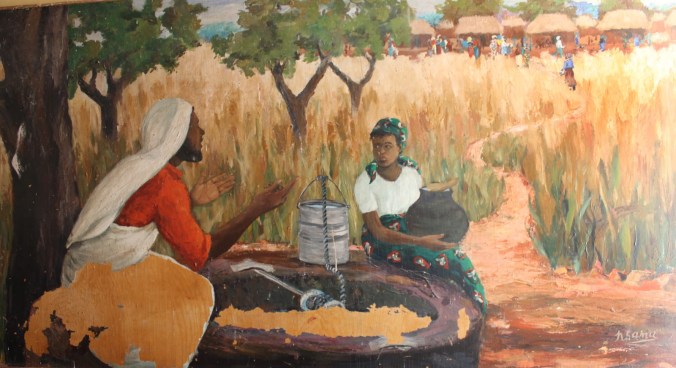
The bible scene with Jesus at the well with the Samaritan woman shows signs of damage and peeling of paint

Mural by  Emmanuel Nsama

If you are following my Book for Lent, welcome! I hope you find it helps.
If you’d like to begin at the very beginning, you could take a look at the chapter on Moses, and the burning bush – the first I Am. You can find a link to my post about that here.


IMG_0864

John 4:1-30, 39-42

It may seem a strange place to start, with this deep conversation that is not normally mentioned as one of the I AM sayings – and indeed, it isn’t one of the classic seven.  However, it is a story which has intrigued me for years, and when I found that this is the place where Jesus first says “I am”, I wanted to explore it more fully.  It is the longest recorded conversation Jesus has with one other person – and it is with someone who was on the other side of so many cultural barriers.

At a time when our politics is increasingly divided and divisive, where people box each other into categories, and make some lesser than others, this is a particularly relevant conversation.

John the Evangelist prepares us for this story very carefully, for it is profoundly counter-cultural. Jesus stops to rest near the plot of ground that Jacob gave his son Joseph. Jacob’s other name was Israel – one who wrestles with God. We are going back to Israel’s common spring, common source, at Jacob’s well. We are being reminded of a time long ago, before the time when and the Jews and Samaritans became peoples who saw themselves as separate. It is a place that holds meaning and memory for Jews and Samaritans – of their common father, and their common salvation story. John is placing us on common ground……

I think it is no coincidence that John begins this story by setting it against an atmosphere of potential conflict – between cousins, between related nations. We see Jesus acting out his mission to be a peacemaker, a reconciler. “For he is our peace; in his flesh he has made both groups into one and has broken down the dividing wall, that is, the hostility between us” Eph 2:14. Jesus himself is common ground, and his presence changes things. If we look carefully at how we are prepared for this encounter, we can see that we are being led away from conflict, towards reconciliation, to inclusion, and to hope…….

And so, as Jesus waits by the well in the heat of the day, a woman approaches.  We can only imagine what it must have been like for her, in a culture where a woman could be divorced “for any and every reason” (Matt 19:3). We often think of her as one utterly disgraced in her community, having to visit the well at such a time.  That may be so, but we must remember that at this time divorces were easy for a man to come by and early death not uncommon.  Whatever her circumstances, she must have known more than her share of tragedy and disappointment.  She may have known deep shame and disgrace.  She may well have been a rejected member of a rejected community.

And yet she, like everyone else, gets thirsty and needs water to drink and water to wash with.  She is as human as everyone else.  So often, we do not see people like this.  So often, we make quick judgements, build fences, wonder about people’s worthiness and, in our own pride and insecurity, seek to feel superior, chosen, righteous in some way.  Not so Jesus.

His question bursts through all our categories and barriers in its gentleness, its humanity.  It is a question that changes everything for this woman, and for her community.

“Will you give me a drink?”

Jesus humbly admits his own thirst, his own need.  If we have heard the parable of the sheep and the goats (Matt 25:31-46), this question may have a deep resonance for us, for there Jesus says that whoever gives a thirsty person water, gives it to him.  This story in John gives us a way of thinking about the needs before us.  How would we respond – how do we respond – if a stranger asks us for a drink?

overflowing_glass_5

And from the Reflection and Response section.

Pour out a jug of water and set it before you, together with a glass.
Ask yourself what you thirst for.  Allow honest answers to emerge and note them.  Where does your life feel dry and unproductive?  What would help?


“I was thirsty and you gave me a drink”
….If you buy drinks out, perhaps you could fast from one or two a week, and give the money to a charity instead………

You could carry extra bottles of water to give to the homeless or buy tea or coffee for those you encounter and drink with them.  I have gift vouchers for coffee shops in my bag to pass on………


trees

Think about this picture – look at the two trees, and the fence.
Where do you find connection in your life, and where separateness?
Are there ways you can reach across divides?
Pray for wisdom.  Remember how Jesus slipped away from potential conflict with the religious leaders.

“For he is our peace; in his flesh he has made both groups into one and has broken down the dividing wall, that is, the hostility between us” Eph 2:14.
What comes to mind as you meditate on this verse? Does it speak into an particular situation for you?


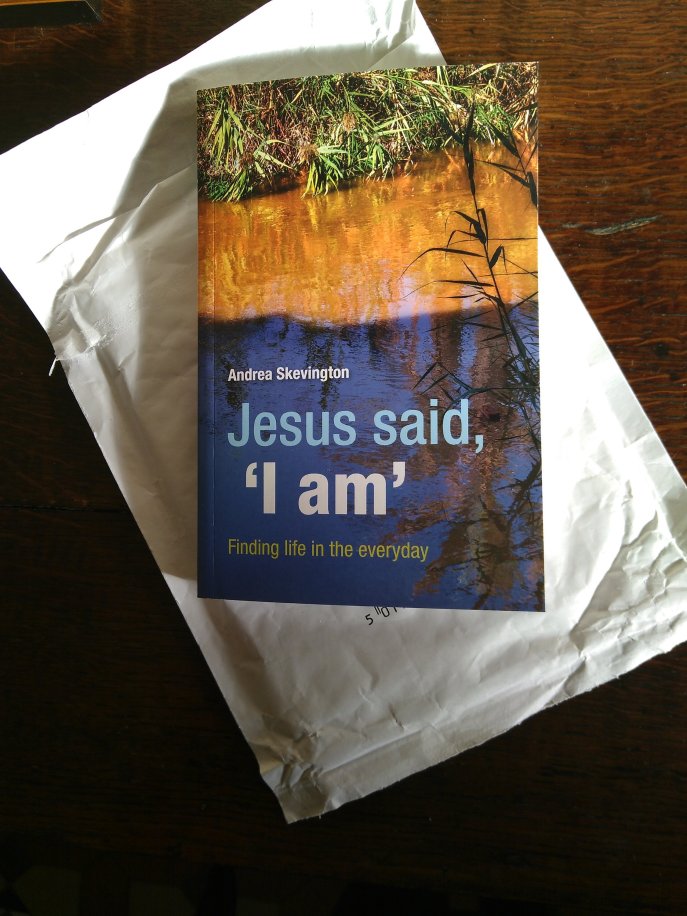
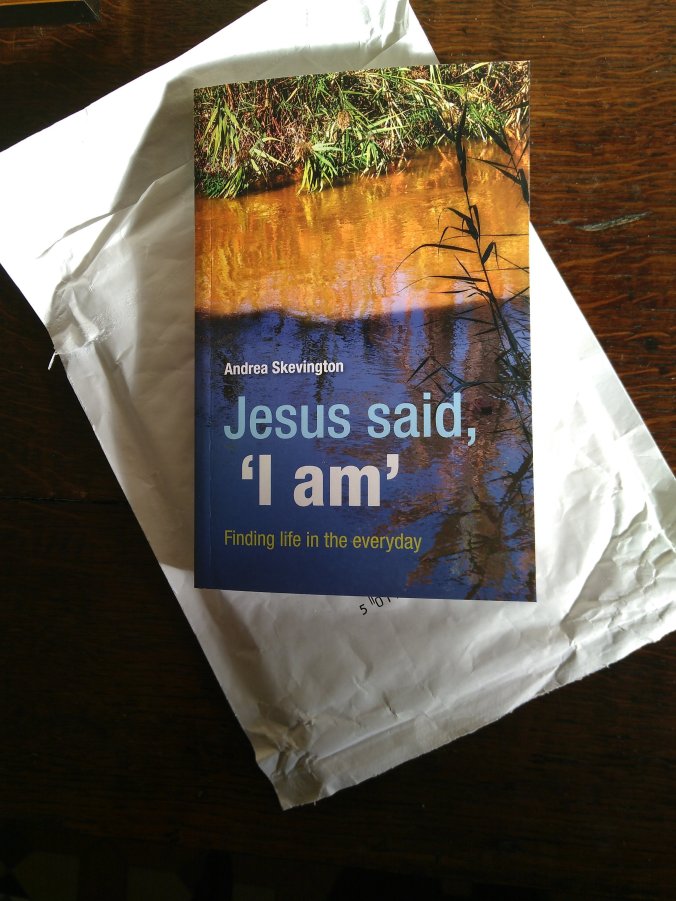
If you’d like a copy of the book, you can ask your local bookshop, or order online.

Here are a few suggestions:
The publishers, BRF

Amazon

img_20181130_114736372319885.jpg

This blog post also draws on the Sunday Retold series.

Thank you for sharing this time with me.
 

Jesus said, ‘I Am’ – for Lent. Getting started


Featured Image -- 5148

Here in the UK, our late winter weather seems brutal.  This is not what we expect for February, and many people are beginning this season with the heartbreak of seeing their homes flooded.  This Lent, the Archbishop is encouraging us to take seriously the call to tend and care for the living earth.

WP_20171016_16_18_46_Pro
We are all increasingly aware of the fragility of the natural world, as well as its beauty, and the response sections of my book pick up these themes and give some practical suggestions for ways we can move towards greater connection, and greater care, of the living earth.  I am so glad to hear various groups, churches, and groups of churches are going to use my book as guide through Lent, and, if you would like to follow, you can find a suggested programme here.

IMG_0790


IMG_0871.JPG
Each week I’ll share with you a little from the relevant chapter.  This week, it’s from the first – I am: Moses and Abraham.  It’s short, so I hope you’ll be able to find time to read it together.  If not, we’ll begin next week with The Woman at the Well.

Moses and I Am
Exodus 3:1-14


John’s gospel looks back to Moses’ ancient story, recording for us how Jesus called himself by this name – “I am”.  This name, which emerged from a burning bush so long ago, is one of the most identifiable features of John’s account. It resonated with his early readers and listeners in Greek Ephesus, and it stirs our imagination even today, millennia later.  Before we go deep into John’s account, and explore why that may be, we will look back to Moses’ story and see what we understand of this earliest “I am”.

…….

Nothing is wasted in God’s economy.  God used the rubbish – and the good – in Moses’ upbringing and his life as a shepherd.  He became ideally suited to his task.  As well as his circumstances and experience, God used his character; in this case, a sense of justice and an indignation at bullies.  What must have felt like failure and a downwards path was the place where Moses encountered God.

We do not know if he was seeking God when God appeared.  We do know that he was in the middle of his everyday, working life, and that God did something strange to arrest his attention, awaken his curiosity, draw him nearer.  Attention and curiosity can guide you, can awaken you to God in the burning bushes we pass every day.

Moses certainly didn’t seem to looking for a job, let alone a great mission.  It is easy to read his rather thin excuses and wonder why he spent so long arguing.  His unwillingness to respond seems to come from uncertainty.

Moses is uncertain about himself, and he is uncertain about God.

“Nothing is wasted in God’s economy” – can we live from this realisation?  Can we acknowledge that even very difficult things can be fuel for something better?
Can we work to eliminate wasteful ways of living?

And from the Reflection and Response section

Earth’s crammed with heaven,
And every common bush afire with God.
But only he who sees, takes off his shoes.
Elizabeth Barrett Browning

As you start your day, pray for open eyes to see where God may be at work, or may be seeking to catch your attention today.  Set off with open eyes, a camera and a notepad.  Record anything that draws your attention.  At the end of the day, mull over what you have recorded in prayer.  What did you see?

IMG_0866.JPG

If you’d like a copy, you can ask your local bookshop, or order online.

Here are a few suggestions:

The publishers, BRF

Amazon


img_20181130_114736372319885.jpg

Thank you for joining me in your reading.  There is more to come…..

Advent 4 – Love – Christmas Readings

candles_flame_in_the_wind-other

It’s getting close now….
It’s nearly midwinter, nearly the shortest day….
It’s nearly Christmas.

And I want to give my attention to the story, to let the wonder of it seep through me, and there is a pile of ironing, and things in the kitchen that need attention, even though I am keeping things simple, even though.

It’s easy to feel the darkness closing in, even though there are lights and music flashing and blaring out there. In here, it’s cosy, and the sun is setting already. I will hold on to the wonder of love being born among us, even though the circumstances could hardly have been less promising – for circumstances are never quite what we hoped, and there’s the lesson. To look deeper than circumstance. To make a courageous decision to hold on to hope, and peace, and joy, and love, even though. For these things are real, and true, and enough. These things are golden strands, woven through the dark fabric.. It is where they can be found. And the One who is coming will light the way, and scatter the darkness, and hold out a helping hand.

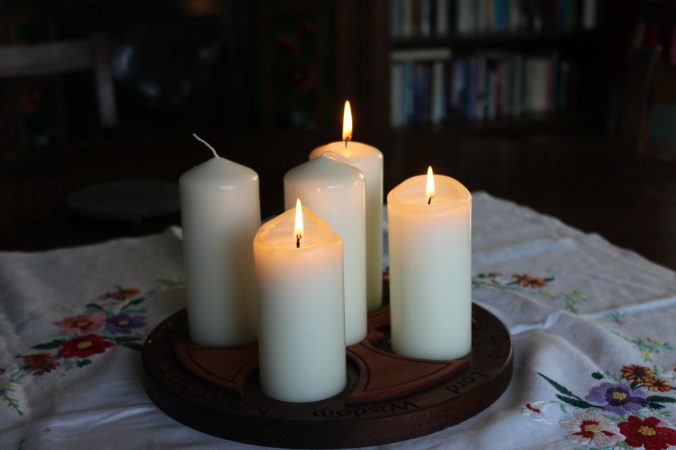
I’ll hold on to the message of “Love came down at Christmas”, and light my candles in the fading light, and watch the rain clouds sweep across the sky, rain falling on all of us, just the same.

Perhaps later, the skies will clear, and we’ll see the stars.

IMG_0950

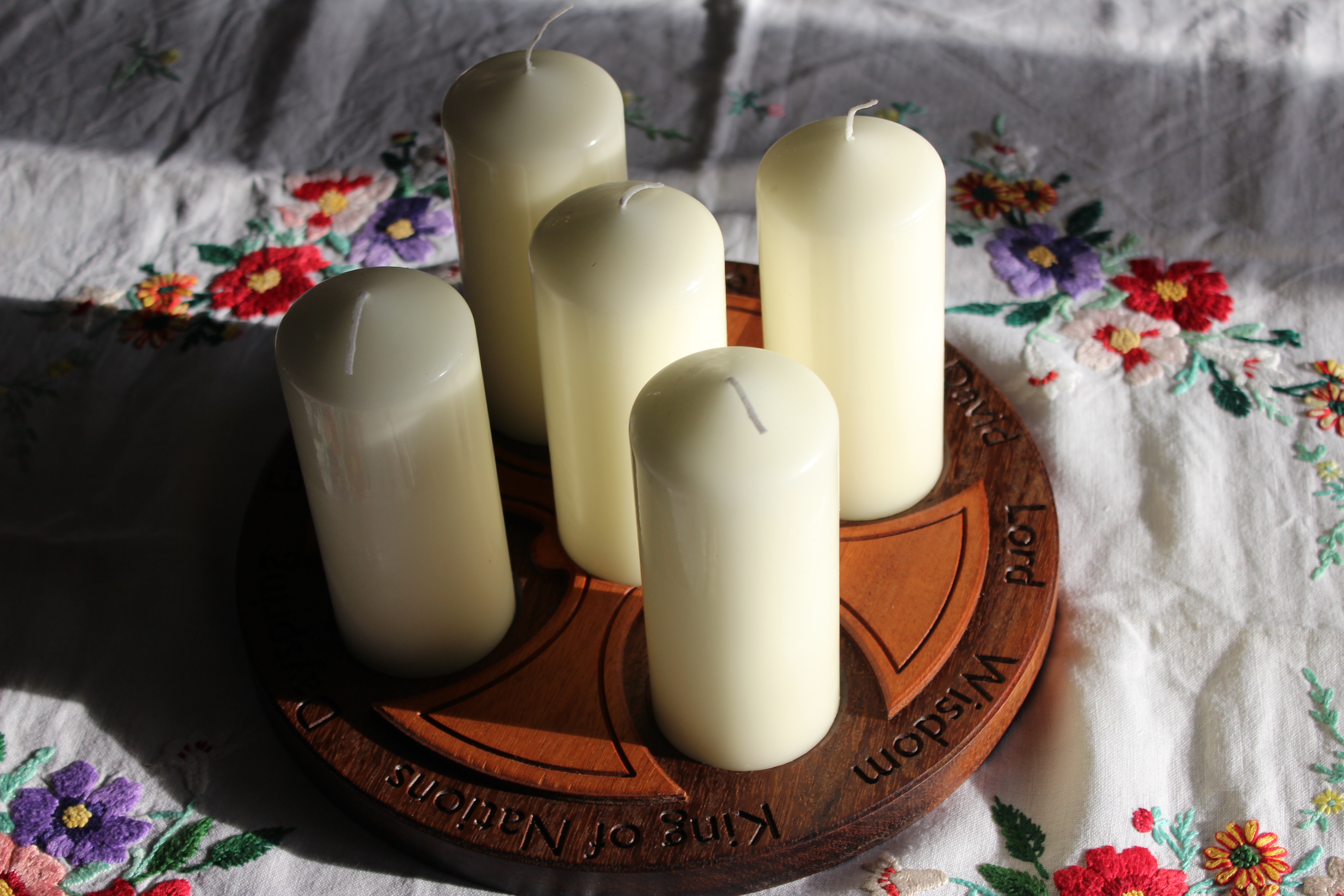
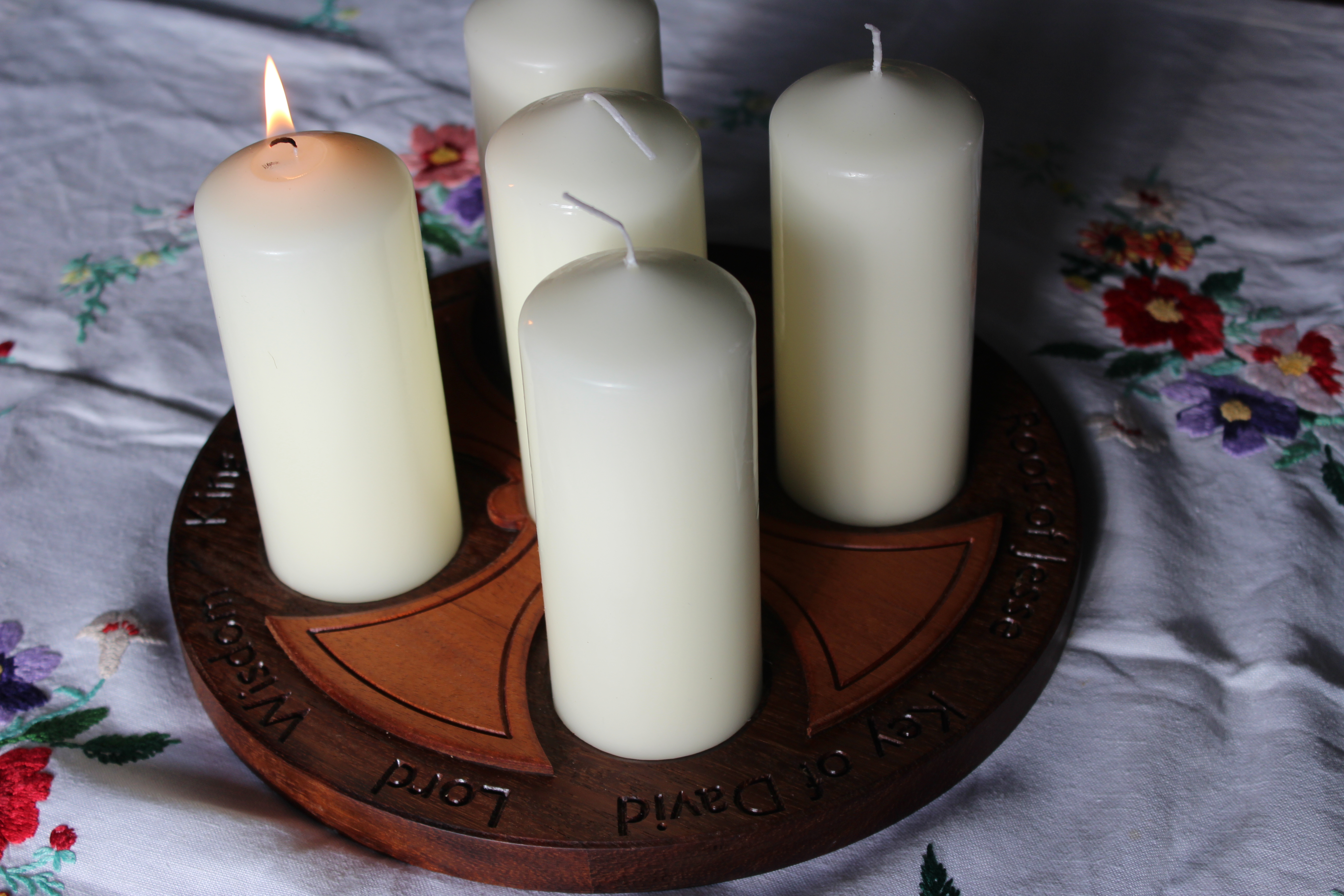
You can find out more about the candle ring, and the words around it, here.

From The Bible Retold

The Roman Emperor, Caesar Augustus, had ordered a census throughout the whole empire, when all the people would be counted, and taxed. The orders spread along straight Roman roads, and were proclaimed first in the white marble cities and ports, and then in the towns and villages of the countryside.

Even quiet Nazareth heard the news, and Mary and Joseph began to gather together their belongings, ready to travel to Bethlehem. That was Joseph’s family home: he was descended from King David, of Bethlehem. They set off south on the crowded road, for the whole empire was travelling. But, for Mary, the journey was especially hard, and the road seemed never ending. It was nearly time for her baby to be born.

At last they came to Bethlehem, but it was not the end of their troubles. The city was noisy, bustling, and heaving with crowds, and Joseph searched anxiously for somewhere quiet for Mary to rest – her pains were beginning, and the baby would be born that night. The inn was already full of travellers, and the only place for them was a stable. There, among the animals, Mary gave birth to her firstborn son, and wrapped him up tightly in swaddling bands and laid him in a manger full of hay. Then, she rested next to the manger, smiling at the baby’s tiny face.

There were shepherds who lived out on the hills nearby – the same hills where King David had once watched over the flocks, long ago. The sheep were sleeping in their fold under the shining stars, while the shepherds kept watch. Their fire flickered and crackled, and the lambs would bleat for their mothers, but they were the only sounds. All was peaceful. All was well.

Suddenly, right there in the shepherd’s simple camp, appeared and angel of the Lord, shining with God’s glory and heaven’s brightness. The shepherds gripped each other in terror, their skin prickling with fright.
“Don’t be afraid, I’m bringing you good news – it will bring joy to all people!” The shepherds listened, awestruck, their faces glowing with the angel’s light. “This is the day the good news begins, and this is the place. In the town of David, a saviour has been born. He is Christ, the Anointed One, the one you have been waiting for. And this is the sign that these words are true: you will find a baby wrapped tightly in swaddling bands, lying in a manger.”

The shepherds watched as light was added to light, voice to voice, until they were surrounded by a dazzling, heavenly host of angels, all praising God and saying
“Glory! Glory to God in the highest,
And on the earth be peace!”

And then, in an instant, the angels were gone, and the shepherds were left in dark night shadows, listening to the sound of a distant wind. But their eyes still shone with heaven’s light.
“Let’s go and see for ourselves!” they called to one another as they raced over the dark, rocky fields to Bethlehem. There, they found Mary and Joseph, and, just as the angel had said, they found the baby wrapped tightly in swaddling bands and lying in a manger. They saw him with their own eyes, and spread the angel’s message to all they met.
“The Promised One has come! The Christ, the Anointed One, has been born!” The angel’s words were on everyone’s lips that night in Bethlehem. And, as the shepherds made their way back to their sheep, bursting with good news, Mary kept their words safe, like treasures, in her heart.

And from Prayers and Verses

Love came down at Christmas
Love came down at Christmas,
Love all lovely, Love Divine,
Love was born at Christmas,
Star and Angels gave the sign.

Worship we the Godhead,
Love Incarnate, Love Divine,
Worship we our Jesus,
But wherewith for sacred sign?

Love shall be our token,
Love shall be yours and love be mine,
Love to God and all men,
Love for plea and gift and sign.
Christina Rosetti
1830-94

O God,
be to me
like the evergreen tree
and shelter me in your shade,
and bless me again
like the warm gentle rain
that gives life to all you have made.

Based on Hosea 14:4-8

The Little Christmas Tree

christmas tree

Please feel free to use any of the material that you find helpful, saying where it is from.

Have a peaceful and joyful Christmas, and thank you so much for giving your time to read this blog

Advent 3 – Joy

maryelyladychapel.jpg

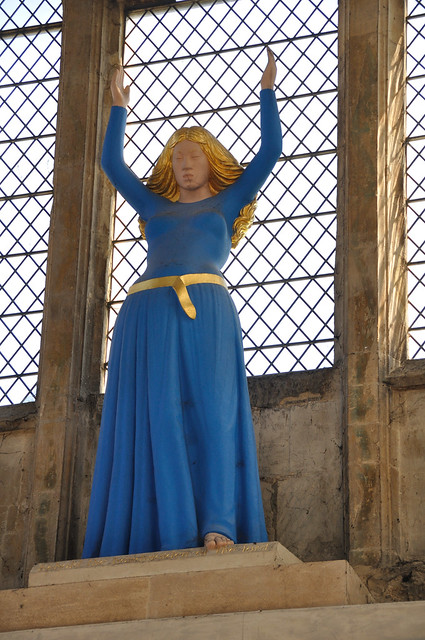
Mary by David Wynne, Lady Chapel, Ely Cathedral

I love this contemporary statue of Mary in the ancient setting of Ely Cathedral’s Lady Chapel.  I love the bright, pure colours of blue and gold, which are probably  much closer to the original look than the current mellow stone.  Most of all, I love her stance.  It is open, powerful, ready to receive the extraordinary gift that was promised her.  It is joyful – with a joy that acknowledges the reality of the difficulties to come, I feel.

Once again, this week, we have a powerful word – Joy – as our theme.  Once again, we are aware that our immediate circumstances may not point to joy, but to sadness, or anxiety, or emptiness.  Once again, we see examples in the stories of Christmas where people have faced great difficulty, as Mary must have done with her unexplained pregnancy. The consequences for her of saying “Yes” could have led to rejection, abandonment, or even death. She does not overlook the huge difficulty, but goes through it, beyond it, to the bigger move of God, the higher purpose her life is serving.  She does this through her own choosing, her active acceptance, of the role the angel gives her.   It is a radical, open, trust, which Wynne’s statue of Mary captures so well. She also does it through seeking out her cousin Elizabeth.  With Elizabeth, also unexpectedly with child, she has someone who might be able to understand her strange predicament, and help her come to terms with what has been promised.  The two women – one too young, the other too old, could nurture and support each other, both giving and receiving, as the time came for Elizabeth to give birth.

Here too is a route to joy – the presence of another.  We are promised that God will not leave us, and we often find that another flesh and blood person embodies the love and care of God for us.  It must have been so good for Mary and Elizabeth to share those three months together. Perhaps, we too can offer some companionship to each other – simply being present, simply listening, simply understanding.

Here is the story, from my book The Bible Retold

Among the fields and vineyards of Nazareth, in Galilee, lived a girl named Mary.  She was soon to be married to Joseph, a carpenter, who could trace his family back to David, the shepherd king.

Then, one day, astonishing news burst into Mary’s quiet, hopeful life.  The angel Gabriel came to her with a message.
“God is with you, Mary!” Mary gasped, and fell to her knees.  “Don’t be afraid. God smiles on you!” The angel spoke the astounding words gently, lovingly. “You will have a son and name him Jesus.  He will be called great – the Son of the Most High God! The Lord God will give him the throne of his ancestor David, and his kingdom will never end!”

For a moment there was silence, as Gabriel’s words filled the air – and Mary’s mind. “But how can this be, as I am not yet married?” Mary asked.
“God’s Holy Spirit will enfold you.  Your child will be holy.  Even Elizabeth, from your own family, is going to have a child, despite her age! She is now in her sixth month.  So you see, nothing is impossible with God!”

Mary raised her eyes to Gabriel’s face. “I am God’s servant. Let it be as you say.” And the angel let her alone, her mind spinning with the strange words.

Then Mary thought of Elizabeth. “The angel knew all about her – I must go to her.” She got ready, and set off quickly for Elizabeth’s home in Judea to the south, near Jerusalem.

As soon as she arrived at the house, she hurried to Elizabeth and took her hands.  At the sound of Mary’s voice, the baby leaped inside Elizabeth, and the Holy Spirit filled her.  She understood at once what had happened to Mary.

“You are blessed among all women, and blessed is your unborn child!” she said. “Why have I been so honoured? Why should the mother of my Lord God come to visit me?” Elizabeth laughed, and put Mary’s hand on her belly. “You see how my child leaps for joy at the sound of your voice?”

Then, Mary speaks out extraordinary words, which in turn echo the words of Hannah when she said goodbye to her long-awaited son, Samuel (I Samuel 2)  You can read Mary’s words in my previous post here.

img_0773

And so begins the journey of one called Lord God by Elizabeth into human flesh – not too pure and holy to found among frail humanity, not too great to be nurtured in the womb of a young woman, and born into uncertain poverty.  One who set up home on this earth, and opened our eyes to see heaven here, even here.

We thank you for being born among us,
sharing with us what it is to be human.
we thank you for showing us a way to live,
full of grace and truth.
Light up our path, and let us walk with you.

From John 1

From Prayers and Verses


IMG_0942.JPG

Advent ring from the good folk at Chapel in the fields. If you’d like to know more about the words, you can find out at my previous post.


Please feel free to use my material, saying where it is from.


Advent 1 – Hope

IMG_0928.JPG

Starting a little late, I thought I’d share with you some thoughts as we go through the four weeks of Advent.

This week’s theme is Hope.  Ah, hope. We were talking about that in our Thursday group a few weeks ago, reflecting on how hope feels different when we hold it in difficult, uncertain times.  Not as a glib avoidance strategy that it’s all fine, really, it’s all going to be fine…. but as a deliberate and courageous stance, holding on to a vision of how things could be.  With politics in uproar, and the climate crisis deepening, we need courageous hope, that’s prepared to work to refashion things around us in defiance of what we see.  There is real power in such acts.

During this time of darkening days, we often revisit the words of the prophets.  They often spoke into desperate, unpromising circumstances with a mixture of a vision to hold in our hearts, and actions for our hands to do.  Those actions can be prophetic themselves, speaking out and making plain God’s dream for the world – a beautiful, hopeful vision strong enough to withstand hard times – brave enough to choose to be born to a poor family, who sheltered in a stable, and had to run from a murderous tyrant.  This is how hope was offered to the world, in the infant Jesus.

During this Advent series, I’ll share with you some extracts from my books.  Here’s something from The Bible Retold , as the retelling of the Hebrew scriptures comes to an end, and we look forward..

As the walls were rebuild, so were the people.  For God was building them into a new kind of kingdom.  Isaiah the prophet wrote: “This is how to truly serve me: unbind people who are trapped by injustice, and lift up those who are ground down.  Share your food with the hungry, and clothe the cold – that is how to live in the light!”

The people listened to his words of bright hope.  “There is much darkness in the world, but your light is coming!  All nations will be drawn to you, and they, too, will shine!”
….

“A child is born to us,
a son is given.
Authority will rest
on his shoulders,
and his names will be
Wonderful Counsellor,
Mighty God,
Everlasting Father,
Prince of Peace.
His kingdom, his peace,
will roll across the lands,
and he will reign on the
throne of David for ever.”

We give thanks for the work that is being done right now, in our communities, to clothe, and feed, and seek justice.  May we have the courageous vision to join with that work of light.

From Prayers and Verses

Scatter the darkness from before our paths.

(Adapted from the Alternative Service Book)

IMG_0930.JPG

The days are dark,
Dear God, give us your true light.

The days are dark,
Dear God, give us your true life.

The days are dark.
Dear God, give us your true love.

The Advent Candle Ring is from the good people at The Chapel in the Fields
It gives me great pleasure to know that the oak at the base was one a lectern, and the lighter wood on top a dining table.  The words written around it are from the ancient chants, the  “O” Antiphons.  I am intrigued by the old Advent practice of placing yourself with the prophets in the time before Jesus, not having a name to call your hope by, but knowing what it is you hope for all the same.  The first few centuries of the Christian Era saw these great prayers, the “O” Antiphons, sung during Advent, calling on Christ to come now, and to come again.
You can listen to the old chant, and read Malcolm Guite’s sonnet, and much more, here.

May you hold on to hope.

Everybody Now – a parable to mark the beginning of Extinction Rebellion’s week of action

wp_20170102_14_12_07_pro

wp_20170114_10_57_06_pro


All around the world, people are taking to the streets to draw our attention to the terrible destruction spreading over our home, the Earth.

It grieves me to learn of so many living things, plants and animals, that are on the brink of being lost from creation for ever.  It grieves me to read of the native European trees, like the ash, and the chestnut, that are now getting closer to dying, of British native mammals whose numbers are diminishing rapidly.

img_0863

But ask the animals, and they will teach you;
    the birds of the air, and they will tell you;
 ask the plants of the earth, and they will teach you;
    and the fish of the sea will declare to you.

Job 12: 7,8
It is time to listen.  What will we learn?

Featured Image -- 5122


Peaceful, imaginative and creative protest can help us wake up.  It can be a revelation, a prophetic voice showing the impact of human greed, and the poverty of our love for our neighbours.  We are not free from the consequences of our actions.

Much of my work draws on a depth of love for the natural world, and so this week I hope to post, and re-post, some pieces which speak into our current crisis, in my own small act of protest.  And so, I begin by reposting this parable.


The parable of the good craftsman

Once there was a craftsman who had two children. As you might expect, he had built a beautiful house out of seasoned wood, with wide windows that looked out over his lush green fields, his flocks and herds.  He had made fine, carved furniture for his house, and he had smiled when he made it, and said, “That’s good!”  He had made beautiful plates and cups and jugs out the red clay near his house, he had smiled when he made those, too, and said, “That’s good!”  He had made a sheepfold to keep his flocks safe, and smiled, then, too.  In fact, all that was around him was good and flourishing and abundant, and as he looked at it all, he laughed out loud and said, “That is all so good!”

The day came when he needed to go on a journey, as the people in these stories often do.  He thought, “My children are old enough to be left in charge now.  They have watched what I did, some of the time, and I have told them how good it is.”  And so he left, and the children looked around, and they, too, saw that it was good.  So good, in fact, that they started to think how much it was all worth.  So they sold the furniture, and the plates and cups and jugs, for a fortune.  They were made by a master craftsman, after all.  The plastic ones they bought to replace them were good enough. They looked at the lush green fields and thought, “We could rear more animals in pens.”  So they did: twice as many, three and four times even, the poor creatures.  They sold the pasture they no longer needed, and a factory and a car park grew there, large and grey and ugly.  The water from the well their father had dug became bitter, but they bought water in bottles with all the money that they had made.

Then, the time came for the father to return.  As he drew near the house, he noticed the trees along the road were withered and dying, and his smile left him.  He came across a bird trapped in plastic that blew across the fields, and he set it free.  Then, near the house, he found a thin child sitting by the side of the road.
“What is the matter?” he asked.
“I drank water from the stream that flows from over there, by that factory.  It tasted bad. Now I’m sick.”  The father gave the child water from his own flask, and picked up the child to take home. He had herbs for medicine there.

But when he got even nearer, he could see that the factory was on his own land, and that where his own fields should be was all noise and smoke.  He could see the plastic rubbish spilling over from his own front garden, from where the flowers and the vegetables and the herbs had been.  He saw his own children, with grey, indoor faces, and said, “what have you done?”
“Father, we are so pleased to see you!  Come inside, we will bring you the accounts and you will see what we have made!”
“That is not the kind of making I intended you for!” replied the father. “And see, see this child, poisoned! How will you enter that in these books of yours?  What have you done with all that I have made – do you not know that I love it all?”

Some prayers from the first chapter of Prayers and Verses

Lord, purge our eyes to see
Within the seed a tree,
Within the glowing egg a bird,
Within the shroud a butterfly.
Till, taught by such we see
Beyond all creatures, thee
And harken to thy tender word
And hear its “Fear not; it is I”.
Christina Rosetti 1830-94

O God, enlarge within us the sense of fellowship with all living things, our brothers the animals to whom thou gavest the earth as their home in common with us.
Basil the Great c330-379

He prayeth best, who loveth best
All things both great and small;
For the dear God who loveth us,
He made and loveth all.
Samuel Taylor Coleridge 1772–1834


#EverybodyNow

Prayers for a new term – from Prayers and Verses

IMG_0607

img_0238

September.

This year, it’s rich, and green, and everything is starting to grow again, like a second spring.  It feels like a new beginning, which is appropriate as it’s the beginning of a new academic year.  And, like all new beginnings, even for those who are almost looking forward to it, it can be a little daunting, and make us feel a little anxious.

For others, it’s the beginning of a new adventure, or a welcome return to time spent with old friends in a safe, familiar space.

Whatever it is for you, may you be blessed in the weeks to come.


Here is an extract from my book, Prayers and Verses.

A new school

Do not imitate what is bad, but imitate what is good.
3 John 11

Goodbye, dear old school,
Hello, bright new start.
May God guide our lives,
Head and hand and heart.

Dear God,
Help us as we learn new things.
If we learn quickly and easily,
may we help others to understand.
If we make mistakes,
may we understand what went wrong.
help us never to be afraid of new things,
but to see them as an adventure.


IMG_0922

IMG_0923.JPG

Otley Hall Quiet Day – the vine, and other growing things.

Last Saturday I had the enormous privilege of leading a Quiet Day for St Mary’s Church of Woodbridge, based on I am the vine.  I’m afraid I wasn’t taking photos, just giving my attention to what was going on around me.

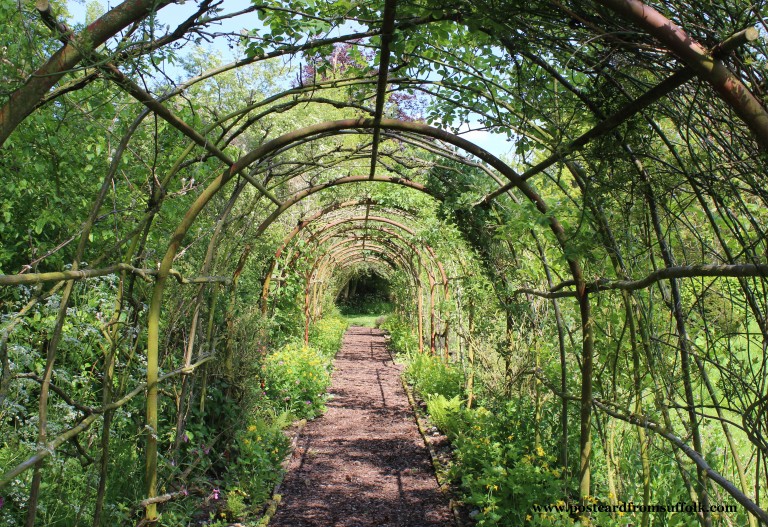
The gardens are so beautiful, as ever, and it was particularly good to see several vines growing and entwined, with small grapes forming.  They were forming a tunnel, you could walk through the vine, almost grafted in.

otley hall suffolk postcards.jpg

A photo from earlier in the year from Postcard from Suffolk

It was so good to sit by the water, and watch the fish and the dragonflies.

IMG_0471

Here is a picture from an earlier visit, in spring.

One of the things we talked about was how Jesus’ I am saying – I am the vine – gives us a way of seeing ourselves as deeply connected.  We talked of many things – how we can deepen that connection to God, and each other.   We talked about everything holding together, ourselves and everything else, in Christ.  We read about that in Colossians.

We used poetry to help us towards prayer, and contemplation, including Malcolm Guite’s sonnet, set to music here by St Brides.

I can’t help thinking today, about our connection to this good green earth.  It is precious and beautiful, and we are only just beginning to learn how it does hold together, interconnected, and mutually dependent, as we are watching with horror as the Amazon burns, and Siberia too.  We know how ancient woodland in our own land has been cut down, or is under threat.

May we find our way home to tending for this beautiful world.

May we take inspiration from the song of the vine.

You can read some more about the vine, from my book on the I am sayings, here.

God, source of all light and life,
help us to see your hand at work
in the beauty of creation.
Help us to know that, in you,
the whole earth is holy ground.

O Lord,
Your greatness
is seen
in all
the world!
Psalm 8:9

From  my collection of prayers, Prayers and Verses


You might like to read A parable for Earth day.


Poem: Jacob’s Ladder


IMG_0914.JPG

One of the loveliest spots in my home is the window seat.  In the winter, the radiator does its work through the wood, and it is warm and snug.  At this time of year, as you sit you are surrounded by flowers, and every day you see something new opening.

IMG_0913

This poem is a poem of waking up. To begin with, the life of the world seems far away, on the other side of glass.  Gradually, though, I begin to see.


Jacob’s Ladder

Sitting on the window seat, in this box of light,
I drink warm, bitter coffee, my mind waking slowly from  sleep.

There is a fly buzzing against the glass, black and slow,
not getting through.  On the other side is the cool sun,
the flowerheads and flowerbuds swaying in the breeze,
their stems crossing and crisscrossing  in straight green lines,
Making rhomboids, diamonds of the brightness.
And so I sit here, as if among the flowers,
not feeling the breeze, not catching the scent.

There are the bright, tissue paper flames of poppies,
and the soft deep pinks of the columbine,
dove among flowers,
And the euphorbia – black with bees –
their green flowers full of sweetness.

But there, suddenly, are the tall spikes of Jacob’s ladder,
new dazzling white, startling, perfect.
They must have opened early while I slept.
Those flowers – small, spread out skirts
of pure white, anthers gold with pollen,
the delicate deep ring of purple veins –
drawing you deep to the green-dark heart of the flower,
curled, mysterious, where the heavy bee probes
for nectar as sweet as the honey yet to come.

Angels ascending and descending,
ascending and descending
as the stiff green stems are swaying,
are still swaying in the cool breeze.  The day begins.

white-jacobs-ladder

The name of this plant calls to mind the story of Jacob in Genesis, which is also a story of coming to see, of waking up.
Here is my retelling from The Bible Retold, the text shared by The Lion Classic Bible

Jacob went alone, travelling unitl it was dark.  Shivering in the chill of the desert night, he took a stone for a pillow, and lay down to sleep.  As Jacob slept, a dream came to him.  He saw a ladder, with its feet on the ground, stretching up and up to heaven.  In his dream, he watched as God’s bright angels travelled up and down in between heaven and earth.  And in his dream, God himself was there.
…….
Jacob woke with a jolt and looked around.  He was alone.
“God was here and I didn’t know it!  This place is the gate of heaven!” he said  Then he took the stone he had slept upon and set it up as an altar to God. He poured oil on it as an offering, and worshipped there.

You can read the Genesis story here

Jacob's ladder

Sophy Williams’ beautiful illustration from The Lion Classic Bible


Help us, like Jacob, dream of angels.
Help us, wherever we wake,
to know that you are there, too.
Help us to see with new eyes.