My new books are here! I’ve just been unpacking them, and I thought I’d share them with you right away.
Thank you to SPCK for these copies, they’re looking delightful. There’s something new, too. The smaller one is a board book. It’s slightly abridged, but still has all of Lorna’s enchanting illustrations. I particularly like the way the sparkles have a texture to them. I can imagine little fingers following the trails of stars across the pictures.
I say my new books, these are new editions of the first book I ever had accepted for publication, and it’s still very close to my heart. I’m so glad it’s been given a shiny new edition.
The story of offering shelter and welcome, which is such a moving part of our Christmas traditions and Nativity plays, seems particularly apt at the moment. It’s worth reminding ourselves of the value of kindness and humility.
The hardback is available now, and the board book will be out in a few weeks. I’ll post some links below, but if you are lucky enough to have a local bookshop, they should be able to get them for you for the next day if not in stock.
For now, I’m just going to go and enjoy my lovely books!
Here are some links as promised: you can order from the publisher SPCK and from Bookshop – this link is for the hardback, and this for the board book to preorder on the site. Also, wherever you usually order books.
Thank you for your support and encouragement over the years, I really appreciate it.
Gradually, we’ve been reducing the size of the unmown places in the grass. It’s been growing so fast this year, and the flowers have had a second and a third go. The sun and the rain have kept everything flourishing. There are small frogs and grasshoppers, and many bees still. It’s worth going very slowly, giving everyone a chance to hop out of the way, and leaving places of refuge. Little by little….
I wish I’d taken a picture of this patch above in the week before it was cut, when a round shape appeared flattening the stems. We were pretty sure it was the muntjac who is a regular visit to the garden – earlier this year, there was a youngster too. You can read more about the deer in the garden here and here. She is a joy. I do worry about her crossing the road between the woods and the garden, about the speeding cars – but the only time I have ever seen her trotting along the road, everyone stopped and waited for her to be safe. Kind drivers!
As I sat by her space I imagined her presence. I felt the hum of the cars through the ground. And I thought of all the places where the creatures who used to make a home no longer do – all the absences. I felt the loss, even as I felt the beauty and abundance of this late flowering meadow. And so this poem emerged, in fits and starts. It’s taken its time, has a basenote of loss, and I hope it carries the gentle tenderness of the deer, and the many creatures I feel kin to even in this one garden.
What the space holds
There is a space in the long grass, a flattened disc of green stems, while all around late flowers nod. A curved bowl, waiting, rimmed with golden light.
Low down, face close to grass, I hear the hiss of breeze through stems, the buzz of bees, crickets, even, perhaps, butterfly wings. But there is no trace of whoever comes here, night after night, and circles, and settles to sleep. Too sweet a hay-smell for fox or badger, too big for cat.
I open my mind’s eye to the night, quiet, and across my heart a dark shape with long, delicate legs steps gently, picks her way through the black shimmer of stems and fills this space with a shadow – a shadow whose heart beats and ears twitch. I see a dream-deer, breathing, her brown sides rising and falling as the space fills with living warmth, with the softness of deer, with the gentleness of one who comes by night.
And as I dream, as I treasure the absent deer, I think of all the empty spaces and places, holding now only memory, fading, or worse, nothing. I think of the absences that there have been and that are yet to come.
Patterns cut out of sky where flocks of birds, tumbles of bees and butterflies are not, but once were. The rivers where there were fish, who are not. Places where the beavers and the big cats and the red squirrels are not, and their spaces cradle nothing, empty and mourning, Earth’s arms aching.
This soft round space that has become a bowl of dreams does not know if the sweet deer will return tonight, as car sound rumbles through the earth.
This bowl in the grass ringing with her absence, with the absence of all creatures who are not here, but who once were, as I run my finger around the rim, and feel the tremor of loss upon me, and through me. May she be safe. May she and all creatures be safe.
The final lines of blessing draw on the Buddhist practice of metta, or lovingkindness, meditation, which I have found deeply helpful and incorporate into my prayer and contemplation regularly.
When I was writing about the spaces where creatures are not, I remembered a wonderful Matisse exhibition we went to of his cutouts, done in his final months and filling his rooms with birds and flowers. I imagined the pieces of paper uncuring from his scissors and falling to the ground. I wondered if what we would be left with would be these negative spaces, with the birds and flowers no more, or if we would find our hearts opened to care for those we share this beautiful green world with.
Once again, we are marking the turning of the year amid uncertainty, upturned plans and that strange mixture of being on repeat with the pandemic, and knowing that this season will be different from what has gone before. Looking back, I find this poem has helped me once more this year, and so I’m sharing it with you again.
May we all have a happy, healthy and peaceful New Year. May we hold on to what is good, and hold a steady course in uncertain times.
I’d like to thank you all for your support, for taking the time to read this blog over the past year. I hope it blesses you in the year to come, too.
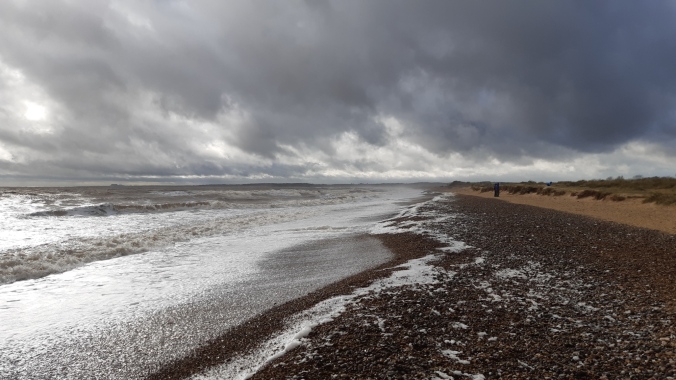
All the photos in this post were taken by my husband on a wild and stormy day at Walberswick.
This is a strange New Year’s Eve. It’s disconcerting to think how little we anticipated what this year would bring at it’s beginning. It throws our attempts at planning and new resolutions into all kinds of disarray, if we try to look ahead. So I’m attempting to leave the future where it is today. I’m trying to look deeper, at some of the lessons this year of a long pause, a long hesition. I’m noticing that there are things I can take forward…. the things I miss and therefore know their worth, the things I don’t miss as much as I expected. Knowing the value of community, connection, kindness more keenly, I’ll look for ways to nurture them in these new days. Knowing how the natural world has sustained me this…
We are getting close to the last Sunday in Advent, and I’m sharing again a post on it’s theme, Love. This year, I’ve been very struck by the contrast between this run up to Christmas, and what we have grown used to in previous years. There is a sadness and a weariness, an underlying anxiety, as we run our errands in masks, seeking to give each other space. It has brought up sharply the old notion of Advent as a time of darkness, waiting while hardly daring to hope, hardly knowing what we are waiting, or hoping, for.
And this year, as many of us are holding back from seeing those we love, we are experiencing in our often aching hearts how much Love means to us, how essential it is. Our very essence. So here are some readings, and thoughts, on our hope that Love still comes down at Christmas.
It’s getting close now….
It’s nearly midwinter, nearly the shortest day….
It’s nearly Christmas.
And I want to give my attention to the story, to let the wonder of it seep through me, and there is a pile of ironing, and things in the kitchen that need attention, even though I am keeping things simple, even though.
It’s easy to feel the darkness closing in, even though there are lights and music flashing and blaring out there. In here, it’s cosy, and the sun is setting already. I will hold on to the wonder of love being born among us, even though the circumstances could hardly have been less promising – for circumstances are never quite what we hoped, and there’s the lesson. To look deeper than circumstance. To make a courageous decision to hold on to hope, and peace, and joy, and love, even though. For these things are…
Here, I’m sharing again a post for the second week of Advent, when some traditions focus on the theme of Peace as we wait in the gathering darkness for the birth of Jesus.
If we look at the world around us, its sometimes a real challenge to hold peace in one hand, when there is so much trouble in the other. And yet, it’s there.
May you have peace today, this week, this Advent.
We’re drawing deeper into Advent now, the days are shortening, the cold and wet are creeping closer. Meanwhile, the shops are full of – beautiful things, and plastic tat, and carols, and cheesy music, all jumbled and clashed together as we go from one to another, and back again.
How to hold on to some kind of centre, some kind of Peace, in the midst of lists and duties and timetables and so many forgotten-to-do-in-time things? How to hold on to a centre, and to peace, in the midst of loss, and loneliness, and Christmas pasts? This Sunday, the second of Advent, sometimes takes the theme of Peace, and peace is much needed.
As Advent Sunday is getting closer, I’m sharing again a post on Hope. This year, we need hope more than ever, and the lighting of Advent candles can help us find enough light to live out our hopes as the days grow shorter.
Starting a little late, I thought I’d share with you some thoughts as we go through the four weeks of Advent.
This week’s theme is Hope. Ah, hope. We were talking about that in our Thursday group a few weeks ago, reflecting on how hope feels different when we hold it in difficult, uncertain times. Not as a glib avoidance strategy that it’s all fine, really, it’s all going to be fine…. but as a deliberate and courageous stance, holding on to a vision of how things could be. With politics in uproar, and the climate crisis deepening, we need courageous hope, that’s prepared to work to refashion things around us in defiance of what we see. There is real power in such acts.
During this time of darkening days, we often revisit the words of the prophets. They often spoke into desperate, unpromising circumstances with a mixture of a…
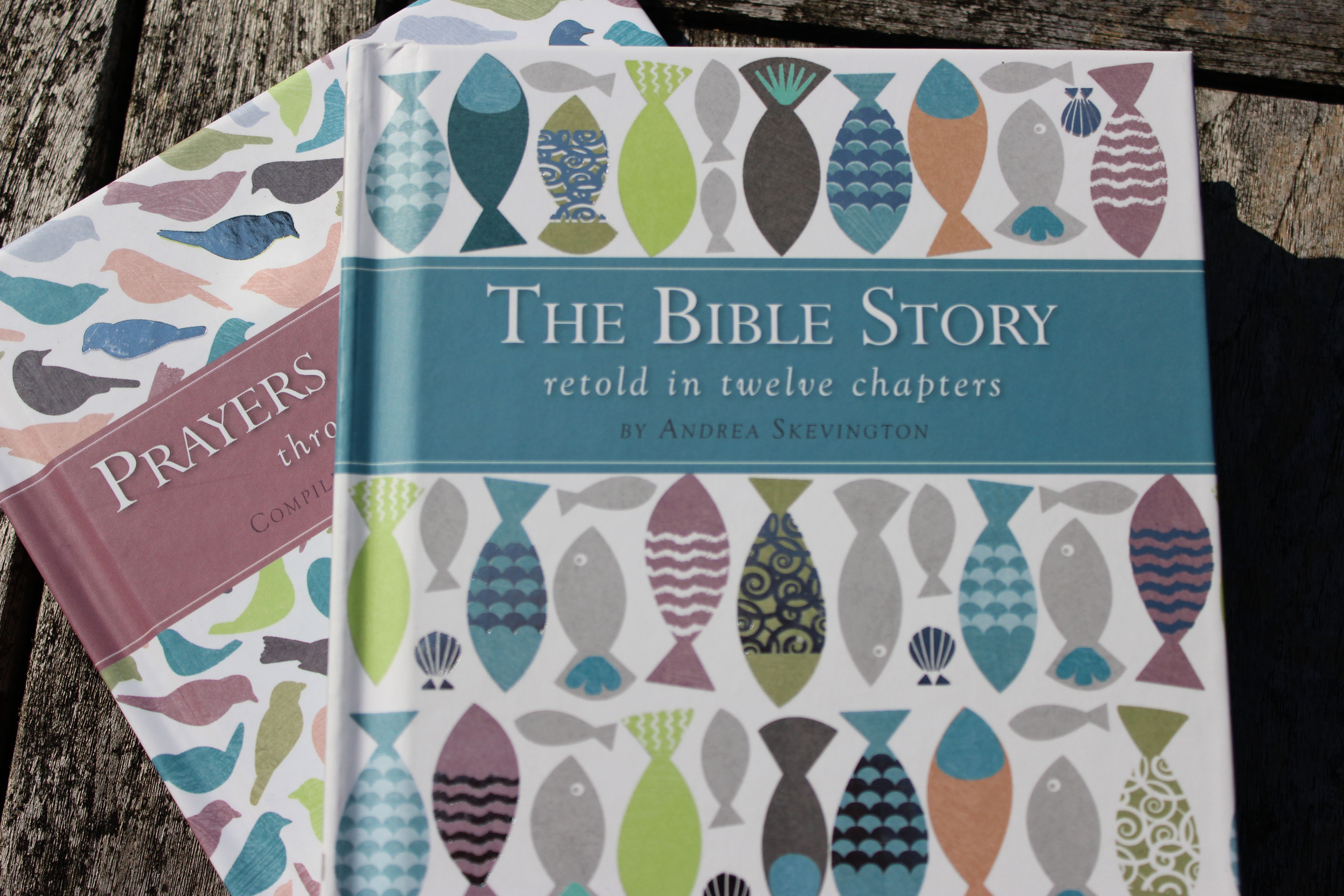
I’ve been sharing a few poems drawing on the Exodos story, and, to sit alongside those poems, I’m also sharing extracts from my book The Bible Story Retold.
I hope that these passages will place the poems in a wider and deeper context. Thank you to all the people who are reading my blog. I really value your time and attention. I’m aware that people from a wide variety of places and backgrounds gather here, in virtual space, and I hope these extracts enrich your time reading.
And here is my retelling…. based onExodus 3 (and 4:27)
Then, one day, as the sheep grazed on the slopes of Mount Sinai, Moses saw something: it was bright flames leaping up from within a bush. He began walking towards the burning bush, curious, because he saw that although it was crackling with flames, the bush was not being burned up. And then a voice called from within the flames.
“Moses, Moses!”
“Yes?”
“Don’t come any closer. Take off your shoes, for you are on holy ground!” Moses obeyed the voice.
“I am the God of your forefathers: the God of Abraham and Isaac and Jacob…”
Moses hid his face, afraid to look on God.
“… and I have heard the cries of my people. I have seen their suffering, and felt their pain. I want to pull them out from under their slave masters’ whips and bring them to a good, gentle land: a land of plenty. You are the man I have chosen to send to Pharaoh. You will rescue my people form Egypt.”
Moses was stunned, utterly shocked. “But…. but…. I can’t! Why me? What if they ask me who sent me?”
“I am God, and I am sending you. I am the God of Abraham, and Isaac, and Jacob: the God of the Israelites.”
“But…” Moses was still full of fears at the thought of returning to Egypt and speaking for his people. He blurted them out to God: no one would listen to him; he stuttered; there had to be someone else for the job. But God did not give up. Glod promes to help, and to work miracles through Moses. Aaron, Moses’ brother, would help him, and God would be with them.
So, fearful and uncertain, Moses left with his wife and sons. And, as he raised his eyes toward Egypt, he saw his brother, Aaron, running to meet him.
And from Prayers and Verses
Grant us a heart wide open to all this beauty; and save our souls from being so blind that we pass unseeing when even the common thornbush is aflame with your glory, O God our creator, who lives and reigns for ever and ever.
WALTER RAUSCHENBUSCH (1861–1918)
Dear Lord, Help us to see you today in all the ordinary things when we walk, and talk, and play; help us to know that the whole earth is full of your glory, and that the ground is holy. Amen
The world is charged with the grandeur of God.
It will flame out, like shining from shook foil.
GERARD MANLEY HOPKINS (1844–89)
This post draws on the Sunday Retold series on this blog, which pairs the readings and prayers together.
If you’d like to order the books, you can do so in the links in their names at the top of this post, or through your usual internet shops. If you have a local bookshop, they should be able to order it for you quickly.
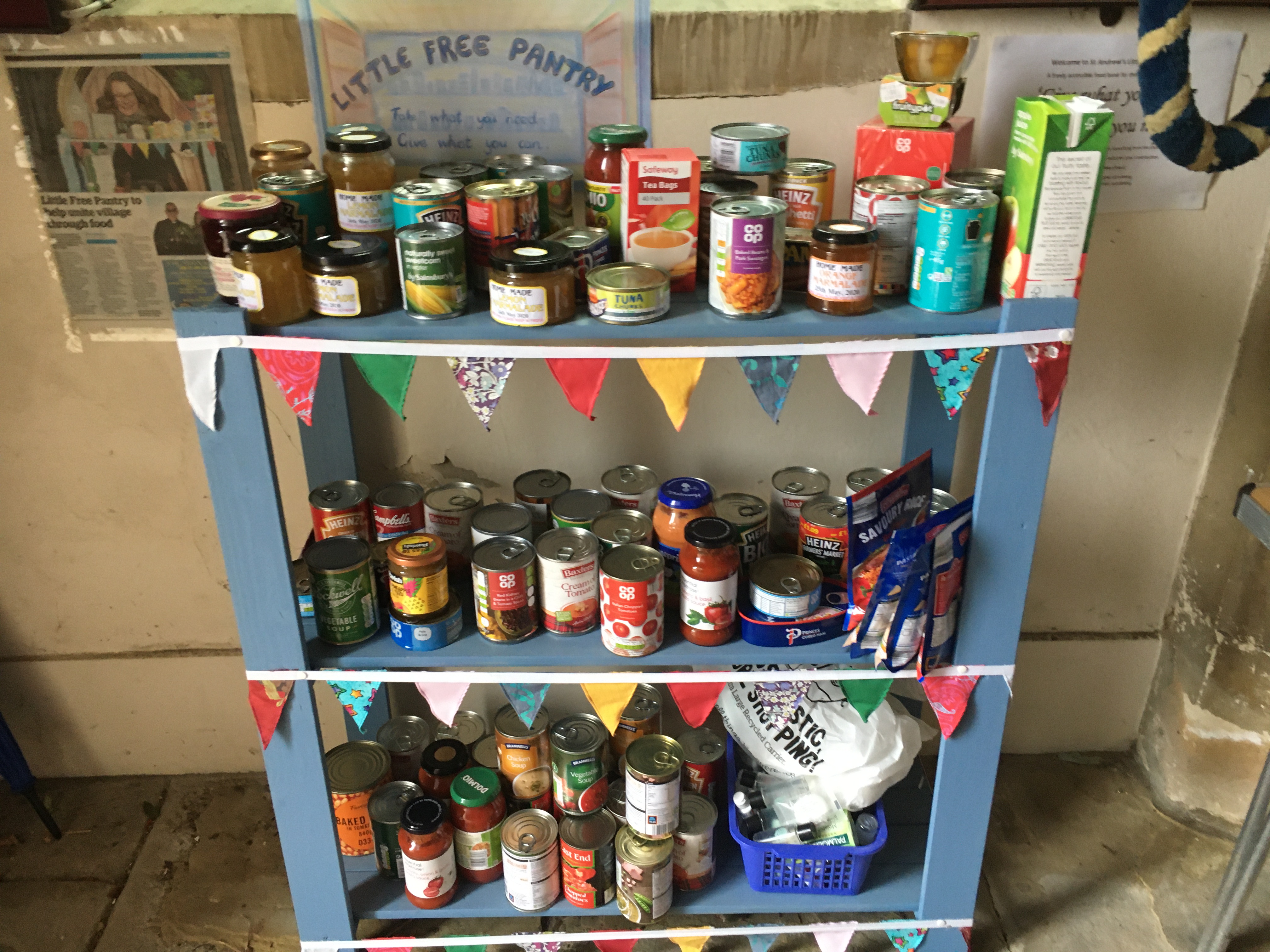
This is just a quick post to thank the wonderful people of Melton and Woodbridge for keeping the Little Free Pantry well stocked during the coronavirus crisis.
It’s in the porch of St Andrew’s church, and is opened by volunteers every day. We aim to have it available from 10 am to 5 pm seven days a week.
Thank you to Elaine for the photos, and keeping an eye on things. Thank you to everyone who has participated, either by giving or by taking food.
It’s very simple.
Give what you can, take what you need.
The porch is open, and unstaffed, so you are free to come and visit the pantry if there is no one else there, without coming in to contact with anyone else. You are free to bring food, or take food, or both. It’s free, and freely available. It’s a sign of neighbours loving each other, and of the love of God which holds us all.
It’s so good that our community is working together in this way, taking care of each other. A hopeful sign.
I wonder if this poem is more of an unLockdown Poem, written as it was after a short trip out to a small scrap of heath between wood and river so close to our house. I had been feeling too tired to walk for a few days, and this was the first short outing. I am very glad I went. Since I have understood and learned to hear the nightingales, I am aware that there are many near where we live – they appeared in the last poem, Night Music, and will again.
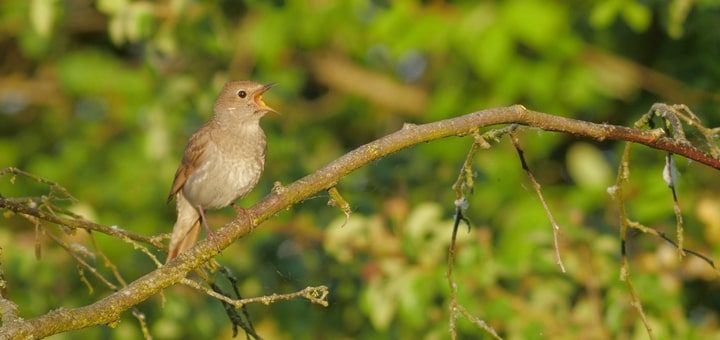
I have no photos of my own of nightingales, such illusive birds, who like to hide away, but here are a few things from the internet. Perhaps, if you don’t already recognise the song, you’ll find you do hear them after listening. If you haven’t had a chance to catch up with The Verb, from Radio 3, the episode on Birdsong begins with singing with nightingales, before my poem, The Blackbird. The tradition of poetry about nightingales is also touched on, and people’s responses to the sound over thousands of years. It’s beautiful.
Photo from free sounds library
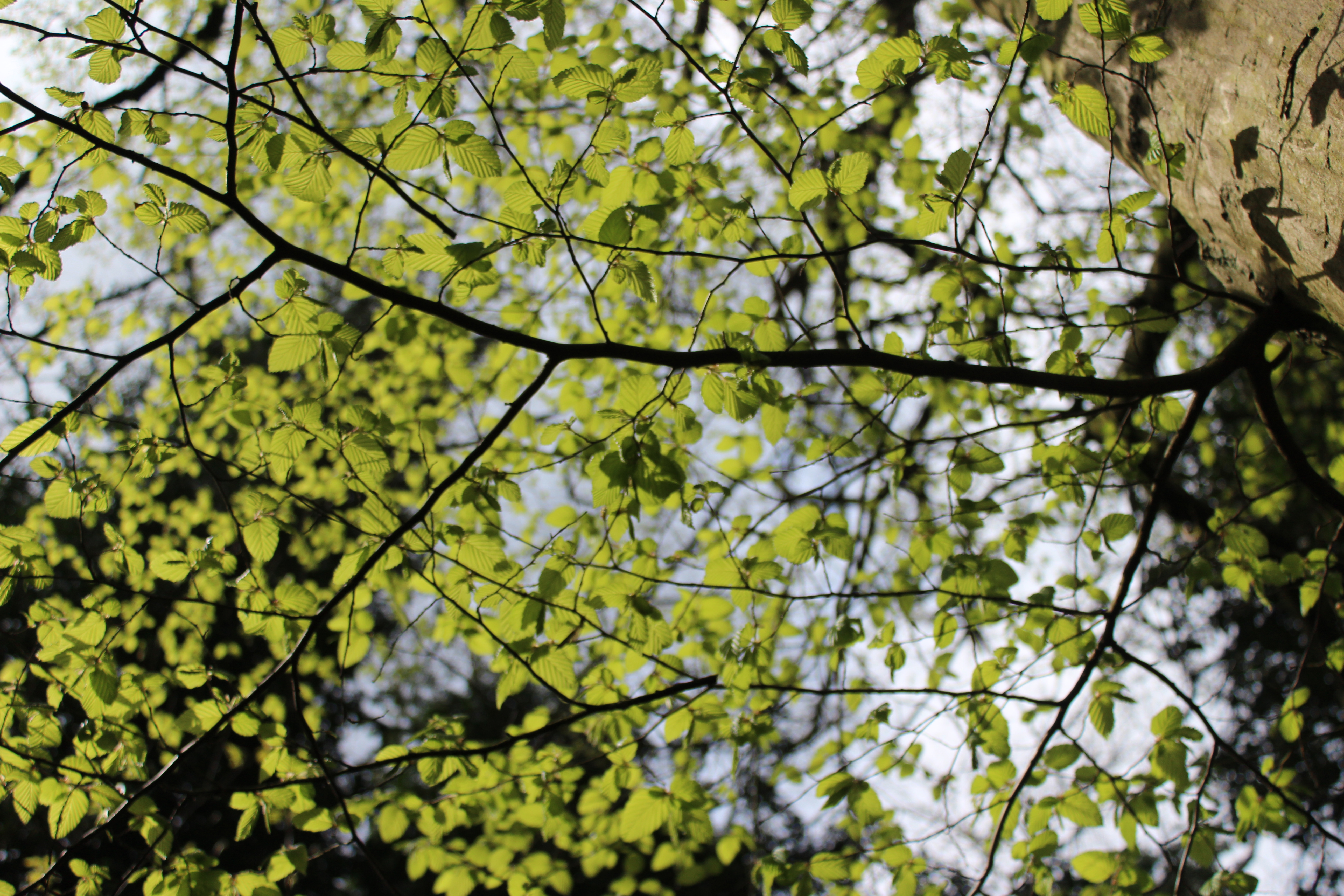
My local wood.
Nightingale Lockdown Poems 23
It’s the quality of sound,
rather than any melody –
loud, round embodied timbre,
rills and repeats
and variations, strange,
almost more than mechanical,
more than the ghost
in the machine,
the spirit and the flesh,
Stunning the air to silence.
There, in the thicket, in the
low grown oak,
overlooking the creek.
I stop, and let my heart
steady, and listen.
I have never been certain
of it before,
the nightingale’s song –
and I was expecting
more song,
more melody,
less strangeness,
less command of the evening
held by such a soft
brown and
hidden bird
Welcome to the next in this series of Lockdown Poems. Although things are growing busier, and there is far more traffic on the road, many of us are still at home. Some are islolating. It is an unsettling, and a frightening time, this time of venturing out a little. And for those who are braving going back to work, maybe a glimpse of green growing things will help too.
As I was looking at the unfolding of the strawberry flowers, I was thinking of all that was hidden, folded within the bud, waiting. The beauty of the flower, and the prospect of fruit. Same with the apple blossom, and, perhaps, same with the moments and days themselves. I thought of how time changed within the deep moments of prayer, too, when we find we are in an enfolded moment, upheld in love.
Alpine Strawberries – Lockdown poems 15
The white flowers of the
alpine strawberries are
opening, everywhere,
under the hum of insects,
under their faint perfume,
groundcover where
newts hide,
and slugs, no doubt.
Each day lengthens,
each day seeming
to hold an infinity
folded within itself,
opening out,
nonetheless, endless,
as the patterns
run on –
Wind and sun,
sun and wind,
playing against each other
as the new apple tree shakes,
holding its new blossom.
Life bending before
time – supple, resilient,
turning to sun –
hopeful, relentless.





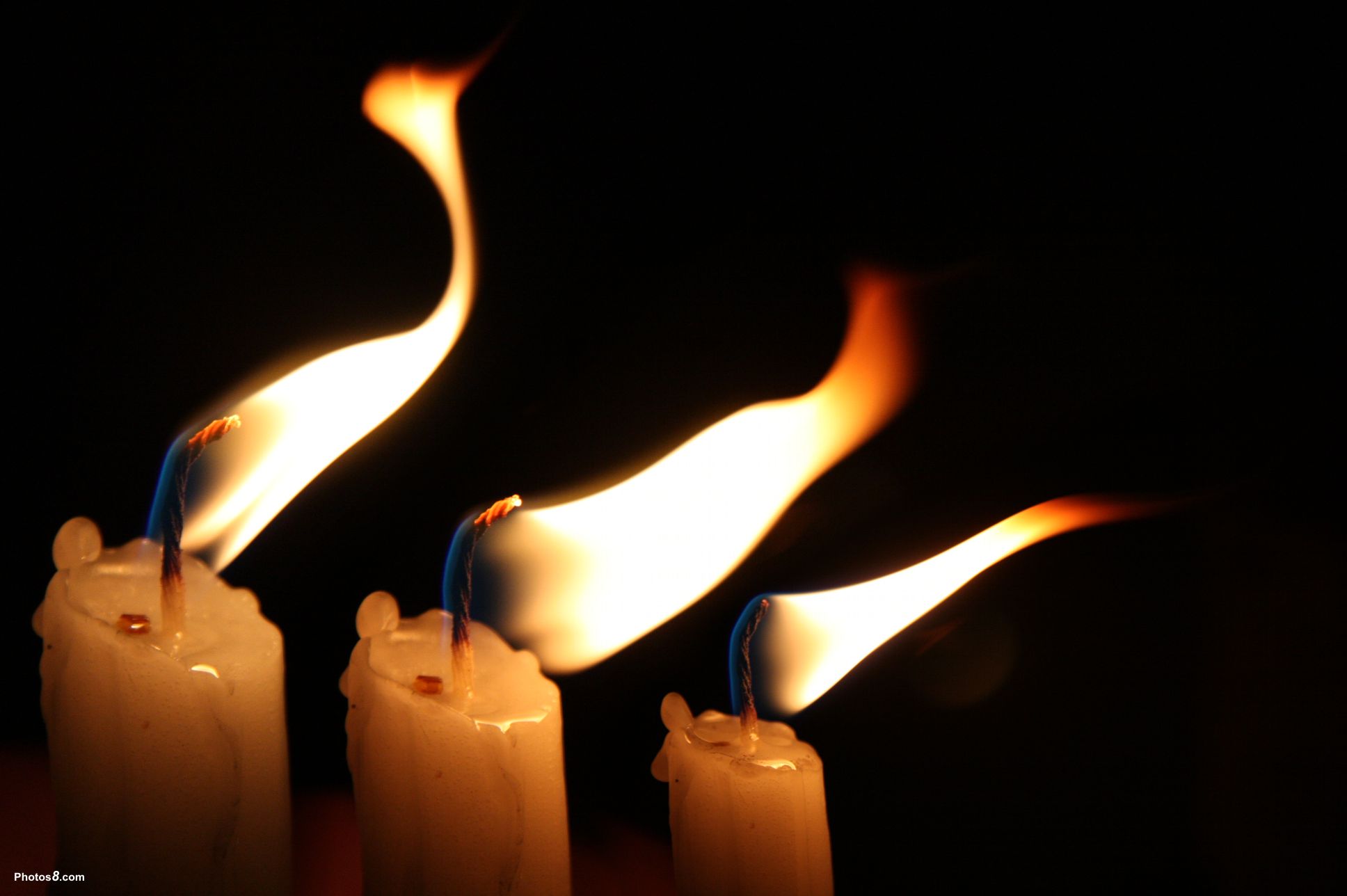

 This beautiful Advent ring is from





 Andrea Skevington