The faith of a Roman

bible retold cover

This Sunday’s readings include a story from Luke’s gospel, of faith in an unexpected place.  The Romans were an occupying force in Israel, and a centurion was a military officer enforcing Roman rule.  It is good to see how Luke records this example of God being at work in unexpected people.  In that category we find not only the Roman centurion – but also  the Jewish elders.  They can recognise that this man, an “unclean” gentile, outside their own people and laws, is “worthy”.  Often the religious leaders seem narrow, legalistic, small-minded even, but not in this instance.  They see something good, and they speak it.  The centurion’s support of their synagogue might be genuine interest in their faith, it might be good politics, but he is honoured whichever it is.

It is good to look about, and see God at work in unexpected people.

Below you will find my telling, in an extract from The Bible Story Retold
If it is of help to you, please feel free to use it, saying where it is from.
The gospel reading is Luke 7:1-10


The centurion stood with his hands behind his back, watching his most loyal servant’s dry lips as they moved without sound.
“That’s enough!” he said to those who were trying to coax him to drink, and they slipped back, away from the couch.  For a moment the centurion leaned down, his ear close to the man’s mouth, but his breath was growing fainter.  He was near death. The centurion strode out to the courtyard and looked up at the road.  He saw Jesus in the distance, with his followers behind.  Quickly, he spoke to the Jewish elders who stood by the gate, and they turned and walked towards Jesus.

“Rabbi,” they said “we come to see you at the request of the Roman centurion stationed here.” The crowds watched Jesus carefully – what would he do?  For the Roman soldiers were an occupying force.  They were the enemy. “As you know, this Centurion has treated us kindly, paying for our synagogue.  Now his servant is very ill, and he asks for you to heal him.”  Jesus did not hesitate.  He quickened his pace into Capernaum. As he came close to the army garrison, the centurion’s friend came out with a message. “Sir, the centurion sends you this message: ‘Please don’t trouble to come into my home. Just say the word, and my servant will be well.  I’m a man of authority.  I give orders, and they are obeyed.  I know you, too, are a man of authority – at your command, the illness will leave.’”

Jesus stopped, and turned around to those following.  “Do you hear that?” he asked “I haven’t found such faith in all of Israel!”  Then, as the friend returned to the garrison, they all heard shouts of joy, and laughter.  For the servant had been healed.
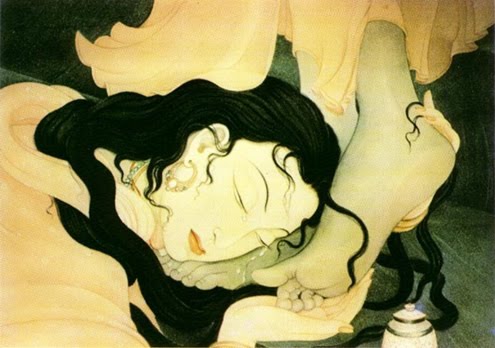
The ‘Mary, at your feet’ poems – Three

mary-anoints-the-feet-of-jesus-by-frank-wesley

Artist – Frank Wesley

This is the third and final ‘Mary, at your feet’ poem, which tells of an evening in Bethany, at the home of Martha, Mary and Lazarus. Jesus is there, too. They are holding a feast to celebrate Lazarus coming back from the dead, and, it being near Jerusalem, they are joined by many others.

I found some spikenard on line, the closest I could find to nard, the rare perfume Mary pours over Jesus, and burnt it as I meditated on the story. It is pungent and earthy, an intense fragrance. As I meditated, I remembered all the times that Jesus had told stories of the Kingdom involving feasting, and banquets, and how he left us a shared meal to remember him. This particular banquet, celebrating a man coming back from the dead, seems like that.

I thought of Mary giving something so costly out of love, I thought of the other story of a woman anointing Jesus’ feet (Luke 7:36-50). And I remembered that Messiah means anointed one, and that the only earthly anointing Jesus receives is like this, at a feast, in an outpouring of love and gratitude.

This poem, too, was read at the Alive festival 2014, and I used it as a starting place for prayerful writing with a group of people. We burned spikenard, and imagined ourselves into the story. Some beautiful work resulted. People were able to connect with times when their life had been restored to them in some way, with times they were grateful, and wanted to pour our love and thanksgiving. For others, they felt they were outside, looking in at the feast.
In this poem I see the doors wide open, like the gates of the city in the book of Revelation (21:25).

You can read the first poem here
and the second one here

Mary, of Bethany, at your feet a third time

And so you come once more to Bethany,
and share a meal with Lazarus,
a resurrection feast,
foreshadowing, foreshining
all those kingdom feasts you told of:
wedding banquets with long tables
set wide with good things,
with room enough for all,
welcome at your table.

Now, in Bethany, the house is ablaze with light,
shutters and doors thrown open,
all wide open with joy unspeakable,
music, laughter, dancing, wild thanksgiving
for one who was dead is alive again,

And all night, while crowds pour in from Jerusalem,
the feast goes on, and on,
as Mary enters now, cheeks glistening with joy,
past her brother at your side, back from the grave.

She kneels at your feet again,
pours out extravagant nard,
scandalous anointing of your warm, living feet,
unbinds her hair and lets it flow like water
over them, wiping them in such reckless
and tender thanksgiving.
Fragrance fills the room, the house, the night,
as more people pour from Jerusalem to you,
to you, who comes to us in our weeping,
who shares our bread with us,
and brings us to such joy as this.

John 12:1-11

I am greatly honoured that this poem was read at the Good Friday Service of the Riverside Church, New York.
The whole service is recorded. The poem appears at about 21:50
You can see it here

Note, March 2024:

I am delighted this poem was shared by Diana Butler Bass on her substack.

https://open.substack.com/pub/dianabutlerbass/p/halfway-through-lent-mary-magdalene?utm_source=share&utm_medium=android&r=46vqv

The ‘Mary, at your feet’ poems – Two

Lazarus

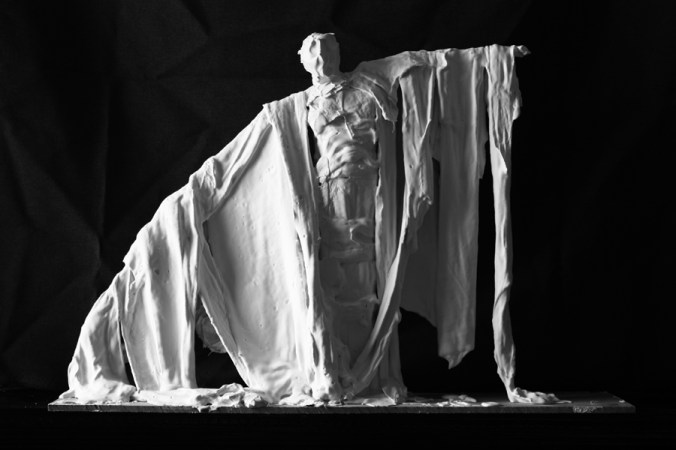
Lazarus, by Jacquie Binns, with her permission.

We come to the second in the ‘Mary, at your feet’ sequence.  This, too, was read at the Alive festival, 2014.  It contains a bigger reversal than a poem can hold – from death to life, for it draws on Mary’s response to the death and raising of her brother Lazarus.

Martha went out to meet Jesus when he finally arrived, and their exchange is sorrowful and powerful and contains words of life and hope.  Mary stays inside, and when she finally goes to Jesus, we feel the depth of their mutual grief. In John’s gospel, where we find this account, the raising of Lazarus plays a crucial role in the events that lead to the crucifixion – the themes of death and life, life from death sound like a returning motif in a piece of music. Here, standing by Lazarus’ tomb, Jesus weeps with Mary, in the company of many who also grieve there.  And then, everything changes.

I am very grateful to Jacquie Binns for permission to use this photograph of her work. She is a textile artist and sculptor of rare vision, and it was an honour to meet her a few years ago, when I saw this piece. It is haunting and breathtaking.  I was particularly struck by the whiteness of the bindings, the light and whiteness seem so cold.  The set plaster holds the fabric grave-clothes in this one moment when the viewer sees Larazus for the first time, before we begin to know the power of what it is we see.

You can read the first poem in this sequence here.


Mary, sister of Lazarus, at your feet a second time

She sits in the shuttered room,
the room where her brother had laid,
dying, dead, the messengers sent out
returning empty, with no reply,
like prayers that bounce  off ceilings
or stick to the roof of the mouth,
choking with sorrow.
When you stay by the Jordan
that shuttered room is where Mary stays.

This is her shadowed valley, the dark forest of her path,
foreshadowing yours, it is all foreshadowing you.
The room where her brother had laid,

how can she ever leave it now?

But leave she did, at last, when you called for her,
she came quickly, running, trailing darkness behind
her weeping.  Mary, once more at your feet,
and when you saw her weeping, you wept too.

You know us in our grief.  You come to us, call to us.
In our darkest, most shuttered places,
your spirit moves, breaks with ours.
Death lay heavy upon you, too, and all the sooner for
this, what you do now, standing before that tomb.

For now, you who are Life,
Word made warm and beating flesh,
and weeping,
call Lazarus out,
You, who are life, and will rise,
call out one who is dead from the cold tomb.
You watch as they run to free him from the graveclothes,
pull darkness from him, calling in strange bewildered delight,
and you see Mary’s face as she sees now,
her brother, who was dead, once more in light,
astonished, seeing your glory, part of your glory,
as she weeps again, is weeping again
breathless with joy.


John 11:1-50

You can read the third poem here


The ‘Mary, at your feet’ poems – One


Two years ago, in May, I was thinking about the three times Mary of Bethany was at Jesus’ feet.  One story is recounted in Luke, the other two in John, where they are a part of the extraordinary Lazarus narrative.  I wanted to explore them more, and I did so in what turned into a series of three poems.  I read early versions of these poems at a local Christian festival, Alive, and as the time of year comes around again, I find I am remembering them, and going back to those thoughts.  I share the first one with you today, and the others will come in their own time, over the next week or so, as I continue to turn them over in my mind.

This first one draws on the story in Luke’s gospel where Jesus visits the home of Martha and Mary, and Mary sits at his feet.  I have not referred to Martha directly, except for in the title.  I do feel her lack. I wonder, in particular, what happened next.  Maybe there are some poems to write about her, too.

There is so much to ponder in this story, but what caught my attention was how hard it is for us to be still, to be.  We are so distracted, so pulled by so many things. We can end up  feeling that those things are what define us. That it is what we do, or think, or believe, or  how people view us that makes us who we are. Just being doesn’t seem enough, but our efforts to be more or different or better than we are can be life-sapping.
Acceptance can be hard to accept!

In writing this poem, I hoped to create a place of stillness. The kind of place where contemplative prayer begins.  A place where we can open up a little to love, and light. A place where we know we are welcomed.

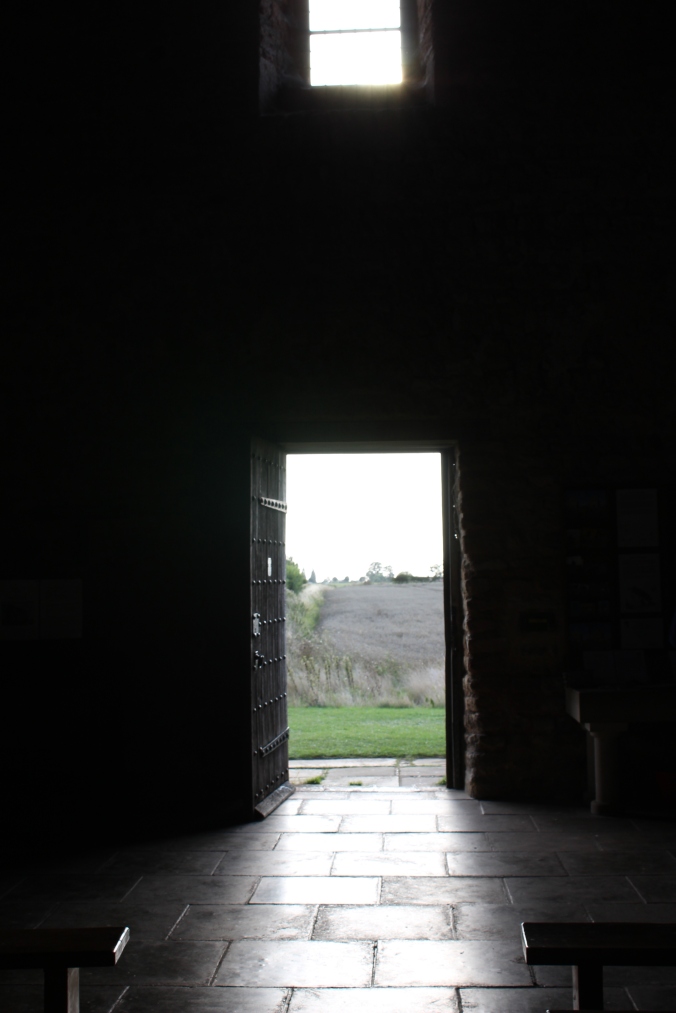
The photograph is taken in the Chapel of St Peter on the Wall, Bradwell on Sea, Essex.

IMG_0366.JPG

Mary, sister of Martha, at your feet for the first time

You came in search of rest
away from the road,
that bright, shadeless road,
where so many came,
and you gave so much.

You came and sat down
in the cool room,
the shutters pulled
against the heat,
and Mary sat, too,
and it was enough.
Just sat, quietly, at your feet,
her face turned up to
yours as she listened.
And you saw how the light
fell across her,
as if for the first time.

And this is what you want,
what you long for.
Not the elaborate
preparations we would make,
not ourselves swept and
scrubbed to perfection,
our acts and our
thoughts impeccable
in lifeless rows,
but to be,  here in this light,
to be, here at your feet,
Luke 10:38-42


You can read the second poem here

and the third one here

The Spirit Comes

bible retold cover

We celebrate Pentecost this weekend, and the story continues its extraordinary movement outwards.  Last week, it was Ascension, when the disciples were still thinking in terms of their own people, and Jesus showed them an ever widening perspective (Acts 1:6-8).
Now, we see how God continues to open and include.  It seems that all those gathered together (1:14-15) were part of the great outpouring of the Spirit, and the impact on the listeners suggests God was at work beyond even those.  The barriers between us of race, gender, nationality, language, youth and age, are being broken down, moving us towards a deep unity (Col 1:17, Gal 3:28). No wonder the whole house was filled with a great sound! This is powerful and much needed work.

We notice how the barrier of language is overcome.  We notice that God’s priority is not to change the listeners so they can understand, but change the words (and the speakers) so people can hear – directly, in a way that makes sense to them as they are.
The words are an overflow of joy.

Below is my version of the story, from The Bible Story Retold

If you wish to use it this weekend, please do, saying where it is from.  I hope it helps.


From the fields it came: the first sheaf of barley cut for that year’s harvest.  It was carried high through streets crammed with visitors, and on to the Temple. And then the priest offered it to God, giving thanks for the good land, and for the gift of harvest. For that day was the celebration of the first fruits.  It was Pentecost.

Meanwhile, the disciples were all together, waiting.  Then, suddenly, it began.  It stared with sound – a sound like the wind – but this was no gentle harvest breeze.  This was a shaking and a roaring: a sound of power, whooshing and howling about the house, rattling every door and shutter.  The sound seemed to come down from heaven itself, and filled the house as the wind fills sails.  Then, the disciples watched wide-eyed as something that looked like fire came down, and tongues of flame peeled off it and rested on each of them without burning them.  All of them were filled, for the Holy Spirit had come.  And as it happened, their tongues were loosened, and they began to speak as the Spirit gave them words.  These words were not Aramaic, their own language, but in languages that were unknown to them.
A crowd had gathered by the house because of the extraordinary sound, but then they heard voices. There were pilgrims in Jerusalem from all over the known world, and they recognized the words the disciples were speaking.
“He’s talking Egyptian!” said one.
“That one’s talking my language,” said a visitor from Crete – and the same was true for all.  Each person heard God’s praises in their own tongue.
“What can it mean?” they asked each other.  But others among the crowd joked that the disciples had been drinking.
The Twelve heard what they were saying, so Simon Peter stood up to speak to the crowds.
“Listen, I’ll tell you what’s happening.  We’re not drunk! It’s too early in the day for that! This is God’s promise come true.  Do you remember what one of the prophets wrote long ago?
I’ll pour out my Spirit on everyone – young and old.
Your sons and daughters will prophesy,
young men will have visions, and old men dreams.
All who follow me – men and women – will
be given my Spirit, and there will be wonders!

Bless you this weekend, and always.

IMG_0478.JPG

Contemplative Prayer – The Cloud of Unknowing

One of the joys of working for Quiet Spaces is that the meditations you write months ago seem to come back when you need them.  So this morning, the latest edition arrived in the post, reminding me of a prayer practice that had slipped away.

IMG_0476.JPG

For this issue, packed with good things, I wrote a series of meditations and explorations of The Cloud of Unknowing. The 14th century text is an extraordinarily rich resource for anyone interested in contemplative prayer. It feels very necessary and timely to me right now, and with the Archbishops’ initiative for a week of prayer before Pentecost, I am finding it helpful  to look again at this way of praying.
The Cloud seeks to remind us that God is above our knowledge, but accessible in love. It asks us to wait, to lose our discomfort with “unknowing”, to be prepared to be in what can feel like a cloud.  We are often afraid of mystery, and sometimes prefer knowing to loving, so this type of prayer calls for humility, and patience with ourselves.  It seems to deepen our ability to connect.

Here is my first suggestion to begin – it may help if you are following the week of prayer.

You may wish to establish a pattern for contemplative prayer.  For example (you could)  turn off technology, find a place, light a candle, do some steadying breathing.  Begin with this verse:

“My soul thirst for God, for the living God.  When can I go and meet with God?”
Psalm 42:2

Calm your mind.  Let go of thoughts. Focus your loving attention on God, who is always present. Stay in the stillness, the silence, for as long as you can.  When your mind wanders, try again.
“Lift up your heart to God with humble love”
The Cloud of Unknowing, Chapter 3

This act of prayer begins with the act of lifting up your heart, and directing your loving attention, to the source of love.

The Cloud of Unknowing is well worth reading. It is broken into small sections, which helps slow down the process and make it less about mastering a technique, or gaining knowledge, and more about entering into presence.
Penguin classics have an excellent version, and you can also access an online version here


Trying to listen to God

This week, I had the great privilege of spending a day at Otley Hall listening to some of Malcolm Guite’s most recent poems, to be published soon in Parable and Paradox  .  This collection on the sayings of Jesus is full of personal response and deep scholarship.  Those of us who were there had time to reflect on all the wisdom and beauty outside, which always helps my thinking!  It was an astonishingly good experience, and several new poems ended up among my jottings – they still feel quite tentative.

IMG_0468


IMG_0473.JPG

Here is the first.


Trying to listen to God

There is all this that speaks –
the electric green grass,
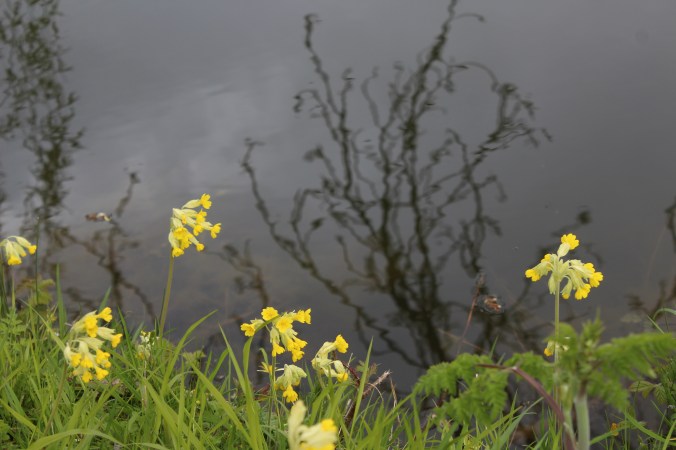
the cowslips and fritillary lilies –
I know I am to consider them,
consider it all.
The song the trees sing today –
their tender beauty
like the beauty of a child –
will not be repeated tomorrow.
Today is the day to hear it.

There is all this
and stories too –
The Kingdom is like this, like that –
slipping past the guard of ego
and reason
they work their slow growth
Seeds that crack the
dark tarmac,
the grey concrete,
soften the callouses our own
stories have worked.

For there is all that too –
the stony weights,
the things that choke.
How does good soil get to be
good?
I wonder, as I am shaken,
as my ground is cleared.


IMG_0471.JPG

Seeing what the Father does

bible retold cover

One of this Sunday’s readings is an account of a healing, stopping short of the controversy that follows.  Retellings have to be more concise, so my version below sketches it out – another example of people missing the point.  The religious leaders were so concerned about policing sabbath observance, making sure law was kept, that they overlooked the astonishing things that were right before their eyes –  healing, and mercy.
What Jesus says in response outrages his listeners, and as we reach the end of the exchange we come to one of those extraordinary phrases of Jesus that stop you short, and stay with you, changing the way you see things.
He is doing what he sees the father do…
If we pay attention to what Jesus does, we might learn something of God’s heart.
It’s helpful to remember that the Greek word we translate disciple – mathetesmeans both pupil and apprentice.  I am drawn to the idea of apprenticeship – of watching and making fumbling first attempts to imitate.  It is an adventure, and I am still working out what it means.
(John 5).

The extract below is from my retelling, The Bible Story Retold, published by Lion.  Also available here and your local bookshop.

One sabbath, Jesus was in Jerusalem.  He came to the pool of Bethesda, which means “House of Mercy”.  The pool, with its steep steps, was surrounded by covered colonnades. Under their shade lay many who were sick, waiting to enter the water when it welled up, for they believed that the water could heal them.  Jesus went and sat down by one man, and asked him “Do you want to be healed?”
“Sir, there’s no one to help me down into the pool.  I’ve been an invalid for 38 years.  How can I reach the water?”
So Jesus said, “Just get up! Take your mat and walk away!” – and he did so.
Some teachers of the Law stopped him. “What do you think you’re doing, carrying a mat on the sabbath?  Don’t you know that’s work, and forbidden?” And the man told them what had happened.  How angry they were at Jesus – a sabbath-breaker, they called him.
“My Father is always at work, so I, too, am working!” Jesus said.  The teachers of the Law gasped, shocked.  He was talking as if he were God’s equal!
“I don’t do anything by myself,” Jesus went on. “I see what my Father is doing and do the same!”

I hope it helps.  If you wish to use this reading, please say where it is from.

The Spirit and the Centurion

bible retold cover

Today’s reading (Acts 10) is strange and beautiful.  It is no accident we start with an account of Cornelius the Centurion’s vision – we see first that God is at work among people considered outsiders, people who did not follow the rules.  It is after the angel appears to the Roman that Peter has his vision, and that vision challenges his idea of the centrality of the Law. To begin with, he saw a temptation to be resisted.  It took time to see that God was inviting him to a more inclusive, more generous understanding.  God is expanding the categories, again and again.  The Spirit is moving, freely.  It was hard for Peter to keep up – but he sees what God is doing, and his response, in the end, is to accept these new brothers and sisters.

The extract is from The Bible Story Retold
If you would like to use it, please feel free, mentioning the source.

Cornelius the centurion had been watching the galleons sail in and out of the white marble port of Caesarea.  Every day these great ships came and went, to and from the rest of the wide Roman empire.  He and his family did not follow the Roman gods or Roman ways.  They were faithful, prayerful, and generous to the poor.  As Cornelius turned away from the bright sunlight, he saw something even more dazzling – a vision of an angel.  The vision spoke.
“Your prayers and gifts to the poor have come before God as an offering.  Send men to Joppa and tell them to bring back someone called Simon Peter.  He is staying at the home of Simon the tanner, who lives by the sea.”
Cornelius did just that.
As his men were approaching Joppa, Simon Peter the fisherman was praying on the flat roof.  There he had a vision. He saw a huge white sheet let down before him.  Inside it were all kinds of animals that the Law of Moses said not to eat.
“You’re hungry, so eat!” said a voice.
“No!” Simon Peter replied. “I’ve never eaten anything unclean in my life!”
This happened three times, and each time the voice answered
“Don’t call anything unclean that God calls clean!”
Just then Cornelius’s men arrived, asking for Simon Peter, and the voice said, “I’ve sent men to find you.  Just go with them, don’t hesitate!” So he went with them.
When Simon Peter went into Cornelius’ house, it was the first time he had entered the home of a Gentile, a non-Jew, where “unclean” food was served, and the Law of Moses was not followed.
“Why did you want to see me?” Simon Peter asked, looking around at the crowd of family and friends Cornelius had invited.  Then Cornelius told him the vision of the angel.
“So it’s true! God really has no favourites,” Simon Peter replied. “He wants everyone to follow him!” And he began to tell them about Jesus.
While he was still speaking, the Holy Spirit came, filling Cornelius, his friends and family with joy, and they spoke in different tongues as the disciples had at Pentecost.  Simon Peter and the other Jews who had come with him were stunned that God had given the same gift to the Gentiles.  And Simon Peter baptized them. “God accepts them, and so will we!” he said.