Poem: Gaia at Ely Cathedral

I’m sharing this post again, September 2025 as part of the Season of Creation some Christian traditions are marking at this time. Meanwhile, I’m continuing to work on a collection of poems for Wild Goose, The Year’s Circle – and this poem is part of that work. I’ll be sharing more on that as we go along.

I hope you find this post a helpful starting point for contemplation.

Additional note, 24th September 2023. I am delighted that this post has appeared at The Cottage, Diana Butler Bass’ rich and thought-provoking Substack, this morning. I’ve admired her work for many years, and it’s such an honour, and very exciting for me, to find myself in her company today, under Inspiration. It’s a profound exploration of envy and gratitude, and a reflection on the deep drivers of our climate and ecological crisis. It’s well worth reading and allowing it to do its inner work on us. You can do so here.

Original post, published 12th July 2021, emerging from lockdowns:

As we are beginning to venture out a little more, we thought we would pay a visit to Ely, and the vast indoor space of its ancient cathedral. They often have contemporary art there, which helps the old stones continue to sing, giving a new perspective on ancient truths. We knew that Gaia, an installation by Luke Jerram, was going to be there in July, and so we went and saw this beautiful, astonishing sight. The comparative emptiness of the cathedral space made it all the more powerful as it floated above us.

And as the space is vast, and it takes time to walk up to, around and beyond the piece, you do have time and space in which to allow the work to speak to you, to stir up responses, and to pray. I am sure that one of the intentions is to give us all an opportunity to experience something like “earthrise”, when the astronauts first saw the whole of the Earth from space, and how that shifted their perspective, and began to change the way all of us are able to see our home. The staggering, indescribable beauty of the whole called out my sense of awe, which sat uncomfortably alongside my awareness of the damage we are doing to our precious, unique home.

In the setting of the cathedral, as Gaia hangs in the nave under the painted ceiling which tells the long stretch of the Bible’s story, I found the language of repentance surprisingly, and helpfully, came to mind. Repentance both in our more familiar understanding of sorrow for wrongdoing, and desire to amend, and in the possibly more ancient meanings carried in the old texts, of returning home, and of undergoing a profound change of mind – a paradigm shift in the way you see.

Much of my writing celebrates the beauty of the natural world, how lovely, precious, and vulnerable it is. But sometimes, that love spills over into grief. So the old stones, and the old story, seemed illuminated by our current crisis, and, in turn, those ancient words seemed to express something necessary, and powerful, and, in the end, with the potential for hope.

You can listen to the poem here.

Gaia at Ely Cathedral

She seems to float, lit up with her own light,
slowly turning, blue and blooming with clouds
as we walk up, look up, small before her.

While above our steps,
the familiar painted roof
rolls on, telling its painted story,
from the tree, and the garden,
on towards this

fathomless shining beauty,
the ‘all’ that was so very good
in that beginning.
Now as she turns
we see how she hangs
below the story’s last scenes –
the gift of a beloved child
held on his mother’s lap,
held forward towards us,
loved and given and giving,
and the wounded golden king,
who gives still.

And below, below hangs the whole shining Earth,
dazzling, vast with sea,
turning and flowering with clouds
from the southern ice-shine,
melting although we do not see her weep,

And the land, those small green swathes
and swags, are dressed in white too,
a veil of vapour,
while the deserts spread brown
and red above our eyes.

The lands are small, countries
seem tales we tell.
What is certain is this one great
flow – ocean and ice and cloud –
and the unseen winds that bear them
through our blue, breathing air.

And the people stand beneath her,
lit by ice, and hold up their hands
as if to carry her, or hold her,
or save her from falling.

How beautiful it is.
How strange and wondrous
that we should be creatures
who live within so much living perfection.

And as she turns slowly
under the child and the king,
I wonder, what do those
familiar words mean now,
‘the sins of the world’,
as the stain of our reckless harm
seeps through the blue and green,
through all this living glory,

And is there any hope in our
waking up to beauty with grief
and loss, even as dust and ashes
float across the sky,
across us all, late as we are
in our repenting?


And is there hope,
hope that we might be granted
this grace – time
for amendment of life,
to tend the garden
with its leaves and fruit,
shining and greening,
to take part in the work
of loving and healing,
of restoration,
of making all things new.

Looking at Gaia from behind the communion table brought to mind the words of repentance from that service, and I was aware of my sense of what “the sins of the world” might mean was creaking open a little wider.

Poem: Overflowing – Sunday Retold

The beach at Walberswick.

So, this Sunday Retold is a little different. The retelling is a poem, which you’ll find below. Some of you may remember that I’m absolutely delighted to be bringing out a book of poems next year, based on the cycle of the seasons – both in nature and in the readings that many churches follow. You can find out a little more about that here. Wild Goose, the publishers, are happy for me to share some pieces in progress with you here as I work on the book.

It seems good to start with Easter, and this week – of the poems I’ve been working on – the one that seems most nearly there is one that happens to tell the story of this week’s gospel reading, John 21:1-19.

It’s such a rich passage, and there is so much that could be and has been said. I think the reason this poem has come most readily is connected to the warmth and tenderness I felt when reading the story. Although we often focus on the extraordinary elements – and they are there, sure enough – I warmed to the ordinary. Once again, Jesus is feeding his friends. He knows they have been working all night, and he anticipates the depth of their hunger, their cold, their disappointment, and their need for this breakfast. It is a feature of these Easter stories, how often eating together is involved, how simple and reassuring the talk.

And here, we see the dance of grace – forgiveness for Peter, yes – but there is also the simple lifegiving grace of sharing food, of receiving, and giving. Of giving, and receiving. It is a revolutionary gift economy in fishing and sharing, in forgiveness and purpose, and its something I’ve missed before…. Perhaps I’ve been too caught up in the strangeness, or the textural intricacies, or the story being about Peter, to see how this new life is also about cooking breakfast for hungry people, and them having enough – strength, fish, new beginnings – to feed others in turn.

I love Wendell Berry’s phrase, “practice resurrection”, and this Easter, I’m wondering what that might mean….

But here is the poem.

Overflowing

Gathered around the fire,
dripping with lake-water
and morning chill,
they warmed themselves
in quiet, not asking who it was
who cooked them breakfast
on charcoal and hot stones.

After such a night, such an empty-
netted night of no-going-back
to the old life, of cold,
of hunger, of ropes
against skin,
they sat on the shore
with the smokesmell
of griddled fish and fresh
bread filling their senses.

In the dawn shadows –
the last stars fading,
the first light gleaming –
you handed them this
feast – loaves and fishes,
bread broken – you fed them
and warmed them.

This is how it flows,
the dance of new life.

We may be fisherfolk with
empty nets, but you
guide our hands. And we are
overflowing. You cook breakfast,
and we share a feast.

And then, and then,
the invitation, the instruction,
the grace to Peter and perhaps to all –
Feed my lambs,
Feed my sheep, my sheep.


We receive, and we give,
we give, and receive, for
there is enough.
There is grace enough to
break the nets and yet
the nets are whole, and look,
still the sea is full of fish

Overflowing
Dancing
In the new light of dawn.

The Little Free Pantry at St Andrew’s Church, Melton – one of many now springing up.

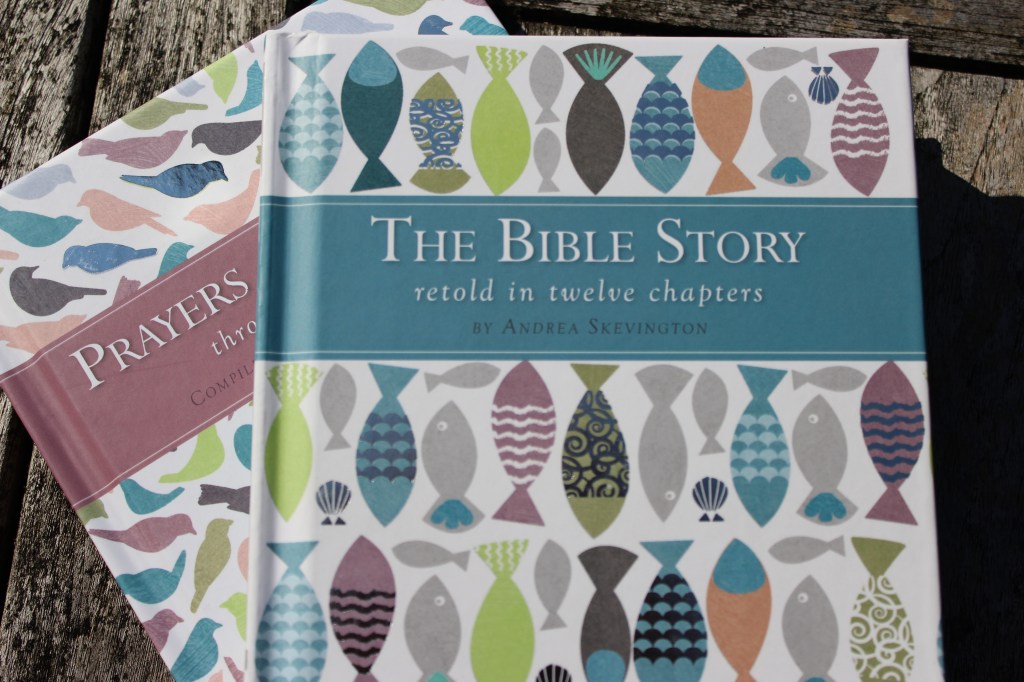
This story, of the miraculous catch of fish, and Peter’s restoration, is included in my retelling pictured above.

Book News! Early notice, poetry book on the way.

I’m so delighted to be able to share with you that I’ve just popped a contract in the post for my first published collection of poetry. Some of you will know the publisher, Wild Goose of Iona, and they’ve been so kind and efficient in coming to an agreement about what we’d like to do together. It should be out next year.

We plan to call it The Year’s Circle, and I intend it as a collection to accompany you through the year. It will weave together poems drawn from Bible stories marking the seasons, such as upcoming Easter, with poems drawn from nature – so the two main strands of work you will find on this blog. I hope it will be good for your own reading and also sharing together with others in groups, churches and festivals. I know many of you already use the poems you find here in those ways.

The Celtic tradition has an idea of God’s two books – the Bible and Creation – and I’m intrigued by that idea and am looking forward to exploring what it might mean.

The collection will include some of the poems you’ll find here as well as new work. I intend to share progress with you as I go along – giving you tasters of the new poems, as well as some insight into the process.

I want to thank you all for being here, for your support and encouragement. It’s played a huge part in making this new venture possible, and I really look forward to including you in the process.

I’m blown away by this opportunity, it’s so good, and I’m really looking forward to getting going with drawing together something beautiful and nourishing in these difficult times. I really hope it helps.

Poem: Water and Dove – Baptism. Sunday Retold

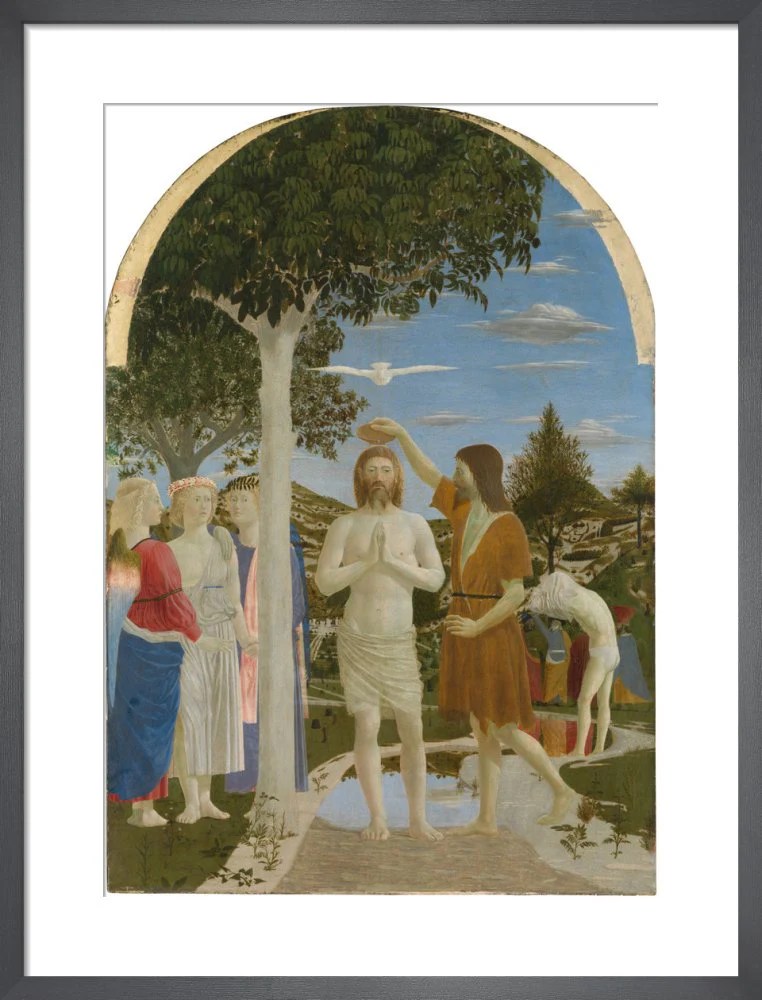
Piero della Francesca, The Baptism of Christ. National Gallery, London.

This coming Sunday many Christian communities are continuing to think of Epiphany, or epiphanies – those moments of clarity, of breakthrough, when you see things anew, or perhaps for the first time. In particular, there are readings to follow which tell us of Jesus’ baptism by John in the Jordan river. It’s a moment when everything seems to change – where we see one who closely resembles a prophet from the Hebrew scriptures, and one who tells us that the Kingdom of God is so close, already among us – standing together in a river. The reading is Luke 3:15-17,21-22. I’m posting a link to the whole chapter, though, as it gives us some very helpful reflections on “What should we do?” as signs of a change of heart, as well as the beautiful and hopeful passage from Isaiah.

I love the picture at the top of this post. I love its lines, its clarity and purity. I have a framed poster very like this one, and see it every day. I’ve often wondered at the river stopping, diverting around this moment of baptism. I assume della Francesca was thinking of the story in the book of Joshua, when the priests carrying the arc of the covenant step into the Jordan, and the waters dry. The people then cross the riverbed. In doing so they leave their time in the wilderness, and it is an echo of the time they entered it by crossing the Red Sea, escaping slavery in Egypt as they did so. This time, crossing the Jordan, God’s presence is suggested by the Arc of the Covenant, rather than the pillar of fire and flame that was with them at the beginning of their journey. It’s quite a change. You can read the story here if you’re interested.

And so, to the poem. As so often, I begin by reading the passage through, several times. I breathe, I wait to see what speaks, what arises, what I feel. And I felt a strong response to the water, and the dove – those natural elements I see myself every day in my own walks by my own river. They moved me. And yet, there was also this background thought of the painting that has formed my imagining of the story. So a poem emerged which is in itself a kind of epiphany, a kind of seeing things in a new way, or perphaps a given insight. I leave that to you, the reader.

If you enjoy following trails, there are some others you might like here, relating to the water and the dove. The first is Jesus’ I am saying – I am the living water. That passage has stayed with me for years. You can read my reflections on it here. And the dove called to mind the story of Noah, and another poem, here. There is more of course, like Jesus washing his friends’ feet. I leave the others to your imagination.

Water and Dove – Baptism

When you stepped into the Jordan,
did the water stop, not daring to
touch your feet – as if
you yourself were the
arc of the covenant,
untouchable, fierce in holiness?
As if you bore within yourself
the whole of the law, the weighty
stones given to Moses? 
The river was in spate then – wild it was,
but it stopped before such fearful holiness.

But I do not see it so. Rather,
I see cool water lapping your feet,
your legs, bathing them clean,
ripples rejoicing, dancing, flowing,
honoured to baptise one
who did not require it,
both water and Son of Man
living out their deep purpose

As the sky opened wide with
tender light, and a white dove
tumbled with the applause
of clattering wings down
to you –  and what then?
Maybe it landed softly
on your shoulder, resting
awhile, heads inclined together,
gently, two wild beings, two beings
overflowing with all love divine.

And so love spoke forth
with delight,
love pouring over you
like the cool water,
river water, living water
like the endless light,
and the softest
brush of feathers
from the wings
of a dove.
Endless,
life-giving
love.

Sunday Retold

If you’ve been joining me here on the blog for a while – thank you, I appreciate your company – you’ll be aware that I have a very occasional series with material from a couple of my books which follow the Sunday readings many Christian communities use. In particular, my retelling, The Bible Story retold in twelve chapters. Recently, I’ve been doing this fresh writing, with a poem, too. But here are some pieces you might find helpful. If you’d like to use any of my material, please feel free to do so, giving this blog as a source. If you’d like to publish it in some form, please do get it touch. Thank you.

For John taught them to hope. In his words, they caught a glimpse of something beyond their everyday lives. They understood that John that Baptist was preparing the way for something, or someone, astonishing.
“I baptize you with water, as a sign of your rependence: your turning back to God and his ways. But wait. There is one coming after me who is so much greater. I am not even worthy to carry his sandals for him. And when he comes, he will baptize you on the inside with the Holy Spirit and with fire. He will sort out the good from the bad, the wheat from the chaff!”

Then Jesus came down from Galilee in the north, and walked through the crowds toward John. John knew Jesus was the one they had been waiting for: the Messiah. Was Jesus really comng forward for baptism like everyone else?
“No!” said John, stepping back. “I need to be baptized by you – and yet you come to me – why?”
Jesus replied, “I must do everything that is right, and it is right to be baptized.”

And so John agreed, and they stepped out into the flow of the Jordan. Jesus went down into the cool water, and was baptised.

As he came up the bright sky broke open, and the Spirit of God came down gently and settled on him like a dove. A voice from heaven said, “This is my Son, the one I love, the one who brings me joy. I am very pleased with him.”
From the Bible Retold

Come, let us follow Jesus, who loves us.
From Prayers and Verses

The picture of birds over water (behind my name) is of the Wash at Snettisham RSPB. You can read more about that here.

Poem: Stones. Sunday Retold.

The open doorway of St Peter-on-the-Wall (founded about 660 AD). The wall in question is Roman. The chapel was built using some of the old stone from that wall. Bradwell, Essex.

I took a look at the set readings for this coming Sunday (17th November), and they are difficult and unsettling. Something about the Gospel reading caught my attention, and I thought I’d follow where that led.

Mark 13:1-8

 And as he came out of the temple, one of his disciples said to him, “Look, Teacher, what wonderful stones and what wonderful buildings!” And Jesus said to him, “Do you see these great buildings? There will not be left here one stone upon another that will not be thrown down.”

And as he sat on the Mount of Olives opposite the temple, Peter and James and John and Andrew asked him privately, “Tell us, when will these things be, and what will be the sign when all these things are about to be accomplished?” And Jesus began to say to them, “See that no one leads you astray. Many will come in my name, saying, ‘I am he!’ and they will lead many astray. And when you hear of wars and rumours of wars, do not be alarmed. This must take place, but the end is not yet. For nation will rise against nation, and kingdom against kingdom. There will be earthquakes in various places; there will be famines. These are but the beginning of the birth pains.

Once again in our world, we see wars, we see power misused, we see the places where we might put our hope and trust are frail. Just this week, the Church of England has been forced to reckon with terrible abuse that has taken place, and the failure of those in authority to protect the young. And COP 29 has opened with the absence of many leaders, and the presence of corruption – although I have been encouraged to see Kier Starmer taking a lead. Much that has seemed firm has been crumbling, and at the same time, forces which seem to be serving themselves seem very powerful, immovable. It’s a hard place to be for many, and we may need to give time to our fear and grief. We may need to find others with whom to walk through these hard places.

And so, turning to this reading, I see we are invited into something like a practice of deep realism, and a long view. We remember that for Mark’s early readers and listeners, this passage would call to mind the terror and trauma of the destruction of the Temple in AD 70 after a relentless seige by the Romans. The Roman historian Josephus records that 1.1 million people died during that time. It’s hard to imagine the suffering and shock of such loss. It must indeed have felt the end of the world. It was the end of the world for many. Even in the midst of such terror and shock, these words may have offered something to hold on to. Maybe there is some wisdom here about how to live through difficult times, when all seems destroyed, or we fear all may be destroyed. Such wisdom is arrived at through pain and loss, it is not intended as some kind of spiritual bypassing, that eveything is going to be fine. Everything is not fine. That much is clear.

So this poem, written in response to Jesus’ words, is an experiment in that long view. I hope that, if it lands with you at the right moment, it might resonate with you.

Stones

These beautiful stones
This beautiful Temple
all that wealth and power
all Herod’s might and posturing

Always, always can
and will be
thrown down.

And always, always, it is not
the end of all things
although it is the end.
For time still stretches out
among ruins lost to
twilight,
and dust settles, or
blows on the grey wind.

Strength seems invincible.
Stones seem solid, immovable.
The might and ritual of a temple
have such sure foundations
in the mind.

And yet time, wind, whispers,
armies, the running of water,
the roots of trees can and will
undo them all.

So do not be cowed
by these great walls,
for they will fall,
nor by their falling

For fall they must,
and the world will turn
and turn again, and what
was an ending may come
to seem the blowing of dry
leaves in autumn, an absence –
it may even, dare we hope,
begin to be birth-pangs, after all.

Gaia at Ely Cathedral. You can find more about that – including a poem – here.

You might enjoy this gentle conversation(Nomad Podcast) with the the musician Jon Bilbrough, known as Wilderthorn. Towards the end is some music recorded in the chapel pictured at the head of this post, St Peter-on-the-wall.


I’m turning back to that chapel in my mind – imagining how the stones from the old Roman wall, probably a fort, were reused in the building of this – itself ancient – place of peace and prayer.


Swords beaten into ploughshares, and things being made new.

New things can and do emerge, in time. That is something we can gather around, and work for.

From Prayers and Verses These are prayers in response to the stories of Exile we find in the Hebrew Scriptures, and I know that experience will resonate with many today. I hope this helps.

Poem: September. Bees. Ivy.

This poem has arrived on the blog a little late. It became marooned in my notebook for a while, until I flicked through the pages and found it again. And although crowds of bees are no longer buzzing among the ivy, there are still a few, here and there.

I hope, though, that although this poem arose out of a particular time, it has something to say in other times, too. About stillness. About the restorative power of simply being, and paying attention. About finding our breath again. We all need that. We all need to feel that connection to the rest of the natural world (oh, how I wish we had better language for these things – bear with, it will emerge) which grounds us, and from which we can rise. For those reading this blog who need a little peace right now, I hope it helps. I’m thinking particularly of dear readers in America, where the election atmosphere seems turbulent. I wish you well over the next days and weeks.

The old hedgeline in front of our house has, in places, been overcome by ivy, which has formed its own structures and patterns of flowering and fruiting. Cutting some of it back to make space for other plants to grow, I was careful to leave the ivy flowers for the bees – which will become fruit for the birds in time. Accidentally, I created a little bower, where I put a chair and sat for a while. As I sat I gradually heard the road less and less, as my attention was taken up with the many bees who were enjoying the feast. And so, this poem emerged.

thebiologist.rsb.org

September. Bees. Ivy.

It is taking a while,
this sitting
in a carved out cave
in the ivy.
Just sitting,
stilling, breathing.
A bower of green leaves
above, and above that
blue sky, white clouds.

In time, the hum of bees,
and their intricate woven
patterns of flight,
come to replace thoughts,
become another form
of thought.
So too the birds –
that wren shaking
the leaves, and
the pipping robin.

And this grey and green lacework
of wild is all that separates
me from the roar of the road –
those black lines we make,
always going
somewhere….

And yet, here is a marvel.
More bees than I have
seen all year.  A hum that soothes
the soul. The darkness of butterflies.

These strands of green woven
through the world – not enough,
by no means enough –

But they shelter the bees,
and me. A space for
the soft and alive,
breathing, green in spirit.
We can be here, the bees and me.
We can be, in this hollowed out
hedge, in a cloud of lightfilled wings.

Poem: Mid October Heat

After some cold damp days, and flooding in some parts of the country, it’s warm and mild – about 6oC above recent average for this time of year. I find myself to be both delighted and unsettled by this lovely soft warmth. I’ve been able to get on with a bit of clearing and composting in patches, it feels like time this year, and making space to ensure the ivy doesn’t take over completely.

I’ve been able to sit in the sun and watch the rising and falling of insects. After the desolate summer of so little life on the wing, this has been such a joy. It is also an encouragement to keep a wild diversity of flowers in the garden, native and from further south, as the insects appear unexpectedly, at strange times. This autumn it feels time, having left it for a few years, to introduce some disturbance and give a chance for a variety of plants to grow. But apart from enjoying the welcome rays, I have also been aware of the wind and rains this extra warmth carries in its wake.
So this poem is an exploration of this turbulence of feeling.

Mid October heat

The sun shines long and low,
as warm as sudden laugher,
a broadening smile
blown in from the south
and damp with oceans,
I can almost smell the tropics
on its strange soft breath.

What do you do with so much
disquieting beauty – with a day
like this, shining, wild and hot,
damp with fever?

The low sun holds too much warmth.
The green around me hums
and sings with growth, rejoicing,
even as the leaves of the trees fade
a little, and tumble across the grass
on this wild hot wind.

I am afraid.
I look up at the strange flows
of air and water above me,
shifting and changing,
heavy and thick,
as the dragonflies rise still,
hunting among gnats,
and the bees hum in this late flowering –
at last, the bees, and here a
hummingbird moth, and
red admirals, all
drunk with sweetness
in these late days.  These late days.

Poem: Jacob’s Dream and Awakening. Sunday Retold.

Hello. This week I’ve been taking a look at the readings many churches follow on Sunday, and found something coming up this week that has sparked my interest, and led to some contemplation. A poem has emerged, as they sometimes do. I’m not sure I can say it’s finished, but it is settled for now, and I’d like to share it with you. Those who have been looking at this blog for a while – thank you – may remember that I’ve a thread running through it called Sunday Retold, which includes extracts from my book, The Bible Story Retold in Twelve Chapters.

Jacob's ladder

This beautiful illustration by Sophy Williams is from another edition of the same text, published as The Lion Classic Bible

Here’s my retelling of Jacob’s dream:

Jacob went alone, travelling until it was dark.  Shivering in the chill of the desert night, he took a stone for a pillow, and lay down to sleep.  As Jacob slept, a dream came to him.  He saw a ladder, with its feet on the ground, stretching up and up to heaven.  In his dream, he watched as God’s bright angels travelled up and down in between heaven and earth.  And in his dream, God himself was there……

Jacob woke with a jolt and looked around.  He was alone.
“God was here and I didn’t know it!  This place is the gate of heaven!” he said  Then he took the stone he had slept upon and set it up as an altar to God. He poured oil on it as an offering, and worshipped there. Starting out once more, he left his homeland far behind.

You can read the original here, Genesis 28: 10-17, it’s the set reading for this week. It’s a story which has spoken to many over the centuries, revealing depths of meaning. For me, this time, I was struck by the way comfort came to one who was a fugitive, who had lost all that was precious to him. It also speaks to me of how our perception can shift, and we can be illuminated with a new understanding, how we can find the simplest things holy.

Jacob’s dream and awakening

Night can fall suddenly
on the road, when alone.
Darkness sweeps in
like a flood,
and one who lived with
others, a dweller
among tents, is out
in open country now.

Alone, he chooses a stone
and rests on cold rock

And finds that to the fugitive,
the lonely, the guilty one,
dreams may come.
And company, too, of sorts –
strange, perhaps luminous –
angels ascending and
descending

And a presence, such a presence,
that is here, and now.
One who is above the angels,
and right beside him, and speaks
with that deep resonance
that comes through dreams.


Perhaps those away
from the knottiness and rush
of their own mind can
know that this stone,
and so every stone,
is the gate of heaven,
shining with oil.
That this place, and so
every place,
is where God is

That this dream-night
can change the day-heart
of one who walks away.
For even the stones have a
sheen of brightness now,
wherever they are.

From my companion collection, Prayers and Verses through the Bible

If you’d like to use any of my material, please feel free to do so, acknowledging this blog as the source. It’s always a great encouragement when people let me know where my writing has been read.

Poem: Empty/Water into Wine, Sunday Retold

Mike Lacey – Glass

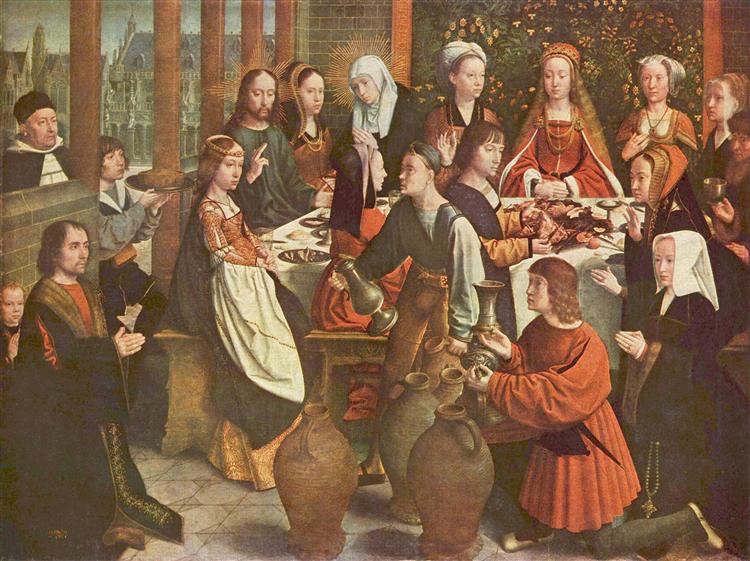
Hello, welcome back. This week, I am combining two things I sometimes do: Sunday Retold, and a poem drawn from the reading. For those who follow set Bible readings through the weeks, we’re still in the season of Epiphany, when we look at moments of understanding and revelation. And this Sunday, we’re meditating on the first sign recorded in John’s gospel, which took place at a wedding. As I was reading it, the image of those stone water jars filled my mind, and I’ve attempted to turn my meditation into a poem, below. I thought I would share it with you even though it’s so new, in case it helps you or prompts you in your own reflection. 

So, first the reading, then the poem:
John 2:1-11

On the third day after Jesus called his disciples, Jesus went with them to a wedding in Cana, near Lake Galilee. The whole community was there, eating and drinking, dancing and laughing, blessing the young man and woman who were starting their life together. But Jesus’ mother, Mary, noticed that the wine had run out and said to her son, “They have no more wine!”
“Dear mother, why are you telling me this? Now is not my time.”
But later, Jesus spoke to the servants. “Fill those jars with water!” he said. For there were six large stone water jars nearby – the sort that were used to store the pure, fresh water the Jewish people used to cleanse and purify themselves before worship. The servants filled the jars with water and, puzzled, dipped their serving jugs into the newly filled jars. They poured some out for the host, as Jesus had told them.
Then the host called the bridegroom over, a broad smile on his face. “By now people are usually serving the rough wine – but this wine is really good – wonderful! You’ve kept the best till last.” He gulped another warm mouthful of the wine that had been water as the servants served the wedding guests.
Jesus had taken the water from the stone jars and turned it into fine wine. When his disciples saw what had happened, and saw the servants pouring out new wine for all the guests at the wedding, they gasped in wonder. They had caught a glimpse of Jesus’ glory, and the glory of God’s kingdom. The disciples put their faith in the one who turned water into wine.

The Bible Story Retold

The Marriage at Cana, Gerard David

It’s a beloved story, often shared at weddings, its many layers rich with meaning. I tend to find that something strikes me in particular, draws me in, and this time it was those empty stone jars. So, here is a poem that grew out of turning the image of those empy jars over in my mind. There is much else that could be said, but today, it’s simply this…..

Empty/Water into Wine

Those empty stone jars,
I see them – pale grey,
with a film of dust, leaning
against the wall, overlooked,
unregarded as the wedding
rolls on, music and dancing
and laughter sending tiny
tremors through their hollowness.

Six of them, as empty as
days can be, an emptiness
we know by taste, our dry mouths
rimed with fine powdered stone.

And this is where you began
your work, with these empty jars. 
Had them filled
with cool water –
so far, so expected.
For purification, cleansing,
the couple’s, the town’s,
love and life,
as the wise look on, nodding,
sure that they have your meaning.

Oh, how you delight in upending
expectations, traditions.
What was drawn from these jars
was not water for making pure,
but the red bubbling joy
of good wine, poured and shared,
for the delight of all gathered,
for the blessing of love, and union,
uproariously, and without fanfare.

After three days, this is the glory
revealed, this is what it means
to be full of grace and truth,

To have our days, our beings,
filled with water, only for it
to poured out as fine vintage,
only for it to be transfigured,
transformed, as wondrous
as the grapes on the vine,
as wondrous as a day,
a life, so open to joy.

If you would like to use the poem or reading, please feel free to do so. I’d appreciate it if you mention this blog and my name is doing so.

Poem: A solitary shining drop

Sedum, after the rain had cleared.

The practice of wandering – often around the garden – contines to be a a helpful one for me, quieting and contemplative. The practice of standing still and looking, too. Quite a lot of apparent “nothing” seems to be fertile ground, after all. Something catches my attention, as if it is saying: ‘look, here is something, a marvel, a meaning, a glimpse of beauty’. I am coming to think they are happening all the time, and what makes the difference is my openness to seeing, hearing and knowing them.

And so, when the sun broke through after the rain, I went outside, and sat on my coat, and looked. Some distance across the lawn, I saw a bright red light, flashing, and, curious, saw a drop of rain acting as a prism. I watched it for as long as the angle of light made it shine with colour. It called to mind two ancient stories – the burning bush, and the flood – from the Hebrew Scriptures. How the world is full of epiphanies. And again, I was in awe of the way the natural world – of earth and fire, water and air – invites us to listen, to pay attention, to wonder.

A solitary shining drop

Just now, I saw the sun
catching a raindrop as it
rolled so slowly down a
sedum stem, fleshy
and green.

It shone through red, rich,
neon and ruby, flashing as the
stem swayed in the breeze, taking
the drop through that one
ray of light, back and forth.

Then it suddenly changed
to the dazzling blue of cobalt
and lapis lazuli – oh, heavenly blue.
Heavenly blue.

Just now, for a moment, this
treasure made of light and rain,
this solitary shining drop
becomes a tiny shard of promise,
a slim fragment of the arc
that holds the sun and the rain.

It all speaks.  All speaks. In the
mind’s quiet, and in a flash of
brilliance that turns your head.
A gentle whisper and a
burning bush, both. 
A drop and a rainbow.
The world shines with
meaning, murmuring,
as the green earth is
drenched by sun and rain.