Spiders


IMG_0837.JPG

IMG_0608.JPG

IMG_0832.JPG


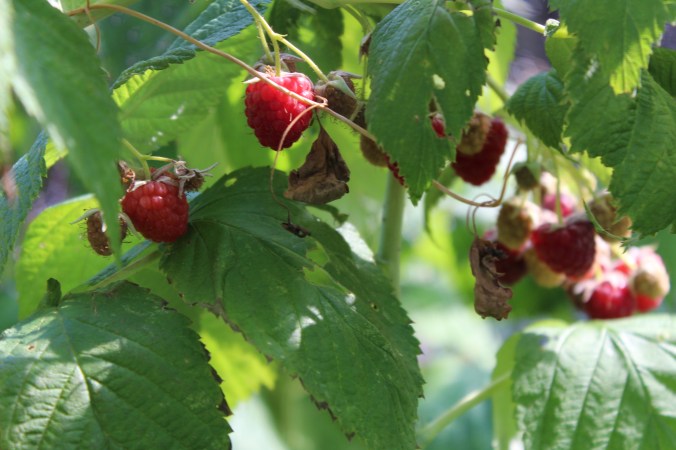
September – such a rich month.  You can feel the year turning. I love the golden light, and the fruit and berries everywhere.  I love the mornings when spider webs are strung with dew, and there is a nip in the air, waking you up.

Spiders – where are they, the rest of the year?
They seem to be everywhere now, including in the house.  I keep reminding myself of the sterling work they are doing eating the flies, which were bothering me last month….

This is a small poem about the ways of spiders, and the power of waiting.  At this time of year, so much slow ripening is coming to fruition.  I find I have forgotten I watched the bees on the raspberries and the apple trees, wondering what the harvest would be.  I have moved on, thinking of something else.

I forget that much I have wondered about, worried about, prayed about, has turned out all right, after all – not everything, but enough.  I am learning the patience of spiders.


Spiders – September

Now is the time of spiders –
their silver webs spun between
leaves, and twigs, and blades of grass.
Each one has its weaver,
resting its legs
on fine threads,
its many eyes watching.

For now, warm fat insects
drift dreamily on
the September breeze.

The hedges hang
with berries, I cannot
pick the plums fast enough,
first apples bend branches,
and beans lengthen on their vines.

I am learning the patience
of spiders.
It comes.  What you need
comes to you.  Gently,
when you have almost
forgotten that you ever asked,
or wanted, or longed for it –
here, and here, and here..


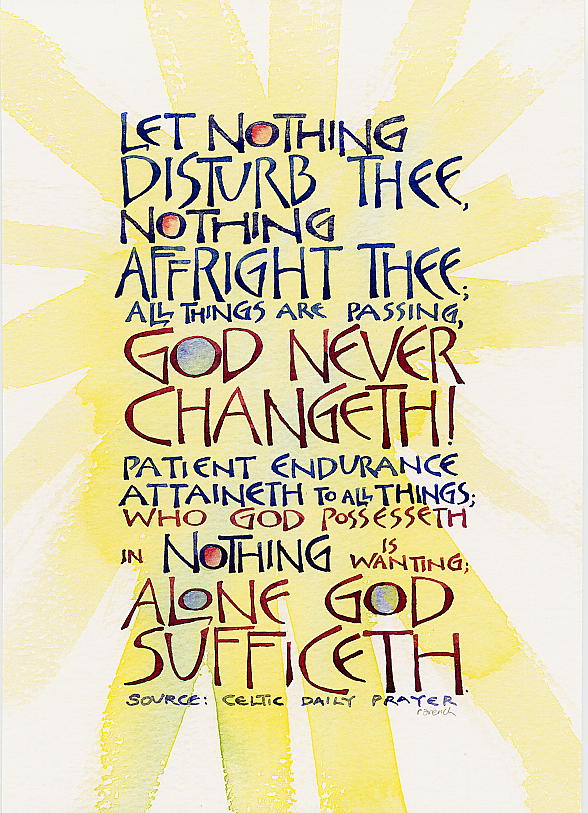
let nothing disturb.jpg

I have this on my computer desktop. It helps me remember the power of patience endurance, of not giving up.


Poem – Treasure, Hidden. Of perseverance and hope.


Treasure, Buried

Each morning I find
small divots in the lawn,
dug neatly, completely.

Sometimes, the squirrel
comes while I am there –
both of us, quiet –
and with an arched back
and a bright eye
she digs.

Does she ever find her
hazelnut?
I don’t know.
I haven’t seen.

I do know I find
a seedling growing
unexpectedly somewhere,
sometimes,
and wonder –
was it her?

I push the divots
back into the lawn.
Each day there are more,
and more.

We value persistence,
the squirrel and I,
we value hope.

Poem – Morning Yoga Practice June 2017

IMG_0815.JPG


IMG_0816.JPG

IMG_0817.JPG

IMG_0818.JPG


There has been much grief in the UK this week, met with an outpouring of love, and courage, and kindness.  These sudden losses shock us, remind us of our fragility, and the fragility of those we love.  The moments of national grief catch up our own more private losses, bring to mind what has gone before, and can take us deeper into questions – and the capacity to endure the space between the question and anything like an answer.

After reading Malcolm Guite’s reflections on being so close to the terrible events at London Bridge on Saturday night, I too have had these words of Shakespeare on my mind.

How with this rage shall beauty hold a plea
Whose action is no stronger than a flower?
O! how shall summer’s honey breath hold out,
Against the wrackful siege of batt’ring days?

Asking questions seems a good response to the depths,

I am returning to my practice of writing freely, recording what draws my attention.  This morning it was this.


Morning yoga practice  June 2017

I bend on the grass,
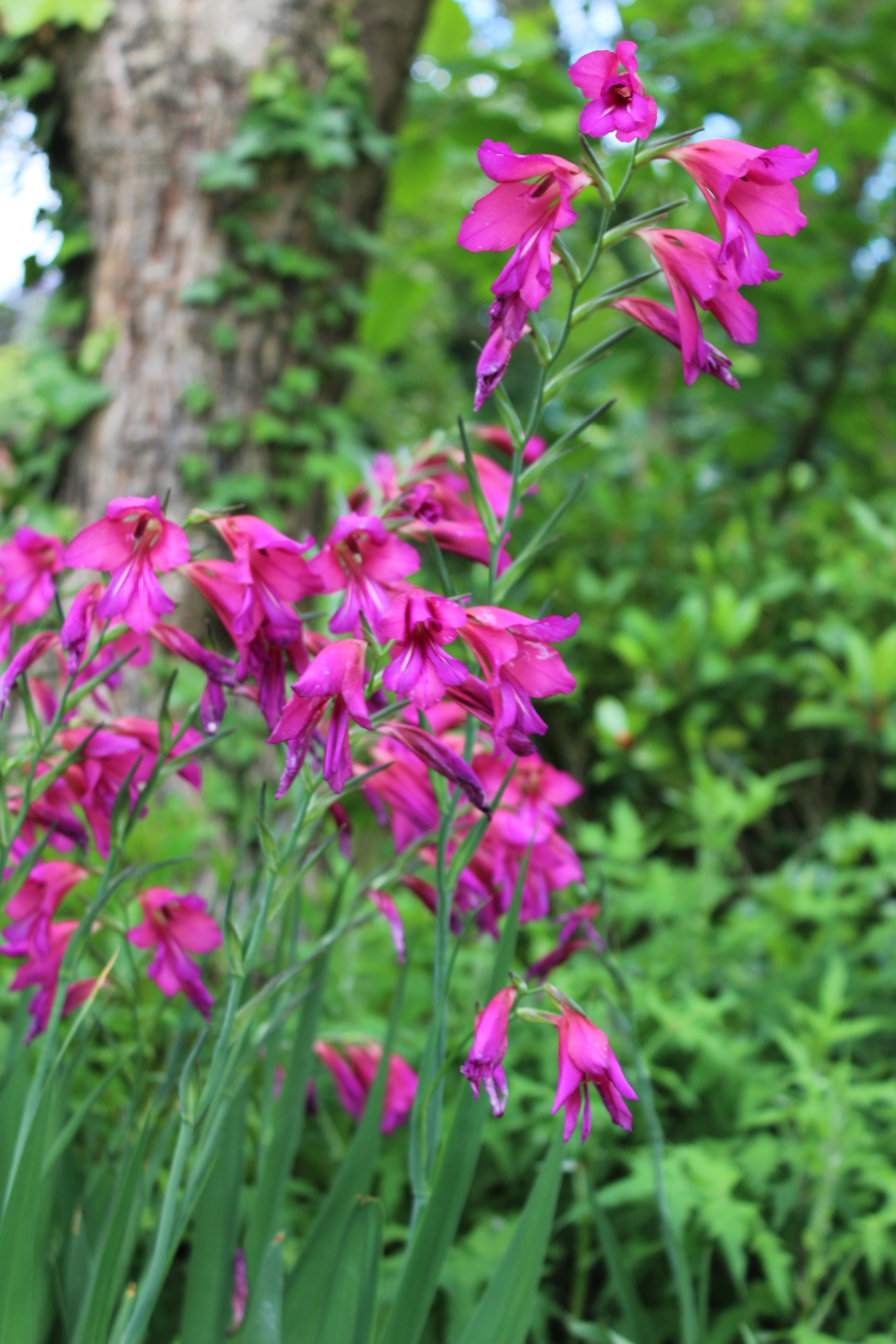
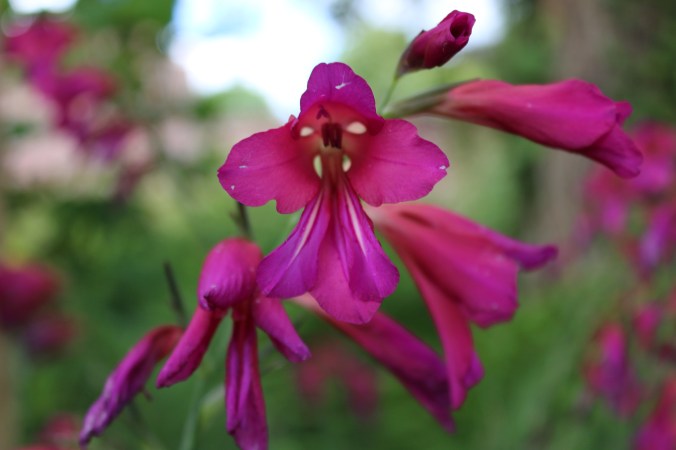
look up at the bending gladioli
dancing cerise with their
graceful arches

as June’s north wind
rocks the branches,
as the air fills with
white petals –
blossom, roses –
that fall.

Why is it all so fragile,
this beauty?
why does it all slip
through my fingers?
I stretch, stretch out my
heart, and my love,
sending it both near,
both near and far away.

 
Restore them dear Lord,
Make them whole,
may they see
this life this beauty,
as the petals fall about me
in a cold blaze,
life and beauty ripped away,
yet carried on this June wind,
yet landing softly on this
green earth.

The Deadline Approaches – I AM book

IMG_0807.JPG

I have been working on a book for BRF for nearly a year now, and my deadline is approaching!

This means I’ll have less time to share things with you good people over the next month,  but I hope to be able to post a little something from time to time when I can.

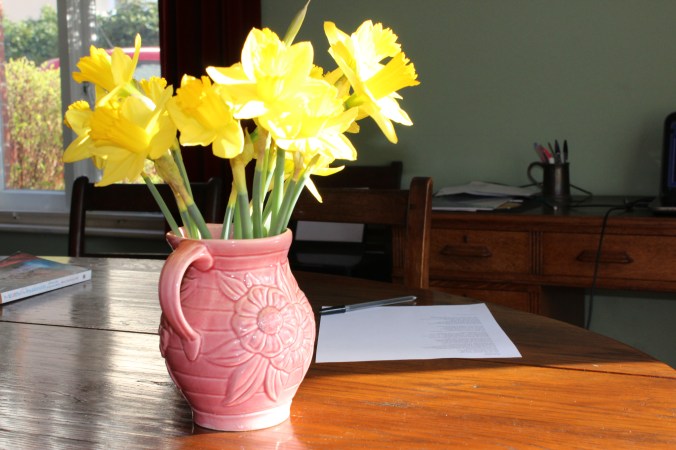
Instead, I shall be sitting at my writing table – it’s a lovely ’60s pine one that was my family kitchen table before being passed on to me.  Many meals have been eaten off it, and veggies chopped and pastry rolled.  It also bears the marks of art projects and homework frustrations which I could sand down, but really don’t want to.

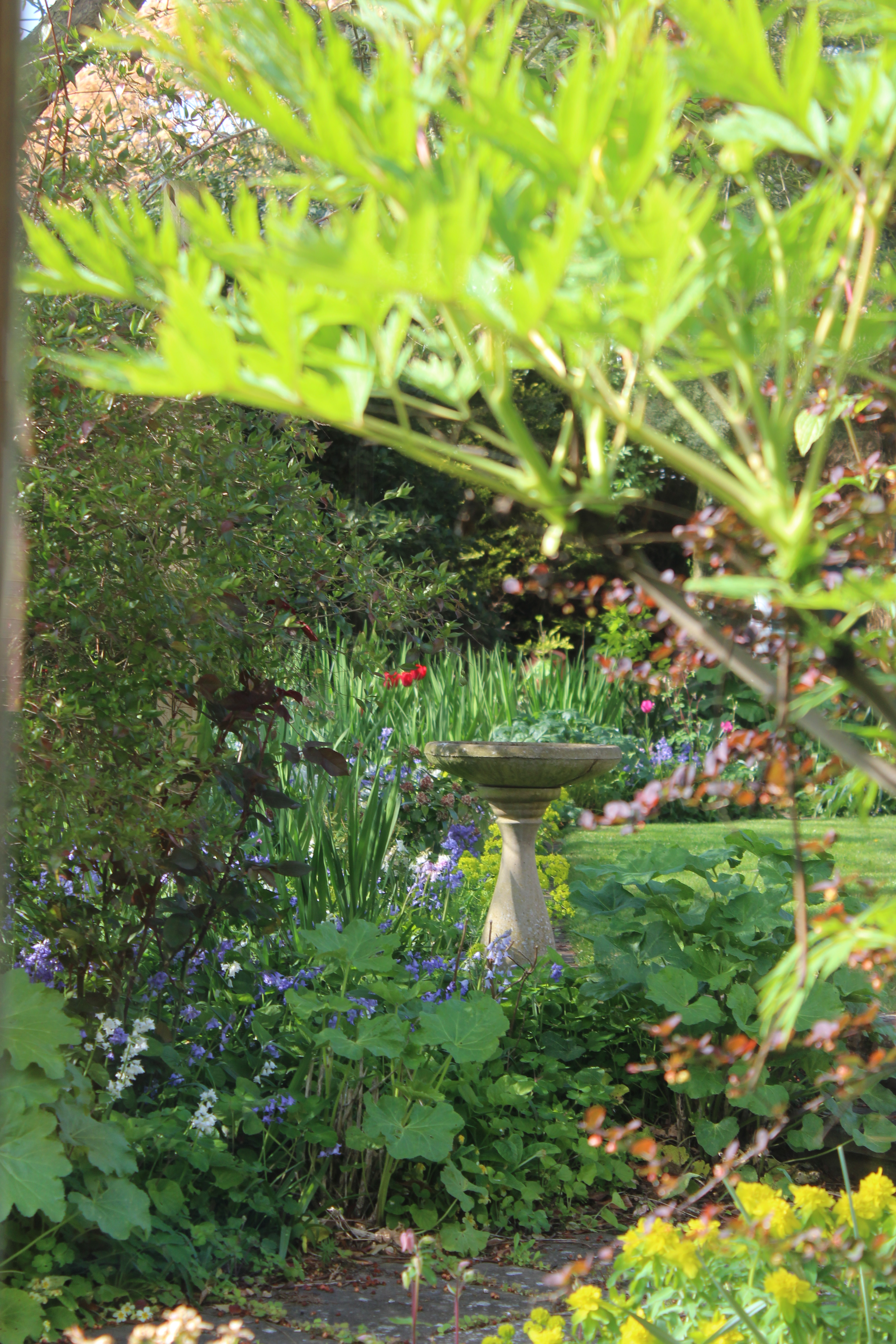
The view from the table is the picture you see here – it’s a little distracting.  Although I haven’t had my camera ready to take pictures, so far today I have seen blackbirds, a robin, and even, briefly, a kestrel at the birdbath. I think the kestrel is watching for smaller birds…..

Today, I am revising a chapter on Jesus’ saying “I AM the bread of life”, thinking about the crowds that were fed by the side of the lake, and what it might mean to be nourished by God.  It is a wonderful thing to be able to do, and it is also wonderful to be able to stretch my legs and think outside, with all that beauty and life around.

Thank you for your patience, and I’ll try to post something soon!

Otley Hall Quiet Day – 12th April

Here is some information about my next event, a day at the stunning Otley Hall in Suffolk on the Wednesday of Holy Week.
Otley Hall in the spring is a beautiful place.
It would be lovely to see you there!

Otley Hall Quiet Day
Wednesday 12th April 2017 10am-4pm

Entering imaginatively into the Bible

mary-anoints-the-feet-of-jesus-by-frank-wesley

We will read gospel stories, imagining ourselves into the scene, and then be free to respond however seems best  – quietness, poetry, prose, media of choice.  For those who wish, we will also think about how to communicate the treasures we find with others.

To book a place on the Quiet Day (£25 including lunch), contact Otley Hall
Otley Hall’s website
01473 890264

I will have a few copies of my books available to buy, thanks to Browsers Bookshop of Woodbridge.


A Poem for the road – Returning

WP_20161106_12_24_49_Pro.jpgWP_20161113_16_45_08_Pro.jpgWP_20170114_10_57_06_Pro.jpg

As we enter into Lent, I have been thinking about pilgrimage, journeys, wandering in a wilderness, being unsure of the way and the destination.  I have been reading Malcolm Guite’s wonderful Word in the Wilderness anthology of poetry, and I turned back to this poem of mine, and looked at it through the eyes of the wanderer in the desert.

The poem was written a few years ago for the Alive Festival, which used to run here in Suffolk, UK.  We were looking for something for our Sunday morning gathering, something which spoke of our sense of longing for home. Something that would help with the journey.  As I was searching, these words began to circle in my mind  They would not leave me alone.  I had to walk them out, pacing restlessly until the poem below took its form.

It draws from many of the stories in the Bible which help us make sense of our life’s journey.  They filled my mind as I paced.  Imagery from Genesis 3 which many churches read together as we prepare for Easter, seemed the starting point.  I moved on to homesickness and exile, which are threads that run through much of the Hebrew scriptures, and also of the discomfort of wilderness, which seems very good to remember now, as we think of Jesus in the wilderness.   But I did not stay there.  My imagination circled round to images drawn from the very end of the book of Revelation  All these images flowed together, as part of a larger, arching story.

I read this poem that morning at the Alive festival, set to  astonishingly beautiful music – Arvo Paart’s Spiegel im Spiegel , played then by Andrew Lord and Jonathan Evans.  The music still moves me to tears.

I hope this poem helps you today, as you walk, whether the way seems hard, or gentle.  May you come to a place of home.


Returning

We left the garden long ago,
Do you remember, though,
still, the trees heavy with fruit,
and how sweet it was?
To stretch out your hand was to be blessed.
Do you remember the cool waters of that deep river
silver with fish, alive and shining in the splashing sun?
And the flowers, bending and bending with the
weight of bees, the low hum of the land
that flowed with milk and honey?
He walked with us then, in the garden.

We have been wanderers for so long
in strange lands, wanderers looking
for a place of shelter, a place to lay down
the heavy loads we gathered at the gate,
when we left the garden. The pain we bear
so hard to bear for it is borne alone.

Our songs dried on our lips, the echoes of the
garden growing distant, and small:
the rhymes of the children playing in the apple tree,
the laughter and the ease of love,
hope’s courage    failing as the long dry road
wound through high and rocky passes
where nothing grows.

The path home is long, but that it what it is,
the path home to the garden,
to return to that place so distant
it has become the place of dreams.
And the gate stands before us,
terrible and splashed with blood,
the gate love made to bring us home.
And the gate is always open,
and beyond, beyond the Tree grows strong,
its green leaves fresh and full of light,
And the river flows deep and wide,
Deep, and wide, and always.
And you know the voice,
you have heard the voice say
Come, all you who have been thirsty for so long,
Come and lay your burdens down,
rest, and drink from these bright waters.
I am your home, your refuge, your song.

You can listen to the poem here.

IMG_0790.JPG

Poem – First Taste

img_0786


The first day of Spring, the first day of Lent –  this year, the first of March marks many beginnings.  I was struck today, as I pulled weeds out of the cool, damp earth, and listened to the birds singing, how strange it was to be entering a season of giving things up, setting things aside, going into the wilderness, when all around is bursting, expansive, beginning.  This is a strange time for dust and ashes, when my hands are covered in the richness of earth, my nose full of the smell of new green.  It feels like holding onto winter.  I am abandoning the patience winter requires, racing ahead in my imagination to new life.

While turning Ash Wednesday over in my mind, I think I shall try to see how this deliberate setting aside may be of some use in understanding the three temptations that Jesus faced at the end of this time  and the role it all plays in preparing for Easter. Self-examination, sharing in some measure of deprivation or self-denial, at a time when hope is bursting out a around us, may help us understand the way of Jesus better.  If we are to love God and love all people, then might this deliberate self-giving, setting aside power, plenty, self interest, really help us do that better?  I am holding questions in my mind, seeing if living things out might help with the answer.

So, this poem hasn’t quite let go of the darkness of winter, but marks the first taste of something new.  The woods near my home are beginning to overflow with ransoms –  to young to fill the place with the smell of garlic, still fresh and very vibrant.  I love foraging, and seek to do it sustainably as a good guest in this beautiful wood.  So, I pick some leaves, and taste.  It is good to feel so connected with the spring, with living growing things.  It feels like a kind of thanksgiving for the winter past, a form of prayer.
I dress my wintery beetroot soup with the leaves, and hold both seasons in my mouth together.  They taste full and sweet and sharp.  A good taste for Ash Wednesday

IMG_0788.JPG


FIRST TASTE

This winter has been long,
so long.  The grey sky,
the darkness, have
pressed down on us
like a grindstone,
leaving these woods dusted
with dull ice.

But now, today, the trees
are black and slick
buds shining with water,
snowdrops and aconites
bright against the dead leaves.
And there, there, the ransoms,
so vividly green, are uncurling.
I stop and pick one soft new
leaf, and bite,
sharper than lemons,
stronger than garlic,
fresh and new.
The first taste of spring
rolling round my mouth for hours


November Sowing


sowing


We have a couple of small veggie patches in our garden.  Maybe, when the garden was planned and the trees were smaller, they were in the perfect place.  Now, they are rather shady, and need just the right weather for things to thrive.  Leaves will grow, though, and sometimes surprisingly.

There are often some seeds left over by the end of the season, and sometimes, I feel inclined to plant anyway.  Maybe, with a mild winter, and some protection, they’ll get a head start in the spring, before the trees are in full leaf.  As I was planting, I thought about all the times when it can feel too late, hopeless.  When we can feel too old to start something, or as if we have blown our chances.  Whatever it was we dreamed of, it can seem like there isn’t enough warmth for our dreams to grow.  It can feel like planting in November with chilly fingers.

I love the defiance of November sowing.  What is wasted by taking a chance, anyway?  A few leftover seeds… and who knows? Come the spring, my veggie patch may be full of little green plants.  I may have good things to eat, and to share.


It is not too late!


 November Sowing

I planted seeds today, scraping my fingernail
into the corners of old packets:
cavolo nero, romanesco, mizuna –
such names – exotic, full leaved, sharp.

I sowed them where I sowed before,
under tall trees thick and damp with falling leaves,
remembering how spring was baked dry,
and summer was pitted with rain, lightless.

But now, today, this low slanting sun is warm.
Now, in this out of season sowing
with leftover seed, I am surprised
to find myself hopeful, joyful
even, at this extravagant gesture.

I know full well that they may never grow,
But maybe, just maybe they will.
Each day is a day for sowing,
it is not too late.


From Prayers and Verses

Help me to be patient as I wait for your kingdom
and your righteousness:
as patient as a farmer who trusts that the rains
will come in their season,
and that the land will produce its harvest.
Keep my hopes high.
Help me to pray to you and to praise you.


Mud from Coleridge’s Garden

IMG_0713.JPG

The Ancient Mariner, at Watchet harbour, where the poem unfolded in Coleridge’s mind. The rope is particularly powerful.


On our Somerset holiday, we visited Coleridge Cottage.  I was not expecting to be so overcome by the place.  Each room was full of connections to his life and work.  Each room echoed with the poems – they flowed across the walls, they came out of the earphones by easy chairs, they whispered to me out of the leaves of books.  To be in the room where he wrote Frost at Midnight  and to sit in the Lime Tree Bower  were deeply moving experiences.  I still remember my marvelous English teacher, Miss Rowlat, talking to us about the Lyrical Ballads, with its paradigm shift of a Prologue, and then to be in the place where Coleridge and Wordsworth met and talked and where these ideas came into being – was beyond words. The Ancient Mariner found voice here, too.  So much wonder in one small, simple cottage. It is not often that I am left speechless.  I was here.

Mud from Coleridge’s Garden

I picked up my muddy shoe –
an unfamiliar pale grey clay,
a leaf stuck to the instep –
and slipped my hand inside
like a glove
as I looked for a cloth

and then I stopped.
It was that leaf,
I remembered the shape –
a jasmine leaf from
the Lime Tree Bower
where I had sat speechless
as I listened to that poem
so full of leaves,

and the pale grey clay
from the damp paths,
from that grassy space
so full of ordinary beauty
it filled me, too,
despite my already full heart.

I walk with muddy shoes now,
each day,
hoping to be rooted to that same earth,
leaving a sprinkling of
Coleridge’s garden
in this lighter, sandier soil.


Sunday Retold – Zacchaeus and the tree

IMG_0053.JPG

IMG_0167

This week’s Sunday Retold follows the Gospel reading set for many churches this week: Luke 19:1-10

A story about climbing trees, and looking up – among other things!

Jesus is making his way towards Jerusalem for the last time – and people still don’t understand.  They are still claiming him as theirs, and keeping out people they consider not good enough.  This man was a tax collector – a collaborator with the Roman invaders, and it would seem a cheat. We don’t know what has drawn him to Jesus, what has made him so determined to catch a glimpse of this teacher despite the hostility he faced, but we do know that Luke’s account of Jesus’ life pays attention to the way Jesus included, accepted, those who were outside – outside what was considered respectable, righteous, good.  He welcomed those others called sinners.  Perhaps the tax collector had heard this.  Perhaps there was something magnetic, attractive, full of life about Jesus.  Perhaps Zacchaeus had heard he healed people.

Here, again, we see it happening.  Jesus looks up.  He sees the unexpected – a wealthy man in a tree.  Trees contain all kinds of riches! When I read this story, I am reminded of the Genesis 3  story – where trees are important, and Adam and Eve hide in the greenery.  Perhaps there are echos here….

We see that Jesus did not berate Zacchaeus with all his cheating thieving treacherous ways, he did not confront him with his sin, he asked this man for hospitality.  He called out his goodness, he treated him as worthy, he accepted him.  If the disapproval of others had the power to make him make amends, there was disapproval enough in Jericho to do it.  He did not need to be reminded of what was wrong, but of what was right.  Jesus reminded him of his essential, elemental goodness.  He treated him as good, with kindness and respect.  He did it publicly, in the face of criticism.  He sat down with him, shared food with him.  The table is a powerful place of deep sharing.  Jesus uses the image of a banquet, a feast, again and again to show us what the Kingdom of God is like.

And see what sharing a table did for Zacchaeus – it gave him the courage to turn his life upside down, to change everything. We can imagine what it must have been like to have Jesus there, next to him, willing him on!

How good it is to know that Jesus shows us what God is like – like this.  We need not be afraid, we need not hide.  God reaches out to find, to love those people who are rejected, who perhaps reject themselves.   God’s power is at work to transform, to change lives, to make new- for all.

trees

The gospels are full of encounters between Jesus and individual people, as well as crowds and groups.  When I read the conversations Jesus has with individuals, I can’t help noticing that each one is different.  He has no formula – he deals with each person as they need. Each one is precious.

You might like to use the picture above, with the trees and the fence, as a way into prayer. What do you see?
Think about the story of Zacchaeus.  Can you remember a time when someone just accepted you as you were?  What was that like?
Have you been in a situation where you have accepted someone else like that, or seen it happen?  What was that like?
Has sharing food with someone been a memorable experience for you?  What happened?
In this story, what did God’s saving power do?  Is there more than one way of answering that?

Here is an extract from The Bible Retold
If you would like to use any of my material, you are welcome to do so, saying where it comes from.

Jesus made his way steadily towards Jerusalem. On his way he passed through Jericho, with its date palms and fragrant balsam trees.  Crowds poured out to see him, and to see the blind beggar who had been healed by the roadside.

“What’s all the commotion – come away from there and get on with your work!” Zacchaeus, the chief tax collector of the region, called out to his assistants.  They scurried back to their work, and the quiet clink of gold coins.  But Zacchaeus could not concentrate – the joy of the crowd had unsettled him.   He swept neat heaps of gold into his purse and went out.

The sounds got louder and louder.  The crowds were calling out for Jesus.  Zacchaeus tried to catch a glimpse of the Teacher, but he could not, for he was a short man, and the people would not let him through.  He ran on ahead and shinned up the stout trunk of a sycamore fig tree, sliding out along one of the branches that shaded the road.  Then he waited, watching Jesus getting closer, as he talked and laughed with the people.  Suddenly, quite close to the tree, Jesus stopped, and looked up.   Zacchaeus gasped, and tried to hide among the leaves.  Everyone was looking now.
“Zacchaeus, isn’t it?” Jesus said “You’d better hurry down from there.  I’d like to stay at your house today!”  So the chief tax collector swung down, rubbing green smears from his fine robes.  They set off together, and Zacchaeus threw open his doors to Jesus and his friends, beaming with joy.

But, the crowds were spitting with anger “Did you see that? He’s gone to be a guest of that thief, that collaborator with the Romans!”

Zacchaeus stood up before them all, and spoke to Jesus. “Look, Lord, right now I’ll give half of everything to the poor! And if I’ve cheated anyone, I’ll pay them back four times over!”
Jesus answered “God’s power is at work in this house today – the power to rescue and to change.  This man, too, is one of God’s children.  For the Son of Man came to seek, and to save, those who have lost the way to God!”

And some prayers from Prayers and Verses
to help us pray through this wonderful story

Grant me to recognise in others, Lord God,
the radiance of your own face.

Pierre Teilhard de Chardin, 1881-1955

Help me, Lord Jesus, learn who you are.
Help me learn as I try to love, and forgive,
and help others as you did.
Thank you most of all for loving me just as I am.

Jesus told us:
You are blessed when you know how poor you are inside,
for then you are open to God and his ways.
You are blessed when you are sad,
for then you will feel a loving hand on your shoulder.
You are blessed when you are gentle and humble;
you will see all of earth’s good things, there for you.
You are blessed when you hunger for what is right;
you will be satisfied.
You are blessed when you live generously and kindly,
for you will be treated with kindness, too.
You are blessed when you are wholeheartedly good;
nothing will stand between you and God.
You are blessed when you work for peace;
you will be called one of God’s children.

IMG_0609.JPG