Poem – First Taste

img_0786


The first day of Spring, the first day of Lent –  this year, the first of March marks many beginnings.  I was struck today, as I pulled weeds out of the cool, damp earth, and listened to the birds singing, how strange it was to be entering a season of giving things up, setting things aside, going into the wilderness, when all around is bursting, expansive, beginning.  This is a strange time for dust and ashes, when my hands are covered in the richness of earth, my nose full of the smell of new green.  It feels like holding onto winter.  I am abandoning the patience winter requires, racing ahead in my imagination to new life.

While turning Ash Wednesday over in my mind, I think I shall try to see how this deliberate setting aside may be of some use in understanding the three temptations that Jesus faced at the end of this time  and the role it all plays in preparing for Easter. Self-examination, sharing in some measure of deprivation or self-denial, at a time when hope is bursting out a around us, may help us understand the way of Jesus better.  If we are to love God and love all people, then might this deliberate self-giving, setting aside power, plenty, self interest, really help us do that better?  I am holding questions in my mind, seeing if living things out might help with the answer.

So, this poem hasn’t quite let go of the darkness of winter, but marks the first taste of something new.  The woods near my home are beginning to overflow with ransoms –  to young to fill the place with the smell of garlic, still fresh and very vibrant.  I love foraging, and seek to do it sustainably as a good guest in this beautiful wood.  So, I pick some leaves, and taste.  It is good to feel so connected with the spring, with living growing things.  It feels like a kind of thanksgiving for the winter past, a form of prayer.
I dress my wintery beetroot soup with the leaves, and hold both seasons in my mouth together.  They taste full and sweet and sharp.  A good taste for Ash Wednesday

IMG_0788.JPG


FIRST TASTE

This winter has been long,
so long.  The grey sky,
the darkness, have
pressed down on us
like a grindstone,
leaving these woods dusted
with dull ice.

But now, today, the trees
are black and slick
buds shining with water,
snowdrops and aconites
bright against the dead leaves.
And there, there, the ransoms,
so vividly green, are uncurling.
I stop and pick one soft new
leaf, and bite,
sharper than lemons,
stronger than garlic,
fresh and new.
The first taste of spring
rolling round my mouth for hours


November Sowing


sowing


We have a couple of small veggie patches in our garden.  Maybe, when the garden was planned and the trees were smaller, they were in the perfect place.  Now, they are rather shady, and need just the right weather for things to thrive.  Leaves will grow, though, and sometimes surprisingly.

There are often some seeds left over by the end of the season, and sometimes, I feel inclined to plant anyway.  Maybe, with a mild winter, and some protection, they’ll get a head start in the spring, before the trees are in full leaf.  As I was planting, I thought about all the times when it can feel too late, hopeless.  When we can feel too old to start something, or as if we have blown our chances.  Whatever it was we dreamed of, it can seem like there isn’t enough warmth for our dreams to grow.  It can feel like planting in November with chilly fingers.

I love the defiance of November sowing.  What is wasted by taking a chance, anyway?  A few leftover seeds… and who knows? Come the spring, my veggie patch may be full of little green plants.  I may have good things to eat, and to share.


It is not too late!


 November Sowing

I planted seeds today, scraping my fingernail
into the corners of old packets:
cavolo nero, romanesco, mizuna –
such names – exotic, full leaved, sharp.

I sowed them where I sowed before,
under tall trees thick and damp with falling leaves,
remembering how spring was baked dry,
and summer was pitted with rain, lightless.

But now, today, this low slanting sun is warm.
Now, in this out of season sowing
with leftover seed, I am surprised
to find myself hopeful, joyful
even, at this extravagant gesture.

I know full well that they may never grow,
But maybe, just maybe they will.
Each day is a day for sowing,
it is not too late.


From Prayers and Verses

Help me to be patient as I wait for your kingdom
and your righteousness:
as patient as a farmer who trusts that the rains
will come in their season,
and that the land will produce its harvest.
Keep my hopes high.
Help me to pray to you and to praise you.


Mud from Coleridge’s Garden

IMG_0713.JPG

The Ancient Mariner, at Watchet harbour, where the poem unfolded in Coleridge’s mind. The rope is particularly powerful.


On our Somerset holiday, we visited Coleridge Cottage.  I was not expecting to be so overcome by the place.  Each room was full of connections to his life and work.  Each room echoed with the poems – they flowed across the walls, they came out of the earphones by easy chairs, they whispered to me out of the leaves of books.  To be in the room where he wrote Frost at Midnight  and to sit in the Lime Tree Bower  were deeply moving experiences.  I still remember my marvelous English teacher, Miss Rowlat, talking to us about the Lyrical Ballads, with its paradigm shift of a Prologue, and then to be in the place where Coleridge and Wordsworth met and talked and where these ideas came into being – was beyond words. The Ancient Mariner found voice here, too.  So much wonder in one small, simple cottage. It is not often that I am left speechless.  I was here.

Mud from Coleridge’s Garden

I picked up my muddy shoe –
an unfamiliar pale grey clay,
a leaf stuck to the instep –
and slipped my hand inside
like a glove
as I looked for a cloth

and then I stopped.
It was that leaf,
I remembered the shape –
a jasmine leaf from
the Lime Tree Bower
where I had sat speechless
as I listened to that poem
so full of leaves,

and the pale grey clay
from the damp paths,
from that grassy space
so full of ordinary beauty
it filled me, too,
despite my already full heart.

I walk with muddy shoes now,
each day,
hoping to be rooted to that same earth,
leaving a sprinkling of
Coleridge’s garden
in this lighter, sandier soil.


Sunday Retold – Zacchaeus and the tree

IMG_0053.JPG

IMG_0167

This week’s Sunday Retold follows the Gospel reading set for many churches this week: Luke 19:1-10

A story about climbing trees, and looking up – among other things!

Jesus is making his way towards Jerusalem for the last time – and people still don’t understand.  They are still claiming him as theirs, and keeping out people they consider not good enough.  This man was a tax collector – a collaborator with the Roman invaders, and it would seem a cheat. We don’t know what has drawn him to Jesus, what has made him so determined to catch a glimpse of this teacher despite the hostility he faced, but we do know that Luke’s account of Jesus’ life pays attention to the way Jesus included, accepted, those who were outside – outside what was considered respectable, righteous, good.  He welcomed those others called sinners.  Perhaps the tax collector had heard this.  Perhaps there was something magnetic, attractive, full of life about Jesus.  Perhaps Zacchaeus had heard he healed people.

Here, again, we see it happening.  Jesus looks up.  He sees the unexpected – a wealthy man in a tree.  Trees contain all kinds of riches! When I read this story, I am reminded of the Genesis 3  story – where trees are important, and Adam and Eve hide in the greenery.  Perhaps there are echos here….

We see that Jesus did not berate Zacchaeus with all his cheating thieving treacherous ways, he did not confront him with his sin, he asked this man for hospitality.  He called out his goodness, he treated him as worthy, he accepted him.  If the disapproval of others had the power to make him make amends, there was disapproval enough in Jericho to do it.  He did not need to be reminded of what was wrong, but of what was right.  Jesus reminded him of his essential, elemental goodness.  He treated him as good, with kindness and respect.  He did it publicly, in the face of criticism.  He sat down with him, shared food with him.  The table is a powerful place of deep sharing.  Jesus uses the image of a banquet, a feast, again and again to show us what the Kingdom of God is like.

And see what sharing a table did for Zacchaeus – it gave him the courage to turn his life upside down, to change everything. We can imagine what it must have been like to have Jesus there, next to him, willing him on!

How good it is to know that Jesus shows us what God is like – like this.  We need not be afraid, we need not hide.  God reaches out to find, to love those people who are rejected, who perhaps reject themselves.   God’s power is at work to transform, to change lives, to make new- for all.

trees

The gospels are full of encounters between Jesus and individual people, as well as crowds and groups.  When I read the conversations Jesus has with individuals, I can’t help noticing that each one is different.  He has no formula – he deals with each person as they need. Each one is precious.

You might like to use the picture above, with the trees and the fence, as a way into prayer. What do you see?
Think about the story of Zacchaeus.  Can you remember a time when someone just accepted you as you were?  What was that like?
Have you been in a situation where you have accepted someone else like that, or seen it happen?  What was that like?
Has sharing food with someone been a memorable experience for you?  What happened?
In this story, what did God’s saving power do?  Is there more than one way of answering that?

Here is an extract from The Bible Retold
If you would like to use any of my material, you are welcome to do so, saying where it comes from.

Jesus made his way steadily towards Jerusalem. On his way he passed through Jericho, with its date palms and fragrant balsam trees.  Crowds poured out to see him, and to see the blind beggar who had been healed by the roadside.

“What’s all the commotion – come away from there and get on with your work!” Zacchaeus, the chief tax collector of the region, called out to his assistants.  They scurried back to their work, and the quiet clink of gold coins.  But Zacchaeus could not concentrate – the joy of the crowd had unsettled him.   He swept neat heaps of gold into his purse and went out.

The sounds got louder and louder.  The crowds were calling out for Jesus.  Zacchaeus tried to catch a glimpse of the Teacher, but he could not, for he was a short man, and the people would not let him through.  He ran on ahead and shinned up the stout trunk of a sycamore fig tree, sliding out along one of the branches that shaded the road.  Then he waited, watching Jesus getting closer, as he talked and laughed with the people.  Suddenly, quite close to the tree, Jesus stopped, and looked up.   Zacchaeus gasped, and tried to hide among the leaves.  Everyone was looking now.
“Zacchaeus, isn’t it?” Jesus said “You’d better hurry down from there.  I’d like to stay at your house today!”  So the chief tax collector swung down, rubbing green smears from his fine robes.  They set off together, and Zacchaeus threw open his doors to Jesus and his friends, beaming with joy.

But, the crowds were spitting with anger “Did you see that? He’s gone to be a guest of that thief, that collaborator with the Romans!”

Zacchaeus stood up before them all, and spoke to Jesus. “Look, Lord, right now I’ll give half of everything to the poor! And if I’ve cheated anyone, I’ll pay them back four times over!”
Jesus answered “God’s power is at work in this house today – the power to rescue and to change.  This man, too, is one of God’s children.  For the Son of Man came to seek, and to save, those who have lost the way to God!”

And some prayers from Prayers and Verses
to help us pray through this wonderful story

Grant me to recognise in others, Lord God,
the radiance of your own face.

Pierre Teilhard de Chardin, 1881-1955

Help me, Lord Jesus, learn who you are.
Help me learn as I try to love, and forgive,
and help others as you did.
Thank you most of all for loving me just as I am.

Jesus told us:
You are blessed when you know how poor you are inside,
for then you are open to God and his ways.
You are blessed when you are sad,
for then you will feel a loving hand on your shoulder.
You are blessed when you are gentle and humble;
you will see all of earth’s good things, there for you.
You are blessed when you hunger for what is right;
you will be satisfied.
You are blessed when you live generously and kindly,
for you will be treated with kindness, too.
You are blessed when you are wholeheartedly good;
nothing will stand between you and God.
You are blessed when you work for peace;
you will be called one of God’s children.

IMG_0609.JPG

October 21st

IMG_0615.JPG

IMG_0617.JPG


IMG_0618.JPG


img_0620

img_0623

This poem is a product of my not-quite daily practice – of simply writing to fill up the page.  It is a discipline learned from Julia Cameron’s invaluable The Artists Way, where she advises Morning Pages – filling up three A4 pages every day.  You are not attempting to “write” or do anything creative, you are just getting to the end of the pages.  In the process, all sorts of interesting things will happen, but that is not your concern.  You are learning to silence your inner editor, getting it to turn the other way while you are in the first tentative stages of creating.

Once you have got used to simply writing, and not reading or thinking about what we have written, after a few weeks of filling up pages, you can begin to go back and look at what you have written.  Sometimes, amidst all sorts of moaning and lists and thinking on the page, you find you have the beginnings of something.  Sometimes, it is like mining ore.  Once your inner critic learns to leave you alone, you find all sorts of things emerge, like this.

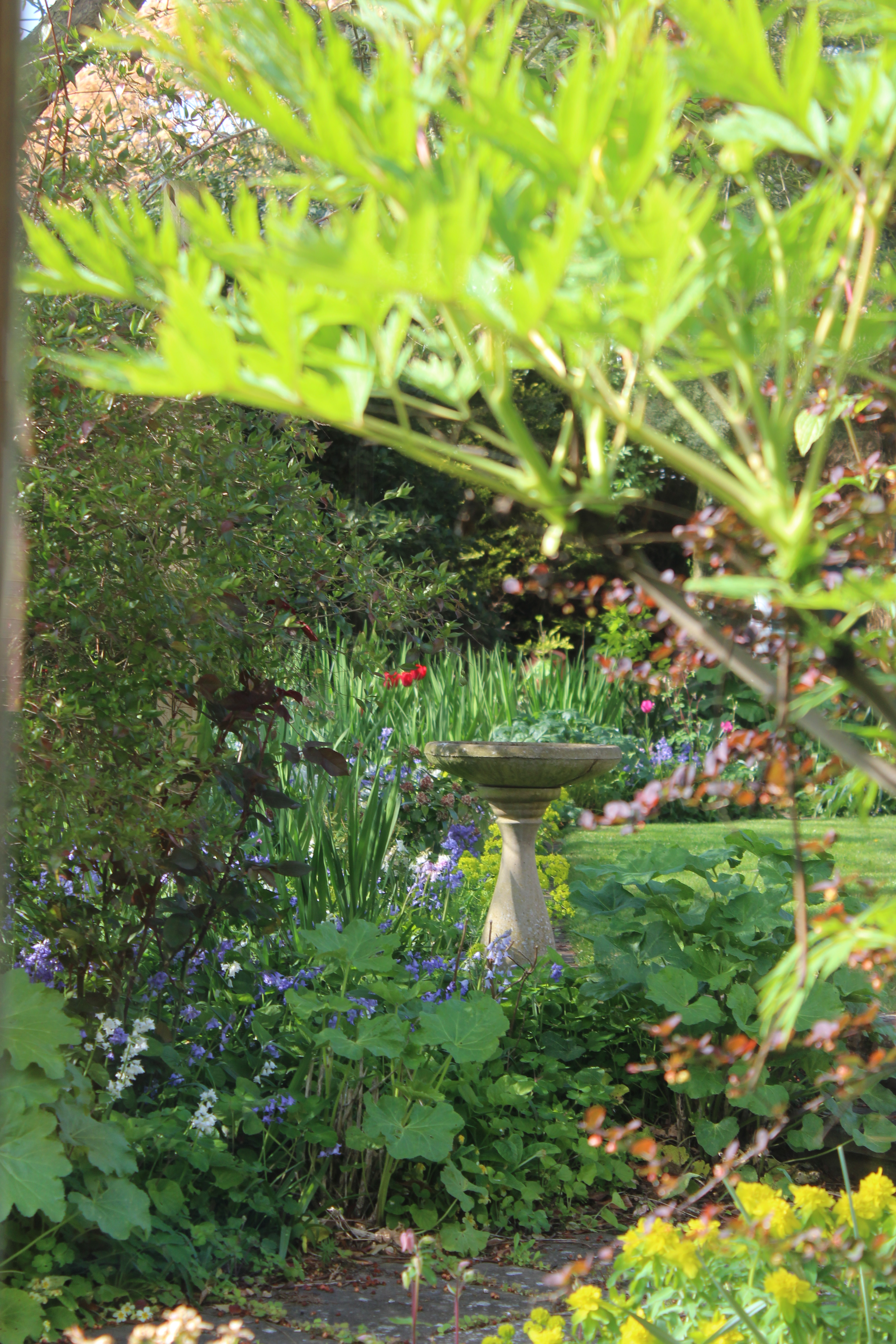
One of the things I often find myself doing is describing what I see around me.  This is what I did.  To honour the process, I have called the poem by the date, rather than giving it a subject.  It is a record of this moment, this sitting in the garden wrapped against the growing cold, writing.


October 21st

How lovely the light is, low and golden,
falling in sheets through low, golden trees.

And the birds sing now, this morning,
in a song sharpened by last night’s frost,
the first – cold, clean, white.

The red roses are scentless with ice,
petals rolled to elegant, sugared points.
And above them the tall, brown seedheads
rattle gently in a gentle breeze.

I will cut them back, but not yet.

They hold this moment, now,
in their full, dry cups, swaying
between summer’s fallen petals,
and spring’s sharp green.
And coiled inside their
tiny black seeds are
flowers without number,
scattering in the icy breeze.

Honesty

honesty-seed-pods

Image from higgledeygarden.com

Where do ideas come from?

You may have decided you would like to write, or paint, or undertake any creative practice, but  white space stares back at you from the paper, or the canvas, or the screen, and your mind feels as blank as the page.

What helps me is to begin.  That means deciding to fill up a page – not trying to accomplish anything grand, or anything specific – showing up at the page and filling it.  Often I do this outside, and often I end up writing about the things I see around me.  Sometimes, as I do sisomething catches my attention.

This time, it was the seed-heads of the honesty.


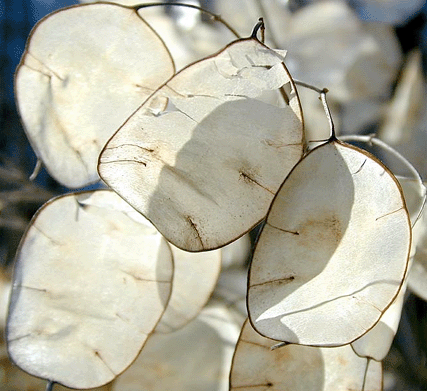
Honesty

The seedheads are drying.
They were purple green, fleshy,
lit up dancing by the summer sun,
and now they are thin, and dark,
like the cratered moon seen
through thick smoke,
or burnt paper with
smudged, forgotten words.

And now, as they dry,
the seedheads rattle and split,
shucked by the north wind,
shedding one half of themselves,
the darker half, those thin circles
rolling over the green lawn.

What is left is shining like
an open shell, glowing
in low light like
so many clear moons
caught in a white net.
Now, they are showing
their heart-colours,
pale and lovely at last.

Rain


IMG_0608.JPG

IMG_0606.JPG


IMG_0607

So, today, it rains.  I am loving listening to the sound of it fall o the dry ground, the coolness, freshness, even the greyness of the sky and the newly soft light.

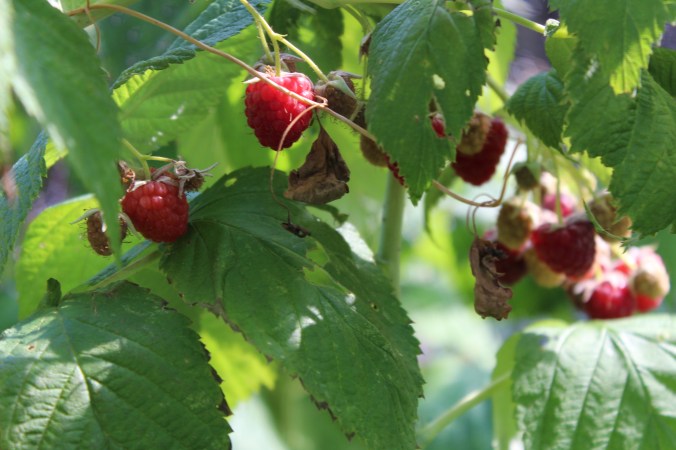
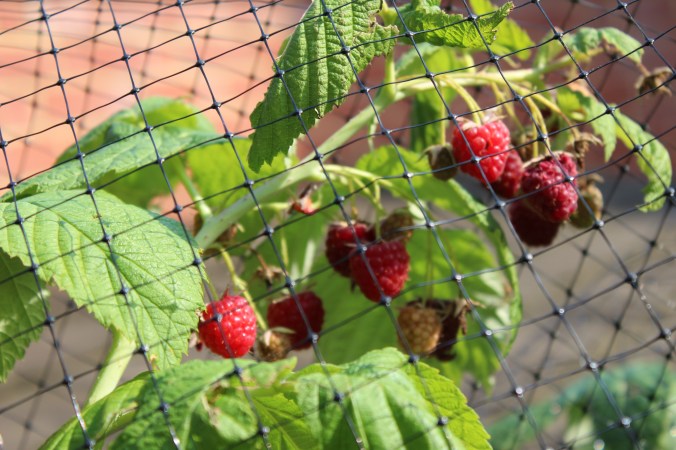
While waiting for the rain, my mind turned back to this poem.  I wrote it a couple of years ago, and so the raspberries in the pictures, this year’s crop, are healthier than the ones described below.  Water has been on my mind as I’ve been working on my  new book   on John’s gospel – water poured out as an offering, water to wash the eyes of the one born blind, water the bubbles up within you, so you are never thirsty again.  That gets closer to the other kinds of thirst here, in this poem.  There are many things we can be thirsty for.

Rain

The breeze stirs the raspberry patch,
the leaves with crisp yellow edges
rustle under their net,
and under them
are deep red fruits, dusted grey,
The colour of blood spilled
not today, or yesterday,
but months ago.

They are strong,
an intense sharpness.
They have lost their sweetness.
Yet, even so, the blackbird balances
on the net,  reaching down
with a hard yellow beak.

The ground beneath is grey, too, and
fissured like the fruit.
The heat rises, stillness falls on the ground
like thin shadows.
This thirst, this longing for rain,
grows stronger.
Desperate.
Joy, and gentleness,
love and lovingkindness.
Presence and peace.
These I long for.
I need them like flowing water.
Come like the rain.
Come to us like rain.

Flags

IMG_0592

IMG_0588.JPG

IMG_0589

Seeds – such extraordinary, tiny, dots of potential, each one full of flowers.  I tend to let the plants I love run to seed, and then I have handfuls of treasure to bury in the ground, for the seed must fall to the ground to grow.  In this case, the ground is the small and unpromising strip of land beyond my boundary, by the road.  It does no harm, that I can see, to sow here, and it carries the possibility of  something beautiful happening where there was little beauty before.

The difficulty with planting wild seeds in wild places is that they are unlikely to grow.  As such, they can seem more like signs of disillusion and futility than of hope.  I was wondering whether we can engage in acts of hope, of planting, of goodness and joy, for their own sake, and then, simply be delighted when something beautiful comes of it.  I sow and I forget that I sow, but, nonetheless,  I now have a few small flowers of campion, scabious and harebell growing where none grew before.

The sun and the rain are beyond my power, but the sowing is entirely within it..


Flags

The seeds are ripening now –
bluebells and red campion,
scabious and harebells –
in this space, this enclosed
garden space

So I offer them to friends,
and I cut the ripe stalks down
and gather them in my hands,
carrying them like so many
ceremonial flags –
my colours.

I take them to the thin strip
of ground beyond my flint wall,
making cars slow for me
as I scatter in this hot,
unpromising soil.
Yet, nonetheless,
I am filling it up with seeds,
slowly, year on year,
colours blazing in my mind.

Most will not take,
but the seeds are there,
and the ground is there,
and so what is there to do
but to sow, freely,
not expecting return,
amazed and laughing
when they grow.


Nest

Pigeon update: and today, just a few moments ago, they fledged!

IMG_0603.JPG

IMG_0604

IMG_0605

andreaskevington's avatarAndrea Skevington

IMG_0585.JPG

Poems can tell stories – I hope this one does – stories which seem to have a meaning beyond the events.  This is a story from the past week or so in my garden –  one of the many that unfold daily.  The story of a pigeons’ nest I uncovered.

As I began writing, I thought of the dilemma we all face as humans sharing their home with other creatures – how to live lightly, how to nurture and care for all who share our little bit of land.  As a large and powerful creature in this world, I have responsibility. I wrote about feeling like a giant in my own garden in Pulling up trees. In this instance, I had not seen the parent birds going in and out of this shrub. I thought I knew where all the nests were. I thought I had left it late enough…

View original post 296 more words

Nest

IMG_0585.JPG

Poems can tell stories – I hope this one does – stories which seem to have a meaning beyond the events.  This is a story from the past week or so in my garden –  one of the many that unfold daily.  The story of a pigeons’ nest I uncovered.

As I began writing, I thought of the dilemma we all face as humans sharing their home with other creatures – how to live lightly, how to nurture and care for all who share our little bit of land.  As a large and powerful creature in this world, I have responsibility. I wrote about feeling like a giant in my own garden in Pulling up trees. In this instance, I had not seen the parent birds going in and out of this shrub. I thought I knew where all the nests were. I thought I had left it late enough. I was mistaken..

As the days passed, I cheered the two youngsters on as they adapted to their new situation – a nest with a view.  Their mother just carried on caring for them, a little nervously at first, protecting them from rain, feeding them, sheltering them from the midday sun, even though they were now exposed to the crows, and the buzzard, that fly overhead.  Without that care, they would not have survived.  With it, they are thriving still, despite my unintentional assault on their home. No one in this family is giving up.

When I speak positively of their new, open situation, of course that is not about the birds, but about me.  The birds are better off hidden.  I was beginning to think of how we, when faced with hard change, can raise our eyes, and find courage and hope in even an unaccustomed view.
The world is full of parables.


Nest

I leave things wild.
I plant flowers the bees
and butterflies
love.
Ground cover
covers the ground,
and frogs and newts
rest in the shade.

So, this is not what should happen
when my window is crowded with leaves
and I wait till high summer
till the birds are quiet
to cut
hard and deep.
Satisfyingly
the ratcheted loppers
slice through wood.

I stop

As I see those two strange
black creatures,
yellow feathered,
shaking in their nest.
I step back, as quietly as I can,
shaking too,
a destroyer of their world.

Inside, I close the curtain,
peep around to see
the mother bird nestles them,
tends and feeds them.

They thrive and grow
in this newly open nest,
small strange dinosaurs,
now fledglings
stretching their wings,
seeing all that space
all that light
in which to rise,
and fly.