This week, I thought I’d share with you my retelling of the reading many churches will be following this Sunday, in the spirit of Sunday Retold.
It explores themes of power, and so follows on from last week’s poem, Stones.
This week’s reading is that electrifying encounter between Jesus and Pontius Pilate – a trial of sorts. For the flow of the storytelling, I’ve taken a longer sweep than the set reading.
So here’s the story from The Bible Story Retold
At the same time, as dawn was breaking, the council gathered – elders, chief priests, teachers of the Law – and faced Jesus.
“If you are the Christ, the promised one, then tell us!” one said, rolling the words around his mouth as if they were bitter to his taste.
“If I told you, you would not believe me,” Jesus replied, holding him in his steady gaze.
“Are you the Son of God?” they asked.
“You are right to say so.”
At this they rose to their feet with an angry roar, and carried Jesus off to the palace of Pilate, the Roman governor, who had power to sentence people to death.
“This man is a threat to the peace – he claims to be Christ, a king, and opposes Roman taxes,” the accusers called out as Pilate circled around Jesus.
“Are you the King of the Jews?” he asked. Jesus felt the cold edges of the mosaic under his bare feet.
“Yes,” he replied. “But my kingdom is not like the kingdoms of this world.”
“So, you are a king!” Pilate responded.
“Yes! That is why I came, to speak the truth. Everyone who is on the side of truth will listen to me.”
“But what is truth?” Pilate asked. Then he went out to see the leaders and the people together. “I see no reason to charge him,” Pilate said. “This man has done nothing to deserve death. I will set him free.”
“No, set Barabbas free instead!” they cired. Now, Barabbas was a rebel who had killed a man.
They shouted louder, drowning out Pilate’s words: “He’s done nothing wrong! I will release him!”
But, with rising rage, the mob shouted, “Crucify crucify!” In the end, Pilate gave in: he set Barabbas free and handed Jesus over to the guards.
The guards tormented Jesus, the one called king. They draped a fine, purple robe around him, and twisted him a crown of sharp thorns to wear. They called out, “Hail, King of the Jews!” and fell on their kneeds before him, laughing. They spat on him, and struck his head with a staff. They, they took back the robe, and led him out to be crucified in his own simple clothes
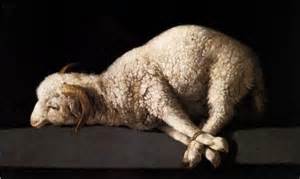
Francisco De Zurbaran
We see how those who held religious power allied themselves with the Imperial power of Rome. I expect they were sure they were being faithful, upholding the law and their traditions, defending their faith as they saw it. Being certain you are right can lead you very astray. And we see too how Pilate saw Jesus very differently, one who had done nothing wrong, and yet seemed to have little power in the face of an angry crowd.
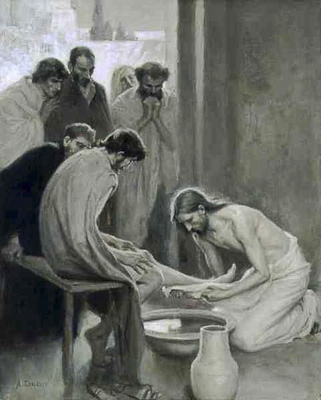
The biggest difference of all, to my mind, is in the understanding of what power is, what a kingdom is, who a king is. Those who are embedded in the power structures of this world, and, to be honest, the rest of us too, find it hard to imagine a different kind of power. One that follows a path downwards, even to death. One that washes the feet of the followers, that does not insist on its own place, but instead works through love, in humility, in radical engagement with the world as it is. We will soon be in Advent, preparing for the coming of Jesus. At that time we think of his unity and solidarity with frail humanity, born in such a humble way, amongst the extraordinary, ordinary, beloved people of Bethlehem.
Lord Jesus,
May our lives bear the mark of love.
As we are kind, as we share, as we are gentle,
may your love be seen in us.
Help us, for this is hard for us.Dear God,
May I welcome you as my king:
King of peace,
King of love,
King in death,
King of life.
From my book of prayers to accompany The Bible Story Retold, Prayers and Verses

 Andrea Skevington