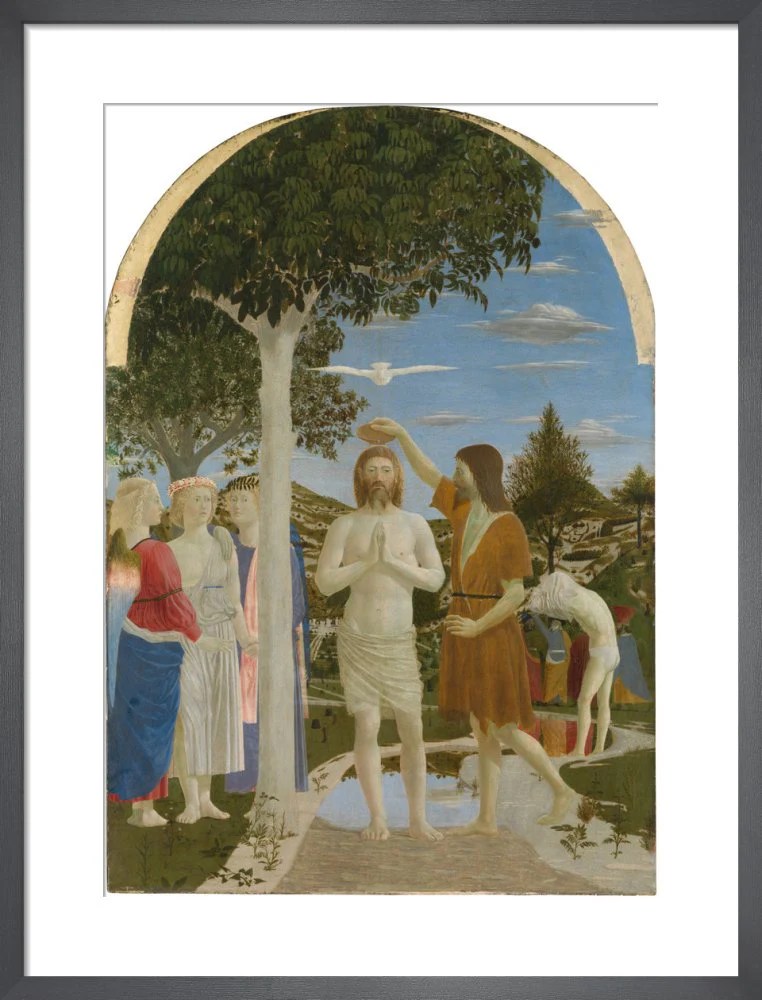
Piero della Francesca, The Baptism of Christ. National Gallery, London.
This coming Sunday many Christian communities are continuing to think of Epiphany, or epiphanies – those moments of clarity, of breakthrough, when you see things anew, or perhaps for the first time. In particular, there are readings to follow which tell us of Jesus’ baptism by John in the Jordan river. It’s a moment when everything seems to change – where we see one who closely resembles a prophet from the Hebrew scriptures, and one who tells us that the Kingdom of God is so close, already among us – standing together in a river. The reading is Luke 3:15-17,21-22. I’m posting a link to the whole chapter, though, as it gives us some very helpful reflections on “What should we do?” as signs of a change of heart, as well as the beautiful and hopeful passage from Isaiah.
I love the picture at the top of this post. I love its lines, its clarity and purity. I have a framed poster very like this one, and see it every day. I’ve often wondered at the river stopping, diverting around this moment of baptism. I assume della Francesca was thinking of the story in the book of Joshua, when the priests carrying the arc of the covenant step into the Jordan, and the waters dry. The people then cross the riverbed. In doing so they leave their time in the wilderness, and it is an echo of the time they entered it by crossing the Red Sea, escaping slavery in Egypt as they did so. This time, crossing the Jordan, God’s presence is suggested by the Arc of the Covenant, rather than the pillar of fire and flame that was with them at the beginning of their journey. It’s quite a change. You can read the story here if you’re interested.
And so, to the poem. As so often, I begin by reading the passage through, several times. I breathe, I wait to see what speaks, what arises, what I feel. And I felt a strong response to the water, and the dove – those natural elements I see myself every day in my own walks by my own river. They moved me. And yet, there was also this background thought of the painting that has formed my imagining of the story. So a poem emerged which is in itself a kind of epiphany, a kind of seeing things in a new way, or perphaps a given insight. I leave that to you, the reader.
If you enjoy following trails, there are some others you might like here, relating to the water and the dove. The first is Jesus’ I am saying – I am the living water. That passage has stayed with me for years. You can read my reflections on it here. And the dove called to mind the story of Noah, and another poem, here. There is more of course, like Jesus washing his friends’ feet. I leave the others to your imagination.
Water and Dove – Baptism
When you stepped into the Jordan, did the water stop, not daring to touch your feet – as if you yourself were the arc of the covenant, untouchable, fierce in holiness? As if you bore within yourself the whole of the law, the weighty stones given to Moses? The river was in spate then – wild it was, but it stopped before such fearful holiness.
But I do not see it so. Rather, I see cool water lapping your feet, your legs, bathing them clean, ripples rejoicing, dancing, flowing, honoured to baptise one who did not require it, both water and Son of Man living out their deep purpose
As the sky opened wide with tender light, and a white dove tumbled with the applause of clattering wings down to you – and what then? Maybe it landed softly on your shoulder, resting awhile, heads inclined together, gently, two wild beings, two beings overflowing with all love divine.
And so love spoke forth with delight, love pouring over you like the cool water, river water, living water like the endless light, and the softest brush of feathers from the wings of a dove. Endless, life-giving love.
Sunday Retold
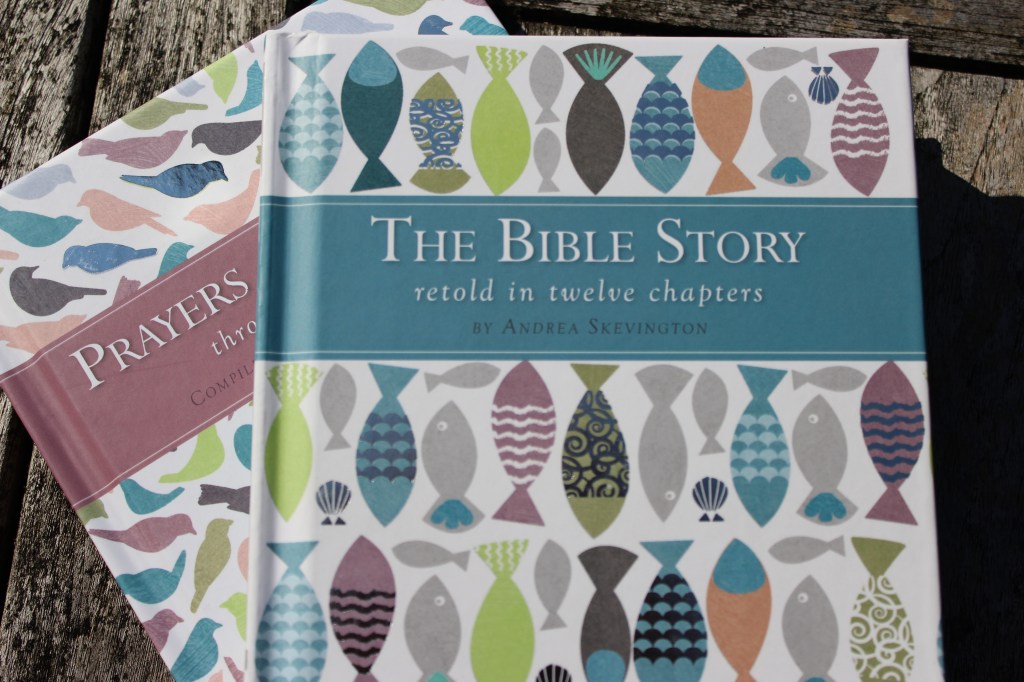
If you’ve been joining me here on the blog for a while – thank you, I appreciate your company – you’ll be aware that I have a very occasional series with material from a couple of my books which follow the Sunday readings many Christian communities use. In particular, my retelling, The Bible Story retold in twelve chapters. Recently, I’ve been doing this fresh writing, with a poem, too. But here are some pieces you might find helpful. If you’d like to use any of my material, please feel free to do so, giving this blog as a source. If you’d like to publish it in some form, please do get it touch. Thank you.
For John taught them to hope. In his words, they caught a glimpse of something beyond their everyday lives. They understood that John that Baptist was preparing the way for something, or someone, astonishing. “I baptize you with water, as a sign of your rependence: your turning back to God and his ways. But wait. There is one coming after me who is so much greater. I am not even worthy to carry his sandals for him. And when he comes, he will baptize you on the inside with the Holy Spirit and with fire. He will sort out the good from the bad, the wheat from the chaff!”
Then Jesus came down from Galilee in the north, and walked through the crowds toward John. John knew Jesus was the one they had been waiting for: the Messiah. Was Jesus really comng forward for baptism like everyone else? “No!” said John, stepping back. “I need to be baptized by you – and yet you come to me – why?” Jesus replied, “I must do everything that is right, and it is right to be baptized.”
And so John agreed, and they stepped out into the flow of the Jordan. Jesus went down into the cool water, and was baptised.
As he came up the bright sky broke open, and the Spirit of God came down gently and settled on him like a dove. A voice from heaven said, “This is my Son, the one I love, the one who brings me joy. I am very pleased with him.” From the Bible Retold
Come, let us follow Jesus, who loves us. From Prayers and Verses
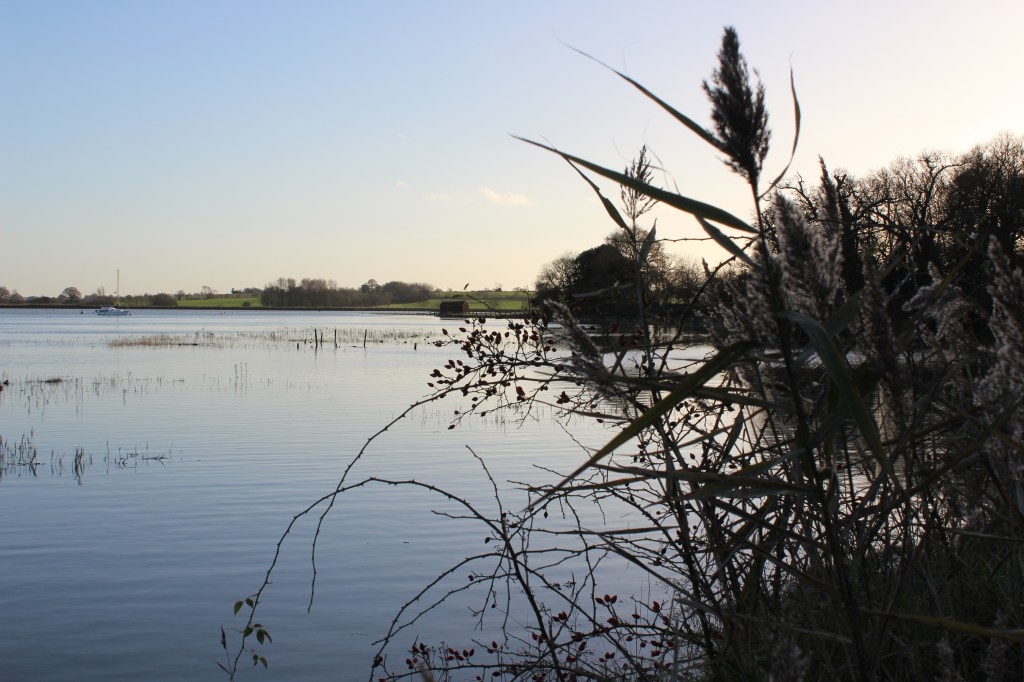
The picture of birds over water (behind my name) is of the Wash at Snettisham RSPB. You can read more about that here.
Hello. This week I’ve been taking a look at the readings many churches follow on Sunday, and found something coming up this week that has sparked my interest, and led to some contemplation. A poem has emerged, as they sometimes do. I’m not sure I can say it’s finished, but it is settled for now, and I’d like to share it with you. Those who have been looking at this blog for a while – thank you – may remember that I’ve a thread running through it called Sunday Retold, which includes extracts from my book, The Bible Story Retold in Twelve Chapters.
This beautiful illustration by Sophy Williams is from another edition of the same text, published as The Lion Classic Bible
Here’s my retelling of Jacob’s dream:
Jacob went alone, travelling until it was dark. Shivering in the chill of the desert night, he took a stone for a pillow, and lay down to sleep. As Jacob slept, a dream came to him. He saw a ladder, with its feet on the ground, stretching up and up to heaven. In his dream, he watched as God’s bright angels travelled up and down in between heaven and earth. And in his dream, God himself was there……
Jacob woke with a jolt and looked around. He was alone. “God was here and I didn’t know it! This place is the gate of heaven!” he said Then he took the stone he had slept upon and set it up as an altar to God. He poured oil on it as an offering, and worshipped there. Starting out once more, he left his homeland far behind.
You can read the original here, Genesis 28: 10-17, it’s the set reading for this week. It’s a story which has spoken to many over the centuries, revealing depths of meaning. For me, this time, I was struck by the way comfort came to one who was a fugitive, who had lost all that was precious to him. It also speaks to me of how our perception can shift, and we can be illuminated with a new understanding, how we can find the simplest things holy.
Jacob’s dream and awakening
Night can fall suddenly on the road, when alone. Darkness sweeps in like a flood, and one who lived with others, a dweller among tents, is out in open country now.
Alone, he chooses a stone and rests on cold rock
And finds that to the fugitive, the lonely, the guilty one, dreams may come. And company, too, of sorts – strange, perhaps luminous – angels ascending and descending
And a presence, such a presence, that is here, and now. One who is above the angels, and right beside him, and speaks with that deep resonance that comes through dreams.
Perhaps those away from the knottiness and rush of their own mind can know that this stone, and so every stone, is the gate of heaven, shining with oil. That this place, and so every place, is where God is
That this dream-night can change the day-heart of one who walks away. For even the stones have a sheen of brightness now, wherever they are.
If you’d like to use any of my material, please feel free to do so, acknowledging this blog as the source. It’s always a great encouragement when people let me know where my writing has been read.
Christ chasing the money changers from the temple Raymond Balze
Hello again. Here’s another post combining a look at the reading many churches will be following on Sunday, and a poem which emerged as I read it and read it again. So it draws on my occasional series Sunday Retold, and my practice of dwelling imaginatively with the story, meditating on it, and seeing what arises.
Jesus went into the Temple courts, and found them choked up with stalls and salesmen, ringing with the shouts of hawkers and hagglers. People were not gathering for worship: they were changing their money into special Temple coins, and buying birds for Temple offerings. Jesus grabbed the traders’ tables and threw them over. The money changers and the dove sellers shouted angrily while the coins clattered and rolled across the stone floor. “You’ve taken ‘the house of prayer’ and turnind it into a ‘den of thieves’!” Jesus said, and all fell silent at his words. Then, the blind and the lame came to him and were healed. And children came, too, running and shounting, “Hosanna to the Son of David!” The Temple was filled with joy, and the priests and teachers of the Law drew back, muttering angrily.
From The Bible Story Retold, based on Matthew 21
One of the things I found while working on this retelling was that there was always so much more I wanted to explore – so much depth and meaning hinted at, or concealed by years and culture and translations. My practice in writing the book was to read widely, and then to meditate on the passages in the style of Lectio Divina – imagine myself into the story, and allow it to unfurl in my mind – a mind with questions, open to prompting I hope. So with this one, there was so much here about Jesus’ rage at the commodification of the things of God, making what was freely given into a commercial venture. We are so used to everything falling into the realm of money it can be hard to imagine how things could be any different, or how the realm of God might offer a radically different Way. Jesus spoke more about money than about prayer, and yet it’s a difficult subject to explore for us. So many of the ills and injustices and exploitation of the natural world we are currently experiencing suggest to me that something has gone wrong with the way we view and use money. Can we begin to dip into the realm of gift, generosity, and finding ways to do what is necessary and right? I hope so.
The Little Free Pantry at St Andrew’s Church, Melton. An example of gift, of sharing. Apologies for the soft focus!
And so, to the poem which came out of my reflections. The meaning of gift and the exchange that arose in my imagination on reading the passage was many layered, and I hope the poem can be read a number of ways depending on what chimes with you the reader. It draws from the Mattew 21 passage, as above, but also the passage early in John’s gospel (John 2).
Poured out and Overturned
Some things cannot be bought and yet, they are. See those neat piles of coins, counted carefully, those inkmarks methodically made, those animals sold for sacrifice, coins given for prayers, for favour, for the words and work of God.
His carpenter’s hands gripped the smooth grained tables and upended them. Poured out the shimmering piles of coins rolling and chiming over the stone floor.
Some things, perhaps, once, all are freely given – life, air, water, growing things for food, breath, beauty, favour, love. So many things we lay out in rows, so many tables, so many neat marks of ink or light.
Bound, we see no alternative, cannot imagine another way, and yet, here is a man throwing coins to the floor, with a whip to drive out money changers while wooden tables lie groaning on their sides.
Set free, then, what happens in this space, this chaos, with all our reckoning upended? The blind and the lame come, and are healed. And the children run and shout Hosanna. And what is, and what will be is all gift. So it is, and may it be so.
John 2:13-22, Matthew 21:12-17
Elisabeth Frink, Chapel of the Transfiguration, St Edmundsbury Cathedral.
I notice that some of you good people are looking up resources for Easter on this blog. Thank you for considering my work. If it helps, here’s a link to a summary…… Please feel free to use my writing in any way that helps, mentioning my name and this blog. And do feel free to let me know, I do love to hear where it gets to!
Edit: Sunday 3rd March.
I’m absolutely delighted to find my poem below at Diana Butler Bass’ The Cottage. She shares an informative piece on this passage which I’ve found has helped me understand what can be a puzzling story. Do read it if you haven’t already. I hope this link will take you there…..
Further edit… I seem to be having difficulty clicking through on this link. She has included one of my Mary of Bethany poems in another recent post if I’ve whetted your appetite and you can’t find Overturned…. try this.
If you search for her name on this blog, you will find other poems and other links.
This New Year, I’m picking up the occasional series, Sunday Retold. Many churches follow a set pattern of readings, so communities up and down the country are gathering around the same stories, the same prayers, and meditating on them together. Often, at least one of the passages appears in my retelling of the Bible, The Bible Story Retold, and so it seems a good idea to share that with you. If you’d like to use any of the material on this blog please do, and please say where you got it from. My books should be available to order at all the usual real life and online places.
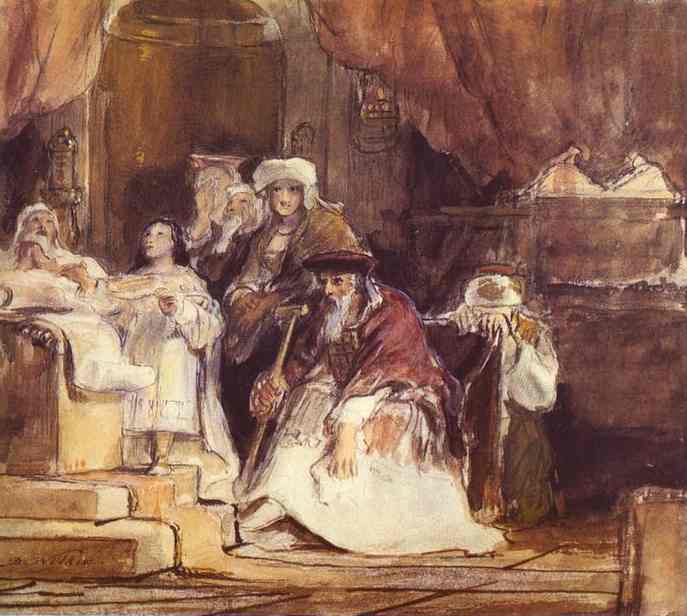
Samuel Dedicated by Hannah at the Temple by Frank W.W. Topham
Anyway, this week is a story often shared with children – at least in part. The central character is the boy Samuel, son of Hannah. He was a much longed for child, who was given to the service of God in the temple at a very young age. Eli, the priest, was given charge of him.
The set reading is 1 Samuel 3:1-10, and here is my retelling:
The boy Samuel learned how to serve God in the shrine. And he slept by the lamp of God’s presence, close to the holy ark of the covenant. One night, in the darkness before dawn a voice called out, “Samuel, Samuel!” So Samuel got up and went to Eli, who was ond, with failing eyes. “Here I am! You called me!” Samuel said. Eli stirred. “I didn’t call you! Go back to sleep!” So he did. But there was the voice again. “Samuel, Samuel!” The boy got up again and went to Eli. “You called, and I came!” “No I didn’t call you. Go back to sleep.” But, when Samuel woke Eli a third time, he wondered what this voice could mean. Perhaps God was speaking. “Go back and lie down. If you are called again, say, ‘Speak, Lord, your servant is listening.'” So Samuel went back to bed and lay there, waiting, hardly daring to breathe. “Samuel, Samuel!” came the voice. Samuel remembered Eli’s words. “Speak, Lord, your servant is listening!” And so God spoke to Samuel. God said that the right to be priests would be taken away from Eli’s family, because his sons had donw wrong, and Eli had not stopped them. They would be punished. In the morning, Samuel had to tell his tacher what God had said. ”God is God, and will do what is best!” Eli sighed.
From The Bible Story Retold in Twelve Chapters
Often, when this passage is shared, the empasis falls on listening to God’s voice, and being ready to respond. We’ll get back to that in due course, but for now I’m following my immediate reaction to this passage today, and how it might help us navigate this difficult new season we’re in.
Samuel in the Temple by David Wilkie
What a message for a child to have to deliver to their high-status, powerful teacher – you and your line have fallen short of the standards expected of you, and your position will be taken away from you. It must have been terrifying for Samuel to have to speak up, even with Eli’s encouragement. I can imagine him shaking in his sandals. Although this story is often a Sunday School favourite, I don’t think many teachers and others in authority would be bold enough to encourage youngsters actively speaking up in condemnation of their elders. And yet, as so often, these stories show God’s leaning towards the powerless, the young, the outsider. So often, the perils of power, and the shortcomings of those who practice it, are central to this counter-cultural narrative. Indeed, as we follow on with Samuel’s story, of how the people of Israel ended up with a king, we see that pattern all the more strongly.
As a story of a child challenging conventional ideas of power, and who has it, the story of the boy Samuel sits well in the season. It’s one of the Epiphany stories in which the rich, the wise, the powerful humbly bow before a mother and child in a simple, working house. It also follows on well from Mary’s radical song in the early stages of her pregnancy, which in turn draws on the words of Hannah, Samuel’s mother, when she leaves her son in Eli’s care. I love the dense connections which imaginatively weave all this together, so rich patterns emerge from the threads. I love the way the lectionary puts things near each other, and then sees what connections and conversation arise like a good host.
And so, back to what struck me today on reading this passage – the wisdom of the child, the going astray of the elders and those in power. I thought of the prophesy “And a little child will lead them” (Isaiah 11.6), and how, today, the young who lives will stretch out far into this century are trying to shake us awake, to speak to us of those things which they care about and will affect their lives and the lives of their children. They see that the way we are living is doing harm, they see the injustice and the destruction more clearly than those of us who may have become immured to it. They see that the structures of power seem to protect the powerful and ride roughshod over those whom the scriptures speak highly of – the widow, the orphan, the outsider, the poor, the young, the old. We need those in power to be humble enough, like Eli, to hear their voices, and to act in their interests. Intergenerational justice is a concept that is coming alive now – especially in terms of debt, and the damage to the ecosystems on which we all depend. We need to pay attention to those who have no voice, and give due respect to the rest of the natural world, as well as to the young. Can we, at the beginning of this year, resolve to notice our natural bias towards the rich and powerful, and seek to listen to the young and the powerless? I think that would be good for us all.
Here in the UK, many have been moved, outraged, saddened and stirred to speak up by the ITV drama, Mr Bates vs The Post Office. It was a powerful drama, compassionately acted. I am always curious, though, about things which really catch the public mood – why this, why now? And I think part of it is the theme of people with power who feel immune and distant from the consequences of their actions, who listen to each other rather than to ordinary people – in this case their employees. I think there is a rising sense of injustice about how some are gathering so much to themselves, while others are stripped of what they have, and what they might come to have in the future too. And this injustice reminds me of the words of the prophets, including the child Samuel.
Of course, this passage carries many meanings, and this critique of power is one amongst many – but it is one that chimes with the biblical narrative as a whole. When we’re thinking of how we might live by it, another question naturally arises – how do we know, in a world of so many voices, which ones to heed? In this passage it is Eli who wonders whether the voice might be God. Yet history is littered with terrible tales of those who were convinced they were acting for God, or doing what was right, and going horribly wrong. Often the very worst things are done by those who claim good motives. And that should give us all pause. I touched on an exploration of this theme in my book, “Jesus said, I Am. Finding life in the everyday” in the chapter on Jesus, the good shepherd, when he talks about the flock knowing his voice.
Of course, knowing the voice, and distinguishing it from the voices of those who would lead us to harm, is no easy thing. I think it helps to come to a place where we don’t see the path ahead of us as a narrow tightrope – one false move and we are lost – but that we look for the relationship, and recognise the freedom to walk behind the shepherd, listening for the voice. ……. History is full of the mistakes people have made, thinking they are doing the right thing but going terribly wrong. I do not ee us going so wrong when we seek to follow the way of love, seeking to keep our eyes fixed on Jesus, and learning from him.
And so, noticing the topsy-turvy nature of the gospel, the way things are not what they seem, let’s be ready to listen, be ready to respond to those promptings and quiet voices which would guide us better than the pomp and power and authority which make so much noise and show.
Dear God, When we hear a mighty wind, strong enough to shatter roci, when the ground underneath us shakes like an earthquake, when fire comes from mountains, help us to know these sounds of power and anger are not your voice. Help us to listen in the silence for your whisper. Help us to wait for your whisper
The practice of wandering – often around the garden – contines to be a a helpful one for me, quieting and contemplative. The practice of standing still and looking, too. Quite a lot of apparent “nothing” seems to be fertile ground, after all. Something catches my attention, as if it is saying: ‘look, here is something, a marvel, a meaning, a glimpse of beauty’. I am coming to think they are happening all the time, and what makes the difference is my openness to seeing, hearing and knowing them.
And so, when the sun broke through after the rain, I went outside, and sat on my coat, and looked. Some distance across the lawn, I saw a bright red light, flashing, and, curious, saw a drop of rain acting as a prism. I watched it for as long as the angle of light made it shine with colour. It called to mind two ancient stories – the burning bush, and the flood – from the Hebrew Scriptures. How the world is full of epiphanies. And again, I was in awe of the way the natural world – of earth and fire, water and air – invites us to listen, to pay attention, to wonder.
A solitary shining drop
Just now, I saw the sun catching a raindrop as it rolled so slowly down a sedum stem, fleshy and green.
It shone through red, rich, neon and ruby, flashing as the stem swayed in the breeze, taking the drop through that one ray of light, back and forth.
Then it suddenly changed to the dazzling blue of cobalt and lapis lazuli – oh, heavenly blue. Heavenly blue.
Just now, for a moment, this treasure made of light and rain, this solitary shining drop becomes a tiny shard of promise, a slim fragment of the arc that holds the sun and the rain.
It all speaks. All speaks. In the mind’s quiet, and in a flash of brilliance that turns your head. A gentle whisper and a burning bush, both. A drop and a rainbow. The world shines with meaning, murmuring, as the green earth is drenched by sun and rain.
A couple of years ago, during lockdown, I felt drawn to explore the stories of Moses and the Exodus.
One of these was inspired by Moses and the burning bush, where he takes off his shoes because the ground is holy. This poem now finds itself at Diana Butler Bass’ The Cottage, as part of her marking of the season of creation. It’s so good to be part of this beautiful musing on an important season, to be marking a shift in awareness as we begin to pause and reconsider our relationship with the rest of life on this dear blue-green planet.
I hope the link below will take you to her rich and thoughtful exploration of this theme.
Over the past few years, I’ve gathered and shared with you links to various readings here on the blog that tell the Easter story. Whether you are joining together with many others, or perhaps staying within a smaller household group, or a gathering of friends, I hope you will find here something that supports you, whatever you are doing..
I notice that two posts are proving particularly helpful at the moment. I’ll share links to these at the beginning, and then go through everything in a Holy Week sequence.
Do please feel free to use any of these resources, acknowledging me and this blog. It’s always good to hear about that, though, so do let me know if you can!
These are the most popular links here on the blog at the moment:
Here you will find the readings, and some things to ponder, as well as one of my Mary at your feet poem. If you would like to focus on the poetry, you could go here:
Other Holy Week stories – You can find these in Chapter 11 of my retelling – both editions: The Bible Story Retold, and The Lion Classic Bible, which share the same text. The second of these has lovely illustrations by Sophie Williamson.
Prayers and Verses also has a section in Chapter 11 called The Road to Good Friday, which you might find useful.
Maundy Thursday – The Last Supper, Jesus washes their feet.
Now, we come to the new poems I’ve written for Good Friday – based on the seven sentences Jesus spoke from the cross. I’ve put them together with some readings, music, and art, to give you a Good Friday Meditation.
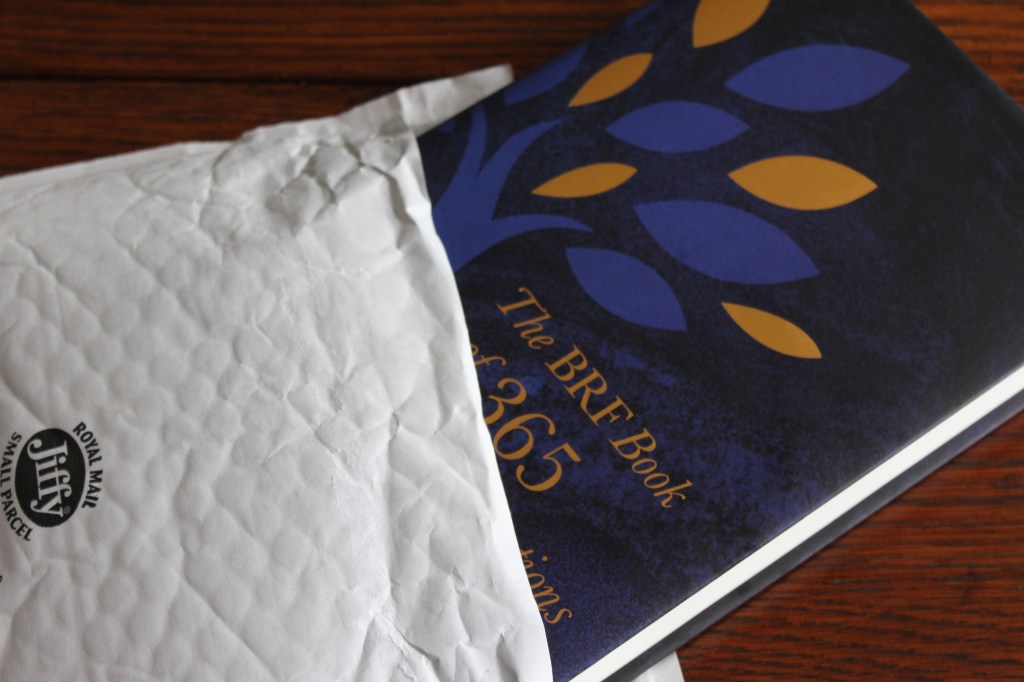
It’s very exciting to receive a parcel for a publisher – and today, this one arrived.
It contains BRF’s book to celebrate 100 years of publishing, and includes a huge depth and breadth of wisdom and insight. They asked a wide range of people to contribute, including me. I’m very honoured to be invited to be part of this important project, it’s so good! I’ve written for them for a while, in Quiet Spaces, and now New Daylight. They also published my most recent book, “Jesus said, I Am – finding life in the everyday”. I find myself in excellent company. Here’s one of the pages that list the contributors, and you can see the depth and breadth BRF have pulled together to make this book. You might find me somewhere in the middle.
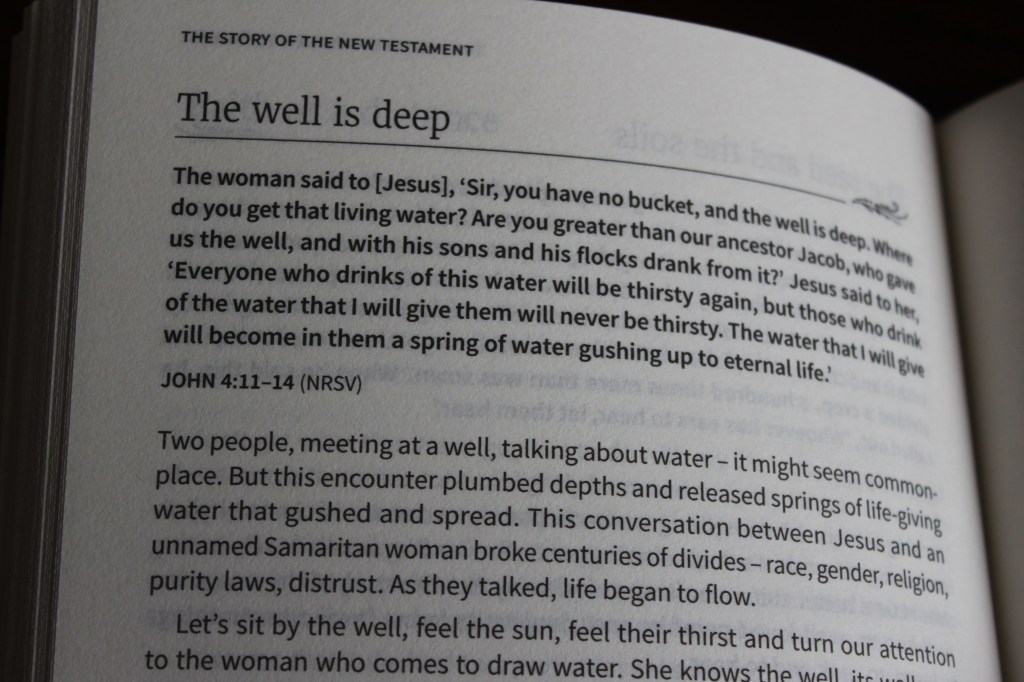
I was asked to write a reflection on a passage from John’s gospel, where Jesus speaks to a woman at a well. It’s a passage I love, and have spoken and written about before. I included a reflection on its themes in my book on the I Am sayings, as some scholars regard it as the first. You can read more about that here. As the title below says, the well is deep, and I find more and more wisdom, compassion and hope in the passage the more I allow myself to sink down into this encounter.
I’ve been having a browse through, and it is a beautiful, thoughtful book. It would make a good gift for someone interested.
You can buy it from the publishers here, or from wherever you like to purchase your books. It can be ordered from any local bookshop.
I feel this is the ending of this sequence of poems, on how the Hebrew people escaped their slavery in Egypt. This poem is a dark sister to the opening one of the sequence, which you can read here. If you have been following this blog, you may see that this last has been a long time coming. It’s been hard, thinking of this last and terrible plague, when the oldest sons of the Egyptians died overnight. I’ll write a post telling the story, with links to the passages, another day.
We normally explore this story from the point of view of the Hebrew slaves, and how they shared the first passover meal, and escaped their slavery. For now, I felt drawn to continue my exploration of these ancient stories from a slightly different place – the place of the Egyptians. As we are beginning to wake up to the ways in which we have exploited the good Earth, and its good people, I have wondered whether we are more like the Egyptians in this story than we would care to admit. I wonder if, as climate disruption and pandemic unfold, we can find some resonance in this story of disasters rolling over the land, one after another.
And of course, this is the worst -the death of the children. It is hard to face up to the possibility that we are leaving a hard future for those who are young now, but that is what we are doing. And we have seen our young people rise up in school strikes, and action to protect their places, seeing that they will pay the price for much of the seemingly endless growth we have attempted. This taking and holding, building and amassing wealth now, seems to rob the future. These thoughts troubled me as I considered the death of the children in this final plague. Of course, there are other meanings, deep and true, but find that I need to consider this one.
There is also a clash of world views – the view of the Egyptians, of empire, wealth, might, and the view of the slaves, who seek freedom, community, worship of God, a different way. In the end, the slaves find their freedom, and the opportunity for living out a different way. As the story of Exodus shows us, there is much hard learning on that road. But, for those who despair of our current difficulties, thinking power and might are bound to win, they may find that power and might carry the seeds of their own destruction, and that hardness of heart will not triumph.
There is no triumph in the Exodus, but there is an exodus. There is an escape from a system that seemed invincible for 430 years. It was not. The world shifted for those slaves at least, and they had the chance of something better. When we, from our place at the beginning of the twenty first century, look back at the systems of thought, and money and power that have dominated for a similar length of time, it’s hard to imagine that they might shift. But I think they are. The shifting is painful, and, as we tend to resist, more painful than it might be. But, perhaps an exodus into a different type of common life is possible. Many of the books of law in the Hebrew scriptures explore what that may be, and they include some radical ideas, for example relating to debt, and land, and these seem radical even now. But that is for another day. For now, we have this hard story, and a costly freedom.
In traditional hedge-laying, the stems are cut and bent to the side, and then they grow vigourously.
The tenth plague – Exodus poems 11
Is this what it takes for your hand to unclasp? Your dearest thing, your dearest one, taken, even as you chill your heart to the warning?
The cold hand of your son now lies still. Do you hold it, and weep over it?
Your way ahead barred, flooded by grief, the future stolen as the young lie lifeless.
Lie still, bound by your hardness of heart, a fearful echo of those slave-babes cast in the Nile – lost into bloodied waters.
Yet now, in this darkness, when each hard drawn breath is a shock, even now, you cannot let go, you chase them still in fear and rage and grief with chariots and swords, as if more death would fill the chasm broken open in your land.
And as the sea of reeds rolls back, rolls back and floods over all your might, your chariots and swords, as those who were slaves turn back and watch from higher ground, all your grandeur runs through your clenched hands like water.
For they stand now, on the other side, out of your grasp at last, with a wild dance, with song and tambourine, in this hard and desperate aftermath of horror, life pulled up from the swirling waters, standing at last in a new and strange freedom.
Last year, I gathered together some links for poems, readings and prayers here on my blog. All of them, on the theme of the road to Easter, are included in this revised post. I’ve also added some links to additional material. You will find sections for different days, with links included. I’ve noticed that quite a few people have been looking at Holy Week and Easter posts, and I’m really grateful for the interest. Thank you for joining me here. I hope you find this update helpful. I’ve also been contacted by some churches in the USA asking if they can use my poems in their online services. I am very happy to share my writing in this way. It really helps me if you acknowledge my authorship, and this blog as the source. It is a real encouragement if you feel able to post a comment about how you have used the material, and also how it went. I do love reading those!
I really didn’t think, when I gathered this stuff together last year, we’d still be keeping these holy days at home, or on zoom, or in very small gatherings, this year. But, as we are, I hope you find what follows useful. At the end, I share a link to a poem I posted for last Easter Sunday, which deals with the themes of being shut away. I wonder if this second strange Easter season may continue to give us some new insight into the isolation and separation recorded in the Gospel accounts.
This season of Holy Week and Easter is filled with realism and hope. It looks darkness, despair, violence and loss full in the face, unflinchingly. And then, it shows something new and good arising. It shows us a strange, unsettling hope for new life. It shows this hope birthed in a tomb. I think our recent collective and solitary experience may help us understand more deeply.
Perhaps we can focus on an inner journey, something quieter, more contemplative. As we do so, we may find, as many have before, that we get to a place of deeper connection, more grounded truth, fuller love. We may find new meaning in Jesus’ teaching and example – how he let things fall away, how he found himself alone, how he loved and forgave even so.
Please feel free to use any of the resources you find helpful, and to share them, saying where they are from.
***
The links will take you to blog posts where you will find extracts from my books, too. The books include:
You may have local bookshops open – if you do, they can order these for you. Otherwise, they are available wherever you usually do your online bookshopping. The links above take you to Bookshop.org, which supports local bookshops in the UK.
The Retold thread of my blog gives you sections from my book, “The Bible Story Retold in Twelve Chapters”, and “Prayers and Verses” that sits alongside it. They are good for all ages, and have been used in all age worship, Messy Church, and care homes alike.
***
******
The House at Bethany, the Raising of Lazarus
Many spend time with this Gospel story in Holy Week. It’s a story that means a great deal to me. You can find some links below.
Here you will find the readings, and some things to ponder, as well as one of my Mary at your feet poem. If you would like to focus on the poetry, you could go here:
Other Holy Week stories – You can find these in Chapter 11 of my retelling – both editions: The Bible Story Retold, and The Lion Classic Bible, which share the same text. The second of these has lovely illustrations by Sophie Williamson.
Prayers and Verses also has a section in Chapter 11 called The Road to Good Friday, which you might find useful.
********
Maundy Thursday – The Last Supper, Jesus washes their feet.
Last year, I wrote a series of poems for Good Friday, which were used in a number of churches near where I live. It was a great honour to be able to do this. I put together a recording and posted it on Youtube, and there’s a link to that below. I also compiled a suggestion for a Good Friday Meditation, with links to music and the poems. It’s all here, I hope it helps!










 Andrea Skevington