Prayers and Verses – 3 The burning bush

prayers and verses cover

UK publication date – Friday 17th June 2016
bible retold cover

It’s nearly here!  the official publication date for Prayers and Verses!
I thought I would share something from Chapter Three of both books – Prayers and Verses and The Bible Retold.
The story of Moses, and how people escaped from slavery, is absolutely central to our understanding of the story of the Bible as a whole. It is truly remarkable.  Written records usually tell the story of the victor, of the rich and powerful.  This ancient narrative tells the story of the slaves, the powerless, the people pushed to the edges.  It says that God is listening to them, and is sending someone to bring them out of slavery, into freedom.

Prayers for those who labour under heavy loads, who bear much sorrow, are included at the opening of the chapter in the prayer book.  The Hebrew scriptures are full of reminders to be compassionate, to remember the hardship, and to let it soften your heart towards others that suffer – strangers in a strange land.  That is why the story is recalled again and again, because it has the capacity to centre us once more on love, on justice, on humility.  It builds our faith that God does listen, and then respond. The faithfulness of God is spoken of again and again. And the turning point of the story is when Moses is stopped in his tracks by the burning bush, and the experience of God he has there.  At a time when he must have felt he had blown all his chances, and had let down his people, this prince of Egypt encountered God when he was simply living out his own life on the edges, as a humble shepherd.  This encounter changed everything, as encounters with God tend to do.

To go alongside this snippet of story, I have chosen an extract from Prayers and Verses which will, I hope, encourage us to open our eyes to the possibility of God being present with us as we go about our daily lives.

Then, one day, as the sheep grazed on the slopes of Mount Sinai, Moses saw something: it was bright flames leaping up from within a bush.  He began walking towards the burning bush, curious, because he saw that although it was crackling with flames, the bush was not being burned up. And then a voice called from within the flames.
“Moses, Moses!”
“Yes?”
“Don’t come any closer.  Take off your shoes, for you are on holy ground!”  Moses obeyed the voice.
“I am the God of your forefathers: the God of Abraham and Isaac and Jacob…”

Moses hid his face, afraid to look on God.

“… and I have heard the cries of my people.  I have seen their suffering, and felt their pain.  I want to pull them out from under their slave masters’ whips and bring them to a good, gentle land: a land of plenty.  You are the man I have chosen to send to Pharaoh.  You will rescue my people form Egypt.”


Grant us a heart wide open to all this beauty; and save our souls from being so blind that we pass unseeing when even the common thornbush is aflame with your glory, O God our creator, who lives and reigns for ever and ever.
WALTER RAUSCHENBUSCH (1861–1918)


Dear Lord, Help us to see you today in all the ordinary things when we walk, and talk, and play; help us to know that the whole earth is full of your glory, and that the ground is holy. Amen
The world is charged with the grandeur of God. It will flame out, like shining from shook foil.
GERARD MANLEY HOPKINS (1844–89)

 

Prayers and Verses – how this book can work together with The Bible Story Retold

prayers and verses cover

Today, I am sharing some more extracts from my new book, which is due for publication next Friday, 17th June (UK), and September 28th (USA and Canada).  The Bible Retold is also available on Kindle.

I thought I would show you how this book of prayers could be used alongside  The Bible Retold – the two books can be read independently, of course, but I hope you will see that they could be quite helpful, powerful even, read together.  I am drawing some examples from the second chapter.  In the retelling, this chapter covers most of the well known stories from the later part of the Bible book of Genesis

img_0225

The story opens with Abram setting out on a journey, called away from all he had known before.  The prayers focus on our new beginnings, on uncertain ways, on “Life’s journey”.

From The Bible Story Retold:

Abraham took one last look behind him at the great city of Ur, with its narrow, crowded streets, and cool buildings made of hard-baked mud.   It was his birthplace, but it would no longer be his home. His father was leaving for the distant land of Canaan, and Abraham was going with him.  So they set off, with Abraham’s wife Sarah, who was childless, and his nephew Lot, who was an orphan. When they had travelled as far as Haran, they stopped and settled: their dreams of reaching Canaan fading with the passing years.

“Get up! It’s time to go!” God said to Abraham.

From Prayers and Verses:

As Abraham set off for an unknown land, so we begin each day, and each journey, knowing you are with us. Bless us on our way, and make us a blessing to those we meet.
Dear God, Help me to find the right way to go, even though the gate to it be narrow, and the path difficult to walk.

As the retelling of Genesis continues, we encounter squabbles and rivalry, deceit and betrayal in the families whose story we are following.  The prayers turn to our own families, how we can live together with love, peacefully.

From The Bible Story Retold:

Esau boiled with anger against his brother. He fumed and stormed among the tents.  “As soon as my father is dead, Jacob will be a dead man, too!” he roared.  Rebecca heard him, and urged Jacob to flee to his uncle Laban’s lands.  Isaac blessed him again before he left, and told him to find a wife among his Laban’s family.

He went alone, travelling until it was dark.  Shivering in the chill of a desert night, he took a stone for a pillow, and lay down to sleep.  As Jacob slept, a dream came to him.  He saw a ladder, with its feet on the ground, stretching up and up to heaven.  In his dream, he watched as God’s bright angels travelled up and down it between heaven and earth.  And in his dream, God himself was there.

From Prayers and Verses

Help us, like Jacob, dream of angels.
Help us, wherever we wake,
know that you are there, too.
Help us to see with new eyes.


I give thanks for the people who are my home: we share a place to shelter; we share our food; we share our times of work and play and rest.
May we provide one another with love, encouragement, respect, and wisdom: through laughter and celebration, through tears and troubled times.
May we be to one another roof and walls, floor and hearth, windows and doors.


Dear God,
Give us the courage
to overcome anger
with love.


I hope these extracts give you a little flavour of how the stories can flow into prayers.
If it helps, please do use them, saying where they are from.

Prayers and Verses – for a new day

prayers and verses cover

UK publication date – Friday 17th June 2016                                     US Publication date – 28th September


IMG_0243

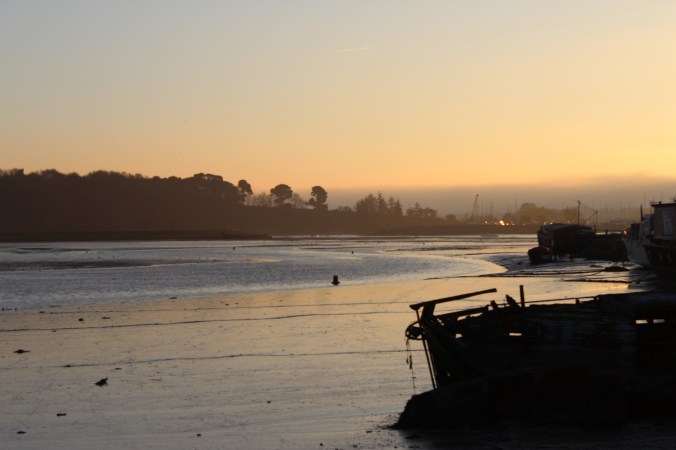
The River Deben in Suffok, one of my favourite walks.

So, it’s nearly time for this collection of prayers to be delivered into the world.  It’s very exciting!

Last summer, I spent much time reading through books  of prayers, and writing my own. It was a very precious time as I was immersed in the prayers of great souls from many centuries, and seeking to find words that would resonate this day, and in the days to come. For any book, especially a book that will be read by the the young, is an exercise in speaking into the future.

This book, Prayers and Verses through the Bible, is a companion to The Bible Retold.  Both  are in twelve chapters, and this collection of prayers picks up the themes which emerged in the retellings.  The first chapter of Prayers and Verses, called Beginnings, invites us to pray for the world around us,and express our love and care for it. As I was writing The Bible Story Retold, I felt the theme of the land as a blessing, as our source of daily food, as both a gift to be treasured and a provision for the future, emerging in a fresh way. For me, God’s love for and delight in all that was made shines through, and later on, the prophets speak of the love and delight of creation, too.  These first Chapter One prayers seek to open up these thoughts, and help us speak them. Another important part of this first chapter is morning prayers – for our own new days, new beginnings.

My hope is that the book will be accessible to the young, but also a blessing to those of any age who are looking for words to make their own.

Here are a few prayers and verses from the first chapter to bless your day.

God, source of all light and life,
help us to see your hand at work
in the beauty of creation.
Help us to know that, in you,
the whole earth is holy ground.
O Lord,
Your greatness
is seen
in all
the world!
PSALM 8:9


Day by day,
dear Lord, of thee
three things I pray:
to see thee more clearly,
love thee more dearly,
follow thee more nearly,
day by day.
RICHARD, BISHOP OF CHICHESTER  (1197–1253)
In all my thinking and speaking and doing
this day,
Help me be loving,
help me be peaceful,
help me be kind.


The ‘Mary, at your feet’ poems – One


Two years ago, in May, I was thinking about the three times Mary of Bethany was at Jesus’ feet.  One story is recounted in Luke, the other two in John, where they are a part of the extraordinary Lazarus narrative.  I wanted to explore them more, and I did so in what turned into a series of three poems.  I read early versions of these poems at a local Christian festival, Alive, and as the time of year comes around again, I find I am remembering them, and going back to those thoughts.  I share the first one with you today, and the others will come in their own time, over the next week or so, as I continue to turn them over in my mind.

This first one draws on the story in Luke’s gospel where Jesus visits the home of Martha and Mary, and Mary sits at his feet.  I have not referred to Martha directly, except for in the title.  I do feel her lack. I wonder, in particular, what happened next.  Maybe there are some poems to write about her, too.

There is so much to ponder in this story, but what caught my attention was how hard it is for us to be still, to be.  We are so distracted, so pulled by so many things. We can end up  feeling that those things are what define us. That it is what we do, or think, or believe, or  how people view us that makes us who we are. Just being doesn’t seem enough, but our efforts to be more or different or better than we are can be life-sapping.
Acceptance can be hard to accept!

In writing this poem, I hoped to create a place of stillness. The kind of place where contemplative prayer begins.  A place where we can open up a little to love, and light. A place where we know we are welcomed.

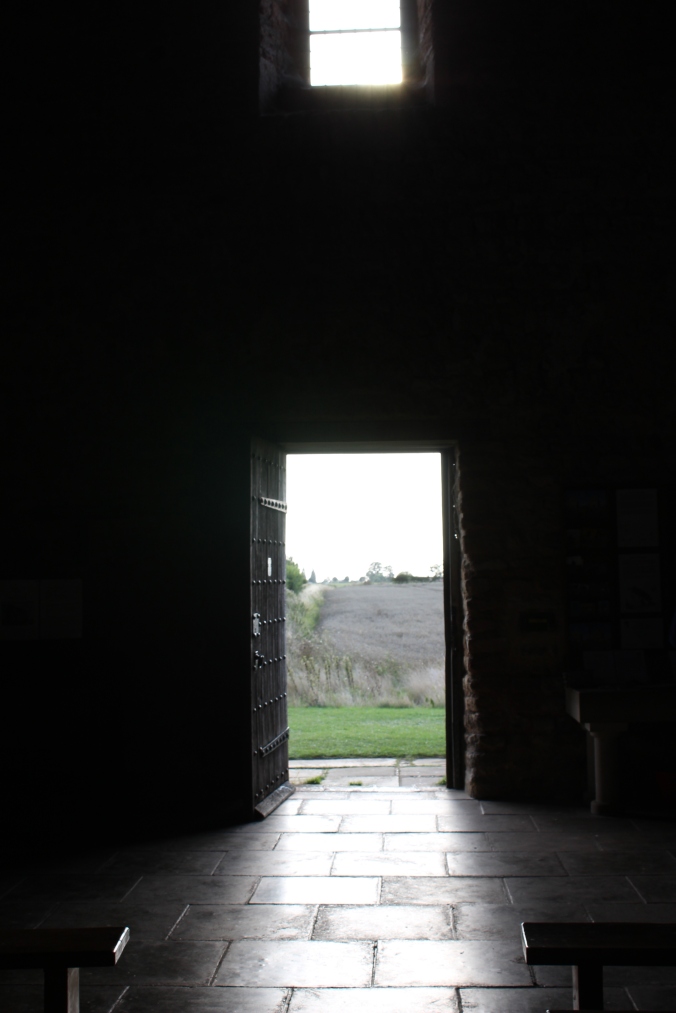
The photograph is taken in the Chapel of St Peter on the Wall, Bradwell on Sea, Essex.

IMG_0366.JPG

Mary, sister of Martha, at your feet for the first time

You came in search of rest
away from the road,
that bright, shadeless road,
where so many came,
and you gave so much.

You came and sat down
in the cool room,
the shutters pulled
against the heat,
and Mary sat, too,
and it was enough.
Just sat, quietly, at your feet,
her face turned up to
yours as she listened.
And you saw how the light
fell across her,
as if for the first time.

And this is what you want,
what you long for.
Not the elaborate
preparations we would make,
not ourselves swept and
scrubbed to perfection,
our acts and our
thoughts impeccable
in lifeless rows,
but to be,  here in this light,
to be, here at your feet,
Luke 10:38-42


You can read the second poem here

and the third one here

Contemplative Prayer – The Cloud of Unknowing

One of the joys of working for Quiet Spaces is that the meditations you write months ago seem to come back when you need them.  So this morning, the latest edition arrived in the post, reminding me of a prayer practice that had slipped away.

IMG_0476.JPG

For this issue, packed with good things, I wrote a series of meditations and explorations of The Cloud of Unknowing. The 14th century text is an extraordinarily rich resource for anyone interested in contemplative prayer. It feels very necessary and timely to me right now, and with the Archbishops’ initiative for a week of prayer before Pentecost, I am finding it helpful  to look again at this way of praying.
The Cloud seeks to remind us that God is above our knowledge, but accessible in love. It asks us to wait, to lose our discomfort with “unknowing”, to be prepared to be in what can feel like a cloud.  We are often afraid of mystery, and sometimes prefer knowing to loving, so this type of prayer calls for humility, and patience with ourselves.  It seems to deepen our ability to connect.

Here is my first suggestion to begin – it may help if you are following the week of prayer.

You may wish to establish a pattern for contemplative prayer.  For example (you could)  turn off technology, find a place, light a candle, do some steadying breathing.  Begin with this verse:

“My soul thirst for God, for the living God.  When can I go and meet with God?”
Psalm 42:2

Calm your mind.  Let go of thoughts. Focus your loving attention on God, who is always present. Stay in the stillness, the silence, for as long as you can.  When your mind wanders, try again.
“Lift up your heart to God with humble love”
The Cloud of Unknowing, Chapter 3

This act of prayer begins with the act of lifting up your heart, and directing your loving attention, to the source of love.

The Cloud of Unknowing is well worth reading. It is broken into small sections, which helps slow down the process and make it less about mastering a technique, or gaining knowledge, and more about entering into presence.
Penguin classics have an excellent version, and you can also access an online version here