I’m sharing another poem from my collection-in-preparation with you, as promised. I started gathering and writing poems last March, and so this Easter poem – and the one to follow – were amongst the first new ones I wrote. So, quite simply, here it is….
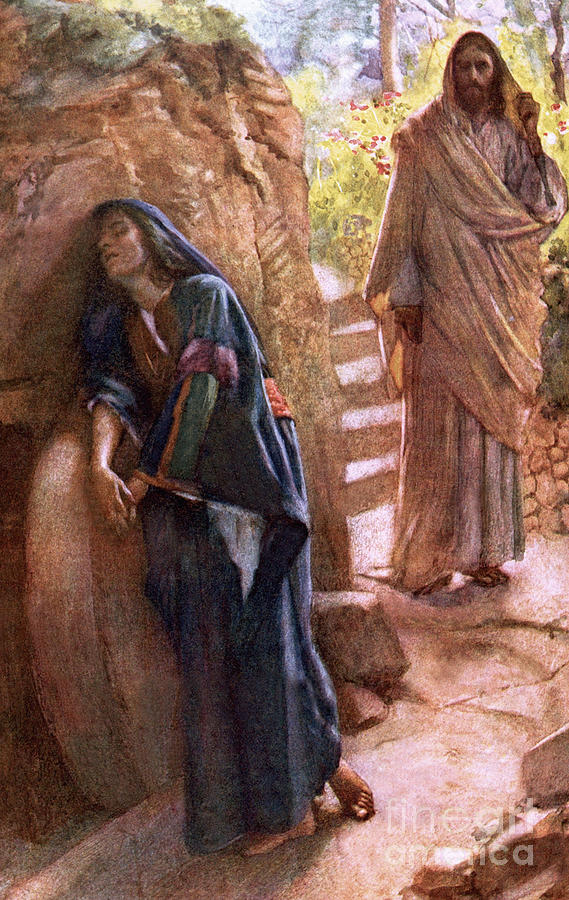
Mary Magdalene at the Sepulchre by Harold Copping
Mary in the garden
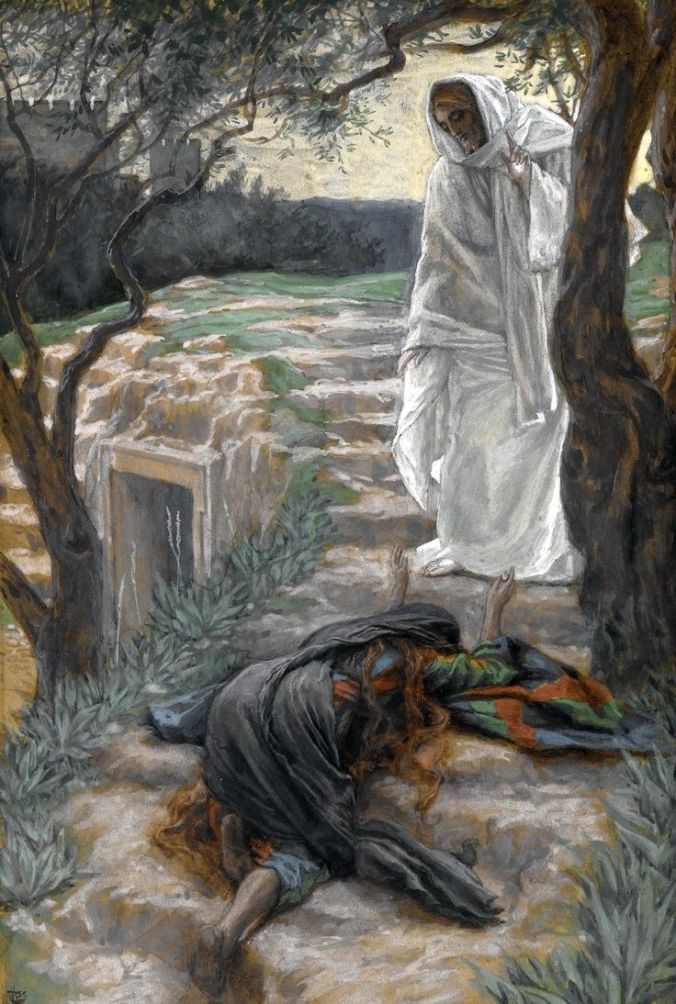
It was in the garden that Mary stood weeping. First light, first flush of green spreading over the warming stones. A quiet place, now.
Alone, shocked, bewildered, she did not see the flowers opening at her feet, or hear the song of the turtledoves.
For she is one who stands by a tomb lost, deserted, heavy-burdened with grief – the weight of a million tears – as if this grief might carry the pain of us all.
And seeing you, she did not see, thought you were like a second Adam, tending the garden in this strange new dawn.
Then, you spoke out a name – her own name. Mary. She knew you then. What must have risen up in that broken heart, touched as she was by your tenderness. Yet as your eyes met, her hand stopped in the warming air between you, singing with birdsong, shining with light.
John 20:11-18, 1 Corinthians 15:21-22
If you would like to read the story, you can find more in the link below….
Christ chasing the money changers from the temple Raymond Balze
The story of Jesus turning over the tables of the moneychangers in the temple is often told today, as we approach Easter. So, I’m sharing with you again my retelling of the story and a poem that I’ve included in my upcoming collection, The Year’s Circle, Iona Publishing.
Jesus went into the Temple courts, and found them choked up with stalls and salesmen, ringing with the shouts of hawkers and hagglers. People were not gathering for worship: they were changing their money into special Temple coins, and buying birds for Temple offerings. Jesus grabbed the traders’ tables and threw them over. The money changers and the dove sellers shouted angrily while the coins clattered and rolled across the stone floor. “You’ve taken ‘the house of prayer’ and turnind it into a ‘den of thieves’!” Jesus said, and all fell silent at his words. Then, the blind and the lame came to him and were healed. And children came, too, running and shounting, “Hosanna to the Son of David!” The Temple was filled with joy, and the priests and teachers of the Law drew back, muttering angrily.
From The Bible Story Retold, based on Matthew 21
One of the things I found while working on this retelling was that there was always so much more I wanted to explore – so much depth and meaning hinted at, or concealed by years and culture and translations. My practice in writing the book was to read widely, and then to meditate on the passages in the style of Lectio Divina – imagine myself into the story, and allow it to unfurl in my mind – a mind with questions, open to prompting I hope. So with this one, there was so much here about Jesus’ rage at the commodification of the things of God, making what was freely given into a commercial venture. We are so used to everything falling into the realm of money it can be hard to imagine how things could be any different, or how the realm of God might offer a radically different Way. Jesus spoke more about money than about prayer, and yet it’s a difficult subject to explore for us. So many of the ills and injustices and exploitation of the natural world we are currently experiencing suggest to me that something has gone wrong with the way we view and use money. Can we begin to dip into the realm of gift, generosity, and finding ways to do what is necessary and right? I hope so.
The Little Free Pantry at St Andrew’s Church, Melton. An example of gift, of sharing. Apologies for the soft focus!
And so, to the poem which came out of my reflections. The meaning of gift and the exchange that arose in my imagination on reading the passage was many layered, and I hope the poem can be read a number of ways depending on what chimes with you the reader. It draws from the Mattew 21 passage, as above, but also the passage early in John’s gospel (John 2).
Poured out and Overturned
Some things cannot be bought and yet, they are. See those neat piles of coins, counted carefully, those inkmarks methodically made, those animals sold for sacrifice, coins given for prayers, for favour, for the words and work of God.
His carpenter’s hands gripped the smooth grained tables and upended them. Poured out the shimmering piles of coins rolling and chiming over the stone floor.
Some things, perhaps, once, all are freely given – life, air, water, growing things for food, breath, beauty, favour, love. So many things we lay out in rows, so many tables, so many neat marks of ink or light.
Bound, we see no alternative, cannot imagine another way, and yet, here is a man throwing coins to the floor, with a whip to drive out money changers while wooden tables lie groaning on their sides.
Set free, then, what happens in this space, this chaos, with all our reckoning upended? The blind and the lame come, and are healed. And the children run and shout Hosanna. And what is, and what will be is all gift. So it is, and may it be so.
John 2:13-22, Matthew 21:12-17
Elisabeth Frink, Chapel of the Transfiguration, St Edmundsbury Cathedral.
I notice that some of you good people are looking up resources for Easter on this blog. Thank you for considering my work. If it helps, here’s a link to a summary…… Please feel free to use my writing in any way that helps, mentioning my name and this blog. And do feel free to let me know, I do love to hear where it gets to!
Edit: Sunday 3rd March.
I’m absolutely delighted to find my poem below at Diana Butler Bass’ The Cottage. She shares an informative piece on this passage which I’ve found has helped me understand what can be a puzzling story. Do read it if you haven’t already. I hope this link will take you there…..
Further edit… I seem to be having difficulty clicking through on this link. She has included one of my Mary of Bethany poems in another recent post if I’ve whetted your appetite and you can’t find Overturned…. try this.
If you search for her name on this blog, you will find other poems and other links.
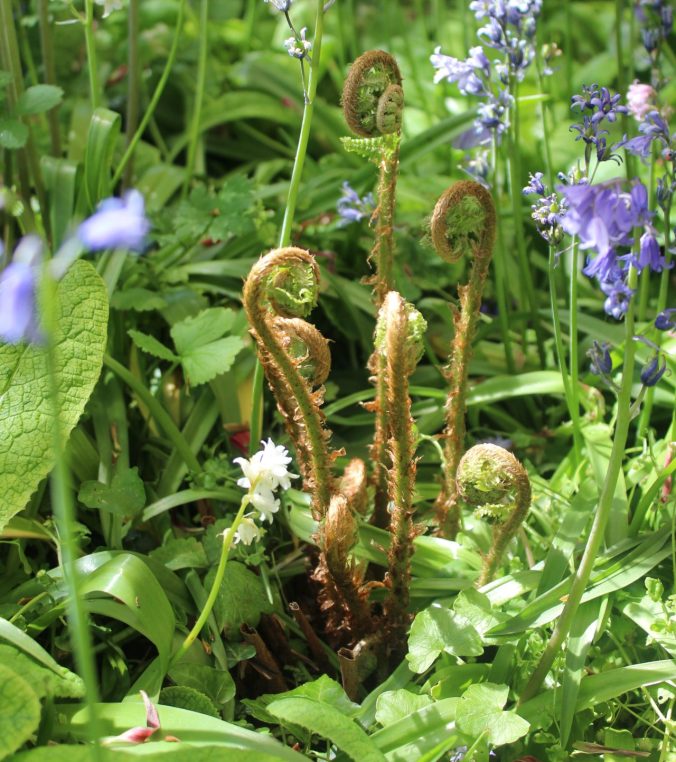
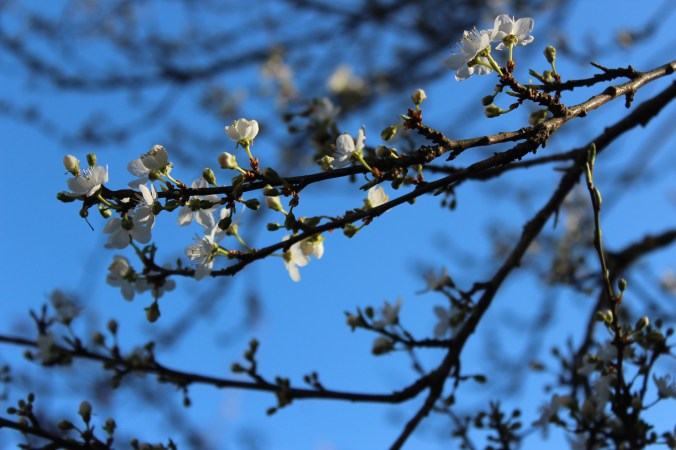
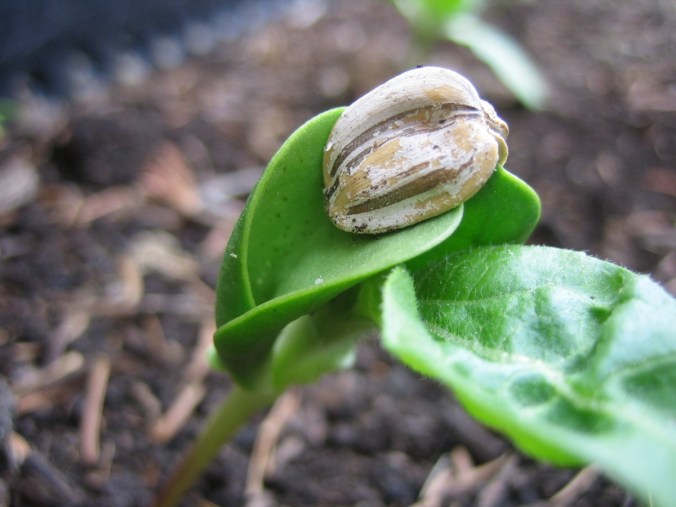
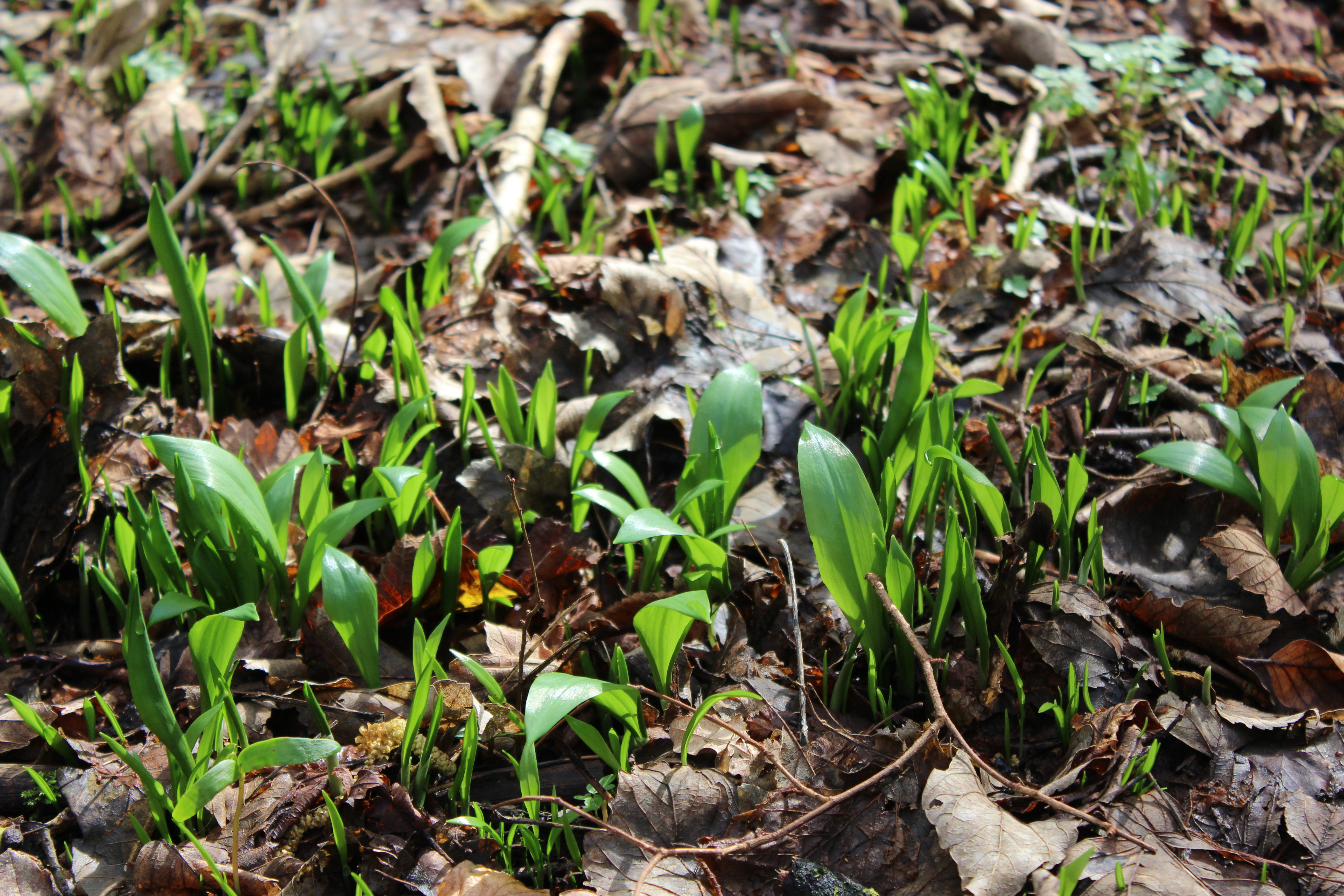
Here is another poem of resurrection – this one exploring the deep, unwitnessed moment of awakening. I’m intrigued by the stirring of seeds, the quiet power of life returning in Spring, and the imagery of spring filled my mind as I thought about Easter resurrection. My forthcoming book – The Year’s Circle, publisher Wild Goose – weaves together poems from the church seasons and the Earth’s seasons. In this piece, I hope, the presence of spring hums through.
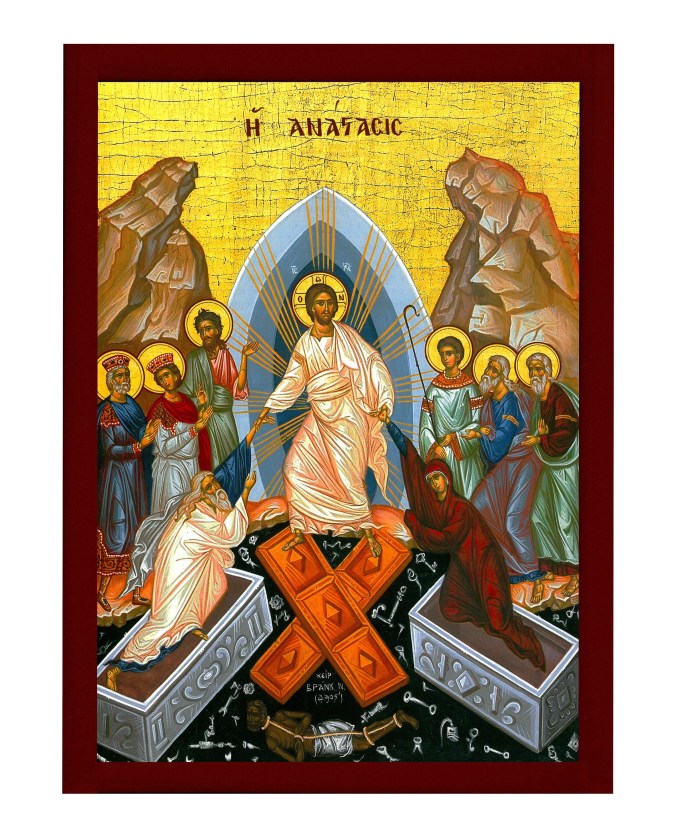
I love the way Eastern Orthodox icons celebrate resurrection not as an event involving one alone, but as something including all those needing to be set free…. and gives us an insight into the pattern of life out of death, hope out of despair, new out of old.
Before first light
Out of the earth, the grave, the tomb, the darkness, life steps out into a shining spring dawn.
Out of the seed, the grain, the stone, the pip, life uncurls in a shimmer of new green.
We do not see the moment of breaking, of rising, it is hidden in the dark womb of the Earth.
But perhaps the ground shakes, a tremor in the deep, as the stone rolls away and death’s imperial seal is broken.
Then, out of a cave humming with clear morning light – no need of grave clothes, no need of husk and shell and stone and seal,
No need of the linen napkin for it is finished, and folded –
Out of the earth who tends her dead, there is a great greening, an awakening, a rising up. Life, and life, and life is stronger even than the grave, and love is stronger than death.
And look, and see, all things are being made new. Now, and now, and now.
Matthew 27:65-7, Mark 16:1-7, Luke 24:1-11, John 20:1-10
If you would like to use this poem, please do so, giving my name and this blog as reference.
I’m sharing another poem from my collection-in-preparation with you, as promised. I started gathering and writing poems last March, and so this Easter poem – and the one to follow – were amongst the first new ones I wrote. So, quite simply, here it is….
Mary Magdalene at the Sepulchre by Harold Copping
Mary in the garden
It was in the garden that Mary stood weeping. First light, first flush of green spreading over the warming stones. A quiet place, now.
Alone, shocked, bewildered, she did not see the flowers opening at her feet, or hear the song of the turtledoves.
For she is one who stands by a tomb lost, deserted, heavy-burdened with grief – the weight of a million tears – as if this grief might carry the pain of us all.
And seeing you, she did not see, thought you were like a second Adam, tending the garden in this strange new dawn.
Then, you spoke out a name – her own name. Mary. She knew you then. What must have risen up in that broken heart, touched as she was by your tenderness. Yet as your eyes met, her hand stopped in the warming air between you, singing with birdsong, shining with light.
John 20:11-18, 1 Corinthians 15:21-22
If you would like to read the story, you can find more in the link below….
So, this Sunday Retold is a little different. The retelling is a poem, which you’ll find below. Some of you may remember that I’m absolutely delighted to be bringing out a book of poems next year, based on the cycle of the seasons – both in nature and in the readings that many churches follow. You can find out a little more about that here. Wild Goose, the publishers, are happy for me to share some pieces in progress with you here as I work on the book.
It seems good to start with Easter, and this week – of the poems I’ve been working on – the one that seems most nearly there is one that happens to tell the story of this week’s gospel reading, John 21:1-19.
It’s such a rich passage, and there is so much that could be and has been said. I think the reason this poem has come most readily is connected to the warmth and tenderness I felt when reading the story. Although we often focus on the extraordinary elements – and they are there, sure enough – I warmed to the ordinary. Once again, Jesus is feeding his friends. He knows they have been working all night, and he anticipates the depth of their hunger, their cold, their disappointment, and their need for this breakfast. It is a feature of these Easter stories, how often eating together is involved, how simple and reassuring the talk.
And here, we see the dance of grace – forgiveness for Peter, yes – but there is also the simple lifegiving grace of sharing food, of receiving, and giving. Of giving, and receiving. It is a revolutionary gift economy in fishing and sharing, in forgiveness and purpose, and its something I’ve missed before…. Perhaps I’ve been too caught up in the strangeness, or the textural intricacies, or the story being about Peter, to see how this new life is also about cooking breakfast for hungry people, and them having enough – strength, fish, new beginnings – to feed others in turn.
I love Wendell Berry’s phrase, “practice resurrection”, and this Easter, I’m wondering what that might mean….
But here is the poem.
Overflowing
Gathered around the fire, dripping with lake-water and morning chill, they warmed themselves in quiet, not asking who it was who cooked them breakfast on charcoal and hot stones.
After such a night, such an empty- netted night of no-going-back to the old life, of cold, of hunger, of ropes against skin, they sat on the shore with the smokesmell of griddled fish and fresh bread filling their senses.
In the dawn shadows – the last stars fading, the first light gleaming – you handed them this feast – loaves and fishes, bread broken – you fed them and warmed them.
This is how it flows, the dance of new life.
We may be fisherfolk with empty nets, but you guide our hands. And we are overflowing. You cook breakfast, and we share a feast.
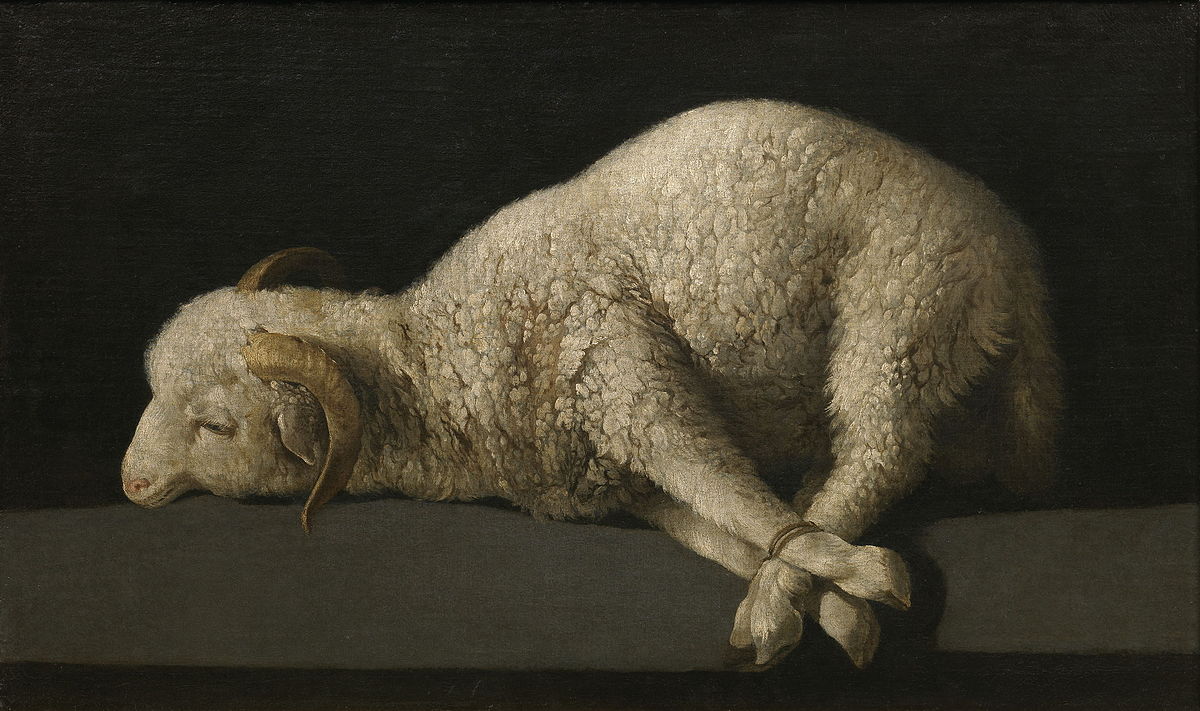
And then, and then, the invitation, the instruction, the grace to Peter and perhaps to all – Feed my lambs, Feed my sheep, my sheep.
We receive, and we give, we give, and receive, for there is enough. There is grace enough to break the nets and yet the nets are whole, and look, still the sea is full of fish
Overflowing Dancing In the new light of dawn.
The Little Free Pantry at St Andrew’s Church, Melton – one of many now springing up.
This story, of the miraculous catch of fish, and Peter’s restoration, is included in my retelling pictured above.
It’s always good to know that our words are part of an online community. So thank you to all who are joining me here, and I do hope the poem helps bless your Easter.
Over the past few years, I’ve gathered and shared with you links to various readings here on the blog that tell the Easter story. Whether you are joining together with many others, or perhaps staying within a smaller household group, or a gathering of friends, I hope you will find here something that supports you, whatever you are doing..
I notice that two posts are proving particularly helpful at the moment. I’ll share links to these at the beginning, and then go through everything in a Holy Week sequence.
Do please feel free to use any of these resources, acknowledging me and this blog. It’s always good to hear about that, though, so do let me know if you can!
These are the most popular links here on the blog at the moment:
Here you will find the readings, and some things to ponder, as well as one of my Mary at your feet poem. If you would like to focus on the poetry, you could go here:
Other Holy Week stories – You can find these in Chapter 11 of my retelling – both editions: The Bible Story Retold, and The Lion Classic Bible, which share the same text. The second of these has lovely illustrations by Sophie Williamson.
Prayers and Verses also has a section in Chapter 11 called The Road to Good Friday, which you might find useful.
Maundy Thursday – The Last Supper, Jesus washes their feet.
Now, we come to the new poems I’ve written for Good Friday – based on the seven sentences Jesus spoke from the cross. I’ve put them together with some readings, music, and art, to give you a Good Friday Meditation.
I thought I’d share with you a reading from my book, The Bible Story Retold, and something from Prayers and Verses, as we continue thinking and praying through Easter this year. As with all the Sunday Retold series, I hope it will be of help for all ages, wherever you find yourself.
The road to Emmaus by Daniel Bonnell
Things often emerge while walking. Conversations can be deeper. These two disciples, possibly husband and wife – Mary, wife of Clopas was at the foot of the cross – were leaving Jerusalem, their world fallen apart, talking over all that had happened.
Maybe, when we are out walking, we can be open to noticing the ways we need to talk through our fears and sadnesses, and then, be open to the possibility of a new perspective, a new vision, a new life. It’s worth noticing how Jesus gave them time and space to tell them their story from their own perspective, and then, how he invited them into a new way of looking.
On the road
Two of Jesus’ followers left Jerusalem that day, walking to the village of Emmaus. While they walked, they began to talk about all that had happened. And as they shared their grief and bewilderment, Jesus joined them and walked with them. But they did not know who he was.
“What are you talking about?” he asked.
They stopped, and stood still on the white, dusty road. “Are you the only one from Jerusalem who doesn’t know what’s been going on?” said Cleopas.
“Tell me!” said Jesus.
“There was a prophet called Jesus of Nazareth, a true man of God. But the chief priests handed him over to be killed, and he was crucified.” Clopas paused. “We had hoped he was the one God had promised from long ago. But then…. today, some of the women went to the tomb and came back saying it was empty, and that Jesus was alive!” For a moment, hope glimmered in Cleopas’s eyes, but then he shook his head.
“But don’t you see?” Jesus said. “Haven’t you read the teachings of the prophets? Don’t you know that these things had to happen?” And so he began to explain. It was as if he were unrolling scroll after scroll along the road before them – all the Law, and all the teachings of the prophets – letting them see that the Messiah had to suffer and die and rise again.
“Stay with us, it’s getting dark!” the pair said as they came to Emmaus. So Jesus stayed at their home. Then, at the table, he took bread, and blessed it, and broke it to share with them. In that breaking and sharing of bread, their eyes were suddenly opened and, with a gasp, they recognized it was Jesus who sat before them. But then he slipped from their sight.
“Did you feel it too, as we walked along? That buning – that deep, rising joy – that sudden understanding?” they asked each other as they grabbed their cloaks. And they set off back to their friends in Jerusalem through the thickening darkness, laughing with joy, and leaving their supper on the table.
When we are sad, help us to speak of our sorrow, and hear words of hope. Help us know you walk with us, as you walked with the two on the Emmaus road. Help us to recognise you in the breaking and sharing of bread, as you warm our hearts with your joy.
Please feel free to share my work, saying where it is from.
I have been writing this lockdown, and am sharing this poem with you first, although it is not the first I have written. I am sharing it while we are still in the season of Easter – a strange, isolated Easter it’s been.
I wonder, though, if it is more like the first Easter than our usual celebrations, in many ways. I wonder how it will seem, when we look back at it.
Easter 2020 Lockdown 9
It wasn’t loud, or triumphant,
that first Easter.
The worship places were not full
of people shouting, together,
Alleluia.
I wonder if it was,
strangely, more like this.
Strange. Shut away
for fear, for love,
behind closed doors,
quiet, while the world
fell apart, while dreams
lay cast aside, a coat
for a long-gone season.
And you came like a gardener,
maybe smelling of soil, with
sap-stains on your un-white,
un-shining clothes. You brought
earth and growth with you
to Mary, who could not touch you,
to others, behind those doors
closed against the world. You
met them in their shut away places.
Maybe you will meet us too,
in our scattered homes, afraid,
untouched, and working in shops,
and bending in fields, that we may
all eat in this wilderness,
maybe exhausted by
the work of healing,
and still holding the hands of those
who are passing into the darkness
of the tomb,
speaking softly in their ear.
Maybe these are the places you
are to be found, this year,
every year.
As we approach Easter, many people take time to focus on the journey Jesus makes towards the cross. Our usual practices at this time are those of meeting together, and remembering together. We can’t do that this year. Instead, as we stay inside, for love of each other, we will have to do things differently.
Perhaps we can focus on an inner journey, something quieter, more contemplative. As we do so, we may find, as many have before, that we get to a place of deeper connection, more grounded truth, fuller love. We may find new meaning in Jesus’ teaching and example, of letting things fall away, of finding himself alone, of allowing.
In case it helps, I’ve gathered together some of the blog posts here that you might find help. I will add to it as more things occur to me, and as I write and update more.
Please feel free to use any of the resources you find helpful, and to share them, saying where they are from.
A little explanation about Easter Retold
The Retold thread of my blog gives you sections from my book, “The Bible Story Retold in Twelve Chapters”, and “Prayers and Verses” that sits alongside it. You can get hold of these through the internet, and maybe your local bookshop if they take orders for delivery. It’s good for all ages, and is used in family services and care homes.
The House at Bethany, the Raising of Lazarus
Many spend time with this Gospel story in Holy Week. It’s a story that means a great deal to me. You can find some links below.
Here you will find the readings, and some things to ponder, as well as one of my Mary at your feet poem. If you would like to focus on the poetry, you could go here:
Other Holy Week stories – You can find these in Chapter 11 of my retelling – both editions: The Bible Story Retold, and The Lion Classic Bible, which share the same text. The second of these has lovely illustrations by Sophie Williamson.
Prayers and Verses also has a section in Chapter 11 called The Road to Good Friday, which you might find useful.
Maundy Thursday – The Last Supper, Jesus washes their feet.
Now, we come to the new poems I’ve written for Good Friday – based on the seven sentences Jesus spoke from the cross. I’ve put them together with some readings, music, and art, to give you a Good Friday Meditation. I’ve recorded the readings and poems, and they should appear on YouTube, on Good Friday, under my name. I’ll post the links here when that happens