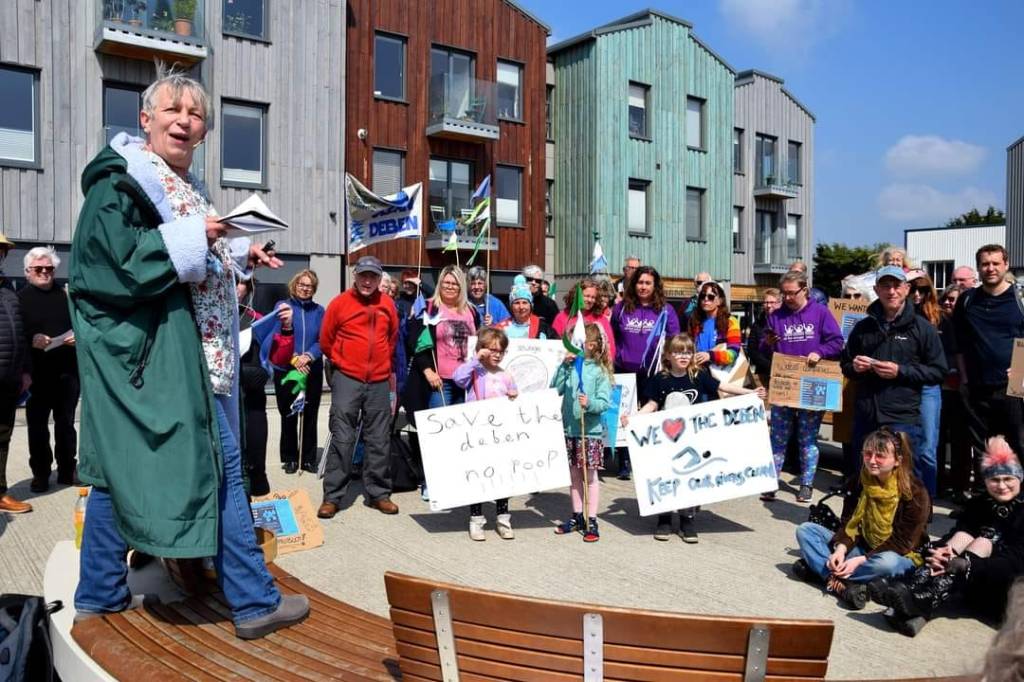
Our beautiful river, the Deben in Suffolk, is in trouble. Testing of the water has revealed that untreated sewage is being dumped. The estuary is a Site of Special Scientific Interest, rich in wildlife, and yet still this is happening. The river is the economic lifeblood of the community, with sailors and walkers, canoeists and birdwatchers all making a vital contribution to the towns and villages by its banks. Wild swimming has also become increasingly popular since the pandemic. We solved these problems long ago – having dirty, unhealthy rivers – and yet, here we are. Economics seems to be a good servant of humanity, and an exceptionally bad master. That can change. The water company – here as elsewhere – can be held to account. Reform of practice is more than possible. You can read more about the situation and our local response here.
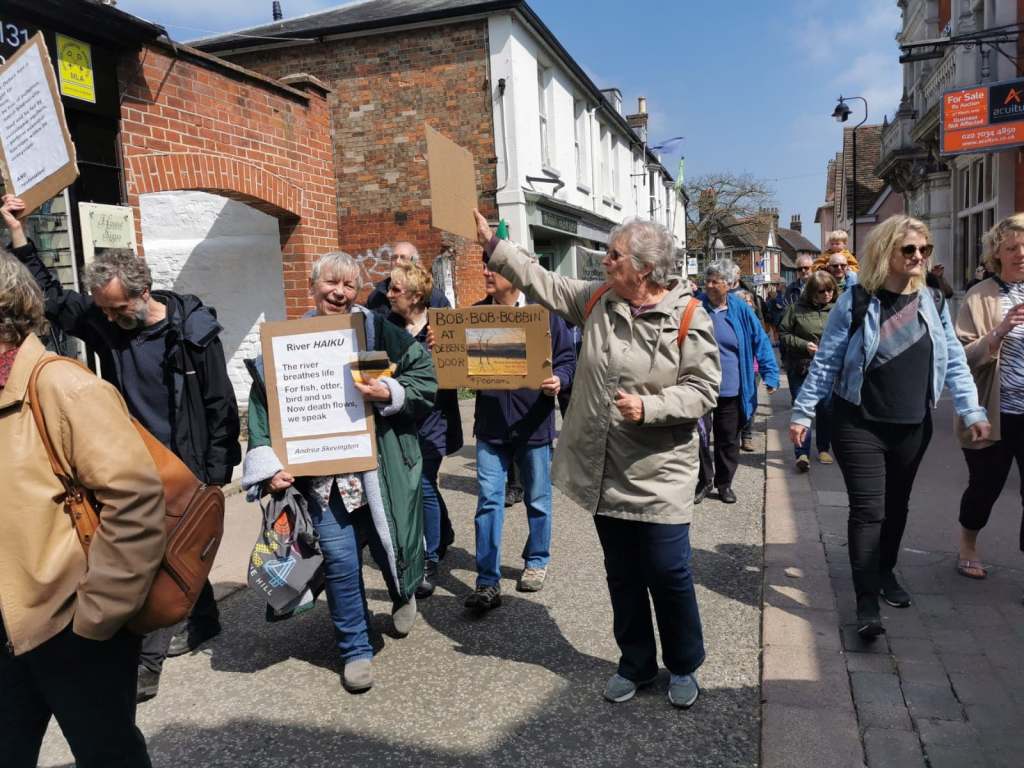
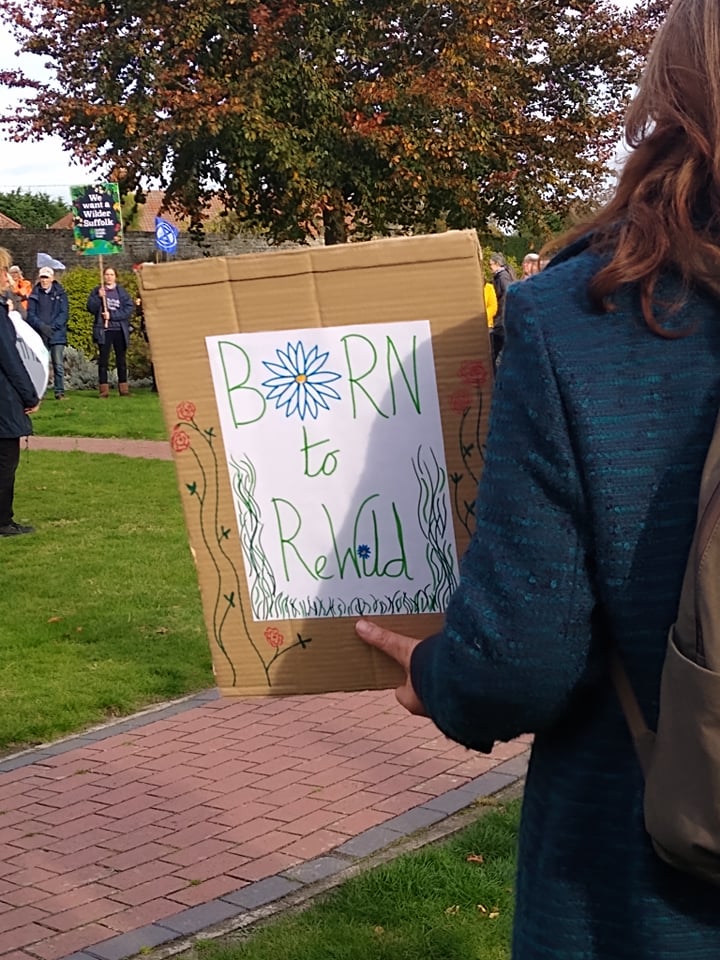
There was a rally and march on Saturday 23rd April, the National Day of Action for Water Quality.
I was very sorry not to be able to go, stuck in the garden with covid – although I couldn’t have a nicer spot to be stuck in. Counsillor Caroline Page (Lib Dems) asked if I felt up to writing a haiku that she could share on my behalf. I’m delighted to be asked and have had a go through the brain fog.
A poet herself, she read it out at the beginning of the rally.
Photo by Charmian Berry
It then joined the march…
Photo by Ruth LeachPhoto by Ruth Leach
You can see more pictures, and video clips, on twitter here
I’m very proud to be part of this fantastic community, who love their place, and seek to protect it.
Photo by Ruth Leach
River Haiku – April 2022
The river breathes life for fish, otter, bird and us: Now death flows, we speak.
It’s such a wondrous river. Let’s treasure our places, and care for them.
Updated 24th April 2022 to include coverage of the Day of Action.
I was so delighted to be asked to be involved in this local event. Our town council has a thoughtful and dedicated Climate Emergency Committee, who invited a range of speakers and exhibitors who could talk about what they are doing, and what we could do, to work more harmoniously with nature to tackle the double and linked emergencies of biodiversity loss and climate change.
If you’ve been reading this blog, you may recall that last autumn I gathered a community poem, November Leaves, and read it out at a council meeting. You can find out more about that here and here. It was following on from reading that poem at a council meeting that I was invited to begin each of the two days with a poem. As I looked through the programme, and wondered what to share, I was struck by the breadth and depth of the experience covered by the speakers.
I’d just like to briefly share with you the poems I read.
Waldringfield Saltmarshes – Seal
This thin strip of solid ground turns away from the shore, snaking through saltmash – sea lavender, sea purslane, samphire glowing in the fading light, the saltsmell of algae – until we are far from ploughed earth, far out on this wide, flat, dizzying land-water-scape.
Pools of infinite grey mud, the hiss of water receding, we walk just as the tide turns to ebb, this winding path our thin line of safety, draped with a strand- crust of drying weed, studded with hundreds of tiny white crab-shells, oysters, mussels. How fragile I feel myself to be. How quick to be lost.
After many turns further, and further out, we come to the place the path stops. On the other bank, we can see the woods where great white egrets nest. At my feet, the red of a spent cartridge hurts my eyes as I hear oystercatchers, and sweet skylarks, and water, and wind scuffing the water.
There, at the end, the limit of where we could go, we saw, in the water, the seal – a low flat head, intelligent eyes, sleek and fat, as grey and rounded as the mudbanks – swimming. We crouched, concealing our profiles from the luminous sky, we held our breath, and watched its dive, and breath, dive, and breath.
And as it swam upstream, we turned to go back, retracing our steps exactly, watching its joy, its contentment, as we grew closer to solid ground, the smell of ripe barley after rain, and mallows, and sweet chamomile carried on the breeze, welcoming us.
But the taste of the saltmash sustained us, sustains us, the peace of the seal stayed with us, stays with us. And the cry of the curlew remains.
One hundred and ten years
Despite this cold there is a shimmer of life in the air above the beds, where bluebells begin their opening.
Tiny flies, and larger, and bees, and the occasional, beautiful, butterfly – look, just there.
I watch them in awe, all these tiny specks of life. Each small thing part of The garden’s constant dance, each being knowing their own irreplaceable steps.
I wonder what it was like, over a hundred years ago now, before the house was built, when all this was orchard. Did butterflies rise in dense bright clouds as you walked through the long grass? Could you lie down softly and hear the loud hum of bees in the speckled blossom above?
Perhaps, like Tom’s Midnight Garden, that rich place is still here, in the shadows. And perhaps, I hope, it is becoming less ghostly, more embodied, more visible, humming in this shimmer of life in the air. Growing stronger after so many years, as if seen with eyes as clear and sure as a dreaming child’s.
As the emphasis of the weekend was on action, and in particular localism, I came away feeling greatly encouraged to keep doing the apparently small things I am doing. To shop locally and seasonally, to allow the garden to grow with the aim of increasing its abundance of life, to buy less and what I buy to be as thoughtful as I can, to connect to others who are seeking to support nature and create networks where life can flourish.
The news about the climate emergency is pretty dire, but I’m trying to look at what I can do, and what we can do, and seeking to add my voice to those who are calling for change.
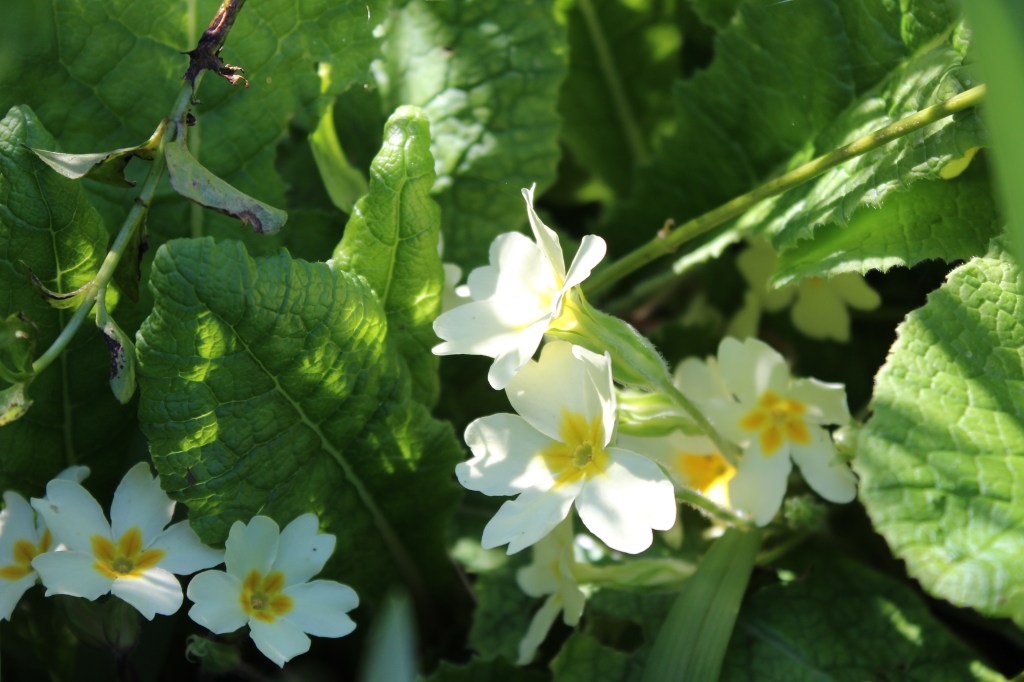
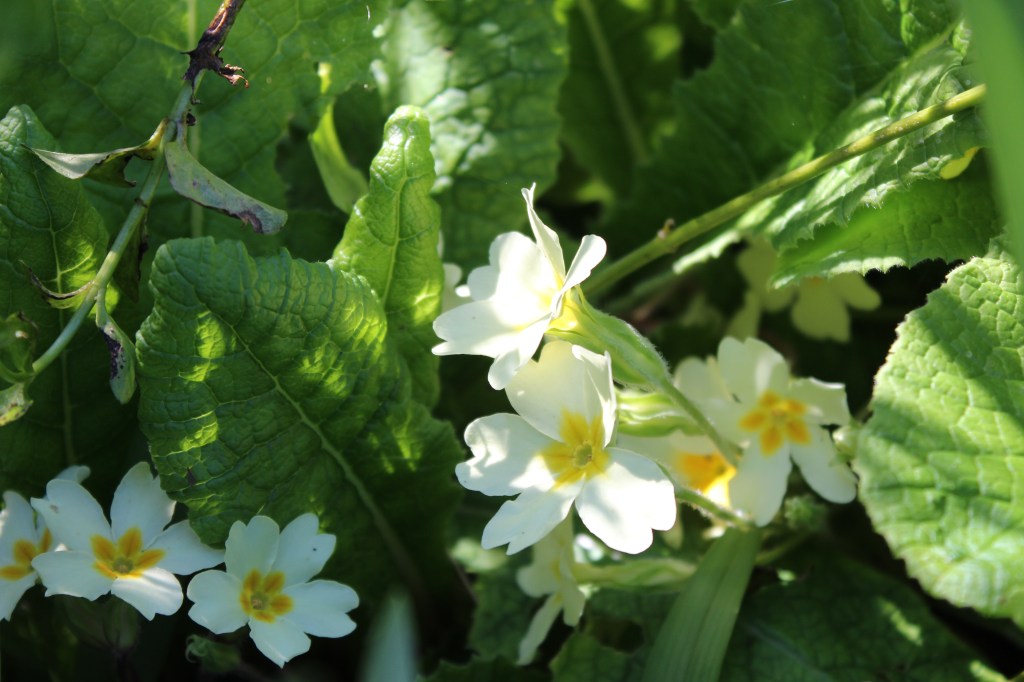
Out in the cold, damp garden, I have been holding my nerve and not cutting things back. Just this week, I’ve snipped a few old stems above the primroses getting ready to flower – and indeed flowering already. I am seeing how long I can sit on my hands and wait as things flop under frost and rain, thinking of the life held in piles of leaves, and the hollow stems of perennials.
Where I have cut back, I have left things in piles near where they grew, giving time for the things that live there to move before I compost them.
As I have left this old growth, and quietened the voice in my head reproving me for untidiness, I’ve noticed real beauty in these seedheads, and fading leaves and flowers, and an increase in the hum of aliveness I’m noticing in the garden.
Even moving a few leaves to clear space for primroses has revealed fat caterpillars, and many tiny creatures unknown to me. There is beauty here, too. All this decay from last year is full of life, full of what will be needed by the bluetits investigating the nest box, the blackbirds turning over leaves.
Winter seedheads
I’ve left it wild – left seedheads and leaves – and the leaves lie piled up in heaps in borders, against fences, swept from paths.
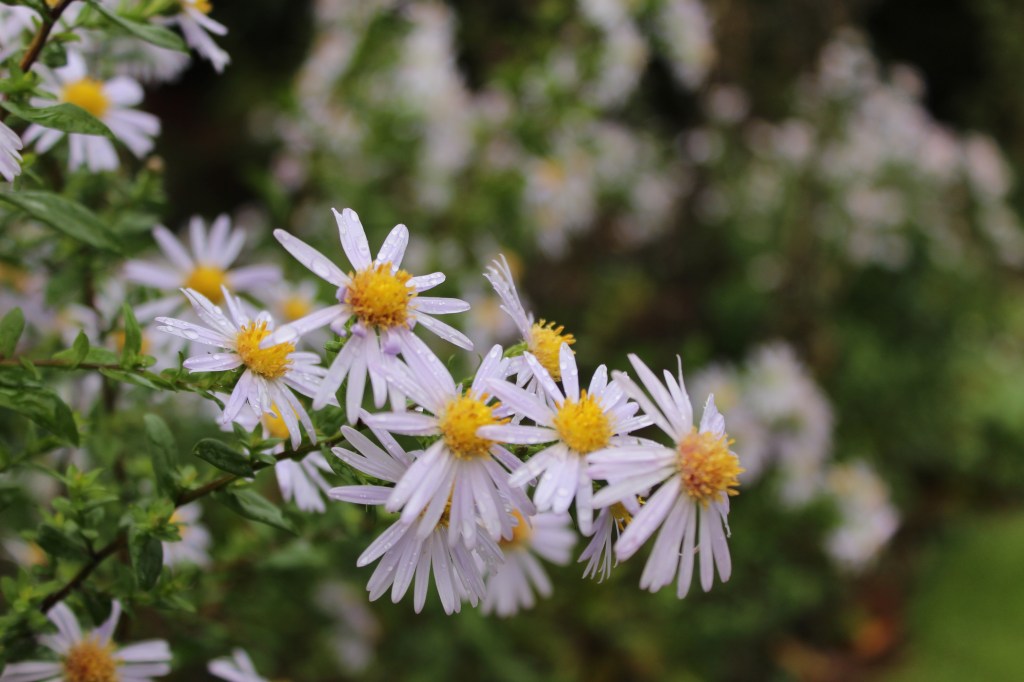
And I find I love the colours of the fading aster leaves, colours I have not seen before, new to my eyes, uncut as they are. And the pale seedheads – like stars – of the alliums, and the dark eyes of rudbeckia, how they sway together as the wind whips round, mingling, full, and darkly shimmering.
I watch the birds as they eat red berries – dark holly, the vivid bright cotoneaster, as the squirrels lope inquiringly over the lawn, looking for what they buried.
There is so much life in the few brief hours of daylight, while the night lingers in the sharp musk of fox, the delicate deer paths deepening in the soft earth. And I feel how precious this space is,
How, now it is cold, the garden is sanctuary to many more than me. And I love to be host to such guests. There is much joy in noticing their need, and in opening my hand to offer what they lack, quietly, invisibly.
Even now, in the darkest days life stirs, life comes through the slick dripping trees, through frost and fog, and finds shelter here, and makes a home.
Saturday 6th November was the mid point of COP 26, and a Day of Action where we could add their voices to the thousands gathered in Glasgow. Here in Woodbridge, a few organisations had got together to plan a march, and it soon became apparent that many were interested in joining them. So, Woodbridge Churches Together, Transition Woodbridge and the local Womens Institute did an excellent job – all working together to organise and hold a peaceful, purposeful, inspiring community action.
Photo by Charmian Berry
There were about 300 of us, which is quite a turn out for a small town. The atmosphere was energising and determined and also celebratory. There was music and speeches to inspire, and to remind us of some of the things that are already going on in the town, and the much more that could be done. We looked forward for ways to proceed, to work locally for a better and fairer place for all, as well as how to continue to let our voices be heard.
As is becoming a tradition in our town, people could leave their banners to be tied to the railings of the Shire Hall, reminding the Town Council of the strength of feeling.
Photo by Councillor Caroline Page
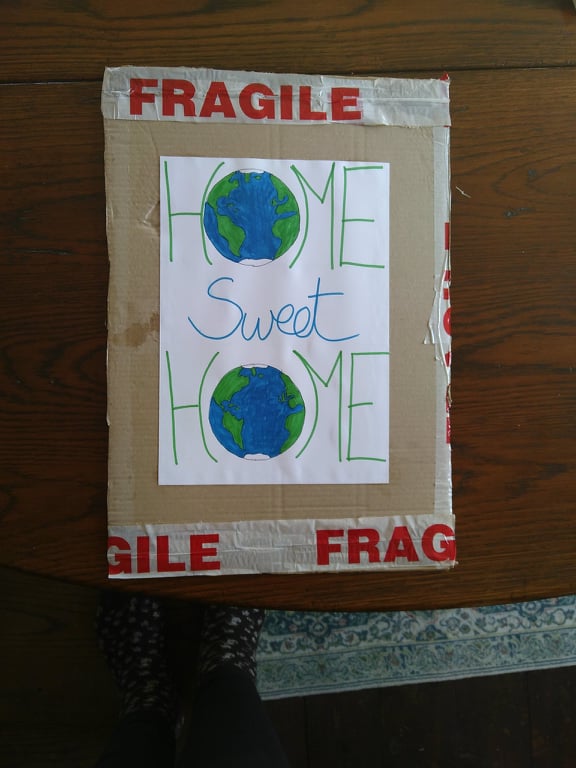
My home-made placard was double sided. Here’s the front… you might be able to see it hanging up.
One of the very positive things about a march in your local commuity is that many of us knew each other. Already, I’ve been having conversations with old friends and acquaintances who were there, and beginning to nudge forward to what we might want to do together to help green our local place even more.
All this was in the afternoon. In the morning, I, and a few friends, were in the Thoroughfare, our main shopping street, having a small happening. Some of you who have followed this blog for a while may remember that last year I had an idea of giving out bulbs and bookmarks, inviting people to Plant Hope. You can read about it following the link. It’s so good that this year, the time seemed right to do it. Having the support of a few friends made all the difference. It was so good having the chance to talk to people about hope in difficult times, about the power of plants and nature to help us in our crisis. A very moving morning.
Photo by Jacquie Tricker
As you can see, by the time we got round to taking a photo, nearly all the bulbs and bookmarks had gone!
There was another aspect to our happening though. If you look at the tree, you’ll see some cardboard leaves. We invited passers by to write down their hopes, dreams and fears for the environment and hang them on the tree. We’ve gathered them up, and are in the process of turning them into a poem to send to our politicians, both local and national, and to others. It’s very moving to see what people young and old have written. It’ll be called November Leaves, and I’ll be sharing more with you on that in due course.
It was a wonderful, hopeful, sad day, a day of coming together in community, which is a thing I’ve missed very much.
It also felt like the beginning of closer engagement for many, with many organisation coming together for the common good.
Last year, I just made this one bookmark. This year, I could have given away twice as many as I made. How things grow.
My friend Jacquie has published an excellent article about eco anxiety and anger, and the power of finding your tribe – people you can work with to take some action. It talks about this march and action, which we did together. You can find it by following the link here.
As we are beginning to venture out a little more, we thought we would pay a visit to Ely, and the vast indoor space of its ancient cathedral. They often have contemporary art there, which helps the old stones continue to sing, giving a new perspective on ancient truths. We knew that Gaia, an installation by Luke Jerram, was going to be there in July, and so we went and saw this beautiful, astonishing sight. The comparative emptiness of the cathedral space made it all the more powerful as it floated above us.
And as the space is vast, and it takes time to walk up to, around and beyond the piece, you do have time and space in which to allow the work to speak to you, to stir up responses, and to pray. I am sure that one of the intentions is to give us all an opportunity to experience something like “earthrise”, when the astronauts first saw the whole of the Earth from space, and how that shifted their perspective, and began to change the way all of us are able to see our home. The staggering, indescribable beauty of the whole called out my sense of awe, which sat uncomfortably alongside my awareness of the damage we are doing to our precious, unique home.
In the setting of the cathedral, as Gaia hangs in the nave under the painted ceiling which tells the long stretch of the Bible’s story, I found the language of repentance surprisingly, and helpfully, came to mind. Repentance both in our more familiar understanding of sorrow for wrongdoing, and desire to amend, and in the possibly more ancient meanings carried in the old texts, of returning home, and of undergoing a profound change of mind – a paradigm shift in the way you see.
Much of my writing celebrates the beauty of the natural world, how lovely, precious, and vulnerable it is. But sometimes, that love spills over into grief. So the old stones, and the old story, seemed illuminated by our current crisis, and, in turn, those ancient words seemed to express something necessary, and powerful, and, in the end, with the potential for hope.
You can listen to the poem here.
Gaia at Ely Cathedral
She seems to float, lit up with her own light, slowly turning, blue and blooming with clouds as we walk up, look up, small before her.
While above our steps, the familiar painted roof rolls on, telling its painted story, from the tree, and the garden, on towards this
fathomless shining beauty, the ‘all’ that was so very good in that beginning. Now as she turns we see how she hangs below the story’s last scenes – the gift of a beloved child held on his mother’s lap, held forward towards us, loved and given and giving, and the wounded golden king, who gives still.
And below, below hangs the whole shining Earth, dazzling, vast with sea, turning and flowering with clouds from the southern ice-shine, melting although we do not see her weep,
And the land, those small green swathes and swags, are dressed in white too, a veil of vapour, while the deserts spread brown and red above our eyes.
The lands are small, countries seem tales we tell. What is certain is this one great flow – ocean and ice and cloud – and the unseen winds that bear them through our blue, breathing air.
And the people stand beneath her, lit by ice, and hold up their hands as if to carry her, or hold her, or save her from falling.
How beautiful it is. How strange and wondrous that we should be creatures who live within so much living perfection.
And as she turns slowly under the child and the king, I wonder, what do those familiar words mean now, ‘the sins of the world’, as the stain of our reckless harm seeps through the blue and green, through all this living glory,
And is there any hope in our waking up to beauty with grief and loss, even as dust and ashes float across the sky, across us all, late as we are in our repenting?
And is there hope, hope that we might be granted this grace – time for amendment of life, to tend the garden with its leaves and fruit, shining and greening, to take part in the work of loving and healing, of restoration, of making all things new.
Looking at Gaia from behind the communion table brought to mind the words of repentance from that service, and I was aware of my sense of what “the sins of the world” might mean was creaking open a little wider.
Things change, yet leave their mark. I was thinking about this as I looked at one of our apple trees, grown curved in its search for light. You can see the shape of the trunk most clearly in the shadow it leaves on the fence. It grew like this to adapt to the dense shade of a neighbouring shrub which grew faster than it, and cast it in shadow. That shrub died, it is gone now. Yet even as light returns, the curve remains. Grown like this, the tree has given us apples in autumn, and beauty all year. I thought about how the tree found a way of flourishing despite the shade, and admired its resilience. So, the poem is mainly about the tree, but also, murmuring away underneath, was an awareness of the tree as teacher, making visible something that is often hidden within us.
The tree adapted to its setting, and as the setting changed, the adaptation remains even though there is more light. We all do this, whether it’s growing accustomed to living quietly and distantly during a pandemic, or learning from a young age how to live in difficult emotional or physical circumstances. Even when things are better, lighter, more friendly, we can find ourselves living as if they are not. Patterns of mind can be changed, new growth can happen, but it takes noticing, with compassion, and stretching ourselves a little into the new, more open space.
As lockdown eases, we can go gently with ourselves as we try to asses what is safe, and what has become a habit that is no longer needed – and those assesments are far from easy. We can be gentle with each other, too, as we all navigate our way into more open living. The changes in how we respond may be, in part, due to patterns of being which were laid down long ago. These, too, can be nurtured into more helpful shapes that keep us safe and help us flourish, both. I believe we can become free from patterns that no longer serve us, and grow with full vigour.
All these things I thought about, as I looked at the apple tree. But mainly, I though how beautiful it was, and how much blossom it bore this year.
The apple tree, having grown in shadow
I follow the curve with my eyes, the way the thin trunk arches back, seeking light. On that side, the branches grow thicker, surer.
It bends away from the dense shade that was there, only weeks ago, a dark shrub that outgrew it, then died. Now, the blossomy branches lean back, away, from open light-filled space.
Cast in shadow, it grew thus, leafing and flowering, supple, adapting to shade, and seeking light.
I wonder, what will happen now? Now we have cut down that dense, dry growth? The thin branches on this side will fill out, strengthen, divide, reaching into the place that was once too dark, heavy, in time, with fruit.
But what of the trunk? Will it bear, one hundred years from now, that curve, lessened, perhaps, by years of thickening growth? The adaptation no longer serves it, yet the tree may still bear it, And the tree’s beauty is held in the grace of this curve.
Such shapes of growth and thought persist, gently, strangely, known or unknown. We make allowance for the ghost of a shadow no longer seen.
This new lockdown, I am writing in my notebooks again, letting what emerges, emerge. You can read about the Lockdown Poems here – their immediacy, their rootedness in my place.
Once again, I have begun writing what I see, and what is before me in this moment. Whereas the earlier poems, starting in March, are largely written outside, this one is about looking out. Beginning to write is a revealing thing. As I proceeded, I felt that what I was exploring was that sensation of being stuck inside – looking out, but not with longing. I am looking out at a world that is far from inviting. Cold, wet, and darkening as it is. Once again, that small moment, that everyday feeling of watching the rain, seemed to unfold and reveal a wider and deeper difficulty. Not so much of being stuck inside, but of not wanting to venture out into a world that seems alarming, potentially dangerous, as we face the terrible acceleration of the pandemic’s spread. It is truly terrible, the grief that is echoing around our closed rooms, the potential for harm in each interaction.
But venture out I will – the natural world still offers its hospitality and welcome, however cold and dark it seems. The garden and area around still see me tramping about for exercise and refreshment. I had a new waterproof coat for Christmas, which is making all the difference to how I feel about being outside just now – at least from the point of view of the weather. The pandemic is a different matter. My venturing is limited now, circumscribed and circumspect. I notice an increasing tendency to some anxiety at the thought of “out”. That anxiety is well founded. I am listening to it, and taking what precautions I can. As we all are.
It will not always be so, though. We will emerge. For now, the balance and relationship between inside and outside has shifted, profoundly connected to the natural world as we are. We can feel cut off from the winter, we are certainly cut off from each other. But even now, there are tiny wonders to be seen out there, small hopes and shifts, if we can raise our eyes and look.
Inside. Outside Lockdown III
Inside, looking out, through golden light to cold grey, through glass and warm air and stillness, to where the cold wind shudders the trees.
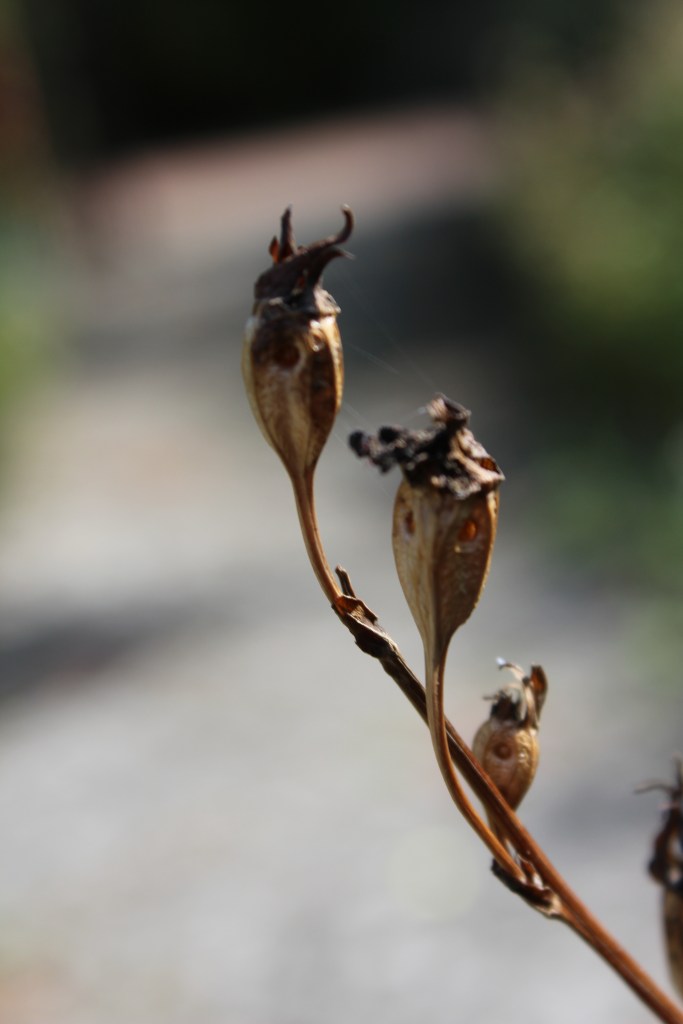
Outside, the curved seedpods of the tree peony drip with ice rain, glittering
While candlelight and lamplight are reflected in the glass, and glow orange in the darkening grey garden.
And a tumble of birds comes, and goes, comes, and goes, chattering endlessly on the feeders that sway in the sharp wind
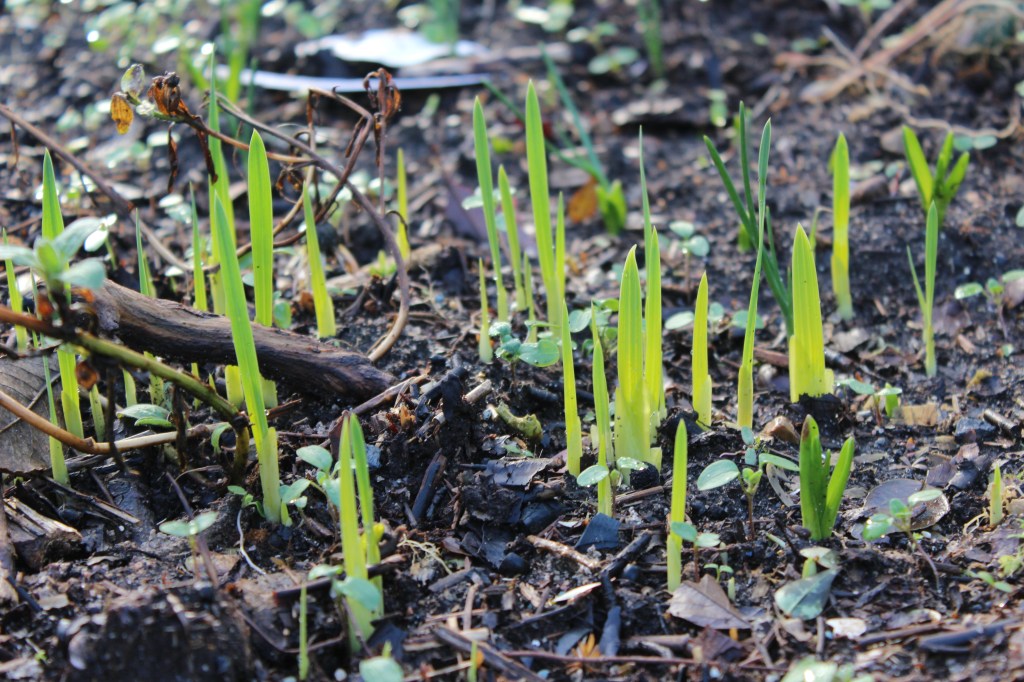
And if I hold my nerve, and hold the gardener’s gaze, even from here I can see that fuzz of green on the ice-furzed soil – Herb Robert, violets, the tissue-paper yellow of wet primroses, and the soft spears of bulbs just beginning. Bluebells. Cerise gladioli.
Outside seems far away. A different air. A different light. But soon my boots will be on my feet, and my coat wrapped about me, and I will feel that frost, and the cold wind, and I will feel the ice rain again.
To keep our spirits up, a reminder of what is to come.
I wrote this when it was darkening fast – by the end I could not see the marks my pencil was making in my notebook. Darkness comes so early now, but that change into night is beautiful, and, if we can take a moment to notice it, has things to teach us too.
So I have no photo of this moment, but am offering you others from autumn, and hope that you will have a chance to look out of the window, or walk through darkening paths, and see the trees as they settle for the winter, and the birds as they settle for the night.
November trees – twilight
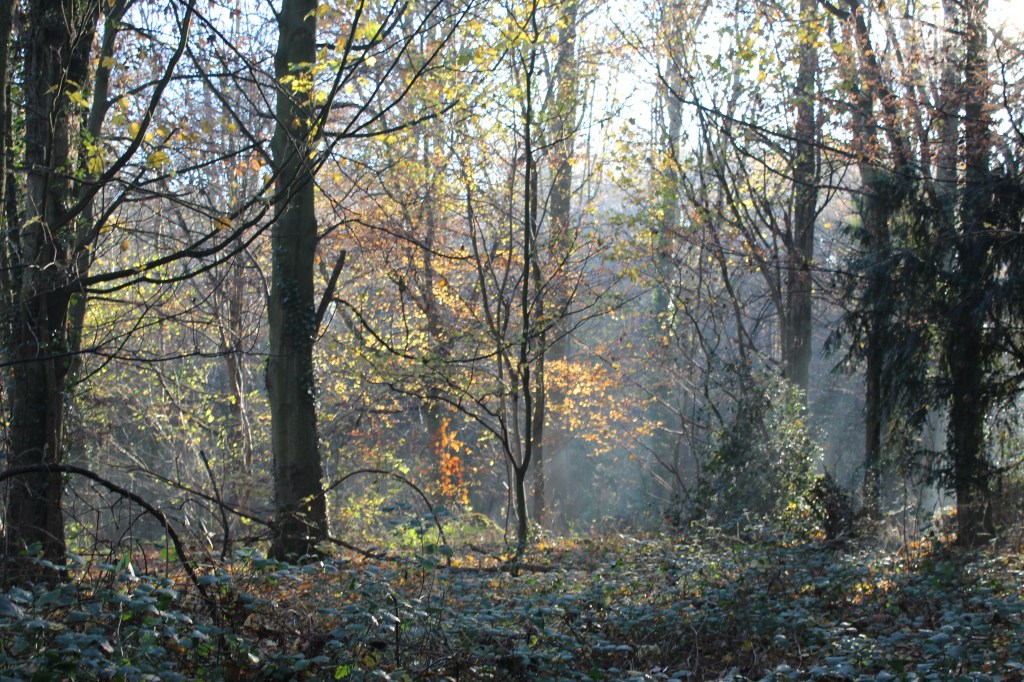
It grows dark. The trees are black lines against a yellow sky which shines, illuminating through a net of ink, and the last birds drift overhead to their roosts by the river, and the last birds murmur and settle in those darkening trees,
And quiet sadness creeps like frost across the grass, as the last flowers bow their rimy heads.
And suddenly, the question – What are we to do? seems a different kind of puzzle. Not one to solve, but one to lay down, in its many pieces, on the cold grass, slowly, in wonder.
All this before me knows what to do, and does it. Rooted, patient, receiving the weather like weather – whatever comes, comes.
From this place, it will act when action stirs it with the unsettling brightness of spring. When the ink stirs once more with green sap.
Until then, the cold trees will net the light, and wait, and deepen, the darkness will spread as I am learning to be grateful for this breath, to watch this red leaf spin on a thread of spiders web, to feel the cold sting me alive.
This week, as the darkness and the weather continue to close in, and the news is full of sadness and anger, I’ve been doing something I have never done before – as so many of us are.
I’ve been participating in an online retreat, by zoom, with the Community of Aiden and Hilda, which should have been at Lindisfarne – Holy Island. I’ve never been to such a retreat before, and had not planned to go, but I was encouraged by a friend to try, and dip my toes into those North Sea waters from further south. The week’s subject is The Way of Three, exploring the Celtic love of Trinity.
Celtic prayers and blessings are full of references to this threefold presence of God – not as inscrutable doctrine, but as a deep way of experiencing God, and indeed, all things. Its participatory, and dwells in the dance of interconnection. I have had a growing awareness of this other way of seeing, and just begin to explore it in the chapter on the True Vine in my book, Jesus said “I Am” – finding life in the everyday. You can read a little from that chapter here.
It’s a beautiful and wise retreat, full of welcome and love. I am so glad I joined. On the morning of the second day, I woke with a really strong sense of how everything is bound together, held together in love, and how our new understandings of interconnectedness in ecology and physics and computing and economics are opening our eyes to a new way of seeing and being in the word. As we see reality as interconnected, it gives us a picture, a frame, to help us see God as participating in a dance of love. We find it hard to open up our understanding of God, and these new ways of looking at the world can work as metaphors, helping us picture what is hard to comprehend. What was, at least to me, a doctrinal puzzle, from a perspective of separateness, is now something liveable, relevant, and joyful. It’s taking me a while to find a way of articulating and knowing more deeply this sense, but in the meantime, here is a poem, which I wrote that morning – the day before yesterday. I hope it helps.
One and many
In my garden, I greet the birds as they slow to land, and hop amongst the plants, and the feeders.
I greet too the plants, arriving more slowly still. I work with what is. I seek to welcome what grows, and as things come to the end, I thank them for their presence, their work in the garden.
This space is encircled with green, protected, so the sharing and flourishing is open, free. And within, and without, all is joined together in the air, the light, the rain, and the soil, the pale threads, deep, deep in the dark earth that join under fences and hedges.
Sometimes, I look and see this bird, this tree, and flower, and butterfly. And then my eyes widen, my focus shifts and I see the whole, bound together in all that is. I see one loud singing green, and that glorious, and that, welcoming me.
Be the eye of God dwelling with you, The foot of Christ in guidance with you, The shower of the Spirit pouring on you, Richly and generously.
This morning, I watched and listened to this beautiful piece by David Whyte – another blessing.
And a quote from today’s notes….
Maximus the Confessor (6th century theologian): “To contemplate the smallest object is to experience the Trinity: the very being of the object takes us back to the Father; the meaning it expresses, its logos, speaks to us of Logos; its growth to fulness and beauty reveals the Breath, the Life-giver.”
Yesterday was the Autumn Equinox, and now, today, there is more dark than light. Yesterday, too, in the UK, there were announcements from politicians about measures to slow the spread of the virus. We are still experiencing pandemic, and six months to the day the first lockdown began. Many will be feeling anxious about the thought of the winter ahead. It feels as if the world grows smaller again.
I’ve been exploring some aspects of our crisis in my meditations on Exodus. You can read the latest poem in that series here. In those reflections, I’ve had at the back of my mind how we hold on to hope in difficult times, and I’ve been thinking of hope as an act of defiance, a radical act. Today’s poem looks at joy in a similar way. As well as looking at the difficulties we face, I am seeking to cultivate joy too as an act of defiance, a radical posture that looks deeper than circumstance, real and pressing though that may be. Of course, it is not always possible. Sometimes, we sit with our sorrows, or our sorrows sit with us, and are reluctant to leave.
Often, though, we can take this stance. Maybe, we can receive both the gift and the grace of joy when it comes, and maybe we can also work to cultivate it as a habit, a practice, a spiritual discipline, a work.
Can we do that? Can we, at least some of the time, choose to take joy where we find it? And even cultivate it, and treasure it?
When that is too hard, perhaps even such beauty as this poem seeks to share will be some help.
On related themes, you might like to read two other poems: Moment/Joy Sorrows
Boyton marshes. Both photos by Peter Skevington
Wings
Boyton salt-marshes, Autumn Equinox
The hot lane is full of wings, rising over the sand-blown tar, spiralling together with the urgency of life.
Dragonflies, dozens – red, blue-green, yellow, joined or unjoined, flying with rainbows caught in their light, clear wings – I have never seen so many.
And large white butterflies dancing, spiralling, looking like great white poppies caught in the breeze, seeking each other, dazzling in the dazzling light.
How it lifts you to see them, how it lifts you to feel the warmth of the sun on your skin as it turns on its balance point towards sleep, and coldness.
And then, down past the foot ferry and the wild swimmers it all opens up – the great windy marsh-weave of river and saltwater, island and marshland, blue of the sky rippling in water, shining mud, and the hiss of rushes in the north wind
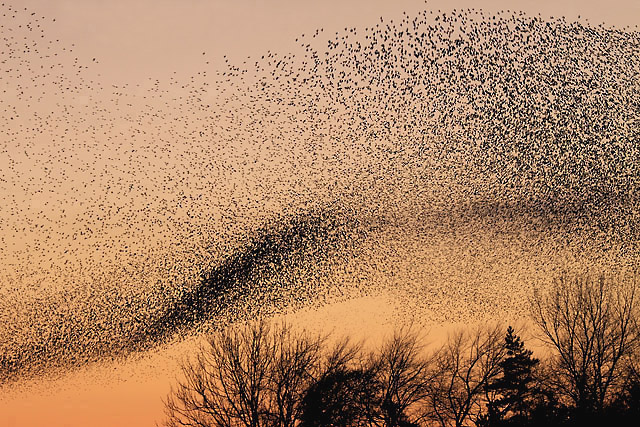
Which carries other wings. Long skeins and lines of loud geese, endlessly joined by threads of sound – the strong echoing call, the beat of thousands of wings that bring dark with them on their dark flight feathers, racing with cold at their backs.
And we know how winter comes, we know the night lengthens with its endless stars, we know our days grow short
Even as this joy rises, even as it rises up, bears you up like wings that beat with such effort of heart, with effort of voice to cry out, cry out like this – look, look how good it is, how good.