I wrote this when it was darkening fast – by the end I could not see the marks my pencil was making in my notebook. Darkness comes so early now, but that change into night is beautiful, and, if we can take a moment to notice it, has things to teach us too.
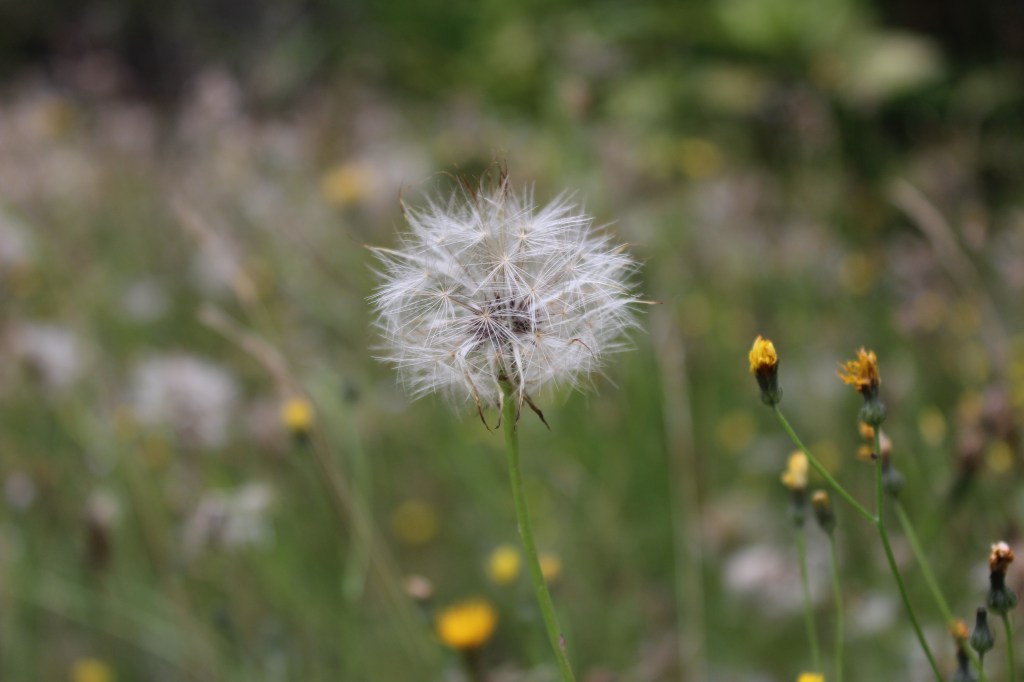
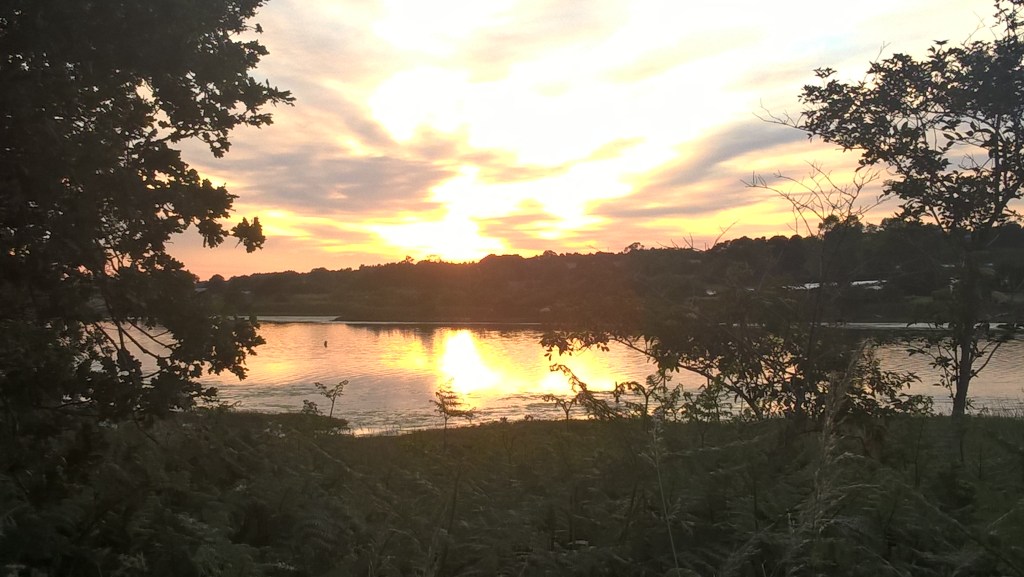
So I have no photo of this moment, but am offering you others from autumn, and hope that you will have a chance to look out of the window, or walk through darkening paths, and see the trees as they settle for the winter, and the birds as they settle for the night.
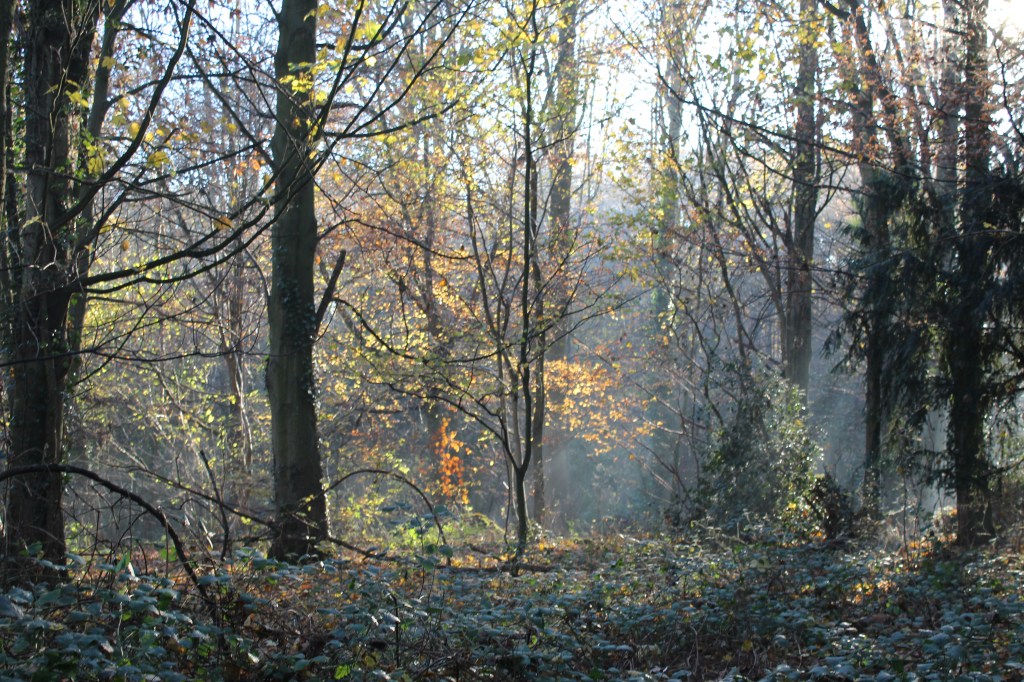
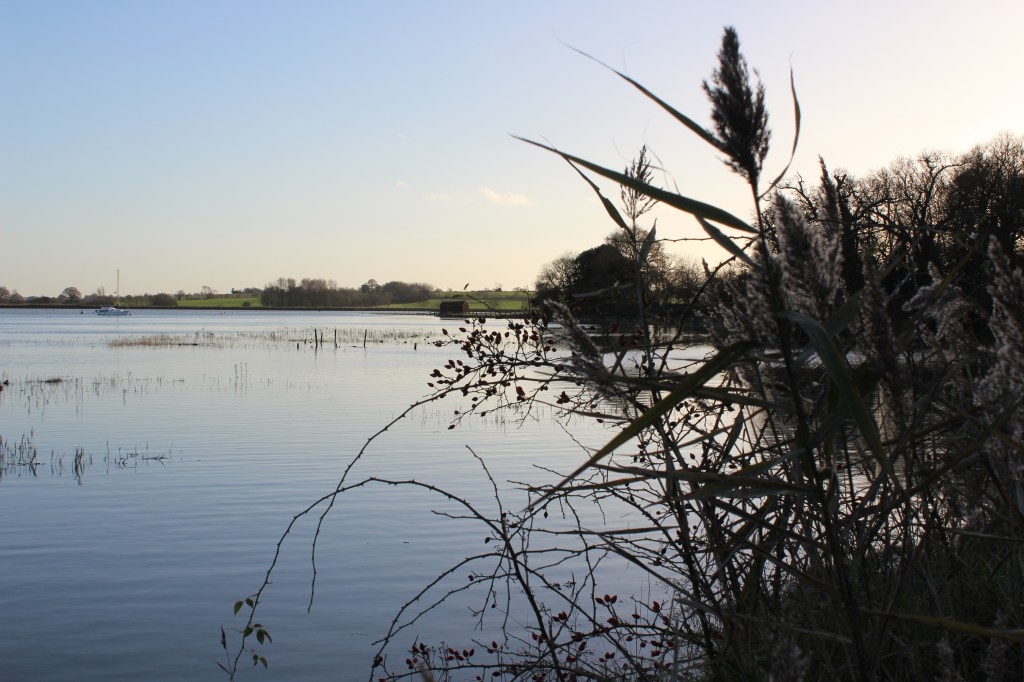
November trees – twilight
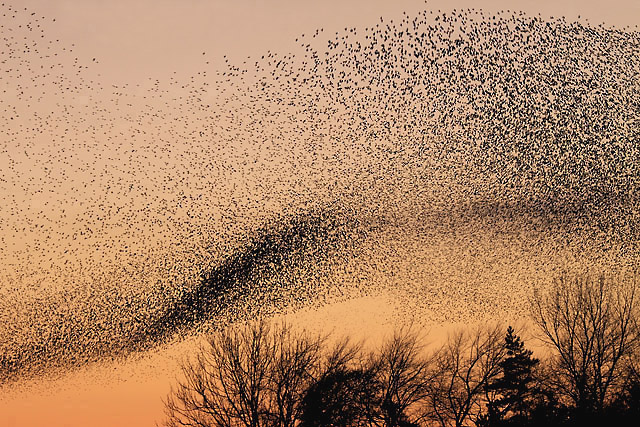
It grows dark. The trees are black lines against a yellow sky which shines, illuminating through a net of ink, and the last birds drift overhead to their roosts by the river, and the last birds murmur and settle in those darkening trees,
And quiet sadness creeps like frost across the grass, as the last flowers bow their rimy heads.
And suddenly, the question – What are we to do? seems a different kind of puzzle. Not one to solve, but one to lay down, in its many pieces, on the cold grass, slowly, in wonder.
All this before me knows what to do, and does it. Rooted, patient, receiving the weather like weather – whatever comes, comes.
From this place, it will act when action stirs it with the unsettling brightness of spring. When the ink stirs once more with green sap.
Until then, the cold trees will net the light, and wait, and deepen, the darkness will spread as I am learning to be grateful for this breath, to watch this red leaf spin on a thread of spiders web, to feel the cold sting me alive.
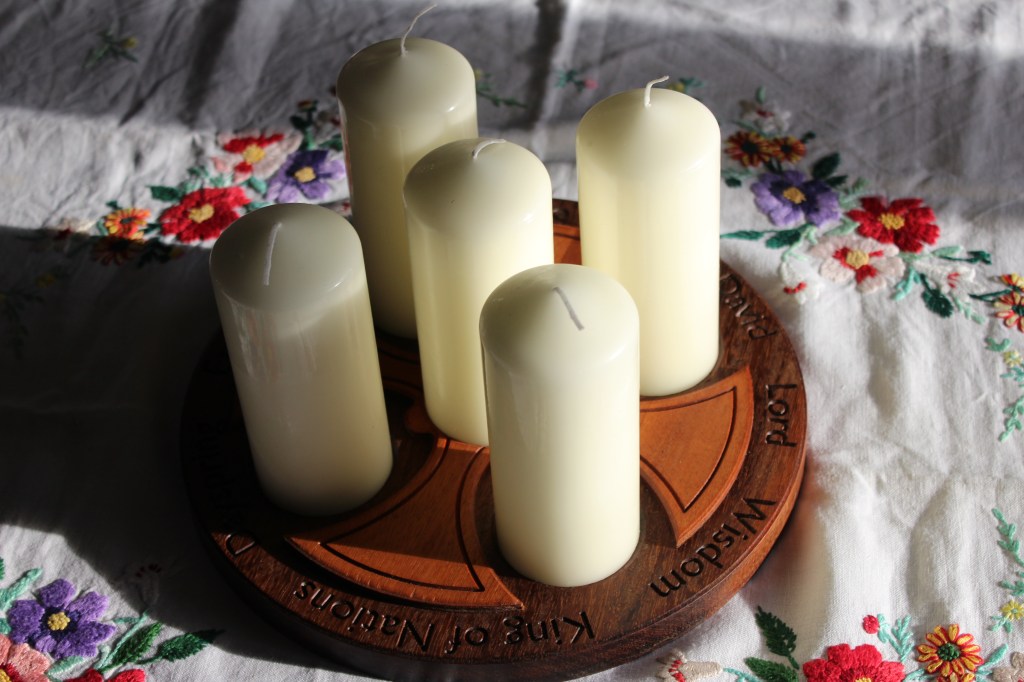
As Advent Sunday is getting closer, I’m sharing again a post on Hope. This year, we need hope more than ever, and the lighting of Advent candles can help us find enough light to live out our hopes as the days grow shorter.
Starting a little late, I thought I’d share with you some thoughts as we go through the four weeks of Advent.
This week’s theme is Hope. Ah, hope. We were talking about that in our Thursday group a few weeks ago, reflecting on how hope feels different when we hold it in difficult, uncertain times. Not as a glib avoidance strategy that it’s all fine, really, it’s all going to be fine…. but as a deliberate and courageous stance, holding on to a vision of how things could be. With politics in uproar, and the climate crisis deepening, we need courageous hope, that’s prepared to work to refashion things around us in defiance of what we see. There is real power in such acts.
During this time of darkening days, we often revisit the words of the prophets. They often spoke into desperate, unpromising circumstances with a mixture of a…
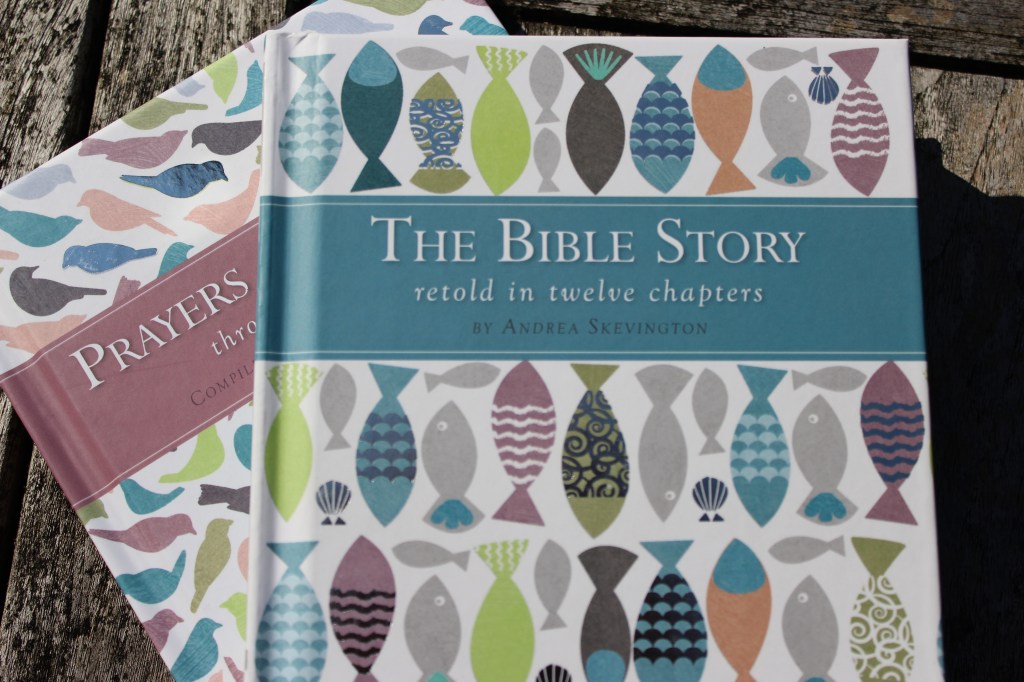
Sitting alongside my series of poems drawn from Exodus, I’m sharing retellings from my book, The Bible Story Retold. I hope this gives some shape and context to the poems, which are free meditations, drawing on what has come up as I’ve spent time in prayer with the stories. This, on the plagues, is a companion to the most recent poem, Stone Heart/Let Go.
This is a hard story. The journey to liberation for the Hebrew people passes through great difficulty. The new beginning comes after a terrible ending. It is a story of the stubborn refusal of Pharaoh to let go, to release the people. It is the story of catastrophies piling up, one on another, or of a cascade of difficulty. Some of the Hebrew scholarship I’ve looked at in researching this section of the story invites us to consider how we can usefully refect on this section as environmental disaster, where exploiting the land and labour leads to these terrible consequences. One of the traditions of Hebrew scholarship is that of midrash, where different ways and levels of reading the story are held, each one having some light to shine for us. So there are, of course, other ways of seeing things, but for me, now, this one is speaking, and illuminating a path to action..
What if we, as individuals and as a culture, let people go, released them, allowed people to do something as apparently unproductive as to journey into the wilderness, and worship? What if we acknowledged that God desires justice, and mercy, and humble walking? I wonder what that would mean for us. Perhaps there is some hope for us, as we find ourselves at a time when difficulties mount up, when things are falling apart,that this could be a turning point, part of the process necessary for things to change.
It’s a long extract, so I’ll leave it to say what it says. You can find the Exodus account from Chapter 7 to Chapter 12, if you would like to read the original. I hope to write about the last plague, but now doesn’t seem the right time. Now, I’m turning my attention to Advent, and hope. When I do write the end of the Exodus series, I’ll share it with you here, and put together a post to help find all the Exodus material together.
Ten Blows for Egypt
Moses and Aaron warned Pharaoh of the terrible things that would happen if he did not set the slaves free, but he would not listen. And so, it began.
First, they spoke to Pharaoh by the Nile as he went down to bathe. Moses and Aaron stood by the banks of the river and said, “This is what our God says: you must free our people to go to the wilderness. If you won’t listen, the river will become blood red, undrinkable, stinking. Egypt will be thirsty.”
Pharaoh turned away and carried on toward the bathing place. Then Aaron raised his staff and brought it down on the water with a mighty splash. The water swirled, thickened, and reddened, like blood, and gave off a foul smell. Fish floated gasping to the surface and died. But Pharaoh’s magicians could change water too, so he simply went back to the palace, unimpressed. He would not let the people go.
Second came the frogs. Once again Moses and Aaron warned Pharaoh, and once again he ignored them. So Aaron went around the land, stretching his staff over the Nile and all of the pools and ditches. They heaved and swarmed with frogs. The frogs came up into people’s houses, hopping on beds, clustering together on the plates.
Pharaoh was disgusted. “Yes, yes, I’ll let them go!” he said, and Moses prayed to God, and the frogs died. The Egyptians swept them into festing heaps. But then Pharaoh changed his mind.
Third came the gnats. There was the warning, and the refusal, and then gnats rose up in clouds like the dust of the destert. All people and animals were covered with bloodsucking insects. There was no relief. Pharaoh’s magicians had never seen anything like it; “This is God’s doing,” they warned him. But Pharaoh’s heart was hard and stubborn. He would not let the people go.
Fourth came the flies. “Go and confront Pharaoh on his way to his bathing place. Tell him he must let my people go. Warn him of what will happen next – the air will be thick with flies. But they will not come to Goshen, the place where my people live.” God’s words were clear, but Pharaoh did not listen. Soon the air was loud with buzzing, and every surface was crawling with flies – all the food was speckled and black. Only Goshen was free from them.
“Go on, then,” said Pharaoh. “Go to the wilderness.” But then he changed his mind.
Fifth came the animals. Moses and Aaron warned Pharaoh, but his heart was as hard as ever. All the livestock sickened and died; all the cattle, the sheep, the horses that pulled the chariots, and the traders’ camels – all dead. Only the animals in Goshen were spared.
Sixth came boils. The warning was ignored once again, and Moses threw soot up in the air right in front of Pharaoh. The soot blew onto the people, and they were covered with red, pus-filled boils. The boils spread, but Pharaoh remained as hard and cold as stone.
Seventh came hail. “This is what God says,” Moses told Pharaoh. He’s warning you: ‘You’re still building your kingdom on the backs of my people. You do not recognize my power, and so you will see more of it. I will send hail. Get everything under cover, for nothing will survive.'”
Pharaoh’s servants heard these words, and some hurried to hide their families and animals. Then the sky boiled with clouds and shuddered with angry thunder, and the hail come down. Huge white hailstones bounced on the earth, smashing everything. Nothing could survive in the open – and the crops were pummelled to a sodden pulp. But in Goshen, the sky stayed clear.
Eighth came locusts. When Pharaoh’s court heard the terrible warnings, they said, “Why don’t you listen to these men and let the slaves go? Can’t you see that the whole country is being ruined?” But Pharaoh’s stony heard would not soften, and so a terrible army of locusts marched across the ground, hungrily devouring everything that had been smashed by the hail. Not a tree, not an ear of grain, was spared.
Ninth came a heavy, suffocating darkness. The air was thick and hard to breathe. Such was the darkness that for three days and nights no one could leave their homes. All sat and talked in whispers under its weight. except in Goshen, for there was light in Goshen.
Tenth was death. Terrible, terrible were the warnings that God gave, heavy with the knowledge that Pharaoh would not listen, for his heart was set against God and the Israelites.
“This is it: get ready. After the tenth blw, Pharaoh will beg you to leave,” God said. And so Moses and Aaron went to Pharaoh and warned him of the grief that would crush Egypt if he did not let the slaves go.
“This is the final message from God, your last chance to change your mind. Listen now to God’s last warning: ‘Every firstborn son will die. From Pharaoh’s son to the son of the lowest slave woman who grinds the grain by hand, no one will be spared if you do not spare my people. When this terrible thing happens, all our people, courteirs and servants alike, will beg on their knees that you let my people go.'”
Pharaoh listened in stony silence. He would not relent
From my book, “The Bible Story retold in twelve chapters”.
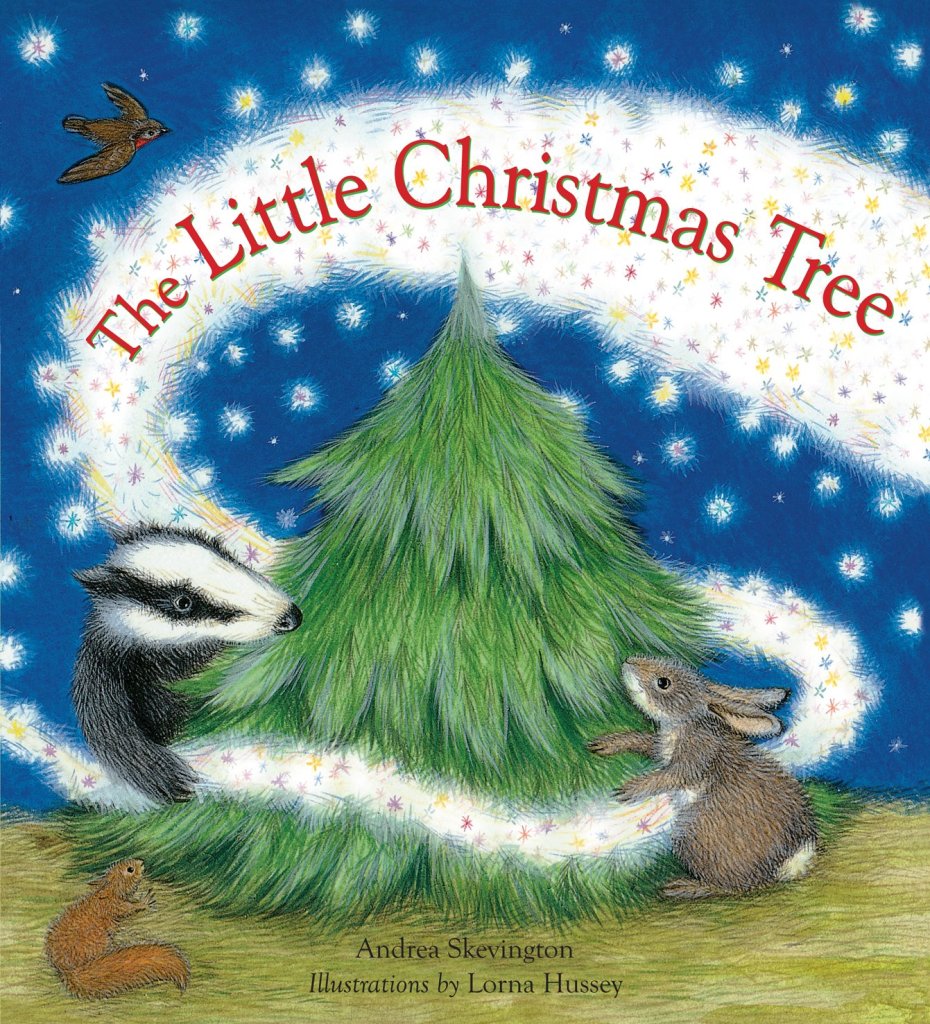
This post is a follow up from yesterday’s on ideas for using my children’s picture book, The Little Christmas Tree, this year for Advent and Christmas. You can read that post here.
I’ve also been contacted by another person who’d like to use my retelling of the Bible this Christmas. My old friend Rev Jenny Tebboth of Chalfont St Giles has had a lovely idea for involving families in an alternative crib service out of doors, which should be possible even if there are restrictions. Jenny has very generously given me permission to share the outline of her idea, in case it is of any help to another community trying to plan Christmas activities…. It’s well worth thinking about if you are puzzling over what to do for a crib service, or nativity of any sort.
It’s like a treasure trail…..
“Families will work through the story in six scenes round the village, read part of the story at each scene, pray and listen to a carol – ending behind the inn for hot chocolate.”
I’m so excited to think that my retelling will form the framework for such a lovely idea. The book is in twelve chapters, and Chapter 8 is mainly the birth and early life of Jesus, so there is a good flow of narrative for the six scenes. It’s a very exciting and innovative way to do a socially distanced Christmas adventure. Being out in the cold of winter will be a powerful way of entering into the Nativity story imaginatively, and offers something new and memorable to do to feel involved in Mary and Joseph’s search for shelter, and the birth of Jesus. It’s a beautiful idea, and I look forward to hearing more about it. I’ll post an update when I know more.
If you’d like to read more of my Christmas Retold, you can do so on a previous blog post, here. There, you’ll also find some prayers from my book, Prayers and Verses, and some beautiful pictures.
Here’s some of the story, though, to give you an idea:
At last they came to Bethlehem, but it was not the end of their troubles. The city was noisy, bustling, and heaving with crowds, and Joseph searched anxiously for somewhere quiet for Mary to rest – her pains were beginning, and the baby would be born that night. The inn was already full of travellers, and the only place for them was a stable. There, among the animals, Mary gave birth to her firstborn son, and wrapped him up tightly in swaddling bands and laid him in a manger full of hay. Then, she rested next to the manger, smiling at the baby’s tiny face.
There were shepherds who lived out on the hills nearby – the same hills where King David had once watched over the flocks, long ago. The sheep were sleeping in their fold under the shining stars, while the shepherds kept watch. Their fire flickered and crackled, and the lambs would bleat for their mothers, but they were the only sounds. All was peaceful. All was well.
Suddenly, right there in the shepherd’s simple camp, appeared and angel of the Lord, shining with God’s glory and heaven’s brightness. The shepherds gripped each other in terror, their skin prickling with fright. “Don’t be afraid, I’m bringing you good news – it will bring joy to all people!” The shepherds listened, awestruck, their faces glowing with the angel’s light. “This is the day the good news begins, and this is the place. In the town of David, a saviour has been born. He is Christ, the Anointed One, the one you have been waiting for. And this is the sign that these words are true: you will find a baby wrapped tightly in swaddling bands, lying in a manger.”
From The Bible Story Retold in Twelve Chapters
If you’d like a copy of The Bible Story Retold, you may well be able to order through your local bookshop even if it’s closed. Alternatively, there are the usual online places. I’m particularly excited about this new venture, though, and commend it to you….
Bookshop.org is a new enterprise which supports local bookshops while selling online. It’s applying for B corporation status in the UK, which means it operates to high ethical standards and makes a positive contribution to communities. You can read a newspaper article about it here.
If you follow this link, you’ll find my book The Bible Story Retold on sale there. It may be they don’t have many copies, so….
You can also find it on Eden bookshops, and all the other online shops.
Once again, it’s so good to hear and share these ideas. If you’d like to use any of my material, I’d love to hear from you. If you’d like, I can share what you plan to do on this blog nearer Christmas. You are very welcome to use my material whether you get in touch or not. Please do acknowledge where it’s from, and that will be good.
Last year, I shared with you how my children’s Christmas book had taken on a new resonance as we considered the need to protect our wild spaces – the home of so many beautiful creatures. The story is set in a wood, and the characters are the woodland animals. You can read more about it in last year’s post here. As we’ve been in lockdown, many of us have experienced a closer bond with nature, realising how important the natural world is to us. In simple ways, we can deepen that bond. I am finding it helps to care for the creatures I share my garden with – in the last few weeks I’ve built – or assembled – a hedgehog house, and put up a new bird feeding station. It gives me joy to watch the birds through my window, even as I’m typing away here.
This year, the story’s themes of kindness and hospitality, of gentleness and welcome, matter greatly. At a time when so many people in our community are facing loneliness and hardship, considering how we can best help when our usual practices of hospitality are not possible is very important. For instance food banks, and our Little Free Pantry, are a good way of giving and sharing if we can. A reverse advent calendar, where you add something to a box for every day leading up to Christmas, can be a way of sharing.
So that’s a couple of ideas that draw on the themes of the book. They might be appropriate for Advent this year, things we can do as individuals, households, or maybe schools. I’d like to share with you some ideas from other people, too…
I’m finding it’s really hard to think about Christmas this year – what might be possible, and what might be wise. It’s hard to think of not seeing those we love as we would wish, and it’s hard not being able to plan ahead. But we can begin. I am greatly encouraged that people are making plans, and beginning to get in touch and share how they’d like to use my books this year.
Here is the sparkly paperback edition
I’ll share something else about The Little Christmas Tree here, and then, an idea for another book another day!
The first idea comes from Janeene Streather, who makes engaging Youtube videos using BSL. Her videos are for the deaf community, their families, and schools – many of whom integrate some BSL into their classrooms and assemblies. You can find a link to her channel here.
She would like to make a BSL video of The Little Christmas Tree, as part of her series of stories for children. Once again, I’ll post more details when I have them. I hope to share the link with you, so you can easily watch Janneene.
For all of us, we are used to being able to visit schools, or churches, or share our work with communities in other ways, and are unable to do so this year. But we can share here.
Please do use these ideas and resources, acknowledging the source. If you’d like to use my book, I’d love to hear your ideas from you, and share them on here if you’d like me to.
If you’d like a copy, you may well be able to order through your local bookshop even if it’s closed. Alternatively, there are the usual online places. I’m particularly excited about this new venture, though, and commend it to you….
Bookshop.org is a new enterprise which supports local bookshops while selling online. It’s applying for B corporation status in the UK, which means it operates to high ethical standards and makes a positive contribution to communities. You can read a newspaper article about it here.
You can also find it on Eden bookshops, and all the other online shops.
Note and Correction:
In an earlier version of this post, I shared an idea for an outside nativity. I’d got my wires crossed and thought it was using The Little Christmas Tree. It will be using another of my books, The Bible Story Retold. You can read all about that here. Apologies for the muddle!
I’ve been working on a series of poems drawing on the first part of Exodus as we have made our way through this strange, upended year. I had a sense that these stories had something to say to us, speaking into our year of pandemic and political upheaval. I feel I may be nearly at the end of the sequence – maybe one more, but we’ll see.
I’ve been mulling this one over for a couple of weeks, and felt at the end of last week, I’d soon release it into the world and see how it got along. Reading it again today, in the light of the Presidential election, I’ve hesitated. As I was writing, I was thinking how important it was for us to be able to see something of ourselves, from time to time, in those characters who are not the heroes of the story. So often we assume we are Moses, or Miriam, and very rarely wonder if there are aspects of our lives where we might be Pharaoh.
And so I was thinking about the ways in which we may – knowingly or not – participate in systems, and make choices, that are in the spirit of Pharaoh. I was seeking to make a gentle equiry of myself – are there ways in which I might be hard-hearted, grasping, not recognising the consequences of my actions for others? I was speaking to myself, and to our consumerist societies, in addressing Pharaoh in this poem. Of course, we have Pharaohs in our age too, be they elected or other sorts of political leaders, or people of immense weath, and power over our lives, and the state of their hearts matters very much indeed. Maybe one reason they matter so much is that they do seem to embody the values we come to live by. If you want to mull over the role of leaders, be they kings, emperors, or their elected equivalents in power, you might turn to this passage from the Hebrew Scriptures, 1 Samuel 8 – quite a picture of a hard and grasping heart. As ever, there is much wisdom to be found here.
My poem is what it is, and I will trust it, and release it into the world as intended. Its narrative frame is the series of plagues that struck Egypt, recorded in Exodus 7-12. Each time, Moses warned that there would be consequences for not letting the slaves go, and each time, Pharaoh refused. I’ll post my retelling of the story, and some more thoughts about the plagues, soon. It’s a difficult, heartbreaking part of the story of the Hebrew people’s road to freedom, and so important. But in the meantime, here is my meditation, here is what came to me, as the story filled my mind.
Stone Heart/Let Go Exodus poems 10
You will not let them go, you will not unclasp your hand, your heart hardens even as the people suffer, and so troubles run together, clattering across the exhausted land, the exhausted people – Nile turned to blood, undrinkable, frogs and gnats, sickness and storms, locusts and darkness,
Each thing connected, all interdependent. The river dies, and its death ripples outward, and still your heart is hard, and still you will not let go as the frogs hop from poisoned mud, and gnats rise in swarms, and all brings death and disease,
You are asked, again, and again, to let them go, unclasp that grasping hand, release the slaves who work this land, as the land itself cries out, exhausted from the taking, and taking, and not letting go
barren under a hard human heart, groaning under the bent human backs, as you take life and strength from mud and field and hand.
Step aside, Pharaoh, from your endless taking. Instead, let go, release, free, unbind all this wealth that seems so necessary to you now.
Open your hands, do not trust in your grasping, as Moses stands again, and stretches out his hand again over the weary land. Soften your heart. Let them go. They were never yours to hold.
This week, as the darkness and the weather continue to close in, and the news is full of sadness and anger, I’ve been doing something I have never done before – as so many of us are.
I’ve been participating in an online retreat, by zoom, with the Community of Aiden and Hilda, which should have been at Lindisfarne – Holy Island. I’ve never been to such a retreat before, and had not planned to go, but I was encouraged by a friend to try, and dip my toes into those North Sea waters from further south. The week’s subject is The Way of Three, exploring the Celtic love of Trinity.
Celtic prayers and blessings are full of references to this threefold presence of God – not as inscrutable doctrine, but as a deep way of experiencing God, and indeed, all things. Its participatory, and dwells in the dance of interconnection. I have had a growing awareness of this other way of seeing, and just begin to explore it in the chapter on the True Vine in my book, Jesus said “I Am” – finding life in the everyday. You can read a little from that chapter here.
It’s a beautiful and wise retreat, full of welcome and love. I am so glad I joined. On the morning of the second day, I woke with a really strong sense of how everything is bound together, held together in love, and how our new understandings of interconnectedness in ecology and physics and computing and economics are opening our eyes to a new way of seeing and being in the word. As we see reality as interconnected, it gives us a picture, a frame, to help us see God as participating in a dance of love. We find it hard to open up our understanding of God, and these new ways of looking at the world can work as metaphors, helping us picture what is hard to comprehend. What was, at least to me, a doctrinal puzzle, from a perspective of separateness, is now something liveable, relevant, and joyful. It’s taking me a while to find a way of articulating and knowing more deeply this sense, but in the meantime, here is a poem, which I wrote that morning – the day before yesterday. I hope it helps.
One and many
In my garden, I greet the birds as they slow to land, and hop amongst the plants, and the feeders.
I greet too the plants, arriving more slowly still. I work with what is. I seek to welcome what grows, and as things come to the end, I thank them for their presence, their work in the garden.
This space is encircled with green, protected, so the sharing and flourishing is open, free. And within, and without, all is joined together in the air, the light, the rain, and the soil, the pale threads, deep, deep in the dark earth that join under fences and hedges.
Sometimes, I look and see this bird, this tree, and flower, and butterfly. And then my eyes widen, my focus shifts and I see the whole, bound together in all that is. I see one loud singing green, and that glorious, and that, welcoming me.
Be the eye of God dwelling with you, The foot of Christ in guidance with you, The shower of the Spirit pouring on you, Richly and generously.
This morning, I watched and listened to this beautiful piece by David Whyte – another blessing.
And a quote from today’s notes….
Maximus the Confessor (6th century theologian): “To contemplate the smallest object is to experience the Trinity: the very being of the object takes us back to the Father; the meaning it expresses, its logos, speaks to us of Logos; its growth to fulness and beauty reveals the Breath, the Life-giver.”
Apologies for the blur – my mask was steaming up my glasses!
It’s half term here in the UK, and there’s a huge row going on about how to provide for those children and young people who are entitled to free school meals – will they go hungry this week? It breaks my heart that there are so many children who are at risk of hunger in our country, and that we don’t seem to be able to get our response together in time for this short holiday – after all, we knew it was coming. One of the things this crisis continues to do is to reveal things that may have been hidden, or we may have overlooked. Child poverty is one of these, and it’s an affront to us all that we aren’t, as a society, doing better to look after our kids and their families.
Of course, we need to look at long term, systemic solutions which genuinely help families to live good lives, but that long term thinking doesn’t help much if you or your child can’t sleep for hunger, or the fear of hunger. And so, we see once again the kindness and generosity of so many individuals and businesses – many themselves close to the edge – doing all they can to make sure children in their area have enough to eat.
In the light of this national effort, St Andrews Little Free Pantry is a small offering of love and care for and by the community in Melton, Suffolk. It may be just what someone needs, though, to help them through this time. Small, local things can make such a difference. Anyone can come along and take what they need, no questions. So, although I’ve been writing about the free school meals situation, I do want to emphasise that the pantry is available for all, whatever your reasons for visiting. You can just come along, and take what you need.
It’s stocked by donations, and anyone can bring food or toiletries along. Just leave them in the lobby of the church rooms, or by the rectory door.
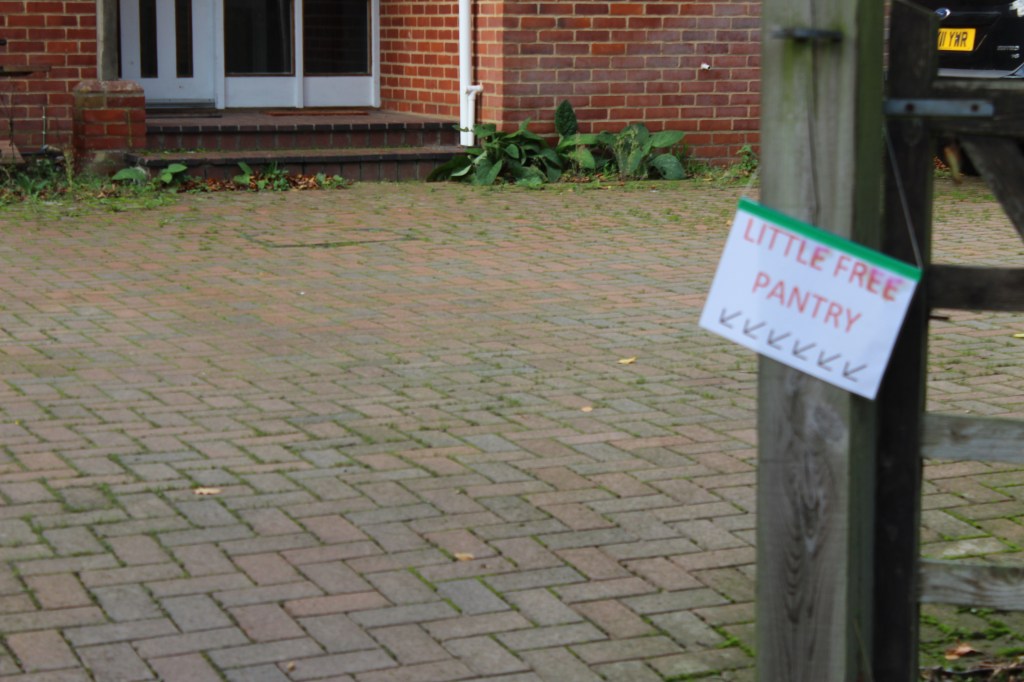
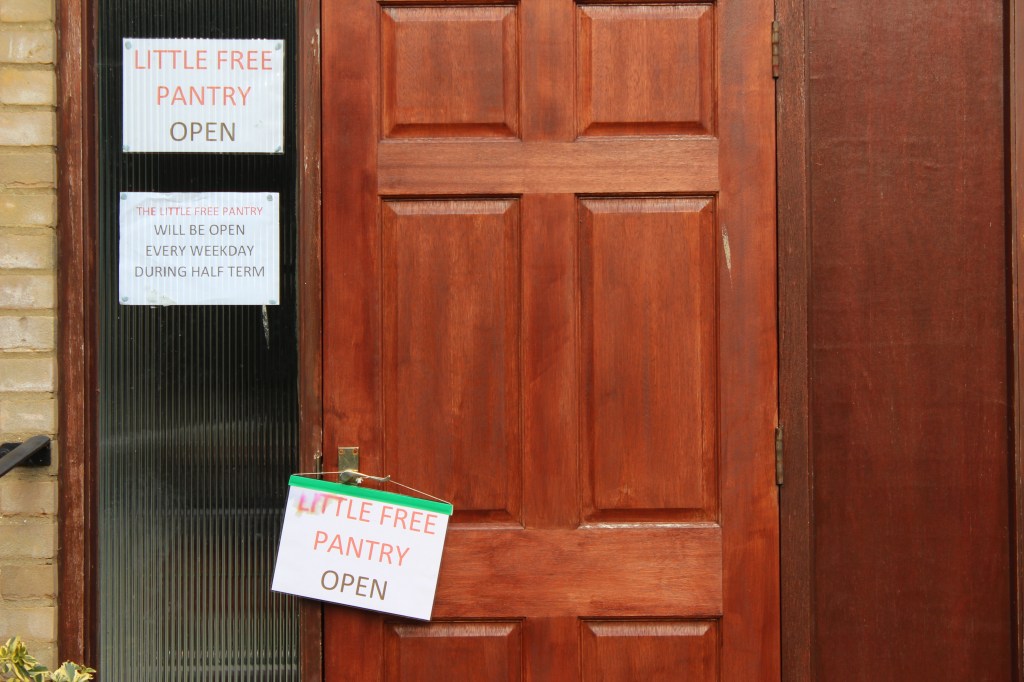
It’s a little tucked away, so I took some photos so you can see where to go beforehand, that might help.
St Andrew’s Church, Melton, Suffolk.
To the right of the church is this little lane. Follow the sign to the Rectory, which has a paper sign directing you to the pantry.
When you get to the Rectory drive, turn sharp left – it’s fine to cut across the end of the drive – and you’ll see a little path leading down the side of the church rooms.
The door is to your left, and the pantry shelves are just inside.
You will see it’s open every day this half term week, 9-5. Normal social distancing applies. Just come along, and take what you need, leave what you can.
You can read more about the Little Free Pantry here.
Over the summer, I had some dreams of what I might do come the autumn. I wasn’t too foolhardy in my dreaming, I knew that the pandemic was likely to bite back by winter, but I wasn’t anticipating it being quite so soon, or feel so much like tipping into darkness and confusion.
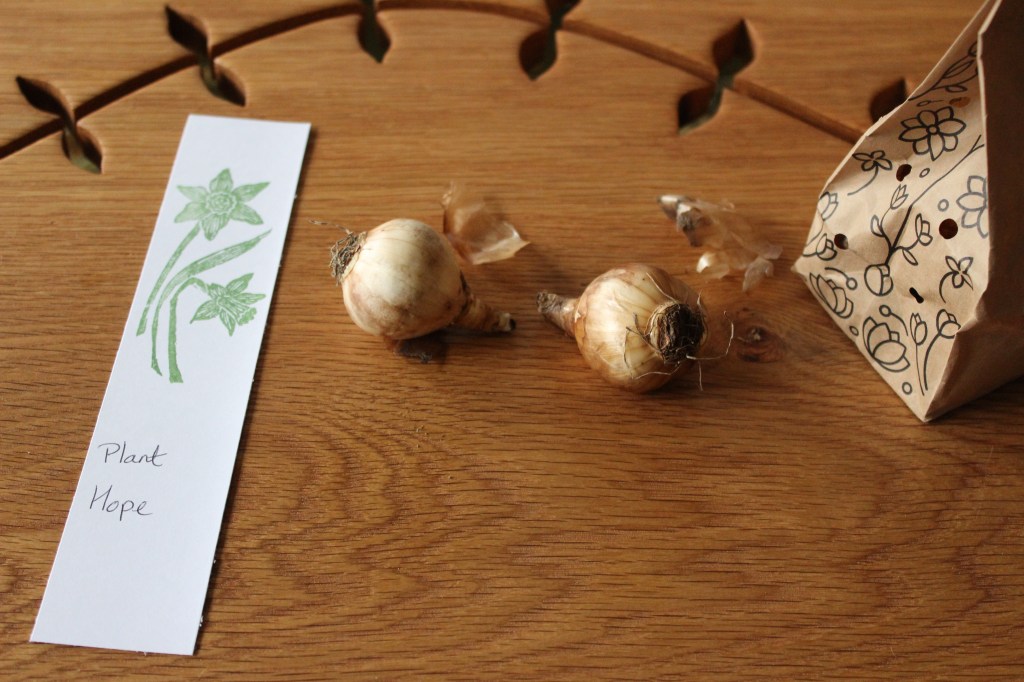
One of my dreams was to “do something” by way of creative protest in support of the environment, something small and local that would perhaps offer hope, and a touch of beauty. I had dreamed of a creative, peaceful presence in my town’s shopping street, giving out bookmarks and daffodil bulbs, encouraging people to #PlantHope. Somehow, I never quite got to the place where I felt brave enough to do it on my own, and I miss the collective gatherings where we can encourage and support each other to do things together. I miss church community, I miss other communities too of friends and likeminded people.
But I am thinking, it’s not too late to start something. And, as local people, and people far away, join me on this blog, I thought I’d share the idea with you, and see what happens. Release it, or plant it, and see what grows.
As the seasons are turning, I’m suprised to find how urgently I’m seeking to prepare for winter, and plant for spring. As news from the pandemic, the economy, the natural world feels grim, I am looking to the natural world to help me through this coming time, as it helped in the spring with the Lockdown Poems. And so the idea of #PlantHope began to grow in my mind. Maybe some would like to pick up the idea of giving out bulbs, observing social distancing. Maybe we can also all do some hopeplanting, or planthoping, in our gardens or windowsills, seeking to nurture and care for something green and growing over the winter, and into the spring.
A reminder not to give up. A reminder that nature is resillent, relentless in its capactity to grow and flourish in even the most difficult situations. It only needs a little light, a little water, and some hope.
Shall we give this a go? Shall we plant hope?
I made my bookmark with a stamp by the lovely Noolibird.
Yesterday was the Autumn Equinox, and now, today, there is more dark than light. Yesterday, too, in the UK, there were announcements from politicians about measures to slow the spread of the virus. We are still experiencing pandemic, and six months to the day the first lockdown began. Many will be feeling anxious about the thought of the winter ahead. It feels as if the world grows smaller again.
I’ve been exploring some aspects of our crisis in my meditations on Exodus. You can read the latest poem in that series here. In those reflections, I’ve had at the back of my mind how we hold on to hope in difficult times, and I’ve been thinking of hope as an act of defiance, a radical act. Today’s poem looks at joy in a similar way. As well as looking at the difficulties we face, I am seeking to cultivate joy too as an act of defiance, a radical posture that looks deeper than circumstance, real and pressing though that may be. Of course, it is not always possible. Sometimes, we sit with our sorrows, or our sorrows sit with us, and are reluctant to leave.
Often, though, we can take this stance. Maybe, we can receive both the gift and the grace of joy when it comes, and maybe we can also work to cultivate it as a habit, a practice, a spiritual discipline, a work.
Can we do that? Can we, at least some of the time, choose to take joy where we find it? And even cultivate it, and treasure it?
When that is too hard, perhaps even such beauty as this poem seeks to share will be some help.
On related themes, you might like to read two other poems: Moment/Joy Sorrows
Boyton marshes. Both photos by Peter Skevington
Wings
Boyton salt-marshes, Autumn Equinox
The hot lane is full of wings, rising over the sand-blown tar, spiralling together with the urgency of life.
Dragonflies, dozens – red, blue-green, yellow, joined or unjoined, flying with rainbows caught in their light, clear wings – I have never seen so many.
And large white butterflies dancing, spiralling, looking like great white poppies caught in the breeze, seeking each other, dazzling in the dazzling light.
How it lifts you to see them, how it lifts you to feel the warmth of the sun on your skin as it turns on its balance point towards sleep, and coldness.
And then, down past the foot ferry and the wild swimmers it all opens up – the great windy marsh-weave of river and saltwater, island and marshland, blue of the sky rippling in water, shining mud, and the hiss of rushes in the north wind
Which carries other wings. Long skeins and lines of loud geese, endlessly joined by threads of sound – the strong echoing call, the beat of thousands of wings that bring dark with them on their dark flight feathers, racing with cold at their backs.
And we know how winter comes, we know the night lengthens with its endless stars, we know our days grow short
Even as this joy rises, even as it rises up, bears you up like wings that beat with such effort of heart, with effort of voice to cry out, cry out like this – look, look how good it is, how good.










 Andrea Skevington